Microwave
welcomes
You..
Facts and statistics..
Agricultural production during 2001-02 was 209MT.
Agro and food processing sector ranks fifth in India’s GDP.
Employs around 18% of country’s industrial force.
Export growth from 2,821cr (91-92) to 10,770cr (2000-01).
Largest live stock population in the world.
Second, fifth and sixth largest producer of fruit &vegetables, eggs, & fish
respectively in the world
[ The Hindu oct-12, 2002 ]
Weakness of Indian food sector..
High wastage levels leading to low processing levels.
High seasonability & perishability – low profit margin.
Lack of requisite packaging quality and presentability required for
marketing.
Lack of ready acceptance in international marketing.
Higher cost of processing
[ The Hindu oct-12,2002 ]
Microwave (MW) Processing..
 MW heating refers to use of non-ionizing electromagnetic
waves of certain frequencies to generate heat in material.
 Microwave processing results in excellent retention of nutritional and
sensory value besides having other advantages like saving in energy,
cost, time, etc
 The speed with which heating takes place in the microwave oven
contributes to most to its rapid growth
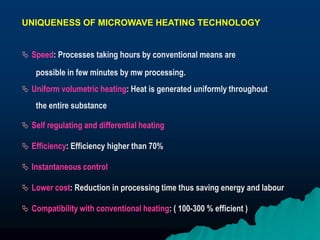
UNIQUENESS OF MICROWAVE HEATING TECHNOLOGY
 Speed: Processes taking hours by conventional means are
possible in few minutes by mw processing.
 Uniform volumetric heating: Heat is generated uniformly throughout
the entire substance
 Self regulating and differential heating
 Efficiency: Efficiency higher than 70%
 Instantaneous control
 Lower cost: Reduction in processing time thus saving energy and labour
 Compatibility with conventional heating: ( 100-300 % efficient )
Electromagnetic spectrum and their
applications
915 MHz ± 13 MHz
2450 MHz ± 50 MHz
5800 MHz ± 75 MHz
24125 MHz ± 125 MHz
Available MW - Frequencies
1m – 1mm
Corresponding wavelength
Frequency range
300MHz – 300GHz
Heating mechanism..
Accomplished by
 Absorption of mw energy by water molecules (Dipolar rotation)
(Tries to align with changing polarity- 2.45 b times / sec ,generates heat)
 Translation of ionic components of foods (Ionic conduction)
Effect of electromagnetic radiation on dipoles
Critical Process Factors in Microwave Heating
Food
Shape, size, composition (moisture, salt), liquid against solid
multiple components (as in a frozen dinner),
Package Presence of metallic elements such as aluminum foil, susceptor
Process
Power level, cycling, presence of hot water or air around the
food, equilibration time
Equipment
Dimensions, shape and other electromagnetic characteristics of
the oven, frequency, agitation of the food, presence of mode
stirrers and turntables
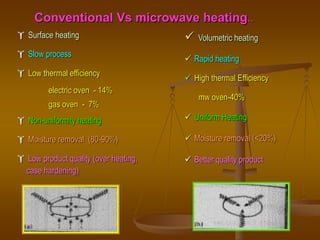
Conventional Vs microwave heating..
 Surface heating
 Slow process
 Low thermal efficiency
electric oven - 14%
gas oven - 7%
 Non-uniformity heating
 Moisture removal (80-90%)
 Low product quality (over heating,
case hardening)
 Volumetric heating
 Rapid heating
 High thermal Efficiency
mw oven-40%
 Uniform Heating
 Moisture removal (<20%)
 Better quality product
Interaction of electromagnetic fields with materials
Absorption
Transmission
Reflection
Food, oil, water,
wood
Applicators
waveguides
Belts, trays,
dishes
Dielectric properties of foods..?
 Intrinsic electrical properties that affect behavior of foods with EM fields
 ε’ - The relative dielectric constant (ability of material to store energy)
 ε” - The dielectric loss factor (ability of material to convert EMW to heat)
 Tan δ - The dissipation factor or loss tangent (ε’/ ε”)
 Measurement of dielectric properties
 Optimization and process control
 Indirect determination of a multitude of material properties.
 The rate of heat generation per unit volume ( wm-3 )
Where,
E = Strength of electric field of the wave at that location (volts / unit distance)
F = is the frequency
ε0 =The permittivity of free space (a physical constant)
ε” = the dielectric loss factor .
 The rate of temperature increase
kƒE2 ε” ε’ δ Cp
Where,
k = constant to define the units of temperature and time
ƒ = frequency of the microwaves
E = strength of the electric field inside the food
δ = density of the food
Cp = specific heat of the food
Q=2Π f ε0 ε” E2
!
Dielectric properties and penetration depth (cm) of various foods @ 2,450
MHz
Material ε' ε” Tanδ Dp
Water (distilled, 25°C) 78.0 12.0 0.15 1.4
Ice (-12°C) 3.2 0.003 0.001 1160.0
Beef (cooked, 30°C) 30.5 9.6 0.31 1.1
Potato (raw, 25°C) 57.3 15.7 0.27 0.9
Potato (mashed, 30°C) 72.5 24.0 0.33 0.7
Wheat (20°C, 5% moisture) 3.3 0.50 0.15 7.1
Corn Oil (25°C) 2.5 0.14 0.06 21.9
Cottonseed Oil (20°C) 2.6 0.18 0.07 17.5
Butter (salted, 20°C) 4.6 0.60 0.13 6.9
Butter (unsalted, 20°C) 2.9 0.45 0.16 7.4
Bread Dough 22.0 9.00 0.41 1.0
Bread 4.6 1.20 0.26 3.5
Microwave oven
External view & Internal parts of the domestic microwave system
600-1400w 2450mhz
• Magnetron converts 50-60 Hz AC to higher frequency EMW
• Applicators waveguides, coaxial tube
Sectional view of a typical magnetron..
Antenna
Electrons form a rotating patterns
Equivalent circuit of
one resonant cavity
[ http:www.dtx.net 1999]
Internal parts of magnetron
Microwave industrial conveyor system
 High energy power source with long life.
 The system has internal protection features
 Forced-air system accelerates the removal of moisture quickly and efficiently.
 A straight-through conveyor assures uniform exposure to the microwaves.
 Because of its high processing capacity, unit costs are much lower than with the batch process
Microwave conveyor system..
FDU-
543VD
54kW
2450MHz
6kW x 9
units
Dimensions (approx): 5.5 x 0.41x 1.52 (meters)
Material of Construction: SS - 300 grade
Conveyor Belt:
Width (0.30m) link
polypropylene belt
Conveyor Opening: H x w (0.03 to 0.08 x 0.32 m)
Elevation of Belt: 1.02 m
Belt Speed: 0 to 50 ft./min
Shipping Weight: 1180 Kg.
Conveyor Drive:
0.75 HP motor driven
sprocket and chain
Controller Panel:
Solid state controls digital
read out, convent belt speed
forward and reverse stop
start, inverter voltage supply
to drive motor
Electrical Requirements:
230V single/ three phase
50- 60 Hz Ac
Microwave Heating Power: 12 kW at 2450 MHz
Safety Interlocks:
Heating chamber, and Panel
interlocks
Removable end Panels:
Entry and exit tunnels and
side covers removable for
cleaning
Capacity- 0.5kg/min
[www.microwavereasearch.com]
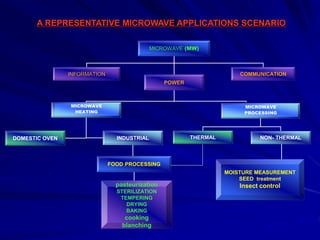
A REPRESENTATIVE MICROWAVE APPLICATIONS SCENARIO
MICROWAVE (MW)
INFORMATION
POWER
COMMUNICATION
MICROWAVE HEATNG MICROWAVE PROCESSING
NON- THERMAL
THERMAL
MOISTURE MEASUREMENT
SEED treatment
Insect control
INDUSTRIAL
DOMESTIC OVEN
FOOD PROCESSING
pasteurization
STERILIZATION
TEMPERING
DRYING
BAKING
cooking
blanching
MICROWAVE
HEATING
MICROWAVE
PROCESSING
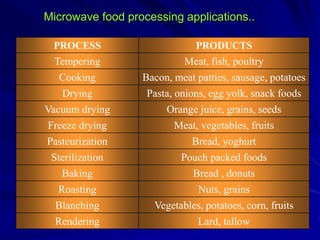
Microwave food processing applications..
PROCESS PRODUCTS
Tempering Meat, fish, poultry
Cooking Bacon, meat patties, sausage, potatoes
Drying Pasta, onions, egg yolk, snack foods
Vacuum drying Orange juice, grains, seeds
Freeze drying Meat, vegetables, fruits
Pasteurization Bread, yoghurt
Sterilization Pouch packed foods
Baking Bread , donuts
Roasting Nuts, grains
Blanching Vegetables, potatoes, corn, fruits
Rendering Lard, tallow
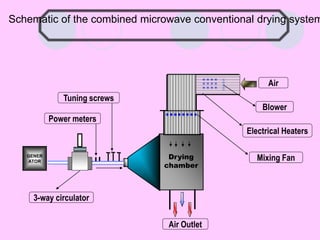
Drying
chamber
GENER
ATOR
Schematic of the combined microwave conventional drying system
Mixing Fan
3-way circulator
Tuning screws
Air Outlet
Air
Power meters
Electrical Heaters
Blower
Economics of microwave drying system..
 mw system varies between 3-4 lakhs / kW for a basic drying system
 1 kW of mw energy removes 1.5 kg of water/h
 mw system has coupling efficiency of 75%
 conversion efficiency of electricity to mw energy is 45-50 %
losses
conversion from AC to DC 4%
DC to mw 40%
waveguide and applicator 10%
Energy Cost/hour = (utility rate/kwh) (kw of system) (efficiency)
Limitations of microwave heating..
 High capital investment:
Initial cost of equipment is very high but has lower operating cost, and
increased output.
 More complex technology devices:
Requires skilled personnel for repair and operation.
 Mw radiation problem:
By proper shielding the radiation can be brought down to safer limit.

14421908-Microwave-Heating.ppt

  • 1.
  • 2.
    Facts and statistics.. Agriculturalproduction during 2001-02 was 209MT. Agro and food processing sector ranks fifth in India’s GDP. Employs around 18% of country’s industrial force. Export growth from 2,821cr (91-92) to 10,770cr (2000-01). Largest live stock population in the world. Second, fifth and sixth largest producer of fruit &vegetables, eggs, & fish respectively in the world [ The Hindu oct-12, 2002 ]
  • 3.
    Weakness of Indianfood sector.. High wastage levels leading to low processing levels. High seasonability & perishability – low profit margin. Lack of requisite packaging quality and presentability required for marketing. Lack of ready acceptance in international marketing. Higher cost of processing [ The Hindu oct-12,2002 ]
  • 4.
    Microwave (MW) Processing.. MW heating refers to use of non-ionizing electromagnetic waves of certain frequencies to generate heat in material.  Microwave processing results in excellent retention of nutritional and sensory value besides having other advantages like saving in energy, cost, time, etc  The speed with which heating takes place in the microwave oven contributes to most to its rapid growth
  • 5.
    UNIQUENESS OF MICROWAVEHEATING TECHNOLOGY  Speed: Processes taking hours by conventional means are possible in few minutes by mw processing.  Uniform volumetric heating: Heat is generated uniformly throughout the entire substance  Self regulating and differential heating  Efficiency: Efficiency higher than 70%  Instantaneous control  Lower cost: Reduction in processing time thus saving energy and labour  Compatibility with conventional heating: ( 100-300 % efficient )
  • 6.
    Electromagnetic spectrum andtheir applications 915 MHz ± 13 MHz 2450 MHz ± 50 MHz 5800 MHz ± 75 MHz 24125 MHz ± 125 MHz Available MW - Frequencies 1m – 1mm Corresponding wavelength Frequency range 300MHz – 300GHz
  • 7.
    Heating mechanism.. Accomplished by Absorption of mw energy by water molecules (Dipolar rotation) (Tries to align with changing polarity- 2.45 b times / sec ,generates heat)  Translation of ionic components of foods (Ionic conduction) Effect of electromagnetic radiation on dipoles
  • 8.
    Critical Process Factorsin Microwave Heating Food Shape, size, composition (moisture, salt), liquid against solid multiple components (as in a frozen dinner), Package Presence of metallic elements such as aluminum foil, susceptor Process Power level, cycling, presence of hot water or air around the food, equilibration time Equipment Dimensions, shape and other electromagnetic characteristics of the oven, frequency, agitation of the food, presence of mode stirrers and turntables
  • 9.
    Conventional Vs microwaveheating..  Surface heating  Slow process  Low thermal efficiency electric oven - 14% gas oven - 7%  Non-uniformity heating  Moisture removal (80-90%)  Low product quality (over heating, case hardening)  Volumetric heating  Rapid heating  High thermal Efficiency mw oven-40%  Uniform Heating  Moisture removal (<20%)  Better quality product
  • 10.
    Interaction of electromagneticfields with materials Absorption Transmission Reflection Food, oil, water, wood Applicators waveguides Belts, trays, dishes
  • 11.
    Dielectric properties offoods..?  Intrinsic electrical properties that affect behavior of foods with EM fields  ε’ - The relative dielectric constant (ability of material to store energy)  ε” - The dielectric loss factor (ability of material to convert EMW to heat)  Tan δ - The dissipation factor or loss tangent (ε’/ ε”)  Measurement of dielectric properties  Optimization and process control  Indirect determination of a multitude of material properties.
  • 12.
     The rateof heat generation per unit volume ( wm-3 ) Where, E = Strength of electric field of the wave at that location (volts / unit distance) F = is the frequency ε0 =The permittivity of free space (a physical constant) ε” = the dielectric loss factor .  The rate of temperature increase kƒE2 ε” ε’ δ Cp Where, k = constant to define the units of temperature and time ƒ = frequency of the microwaves E = strength of the electric field inside the food δ = density of the food Cp = specific heat of the food Q=2Π f ε0 ε” E2 !
  • 13.
    Dielectric properties andpenetration depth (cm) of various foods @ 2,450 MHz Material ε' ε” Tanδ Dp Water (distilled, 25°C) 78.0 12.0 0.15 1.4 Ice (-12°C) 3.2 0.003 0.001 1160.0 Beef (cooked, 30°C) 30.5 9.6 0.31 1.1 Potato (raw, 25°C) 57.3 15.7 0.27 0.9 Potato (mashed, 30°C) 72.5 24.0 0.33 0.7 Wheat (20°C, 5% moisture) 3.3 0.50 0.15 7.1 Corn Oil (25°C) 2.5 0.14 0.06 21.9 Cottonseed Oil (20°C) 2.6 0.18 0.07 17.5 Butter (salted, 20°C) 4.6 0.60 0.13 6.9 Butter (unsalted, 20°C) 2.9 0.45 0.16 7.4 Bread Dough 22.0 9.00 0.41 1.0 Bread 4.6 1.20 0.26 3.5
  • 14.
    Microwave oven External view& Internal parts of the domestic microwave system 600-1400w 2450mhz • Magnetron converts 50-60 Hz AC to higher frequency EMW • Applicators waveguides, coaxial tube
  • 15.
    Sectional view ofa typical magnetron.. Antenna Electrons form a rotating patterns Equivalent circuit of one resonant cavity [ http:www.dtx.net 1999] Internal parts of magnetron
  • 16.
    Microwave industrial conveyorsystem  High energy power source with long life.  The system has internal protection features  Forced-air system accelerates the removal of moisture quickly and efficiently.  A straight-through conveyor assures uniform exposure to the microwaves.  Because of its high processing capacity, unit costs are much lower than with the batch process
  • 17.
    Microwave conveyor system.. FDU- 543VD 54kW 2450MHz 6kWx 9 units Dimensions (approx): 5.5 x 0.41x 1.52 (meters) Material of Construction: SS - 300 grade Conveyor Belt: Width (0.30m) link polypropylene belt Conveyor Opening: H x w (0.03 to 0.08 x 0.32 m) Elevation of Belt: 1.02 m Belt Speed: 0 to 50 ft./min Shipping Weight: 1180 Kg. Conveyor Drive: 0.75 HP motor driven sprocket and chain Controller Panel: Solid state controls digital read out, convent belt speed forward and reverse stop start, inverter voltage supply to drive motor Electrical Requirements: 230V single/ three phase 50- 60 Hz Ac Microwave Heating Power: 12 kW at 2450 MHz Safety Interlocks: Heating chamber, and Panel interlocks Removable end Panels: Entry and exit tunnels and side covers removable for cleaning Capacity- 0.5kg/min [www.microwavereasearch.com]
  • 18.
    A REPRESENTATIVE MICROWAVEAPPLICATIONS SCENARIO MICROWAVE (MW) INFORMATION POWER COMMUNICATION MICROWAVE HEATNG MICROWAVE PROCESSING NON- THERMAL THERMAL MOISTURE MEASUREMENT SEED treatment Insect control INDUSTRIAL DOMESTIC OVEN FOOD PROCESSING pasteurization STERILIZATION TEMPERING DRYING BAKING cooking blanching MICROWAVE HEATING MICROWAVE PROCESSING
  • 19.
    Microwave food processingapplications.. PROCESS PRODUCTS Tempering Meat, fish, poultry Cooking Bacon, meat patties, sausage, potatoes Drying Pasta, onions, egg yolk, snack foods Vacuum drying Orange juice, grains, seeds Freeze drying Meat, vegetables, fruits Pasteurization Bread, yoghurt Sterilization Pouch packed foods Baking Bread , donuts Roasting Nuts, grains Blanching Vegetables, potatoes, corn, fruits Rendering Lard, tallow
  • 20.
    Drying chamber GENER ATOR Schematic of thecombined microwave conventional drying system Mixing Fan 3-way circulator Tuning screws Air Outlet Air Power meters Electrical Heaters Blower
  • 21.
    Economics of microwavedrying system..  mw system varies between 3-4 lakhs / kW for a basic drying system  1 kW of mw energy removes 1.5 kg of water/h  mw system has coupling efficiency of 75%  conversion efficiency of electricity to mw energy is 45-50 % losses conversion from AC to DC 4% DC to mw 40% waveguide and applicator 10% Energy Cost/hour = (utility rate/kwh) (kw of system) (efficiency)
  • 22.
    Limitations of microwaveheating..  High capital investment: Initial cost of equipment is very high but has lower operating cost, and increased output.  More complex technology devices: Requires skilled personnel for repair and operation.  Mw radiation problem: By proper shielding the radiation can be brought down to safer limit.