Chapter-28: Risk Management
• Objectives
– Project Risk
– Proactive Risk Management
– Principles
– Risk identification
– Risk Table
– Summary
2
Project Risks
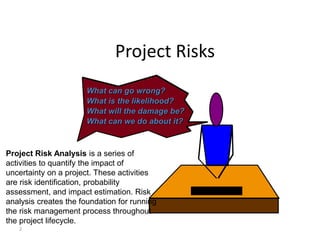
What can go wrong?
What is the likelihood?
What will the damage be?
What can we do about it?
Project Risk Analysis is a series of
activities to quantify the impact of
uncertainty on a project. These activities
are risk identification, probability
assessment, and impact estimation. Risk
analysis creates the foundation for running
the risk management process throughout
the project lifecycle.
3
Reactive Risk Management
• project team reacts to risks when they
occur
• mitigation—plan for additional resources
in anticipation of fire fighting
• fix on failure—resource are found and
applied when the risk strikes
• crisis management—failure does not
respond to applied resources and project
is in jeopardy
4
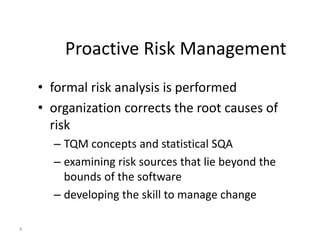
Proactive Risk Management
• formal risk analysis is performed
• organization corrects the root causes of
risk
– TQM concepts and statistical SQA
– examining risk sources that lie beyond the
bounds of the software
– developing the skill to manage change
5
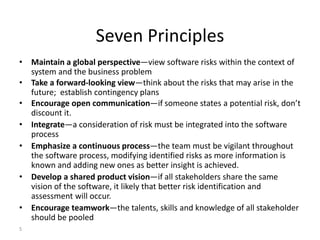
Seven Principles
• Maintain a global perspective—view software risks within the context of
system and the business problem
• Take a forward-looking view—think about the risks that may arise in the
future; establish contingency plans
• Encourage open communication—if someone states a potential risk, don’t
discount it.
• Integrate—a consideration of risk must be integrated into the software
process
• Emphasize a continuous process—the team must be vigilant throughout
the software process, modifying identified risks as more information is
known and adding new ones as better insight is achieved.
• Develop a shared product vision—if all stakeholders share the same
vision of the software, it likely that better risk identification and
assessment will occur.
• Encourage teamwork—the talents, skills and knowledge of all stakeholder
should be pooled
6
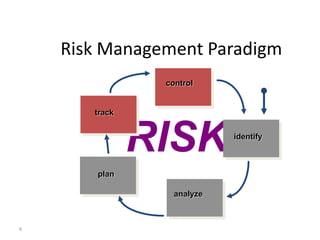
RISK
Risk Management Paradigm
control
identify
analyze
plan
track
7
Risk Identification
• Product size—risks associated with the overall size of the software to
be built or modified.
• Business impact—risks associated with constraints imposed by
management or the marketplace.
• Customer characteristics—risks associated with the sophistication of
the customer and the developer's ability to communicate with the
customer in a timely manner.
• Process definition—risks associated with the degree to which the
software process has been defined and is followed by the development
organization.
• Development environment—risks associated with the availability and
quality of the tools to be used to build the product.
• Technology to be built—risks associated with the complexity of the
system to be built and the "newness" of the technology that is
packaged by the system.
• Staff size and experience—risks associated with the overall technical
and project experience of the software engineers who will do the
work.
8
Risk Components
• performance risk—the degree of uncertainty
that the product will meet its requirements
and be fit for its intended use.
• cost risk—the degree of uncertainty that the
project budget will be maintained.
• support risk—the degree of uncertainty that
the resultant software will be easy to correct,
adapt, and enhance.
• schedule risk—the degree of uncertainty that
the project schedule will be maintained and
that the product will be delivered on time.
9
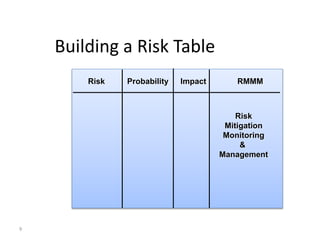
Building a Risk Table
Risk Probability Impact RMMM
Risk
Mitigation
Monitoring
&
Management
10
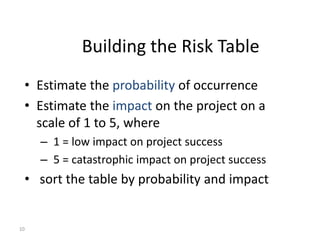
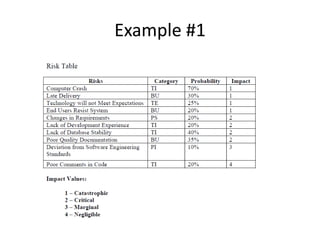
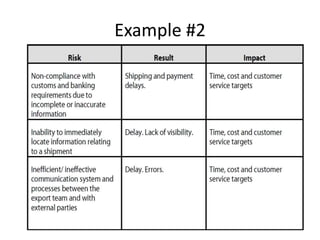
Building the Risk Table
• Estimate the probability of occurrence
• Estimate the impact on the project on a
scale of 1 to 5, where
– 1 = low impact on project success
– 5 = catastrophic impact on project success
• sort the table by probability and impact
Example #1
Example #2
13
Risk Exposure (Impact)
The overall risk exposure, RE, is determined using the
following relationship [Hal98]:
RE = P x C
where
P is the probability of occurrence for a risk, and
C is the cost to the project if the risk occur (i.e loss).
14
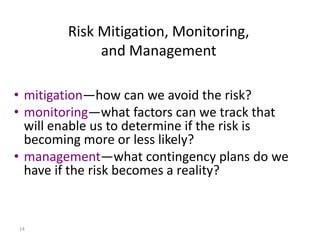
• mitigation—how can we avoid the risk?
• monitoring—what factors can we track that
will enable us to determine if the risk is
becoming more or less likely?
• management—what contingency plans do we
have if the risk becomes a reality?
Risk Mitigation, Monitoring,
and Management
Summary
• This lecture emphasise on Risk Management.
• Risk identification is the most important part of
the phase Risk Analysis.
• Risk mitigation can be easily done with help of
Risk table
References
1- These slides are designed to accompany Software
Engineering: A Practitioner’s Approach, 7/e (McGraw-Hill
2009). Slides copyright 2009 by Roger Pressman.
2- http://www.cs.unc.edu/~stotts/145/cocomo7.gif

Risk-Management-05012023-025512pm.ppt

  • 1.
    Chapter-28: Risk Management •Objectives – Project Risk – Proactive Risk Management – Principles – Risk identification – Risk Table – Summary
  • 2.
    2 Project Risks What cango wrong? What is the likelihood? What will the damage be? What can we do about it? Project Risk Analysis is a series of activities to quantify the impact of uncertainty on a project. These activities are risk identification, probability assessment, and impact estimation. Risk analysis creates the foundation for running the risk management process throughout the project lifecycle.
  • 3.
    3 Reactive Risk Management •project team reacts to risks when they occur • mitigation—plan for additional resources in anticipation of fire fighting • fix on failure—resource are found and applied when the risk strikes • crisis management—failure does not respond to applied resources and project is in jeopardy
  • 4.
    4 Proactive Risk Management •formal risk analysis is performed • organization corrects the root causes of risk – TQM concepts and statistical SQA – examining risk sources that lie beyond the bounds of the software – developing the skill to manage change
  • 5.
    5 Seven Principles • Maintaina global perspective—view software risks within the context of system and the business problem • Take a forward-looking view—think about the risks that may arise in the future; establish contingency plans • Encourage open communication—if someone states a potential risk, don’t discount it. • Integrate—a consideration of risk must be integrated into the software process • Emphasize a continuous process—the team must be vigilant throughout the software process, modifying identified risks as more information is known and adding new ones as better insight is achieved. • Develop a shared product vision—if all stakeholders share the same vision of the software, it likely that better risk identification and assessment will occur. • Encourage teamwork—the talents, skills and knowledge of all stakeholder should be pooled
  • 6.
  • 7.
    7 Risk Identification • Productsize—risks associated with the overall size of the software to be built or modified. • Business impact—risks associated with constraints imposed by management or the marketplace. • Customer characteristics—risks associated with the sophistication of the customer and the developer's ability to communicate with the customer in a timely manner. • Process definition—risks associated with the degree to which the software process has been defined and is followed by the development organization. • Development environment—risks associated with the availability and quality of the tools to be used to build the product. • Technology to be built—risks associated with the complexity of the system to be built and the "newness" of the technology that is packaged by the system. • Staff size and experience—risks associated with the overall technical and project experience of the software engineers who will do the work.
  • 8.
    8 Risk Components • performancerisk—the degree of uncertainty that the product will meet its requirements and be fit for its intended use. • cost risk—the degree of uncertainty that the project budget will be maintained. • support risk—the degree of uncertainty that the resultant software will be easy to correct, adapt, and enhance. • schedule risk—the degree of uncertainty that the project schedule will be maintained and that the product will be delivered on time.
  • 9.
    9 Building a RiskTable Risk Probability Impact RMMM Risk Mitigation Monitoring & Management
  • 10.
    10 Building the RiskTable • Estimate the probability of occurrence • Estimate the impact on the project on a scale of 1 to 5, where – 1 = low impact on project success – 5 = catastrophic impact on project success • sort the table by probability and impact
  • 11.
  • 12.
  • 13.
    13 Risk Exposure (Impact) Theoverall risk exposure, RE, is determined using the following relationship [Hal98]: RE = P x C where P is the probability of occurrence for a risk, and C is the cost to the project if the risk occur (i.e loss).
  • 14.
    14 • mitigation—how canwe avoid the risk? • monitoring—what factors can we track that will enable us to determine if the risk is becoming more or less likely? • management—what contingency plans do we have if the risk becomes a reality? Risk Mitigation, Monitoring, and Management
  • 15.
    Summary • This lectureemphasise on Risk Management. • Risk identification is the most important part of the phase Risk Analysis. • Risk mitigation can be easily done with help of Risk table
  • 16.
    References 1- These slidesare designed to accompany Software Engineering: A Practitioner’s Approach, 7/e (McGraw-Hill 2009). Slides copyright 2009 by Roger Pressman. 2- http://www.cs.unc.edu/~stotts/145/cocomo7.gif