MICRO SERVICES
Anki
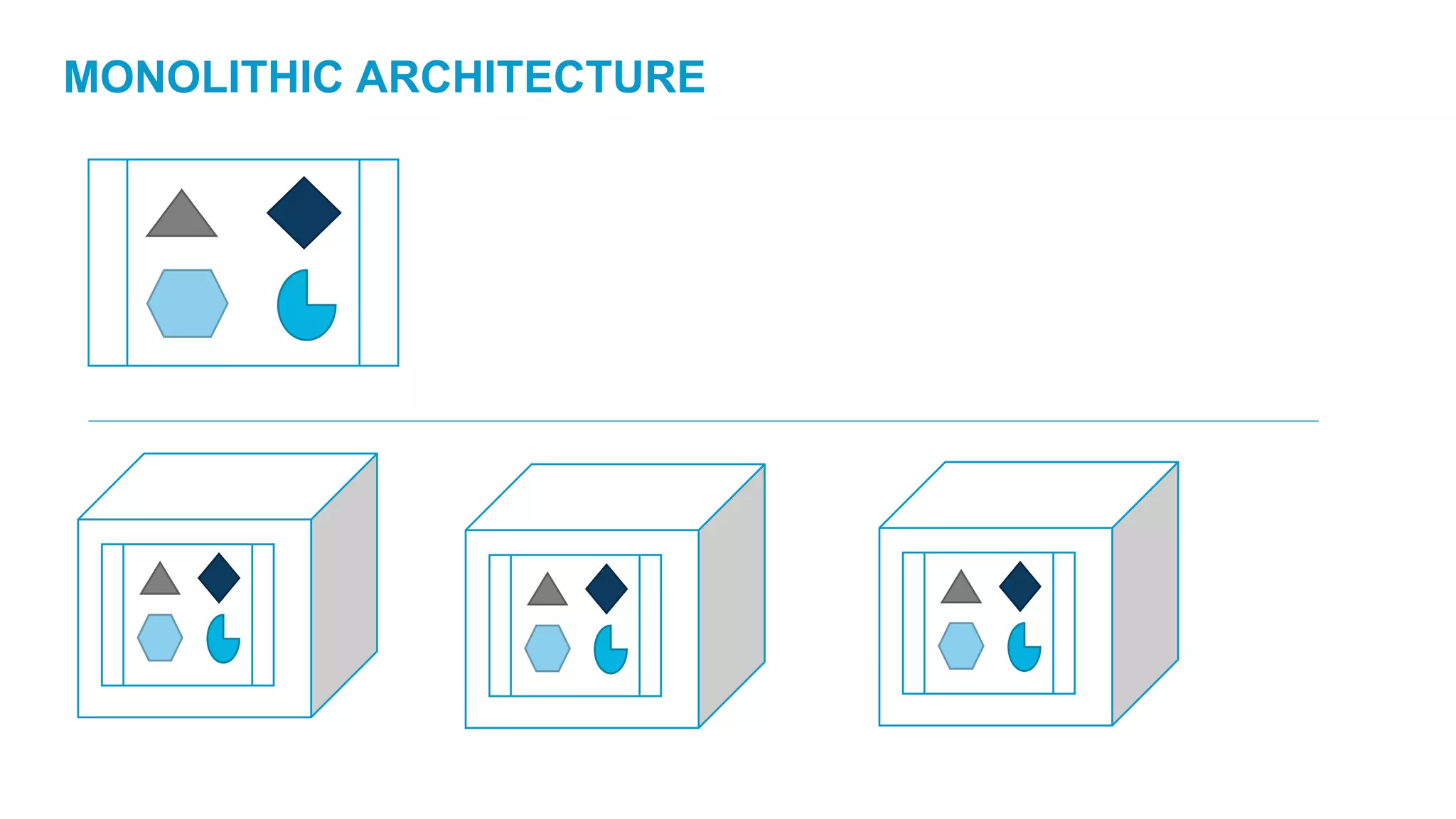
MONOLITHIC ARCHITECTURE
• Monolithic application either a layered or hexagonal architecture and consists of
different types of components
– Document Components
– Business Logic
– Database Access Logic
– Application Integration Logic
These are different logical components corresponding to different functional areas of
application
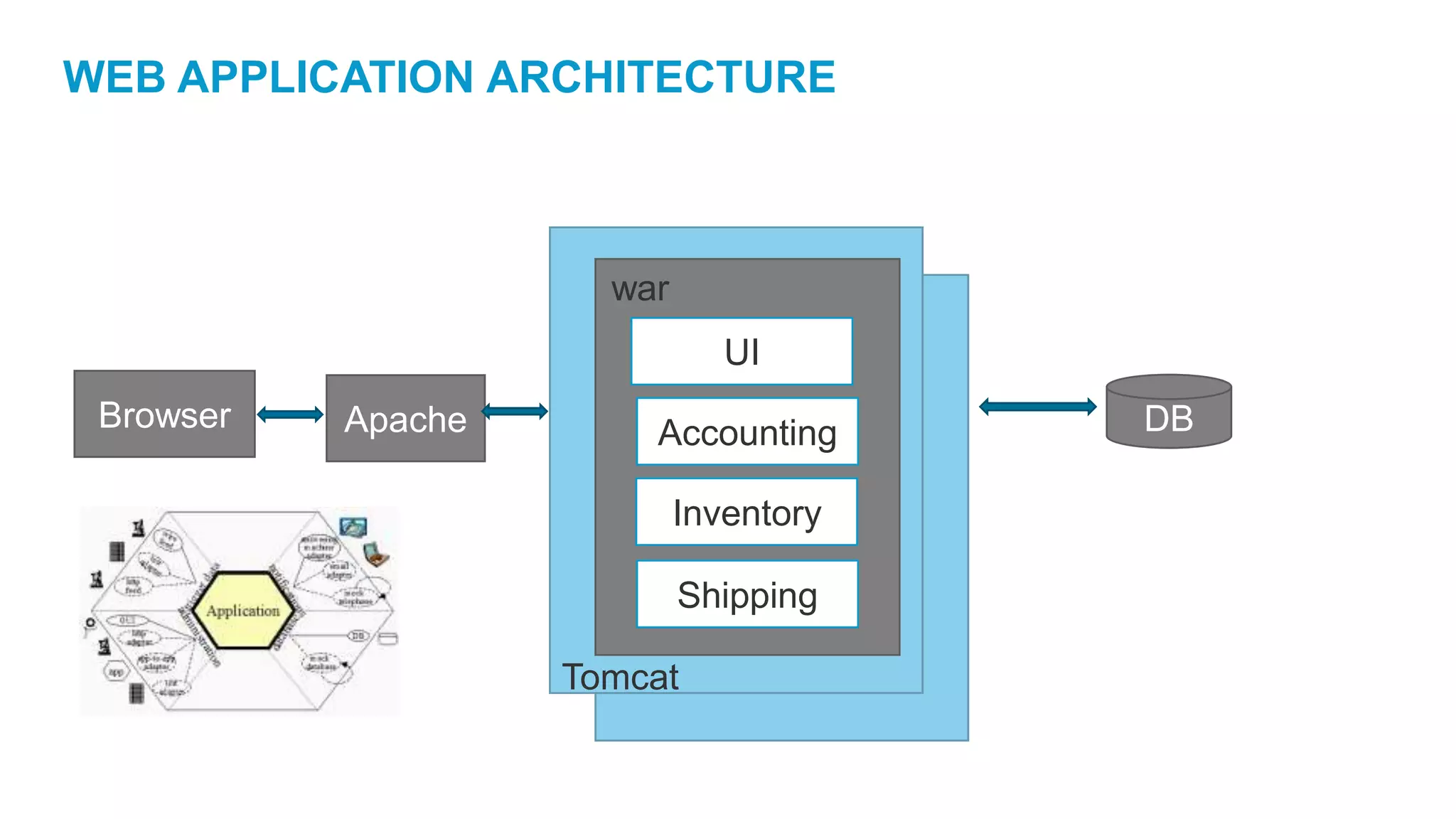
WEB APPLICATION ARCHITECTURE
To
Tomcat
war
UI
Accounting
Inventory
Shipping
Browser Apache DB
ADVANTAGES
• Simple to
– Develop
– Test
– Deploy
– Scale
© 2016 Company XY. All rights reserved. For internal use only
DISADVANTAGES
• Overloaded IDE
• Overloaded web container
• Continuous deployment is difficult
• Obstacle to scaling development
• Requires a long-term commitment to a technology stack
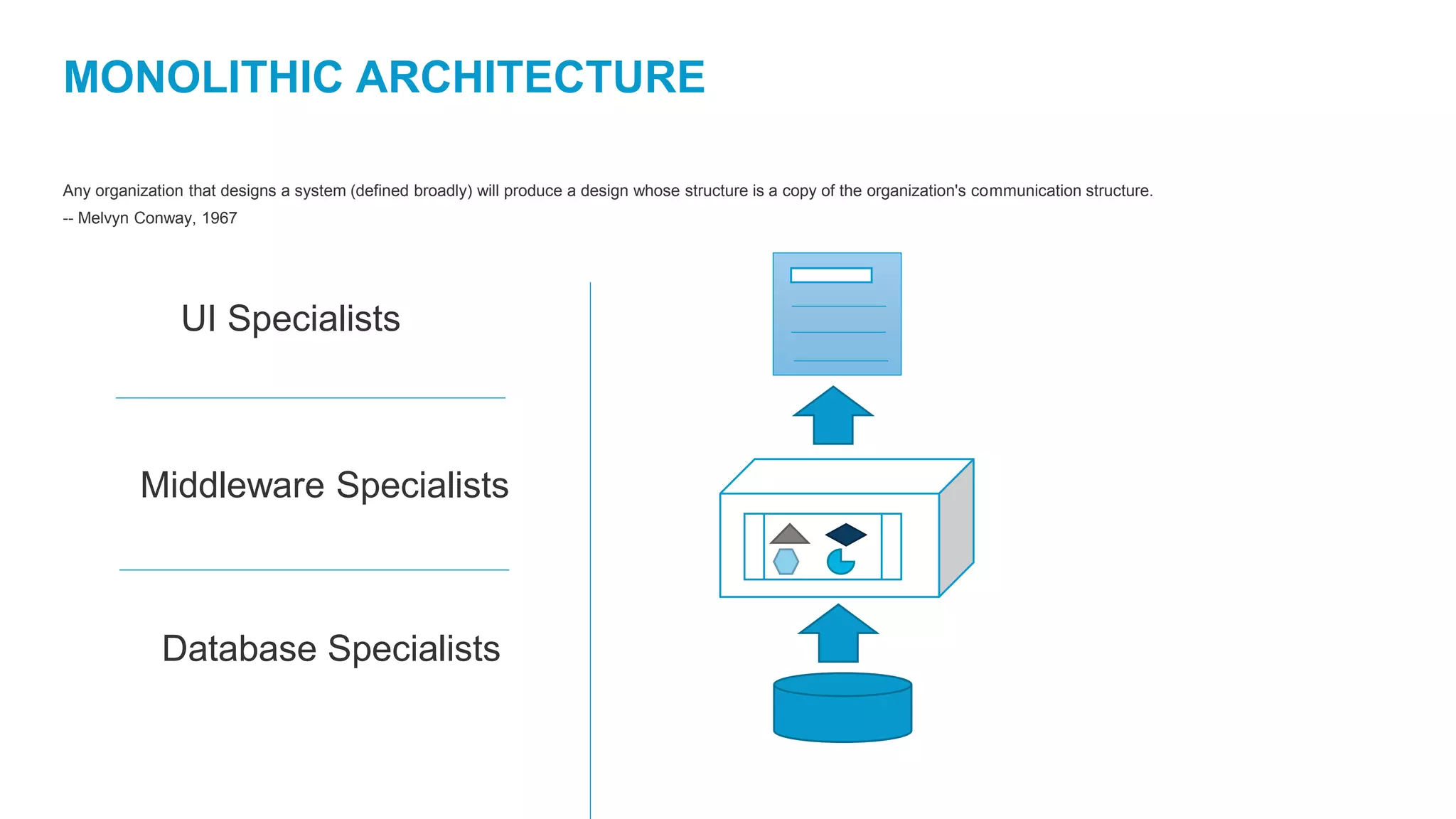
MONOLITHIC ARCHITECTURE
Any organization that designs a system (defined broadly) will produce a design whose structure is a copy of the organization's communication structure.
-- Melvyn Conway, 1967
UI Specialists
Middleware Specialists
Database Specialists
MICRO SERVICES ARCHITECTURE
• Micro services architecture is a new way of designing software applications as a
suite of individually deployable services.
KEY BENEFITS
• Technology Heterogeneity
• Resilience
• Scaling
• Ease of Deployment
• Composability
• Optimizing for Replicability
• Organizational Alignment
MICRO SERVICES ARCHITECTURE
DIFFERENCE BETWEEN SOA AND MICRO SERVICES
• None ( Answer from the people who read the OASIS SOA Reference Model )
• Microservice is SOA today
• Microservice approach has emerged from the real-world user, taking our better
understanding of system and architecture to do SOA well.
WHAT MAKES A GOOD SERVICE?
• Loose Coupling
– A change in one service should not require change in other services
• High Cohesion
– Related behaviour sit together and unrelated behaviour else where
– If you want to change a behaviour you can change in single place & release that
service alone for delivering that change
HOW TO INTEGRATE SERVICE?
• Database
• Synchronous versus Asynchronous
• Service orchestration versus Choreography
• Remote Procedure calls
• REST
• Asynchronous Event-Based collaboration
PRINCIPLES OF MICRO SERVICES
• Modelled around business concepts
• Adapt culture of automation
• Hide internal implementation details
• Decentralize all the things
• Deploy independently
• Isolate failure
• Highly Observable
SPLITTING MONOLITHIC APPLICATION
• When we split monolithic application into micro services, the biggest issue lies in
changing the communication pattern i.e. in memory method calls to RPC leads
to chatty communications which does not perform well
IDENTIFY SEAMS
• What is seam ?
– A portion of the code can be treated on isolation, worked on without impacting the rest
of the code base
THINK MONOLITHIC AS MARBLE
© 2016 Company XY. All rights reserved. For internal use only
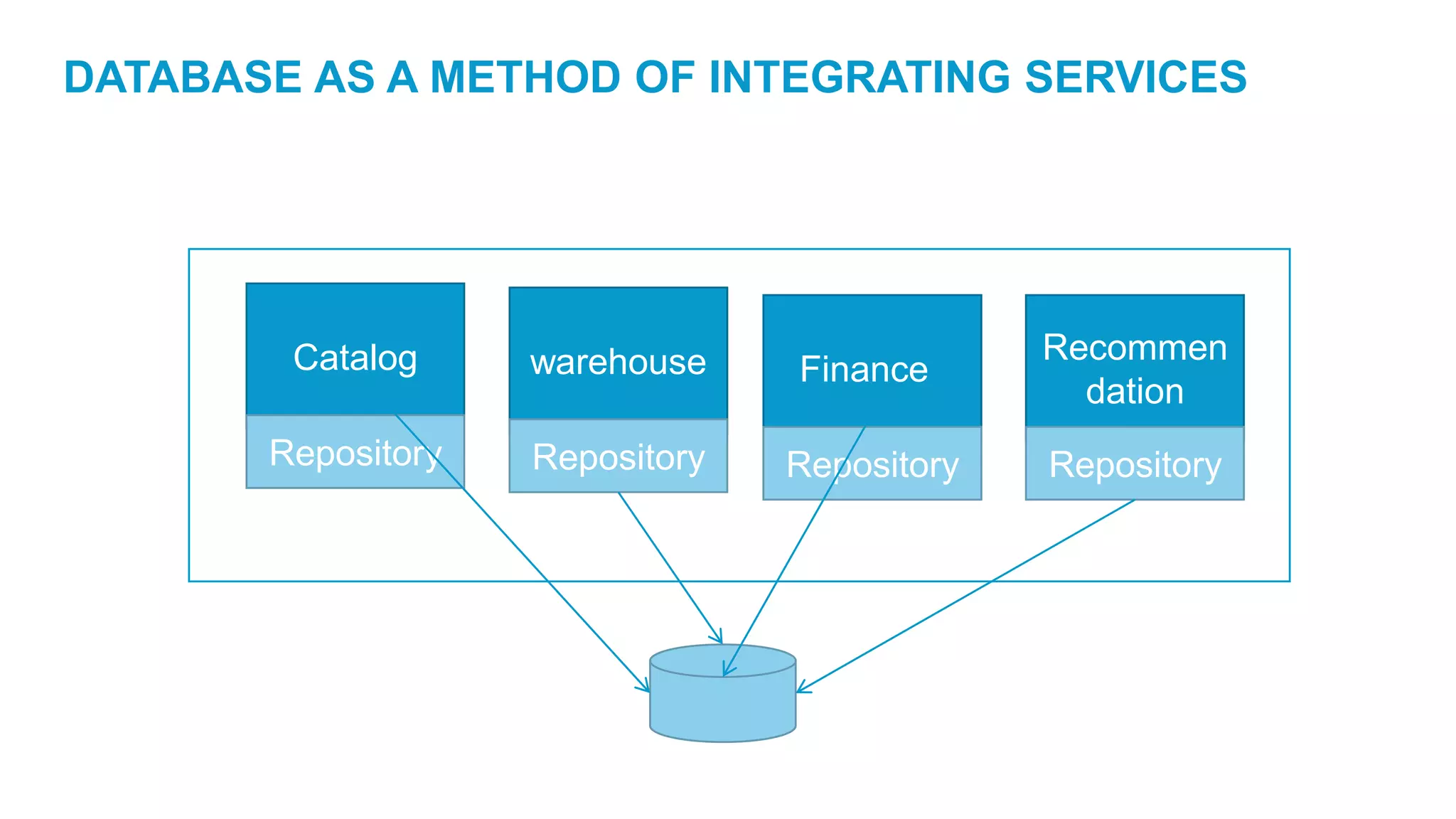
DATABASE AS A METHOD OF INTEGRATING SERVICES
Catalog
Repository
warehouse
Repository
Finance
Repository
Recommen
dation
Repository
DEPLOYMENT
© 2016 Company XY. All rights reserved. For internal use only
DEPLOYMENT
• Multiple Services for Host
• Application Containers
• Single Service for Host
DEPLOYMENT
VMWare, Aws will reduce the overhead of host management using virtualization.
MONITORING
What needs to be monitored ?
- CPU
- Memory
- Response Time
LOGSTATSH & KIBANA
Service
System
Log
Logstatsh
Application
Log Kibana
Host
Host Host Host
© 2016 Company XY. All rights reserved. For internal use only
SEMATIC MONITORING
• Synthetic Transaction
© 2016 Company XY. All rights reserved. For internal use only
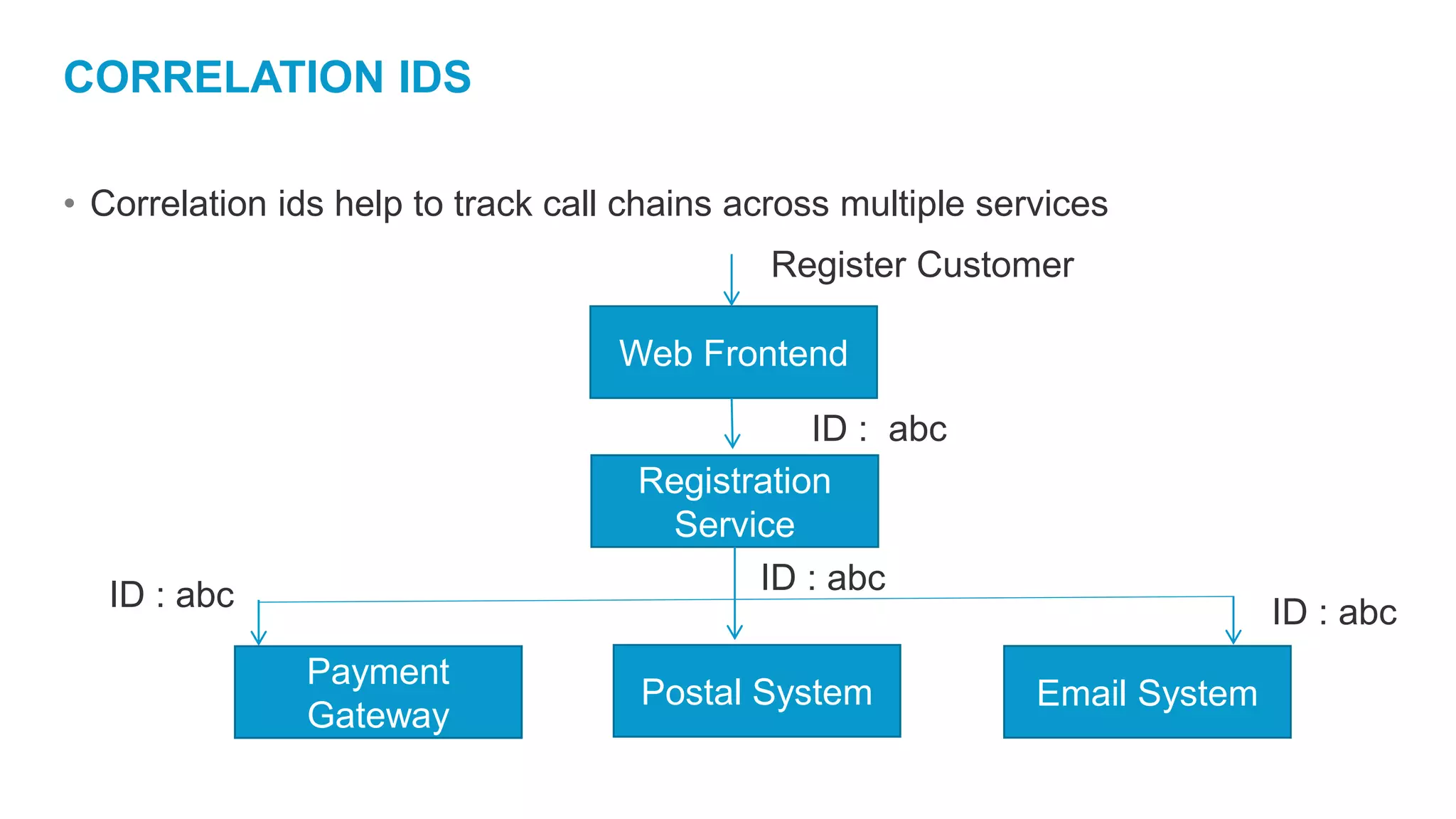
CORRELATION IDS
• Correlation ids help to track call chains across multiple services
Web Frontend
Registration
Service
Payment
Gateway
Postal System Email System
Register Customer
ID : abc
ID : abc ID : abc
ID : abc
FAILURE IS EVERYWHERE
• Autoscaling of system capable of reacting to the increased load or failure of
individual nodes might be fantastic
• The following is the requirements before think about scaling
– Response time
– Availability
– Durability of Data
FAILURE IS EVERYWHERE
• In Micro service architecture we can consider a much more nauncend situation
• In e-commerce website for example cart service is down, but still we could show
the web page with listing.
ARCHITECTURAL SAFETY MEASURES
• When some thing goes wrong, that should not cause ripple-effects.
• System that just act slow are much harder to deal with than systems that just fail
fast.
• Implementing right timeouts
• Implementing bulkheads, separating different connection pools.
• Implementing a circuit breaker to avoid sending calls to an unhealthy system
ANTIFRAGILE ORGANIZATION
• Benefit from failure and disaster
• Embracing and inciting failure through software, building systems that can
handle it.
– Choas Monkey
– Choas Gorilla
– Latency Monkey
TOOLS
• Schema Spy (http://schemaspy.sourceforge.net/)
• Structure 101 (http://structure101.com/)
• https://www.nagios.org/
• http://newrelic.com/
• https://twitter.github.io/zipkin/
© 2016 Company XY. All rights reserved. For internal use only

Microservices

  • 1.
  • 2.
    MONOLITHIC ARCHITECTURE • Monolithicapplication either a layered or hexagonal architecture and consists of different types of components – Document Components – Business Logic – Database Access Logic – Application Integration Logic These are different logical components corresponding to different functional areas of application
  • 3.
  • 4.
    ADVANTAGES • Simple to –Develop – Test – Deploy – Scale © 2016 Company XY. All rights reserved. For internal use only
  • 5.
    DISADVANTAGES • Overloaded IDE •Overloaded web container • Continuous deployment is difficult • Obstacle to scaling development • Requires a long-term commitment to a technology stack
  • 6.
  • 7.
    MONOLITHIC ARCHITECTURE Any organizationthat designs a system (defined broadly) will produce a design whose structure is a copy of the organization's communication structure. -- Melvyn Conway, 1967 UI Specialists Middleware Specialists Database Specialists
  • 8.
    MICRO SERVICES ARCHITECTURE •Micro services architecture is a new way of designing software applications as a suite of individually deployable services.
  • 9.
    KEY BENEFITS • TechnologyHeterogeneity • Resilience • Scaling • Ease of Deployment • Composability • Optimizing for Replicability • Organizational Alignment
  • 10.
  • 11.
    DIFFERENCE BETWEEN SOAAND MICRO SERVICES • None ( Answer from the people who read the OASIS SOA Reference Model ) • Microservice is SOA today • Microservice approach has emerged from the real-world user, taking our better understanding of system and architecture to do SOA well.
  • 12.
    WHAT MAKES AGOOD SERVICE? • Loose Coupling – A change in one service should not require change in other services • High Cohesion – Related behaviour sit together and unrelated behaviour else where – If you want to change a behaviour you can change in single place & release that service alone for delivering that change
  • 13.
    HOW TO INTEGRATESERVICE? • Database • Synchronous versus Asynchronous • Service orchestration versus Choreography • Remote Procedure calls • REST • Asynchronous Event-Based collaboration
  • 14.
    PRINCIPLES OF MICROSERVICES • Modelled around business concepts • Adapt culture of automation • Hide internal implementation details • Decentralize all the things • Deploy independently • Isolate failure • Highly Observable
  • 15.
    SPLITTING MONOLITHIC APPLICATION •When we split monolithic application into micro services, the biggest issue lies in changing the communication pattern i.e. in memory method calls to RPC leads to chatty communications which does not perform well
  • 16.
    IDENTIFY SEAMS • Whatis seam ? – A portion of the code can be treated on isolation, worked on without impacting the rest of the code base
  • 17.
    THINK MONOLITHIC ASMARBLE © 2016 Company XY. All rights reserved. For internal use only
  • 18.
    DATABASE AS AMETHOD OF INTEGRATING SERVICES Catalog Repository warehouse Repository Finance Repository Recommen dation Repository
  • 19.
    DEPLOYMENT © 2016 CompanyXY. All rights reserved. For internal use only
  • 20.
    DEPLOYMENT • Multiple Servicesfor Host • Application Containers • Single Service for Host
  • 21.
    DEPLOYMENT VMWare, Aws willreduce the overhead of host management using virtualization.
  • 22.
    MONITORING What needs tobe monitored ? - CPU - Memory - Response Time
  • 23.
    LOGSTATSH & KIBANA Service System Log Logstatsh Application LogKibana Host Host Host Host © 2016 Company XY. All rights reserved. For internal use only
  • 24.
    SEMATIC MONITORING • SyntheticTransaction © 2016 Company XY. All rights reserved. For internal use only
  • 25.
    CORRELATION IDS • Correlationids help to track call chains across multiple services Web Frontend Registration Service Payment Gateway Postal System Email System Register Customer ID : abc ID : abc ID : abc ID : abc
  • 26.
    FAILURE IS EVERYWHERE •Autoscaling of system capable of reacting to the increased load or failure of individual nodes might be fantastic • The following is the requirements before think about scaling – Response time – Availability – Durability of Data
  • 27.
    FAILURE IS EVERYWHERE •In Micro service architecture we can consider a much more nauncend situation • In e-commerce website for example cart service is down, but still we could show the web page with listing.
  • 28.
    ARCHITECTURAL SAFETY MEASURES •When some thing goes wrong, that should not cause ripple-effects. • System that just act slow are much harder to deal with than systems that just fail fast. • Implementing right timeouts • Implementing bulkheads, separating different connection pools. • Implementing a circuit breaker to avoid sending calls to an unhealthy system
  • 29.
    ANTIFRAGILE ORGANIZATION • Benefitfrom failure and disaster • Embracing and inciting failure through software, building systems that can handle it. – Choas Monkey – Choas Gorilla – Latency Monkey
  • 30.
    TOOLS • Schema Spy(http://schemaspy.sourceforge.net/) • Structure 101 (http://structure101.com/) • https://www.nagios.org/ • http://newrelic.com/ • https://twitter.github.io/zipkin/
  • 31.
    © 2016 CompanyXY. All rights reserved. For internal use only

Editor's Notes

  • #17 Bounded Context become excellent seams because by definition they represent cohesive. Namespaces used to group similar code together. Java package is an weak example.
  • #18 We could blow the whole thing up, but that rarely ends well. Instead just chip away at it incremental We can consider the factors like modules which we are going to change, all the team members within the same location, security, technology Least dependent one
  • #19 Breaking foreign key releations Shared Data Static Data Shared Table Refactoring the databases Single schema Split schema Split application into services
  • #20 Deploying monolithic application is straight forward process, microservices with their interdependence, are a different kettle of fish together. Continuous Integration and Continuous deployment Newly checked-in code properly integrate with existing code Continuous Integration server Check out the code Compile the code 3) Execute the Tests Without continuous Integration the journey to micro services is painful.
  • #21 Automation even required here since we have deploying services on more than one host Automation to deploy the artifact Collect logs from the systems Monitor the service
  • #23 Multiple servers to monitor, multiple log files needs to collect and multiple places where latency could cause problems. Single point of failure also makes failure investigation simple. In case of micro services world, the capabilities offers to user are served by small services, some of which communicate with others services to accomplish the given task. Use tools Single service, single server Single service, multiple servers Multiple service, Multiple servers
  • #27 Autosacling reporting system Durabliity of Data How many days we need to main the data.