What is the problem with current Enterprise WAN solutions?
• Customer applications are moving toward
SaaS and PaaS models. As such, hair
pinning traffic from branch office to
customer data center first, then to cloud
causes performance issues.
• Internet has become almost as reliable as
dedicated IP (MPLS) networks at a fraction
of the cost.
• Customers have less IT staff that
understand the complexities of the myriad
of branch CPE that is required to secure
and optimize the WAN. Any single branch
office could have a router, firewall, security
appliance, wan acceleration device,
caching device, etc. It is too much cost for
the customer to manage and maintain all
that hardware.
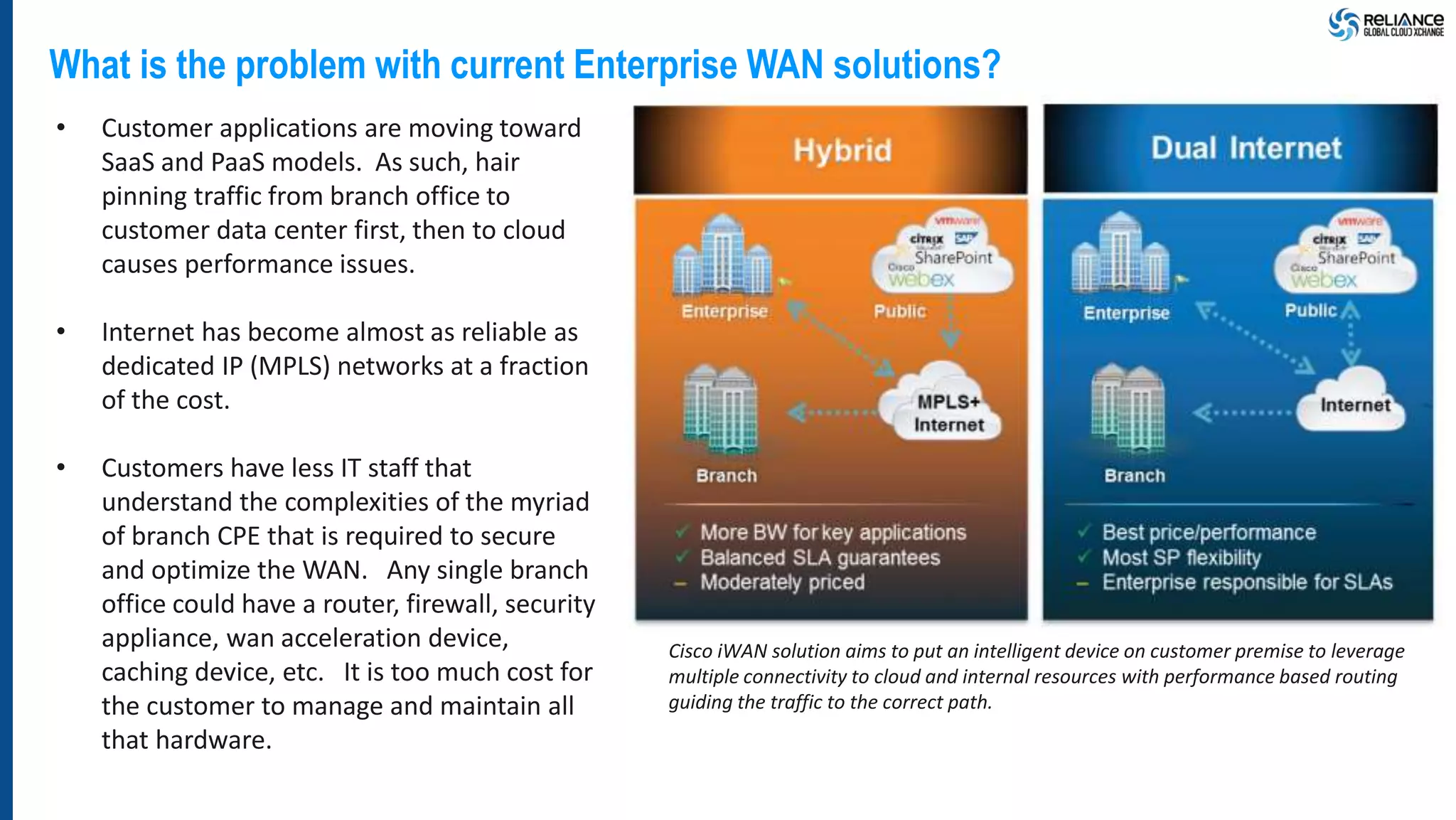
Cisco iWAN solution aims to put an intelligent device on customer premise to leverage
multiple connectivity to cloud and internal resources with performance based routing
guiding the traffic to the correct path.
What are the demands facing IT departments?
Public
Cloud
Private Data
Center
Private
Cloud
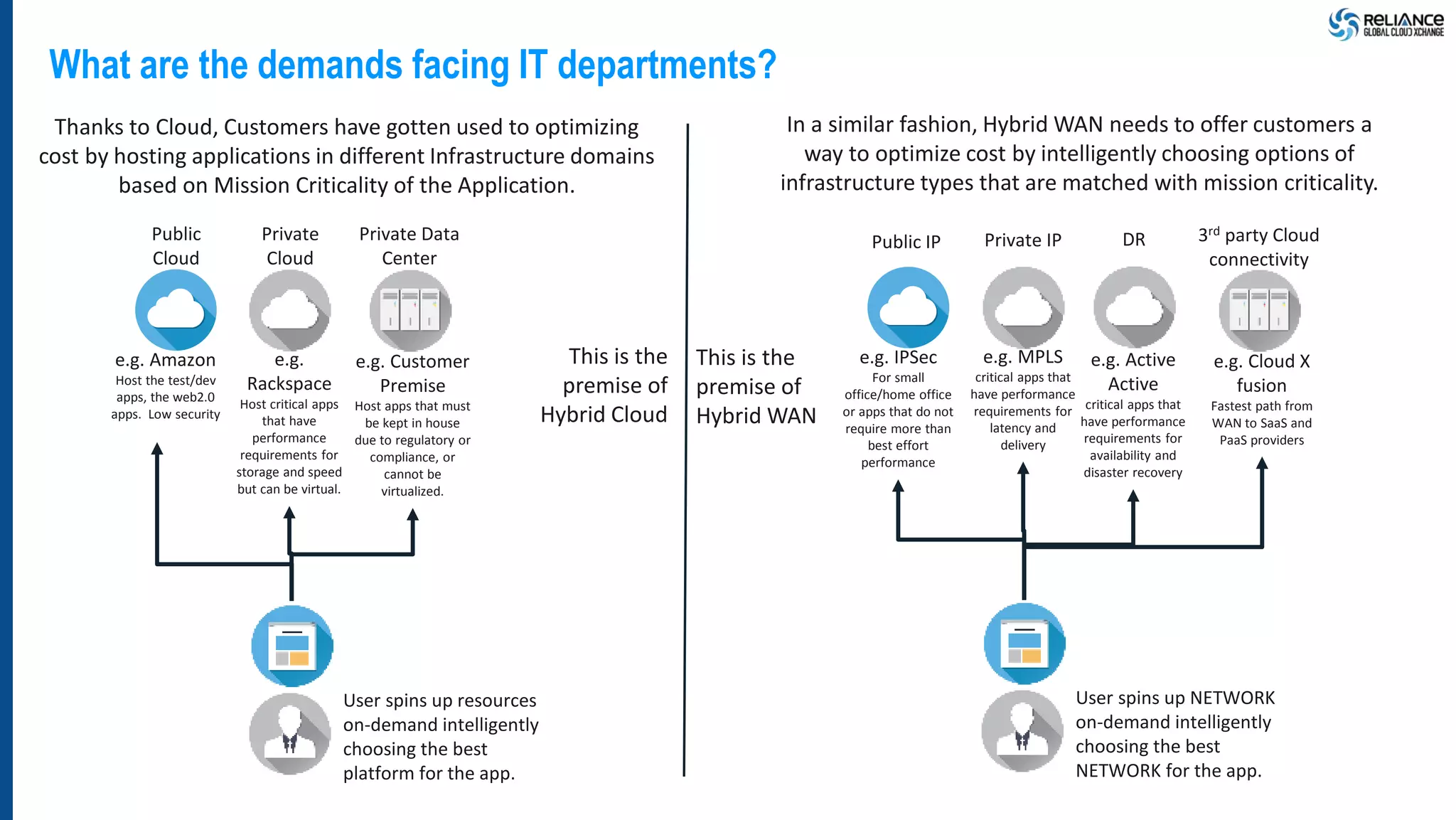
Thanks to Cloud, Customers have gotten used to optimizing
cost by hosting applications in different Infrastructure domains
based on Mission Criticality of the Application.
e.g. Amazon
Host the test/dev
apps, the web2.0
apps. Low security
e.g.
Rackspace
Host critical apps
that have
performance
requirements for
storage and speed
but can be virtual.
e.g. Customer
Premise
Host apps that must
be kept in house
due to regulatory or
compliance, or
cannot be
virtualized.
User spins up resources
on-demand intelligently
choosing the best
platform for the app.
This is the
premise of
Hybrid Cloud
Public IP 3rd party Cloud
connectivity
Private IP
In a similar fashion, Hybrid WAN needs to offer customers a
way to optimize cost by intelligently choosing options of
infrastructure types that are matched with mission criticality.
e.g. IPSec
For small
office/home office
or apps that do not
require more than
best effort
performance
e.g. MPLS
critical apps that
have performance
requirements for
latency and
delivery
e.g. Cloud X
fusion
Fastest path from
WAN to SaaS and
PaaS providers
User spins up NETWORK
on-demand intelligently
choosing the best
NETWORK for the app.
This is the
premise of
Hybrid WAN
DR
e.g. Active
Active
critical apps that
have performance
requirements for
availability and
disaster recovery
Solutions: SD WAN is Step 1, NFV is Step 2
Public IP 3rd party Cloud
connectivity
Private IP
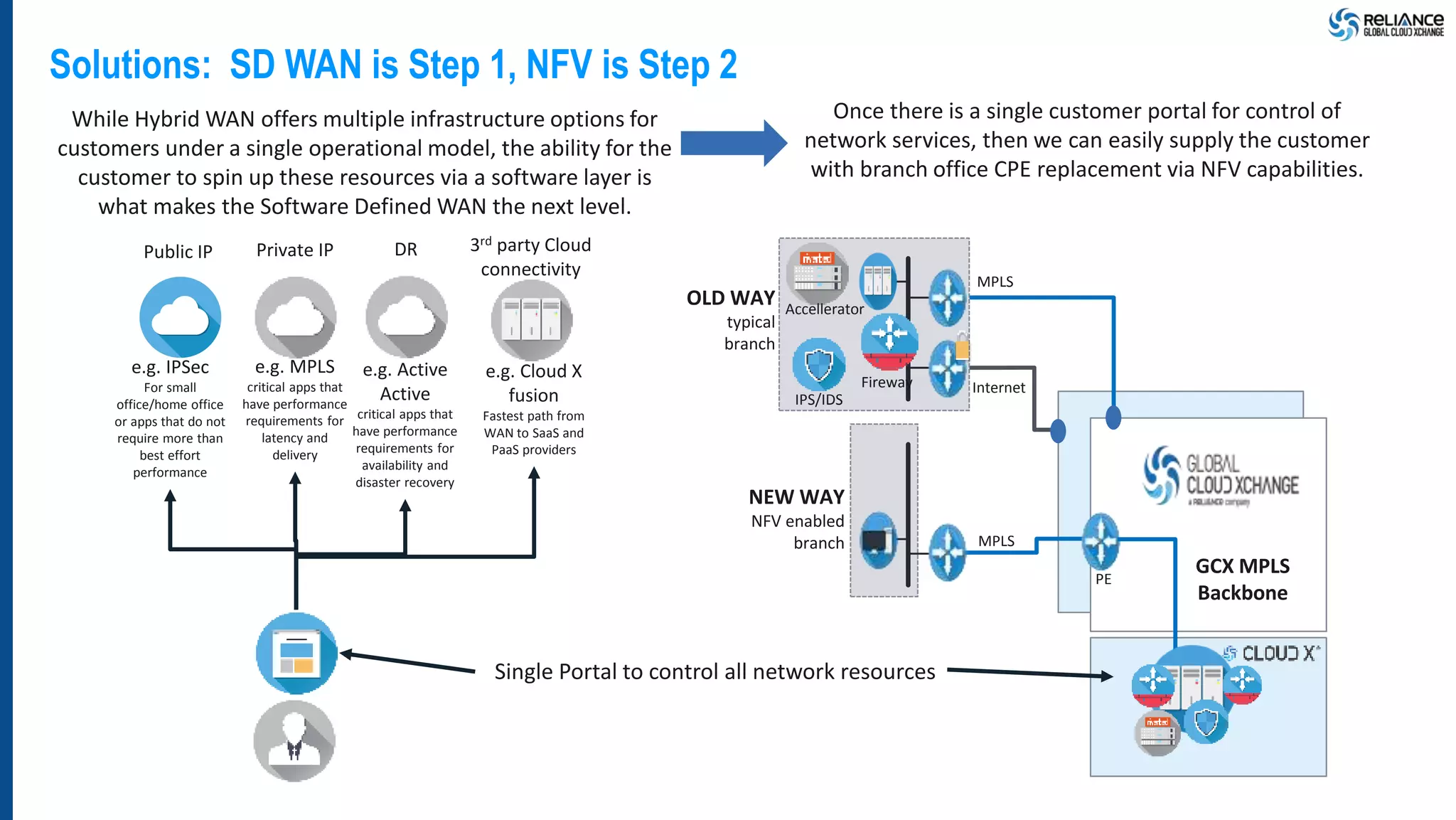
While Hybrid WAN offers multiple infrastructure options for
customers under a single operational model, the ability for the
customer to spin up these resources via a software layer is
what makes the Software Defined WAN the next level.
e.g. IPSec
For small
office/home office
or apps that do not
require more than
best effort
performance
e.g. MPLS
critical apps that
have performance
requirements for
latency and
delivery
e.g. Cloud X
fusion
Fastest path from
WAN to SaaS and
PaaS providers
Once there is a single customer portal for control of
network services, then we can easily supply the customer
with branch office CPE replacement via NFV capabilities.
DR
e.g. Active
Active
critical apps that
have performance
requirements for
availability and
disaster recovery
GCX MPLS
Backbone
MPLS
Internet
OLD WAY
typical
branch
MPLS
NEW WAY
NFV enabled
branch
Accellerator
IPS/IDS
Fireway
PE
Single Portal to control all network resources
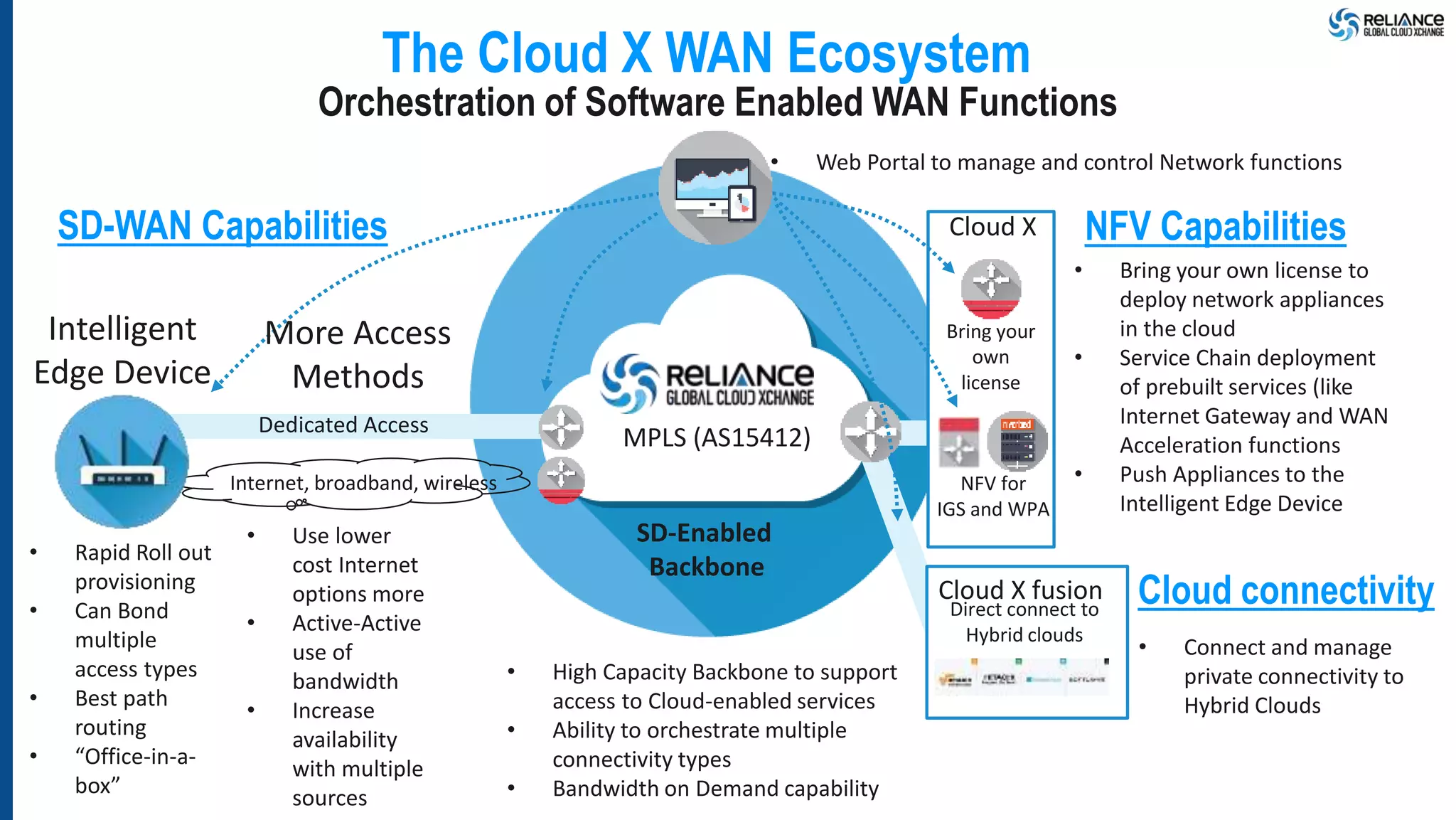
The Cloud X WAN Ecosystem
MPLS (AS15412)
SD-Enabled
Backbone
SD-WAN Capabilities
• Rapid Roll out
provisioning
• Can Bond
multiple
access types
• Best path
routing
• “Office-in-a-
box”
Intelligent
Edge Device
Internet, broadband, wireless
Dedicated Access
• Use lower
cost Internet
options more
• Active-Active
use of
bandwidth
• Increase
availability
with multiple
sources
• High Capacity Backbone to support
access to Cloud-enabled services
• Ability to orchestrate multiple
connectivity types
• Bandwidth on Demand capability
NFV Capabilities
• Bring your own license to
deploy network appliances
in the cloud
• Service Chain deployment
of prebuilt services (like
Internet Gateway and WAN
Acceleration functions
• Push Appliances to the
Intelligent Edge Device
Cloud X fusion
Direct connect to
Hybrid clouds
Cloud connectivity
• Connect and manage
private connectivity to
Hybrid Clouds
Orchestration of Software Enabled WAN Functions
Cloud X
Bring your
own
license
NFV for
IGS and WPA
More Access
Methods
• Web Portal to manage and control Network functions

Problems with enterprise wan solutions - The Cloud X Ecosystem

  • 1.
    What is theproblem with current Enterprise WAN solutions? • Customer applications are moving toward SaaS and PaaS models. As such, hair pinning traffic from branch office to customer data center first, then to cloud causes performance issues. • Internet has become almost as reliable as dedicated IP (MPLS) networks at a fraction of the cost. • Customers have less IT staff that understand the complexities of the myriad of branch CPE that is required to secure and optimize the WAN. Any single branch office could have a router, firewall, security appliance, wan acceleration device, caching device, etc. It is too much cost for the customer to manage and maintain all that hardware. Cisco iWAN solution aims to put an intelligent device on customer premise to leverage multiple connectivity to cloud and internal resources with performance based routing guiding the traffic to the correct path.
  • 2.
    What are thedemands facing IT departments? Public Cloud Private Data Center Private Cloud Thanks to Cloud, Customers have gotten used to optimizing cost by hosting applications in different Infrastructure domains based on Mission Criticality of the Application. e.g. Amazon Host the test/dev apps, the web2.0 apps. Low security e.g. Rackspace Host critical apps that have performance requirements for storage and speed but can be virtual. e.g. Customer Premise Host apps that must be kept in house due to regulatory or compliance, or cannot be virtualized. User spins up resources on-demand intelligently choosing the best platform for the app. This is the premise of Hybrid Cloud Public IP 3rd party Cloud connectivity Private IP In a similar fashion, Hybrid WAN needs to offer customers a way to optimize cost by intelligently choosing options of infrastructure types that are matched with mission criticality. e.g. IPSec For small office/home office or apps that do not require more than best effort performance e.g. MPLS critical apps that have performance requirements for latency and delivery e.g. Cloud X fusion Fastest path from WAN to SaaS and PaaS providers User spins up NETWORK on-demand intelligently choosing the best NETWORK for the app. This is the premise of Hybrid WAN DR e.g. Active Active critical apps that have performance requirements for availability and disaster recovery
  • 3.
    Solutions: SD WANis Step 1, NFV is Step 2 Public IP 3rd party Cloud connectivity Private IP While Hybrid WAN offers multiple infrastructure options for customers under a single operational model, the ability for the customer to spin up these resources via a software layer is what makes the Software Defined WAN the next level. e.g. IPSec For small office/home office or apps that do not require more than best effort performance e.g. MPLS critical apps that have performance requirements for latency and delivery e.g. Cloud X fusion Fastest path from WAN to SaaS and PaaS providers Once there is a single customer portal for control of network services, then we can easily supply the customer with branch office CPE replacement via NFV capabilities. DR e.g. Active Active critical apps that have performance requirements for availability and disaster recovery GCX MPLS Backbone MPLS Internet OLD WAY typical branch MPLS NEW WAY NFV enabled branch Accellerator IPS/IDS Fireway PE Single Portal to control all network resources
  • 4.
    The Cloud XWAN Ecosystem MPLS (AS15412) SD-Enabled Backbone SD-WAN Capabilities • Rapid Roll out provisioning • Can Bond multiple access types • Best path routing • “Office-in-a- box” Intelligent Edge Device Internet, broadband, wireless Dedicated Access • Use lower cost Internet options more • Active-Active use of bandwidth • Increase availability with multiple sources • High Capacity Backbone to support access to Cloud-enabled services • Ability to orchestrate multiple connectivity types • Bandwidth on Demand capability NFV Capabilities • Bring your own license to deploy network appliances in the cloud • Service Chain deployment of prebuilt services (like Internet Gateway and WAN Acceleration functions • Push Appliances to the Intelligent Edge Device Cloud X fusion Direct connect to Hybrid clouds Cloud connectivity • Connect and manage private connectivity to Hybrid Clouds Orchestration of Software Enabled WAN Functions Cloud X Bring your own license NFV for IGS and WPA More Access Methods • Web Portal to manage and control Network functions