


Understanding	Microservice	Architecture	
Kasun	Indrasiri		
Director,	Integra.on	Technologies	
WSO2
Microservices?
Monolithic	Architecture
Monolithic	Architecture		
•  All	func.onali.es	are	implemented/deployed	into	a	single	
soBware	applica.on.		
•  Enterprise	soBware	applica.ons	-	ERPs,	CRMs	etc.	
•  SOA/web	services:	'coarse-grained'	services,	broad	scope,	
mammoth	services	with	several	dozens	of	opera.ons	and	
complex	message	formats
Monolithic	Architecture		
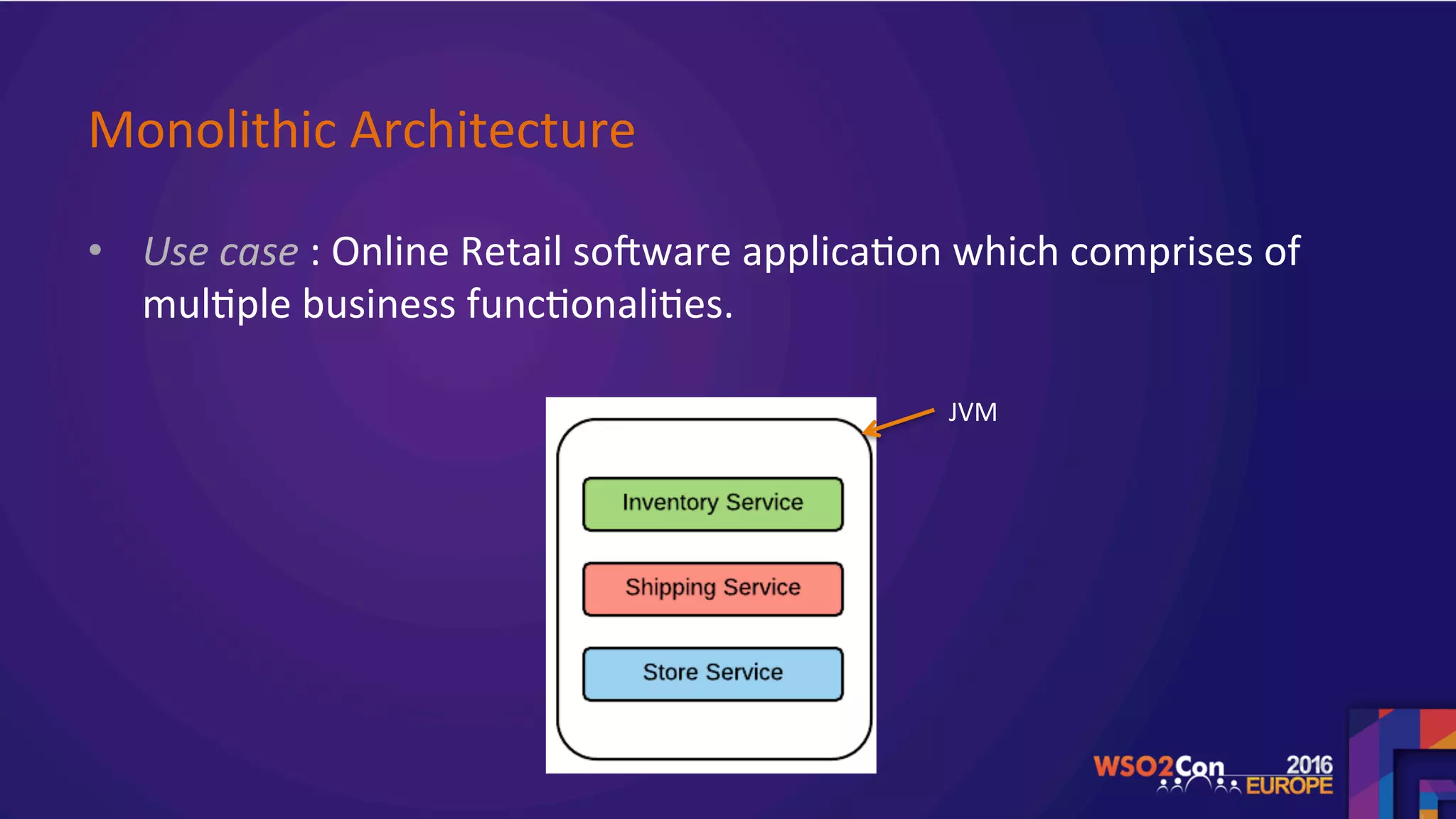
•  Use	case	:	Online	Retail	soBware	applica.on	which	comprises	of	
mul.ple	business	func.onali.es.		
	
JVM
Monolithic	Architecture		
•  Developed	and	deployed	as	a	single	unit.	
•  Overwhelmingly	complex;	which	leads	to	nightmares	in	
maintaining,	upgrading	and	adding	new	features.	
•  Redeploy	the	en>re	applica>on,	in	order	to	update	a	part	of	it.	
•  Scaling	:	scaled	as	a	single	applica>on	and	difficult	to	scale	with	
conflic>ng	resource	requirements	whole	applica>on	down	
•  Reliability	-	One	unstable	service	can	bring	the.		
•  Hard	to	innovate,	prac>ce	agile	development	and	delivery	
methodologies
Microservices	Architecture
Microservices	Architecture	
•  The	founda.on	of	microservices	architecture(MSA)	is	about	
developing	a	single	applica.on	as	a	suite	of	fine-grained	and	
independent	services	that	are		running	in	its	own	process,	
developed	and	deployed	independently.	
•  It	is	more	than	just	segrega.ng	the	services	in	a	monolith…
Microservices	Architecture	
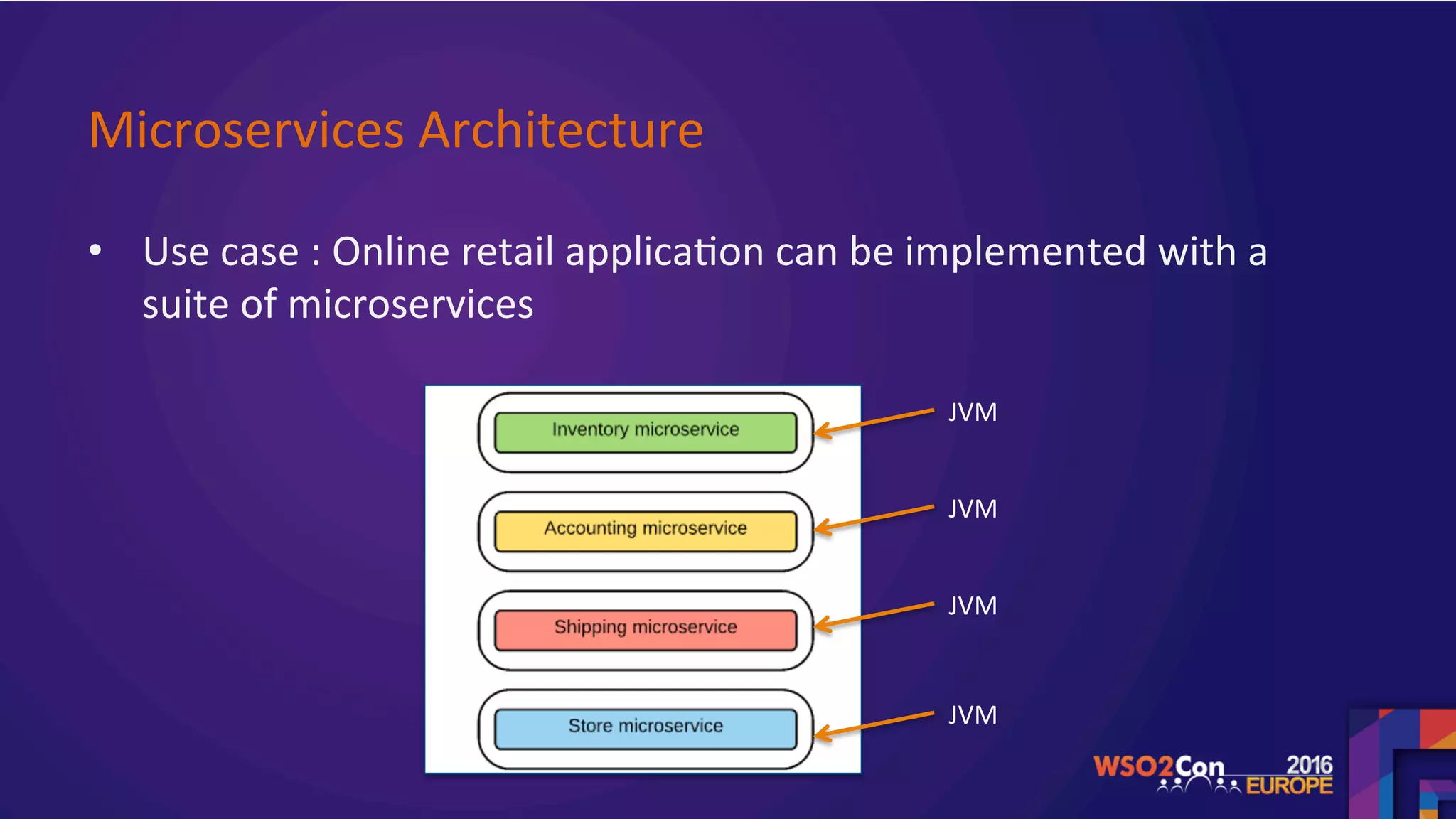
•  Use	case	:	Online	retail	applica.on	can	be	implemented	with	a	
suite	of	microservices		
	
JVM	
JVM	
JVM	
JVM
Designing	Microservices	:	Size,	scope	and	capabili.es	
•  Common	Misconcep.ons		
–  Lines	of	Code	
–  Team	size		
–  'Micro'	is	a	bit	misleading	term		
–  Use	web	services	and	rebranding	them	as	microservices
Designing	Microservices	:	Size,	scope	and	capabili.es	
•  Common	Misconcep.ons		
–  Lines	of	Code	
–  Team	size		
–  'Micro'	is	a	bit	misleading	term		
–  Use	web	services	and	rebranding	them	as	microservices
Designing	Microservices	:	Size,	scope	and	capabili.es	
•  Single	Responsibility	Principle(SRP):	Having	a	limited	and	a	focused	
business	scope.		
•  Scope	
–  Find	the	service	boundaries	and	align	them	with	the	business	
capabili.es	(aka	DDD)	
–  Focus	on	scope	of	the	microservice.		
–  Its	not	about	making	services	small…		
•  Agile	and	independent	development	and	deployment	of	the	service.	
•  Microservice	should	have	a	very	few	opera.ons/func.onali.es	and	
simple	message	format.
Messaging	in	Microservices		
•  In	Monolithic	architecture:		
–  Func.on	calls	or	language-level	method	calls	
–  SOA/web	services	:	SOAP	and	WS*	with	HTTP,	JMS	etc.		
–  Web	services	with	several	dozens	of	opera.ons	and	complex	
message	schemas		
•  In	Microservices	architecture:		
–  Simple	and	lightweight	messaging	mechanism.
Messaging	in	Microservices		
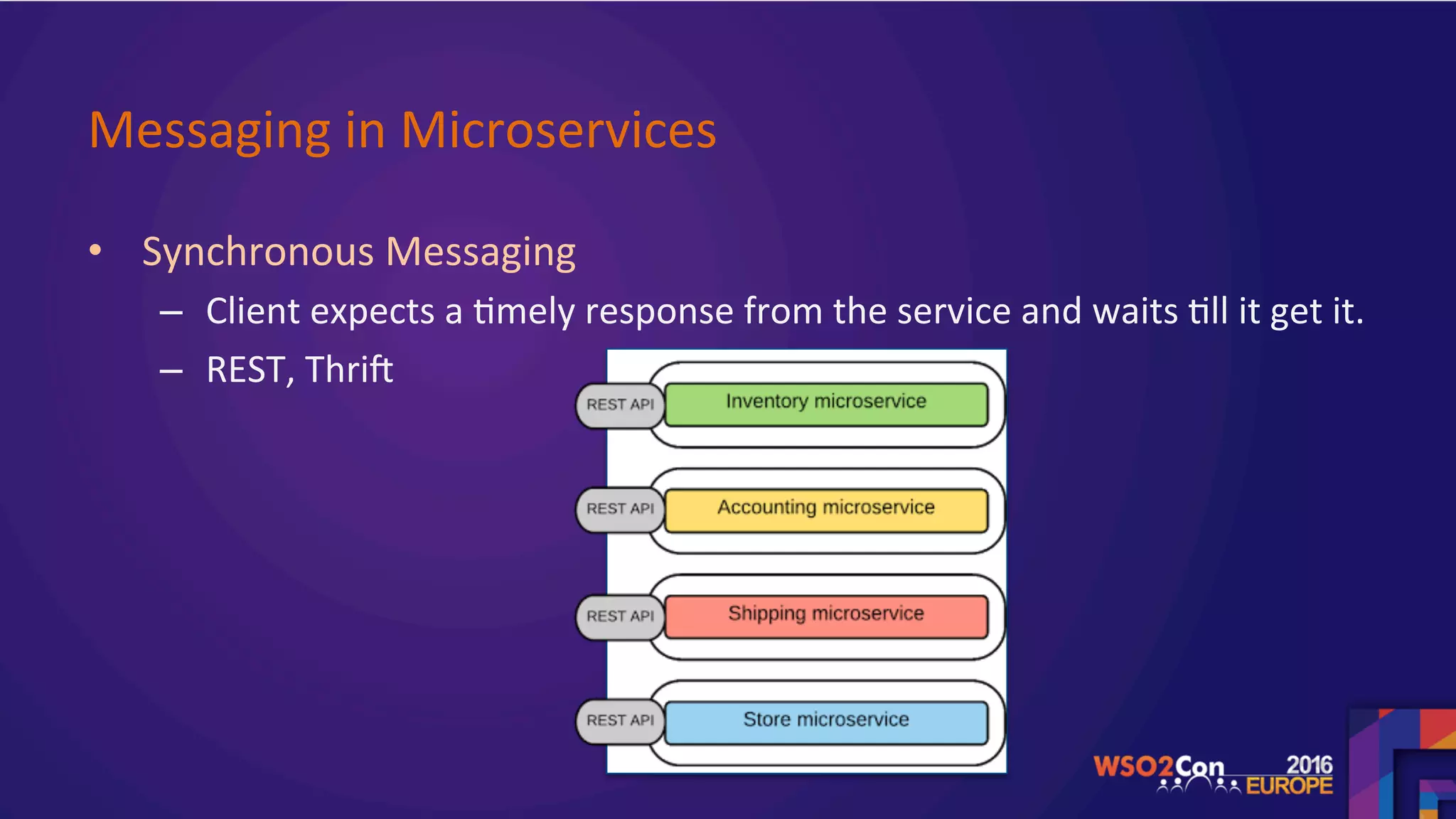
•  Synchronous	Messaging	
–  Client	expects	a	.mely	response	from	the	service	and	waits	.ll	it	get	it.		
–  REST,	ThriB
Messaging	in	Microservices		
•  Asynchronous	Messaging	
–  Client	doesn't	expects	a	response	immediately,	or	not	accepts	a	response	at	all	
–  AMQP,	STOMP,	MQTT	
•  Message	Formats	
–  JSON,	XML,	ThriB,	ProtoBuf,	Avro		
•  Service	Contracts		
–  Defining	the	service	interfaces	-	Swagger,	RAML,	ThriB	IDL
Data	Management		
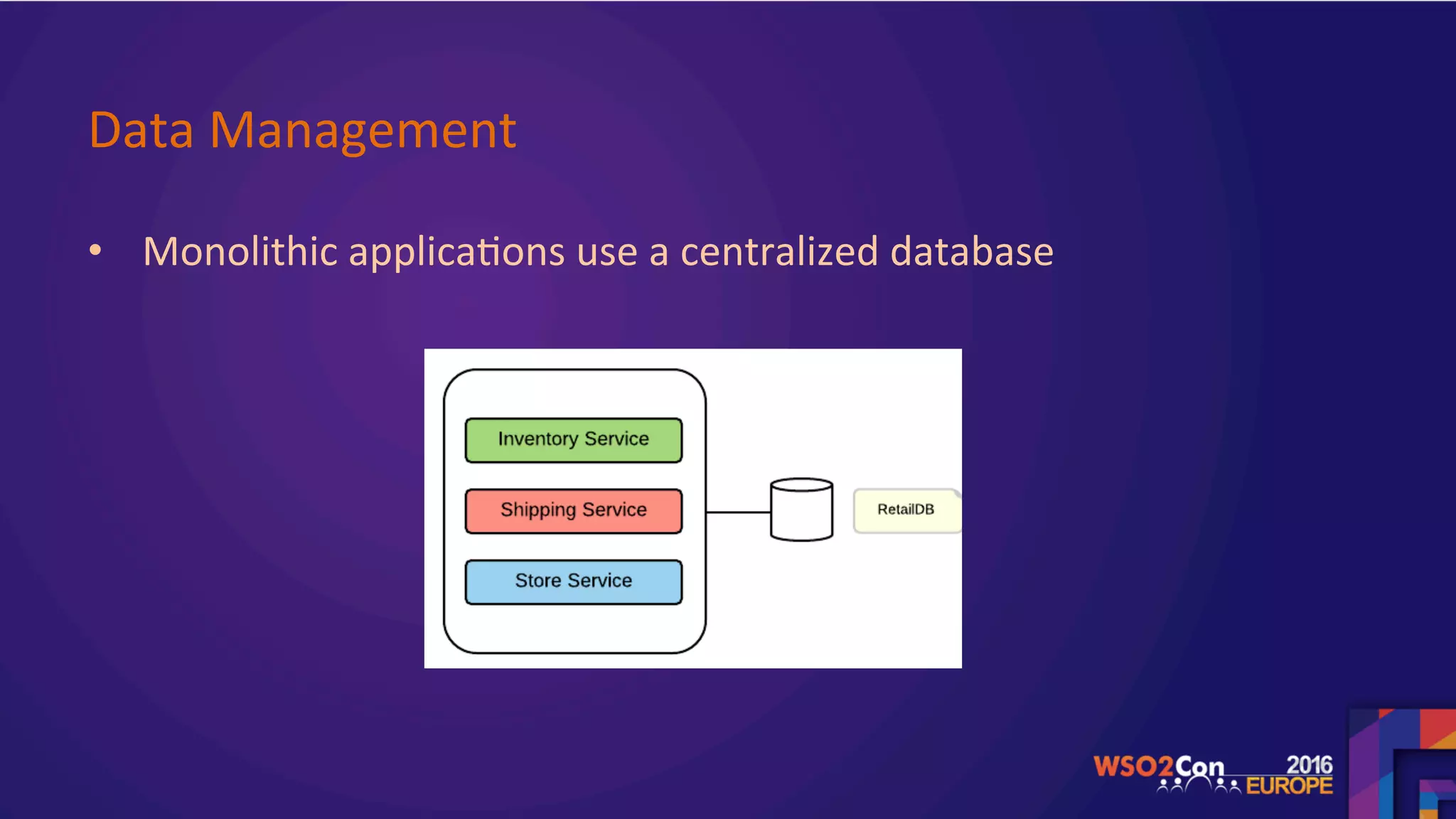
•  Monolithic	applica.ons	use	a	centralized	database
Data	Management		
•  Monolithic	applica.ons	use	a	centralized	database
Data	Management		
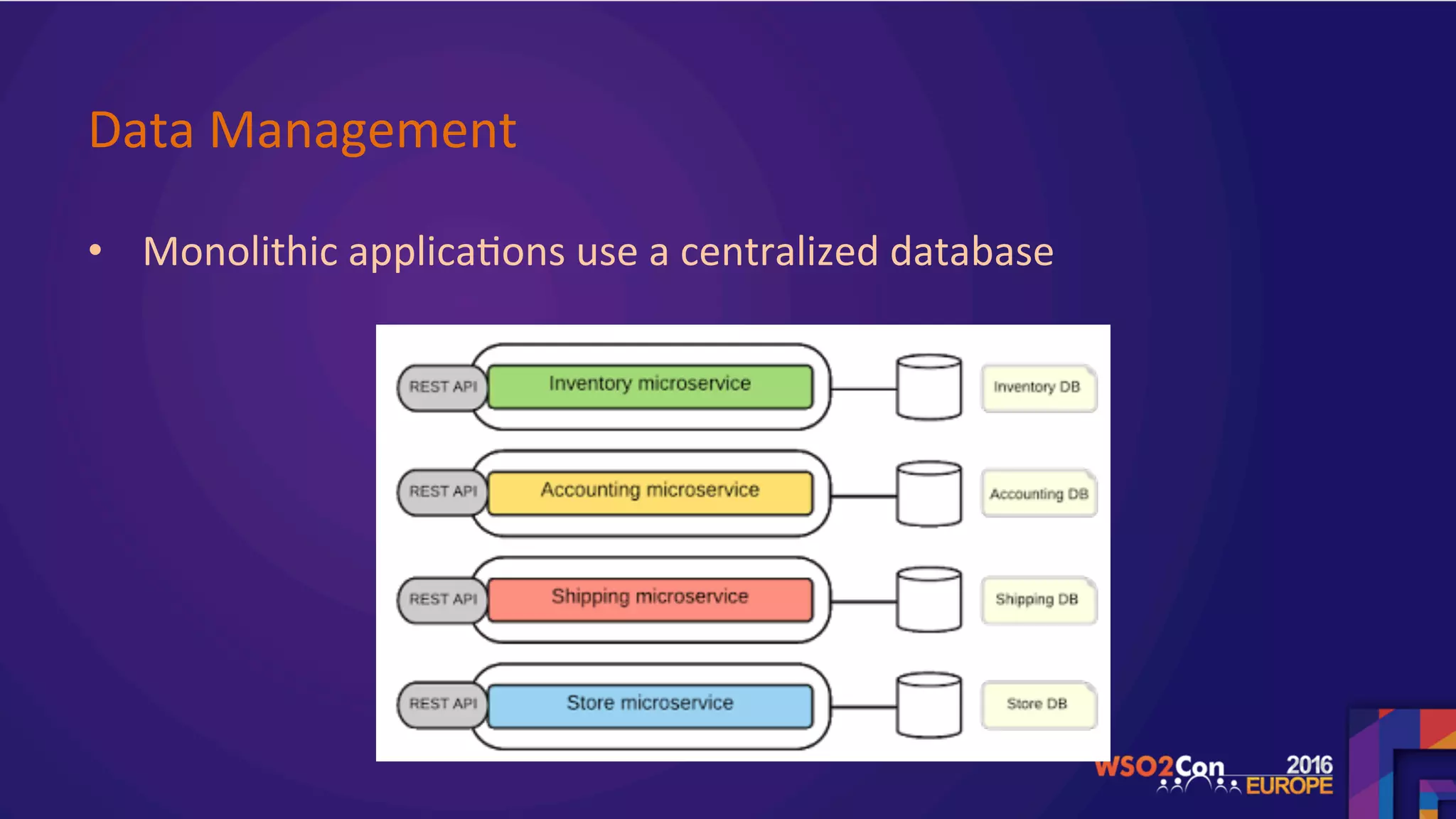
•  Decentralized	Data	management	with	Microservices		
–  Each	microservice	can	have	a	private	database	to	persist	the	data	that	
requires	to	implement	the	business	func.onality	offered	from	it.	
–  	Can	only	access	the	dedicated	private	database	but	not	the	databases	
of	other	microservices.	
–  You	might	have	to	update	several	database	for	a	single	transac.on.	In	
such	scenarios,	the	databases	of	other	microservices	should	be	
updated	through	its	service	API	only.
Decentralized	Governance		
•  Governance	–	“establishing	and	enforcing	how	people	and	
solu.ons	work	together	to	achieve	organiza.onal	objec.ves”,	
run.me/design	.me.	
•  In	MSA:			
–  No	centralized	design-.me	governance.	
–  Make	their	own	decisions	about	its	design	and	implementa.on.	
–  Foster	the	sharing	of	common/reusable	services.	
–  Run-.me	governance	aspects	such	as	SLAs,	throgling,	monitoring,	
common	security	requirements	and	service	discovery	may	be	
implemented	at	API-GW	level.
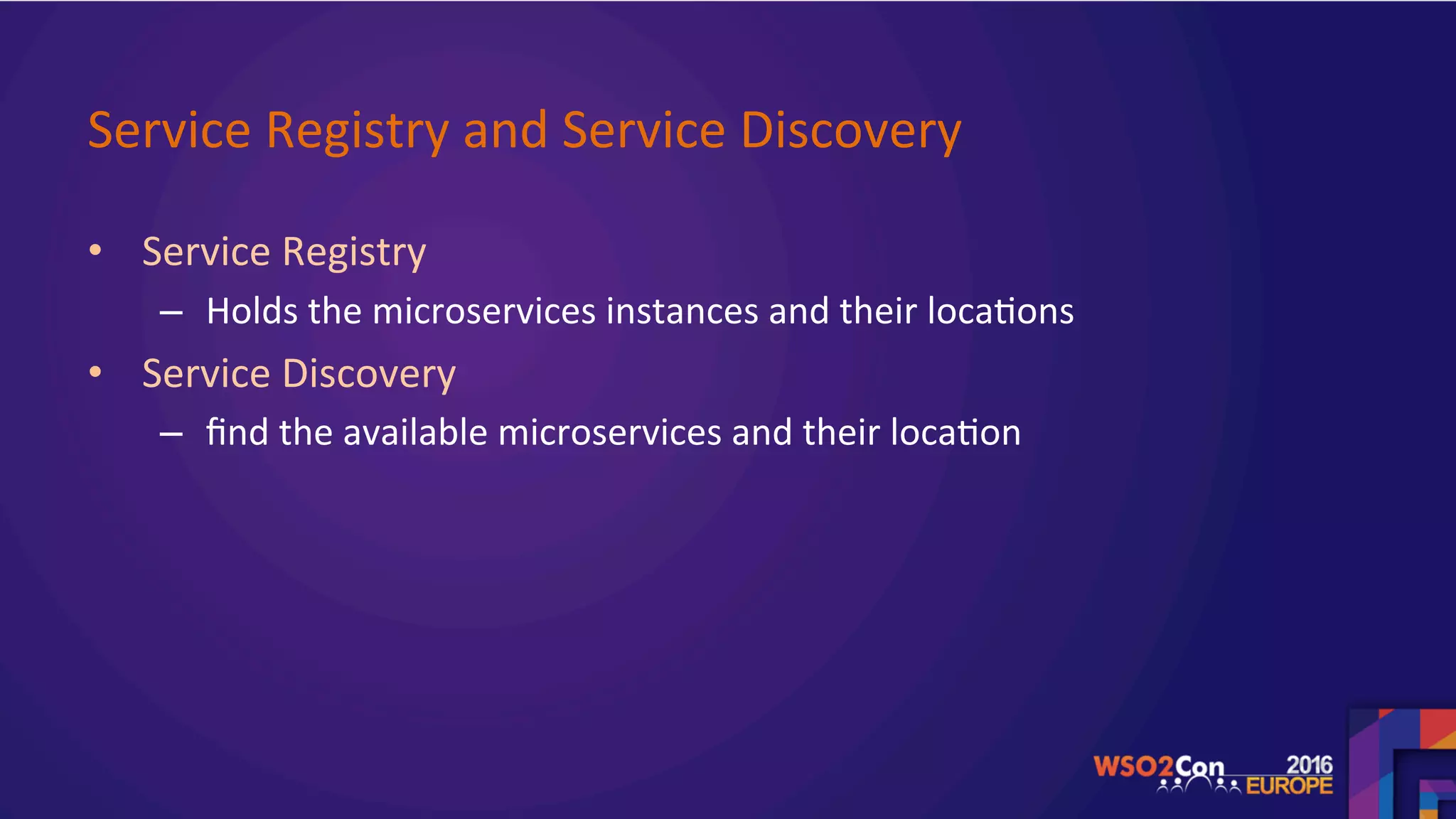
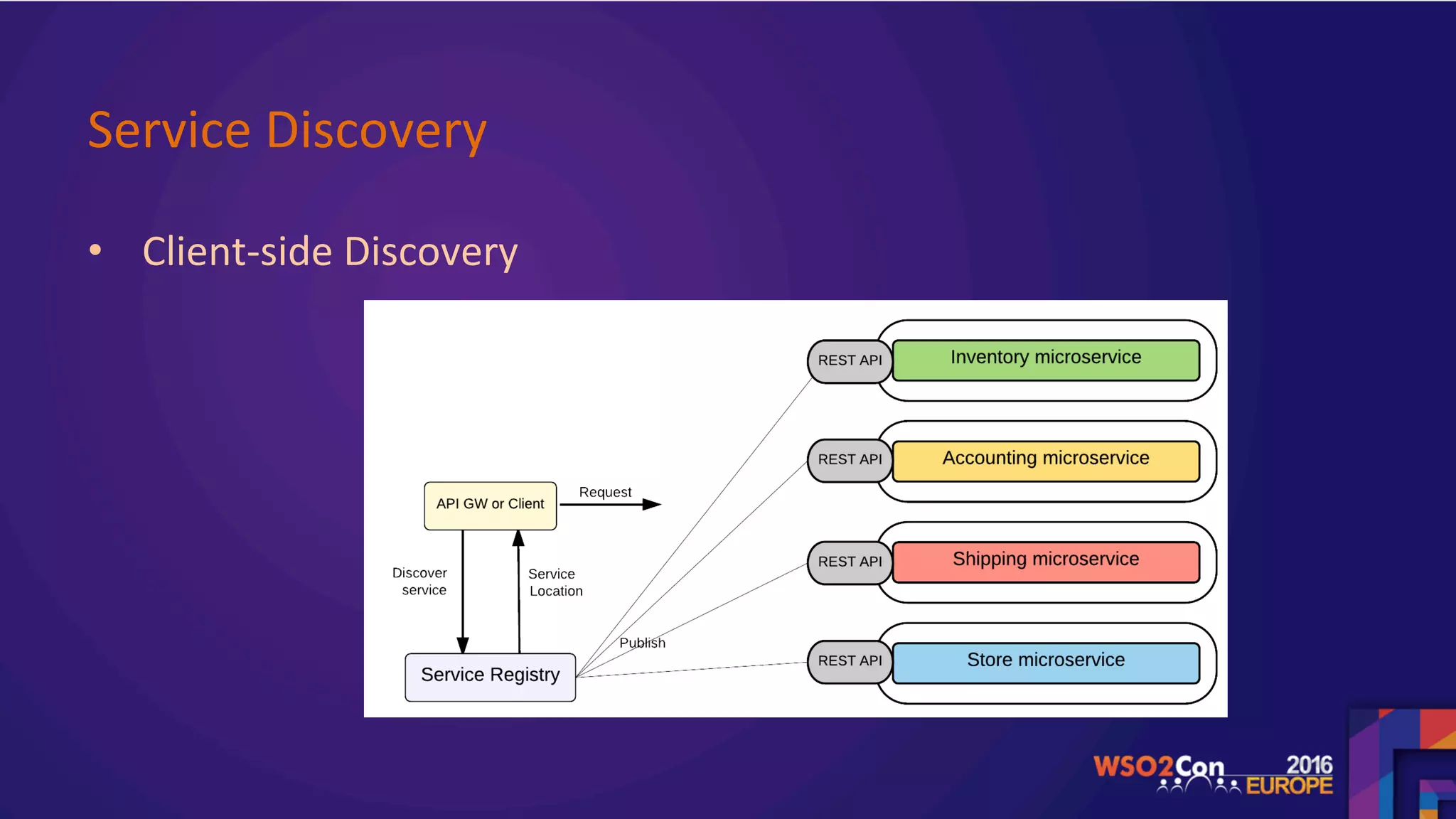
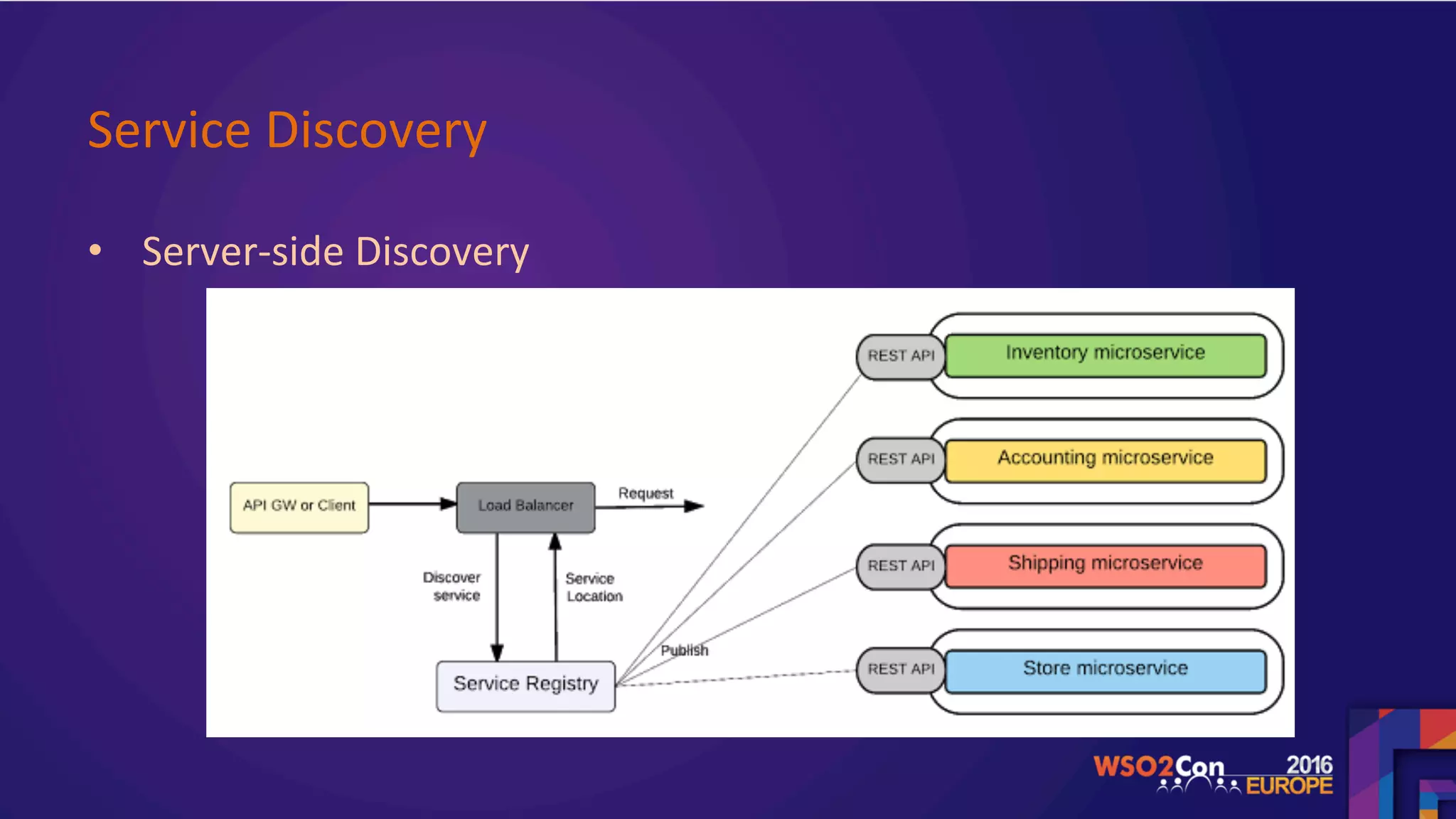
Service	Registry	and	Service	Discovery		
•  Service	Registry	
–  Holds	the	microservices	instances	and	their	loca.ons	
•  Service	Discovery	
–  find	the	available	microservices	and	their	loca.on
Service	Discovery	
•  Client-side	Discovery
Service	Discovery	
•  Server-side	Discovery
Microservices	Deployment		
•  Ability	to	deploy/un-deploy	independently	of	other	microservices.	
•  Must	be	able	to	scale	at	each	microservices	level.		
•  Building	and	deploying	microservices	quickly.		
•  Failure	in	one	microservice	must	not	affect	any	of	the	other	
services.
Microservices	Deployment		
•  Docker	
–  Docker	is	becoming	an	extremely	popular	way	of	packaging	and	
deploying	services.		
–  Package	the	microservice	as	a	(Docker)	container	image.	
–  Deploy	each	service	instance	as	a	container.	
–  Scaling	is	done	based	on	changing	the	number	of	container	instances.	
–  Building,	deploying	and	star.ng	microservices	will	be	much	faster	as	
we	are	using	Docker	containers
Microservices	Deployment		
•  Kubernetes	
–  Extending	Docker	capabili.es	by	allowing	to	manage	a	cluster	of	Linux	
containers	as	a	single	system,	managing	and	running	Docker	
containers	across	mul.ple	hosts,	offering	co-loca.on	of	containers,	
service	discovery	and	replica.on	control.
Microservices	Deployment		
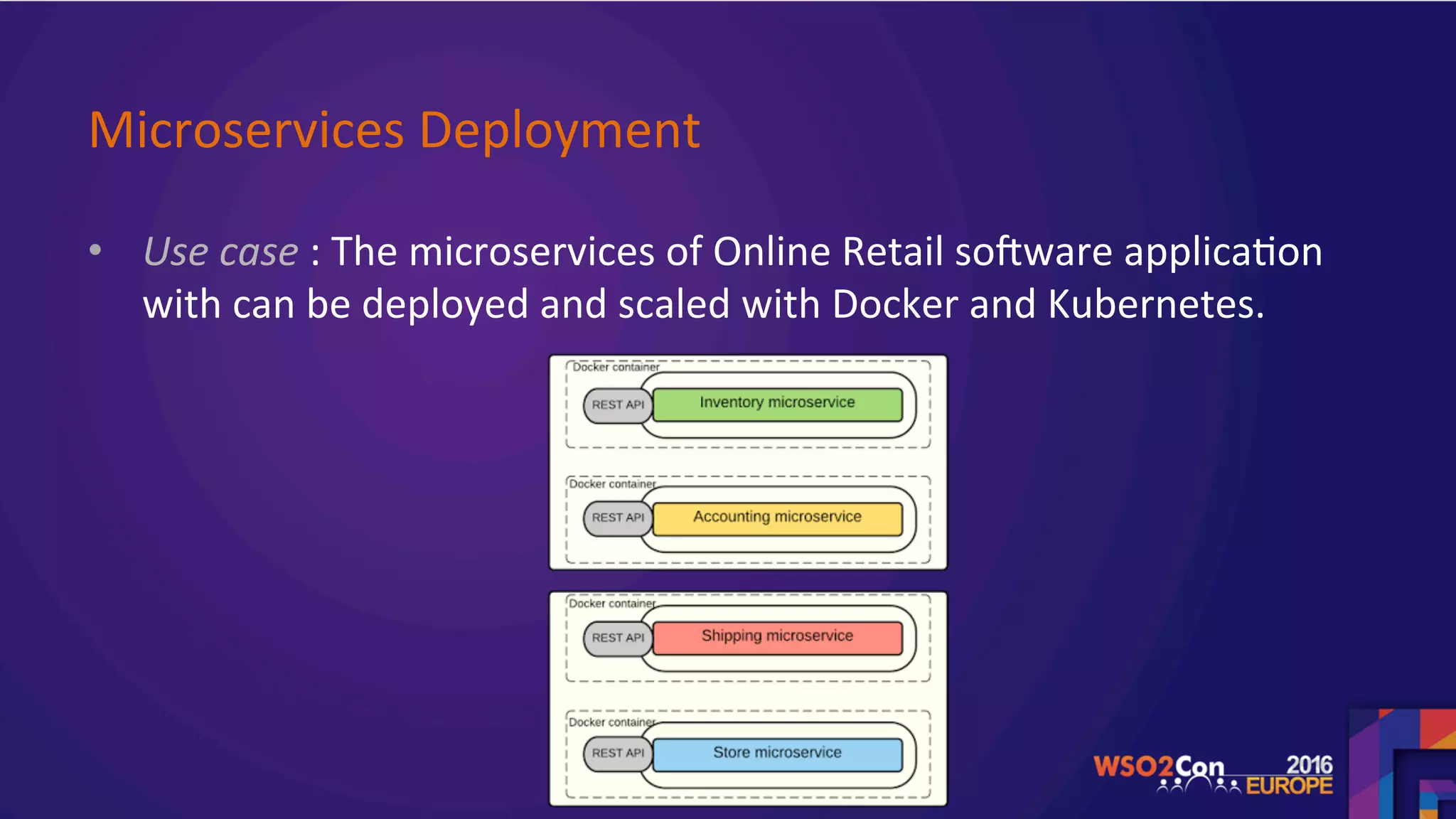
•  Use	case	:	The	microservices	of	Online	Retail	soBware	applica.on	
with	can	be	deployed	and	scaled	with	Docker	and	Kubernetes.
Security	
•  Security	in	Monolithic	applica.ons		
–  	'who	is	the	caller',	'what	can	the	caller	do'	and	'how	do	we	propagate	
that	informa>on’	
–  Implemented	at	a	common	security	component	which	is	at	the	
beginning	of	the	request	handling	chain	and	that	component	
populates	the	required	informa.on	with	the	use	of	an	underlying	user	
repository
Security	
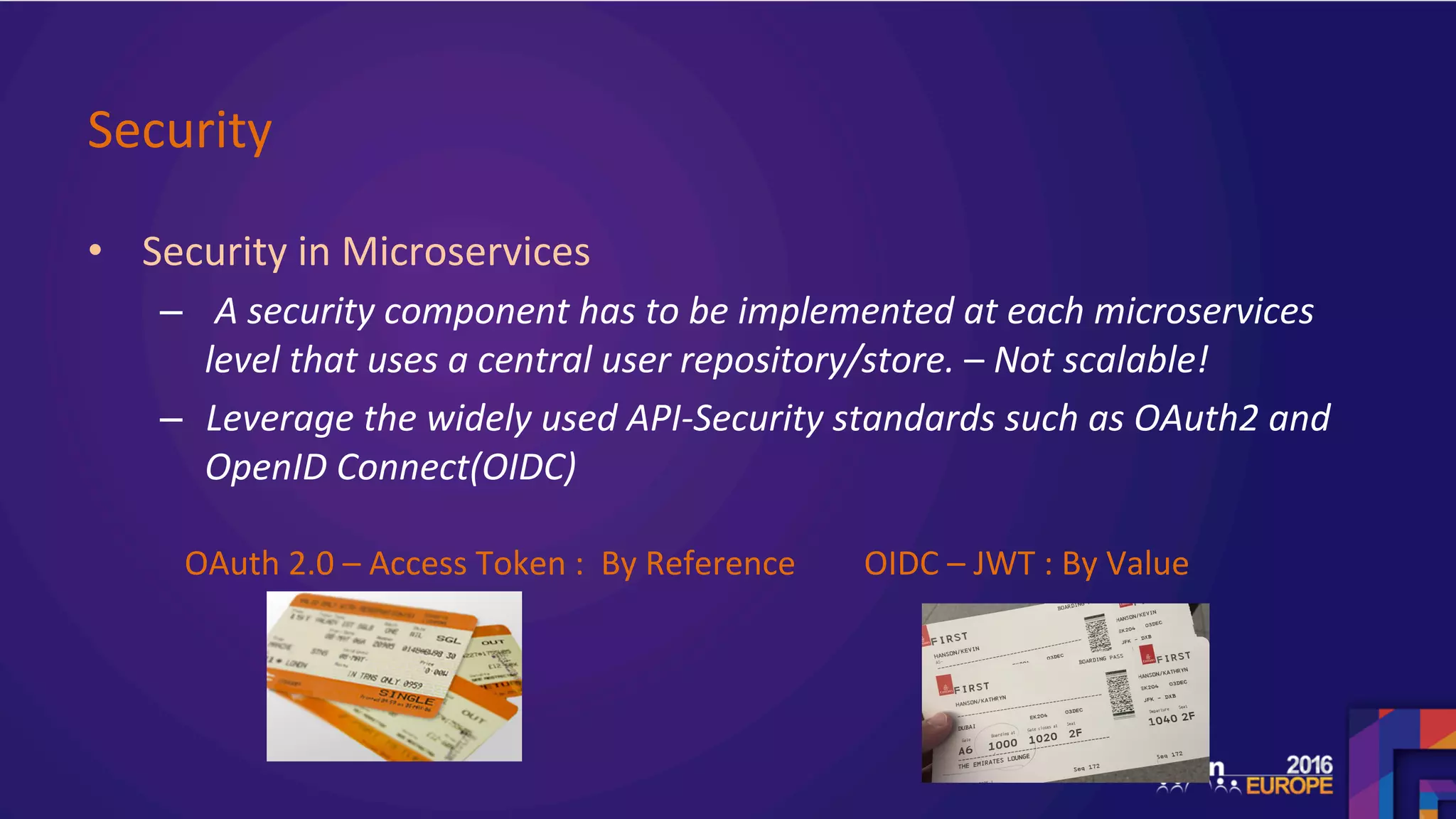
•  Security	in	Microservices	
–  	A	security	component	has	to	be	implemented	at	each	microservices	
level	that	uses	a	central	user	repository/store.	–	Not	scalable!		
–  Leverage	the	widely	used	API-Security	standards	such	as	OAuth2	and	
OpenID	Connect(OIDC)	
	
	
OAuth	2.0	–	Access	Token	:		By	Reference		 OIDC	–	JWT	:	By	Value
Security	
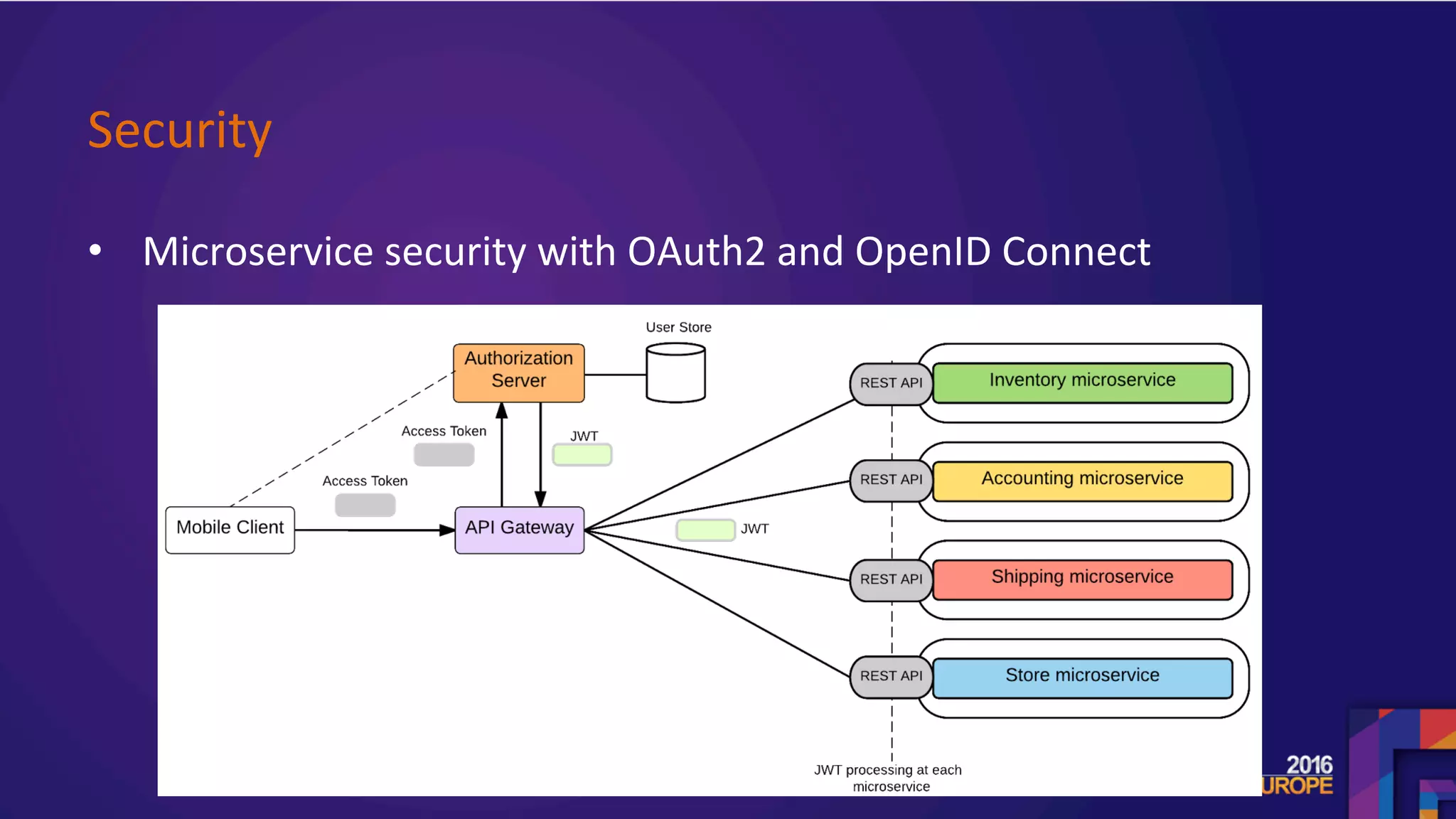
•  Microservice	security	with	OAuth2	and	OpenID	Connect
Orchestra.ng	Microservices		
•  No	ESB	in	MSA.	Then	how?
Orchestra.ng	Microservices		
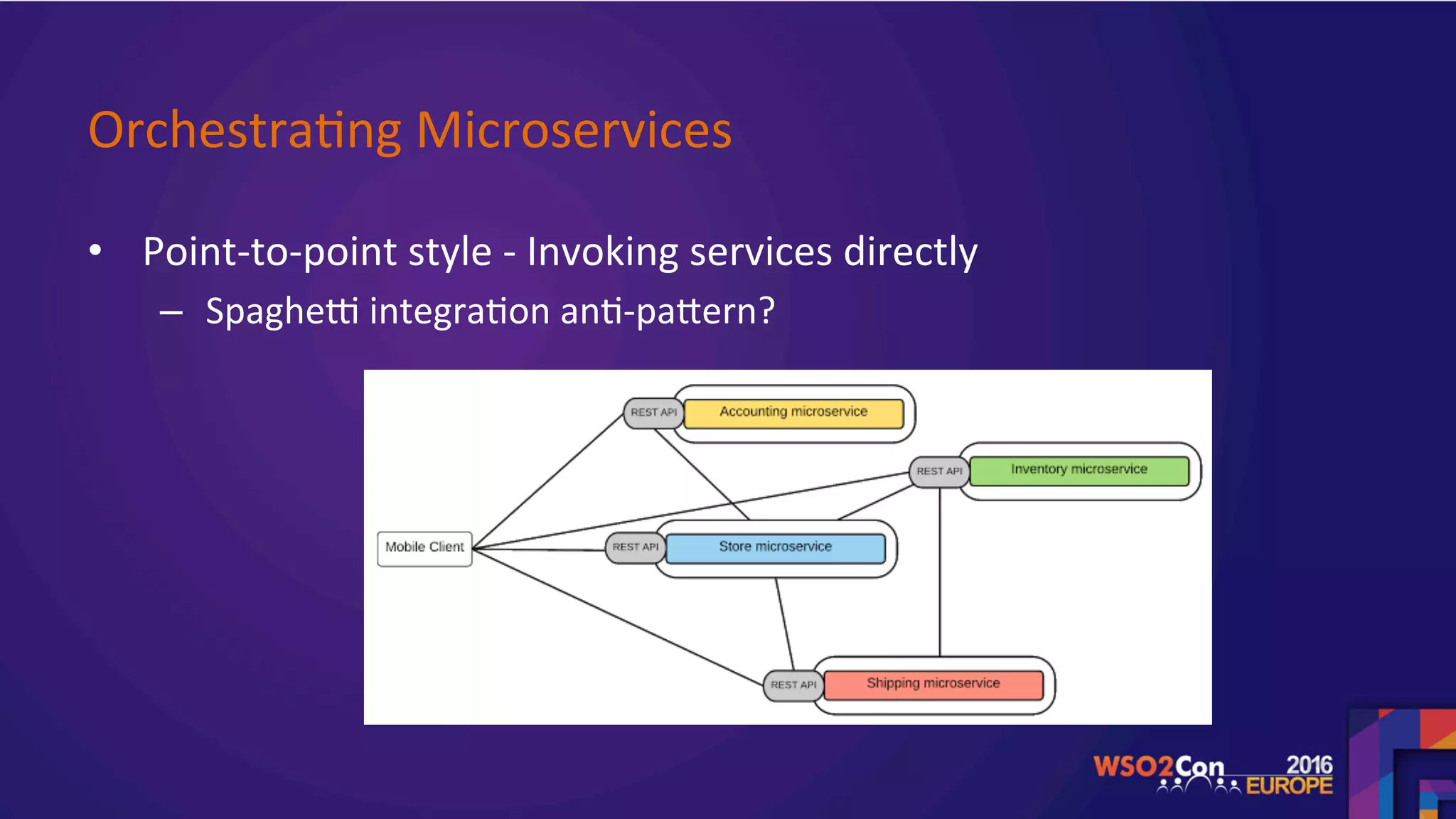
•  Point-to-point	style	-	Invoking	services	directly	
–  Spaghej	integra.on	an.-pagern?
Orchestra.ng	Microservices		
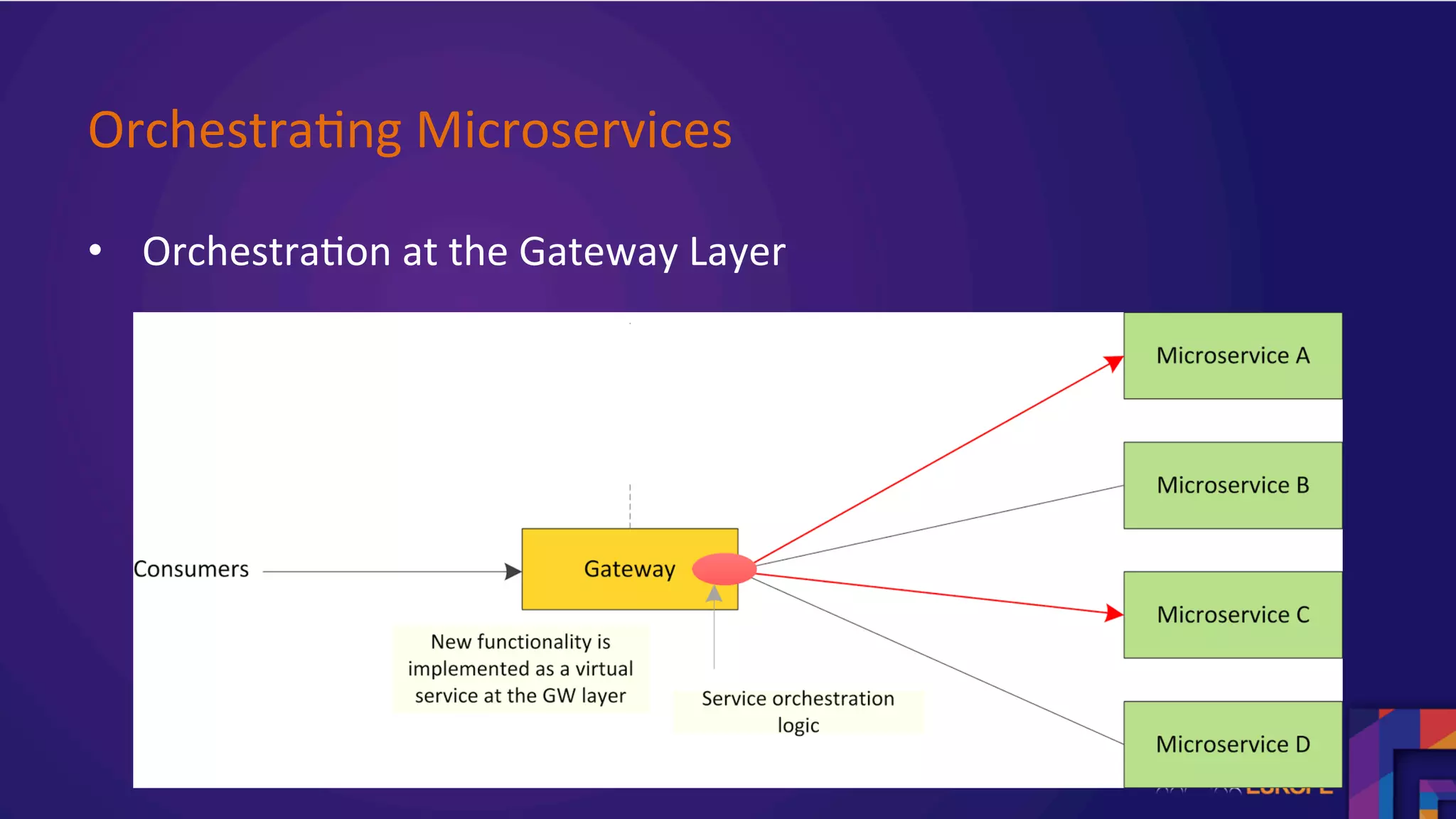
•  Orchestra.on	at	the	Gateway	Layer
Orchestra.ng	Microservices		
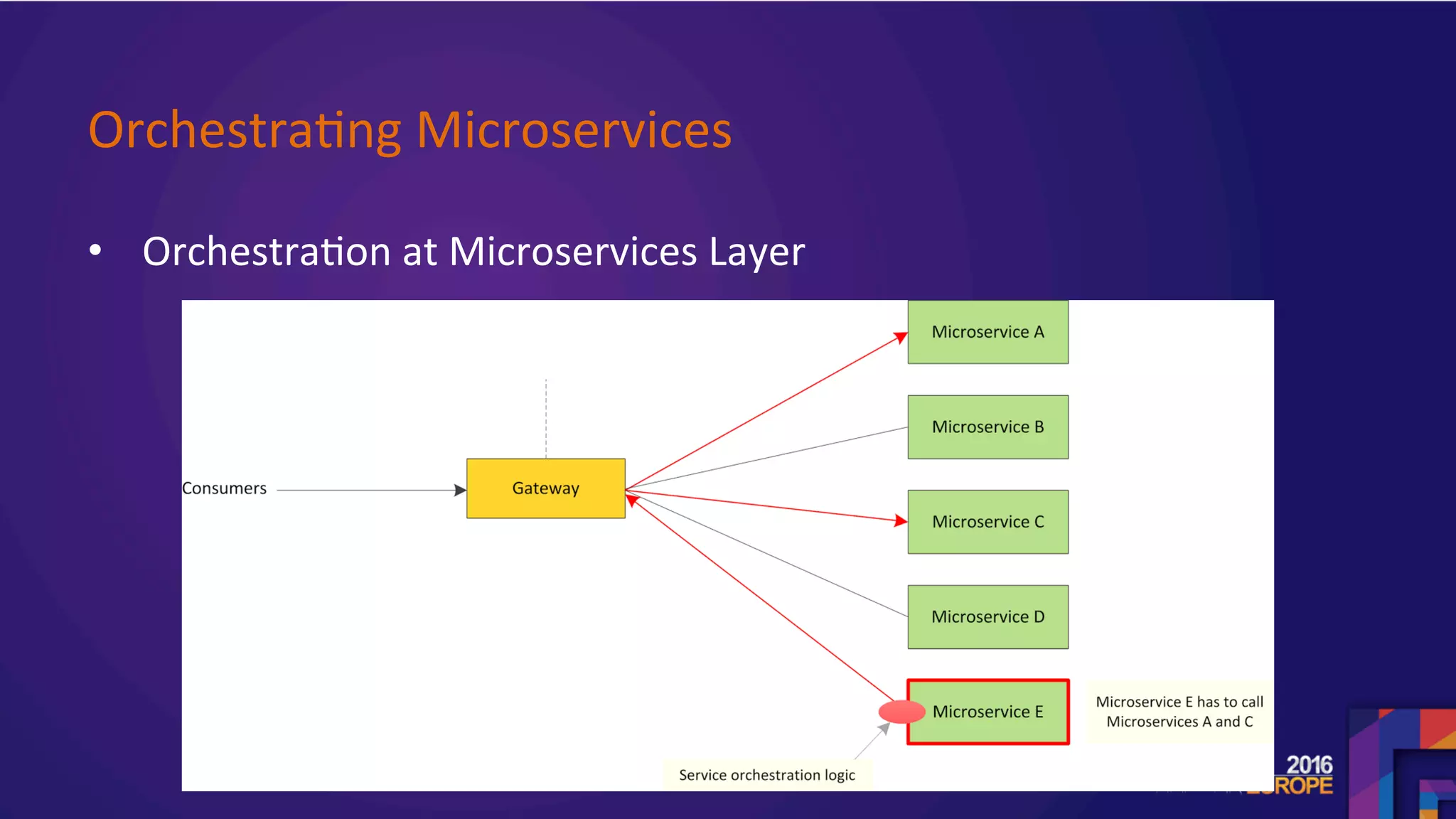
•  Orchestra.on	at	Microservices	Layer
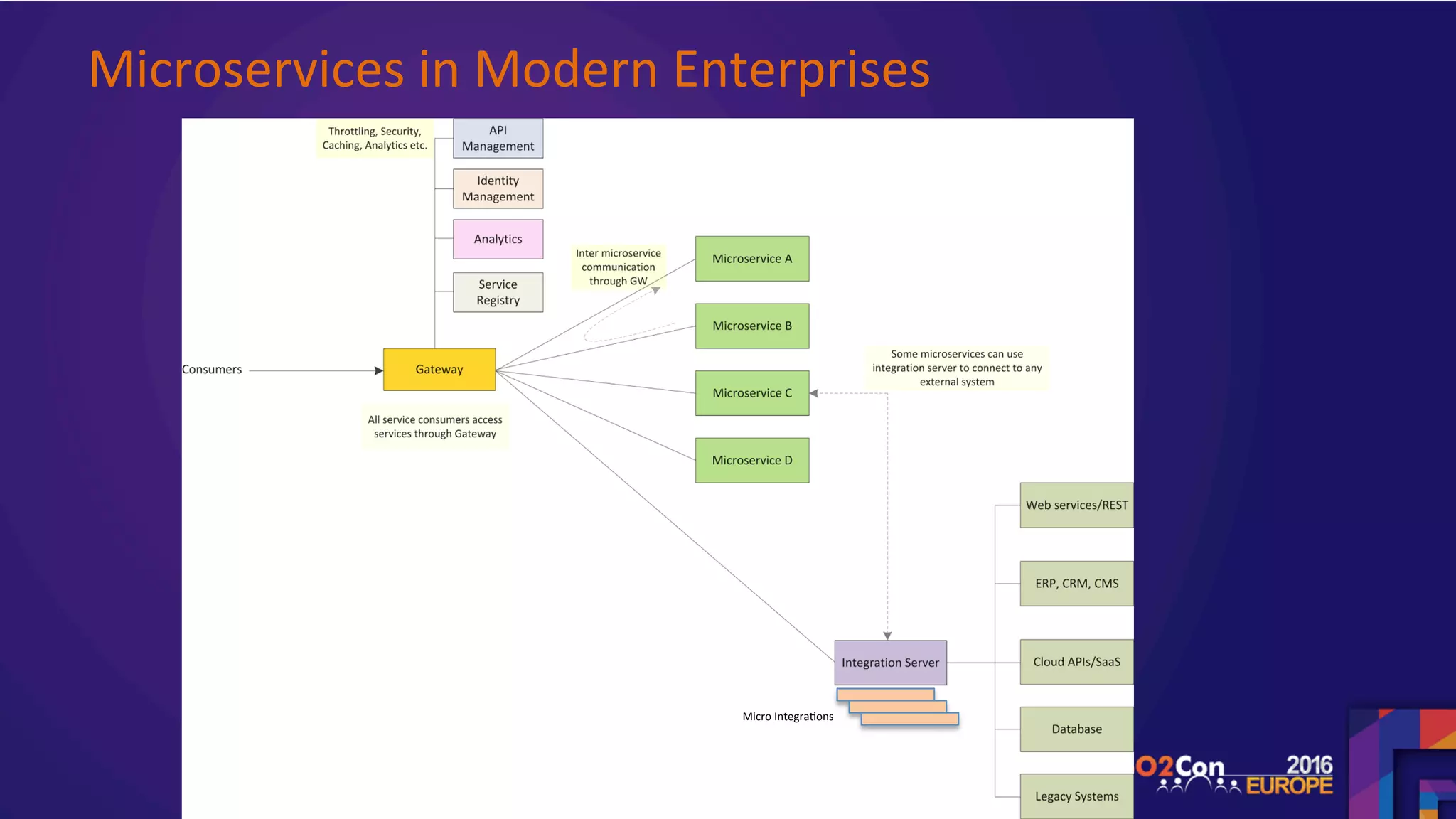
Microservices	in	Modern	Enterprises		
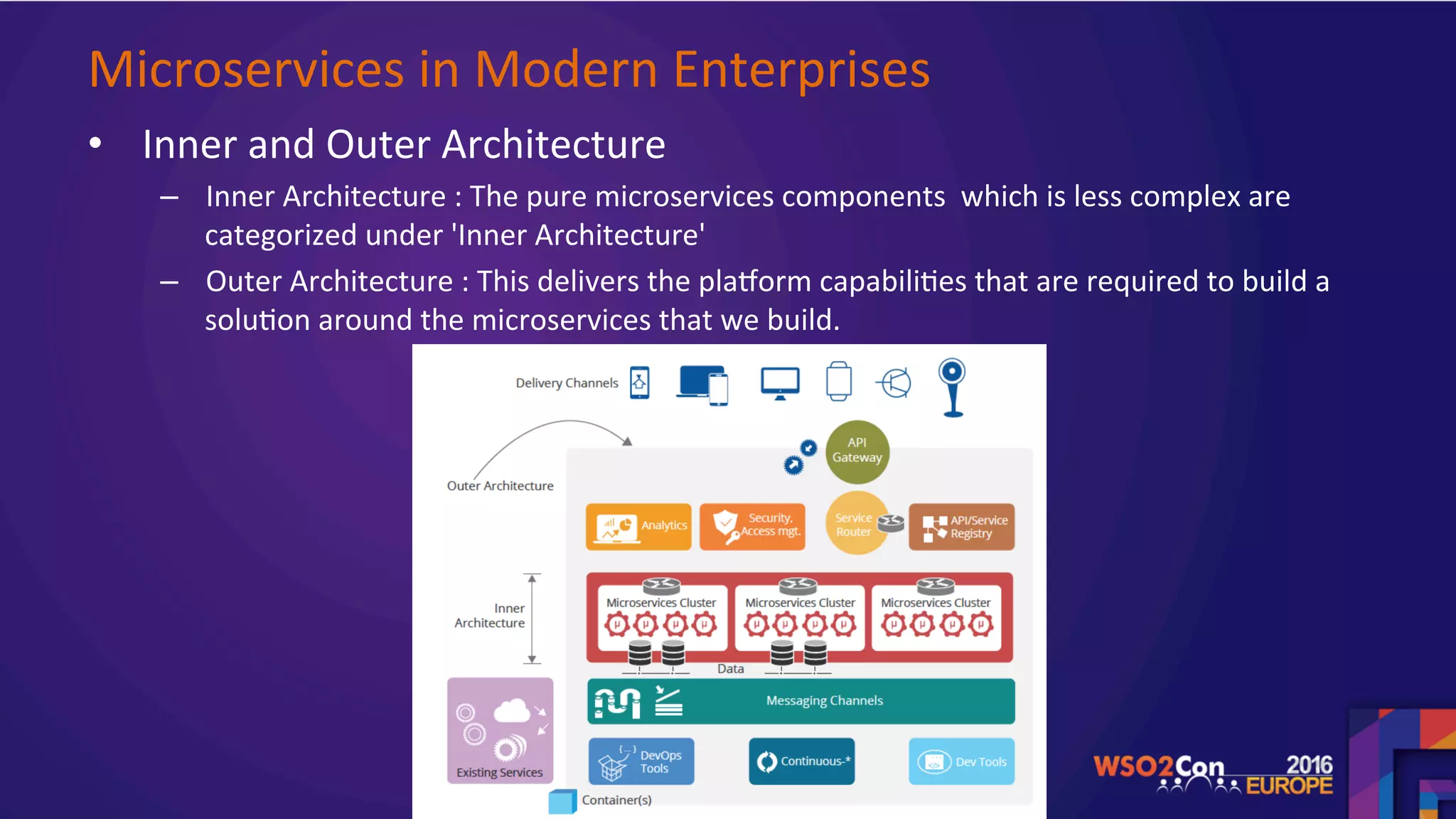
•  Inner	and	Outer	Architecture	
–  Inner	Architecture	:	The	pure	microservices	components		which	is	less	complex	are	
categorized	under	'Inner	Architecture'		
–  Outer	Architecture	:	This	delivers	the	plakorm	capabili.es	that	are	required	to	build	a	
solu.on	around	the	microservices	that	we	build.
Microservices	in	Modern	Enterprises		


Micro	Integra.ons
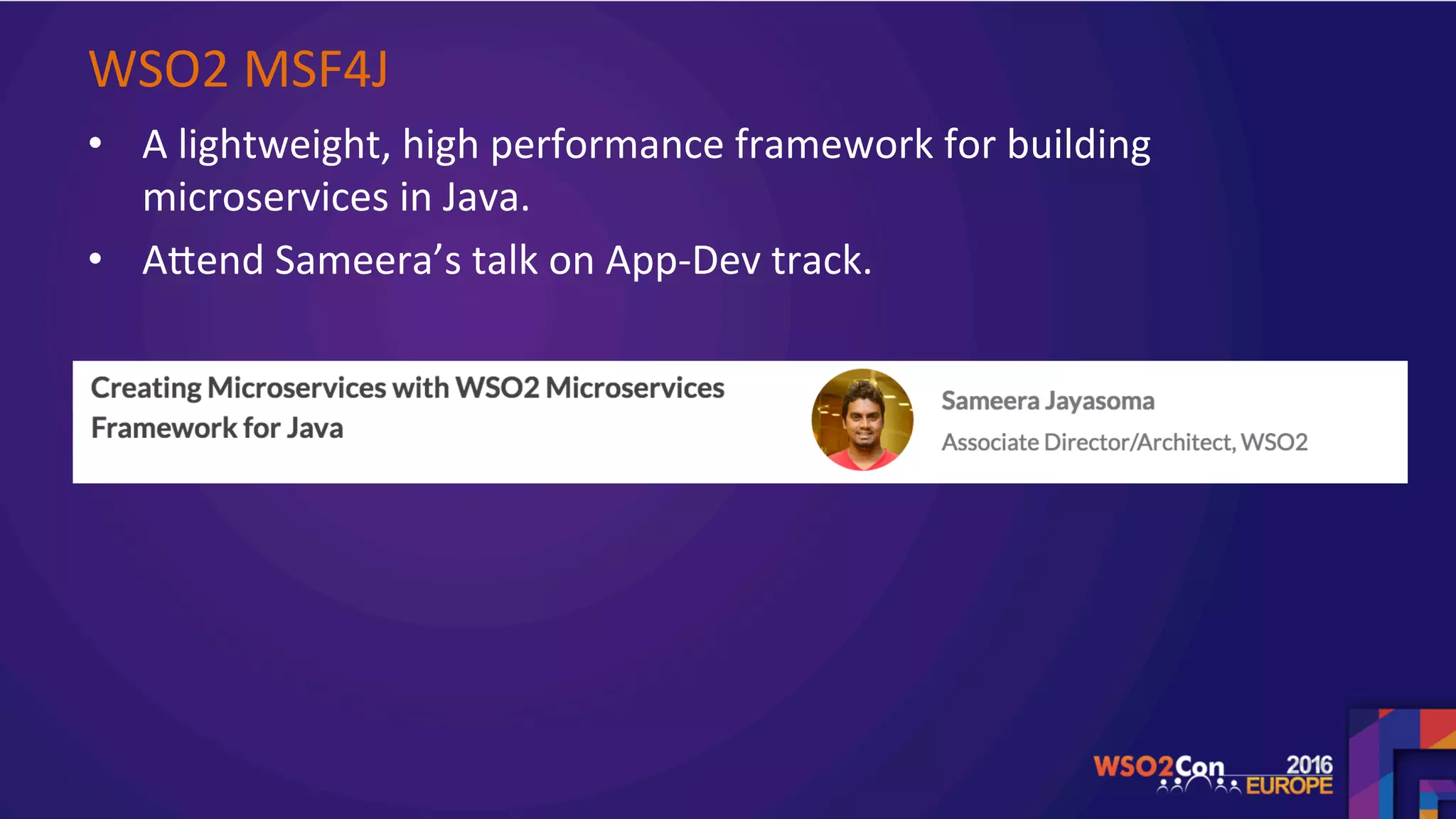
WSO2	MSF4J		
•  A	lightweight,	high	performance	framework	for	building	
microservices	in	Java.		
•  Agend	Sameera’s	talk	on	App-Dev	track.
Conclusion	
•  Microservices	is	not	a	panacea	:	It	won't	solve	all	your	enterprise	IT	
needs.	
•  ‘SOA	done	right’!	
•  Most	enterprise	won't	be	able	to	convert	their	en.re	enterprise	IT	
systems	to	microservices.		
•  Enterprise	Integra.on	never	goes	away.	
•  Microservices	are	exposed	as	APIs.		
•  Interac.on	between	microservices	should	be	support	via	a	
lightweight	orchestra.on	engine	or	inside	another	microservice.
Reference		
•  hgp://kasunpanorama.blogspot.co.uk/2015/11/microservices-in-
prac.ce.html	
•  hgp://microservices.io/pagerns/microservices.html
Thank	You!	
#WSO2ConEU	
Share	your	feedback	for	this	session	
wso2con.com/app

WSO2Con EU 2016: Understanding Microservice Architecture