IoT Cloud Platform
Transitioning from a monolith to micro services architecture
BY VINOD WILSON – ARCHITECT – CRESTRON ELECTRONICS
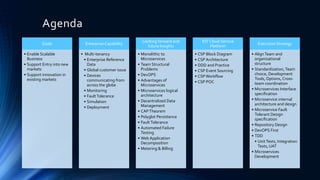
Agenda
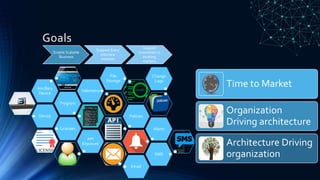
Goals
• Enable Scalable
Business
• Support Entry into new
markets
• Support innovation in
existing markets
Enterprise Capability
• Multi-tenancy
• Enterprise Reference
Data
• Global customer issue
• Devices
communicating from
across the globe
• Monitoring
• FaultTolerance
• Simulation
• Deployment
Looking forward and
future Insights
• Monolithic to
Microservices
• Team Structural
Problems
• DevOPS
• Advantages of
Microservices
• Microservices logical
architecture
• Decentralized Data
Management
• CAPTheorem
• Polyglot Persistence
• FaultTolerance
• Automated Failure
Testing
• Web Application
Decomposition
• Metering & Billing
IOT Cloud Service
Platform
• CSP Block Diagram
• CSP Architecture
• DDD and Practice
• CSP Event Sourcing
• CSPWorkflow
• CSP POC
Execution Strategy
• AlignTeam and
organizational
structure
• Standardization,Team
choice, Development
Tools, Options, Cross-
team coordination
• Microservices Interface
specification
• Microservice internal
architecture and design
• Microservice Fault
Tolerant Design
specification
• Repository Design
• DevOPS First
• TDD
• UnitTests, Integration
Tests, UAT
• Microservices
Development
Goals
Device
Program
Ancillary
Device
Telemetry
File
Storage
Policies
Licenses Alerts
Change
Logs
API
Exposure
Email
SMS
Time to Market
Organization
Driving architecture
Architecture Driving
organization
Enable Scalable
Business
Support Entry
into new
markets
Support
innovation in
existing
markets
Cloud Service – Data - Multi-tenancy
Cloud
Service Multi-
tenancy
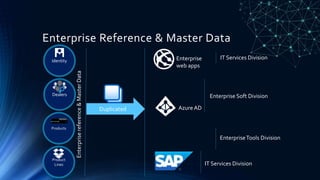
Reference Data & Master Data
Management
Enterprise Reference & Master Data
Dealers
Products
Identity Enterprise
web apps
Product
Lines
Enterprisereference&MasterData
Duplicated Azure AD
Enterprise Soft Division
IT Services Division
EnterpriseTools Division
IT Services Division
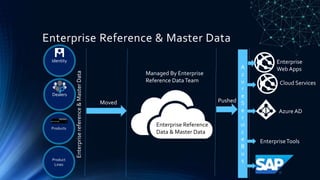
Enterprise Reference & Master Data
Enterprise Reference
Data & Master Data
Dealers
Products
Identity
Product
Lines
Enterprisereference&MasterData
Moved
Managed By Enterprise
Reference DataTeam
Pushed
A
z
u
r
e
S
e
r
vi
c
e
B
u
s
Enterprise
Web Apps
EnterpriseTools
Azure AD
Cloud Services
Device communication from across the
globe
Has Huge Impact
on the service
Service should be
exposed always to
one region
Service Monitoring and Monitoring
Apps
• Service Monitoring should never be an after-
thought
• Service Monitoring solutions should be developed in
parallel
Simulation
• Simulation service to
simulate hundreds and
thousands of devices
should also be developed
in parallel along with the
monitoring apps
Monolith Service Deployment
• Always involves deployment of the entire service
• For major schema changes the deployment might take long hours
• Deployment checklist is huge and only few people in the team might
know about it
Future Insights
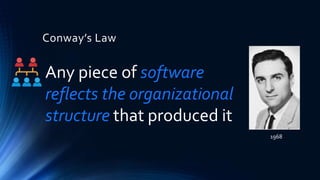
Conway’s Law
1968
Any piece of software
reflects the organizational
structure that produced it
What is a Microservice?
Microservices are a loosely coupled Service-Oriented
Architecture (SOA) with bounded contexts
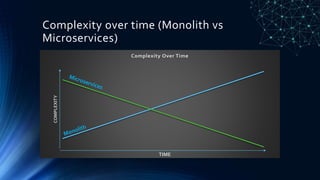
Complexity over time (Monolith vs
Microservices)
COMPLEXITY
TIME
Complexity Over Time
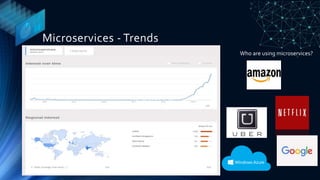
Microservices - Trends
Who are using microservices?
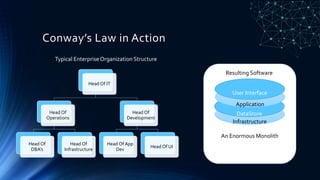
Conway’s Law in Action
Head Of IT
Head Of
Operations
Head Of
DBA’s
Head Of
Infrastructure
Head Of
Development
Head Of App
Dev
Head Of UI
Typical Enterprise Organization Structure
Infrastructure
DataStore
Application
User Interface
Resulting Software
An Enormous Monolith
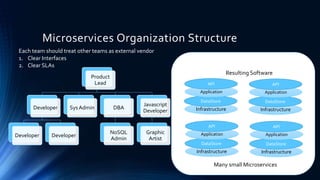
Microservices Organization Structure
Product
Lead
Developer
Developer Developer
Sys Admin DBA
NoSQL
Admin
Javascript
Developer
Graphic
Artist
Infrastructure
DataStore
Application
API
Resulting Software
Infrastructure
DataStore
Application
API
Infrastructure
DataStore
Application
API
Infrastructure
DataStore
Application
API
Many small Microservices
Each team should treat other teams as external vendor
1. Clear Interfaces
2. Clear SLAs
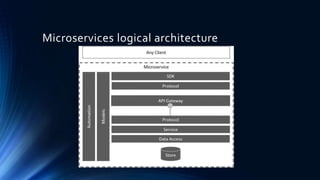
Microservices logical architecture
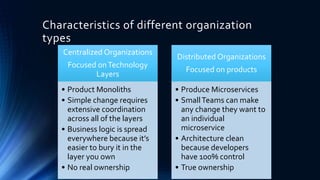
Characteristics of different organization
types
Centralized Organizations
Focused onTechnology
Layers
• Product Monoliths
• Simple change requires
extensive coordination
across all of the layers
• Business logic is spread
everywhere because it’s
easier to bury it in the
layer you own
• No real ownership
Distributed Organizations
Focused on products
• Produce Microservices
• SmallTeams can make
any change they want to
an individual
microservice
• Architecture clean
because developers
have 100% control
• True ownership
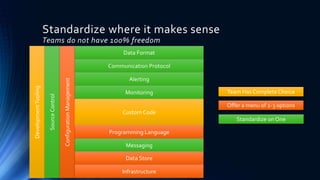
Standardize where it makes sense
Teams do not have 100% freedomDevelopmentTooling
SourceControl
ConfigurationManagement
Data Format
Communication Protocol
Alerting
Monitoring
Custom Code
Programming Language
Messaging
Data Store
Infrastructure
Team Has Complete Choice
Offer a menu of 2-3 options
Standardize on One
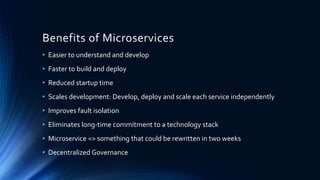
Benefits of Microservices
• Easier to understand and develop
• Faster to build and deploy
• Reduced startup time
• Scales development: Develop, deploy and scale each service independently
• Improves fault isolation
• Eliminates long-time commitment to a technology stack
• Microservice => something that could be rewritten in two weeks
• Decentralized Governance
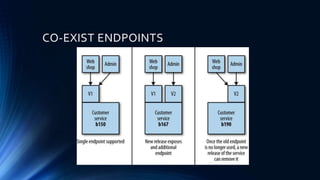
CO-EXIST ENDPOINTS
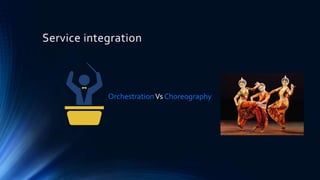
Service integration
OrchestrationVs Choreography
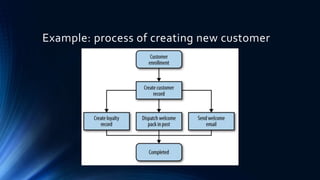
Example: process of creating new customer
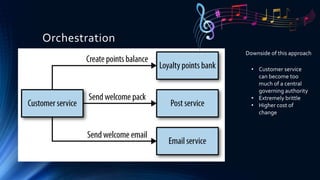
Orchestration
Downside of this approach
• Customer service
can become too
much of a central
governing authority
• Extremely brittle
• Higher cost of
change
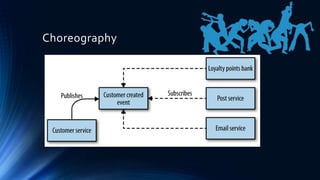
Choreography
Event driven architecture and Eventual
Consistency
• Application has to handle eventually consistent data
• Application has to handle duplicate events
• How to generate events?
• Atomically publish an event since there could be failures
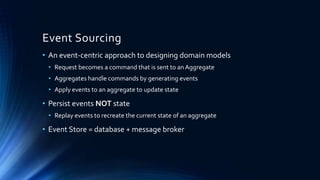
Event Sourcing
• An event-centric approach to designing domain models
• Request becomes a command that is sent to anAggregate
• Aggregates handle commands by generating events
• Apply events to an aggregate to update state
• Persist events NOT state
• Replay events to recreate the current state of an aggregate
• Event Store = database + message broker
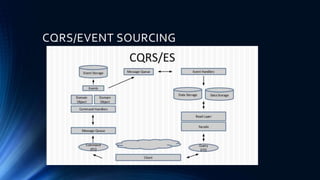
CQRS/EVENT SOURCING
DevOPS
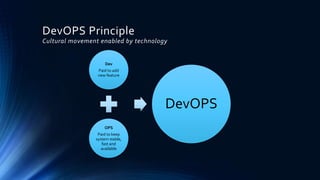
DevOPS Principle
Cultural movement enabled by technology
Dev
Paid to add
new feature
OPS
Paid to keep
system stable,
fast and
available
DevOPS
Decentralized Data Management
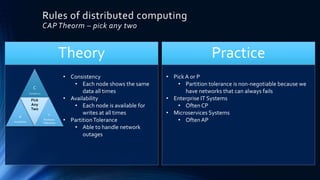
Rules of distributed computing
CAP Theorm – pick any two
Theory
C
Consistency
A
Availability
Pick
Any
Two
P
Partition
Tolerance
• Consistency
• Each node shows the same
data all times
• Availability
• Each node is available for
writes at all times
• PartitionTolerance
• Able to handle network
outages
Practice
• PickA or P
• Partition tolerance is non-negotiable because we
have networks that can always fails
• Enterprise IT Systems
• Often CP
• Microservices Systems
• Often AP
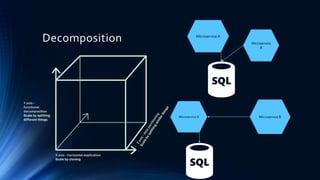
Decomposition MicroserviceA
Microservice
B
Microservice A Microservice B
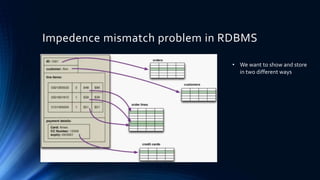
Impedence mismatch problem in RDBMS
• We want to show and store
in two different ways
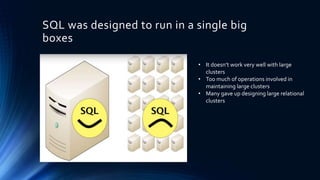
SQL was designed to run in a single big
boxes
• It doesn’t work very well with large
clusters
• Too much of operations involved in
maintaining large clusters
• Many gave up designing large relational
clusters
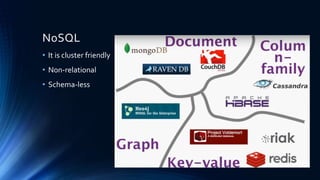
NoSQL
• It is cluster friendly
• Non-relational
• Schema-less
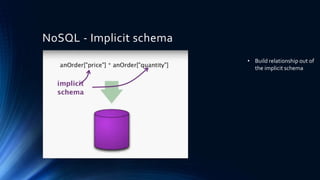
NoSQL - Implicit schema
• Build relationship out of
the implicit schema
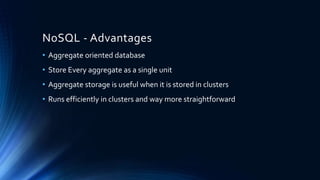
NoSQL - Advantages
• Aggregate oriented database
• Store Every aggregate as a single unit
• Aggregate storage is useful when it is stored in clusters
• Runs efficiently in clusters and way more straightforward
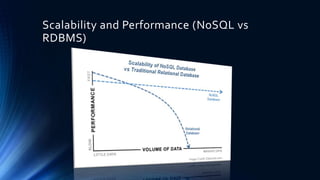
Scalability and Performance (NoSQL vs
RDBMS)
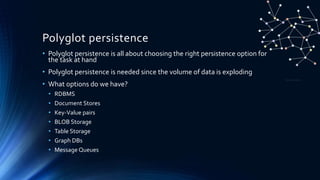
Polyglot persistence
• Polyglot persistence is all about choosing the right persistence option for
the task at hand
• Polyglot persistence is needed since the volume of data is exploding
• What options do we have?
• RDBMS
• Document Stores
• Key-Value pairs
• BLOB Storage
• Table Storage
• Graph DBs
• Message Queues
Fault Tolerance
• FaultTolerance is a Requirement, Not a Feature
• Network timeouts and retries
• Using Semaphores to control resource usage
• Circuit breakers
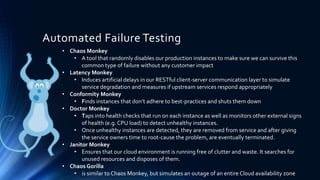
Automated Failure Testing
• Chaos Monkey
• A tool that randomly disables our production instances to make sure we can survive this
common type of failure without any customer impact
• Latency Monkey
• Induces artificial delays in our RESTful client-server communication layer to simulate
service degradation and measures if upstream services respond appropriately
• Conformity Monkey
• Finds instances that don’t adhere to best-practices and shuts them down
• Doctor Monkey
• Taps into health checks that run on each instance as well as monitors other external signs
of health (e.g. CPU load) to detect unhealthy instances.
• Once unhealthy instances are detected, they are removed from service and after giving
the service owners time to root-cause the problem, are eventually terminated.
• Janitor Monkey
• Ensures that our cloud environment is running free of clutter and waste. It searches for
unused resources and disposes of them.
• Chaos Gorilla
• is similar to Chaos Monkey, but simulates an outage of an entire Cloud availability zone
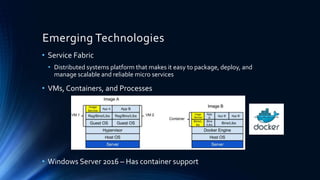
Emerging Technologies
• Service Fabric
• Distributed systems platform that makes it easy to package, deploy, and
manage scalable and reliable micro services
• VMs, Containers, and Processes
• Windows Server 2016 – Has container support
IoT Cloud Service Platform
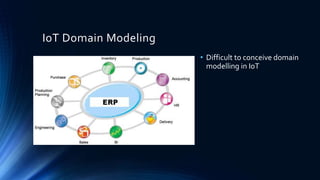
IoT Domain Modeling
• Difficult to conceive domain
modelling in IoT
Web Application Decomposition
(Partitioned Web Application)
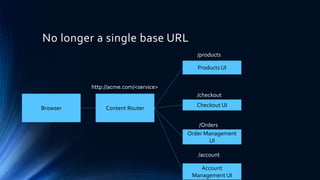
No longer a single base URL
Browser Content Router
Products UI
Checkout UI
Order Management
UI
Account
Management UI
/products
/checkout
/Orders
/account
http://acme.com/<service>
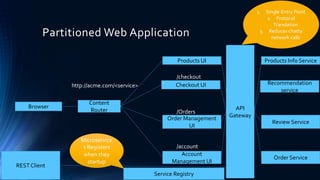
Partitioned Web Application
Browser
Content
Router
Products UI
Checkout UI
Order Management
UI
Account
Management UI
/checkout
/Orders
/account
http://acme.com/<service>
API
Gateway
REST Client
Products Info Service
Recommendation
service
Review Service
Order Service
Service Registry
1. Single Entry Point
2. Protocol
Translation
3. Reduces chatty
network calls
Microservice
s Registers
when they
startup
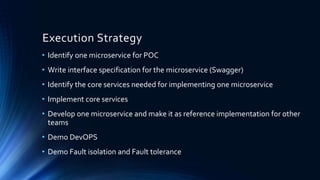
Execution Strategy
• Identify one microservice for POC
• Write interface specification for the microservice (Swagger)
• Identify the core services needed for implementing one microservice
• Implement core services
• Develop one microservice and make it as reference implementation for other
teams
• Demo DevOPS
• Demo Fault isolation and Fault tolerance
ThankYou

Iot cloud service v2.0

  • 1.
    IoT Cloud Platform Transitioningfrom a monolith to micro services architecture BY VINOD WILSON – ARCHITECT – CRESTRON ELECTRONICS
  • 2.
    Agenda Goals • Enable Scalable Business •Support Entry into new markets • Support innovation in existing markets Enterprise Capability • Multi-tenancy • Enterprise Reference Data • Global customer issue • Devices communicating from across the globe • Monitoring • FaultTolerance • Simulation • Deployment Looking forward and future Insights • Monolithic to Microservices • Team Structural Problems • DevOPS • Advantages of Microservices • Microservices logical architecture • Decentralized Data Management • CAPTheorem • Polyglot Persistence • FaultTolerance • Automated Failure Testing • Web Application Decomposition • Metering & Billing IOT Cloud Service Platform • CSP Block Diagram • CSP Architecture • DDD and Practice • CSP Event Sourcing • CSPWorkflow • CSP POC Execution Strategy • AlignTeam and organizational structure • Standardization,Team choice, Development Tools, Options, Cross- team coordination • Microservices Interface specification • Microservice internal architecture and design • Microservice Fault Tolerant Design specification • Repository Design • DevOPS First • TDD • UnitTests, Integration Tests, UAT • Microservices Development
  • 3.
    Goals Device Program Ancillary Device Telemetry File Storage Policies Licenses Alerts Change Logs API Exposure Email SMS Time toMarket Organization Driving architecture Architecture Driving organization Enable Scalable Business Support Entry into new markets Support innovation in existing markets
  • 4.
    Cloud Service –Data - Multi-tenancy Cloud Service Multi- tenancy
  • 5.
    Reference Data &Master Data Management
  • 6.
    Enterprise Reference &Master Data Dealers Products Identity Enterprise web apps Product Lines Enterprisereference&MasterData Duplicated Azure AD Enterprise Soft Division IT Services Division EnterpriseTools Division IT Services Division
  • 7.
    Enterprise Reference &Master Data Enterprise Reference Data & Master Data Dealers Products Identity Product Lines Enterprisereference&MasterData Moved Managed By Enterprise Reference DataTeam Pushed A z u r e S e r vi c e B u s Enterprise Web Apps EnterpriseTools Azure AD Cloud Services
  • 8.
    Device communication fromacross the globe Has Huge Impact on the service Service should be exposed always to one region
  • 9.
    Service Monitoring andMonitoring Apps • Service Monitoring should never be an after- thought • Service Monitoring solutions should be developed in parallel
  • 10.
    Simulation • Simulation serviceto simulate hundreds and thousands of devices should also be developed in parallel along with the monitoring apps
  • 11.
    Monolith Service Deployment •Always involves deployment of the entire service • For major schema changes the deployment might take long hours • Deployment checklist is huge and only few people in the team might know about it
  • 12.
  • 13.
    Conway’s Law 1968 Any pieceof software reflects the organizational structure that produced it
  • 14.
    What is aMicroservice? Microservices are a loosely coupled Service-Oriented Architecture (SOA) with bounded contexts
  • 15.
    Complexity over time(Monolith vs Microservices) COMPLEXITY TIME Complexity Over Time
  • 16.
    Microservices - Trends Whoare using microservices?
  • 17.
    Conway’s Law inAction Head Of IT Head Of Operations Head Of DBA’s Head Of Infrastructure Head Of Development Head Of App Dev Head Of UI Typical Enterprise Organization Structure Infrastructure DataStore Application User Interface Resulting Software An Enormous Monolith
  • 18.
    Microservices Organization Structure Product Lead Developer DeveloperDeveloper Sys Admin DBA NoSQL Admin Javascript Developer Graphic Artist Infrastructure DataStore Application API Resulting Software Infrastructure DataStore Application API Infrastructure DataStore Application API Infrastructure DataStore Application API Many small Microservices Each team should treat other teams as external vendor 1. Clear Interfaces 2. Clear SLAs
  • 19.
  • 20.
    Characteristics of differentorganization types Centralized Organizations Focused onTechnology Layers • Product Monoliths • Simple change requires extensive coordination across all of the layers • Business logic is spread everywhere because it’s easier to bury it in the layer you own • No real ownership Distributed Organizations Focused on products • Produce Microservices • SmallTeams can make any change they want to an individual microservice • Architecture clean because developers have 100% control • True ownership
  • 21.
    Standardize where itmakes sense Teams do not have 100% freedomDevelopmentTooling SourceControl ConfigurationManagement Data Format Communication Protocol Alerting Monitoring Custom Code Programming Language Messaging Data Store Infrastructure Team Has Complete Choice Offer a menu of 2-3 options Standardize on One
  • 22.
    Benefits of Microservices •Easier to understand and develop • Faster to build and deploy • Reduced startup time • Scales development: Develop, deploy and scale each service independently • Improves fault isolation • Eliminates long-time commitment to a technology stack • Microservice => something that could be rewritten in two weeks • Decentralized Governance
  • 23.
  • 24.
  • 25.
    Example: process ofcreating new customer
  • 26.
    Orchestration Downside of thisapproach • Customer service can become too much of a central governing authority • Extremely brittle • Higher cost of change
  • 27.
  • 28.
    Event driven architectureand Eventual Consistency • Application has to handle eventually consistent data • Application has to handle duplicate events • How to generate events? • Atomically publish an event since there could be failures
  • 29.
    Event Sourcing • Anevent-centric approach to designing domain models • Request becomes a command that is sent to anAggregate • Aggregates handle commands by generating events • Apply events to an aggregate to update state • Persist events NOT state • Replay events to recreate the current state of an aggregate • Event Store = database + message broker
  • 30.
  • 31.
  • 32.
    DevOPS Principle Cultural movementenabled by technology Dev Paid to add new feature OPS Paid to keep system stable, fast and available DevOPS
  • 33.
  • 34.
    Rules of distributedcomputing CAP Theorm – pick any two Theory C Consistency A Availability Pick Any Two P Partition Tolerance • Consistency • Each node shows the same data all times • Availability • Each node is available for writes at all times • PartitionTolerance • Able to handle network outages Practice • PickA or P • Partition tolerance is non-negotiable because we have networks that can always fails • Enterprise IT Systems • Often CP • Microservices Systems • Often AP
  • 35.
  • 36.
    Impedence mismatch problemin RDBMS • We want to show and store in two different ways
  • 37.
    SQL was designedto run in a single big boxes • It doesn’t work very well with large clusters • Too much of operations involved in maintaining large clusters • Many gave up designing large relational clusters
  • 38.
    NoSQL • It iscluster friendly • Non-relational • Schema-less
  • 39.
    NoSQL - Implicitschema • Build relationship out of the implicit schema
  • 40.
    NoSQL - Advantages •Aggregate oriented database • Store Every aggregate as a single unit • Aggregate storage is useful when it is stored in clusters • Runs efficiently in clusters and way more straightforward
  • 41.
  • 42.
    Polyglot persistence • Polyglotpersistence is all about choosing the right persistence option for the task at hand • Polyglot persistence is needed since the volume of data is exploding • What options do we have? • RDBMS • Document Stores • Key-Value pairs • BLOB Storage • Table Storage • Graph DBs • Message Queues
  • 43.
    Fault Tolerance • FaultToleranceis a Requirement, Not a Feature • Network timeouts and retries • Using Semaphores to control resource usage • Circuit breakers
  • 44.
    Automated Failure Testing •Chaos Monkey • A tool that randomly disables our production instances to make sure we can survive this common type of failure without any customer impact • Latency Monkey • Induces artificial delays in our RESTful client-server communication layer to simulate service degradation and measures if upstream services respond appropriately • Conformity Monkey • Finds instances that don’t adhere to best-practices and shuts them down • Doctor Monkey • Taps into health checks that run on each instance as well as monitors other external signs of health (e.g. CPU load) to detect unhealthy instances. • Once unhealthy instances are detected, they are removed from service and after giving the service owners time to root-cause the problem, are eventually terminated. • Janitor Monkey • Ensures that our cloud environment is running free of clutter and waste. It searches for unused resources and disposes of them. • Chaos Gorilla • is similar to Chaos Monkey, but simulates an outage of an entire Cloud availability zone
  • 45.
    Emerging Technologies • ServiceFabric • Distributed systems platform that makes it easy to package, deploy, and manage scalable and reliable micro services • VMs, Containers, and Processes • Windows Server 2016 – Has container support
  • 46.
  • 47.
    IoT Domain Modeling •Difficult to conceive domain modelling in IoT
  • 48.
  • 49.
    No longer asingle base URL Browser Content Router Products UI Checkout UI Order Management UI Account Management UI /products /checkout /Orders /account http://acme.com/<service>
  • 50.
    Partitioned Web Application Browser Content Router ProductsUI Checkout UI Order Management UI Account Management UI /checkout /Orders /account http://acme.com/<service> API Gateway REST Client Products Info Service Recommendation service Review Service Order Service Service Registry 1. Single Entry Point 2. Protocol Translation 3. Reduces chatty network calls Microservice s Registers when they startup
  • 51.
    Execution Strategy • Identifyone microservice for POC • Write interface specification for the microservice (Swagger) • Identify the core services needed for implementing one microservice • Implement core services • Develop one microservice and make it as reference implementation for other teams • Demo DevOPS • Demo Fault isolation and Fault tolerance
  • 52.