A microprocessor is a computer processor which
incorporates the functions of a computer's central
processing unit (CPU) on a single integrated
circuit (IC), or at most a few integrated circuits The
microprocessor is a multipurpose, clock
driven, register based, programmable electronic device
which accepts digital or binary data as input, processes it
according to instructions stored in its memory, and
provides results as output. Microprocessors contain both
combinational logic and sequential digital logic.
STRUCTURE
 The internal arrangement of a microprocessor varies
depending on the age of the design and the intended
purposes of the microprocessor.
 The complexity of an integrated circuit (IC) is
bounded by physical limitations of the number
of transistors that can be put onto one chip, the
number of package terminations that can connect the
processor to other parts of the system, the number of
interconnections it is possible to make on the chip,
and the heat that the chip can dissipate.
A microprocessor is a general purpose system. Several
specialized processing devices have followed from the
technology:
A digital signal processor (DSP) is specialized for signal
processing.
Graphics processing units (GPUs) are processors designed
primarily for real-time rendering of 3D images. They may
be fixed function (as was more common in the 1990s), or
support programmable shaders.
Thousands of items that were traditionally not computer-
related include microprocessors. These include large and
small household appliances, cars (and their accessory
equipment units), car keys, tools and test instruments,
toys, light switches/dimmers and electrical circuit
breakers, smoke alarms, battery packs, and hi-fi
audio/visual components (from DVD players
to phonograph turntables).
The advent of low-cost computers on integrated circuits
has transformed modern society. General-purpose
microprocessors in personal computers are used for
computation, text editing, multimedia display, and
communication over the Internet. Many more
microprocessors are part of embedded systems, providing
digital control over myriad objects from appliances to
automobiles to cellular phones and industrial process
control.
In the NASA Apollo space missions to
the moon in the 1960s and 1970s, all
onboard computations for primary
guidance, navigation and control were
provided by a small custom processor
called "The Apollo Guidance Computer". It
used wire wrap circuit boards whose
only logic elements were three-input NOR
gates.
Three projects delivered a microprocessor at about the same
time: Garrett AiResearch's Central Air Data
Computer (CADC), Texas Instruments (TI) TMS 1000 (1971
September), and Intel's 4004 (1971 November).
In 1968, Garrett AiResearch (which employed designers Ray
Holt and Steve Geller) was invited to produce a digital
computer to compete with electromechanical systems then
under development for the main flight control computer in
the US Navy's new F-14 Tomcat fighter.
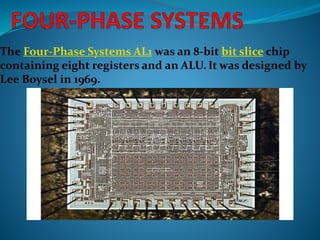
The Four-Phase Systems AL1 was an 8-bit bit slice chip
containing eight registers and an ALU. It was designed by
Lee Boysel in 1969.
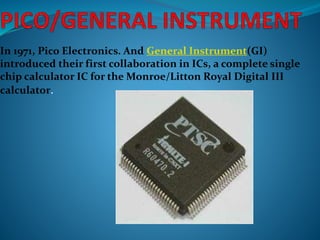
In 1971, Pico Electronics. And General Instrument(GI)
introduced their first collaboration in ICs, a complete single
chip calculator IC for the Monroe/Litton Royal Digital III
calculator.
The Intel 4004 is generally regarded as the first
commercially available
microprocessor,cost US$60(equivalent to $351.18 in 2015).
The first known advertisement for the 4004 is dated
November 15, 1971 and appeared in Electronic News.
The project that produced the 4004 originated in 1969,
when Busicom, a Japanese calculator manufacturer, asked
Intel to build a chipset for high-performance desktop
calculators.
The Intel 4004 was followed in 1972 by the Intel 8008, the
world's first 8-bit microprocessor. The 8008 was not,
however, an extension of the 4004 design, but instead the
culmination of a separate design project at Intel, arising
from a contract with Computer Terminals Corporation, of
San Antonio TX, for a chip for a terminal they were
designing,[35] the Datapoint 2200—fundamental aspects of
the design came not from Intel but from CTC.
The first multi-chip 16-bit microprocessor was
the National Semiconductor IMP-16, introduced
in early 1973. An 8-bit version of the chipset was
introduced in 1974 as the IMP-8.
Other early multi-chip 16-bit microprocessors
include one that Digital Equipment Corporation
(DEC) used in the LSI-11 OEM board set and the
packaged PDP 11/03 minicomputer—and
the Fairchild Semiconductor MicroFlame 9440,
both introduced in 1975–76.
While 64-bit microprocessor designs have been in use
in several markets since the early 1990s (including
the Nintendo 64 gaming console in 1996), the early
2000s saw the introduction of 64-bit microprocessors
targeted at the PC market.
The move to 64 bits by PowerPC had been intended
since the architecture's design in the early 90s and was
not a major cause of incompatibility.
A different approach to improving a computer's
performance is to add extra processors, as
in symmetric multiprocessing designs, which have
been popular in servers and workstations since the
early 1990s. Keeping up with Moore's Law is becoming
increasingly challenging as chip-making technologies
approach their physical limits.
In 1997, about 55% of all CPUs sold in the world are 8-
bit microcontrollers, over two billion of which were sold.
In 2002, less than 10% of all the CPUs sold in the world were
32-bit or more. Of all the 32-bit CPUs sold, about 2% are used
in desktop or laptop personal computers.
Most microprocessors are used in embedded control
applications such as household appliances,
automobiles, and computer peripherals.

Microprocesser

  • 1.
    A microprocessor isa computer processor which incorporates the functions of a computer's central processing unit (CPU) on a single integrated circuit (IC), or at most a few integrated circuits The microprocessor is a multipurpose, clock driven, register based, programmable electronic device which accepts digital or binary data as input, processes it according to instructions stored in its memory, and provides results as output. Microprocessors contain both combinational logic and sequential digital logic.
  • 2.
    STRUCTURE  The internalarrangement of a microprocessor varies depending on the age of the design and the intended purposes of the microprocessor.  The complexity of an integrated circuit (IC) is bounded by physical limitations of the number of transistors that can be put onto one chip, the number of package terminations that can connect the processor to other parts of the system, the number of interconnections it is possible to make on the chip, and the heat that the chip can dissipate.
  • 4.
    A microprocessor isa general purpose system. Several specialized processing devices have followed from the technology: A digital signal processor (DSP) is specialized for signal processing. Graphics processing units (GPUs) are processors designed primarily for real-time rendering of 3D images. They may be fixed function (as was more common in the 1990s), or support programmable shaders.
  • 5.
    Thousands of itemsthat were traditionally not computer- related include microprocessors. These include large and small household appliances, cars (and their accessory equipment units), car keys, tools and test instruments, toys, light switches/dimmers and electrical circuit breakers, smoke alarms, battery packs, and hi-fi audio/visual components (from DVD players to phonograph turntables).
  • 6.
    The advent oflow-cost computers on integrated circuits has transformed modern society. General-purpose microprocessors in personal computers are used for computation, text editing, multimedia display, and communication over the Internet. Many more microprocessors are part of embedded systems, providing digital control over myriad objects from appliances to automobiles to cellular phones and industrial process control.
  • 7.
    In the NASAApollo space missions to the moon in the 1960s and 1970s, all onboard computations for primary guidance, navigation and control were provided by a small custom processor called "The Apollo Guidance Computer". It used wire wrap circuit boards whose only logic elements were three-input NOR gates.
  • 8.
    Three projects delivereda microprocessor at about the same time: Garrett AiResearch's Central Air Data Computer (CADC), Texas Instruments (TI) TMS 1000 (1971 September), and Intel's 4004 (1971 November). In 1968, Garrett AiResearch (which employed designers Ray Holt and Steve Geller) was invited to produce a digital computer to compete with electromechanical systems then under development for the main flight control computer in the US Navy's new F-14 Tomcat fighter.
  • 9.
    The Four-Phase SystemsAL1 was an 8-bit bit slice chip containing eight registers and an ALU. It was designed by Lee Boysel in 1969.
  • 10.
    In 1971, PicoElectronics. And General Instrument(GI) introduced their first collaboration in ICs, a complete single chip calculator IC for the Monroe/Litton Royal Digital III calculator.
  • 11.
    The Intel 4004is generally regarded as the first commercially available microprocessor,cost US$60(equivalent to $351.18 in 2015). The first known advertisement for the 4004 is dated November 15, 1971 and appeared in Electronic News. The project that produced the 4004 originated in 1969, when Busicom, a Japanese calculator manufacturer, asked Intel to build a chipset for high-performance desktop calculators.
  • 12.
    The Intel 4004was followed in 1972 by the Intel 8008, the world's first 8-bit microprocessor. The 8008 was not, however, an extension of the 4004 design, but instead the culmination of a separate design project at Intel, arising from a contract with Computer Terminals Corporation, of San Antonio TX, for a chip for a terminal they were designing,[35] the Datapoint 2200—fundamental aspects of the design came not from Intel but from CTC.
  • 13.
    The first multi-chip16-bit microprocessor was the National Semiconductor IMP-16, introduced in early 1973. An 8-bit version of the chipset was introduced in 1974 as the IMP-8. Other early multi-chip 16-bit microprocessors include one that Digital Equipment Corporation (DEC) used in the LSI-11 OEM board set and the packaged PDP 11/03 minicomputer—and the Fairchild Semiconductor MicroFlame 9440, both introduced in 1975–76.
  • 14.
    While 64-bit microprocessordesigns have been in use in several markets since the early 1990s (including the Nintendo 64 gaming console in 1996), the early 2000s saw the introduction of 64-bit microprocessors targeted at the PC market. The move to 64 bits by PowerPC had been intended since the architecture's design in the early 90s and was not a major cause of incompatibility.
  • 15.
    A different approachto improving a computer's performance is to add extra processors, as in symmetric multiprocessing designs, which have been popular in servers and workstations since the early 1990s. Keeping up with Moore's Law is becoming increasingly challenging as chip-making technologies approach their physical limits.
  • 16.
    In 1997, about55% of all CPUs sold in the world are 8- bit microcontrollers, over two billion of which were sold. In 2002, less than 10% of all the CPUs sold in the world were 32-bit or more. Of all the 32-bit CPUs sold, about 2% are used in desktop or laptop personal computers. Most microprocessors are used in embedded control applications such as household appliances, automobiles, and computer peripherals.