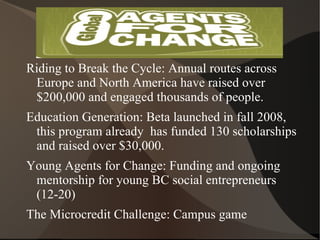
Micro-Finance Class Break-Down I.  Micro-Finance II.  Micro-Credit III. Global Agents for Change IV. Business Scenario  V.  In-Class Blogging
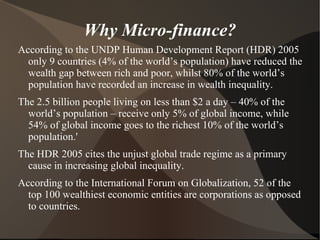
Why Micro-finance? According to the UNDP Human Development Report (HDR) 2005 only 9 countries (4% of the world’s population) have reduced the wealth gap between rich and poor, whilst 80% of the world’s population have recorded an increase in wealth inequality.
The 2.5 billion people living on less than $2 a day – 40% of the world’s population – receive only 5% of global income, while 54% of global income goes to the richest 10% of the world’s population.'
The HDR 2005 cites the unjust global trade regime as a primary cause in increasing global inequality.
According to the International Forum on Globalization, 52 of the top 100 wealthiest economic entities are corporations as opposed to countries.
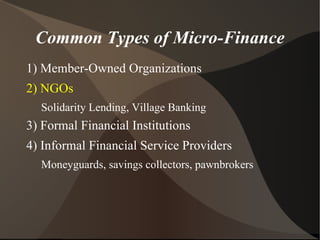
Common Types of Micro-Finance 1) Member-Owned Organizations
2) NGOs  Solidarity Lending, Village Banking 3) Formal Financial Institutions
4) Informal Financial Service Providers  Moneyguards, savings collectors, pawnbrokers
How it Works Solidarity lending is based on groups borrowing collectively and encouraging one another to repay.
Avoids fixed cost by bundling
A business model is established
Banker comes to villages/borrowers
Repayment schedule is determined by business plan (usually 6-12 months)
Defaults are handled by village leader of eight solidarity groups
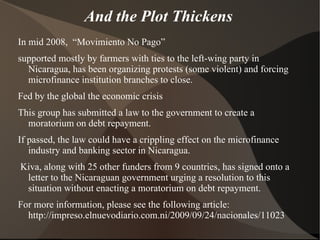
How it Works Part II A lender is found outside of the community
Loans are established through peer-to-peer lending Kiva and business profiles
Not charity, it's about fair access
100% delivered to borrowers
Repayment rate

Microcredit Presentation

  • 1.
    Micro-Finance Class Break-DownI. Micro-Finance II. Micro-Credit III. Global Agents for Change IV. Business Scenario V. In-Class Blogging
  • 2.
    Why Micro-finance? Accordingto the UNDP Human Development Report (HDR) 2005 only 9 countries (4% of the world’s population) have reduced the wealth gap between rich and poor, whilst 80% of the world’s population have recorded an increase in wealth inequality.
  • 3.
    The 2.5 billionpeople living on less than $2 a day – 40% of the world’s population – receive only 5% of global income, while 54% of global income goes to the richest 10% of the world’s population.'
  • 4.
    The HDR 2005cites the unjust global trade regime as a primary cause in increasing global inequality.
  • 5.
    According to theInternational Forum on Globalization, 52 of the top 100 wealthiest economic entities are corporations as opposed to countries.
  • 6.
    Common Types ofMicro-Finance 1) Member-Owned Organizations
  • 7.
    2) NGOs Solidarity Lending, Village Banking 3) Formal Financial Institutions
  • 8.
    4) Informal FinancialService Providers Moneyguards, savings collectors, pawnbrokers
  • 9.
    How it WorksSolidarity lending is based on groups borrowing collectively and encouraging one another to repay.
  • 10.
    Avoids fixed costby bundling
  • 11.
    A business modelis established
  • 12.
    Banker comes tovillages/borrowers
  • 13.
    Repayment schedule isdetermined by business plan (usually 6-12 months)
  • 14.
    Defaults are handledby village leader of eight solidarity groups
  • 15.
    How it WorksPart II A lender is found outside of the community
  • 16.
    Loans are establishedthrough peer-to-peer lending Kiva and business profiles
  • 17.
    Not charity, it'sabout fair access
  • 18.
  • 19.