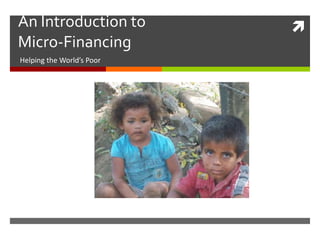
An Introduction to         
Micro-Financing
Helping the World’s Poor
To start off: Two types of Poverty

 1) Relative Poverty – An individual lacking a certain level of
   resources or income compared to the rest of society
    Example: In the US, relative poverty was set in 2011 at a yearly
       income of $22,314 (family of four) and $11,139 for an individual*


                                                             *CNNMoney
And the worse kind...

 2) Absolute Poverty – An individual living on less than $1.25 a
   day* and lacks basic human necessities:
    Clean drinking water
    Healthcare
    Nutrition
    Education

 In 2011 there were 1.5 billion people living in absolute poverty
   throughout the world**

                                               *World Bank
                                               **United Nations General
                                               Assembly
Why do we have absolute poverty?

 Lack of resources

 Political corruption

 Poor are marginalized from society and not given a voice

 Institutions in place benefit the rich, not the poor

 Cutbacks in social services

 Combine most of these together and you get…
Modern Day Slavery

 27 million slaves in the world today* with some activists saying as
    much as 200 million
 Sufiya from Bangladesh**
   Makes bamboo stools
       5 Taka for supplies
       Borrows it from the paikars (middlemen)
       MUST sell the stools back to them to repay her loan
       Sells it for 5 Taka and 50 poysha
       Makes a profit of 2 cents per stool
   Bonded slave labor
   Situations like this is one of the reasons why the cycle of poverty
      continues
                                                             *Disposable People
                                                             **Banker to the Poor
How do we break this cycle?
   All Sufiya needed was 22 cents
     Could buy her own raw material
     Set her own price to sell stools
     Sell to more people
     Make more of a profit  Improve her family’s life (better nutrition,
         medicine, shelter, education for children etc.)  Better life means new
         opportunities and a way out of poverty

   We need to provide these people with financial resources like credit
“People like Sufiya were poor not because they were stupid or lazy. They worked all day long, doing
    complex physical tasks. They were poor because the financial institution in the country did not
             help them widen their economic base.” Muhammad Yunus – Banker to the Poor
Here’s the problem

 What bank would loan out such a small amount?
   The costs for all the “behind the scenes” tasks like processing
    the loan, salary of banker etc. doesn’t equal out to what the
    bank makes in interest
   To make money, banks charge absurdly high interest rates on
    these small loans

 Banks want collateral to guarantee repayment, which poor
   people don’t have
 In the end, existing banking institutions do not help those that
   need it most
Finally we get to: Micro-Financing

 A general term describing financial services for low-income
    individuals.
       Credit
       Savings
       Fund transfers
       Insurance

 The poor need this because they lack access to traditional banking
    services
 It (ideally) helps lift low-income individuals out of the vicious cycle of
    poverty
Micro-Credit

 A term referring to a small amount of money loaned out to low-
    income individuals
 How small of a loan?
   Depends on the micro-finance institution (MFI)
   For example: $50 to $2,000*

 Interest rates:
   MFI interest rates range from 4% to as high as 85%**
       Note: High interest rates like the 85% are uncommon and a topic of
         heated debate. Some argue that this is excessive and these types of
         organizations are exploiting the poor.**

                                                                 *Hope
                                                                 International

How does micro-credit work?

 MFI’s have their own way of doing things but generally:
    Loan out small amount of money at low interest rate (say 10%)
    Individual(s) pays back the amount, plus interest at a set time
     (every day/week/month)
    Once fully repaid, that individual(s) can take out another, larger
     micro-loan

 Some MFI’s like Grameen Bank set up groups of borrowers for
   support and an added security measure for loan repayment
High Repayment Rates

 98% with Grameen Bank, 98.88% with Kiva and 96% with Hope
   International

 Why so successful?
    The poor know this is their only chance to break the cycle of
     poverty
    They are so thankful that someone gave them a chance


   “Unlike the rich, the poor can’t risk not repaying. This is the only chance they
                      have.” Muhammad Yunus – Banker to the Poor


                                                                    *Grameen Bank
Women borrowers

“Micro-credit plays a critical role in empowering women, helps deliver newfound
     respect, independence, and participation for women in their communities
           and in their households.” – Juan Somavia, International Labor
                                 Office, Director-General

 70% of the world’s poor are women

 In 2006, 93 million poorest of the poor took out their first loan, 85%
    were women
 Women have higher repayment rates

 Money entering the household through a woman usually benefits the
    family as a whole whereas men are more likely to spend the earned
    money on themselves
                                                             International Labor
                                                             Office
So does it work?

 There is some debate.
    In Bosnia, micro-enterprises were failing by 50% just after one
      year*
       But what support systems were in place? What MFI was operating?
    Critics argue that over time the market becomes saturated and
      the people in these poverty stricken areas are using the same skill
      sets and selling the same products.*
       Why business 101 skills should be taught so borrowers are
         encouraged to think of new business ventures


                                                          *Share the World’s
                                                          Economic Resources
On the up-side

 It helps poor households meet basic human needs: clean
   drinking water, healthcare, education, nutrition etc.

 Protects against risks like illnesses and natural disasters

 Helps economic welfare, stability and growth

 With women borrowers it provides empowerment and thus
   promotes gender-equality


                                                                CGAP
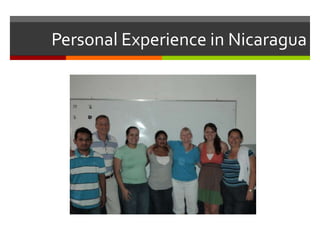
Personal Experience in Nicaragua
In the end

“Micro-credit is not a miracle sure that can eliminate poverty in one
       fell swoop. But it can end poverty for many and reduce its
    severity for others. Combined with other innovative programs
   that unleash people’s potential, micro-credit is an essential tool
     in our search for a poverty-free world.” Muhammad Yunus –
                            Banker to the Poor
References

   Banker to the Poor by Muhammad  Kiva
    Yunus

   CGAP                                Poverty Rate Rises in America
                                          – CNNMoney
   Disposable People by Kevin Bales
                                        Share the World’s Resources
   Grameen Bank

   Hope International                  United Nations General
                                          Assembly – GA/EF/3313
   International Labor Office – “Small
    Change, Big Change. Women and  World Bank
    Micro-Finance”
Additional Resources

 Ashoka documentary on Muhammad Yunus

 Grameen Foundation: Empowering the World’s Poor

Intro to Micro-Financing

  • 1.
    An Introduction to  Micro-Financing Helping the World’s Poor
  • 2.
    To start off:Two types of Poverty  1) Relative Poverty – An individual lacking a certain level of resources or income compared to the rest of society  Example: In the US, relative poverty was set in 2011 at a yearly income of $22,314 (family of four) and $11,139 for an individual* *CNNMoney
  • 3.
    And the worsekind...  2) Absolute Poverty – An individual living on less than $1.25 a day* and lacks basic human necessities:  Clean drinking water  Healthcare  Nutrition  Education  In 2011 there were 1.5 billion people living in absolute poverty throughout the world** *World Bank **United Nations General Assembly
  • 4.
    Why do wehave absolute poverty?  Lack of resources  Political corruption  Poor are marginalized from society and not given a voice  Institutions in place benefit the rich, not the poor  Cutbacks in social services  Combine most of these together and you get…
  • 5.
    Modern Day Slavery 27 million slaves in the world today* with some activists saying as much as 200 million  Sufiya from Bangladesh**  Makes bamboo stools  5 Taka for supplies  Borrows it from the paikars (middlemen)  MUST sell the stools back to them to repay her loan  Sells it for 5 Taka and 50 poysha  Makes a profit of 2 cents per stool  Bonded slave labor  Situations like this is one of the reasons why the cycle of poverty continues *Disposable People **Banker to the Poor
  • 6.
    How do webreak this cycle?  All Sufiya needed was 22 cents  Could buy her own raw material  Set her own price to sell stools  Sell to more people  Make more of a profit  Improve her family’s life (better nutrition, medicine, shelter, education for children etc.)  Better life means new opportunities and a way out of poverty  We need to provide these people with financial resources like credit “People like Sufiya were poor not because they were stupid or lazy. They worked all day long, doing complex physical tasks. They were poor because the financial institution in the country did not help them widen their economic base.” Muhammad Yunus – Banker to the Poor
  • 7.
    Here’s the problem What bank would loan out such a small amount?  The costs for all the “behind the scenes” tasks like processing the loan, salary of banker etc. doesn’t equal out to what the bank makes in interest  To make money, banks charge absurdly high interest rates on these small loans  Banks want collateral to guarantee repayment, which poor people don’t have  In the end, existing banking institutions do not help those that need it most
  • 8.
    Finally we getto: Micro-Financing  A general term describing financial services for low-income individuals.  Credit  Savings  Fund transfers  Insurance  The poor need this because they lack access to traditional banking services  It (ideally) helps lift low-income individuals out of the vicious cycle of poverty
  • 9.
    Micro-Credit  A termreferring to a small amount of money loaned out to low- income individuals  How small of a loan?  Depends on the micro-finance institution (MFI)  For example: $50 to $2,000*  Interest rates:  MFI interest rates range from 4% to as high as 85%**  Note: High interest rates like the 85% are uncommon and a topic of heated debate. Some argue that this is excessive and these types of organizations are exploiting the poor.** *Hope International
  • 10.
  • 11.
    How does micro-creditwork?  MFI’s have their own way of doing things but generally:  Loan out small amount of money at low interest rate (say 10%)  Individual(s) pays back the amount, plus interest at a set time (every day/week/month)  Once fully repaid, that individual(s) can take out another, larger micro-loan  Some MFI’s like Grameen Bank set up groups of borrowers for support and an added security measure for loan repayment
  • 12.
    High Repayment Rates 98% with Grameen Bank, 98.88% with Kiva and 96% with Hope International  Why so successful?  The poor know this is their only chance to break the cycle of poverty  They are so thankful that someone gave them a chance “Unlike the rich, the poor can’t risk not repaying. This is the only chance they have.” Muhammad Yunus – Banker to the Poor *Grameen Bank
  • 13.
    Women borrowers “Micro-credit playsa critical role in empowering women, helps deliver newfound respect, independence, and participation for women in their communities and in their households.” – Juan Somavia, International Labor Office, Director-General  70% of the world’s poor are women  In 2006, 93 million poorest of the poor took out their first loan, 85% were women  Women have higher repayment rates  Money entering the household through a woman usually benefits the family as a whole whereas men are more likely to spend the earned money on themselves International Labor Office
  • 14.
    So does itwork?  There is some debate.  In Bosnia, micro-enterprises were failing by 50% just after one year*  But what support systems were in place? What MFI was operating?  Critics argue that over time the market becomes saturated and the people in these poverty stricken areas are using the same skill sets and selling the same products.*  Why business 101 skills should be taught so borrowers are encouraged to think of new business ventures *Share the World’s Economic Resources
  • 15.
    On the up-side It helps poor households meet basic human needs: clean drinking water, healthcare, education, nutrition etc.  Protects against risks like illnesses and natural disasters  Helps economic welfare, stability and growth  With women borrowers it provides empowerment and thus promotes gender-equality CGAP
  • 16.
  • 17.
    In the end “Micro-creditis not a miracle sure that can eliminate poverty in one fell swoop. But it can end poverty for many and reduce its severity for others. Combined with other innovative programs that unleash people’s potential, micro-credit is an essential tool in our search for a poverty-free world.” Muhammad Yunus – Banker to the Poor
  • 18.
    References  Banker to the Poor by Muhammad  Kiva Yunus  CGAP  Poverty Rate Rises in America – CNNMoney  Disposable People by Kevin Bales  Share the World’s Resources  Grameen Bank  Hope International  United Nations General Assembly – GA/EF/3313  International Labor Office – “Small Change, Big Change. Women and  World Bank Micro-Finance”
  • 19.
    Additional Resources  Ashokadocumentary on Muhammad Yunus  Grameen Foundation: Empowering the World’s Poor