Micro- 
Financing
Plan Canada and micro financing 
support 
Plan is a global movement for change, 
mobilizing millions of people around the world to 
support social justice for children in developing 
countries. 
Founded in 1937, PLAN is one of the world’s 
oldest and largest international development 
agencies, working in partnership with millions of 
people around the world to end global poverty.
Microfinance 
Microfinance involves extending small loans, 
savings and other basic financial services to people 
that don’t currently have access to capital. It’s a key 
strategy in helping people living in poverty to 
become financially independent, which helps them 
become more resilient and better able to provide for 
their families in times of economic difficulty. 
Considering nearly half the world survives on less 
than $2 a day, microfinance is a vital solution.
Six benefits of microfinance: 
1. Access Banks simply won’t extend loans to 
those with little or no assets, and generally don’t 
engage in the small size of loans typically 
associated with microfinancing. Microfinancing 
is based on the philosophy that even small 
amounts of credit can help end the cycle of 
poverty. 
2. Better loan repayment rates Microfinance 
tends to target women borrowers, who are 
statistically less likely to default on their loans 
than men. So these loans help empower 
women, and they are often safer investments for 
those loaning the funds.
3. Extending education Families receiving 
microfinancing are less likely to pull their 
children out of school for economic reasons. 
4. Improved health and welfare Microfinancing 
can lead to improved access to clean water and 
better sanitation while also providing better 
access to health care. 
5. Sustainability Even a small working capital 
loan of $100 can be enough to launch a small 
business in a developing country that could help 
the benefactor pull themselves and their family 
out of poverty..
6. Job creation Microfinancing can help create 
new employment opportunities, which has a 
beneficial impact on the local economy.
Village Savings & Loans 
WHO? Youth and adults 
WHAT? A program that allows members to pool 
their money and resources and invest in each 
other’s initiatives, like selling rice, returning to 
school or buying livestock. 
WHY? These projects help people lift 
themselves out of poverty by helping them 
establish successful businesses. They also 
teach financial literacy and reinforce the 
benefits of working together to benefit everyone.
HOW? At each Village Savings and Loans 
Association (VSLA) meeting, the group focuses on 
business and loan proposals that have been put up 
for consideration. They then determine which 
individuals to loan money to. After a loan is given, it 
must be repaid within 3 months with a small amount 
of interest 
COMMUNITY BUILDING 
Members also give a small amount at each meeting 
to a "social fund". This fund is used when someone 
in the group has sudden unexpected expenses, like 
medical bills, special food for a family health issue or 
other emergency.
Plan’s involvement in Micro 
financing 
Hundreds of thousands of people achieve 
financial stability thanks to microfinance 
schemes facilitated by Plan through its partners, 
helping them protect their families from 
emergencies and plan for the future. 
Through small loans and savings schemes, 
Plan's microfinance programs offer assistance 
to the very poor with a special emphasis on 
access for women.
By providing access to financial resources and 
the opportunity to accumulate savings, PLAN 
microfinance schemes allow families greater 
flexibility in managing their resources to become 
more resilient and provide for their children. 
In Peru, for example, Plan’s work through 
partnerships has helped 8,000 families access 
financial services and receive educational 
support.
One partner is Arariwa, a non-governmental 
organization with expertise in microfinance 
projects. Together PLAN has helped bring 
village banks to rural areas of the Cusco region 
and complemented these services with 
educational projects on business management 
and children's and women's health. 
http://plancanada.ca/microfinance
Other Micro finance institutions 
KIVA 
KIVA is a non-profit organization with a mission 
to connect people through lending to alleviate 
poverty. Leveraging the internet and a 
worldwide network of microfinance institutions, 
Kiva lets individuals lend as little as $25 to help 
create opportunity around the world
Kiva envisions a world where all people - even 
in the most remote areas of the globe - hold the 
power to create opportunity for themselves and 
others. 
Kiva believes providing safe, affordable access 
to capital to those in need helps people create 
better lives for themselves and their families
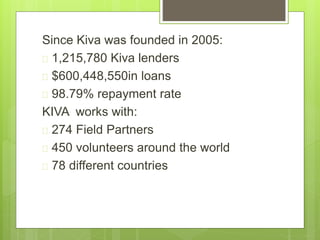
Since Kiva was founded in 2005: 
 1,215,780 Kiva lenders 
 $600,448,550in loans 
 98.79% repayment rate 
KIVA works with: 
 274 Field Partners 
 450 volunteers around the world 
 78 different countries
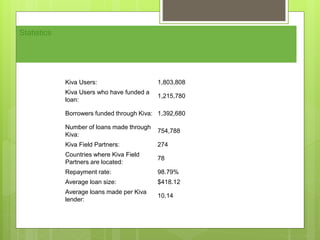
Total amount lent through Kiva: $600,448,550 
Kiva Users: 1,803,808 
Kiva Users who have funded a 
1,215,780 
loan: 
Borrowers funded through Kiva: 1,392,680 
Number of loans made through 
Kiva: 
754,788 
Kiva Field Partners: 274 
Countries where Kiva Field 
78 
Partners are located: 
Repayment rate: 98.79% 
Average loan size: $418.12 
Average loans made per Kiva 
10.14 
lender: 
Statistics
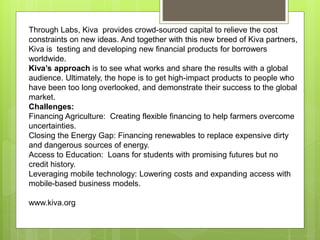
Through Labs, Kiva provides crowd-sourced capital to relieve the cost 
constraints on new ideas. And together with this new breed of Kiva partners, 
Kiva is testing and developing new financial products for borrowers 
worldwide. 
Kiva’s approach is to see what works and share the results with a global 
audience. Ultimately, the hope is to get high-impact products to people who 
have been too long overlooked, and demonstrate their success to the global 
market. 
Challenges: 
Financing Agriculture: Creating flexible financing to help farmers overcome 
uncertainties. 
Closing the Energy Gap: Financing renewables to replace expensive dirty 
and dangerous sources of energy. 
Access to Education: Loans for students with promising futures but no 
credit history. 
Leveraging mobile technology: Lowering costs and expanding access with 
mobile-based business models. 
www.kiva.org
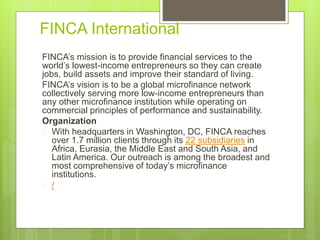
FINCA International 
FINCA’s mission is to provide financial services to the 
world’s lowest-income entrepreneurs so they can create 
jobs, build assets and improve their standard of living. 
FINCA’s vision is to be a global microfinance network 
collectively serving more low-income entrepreneurs than 
any other microfinance institution while operating on 
commercial principles of performance and sustainability. 
Organization 
 With headquarters in Washington, DC, FINCA reaches 
over 1.7 million clients through its 22 subsidiaries in 
Africa, Eurasia, the Middle East and South Asia, and 
Latin America. Our outreach is among the broadest and 
most comprehensive of today’s microfinance 
institutions. 
 /
Approach 
 When clients come to FINCA for a loan, most of them are already 
micro-entrepreneurs. They have enough experience to know 
that, without additional working capital, their odds of becoming or 
staying profitable and productive, or of making improvements in 
their lives, remain low. They are looking for a business loan, 
much like any other entrepreneur, but at a micro level. 
 For these small-scale businesses, even small amounts of capital 
can make a dramatic difference. A business loan of a few 
hundred dollars can enable micro-entrepreneurs to pay 
wholesale rather than retail prices for the goods they resell, or to 
buy with cash rather than on consignment, or acquire a more 
modern piece of essential equipment, turning their businesses 
into profitable, sustainable enterprises. This small increase in 
purchasing power can have an immediate impact on a client’s 
productivity and earnings. For other clients, having a safe and 
trusted place to store and save their daily revenue is most 
critical. All of these needs are met by FINCA.
FINCA provides clients with a wide range of the financial 
products and services that micro-entrepreneurs need 
including savings accounts; group and individual loans; 
credit life, short-term disability, and hospitalization 
insurance; and money transfers. These products vary by 
local demand, and they are adapted to comply with local 
regulations and culture. Each FINCA Subsidiary is run by 
a local team of professionals with intimate knowledge of 
their market, and it is this localized, client-driven approach 
that has made FINCA’s global expansion possible and so 
effective. FINCA is firmly committed to Client 
Protection and fair practices and maintains strict policies 
to ensure compliance. Our local loan officers are trained 
in FINCA’s mission, and dedicated to helping clients build 
successful businesses while ensuring that they are 
protected from unnecessary risks.
FINCA providing pathways out of Poverty 
http://www.fincacanada.org/

Microfinancing

  • 1.
  • 2.
    Plan Canada andmicro financing support Plan is a global movement for change, mobilizing millions of people around the world to support social justice for children in developing countries. Founded in 1937, PLAN is one of the world’s oldest and largest international development agencies, working in partnership with millions of people around the world to end global poverty.
  • 3.
    Microfinance Microfinance involvesextending small loans, savings and other basic financial services to people that don’t currently have access to capital. It’s a key strategy in helping people living in poverty to become financially independent, which helps them become more resilient and better able to provide for their families in times of economic difficulty. Considering nearly half the world survives on less than $2 a day, microfinance is a vital solution.
  • 4.
    Six benefits ofmicrofinance: 1. Access Banks simply won’t extend loans to those with little or no assets, and generally don’t engage in the small size of loans typically associated with microfinancing. Microfinancing is based on the philosophy that even small amounts of credit can help end the cycle of poverty. 2. Better loan repayment rates Microfinance tends to target women borrowers, who are statistically less likely to default on their loans than men. So these loans help empower women, and they are often safer investments for those loaning the funds.
  • 5.
    3. Extending educationFamilies receiving microfinancing are less likely to pull their children out of school for economic reasons. 4. Improved health and welfare Microfinancing can lead to improved access to clean water and better sanitation while also providing better access to health care. 5. Sustainability Even a small working capital loan of $100 can be enough to launch a small business in a developing country that could help the benefactor pull themselves and their family out of poverty..
  • 6.
    6. Job creationMicrofinancing can help create new employment opportunities, which has a beneficial impact on the local economy.
  • 7.
    Village Savings &Loans WHO? Youth and adults WHAT? A program that allows members to pool their money and resources and invest in each other’s initiatives, like selling rice, returning to school or buying livestock. WHY? These projects help people lift themselves out of poverty by helping them establish successful businesses. They also teach financial literacy and reinforce the benefits of working together to benefit everyone.
  • 8.
    HOW? At eachVillage Savings and Loans Association (VSLA) meeting, the group focuses on business and loan proposals that have been put up for consideration. They then determine which individuals to loan money to. After a loan is given, it must be repaid within 3 months with a small amount of interest COMMUNITY BUILDING Members also give a small amount at each meeting to a "social fund". This fund is used when someone in the group has sudden unexpected expenses, like medical bills, special food for a family health issue or other emergency.
  • 9.
    Plan’s involvement inMicro financing Hundreds of thousands of people achieve financial stability thanks to microfinance schemes facilitated by Plan through its partners, helping them protect their families from emergencies and plan for the future. Through small loans and savings schemes, Plan's microfinance programs offer assistance to the very poor with a special emphasis on access for women.
  • 10.
    By providing accessto financial resources and the opportunity to accumulate savings, PLAN microfinance schemes allow families greater flexibility in managing their resources to become more resilient and provide for their children. In Peru, for example, Plan’s work through partnerships has helped 8,000 families access financial services and receive educational support.
  • 11.
    One partner isArariwa, a non-governmental organization with expertise in microfinance projects. Together PLAN has helped bring village banks to rural areas of the Cusco region and complemented these services with educational projects on business management and children's and women's health. http://plancanada.ca/microfinance
  • 12.
    Other Micro financeinstitutions KIVA KIVA is a non-profit organization with a mission to connect people through lending to alleviate poverty. Leveraging the internet and a worldwide network of microfinance institutions, Kiva lets individuals lend as little as $25 to help create opportunity around the world
  • 13.
    Kiva envisions aworld where all people - even in the most remote areas of the globe - hold the power to create opportunity for themselves and others. Kiva believes providing safe, affordable access to capital to those in need helps people create better lives for themselves and their families
  • 14.
    Since Kiva wasfounded in 2005:  1,215,780 Kiva lenders  $600,448,550in loans  98.79% repayment rate KIVA works with:  274 Field Partners  450 volunteers around the world  78 different countries
  • 15.
    Total amount lentthrough Kiva: $600,448,550 Kiva Users: 1,803,808 Kiva Users who have funded a 1,215,780 loan: Borrowers funded through Kiva: 1,392,680 Number of loans made through Kiva: 754,788 Kiva Field Partners: 274 Countries where Kiva Field 78 Partners are located: Repayment rate: 98.79% Average loan size: $418.12 Average loans made per Kiva 10.14 lender: Statistics
  • 16.
    Through Labs, Kivaprovides crowd-sourced capital to relieve the cost constraints on new ideas. And together with this new breed of Kiva partners, Kiva is testing and developing new financial products for borrowers worldwide. Kiva’s approach is to see what works and share the results with a global audience. Ultimately, the hope is to get high-impact products to people who have been too long overlooked, and demonstrate their success to the global market. Challenges: Financing Agriculture: Creating flexible financing to help farmers overcome uncertainties. Closing the Energy Gap: Financing renewables to replace expensive dirty and dangerous sources of energy. Access to Education: Loans for students with promising futures but no credit history. Leveraging mobile technology: Lowering costs and expanding access with mobile-based business models. www.kiva.org
  • 17.
    FINCA International FINCA’smission is to provide financial services to the world’s lowest-income entrepreneurs so they can create jobs, build assets and improve their standard of living. FINCA’s vision is to be a global microfinance network collectively serving more low-income entrepreneurs than any other microfinance institution while operating on commercial principles of performance and sustainability. Organization  With headquarters in Washington, DC, FINCA reaches over 1.7 million clients through its 22 subsidiaries in Africa, Eurasia, the Middle East and South Asia, and Latin America. Our outreach is among the broadest and most comprehensive of today’s microfinance institutions.  /
  • 18.
    Approach  Whenclients come to FINCA for a loan, most of them are already micro-entrepreneurs. They have enough experience to know that, without additional working capital, their odds of becoming or staying profitable and productive, or of making improvements in their lives, remain low. They are looking for a business loan, much like any other entrepreneur, but at a micro level.  For these small-scale businesses, even small amounts of capital can make a dramatic difference. A business loan of a few hundred dollars can enable micro-entrepreneurs to pay wholesale rather than retail prices for the goods they resell, or to buy with cash rather than on consignment, or acquire a more modern piece of essential equipment, turning their businesses into profitable, sustainable enterprises. This small increase in purchasing power can have an immediate impact on a client’s productivity and earnings. For other clients, having a safe and trusted place to store and save their daily revenue is most critical. All of these needs are met by FINCA.
  • 19.
    FINCA provides clientswith a wide range of the financial products and services that micro-entrepreneurs need including savings accounts; group and individual loans; credit life, short-term disability, and hospitalization insurance; and money transfers. These products vary by local demand, and they are adapted to comply with local regulations and culture. Each FINCA Subsidiary is run by a local team of professionals with intimate knowledge of their market, and it is this localized, client-driven approach that has made FINCA’s global expansion possible and so effective. FINCA is firmly committed to Client Protection and fair practices and maintains strict policies to ensure compliance. Our local loan officers are trained in FINCA’s mission, and dedicated to helping clients build successful businesses while ensuring that they are protected from unnecessary risks.
  • 20.
    FINCA providing pathwaysout of Poverty http://www.fincacanada.org/