DNA
EXTRACTION
COURSE INSTRUCTOR:
DR. FIRASAT HUSSAIN
Course : Fundamental of Microbial Genetics
Group : G1
Members :
Fatima Tuz Zahra (L)
Nain Tara
Misbah Musadiq
Muhammad Amjad
Waqas Ahmad
Muhammad Naeem
Muhammad Irfan
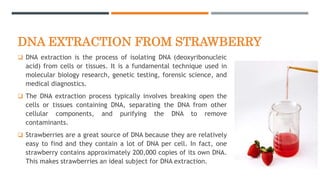
DNA EXTRACTION FROM STRAWBERRY
 DNA extraction is the process of isolating DNA (deoxyribonucleic
acid) from cells or tissues. It is a fundamental technique used in
molecular biology research, genetic testing, forensic science, and
medical diagnostics.
 The DNA extraction process typically involves breaking open the
cells or tissues containing DNA, separating the DNA from other
cellular components, and purifying the DNA to remove
contaminants.
 Strawberries are a great source of DNA because they are relatively
easy to find and they contain a lot of DNA per cell. In fact, one
strawberry contains approximately 200,000 copies of its own DNA.
This makes strawberries an ideal subject for DNA extraction.
MATERIAL
Ripe Strawberries
Plastic bag
DNA extracting solution (mix about 1 tablespoon of dish detergent and 1 teaspoon of salt into 1 cup of water)
Measuring beaker & Plastic cup
Coffee filter
Denatured alcohol e.g. methylated spirits or rubbing alcohol - put in the freezer for best results
Wooden stick or toothpick
Eppendorf tubes
EXPERIMENTAL PROCEDURE
 Step 1: Mix the DNA Extraction Liquid
 Take 1 plastic cup and mix together 2 teaspoons of dish
dish detergent.
 Slowly mix in 1 teaspoon of salt.
 Add 1/2 cup of water and mix.
 Step 2: Prepare the strawberries
 Take strawberries and removing leaves and insert it into
into your plastic bag.
 Using your hand, mash up the strawberry until there are
are no big chunks
EXPERIMENTAL PROCEDURE
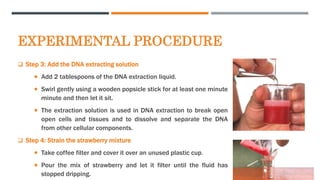
 Step 3: Add the DNA extracting solution
 Add 2 tablespoons of the DNA extraction liquid.
 Swirl gently using a wooden popsicle stick for at least one minute
minute and then let it sit.
 The extraction solution is used in DNA extraction to break open
open cells and tissues and to dissolve and separate the DNA
from other cellular components.
 Step 4: Strain the strawberry mixture
 Take coffee filter and cover it over an unused plastic cup.
 Pour the mix of strawberry and let it filter until the fluid has
stopped dripping.
EXPERIMENTAL PROCEDURE
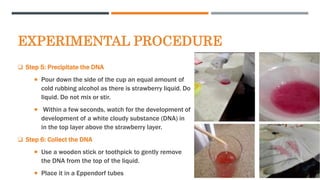
 Step 5: Precipitate the DNA
 Pour down the side of the cup an equal amount of
cold rubbing alcohol as there is strawberry liquid. Do
liquid. Do not mix or stir.
 Within a few seconds, watch for the development of
development of a white cloudy substance (DNA) in
in the top layer above the strawberry layer.
 Step 6: Collect the DNA
 Use a wooden stick or toothpick to gently remove
the DNA from the top of the liquid.
 Place it in a Eppendorf tubes
DNA EXTRACTION FROM STAPHYLOCOCCUS AUREUS
 The aim of DNA extraction from bacteria is to isolate and purify the bacterial DNA.
 This is done to obtain a high-quality sample of DNA that can be used for further analysis,
such as PCR amplification, DNA sequencing, and other molecular biology techniques.
 Staphylococcus aureus is well known as bacterial pathogen of both human and animal.
 In humans, this bacteria causes food poisoning, toxic shock and variety of pyogenic
infections .
 Staphylococcus aureus also could cause mastitis in cows, sheep and goats.
 Staphylococcus aureus is an important food-borne pathogen because of its ability to
produce a wide range of extracellular protein toxins and virulence factors that contribute
to pathogenicity of the organism
 The primary habitat of Staphylococcus aureus is in the nasal passage on the skin and hair of
MATERIAL
Staphylococcus aureus cells
Detergent (such as sodium dodecyl sulfate, SDS)
70% ethanol
TE buffer (10 mM Tris-HCl, 1 mM EDTA, pH 8.0)
EXPERIMENTAL PROCEDURE
 Collect a pure culture of Staphylococcus aureus cells in a sterile tube.
 Pellet the cells by centrifugation at 10,000 x g for 5 minutes.
 Resuspend the cells in a solution containing detergent (such as SDS) and mix gently.
 Incubate the mixture at 55-60°C for 30-60 minutes to allow the detergent to break down the cell
wall and release the DNA.
 Add an equal volume of 70% ethanol to the mixture and invert the tube gently to mix.
 Centrifuge the mixture at 10,000 x g for 5 minutes to pellet the DNA.
 Carefully remove the supernatant and wash the DNA pellet with 70% ethanol.
 Air dry the pellet and resuspend it in TE buffer (10 mM Tris-HCl, 1 mM EDTA, pH 8.0).

DNA Extraction.pptx

  • 1.
  • 2.
    Course : Fundamentalof Microbial Genetics Group : G1 Members : Fatima Tuz Zahra (L) Nain Tara Misbah Musadiq Muhammad Amjad Waqas Ahmad Muhammad Naeem Muhammad Irfan
  • 3.
    DNA EXTRACTION FROMSTRAWBERRY  DNA extraction is the process of isolating DNA (deoxyribonucleic acid) from cells or tissues. It is a fundamental technique used in molecular biology research, genetic testing, forensic science, and medical diagnostics.  The DNA extraction process typically involves breaking open the cells or tissues containing DNA, separating the DNA from other cellular components, and purifying the DNA to remove contaminants.  Strawberries are a great source of DNA because they are relatively easy to find and they contain a lot of DNA per cell. In fact, one strawberry contains approximately 200,000 copies of its own DNA. This makes strawberries an ideal subject for DNA extraction.
  • 4.
    MATERIAL Ripe Strawberries Plastic bag DNAextracting solution (mix about 1 tablespoon of dish detergent and 1 teaspoon of salt into 1 cup of water) Measuring beaker & Plastic cup Coffee filter Denatured alcohol e.g. methylated spirits or rubbing alcohol - put in the freezer for best results Wooden stick or toothpick Eppendorf tubes
  • 5.
    EXPERIMENTAL PROCEDURE  Step1: Mix the DNA Extraction Liquid  Take 1 plastic cup and mix together 2 teaspoons of dish dish detergent.  Slowly mix in 1 teaspoon of salt.  Add 1/2 cup of water and mix.  Step 2: Prepare the strawberries  Take strawberries and removing leaves and insert it into into your plastic bag.  Using your hand, mash up the strawberry until there are are no big chunks
  • 6.
    EXPERIMENTAL PROCEDURE  Step3: Add the DNA extracting solution  Add 2 tablespoons of the DNA extraction liquid.  Swirl gently using a wooden popsicle stick for at least one minute minute and then let it sit.  The extraction solution is used in DNA extraction to break open open cells and tissues and to dissolve and separate the DNA from other cellular components.  Step 4: Strain the strawberry mixture  Take coffee filter and cover it over an unused plastic cup.  Pour the mix of strawberry and let it filter until the fluid has stopped dripping.
  • 7.
    EXPERIMENTAL PROCEDURE  Step5: Precipitate the DNA  Pour down the side of the cup an equal amount of cold rubbing alcohol as there is strawberry liquid. Do liquid. Do not mix or stir.  Within a few seconds, watch for the development of development of a white cloudy substance (DNA) in in the top layer above the strawberry layer.  Step 6: Collect the DNA  Use a wooden stick or toothpick to gently remove the DNA from the top of the liquid.  Place it in a Eppendorf tubes
  • 8.
    DNA EXTRACTION FROMSTAPHYLOCOCCUS AUREUS  The aim of DNA extraction from bacteria is to isolate and purify the bacterial DNA.  This is done to obtain a high-quality sample of DNA that can be used for further analysis, such as PCR amplification, DNA sequencing, and other molecular biology techniques.  Staphylococcus aureus is well known as bacterial pathogen of both human and animal.  In humans, this bacteria causes food poisoning, toxic shock and variety of pyogenic infections .  Staphylococcus aureus also could cause mastitis in cows, sheep and goats.  Staphylococcus aureus is an important food-borne pathogen because of its ability to produce a wide range of extracellular protein toxins and virulence factors that contribute to pathogenicity of the organism  The primary habitat of Staphylococcus aureus is in the nasal passage on the skin and hair of
  • 9.
    MATERIAL Staphylococcus aureus cells Detergent(such as sodium dodecyl sulfate, SDS) 70% ethanol TE buffer (10 mM Tris-HCl, 1 mM EDTA, pH 8.0)
  • 10.
    EXPERIMENTAL PROCEDURE  Collecta pure culture of Staphylococcus aureus cells in a sterile tube.  Pellet the cells by centrifugation at 10,000 x g for 5 minutes.  Resuspend the cells in a solution containing detergent (such as SDS) and mix gently.  Incubate the mixture at 55-60°C for 30-60 minutes to allow the detergent to break down the cell wall and release the DNA.  Add an equal volume of 70% ethanol to the mixture and invert the tube gently to mix.  Centrifuge the mixture at 10,000 x g for 5 minutes to pellet the DNA.  Carefully remove the supernatant and wash the DNA pellet with 70% ethanol.  Air dry the pellet and resuspend it in TE buffer (10 mM Tris-HCl, 1 mM EDTA, pH 8.0).