Presentation on Microbial Control
Md. Chayan Ali
chayanali7@gmail.com
Biotechnology & Genetic Engineering
Islamic University- Kushtia, Bangladesh
Contents of this slide
 Definition of microbial control
 Importance of biological or microbial control
 Microbial control of insect pests
Bacteria as control agent
Virus as control agents
Protozoa as control agents
Fungi as control agent
 Microbial control of animal pests
 Microbial control of weeds
 Microbial control of cyanobacterial blooms
 Genetic engineering in biological control
Microbial control: Microbial control refers to the use of pathogenic microbes to
control insects-pest, animal pests, weeds, algae, predators etc.
Possible agents:
Virus : Baculoviridae, Poxviridae, Reoviridae, Parvoviridae, Picornaviridae,
Rhabdoviridae
Bacteria: Bacillus popiliae, B. thuringiensis, B. lentimorbus, C. malacosome, P.
aeruginosa, P. azotoformans
Fungi: Beauveria, metarrhizium, Entomophthora, Entomophaga maimaga,
Hirsetulla etc.
Protozoa: Mastigophora sarcodina
Importance of biological or microbial control
 Environmental friendly
 Specific to the particular host
 Ability to multiply in host
 Cheap after startup
 Can be use year round
 No problems with poisoning
 Cost, benefit ratio is higher
 Low or no pathogenicity to the nature fauna
 No problems of cross resistance
 Contribute to the recovery of biological property of soils
 No residue problems
 Can be exercised in a wide area
 Safe for human and animals
 Possibility to apply in dense forest
Bacteria as a bio-control agent
 Plant pathogenic bacteria are very useful in controlling insect-pests
 Bacillus thuringiensis are most useful insect controlling agent
 Plant pathogenic bacteria are very useful in controlling insect-pests
 Bacillus thuringiensis are most useful insect controlling agent
 Four toxic substance are produce by Bacillus thurengienesis
 The main component of procrystalline inclusions are polypeptides 130 to 140
kilodaltons in size. These molecules are termed protoxins.
 They are solubilized in the alkaline midgut of susceptible insect larvae,
realizing an active toxin estimated to have a size of 30-40 kDa. Activated
toxin binds to the convoluted brush border membranes of the columnar cells
of the insect midgut epithelium. Binding of bt toxin affects osmoregulation
and specifically alters the flux of potassium ions across the epithelium midgut
.
Mechanism of action of BT toxin-
Insect
Pro toxin in insect gut
Eat plant tissue
Activated toxin by protease
Oligomerization
Pore formation
Gut cell paralyzed
Rupture gut epithelial cell
Death of insect
1
3
2
5
4
6
8
7
9
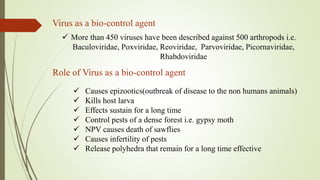
Virus as a bio-control agent
 More than 450 viruses have been described against 500 arthropods i.e.
Baculoviridae, Poxviridae, Reoviridae, Parvoviridae, Picornaviridae,
Rhabdoviridae
Role of Virus as a bio-control agent
 Causes epizootics(outbreak of disease to the non humans animals)
 Kills host larva
 Effects sustain for a long time
 Control pests of a dense forest i.e. gypsy moth
 NPV causes death of sawflies
 Causes infertility of pests
 Release polyhedra that remain for a long time effective
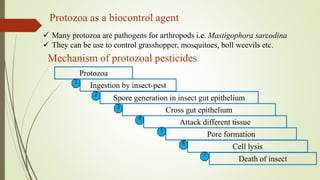
Protozoa as a biocontrol agent
 Many protozoa are pathogens for arthropods i.e. Mastigophora sarcodina
 They can be use to control grasshopper, mosquitoes, boll weevils etc.
Mechanism of protozoal pesticides
Protozoa
Spore generation in insect gut epithelium
Cross gut epithelium
Attack different tissue
Pore formation
Cell lysis
Death of insect
Ingestion by insect-pest
2
1
4
3
5
7
6
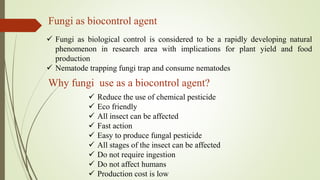
Fungi as biocontrol agent
 Fungi as biological control is considered to be a rapidly developing natural
phenomenon in research area with implications for plant yield and food
production
 Nematode trapping fungi trap and consume nematodes
Why fungi use as a biocontrol agent?
 Reduce the use of chemical pesticide
 Eco friendly
 All insect can be affected
 Fast action
 Easy to produce fungal pesticide
 All stages of the insect can be affected
 Do not require ingestion
 Do not affect humans
 Production cost is low
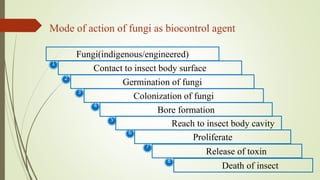
Mode of action of fungi as biocontrol agent
Fungi(indigenous/engineered)
Contact to insect body surface
Germination of fungi
Colonization of fungi
Bore formation
Reach to insect body cavity
Proliferate
Release of toxin
Death of insect
1
4
2
3
7
8
5
6
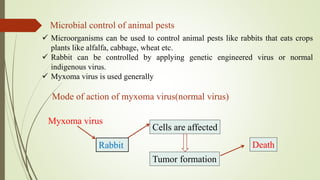
Microbial control of animal pests
 Microorganisms can be used to control animal pests like rabbits that eats crops
plants like alfalfa, cabbage, wheat etc.
 Rabbit can be controlled by applying genetic engineered virus or normal
indigenous virus.
 Myxoma virus is used generally
Mode of action of myxoma virus(normal virus)
Myxoma virus
Rabbit
Cells are affected
Tumor formation
Death
Mechanism of engineered virus to control rabbit population
Rabbit sperm DNA
Myxoma virus
Female rabbit
Produce sperm protein
Develop immunity
No reproduction
Male rabbit
Mating
Sperm
Insertion
Infection
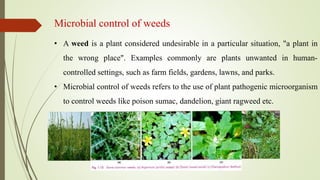
Microbial control of weeds
• A weed is a plant considered undesirable in a particular situation, "a plant in
the wrong place". Examples commonly are plants unwanted in human-
controlled settings, such as farm fields, gardens, lawns, and parks.
• Microbial control of weeds refers to the use of plant pathogenic microorganism
to control weeds like poison sumac, dandelion, giant ragweed etc.
Impact of weeds on agriculture
 Reduce productivity
 Aggressively compete for water, nutrients and sunlight, resulting in reduced
crop yield and poor crop quality
 Outgrow the crops and consume large amount of water and nutrients. Thus
causing heavy losses in yields
 Weeds compete for space both in the rhizosphere and atmosphere
 Transpire more water than most crop plants
 Competition for Solar energy
 Weeds reduce the crop quality
 Weeds reduce the value of the land
 Biological control of wees is the deliberate use of natural enemies to reduce
the density of a particular weed to a tolerable level.
 Biological control method uses one living organism to control another. Bio
agent like insects, pathogens etc. and other animals are used to control weeds
 The objective of biological weed control is not eradication but simply the
reduction of the weed population to an economically low level.
 In fact for biological control to be continuously successful, small numbers of
the weed host must always be present to assured the survival of the natural
enemy
Biological Methods of weed control
Agents of biocontrol of weeds
Generally
 Fungi, bacteria, virus etc.
Bacterial strain for weeds control
 Xanthomonas campestris pv. Poannua
 Pseudomonas syringa pv. tagetis
Process of weed control by biological agents
 A weed becomes a problem as it’s population density is above a threshold at
which it affects the economic or ecological sustainability of the ecosystem.
 Biological agents are released at this point population of biological control
agents build up to very high levels due to the abundance of host plant.
There are 3 types of control weeds
 Classical (inoculative) Biocontrol: It involves the relatively small number of
control agent.
 Inductive biocontrol: In this type of biological control, large quantities of
control agent, generally a pathogen is –applied to weeds and large quantities of
pathogen
 Conversion method : It is an indirect method indirect method which manipulate
habitat around the weeds with aim of encouraging those that life taw law
Microbial Control of cyanobacterial blooms
• Cyanobacteria, also known as blue-green algae are found in the oldest known
fossils, dating back 3.5 billion years
• Cyanobacteria (blue-green algae) are microscopic bacteria found in freshwater
lakes, streams, oceans, damp soil, moistened rocks and even sloth fur
• Cyanobacterial blooms can lead to a depletion of oxygen in the water, a release
of toxins, as well as taste and odor problems
Why we need to Control cyanobacterial blooms?
• Causes nutrient pollution
• Promote eutrophication
• Damage the water ecosystem
• Promote cyanotoxin
• Kills fish
• Causes Septic odor
• Loss of recreational space
• Increase water treatment cost
• Increase BOD
• Decrease DO
• Hurt industry that depend on clean water
Bio Control methods of cyanobacterial blooms
Agents:
• Virus
• Fungi
• Cyanophage
• aquatic myxobacteria
• Cyanophages or other biocontrol agents are directly applied to the water bodies
to control cyanobacterial blooms. Cyanophages incorporate their genetic
materials to the algae body and break down the genetic materials of algae and
diminish them from water.
Genetic engineering in biocontrol
• Genetic engineering approaches can be effectively used to control
insect-pests
• Production of engineered baculo virus is example of this approach
Genetic engineering of virus to control insect: A process of
engineered Baculo virus production
i. Isolation of virulence gene
ii. Incorporation of virulence gene into the virus
iii. Selection of successfully engineered virus
i. Isolation of gene:
Diuretic hormone gene and juvenile hormone esterase genes are isolated
from tobacco plants.
ii. Incorporation of virulence gene into the virus
• Promoter of the polyhedron gene is upregulated with the incorporation
of foreign gene.
• Insectotoxin -1 gene also expressed to improve infectivity
• Both pohl and jvh gene are inserted along with the above genes
iii. Selection of transformed virus
• The engineered viruses are selected based on some molecular techniques
like DNA microarray, ELISA etc.
Mechanism of action:
Basically this virus disrupt the osmotic balance of the host insect and
kills them.
Future of genetic engineering in biological control
 Multi Bt gene insertion
 Genetically engineered insect for pest control
 Introducing lethal genes to insects causing death to the female
moths
 Modified mosquito
 Gene driving
 Self limiting insect production for pest control
Thank you.

microbialcontrol-group02-190505151538.pdf

  • 1.
    Presentation on MicrobialControl Md. Chayan Ali chayanali7@gmail.com Biotechnology & Genetic Engineering Islamic University- Kushtia, Bangladesh
  • 2.
    Contents of thisslide  Definition of microbial control  Importance of biological or microbial control  Microbial control of insect pests Bacteria as control agent Virus as control agents Protozoa as control agents Fungi as control agent  Microbial control of animal pests  Microbial control of weeds  Microbial control of cyanobacterial blooms  Genetic engineering in biological control
  • 3.
    Microbial control: Microbialcontrol refers to the use of pathogenic microbes to control insects-pest, animal pests, weeds, algae, predators etc. Possible agents: Virus : Baculoviridae, Poxviridae, Reoviridae, Parvoviridae, Picornaviridae, Rhabdoviridae Bacteria: Bacillus popiliae, B. thuringiensis, B. lentimorbus, C. malacosome, P. aeruginosa, P. azotoformans Fungi: Beauveria, metarrhizium, Entomophthora, Entomophaga maimaga, Hirsetulla etc. Protozoa: Mastigophora sarcodina
  • 4.
    Importance of biologicalor microbial control  Environmental friendly  Specific to the particular host  Ability to multiply in host  Cheap after startup  Can be use year round  No problems with poisoning  Cost, benefit ratio is higher  Low or no pathogenicity to the nature fauna  No problems of cross resistance  Contribute to the recovery of biological property of soils  No residue problems  Can be exercised in a wide area  Safe for human and animals  Possibility to apply in dense forest
  • 5.
    Bacteria as abio-control agent  Plant pathogenic bacteria are very useful in controlling insect-pests  Bacillus thuringiensis are most useful insect controlling agent  Plant pathogenic bacteria are very useful in controlling insect-pests  Bacillus thuringiensis are most useful insect controlling agent  Four toxic substance are produce by Bacillus thurengienesis  The main component of procrystalline inclusions are polypeptides 130 to 140 kilodaltons in size. These molecules are termed protoxins.  They are solubilized in the alkaline midgut of susceptible insect larvae, realizing an active toxin estimated to have a size of 30-40 kDa. Activated toxin binds to the convoluted brush border membranes of the columnar cells of the insect midgut epithelium. Binding of bt toxin affects osmoregulation and specifically alters the flux of potassium ions across the epithelium midgut .
  • 6.
    Mechanism of actionof BT toxin- Insect Pro toxin in insect gut Eat plant tissue Activated toxin by protease Oligomerization Pore formation Gut cell paralyzed Rupture gut epithelial cell Death of insect 1 3 2 5 4 6 8 7 9
  • 7.
    Virus as abio-control agent  More than 450 viruses have been described against 500 arthropods i.e. Baculoviridae, Poxviridae, Reoviridae, Parvoviridae, Picornaviridae, Rhabdoviridae Role of Virus as a bio-control agent  Causes epizootics(outbreak of disease to the non humans animals)  Kills host larva  Effects sustain for a long time  Control pests of a dense forest i.e. gypsy moth  NPV causes death of sawflies  Causes infertility of pests  Release polyhedra that remain for a long time effective
  • 8.
    Protozoa as abiocontrol agent  Many protozoa are pathogens for arthropods i.e. Mastigophora sarcodina  They can be use to control grasshopper, mosquitoes, boll weevils etc. Mechanism of protozoal pesticides Protozoa Spore generation in insect gut epithelium Cross gut epithelium Attack different tissue Pore formation Cell lysis Death of insect Ingestion by insect-pest 2 1 4 3 5 7 6
  • 9.
    Fungi as biocontrolagent  Fungi as biological control is considered to be a rapidly developing natural phenomenon in research area with implications for plant yield and food production  Nematode trapping fungi trap and consume nematodes Why fungi use as a biocontrol agent?  Reduce the use of chemical pesticide  Eco friendly  All insect can be affected  Fast action  Easy to produce fungal pesticide  All stages of the insect can be affected  Do not require ingestion  Do not affect humans  Production cost is low
  • 10.
    Mode of actionof fungi as biocontrol agent Fungi(indigenous/engineered) Contact to insect body surface Germination of fungi Colonization of fungi Bore formation Reach to insect body cavity Proliferate Release of toxin Death of insect 1 4 2 3 7 8 5 6
  • 11.
    Microbial control ofanimal pests  Microorganisms can be used to control animal pests like rabbits that eats crops plants like alfalfa, cabbage, wheat etc.  Rabbit can be controlled by applying genetic engineered virus or normal indigenous virus.  Myxoma virus is used generally Mode of action of myxoma virus(normal virus) Myxoma virus Rabbit Cells are affected Tumor formation Death
  • 12.
    Mechanism of engineeredvirus to control rabbit population Rabbit sperm DNA Myxoma virus Female rabbit Produce sperm protein Develop immunity No reproduction Male rabbit Mating Sperm Insertion Infection
  • 13.
    Microbial control ofweeds • A weed is a plant considered undesirable in a particular situation, "a plant in the wrong place". Examples commonly are plants unwanted in human- controlled settings, such as farm fields, gardens, lawns, and parks. • Microbial control of weeds refers to the use of plant pathogenic microorganism to control weeds like poison sumac, dandelion, giant ragweed etc.
  • 14.
    Impact of weedson agriculture  Reduce productivity  Aggressively compete for water, nutrients and sunlight, resulting in reduced crop yield and poor crop quality  Outgrow the crops and consume large amount of water and nutrients. Thus causing heavy losses in yields  Weeds compete for space both in the rhizosphere and atmosphere  Transpire more water than most crop plants  Competition for Solar energy  Weeds reduce the crop quality  Weeds reduce the value of the land
  • 15.
     Biological controlof wees is the deliberate use of natural enemies to reduce the density of a particular weed to a tolerable level.  Biological control method uses one living organism to control another. Bio agent like insects, pathogens etc. and other animals are used to control weeds  The objective of biological weed control is not eradication but simply the reduction of the weed population to an economically low level.  In fact for biological control to be continuously successful, small numbers of the weed host must always be present to assured the survival of the natural enemy Biological Methods of weed control
  • 16.
    Agents of biocontrolof weeds Generally  Fungi, bacteria, virus etc. Bacterial strain for weeds control  Xanthomonas campestris pv. Poannua  Pseudomonas syringa pv. tagetis
  • 17.
    Process of weedcontrol by biological agents  A weed becomes a problem as it’s population density is above a threshold at which it affects the economic or ecological sustainability of the ecosystem.  Biological agents are released at this point population of biological control agents build up to very high levels due to the abundance of host plant. There are 3 types of control weeds  Classical (inoculative) Biocontrol: It involves the relatively small number of control agent.  Inductive biocontrol: In this type of biological control, large quantities of control agent, generally a pathogen is –applied to weeds and large quantities of pathogen  Conversion method : It is an indirect method indirect method which manipulate habitat around the weeds with aim of encouraging those that life taw law
  • 18.
    Microbial Control ofcyanobacterial blooms • Cyanobacteria, also known as blue-green algae are found in the oldest known fossils, dating back 3.5 billion years • Cyanobacteria (blue-green algae) are microscopic bacteria found in freshwater lakes, streams, oceans, damp soil, moistened rocks and even sloth fur • Cyanobacterial blooms can lead to a depletion of oxygen in the water, a release of toxins, as well as taste and odor problems Why we need to Control cyanobacterial blooms? • Causes nutrient pollution • Promote eutrophication • Damage the water ecosystem • Promote cyanotoxin • Kills fish • Causes Septic odor
  • 19.
    • Loss ofrecreational space • Increase water treatment cost • Increase BOD • Decrease DO • Hurt industry that depend on clean water
  • 20.
    Bio Control methodsof cyanobacterial blooms Agents: • Virus • Fungi • Cyanophage • aquatic myxobacteria • Cyanophages or other biocontrol agents are directly applied to the water bodies to control cyanobacterial blooms. Cyanophages incorporate their genetic materials to the algae body and break down the genetic materials of algae and diminish them from water.
  • 21.
    Genetic engineering inbiocontrol • Genetic engineering approaches can be effectively used to control insect-pests • Production of engineered baculo virus is example of this approach Genetic engineering of virus to control insect: A process of engineered Baculo virus production i. Isolation of virulence gene ii. Incorporation of virulence gene into the virus iii. Selection of successfully engineered virus
  • 22.
    i. Isolation ofgene: Diuretic hormone gene and juvenile hormone esterase genes are isolated from tobacco plants. ii. Incorporation of virulence gene into the virus • Promoter of the polyhedron gene is upregulated with the incorporation of foreign gene. • Insectotoxin -1 gene also expressed to improve infectivity • Both pohl and jvh gene are inserted along with the above genes
  • 23.
    iii. Selection oftransformed virus • The engineered viruses are selected based on some molecular techniques like DNA microarray, ELISA etc. Mechanism of action: Basically this virus disrupt the osmotic balance of the host insect and kills them.
  • 24.
    Future of geneticengineering in biological control  Multi Bt gene insertion  Genetically engineered insect for pest control  Introducing lethal genes to insects causing death to the female moths  Modified mosquito  Gene driving  Self limiting insect production for pest control
  • 25.