NATIONAL
MATHEMATICS
PROGRAM
INTERIOR AND EXTERIOR ANGLE
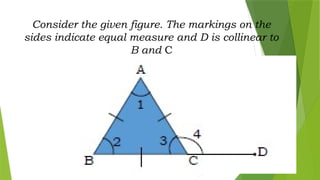
Consider the given figure. The markings on the
sides indicate equal measure and D is collinear to
B and C
Consider the given figure. The markings on the
sides indicate equal measure and D is collinear to
B and C
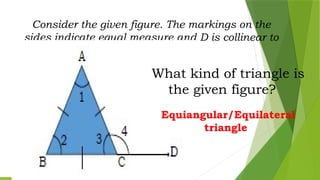
What kind of triangle is
the given figure?
Equiangular/Equilateral
triangle
Consider the given figure. The markings on the
sides indicate equal measure and D is collinear to
B and C
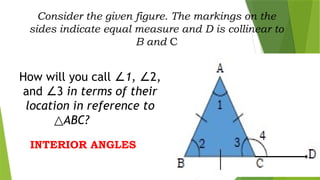
How will you call ∠1, 2,
∠
and 3
∠ in terms of their
location in reference to
△ABC?
INTERIOR ANGLES
Consider the given figure. The markings on the
sides indicate equal measure and D is collinear to
B and C
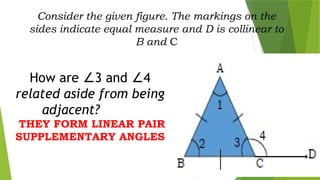
How are 3 and 4
∠ ∠
related aside from being
adjacent?
THEY FORM LINEAR PAIR
SUPPLEMENTARY ANGLES
Consider the given figure. The markings on the
sides indicate equal measure and D is collinear to
B and C
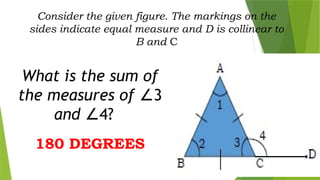
What is the sum of
the measures of 3
∠
and 4?
∠
180 DEGREES
Consider the given figure. The markings on the
sides indicate equal measure and D is collinear to
B and C
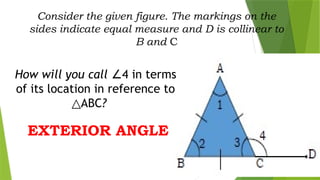
How will you call 4 in terms
∠
of its location in reference to
ABC
△ ?
EXTERIOR ANGLE
Unlock the mathematical term/phrase by
completing the statements.
Choose the term or phrase in the box.
extended Exterior angle
vertex adjacent Interior
angle interior
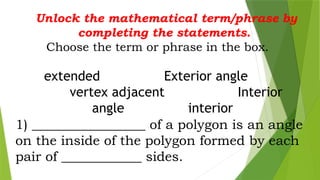
1) _________________ of a polygon is an angle
on the inside of the polygon formed by each
pair of ____________ sides.
Unlock the mathematical term/phrase by
completing the statements.
Choose the term or phrase in the box.
extended Exterior angle
vertex adjacent Interior
angle interior
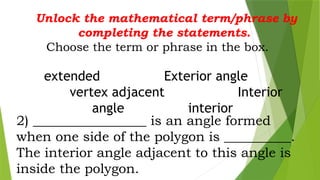
2) _________________ is an angle formed
when one side of the polygon is __________.
The interior angle adjacent to this angle is
inside the polygon.
Unlock the mathematical term/phrase by
completing the statements.
Choose the term or phrase in the box.
extended Exterior angle
vertex adjacent Interior
angle interior
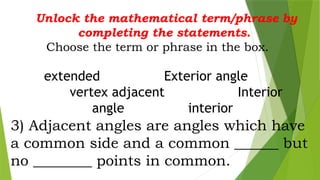
3) Adjacent angles are angles which have
a common side and a common ______ but
no ________ points in common.
REMEMBER:
An exterior angle of a polygon is
formed when one side of the
polygon is extended. The interior
angle adjacent to this exterior
angle is inside the polygon.
ACTIVITY:
The Secrets of Polygons
In a small village named Shapeville, lived Mr. and Mrs.
Polygons. Their house was uniquely shaped like a
pentagon. They were beloved by their neighborhood for
their warmth and their love of Geometry. When one day,
they woke up mystically puzzled to find the neighboring
houses were disarranged. The neighboring houses, each
representing different shapes – triangles, squares,
pentagon, and circle.
ACTIVITY:
The Secrets of Polygons
It seemed that someone had rearranged the houses
overnight creating chaos and confusion. Mr. and Mrs.
Polygons are determined to restore the order realizing
that their mischievous neighbor, Mr. Circle, had
playfully rearranged the houses as a prank. Using their
understanding of shapes and angles, they restore
Shapeville and placed “triangle” adjacent to their house.
GUIDE QUESTIONS:
1.How did Mr. and Mrs. Polygons use their knowledge of
shapes and angles to solve the mystery?
2.Sketch the house of Mr. and Mrs. Polygons and the triangle
adjacent to their house.
3.Is there an angle formed between a side and an extension
of an adjacent side of the pentagon? How will you call this
angle?
4. Describe the neighborhood of Shapeville.
5. Who was behind the chaos in Shapeville?
6.Is circle a polygon? Why or why not?
POSSIBLE ANSWERS:
 They used their understanding of angles and geometric properties to
analyze the positions and orientations of the houses relative to each
other
 Yes, exterior angle
 The houses were uniquely shaped. Each was designed to represent a
different geometric shape such as triangles, squares, pentagons, and
circles.
 Mr. Circle
 Circle is not a polygon because a polygon is made up of straight-line
segments connected to form a closed shape, while a circle is a
continuous curve with no straight sides.

NATIONAL MATHEMATICS PROGRAM DAY 3.pptx

  • 1.
  • 2.
    Consider the givenfigure. The markings on the sides indicate equal measure and D is collinear to B and C
  • 3.
    Consider the givenfigure. The markings on the sides indicate equal measure and D is collinear to B and C What kind of triangle is the given figure? Equiangular/Equilateral triangle
  • 4.
    Consider the givenfigure. The markings on the sides indicate equal measure and D is collinear to B and C How will you call ∠1, 2, ∠ and 3 ∠ in terms of their location in reference to △ABC? INTERIOR ANGLES
  • 5.
    Consider the givenfigure. The markings on the sides indicate equal measure and D is collinear to B and C How are 3 and 4 ∠ ∠ related aside from being adjacent? THEY FORM LINEAR PAIR SUPPLEMENTARY ANGLES
  • 6.
    Consider the givenfigure. The markings on the sides indicate equal measure and D is collinear to B and C What is the sum of the measures of 3 ∠ and 4? ∠ 180 DEGREES
  • 7.
    Consider the givenfigure. The markings on the sides indicate equal measure and D is collinear to B and C How will you call 4 in terms ∠ of its location in reference to ABC △ ? EXTERIOR ANGLE
  • 8.
    Unlock the mathematicalterm/phrase by completing the statements. Choose the term or phrase in the box. extended Exterior angle vertex adjacent Interior angle interior 1) _________________ of a polygon is an angle on the inside of the polygon formed by each pair of ____________ sides.
  • 9.
    Unlock the mathematicalterm/phrase by completing the statements. Choose the term or phrase in the box. extended Exterior angle vertex adjacent Interior angle interior 2) _________________ is an angle formed when one side of the polygon is __________. The interior angle adjacent to this angle is inside the polygon.
  • 10.
    Unlock the mathematicalterm/phrase by completing the statements. Choose the term or phrase in the box. extended Exterior angle vertex adjacent Interior angle interior 3) Adjacent angles are angles which have a common side and a common ______ but no ________ points in common.
  • 11.
    REMEMBER: An exterior angleof a polygon is formed when one side of the polygon is extended. The interior angle adjacent to this exterior angle is inside the polygon.
  • 12.
    ACTIVITY: The Secrets ofPolygons In a small village named Shapeville, lived Mr. and Mrs. Polygons. Their house was uniquely shaped like a pentagon. They were beloved by their neighborhood for their warmth and their love of Geometry. When one day, they woke up mystically puzzled to find the neighboring houses were disarranged. The neighboring houses, each representing different shapes – triangles, squares, pentagon, and circle.
  • 13.
    ACTIVITY: The Secrets ofPolygons It seemed that someone had rearranged the houses overnight creating chaos and confusion. Mr. and Mrs. Polygons are determined to restore the order realizing that their mischievous neighbor, Mr. Circle, had playfully rearranged the houses as a prank. Using their understanding of shapes and angles, they restore Shapeville and placed “triangle” adjacent to their house.
  • 14.
    GUIDE QUESTIONS: 1.How didMr. and Mrs. Polygons use their knowledge of shapes and angles to solve the mystery? 2.Sketch the house of Mr. and Mrs. Polygons and the triangle adjacent to their house. 3.Is there an angle formed between a side and an extension of an adjacent side of the pentagon? How will you call this angle? 4. Describe the neighborhood of Shapeville. 5. Who was behind the chaos in Shapeville? 6.Is circle a polygon? Why or why not?
  • 15.
    POSSIBLE ANSWERS:  Theyused their understanding of angles and geometric properties to analyze the positions and orientations of the houses relative to each other  Yes, exterior angle  The houses were uniquely shaped. Each was designed to represent a different geometric shape such as triangles, squares, pentagons, and circles.  Mr. Circle  Circle is not a polygon because a polygon is made up of straight-line segments connected to form a closed shape, while a circle is a continuous curve with no straight sides.

Editor's Notes

  • #2 we are going to derive a conclusion about the relationship between an exterior angle and its adjacent interior angle. This will help us solve problems involving angles in polygons. Consider the given figure. The markings on the sides indicate equal measure.
  • #8 Interior angle of a polygon is an angle on the inside of the polygon formed by each pair of adjacent sides.
  • #9 Exterior angle is an angle formed when one side of the polygon is extended. The interior angle adjacent to this angle is inside the polygon.
  • #10 Adjacent angles are angles which have a common side and a common vertex but no interior points in common.