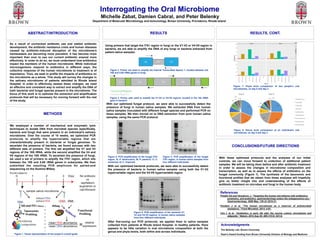
Interrogating the Oral Microbiome
Acknowledgments
The Belenky Lab, Brown University
Dean’s Award funding from Brown University Division of Biology and Medicine
Michelle Zabat, Damien Cabral, and Peter Belenky
References
Preidis GA and Versalovic J. “Targeting the human microbiome with antibiotics,
probiotics, and prebiotics: gastroenterology enters the metagenomics era.”
Gastroenterology. 2009 May; 136 (3) 2015-31.
Penders J et al. “The human microbiome as a reservoir of antimicrobial
resistance.” Front Microbiol. 2013; 4:87.
Cho I, et al. “Antibiotics in early life alter the murine colonic microbiome and
adiposity.” Nature. 2012 Aug 30; 488 (7413): 621-6.
ABSTRACT/INTRODUCTION
As a result of unchecked antibiotic use and stalled antibiotic
development, the antibiotic resistance crisis and human diseases
caused by antibiotic-induced disruption of the microbiome’s
homeostasis are becoming more prevalent. it has become more
important than ever to use our current antibiotic arsenal more
effectively. In order to do so, we must understand how antibiotics
impact the members of the human microbiome. While individual
microorganisms respond to antibiotics in different ways, the
collective response of the human microbiome to treatment is of
importance. Thus, we seek to profile the impacts of antibiotics on
the microbiome as a whole. This study will survey the changes in
the salivary microbiome of patients admitted to Rhode Island
Hospital. In order to effectively assess these changes, we need
an effective and consistent way to extract and amplify the DNA of
both bacterial and fungal species present in the microbiome. The
focus of this work is to optimize the extraction and amplification
protocols that will be necessary for moving forward with the rest
of the study.
METHODS
We employed a number of mechanical and enzymatic lysis
techniques to isolate DNA from microbial species (specifically,
bacteria and fungi) that were present in an individual’s salivary
microbiome. Over the course of 10 weeks, we optimized PCR
protocols to amplify the hypervariable regions that are
characteristically present in bacterial or fungal genomes. To
ascertain the presence of bacteria, we found success with two
different sets of primers. The first set amplified the V1 and V2
regions of the 16S rRNA, while the second amplified the V4 and
V5 regions of the 16S rRNA. To ascertain the presence of fungi,
we used a set of primers to amplify the ITS1 region, which sits
between the 18S and 5.8S rRNA genes in eukaryotes. We then
submitted the resulting PCR amplicons for paired-end
sequencing on the Illumina MiSeq.
RESULTS
With our optimized fungal protocol, we were able to successfully detect the
presence of fungi in human saliva samples. We extracted DNA from human
saliva samples inoculated with different fungal species and performed PCR on
these samples. We then moved on to DNA extraction from pure human saliva
samples, using the same PCR protocol.
CONCLUSIONS/FUTURE DIRECTIONS
Department of Molecular Microbiology and Immunology, Brown University, Providence, Rhode Island
Figure 4. PCR amplification of the fungal ITS1
region. A) P. destructans; B) P. pastoris; C) C.
lusitaniae; D) C. tropicalis
Figure 5. PCR amplification of the fungal
ITS1 region, in human saliva samples from
four different individuals
With our optimized bacterial protocols, we were able to successfully detect
the presence of bacteria in human saliva samples using both the V1-V2
hypervariable region and the V4-V5 hypervariable region.
Figure 6. PCR amplification of the bacterial V1-
V2 and V4-V5 regions, in human saliva samples
from four different individuals
RESULTS, CONT.
After fine-tuning our PCR protocols, we applied them to saliva samples
collected from patients at Rhode Island Hospital. In healthy patients, there
appears to be little variation in oral microbiome composition at both the
genus and phyla levels, both within and across individuals.
Figure 1. Visual representation of the project’s overall goals
Figure 3. Primer sets used to amplify the V1-V2 or V4-V5 regions, located in the 16s rRNA
gene in bacteria
Figure 2. Primer set used to amplify the Internal Transcribed Spacer 1, located between the
18S and 5.8S rRNA genes in fungi
Using primers that target the ITS1 region in fungi or the V1-V2 or V4-V5 region in
bacteria, we are able to amplify the DNA of any fungi or bacteria extracted from
patient saliva samples.
Figure 7. Phyla level comparison of two people’s oral
microbiomes, on day 0 and day 3
Figure 8. Genus level comparison of an individual’s oral
microbiome, on day 0 and day 3
With these optimized protocols and the analyses of our initial
controls, we can move forward to collection of additional patient
samples. We will be taking them before and after antibiotic treatment
in order to assess the changes in microbiome composition and
transcription, as well as to assess the effects of antibiotics on the
fungal community (Figure 1). The synthesis of the taxonomic and
functional profiles that we obtain from these analyses will hopefully
give us better insight into and understanding of the effects of
antibiotic treatment on microbes and fungi in the human body.

Michelle Poster Draft

  • 1.
    Interrogating the OralMicrobiome Acknowledgments The Belenky Lab, Brown University Dean’s Award funding from Brown University Division of Biology and Medicine Michelle Zabat, Damien Cabral, and Peter Belenky References Preidis GA and Versalovic J. “Targeting the human microbiome with antibiotics, probiotics, and prebiotics: gastroenterology enters the metagenomics era.” Gastroenterology. 2009 May; 136 (3) 2015-31. Penders J et al. “The human microbiome as a reservoir of antimicrobial resistance.” Front Microbiol. 2013; 4:87. Cho I, et al. “Antibiotics in early life alter the murine colonic microbiome and adiposity.” Nature. 2012 Aug 30; 488 (7413): 621-6. ABSTRACT/INTRODUCTION As a result of unchecked antibiotic use and stalled antibiotic development, the antibiotic resistance crisis and human diseases caused by antibiotic-induced disruption of the microbiome’s homeostasis are becoming more prevalent. it has become more important than ever to use our current antibiotic arsenal more effectively. In order to do so, we must understand how antibiotics impact the members of the human microbiome. While individual microorganisms respond to antibiotics in different ways, the collective response of the human microbiome to treatment is of importance. Thus, we seek to profile the impacts of antibiotics on the microbiome as a whole. This study will survey the changes in the salivary microbiome of patients admitted to Rhode Island Hospital. In order to effectively assess these changes, we need an effective and consistent way to extract and amplify the DNA of both bacterial and fungal species present in the microbiome. The focus of this work is to optimize the extraction and amplification protocols that will be necessary for moving forward with the rest of the study. METHODS We employed a number of mechanical and enzymatic lysis techniques to isolate DNA from microbial species (specifically, bacteria and fungi) that were present in an individual’s salivary microbiome. Over the course of 10 weeks, we optimized PCR protocols to amplify the hypervariable regions that are characteristically present in bacterial or fungal genomes. To ascertain the presence of bacteria, we found success with two different sets of primers. The first set amplified the V1 and V2 regions of the 16S rRNA, while the second amplified the V4 and V5 regions of the 16S rRNA. To ascertain the presence of fungi, we used a set of primers to amplify the ITS1 region, which sits between the 18S and 5.8S rRNA genes in eukaryotes. We then submitted the resulting PCR amplicons for paired-end sequencing on the Illumina MiSeq. RESULTS With our optimized fungal protocol, we were able to successfully detect the presence of fungi in human saliva samples. We extracted DNA from human saliva samples inoculated with different fungal species and performed PCR on these samples. We then moved on to DNA extraction from pure human saliva samples, using the same PCR protocol. CONCLUSIONS/FUTURE DIRECTIONS Department of Molecular Microbiology and Immunology, Brown University, Providence, Rhode Island Figure 4. PCR amplification of the fungal ITS1 region. A) P. destructans; B) P. pastoris; C) C. lusitaniae; D) C. tropicalis Figure 5. PCR amplification of the fungal ITS1 region, in human saliva samples from four different individuals With our optimized bacterial protocols, we were able to successfully detect the presence of bacteria in human saliva samples using both the V1-V2 hypervariable region and the V4-V5 hypervariable region. Figure 6. PCR amplification of the bacterial V1- V2 and V4-V5 regions, in human saliva samples from four different individuals RESULTS, CONT. After fine-tuning our PCR protocols, we applied them to saliva samples collected from patients at Rhode Island Hospital. In healthy patients, there appears to be little variation in oral microbiome composition at both the genus and phyla levels, both within and across individuals. Figure 1. Visual representation of the project’s overall goals Figure 3. Primer sets used to amplify the V1-V2 or V4-V5 regions, located in the 16s rRNA gene in bacteria Figure 2. Primer set used to amplify the Internal Transcribed Spacer 1, located between the 18S and 5.8S rRNA genes in fungi Using primers that target the ITS1 region in fungi or the V1-V2 or V4-V5 region in bacteria, we are able to amplify the DNA of any fungi or bacteria extracted from patient saliva samples. Figure 7. Phyla level comparison of two people’s oral microbiomes, on day 0 and day 3 Figure 8. Genus level comparison of an individual’s oral microbiome, on day 0 and day 3 With these optimized protocols and the analyses of our initial controls, we can move forward to collection of additional patient samples. We will be taking them before and after antibiotic treatment in order to assess the changes in microbiome composition and transcription, as well as to assess the effects of antibiotics on the fungal community (Figure 1). The synthesis of the taxonomic and functional profiles that we obtain from these analyses will hopefully give us better insight into and understanding of the effects of antibiotic treatment on microbes and fungi in the human body.