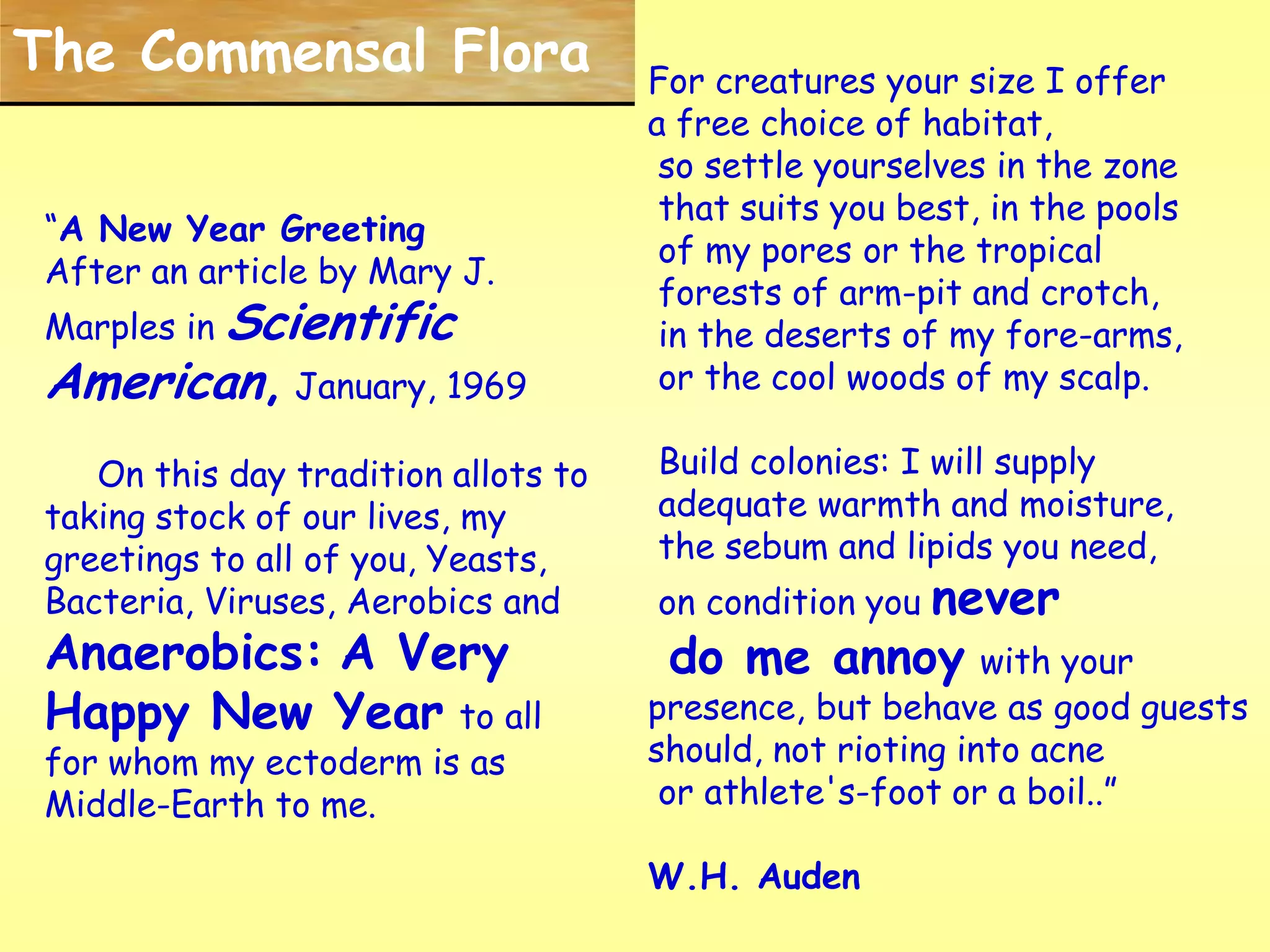

The Commensal FloraFor creatures your size I offera free choice of habitat, so settle yourselves in the zone that suits you best, in the pools of my pores or the tropical forests of arm-pit and crotch, in the deserts of my fore-arms, or the cool woods of my scalp. Build colonies: I will supply adequate warmth and moisture, the sebum and lipids you need, on condition you never do me annoywith your presence, but behave as good guests should, not rioting into acne or athlete's-foot or a boil..” W.H. Auden“A New Year GreetingAfter an article by Mary J. Marples in Scientific American, January, 1969     On this day tradition allots to taking stock of our lives, my greetings to all of you, Yeasts, Bacteria, Viruses, Aerobics and Anaerobics:A Very Happy New Yearto all for whom my ectoderm is as Middle-Earth to me.
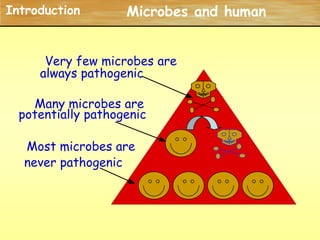
Very few microbes arealways pathogenicMany microbes arepotentially pathogenicMost microbes arenever pathogenicIntroductionMicrobes and human
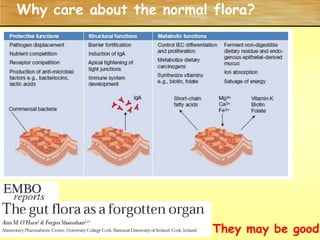
Why care about the normal flora?They may be good
great majority of commensal bacteriaRich in microbial biodiversityMost fairly permanent.Composition varies from individual.Difficult to alter composition of the normal flora of gut in a healthy individual.
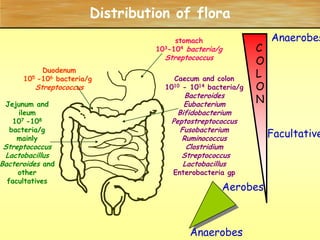
Anaerobesstomach103-104bacteria/g StreptococcusCOLONDuodenum105 -106 bacteria/g StreptococcusCaecum and colon1010 - 1014 bacteria/gBacteroidesEubacteriumBifidobacteriumPeptostreptococcusFusobacteriumRuminococcusClostridium StreptococcusLactobacillusEnterobacteria gpJejunum and ileum107 -108 bacteria/g mainly StreptococcusLactobacillusBacteroides and other facultativesFacultativeAerobesAnaerobesDistribution of flora
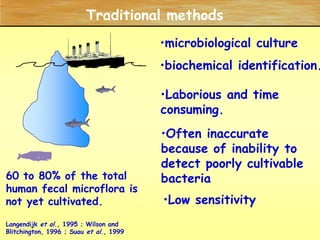
Traditional methodsmicrobiological culture
biochemical identification.
Laborious and time consuming.
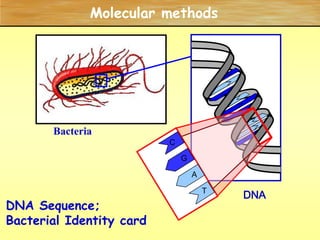
Often inaccurate because of inability to detect poorly cultivable bacteria60 to 80% of the total human fecal microflora is not yet cultivated.Langendijk et al., 1995 ; Wilson and Blitchington, 1996 ; Suau et al., 1999Low sensitivityBacteriaCGATDNAMolecular methodsDNA Sequence;Bacterial Identity card
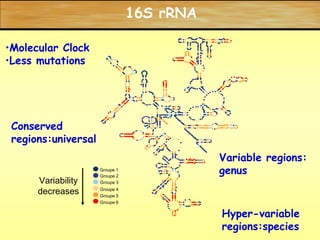
16S rRNAVariability decreasesGroupe 1Groupe 2Groupe 3Groupe 4Groupe 5Groupe 6Molecular Clock
Less mutationsConserved regions:universalVariable regions: genusHyper-variable regions:species
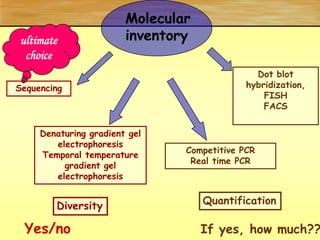
Molecular inventoryDot blot hybridization,FISHFACSSequencingDenaturing gradient gel electrophoresisTemporal temperature gradient gel electrophoresisCompetitive PCRReal time PCRYes/noIf yes, how much??ultimate choiceQuantificationDiversity
COMMENSAL FECAL ANAEROBIC FLORA IN HEALTH AND DISEASERamadass Balamurugan
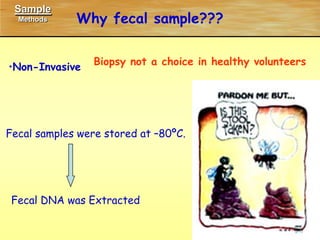
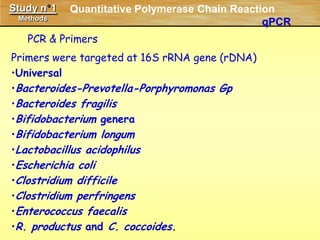
SampleMethodsFecal samples were stored at –80ºC.Fecal DNA was ExtractedWhy fecal sample???Biopsy not a choice in healthy volunteersNon-InvasiveStudy n°1MethodsQuantitative Polymerase Chain Reaction      							qPCRPCR & PrimersPrimers were targeted at 16S rRNA gene (rDNA)Universal
Bacteroides-Prevotella-Porphyromonas Gp
Bacteroides fragilis
Bifidobacterium genera
Bifidobacterium longum
Lactobacillus acidophilus
Escherichia coli
Clostridium difficile
Clostridium perfringens
Enterococcus faecalis
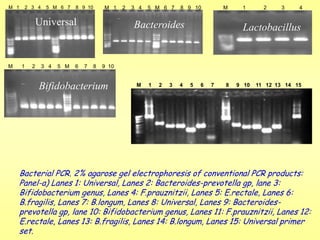
R. productus and C. coccoides.UniversalBacteroidesLactobacillusM     1     2     3     4     5     6     7        8     9   10    11   12  13   14   15BifidobacteriumM   1    2   3   4    5   M   6   7    8   9  10 M      1     2    3   4    5   M    6    7    8    9  10  M          1            2          3          4   M   1    2    3   4    5   M   6   7    8   9   10Bacterial PCR. 2% agarose gel electrophoresis of conventional PCR products: Panel-a) Lanes 1: Universal, Lanes 2: Bacteroides-prevotella gp, lane 3: Bifidobacterium genus, Lanes 4: F.prauznitzii, Lanes 5: E.rectale, Lanes 6: B.fragilis, Lanes 7: B.longum, Lanes 8: Universal, Lanes 9: Bacteroides-prevotella gp, lane 10: Bifidobacterium genus, Lanes 11: F.prauznitzii, Lanes 12: E.rectale, Lanes 13: B.fragilis, Lanes 14: B.longum, Lanes 15: Universal primer set.
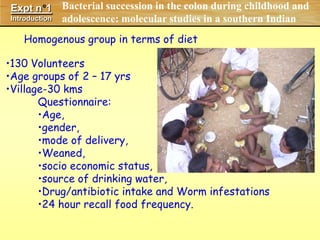
Bacterial succession in the colon during childhood and adolescence: molecular studies in a southern Indian villageExpt n°1Introduction130 Volunteers
Age groups of 2 – 17 yrs
Village-30 kms  Questionnaire:Age,
gender,
mode of delivery,
Weaned,
socio economic status,
source of drinking water,
Drug/antibiotic intake and Worm infestations
24 hour recall food frequency.Homogenous group in terms of diet
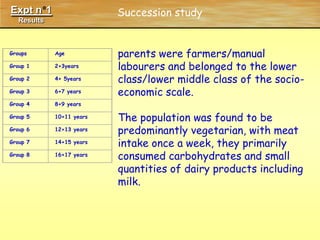
GroupsAgeExpt n°1ResultsSuccession studyGroup 12+3yearsGroup 24+ 5yearsGroup 36+7 yearsGroup 48+9 yearsGroup 510+11 yearsGroup 612+13 yearsGroup 714+15 yearsGroup 816+17 yearsparents were farmers/manual labourers and belonged to the lower class/lower middle class of the socio-economic scale.The population was found to be predominantly vegetarian, with meat intake once a week, they primarily consumed carbohydrates and small quantities of dairy products including milk.
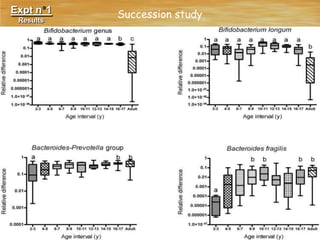
Expt n°1ResultsSuccession study
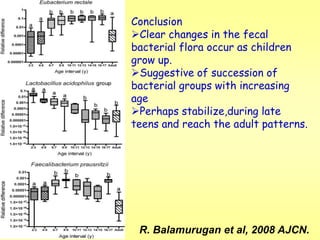
ConclusionClear changes in the fecal bacterial flora occur as children grow up.
Suggestive of succession of bacterial groups with increasing age
Perhaps stabilize,during late teens and reach the adult patterns.R. Balamurugan et al, 2008 AJCN.
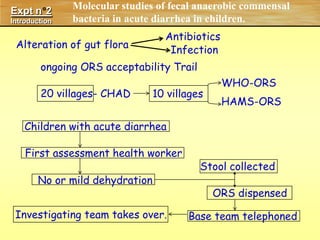
Molecular studies of fecal anaerobic commensal bacteria in acute diarrhea in children.Expt n°2IntroductionAntibiotics20 villages- CHADInfectionChildren with acute diarrheaFirst assessment health workerORS dispensedNo or mild dehydrationStool collectedWHO-ORS10 villagesHAMS-ORSBase team telephonedInvestigating team takes over.Alteration of gut floraongoing ORS acceptability Trail
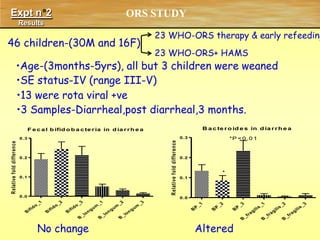
Expt n°2ResultsORS STUDY23 WHO-ORS therapy & early refeeding23 WHO-ORS+ HAMSNo changeAltered46 children-(30M and 16F)Age-(3months-5yrs), all but 3 children were weaned
SE status-IV (range III-V)
13 were rota viral +ve
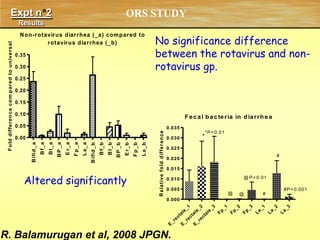
3 Samples-Diarrheal,post diarrheal,3 months.Expt n°2ResultsORS STUDYNo significance difference between the rotavirus and non-rotavirus gp.Altered significantlyR. Balamurugan et al, 2008 JPGN.
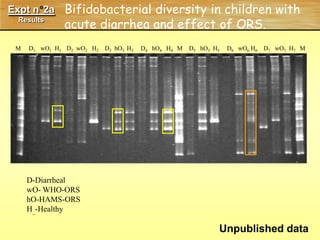
Bifidobacterial diversity in children with acute diarrhea and effect of ORS. M     D1     wO1  H1     D2  wO2   H2      D3  hO3  H3       D4   hO4   H4    MD5   hO5  H5       D6   wO6 H6      D7   wO7  H7    MExpt n°2aResultsD-Diarrheal  wO- WHO-ORShO-HAMS-ORSH_-HealthyUnpublished data
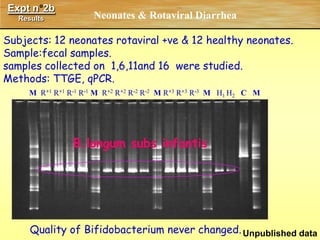
Expt n°2bResultsNeonates & Rotaviral DiarrheaM  R+1R+1R-1R-1 M  R+2R+2R-2R-2  M R+3R+3R-3  M   H1 H2   C   M B.longum subs infantisSubjects: 12 neonates rotaviral +ve & 12 healthy neonates.Sample:fecal samples.samples collected on  1,6,11and 16  were studied.Methods: TTGE, qPCR.Quality of Bifidobacterium never changed.Unpublished data
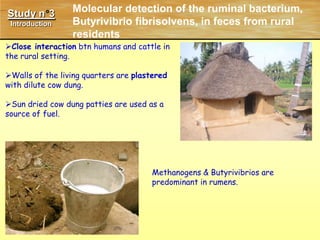
Molecular detection of the ruminal bacterium,Butyrivibrio fibrisolvens, in feces from rural residentsof southern IndiaStudy n°3IntroductionClose interaction btn humans and cattle in the rural setting.
Walls of the living quarters are plastered with dilute cow dung.
Sun dried cow dung patties are used as a source of fuel. Methanogens & Butyrivibrios are predominant in rumens.
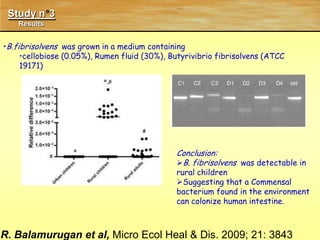
Study n°3ResultsB.fibrisolvens  was grown in a medium containing
cellobiose (0.05%), Rumen fluid (30%), Butyrivibrio fibrisolvens (ATCC 19171)Conclusion:B. fibrisolvens  was detectable in rural children
Suggesting that a Commensal bacterium found in the environment can colonize human intestine.R. Balamurugan et al, Micro Ecol Heal & Dis. 2009; 21: 3843
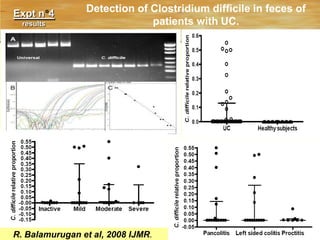
Detection of Clostridium difficile in feces of patients with UC. Expt n°4resultsR. Balamurugan et al, 2008IJMR.
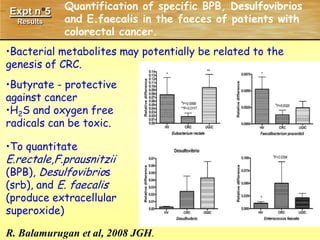
Quantification of specific BPB, Desulfovibrios and E.faecalis in the faeces of patients with colorectal cancer.Expt n°5ResultsBacterial metabolites may potentially be related to the genesis of CRC.
Butyrate - protective against cancer
H2S and oxygen free radicals can be toxic.

Wips

  • 1.
    The Commensal FloraForcreatures your size I offera free choice of habitat, so settle yourselves in the zone that suits you best, in the pools of my pores or the tropical forests of arm-pit and crotch, in the deserts of my fore-arms, or the cool woods of my scalp. Build colonies: I will supply adequate warmth and moisture, the sebum and lipids you need, on condition you never do me annoywith your presence, but behave as good guests should, not rioting into acne or athlete's-foot or a boil..” W.H. Auden“A New Year GreetingAfter an article by Mary J. Marples in Scientific American, January, 1969 On this day tradition allots to taking stock of our lives, my greetings to all of you, Yeasts, Bacteria, Viruses, Aerobics and Anaerobics:A Very Happy New Yearto all for whom my ectoderm is as Middle-Earth to me.
  • 2.
    Very few microbesarealways pathogenicMany microbes arepotentially pathogenicMost microbes arenever pathogenicIntroductionMicrobes and human
  • 3.
    Why care aboutthe normal flora?They may be good
  • 4.
    great majority ofcommensal bacteriaRich in microbial biodiversityMost fairly permanent.Composition varies from individual.Difficult to alter composition of the normal flora of gut in a healthy individual.
  • 5.
    Anaerobesstomach103-104bacteria/g StreptococcusCOLONDuodenum105 -106bacteria/g StreptococcusCaecum and colon1010 - 1014 bacteria/gBacteroidesEubacteriumBifidobacteriumPeptostreptococcusFusobacteriumRuminococcusClostridium StreptococcusLactobacillusEnterobacteria gpJejunum and ileum107 -108 bacteria/g mainly StreptococcusLactobacillusBacteroides and other facultativesFacultativeAerobesAnaerobesDistribution of flora
  • 6.
  • 7.
  • 8.
  • 9.
    Often inaccurate becauseof inability to detect poorly cultivable bacteria60 to 80% of the total human fecal microflora is not yet cultivated.Langendijk et al., 1995 ; Wilson and Blitchington, 1996 ; Suau et al., 1999Low sensitivityBacteriaCGATDNAMolecular methodsDNA Sequence;Bacterial Identity card
  • 10.
    16S rRNAVariability decreasesGroupe1Groupe 2Groupe 3Groupe 4Groupe 5Groupe 6Molecular Clock
  • 11.
    Less mutationsConserved regions:universalVariableregions: genusHyper-variable regions:species
  • 12.
    Molecular inventoryDot blothybridization,FISHFACSSequencingDenaturing gradient gel electrophoresisTemporal temperature gradient gel electrophoresisCompetitive PCRReal time PCRYes/noIf yes, how much??ultimate choiceQuantificationDiversity
  • 13.
    COMMENSAL FECAL ANAEROBICFLORA IN HEALTH AND DISEASERamadass Balamurugan
  • 14.
    SampleMethodsFecal samples werestored at –80ºC.Fecal DNA was ExtractedWhy fecal sample???Biopsy not a choice in healthy volunteersNon-InvasiveStudy n°1MethodsQuantitative Polymerase Chain Reaction qPCRPCR & PrimersPrimers were targeted at 16S rRNA gene (rDNA)Universal
  • 15.
  • 16.
  • 17.
  • 18.
  • 19.
  • 20.
  • 21.
  • 22.
  • 23.
  • 24.
    R. productus andC. coccoides.UniversalBacteroidesLactobacillusM 1 2 3 4 5 6 7 8 9 10 11 12 13 14 15BifidobacteriumM 1 2 3 4 5 M 6 7 8 9 10 M 1 2 3 4 5 M 6 7 8 9 10 M 1 2 3 4 M 1 2 3 4 5 M 6 7 8 9 10Bacterial PCR. 2% agarose gel electrophoresis of conventional PCR products: Panel-a) Lanes 1: Universal, Lanes 2: Bacteroides-prevotella gp, lane 3: Bifidobacterium genus, Lanes 4: F.prauznitzii, Lanes 5: E.rectale, Lanes 6: B.fragilis, Lanes 7: B.longum, Lanes 8: Universal, Lanes 9: Bacteroides-prevotella gp, lane 10: Bifidobacterium genus, Lanes 11: F.prauznitzii, Lanes 12: E.rectale, Lanes 13: B.fragilis, Lanes 14: B.longum, Lanes 15: Universal primer set.
  • 25.
    Bacterial succession inthe colon during childhood and adolescence: molecular studies in a southern Indian villageExpt n°1Introduction130 Volunteers
  • 26.
    Age groups of2 – 17 yrs
  • 27.
    Village-30 kms Questionnaire:Age,
  • 28.
  • 29.
  • 30.
  • 31.
  • 32.
  • 33.
  • 34.
    24 hour recallfood frequency.Homogenous group in terms of diet
  • 35.
    GroupsAgeExpt n°1ResultsSuccession studyGroup12+3yearsGroup 24+ 5yearsGroup 36+7 yearsGroup 48+9 yearsGroup 510+11 yearsGroup 612+13 yearsGroup 714+15 yearsGroup 816+17 yearsparents were farmers/manual labourers and belonged to the lower class/lower middle class of the socio-economic scale.The population was found to be predominantly vegetarian, with meat intake once a week, they primarily consumed carbohydrates and small quantities of dairy products including milk.
  • 36.
  • 37.
    ConclusionClear changes inthe fecal bacterial flora occur as children grow up.
  • 38.
    Suggestive of successionof bacterial groups with increasing age
  • 39.
    Perhaps stabilize,during lateteens and reach the adult patterns.R. Balamurugan et al, 2008 AJCN.
  • 40.
    Molecular studies offecal anaerobic commensal bacteria in acute diarrhea in children.Expt n°2IntroductionAntibiotics20 villages- CHADInfectionChildren with acute diarrheaFirst assessment health workerORS dispensedNo or mild dehydrationStool collectedWHO-ORS10 villagesHAMS-ORSBase team telephonedInvestigating team takes over.Alteration of gut floraongoing ORS acceptability Trail
  • 41.
    Expt n°2ResultsORS STUDY23WHO-ORS therapy & early refeeding23 WHO-ORS+ HAMSNo changeAltered46 children-(30M and 16F)Age-(3months-5yrs), all but 3 children were weaned
  • 42.
  • 43.
    13 were rotaviral +ve
  • 44.
    3 Samples-Diarrheal,post diarrheal,3months.Expt n°2ResultsORS STUDYNo significance difference between the rotavirus and non-rotavirus gp.Altered significantlyR. Balamurugan et al, 2008 JPGN.
  • 45.
    Bifidobacterial diversity inchildren with acute diarrhea and effect of ORS. M D1 wO1 H1 D2 wO2 H2 D3 hO3 H3 D4 hO4 H4 MD5 hO5 H5 D6 wO6 H6 D7 wO7 H7 MExpt n°2aResultsD-Diarrheal wO- WHO-ORShO-HAMS-ORSH_-HealthyUnpublished data
  • 46.
    Expt n°2bResultsNeonates &Rotaviral DiarrheaM R+1R+1R-1R-1 M R+2R+2R-2R-2 M R+3R+3R-3 M H1 H2 C M B.longum subs infantisSubjects: 12 neonates rotaviral +ve & 12 healthy neonates.Sample:fecal samples.samples collected on 1,6,11and 16 were studied.Methods: TTGE, qPCR.Quality of Bifidobacterium never changed.Unpublished data
  • 47.
    Molecular detection ofthe ruminal bacterium,Butyrivibrio fibrisolvens, in feces from rural residentsof southern IndiaStudy n°3IntroductionClose interaction btn humans and cattle in the rural setting.
  • 48.
    Walls of theliving quarters are plastered with dilute cow dung.
  • 49.
    Sun dried cowdung patties are used as a source of fuel. Methanogens & Butyrivibrios are predominant in rumens.
  • 50.
    Study n°3ResultsB.fibrisolvens was grown in a medium containing
  • 51.
    cellobiose (0.05%), Rumenfluid (30%), Butyrivibrio fibrisolvens (ATCC 19171)Conclusion:B. fibrisolvens was detectable in rural children
  • 52.
    Suggesting that aCommensal bacterium found in the environment can colonize human intestine.R. Balamurugan et al, Micro Ecol Heal & Dis. 2009; 21: 3843
  • 53.
    Detection of Clostridiumdifficile in feces of patients with UC. Expt n°4resultsR. Balamurugan et al, 2008IJMR.
  • 54.
    Quantification of specificBPB, Desulfovibrios and E.faecalis in the faeces of patients with colorectal cancer.Expt n°5ResultsBacterial metabolites may potentially be related to the genesis of CRC.
  • 55.
    Butyrate - protectiveagainst cancer
  • 56.
    H2S and oxygenfree radicals can be toxic.