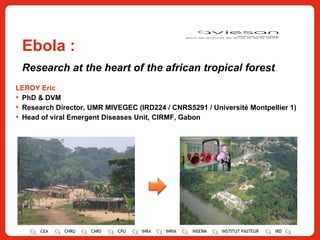
Ebola : Research at the heart of the african tropical forest LEROY Eric PhD & DVM Research Director, UMR MIVEGEC (IRD224 / CNRS5291 / Université Montpellier 1) Head of viral Emergent Diseases Unit, CIRMF, Gabon CEA CHRU CNRS CPU INRA INRIA INSERM INSTITUT PASTEUR IRD
2000 human deaths > 10,000 deaths in gorillas and chimpanzees:  decline of 80% Ebola virus: an emergent pathogen infecting humans and animals Ebola virus: an emergent pathogen Recent discovery (1976) Unique form among virology world  ~ highest lethal pathogens : 80 % mortality within days Lancet  1997;  J Infect Dis  1999;  Science  2004  Lancet  2002; Clin Infect Dis 2006 J Infect Dis 2011; Trans Roy Soc 2011
The fundamentals of the pathogen Emergence 1 Step 1: from the natural host to human Step 2: from exposure to infection 2 Step 3: from human to human 3
Tracking Ebola: from field to lab Outbreak Field investigations In situ  cohort studies: ~ 400 patients Animal trapping Molecular virology, immunological studies BSL4 lab, unique in sub saharian Africa WHO reference center for viral haemorrhagic fevers in Central Africa Field studies Laboratory investigations Human Animal
outbreak direct contact Fruit bat species as Ebola virus reservoir as well as for Marburg virus Multi-emergence into great apes and/or humans with spill over events from bats Massive outbreaks in wild great ape populations with dramatic population decline Step 1 to Emergence: From bats to humans J Infect Dis  2004;  Science  2004;  Nature  2005  ; Emerg Infec Dis  2005 Vect born Zoo Dis  2009;  J Infect Dis  2010
Tracking and following the Ebola virus history for the understanding of its Genomic evolution Viral strains in animals Step 2: From exposure to infection, virus evolution J  Gen Virol  2003;  Science  2004 Proc Natl Acad Sc USA  2008 J Infect Dis  2011 Before Our study Recombinant viruses Lineage  B Lineage  A Genetic characterization of 16 strains among 18 known zaire ebolavirus Two lineages with ancient ancestor  Long lasting circulation in Africa First evidence of recombination Viral strains in great apes
Host response: Deep defective immunity Aberrant innate immunity  : "cytokine storm" & absence of IFN I responses CD3+CD4+ CD3+CD8+ Absence of adaptative immunity 0.7% 11.0% 51.9% 0.9% 72.6% T8 CD95+ T4 CD95+ Fas  mechanism Deep immunosuppression by apoptosis of T cells CTL DCD SURV 12.3% 5.4% 22.4% 43.6% T4 T8 46.2% 24.1%
Pathogenesis: virus replication and superantigen activity ? Nat Med  1999;  Clin Exp immunol  2001  PLoS Neg Trop Dis 2010 J Virol 2011  -actin V  2 V  5.1 V  12 V  1 1 V  7 V  6 V  17 V  16 V  13.2 V  19 Controls Fatal cases Days before death 9  8  7  4  3  2  1  0
Step 3 of Emergence: From humans to humans Routes of transmission From animals From body fluids At the hospital Traditional healer Strategy to control outbreaks: Prevention only Barriers nursing Individual protection
Human asymptomatic infection of Ebola virus EBOV RNA+ EBOV RNA+ detection in PBMC for two weeks EBOV -IgG and -IgM detection three weeks post infection Identical viral strain as for survivors and deceased Strong and early inflammatory responses Real pathogenicity of Ebola virus? Natural protective immunity?  Exposure: fruits with saliva from infected fruit bats ? 7  9  16  23 High overall EBOV -IgG prevalence in Gabon Association with forested areas T cell memory responses
Ebola Origin of massive and rapid apoptosis Vaccine and/or therapeutic development Global surveillance of emergent diseases General survey, tracking of emergent diseases risk Search for animal reservoirs of viruses International research networks and local plateforms Perspectives

3.2 eric leroy

  • 1.
    Ebola : Researchat the heart of the african tropical forest LEROY Eric PhD & DVM Research Director, UMR MIVEGEC (IRD224 / CNRS5291 / Université Montpellier 1) Head of viral Emergent Diseases Unit, CIRMF, Gabon CEA CHRU CNRS CPU INRA INRIA INSERM INSTITUT PASTEUR IRD
  • 2.
    2000 human deaths> 10,000 deaths in gorillas and chimpanzees: decline of 80% Ebola virus: an emergent pathogen infecting humans and animals Ebola virus: an emergent pathogen Recent discovery (1976) Unique form among virology world ~ highest lethal pathogens : 80 % mortality within days Lancet 1997; J Infect Dis 1999; Science 2004 Lancet 2002; Clin Infect Dis 2006 J Infect Dis 2011; Trans Roy Soc 2011
  • 3.
    The fundamentals ofthe pathogen Emergence 1 Step 1: from the natural host to human Step 2: from exposure to infection 2 Step 3: from human to human 3
  • 4.
    Tracking Ebola: fromfield to lab Outbreak Field investigations In situ cohort studies: ~ 400 patients Animal trapping Molecular virology, immunological studies BSL4 lab, unique in sub saharian Africa WHO reference center for viral haemorrhagic fevers in Central Africa Field studies Laboratory investigations Human Animal
  • 5.
    outbreak direct contactFruit bat species as Ebola virus reservoir as well as for Marburg virus Multi-emergence into great apes and/or humans with spill over events from bats Massive outbreaks in wild great ape populations with dramatic population decline Step 1 to Emergence: From bats to humans J Infect Dis 2004; Science 2004; Nature 2005 ; Emerg Infec Dis 2005 Vect born Zoo Dis 2009; J Infect Dis 2010
  • 6.
    Tracking and followingthe Ebola virus history for the understanding of its Genomic evolution Viral strains in animals Step 2: From exposure to infection, virus evolution J Gen Virol 2003; Science 2004 Proc Natl Acad Sc USA 2008 J Infect Dis 2011 Before Our study Recombinant viruses Lineage B Lineage A Genetic characterization of 16 strains among 18 known zaire ebolavirus Two lineages with ancient ancestor Long lasting circulation in Africa First evidence of recombination Viral strains in great apes
  • 7.
    Host response: Deepdefective immunity Aberrant innate immunity : "cytokine storm" & absence of IFN I responses CD3+CD4+ CD3+CD8+ Absence of adaptative immunity 0.7% 11.0% 51.9% 0.9% 72.6% T8 CD95+ T4 CD95+ Fas mechanism Deep immunosuppression by apoptosis of T cells CTL DCD SURV 12.3% 5.4% 22.4% 43.6% T4 T8 46.2% 24.1%
  • 8.
    Pathogenesis: virus replicationand superantigen activity ? Nat Med 1999; Clin Exp immunol 2001 PLoS Neg Trop Dis 2010 J Virol 2011  -actin V  2 V  5.1 V  12 V  1 1 V  7 V  6 V  17 V  16 V  13.2 V  19 Controls Fatal cases Days before death 9 8 7 4 3 2 1 0
  • 9.
    Step 3 ofEmergence: From humans to humans Routes of transmission From animals From body fluids At the hospital Traditional healer Strategy to control outbreaks: Prevention only Barriers nursing Individual protection
  • 10.
    Human asymptomatic infectionof Ebola virus EBOV RNA+ EBOV RNA+ detection in PBMC for two weeks EBOV -IgG and -IgM detection three weeks post infection Identical viral strain as for survivors and deceased Strong and early inflammatory responses Real pathogenicity of Ebola virus? Natural protective immunity? Exposure: fruits with saliva from infected fruit bats ? 7 9 16 23 High overall EBOV -IgG prevalence in Gabon Association with forested areas T cell memory responses
  • 11.
    Ebola Origin ofmassive and rapid apoptosis Vaccine and/or therapeutic development Global surveillance of emergent diseases General survey, tracking of emergent diseases risk Search for animal reservoirs of viruses International research networks and local plateforms Perspectives