SHINING A LIGHT ON VIRUS INFECTION WITH
HIGH-RESOLUTION MICROSCOPY
Roland Remenyi, Hong Zhou#, Ren Sun#, Mark Harris
#: UC Los Angeles
School of Molecular and Cellular Biology
FACULTY OF BIOLOGICAL SCIENCES
Mark Harris Laboratory
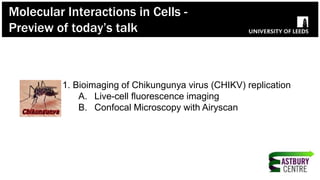
1. Bioimaging of Chikungunya virus (CHIKV) replication
A. Live-cell fluorescence imaging
B. Confocal Microscopy with Airyscan
Molecular Interactions in Cells -
Preview of today’s talk
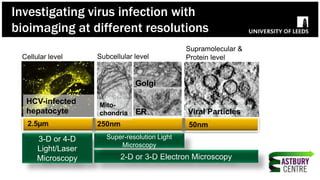
2.5µm 250nm 50nm
Cellular level Subcellular level
Supramolecular &
Protein level
HCV-infected
hepatocyte
Mito-
chondria ER
Golgi
3-D or 4-D
Light/Laser
Microscopy 2-D or 3-D Electron Microscopy
Super-resolution Light
Microscopy
Viral Particles
Investigating virus infection with
bioimaging at different resolutions
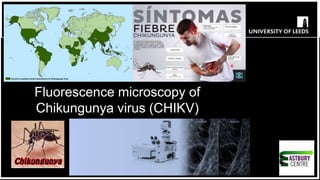
Fluorescence microscopy of
Chikungunya virus (CHIKV)
replication
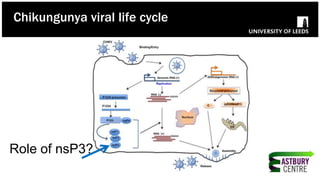
Chikungunya viral life cycle
Role of nsP3?
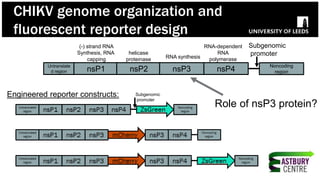
CHIKV genome organization and
fluorescent reporter design
Untranslate
d region nsP1 nsP2 nsP3 nsP4
Noncoding
region
Subgenomic
promoter
(-) strand RNA
Synthesis, RNA
capping
helicase
proteinase
RNA-dependent
RNA
polymeraseRNA synthesis
Engineered reporter constructs: Subgenomic
promoter
Role of nsP3 protein?
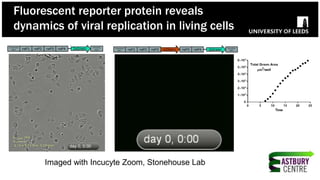
Fluorescent reporter protein reveals
dynamics of viral replication in living cells
Imaged with Incucyte Zoom, Stonehouse Lab
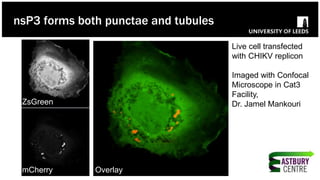
ZsGreen
mCherry Overlay
Live cell transfected
with CHIKV replicon
Imaged with Confocal
Microscope in Cat3
Facility,
Dr. Jamel Mankouri
nsP3 forms both punctae and tubules
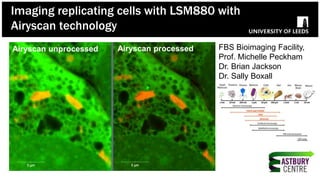
Airyscan unprocessed Airyscan processed FBS Bioimaging Facility,
Prof. Michelle Peckham
Dr. Brian Jackson
Dr. Sally Boxall
Imaging replicating cells with LSM880 with
Airyscan technology
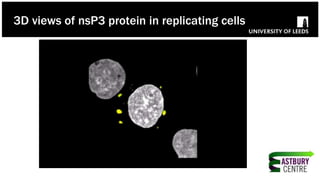
3D views of nsP3 protein in replicating cells
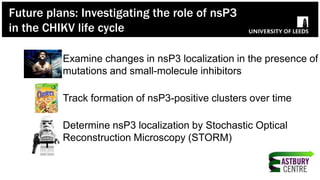
Future plans: Investigating the role of nsP3
in the CHIKV life cycle
Examine changes in nsP3 localization in the presence of
mutations and small-molecule inhibitors
Track formation of nsP3-positive clusters over time
Determine nsP3 localization by Stochastic Optical
Reconstruction Microscopy (STORM)
Charles Rice, Rockefeller
Steven Foung, Stanford
Confocal microscope in Cat3 Facility, Dr. Jamel Mankouri
FBS bioimaging facility, LSM880 Airyscan, Prof. Michelle Peckham, Dr. Brian Jackson, Dr. Sally
Boxall
Incucyte Zoom System, Prof. Nicola Stonehouse
Electron Imaging Center for Nanomachines, Dr. Ivo Atanasov, Dr. Xing Zhang
Advanced Light Microscopy and Spectroscopy Facility, Dr. Laurent Bentolila, Dr. Matt Schibler
Electron Microscopy Laboratory, Dr Sergey Ryazantsev
Reagents
Facilities/Microscopes
Funding
NIH (National Institutes of Health) Virology/Gene therapy training grant
Seed Grant for AIDS Related Malignancy Research
Wellcome Trust Investigator and Multi-user equipment Award
Dr. Hangfei Qi, Dr. Vaithi Arumugaswami (former member)
Ren Sun lab HCV team
Predoctoral Researchers
Tamar Stokelman, Jerry Lo
Francis Chisari, Scripps
California Nanosystems
Institute
University of Leeds
SMCB Virology Chikungunya Team
Dr. Mark Harris, Dr. Andrew Tuplin
Grace Roberts, Lauren Branfield, Raymond Li
Andres Merits, University of Tartu
Dr. Niluka Goonawardane, Dr. Hazel Stewart, Carsten Zothner, Christopher Bartlett, Lorna Kelly, Joseph Lattimer, Tracy
Yin
Harris Lab
Acknowledgements
Contact: r.g.remenyi@leeds.ac.uk
Twitter: rol_rem

Shining a light on virus infection with high-resolution microscopy

  • 1.
    SHINING A LIGHTON VIRUS INFECTION WITH HIGH-RESOLUTION MICROSCOPY Roland Remenyi, Hong Zhou#, Ren Sun#, Mark Harris #: UC Los Angeles School of Molecular and Cellular Biology FACULTY OF BIOLOGICAL SCIENCES Mark Harris Laboratory
  • 2.
    1. Bioimaging ofChikungunya virus (CHIKV) replication A. Live-cell fluorescence imaging B. Confocal Microscopy with Airyscan Molecular Interactions in Cells - Preview of today’s talk
  • 3.
    2.5µm 250nm 50nm Cellularlevel Subcellular level Supramolecular & Protein level HCV-infected hepatocyte Mito- chondria ER Golgi 3-D or 4-D Light/Laser Microscopy 2-D or 3-D Electron Microscopy Super-resolution Light Microscopy Viral Particles Investigating virus infection with bioimaging at different resolutions
  • 4.
    Fluorescence microscopy of Chikungunyavirus (CHIKV) replication
  • 5.
    Chikungunya viral lifecycle Role of nsP3?
  • 6.
    CHIKV genome organizationand fluorescent reporter design Untranslate d region nsP1 nsP2 nsP3 nsP4 Noncoding region Subgenomic promoter (-) strand RNA Synthesis, RNA capping helicase proteinase RNA-dependent RNA polymeraseRNA synthesis Engineered reporter constructs: Subgenomic promoter Role of nsP3 protein?
  • 7.
    Fluorescent reporter proteinreveals dynamics of viral replication in living cells Imaged with Incucyte Zoom, Stonehouse Lab
  • 8.
    ZsGreen mCherry Overlay Live celltransfected with CHIKV replicon Imaged with Confocal Microscope in Cat3 Facility, Dr. Jamel Mankouri nsP3 forms both punctae and tubules
  • 9.
    Airyscan unprocessed Airyscanprocessed FBS Bioimaging Facility, Prof. Michelle Peckham Dr. Brian Jackson Dr. Sally Boxall Imaging replicating cells with LSM880 with Airyscan technology
  • 10.
    3D views ofnsP3 protein in replicating cells
  • 11.
    Future plans: Investigatingthe role of nsP3 in the CHIKV life cycle Examine changes in nsP3 localization in the presence of mutations and small-molecule inhibitors Track formation of nsP3-positive clusters over time Determine nsP3 localization by Stochastic Optical Reconstruction Microscopy (STORM)
  • 12.
    Charles Rice, Rockefeller StevenFoung, Stanford Confocal microscope in Cat3 Facility, Dr. Jamel Mankouri FBS bioimaging facility, LSM880 Airyscan, Prof. Michelle Peckham, Dr. Brian Jackson, Dr. Sally Boxall Incucyte Zoom System, Prof. Nicola Stonehouse Electron Imaging Center for Nanomachines, Dr. Ivo Atanasov, Dr. Xing Zhang Advanced Light Microscopy and Spectroscopy Facility, Dr. Laurent Bentolila, Dr. Matt Schibler Electron Microscopy Laboratory, Dr Sergey Ryazantsev Reagents Facilities/Microscopes Funding NIH (National Institutes of Health) Virology/Gene therapy training grant Seed Grant for AIDS Related Malignancy Research Wellcome Trust Investigator and Multi-user equipment Award Dr. Hangfei Qi, Dr. Vaithi Arumugaswami (former member) Ren Sun lab HCV team Predoctoral Researchers Tamar Stokelman, Jerry Lo Francis Chisari, Scripps California Nanosystems Institute University of Leeds SMCB Virology Chikungunya Team Dr. Mark Harris, Dr. Andrew Tuplin Grace Roberts, Lauren Branfield, Raymond Li Andres Merits, University of Tartu Dr. Niluka Goonawardane, Dr. Hazel Stewart, Carsten Zothner, Christopher Bartlett, Lorna Kelly, Joseph Lattimer, Tracy Yin Harris Lab Acknowledgements Contact: r.g.remenyi@leeds.ac.uk Twitter: rol_rem

Editor's Notes

  • #4 Task: Viruses are intracellular parasites whose pathogenicity depends on the interaction with infected cells. We use a bioimaging approach to investigate infection at different resolutions.
  • #5 Goal: to establish a research portfolio to investigate Chikungunya virus, a re-emerging member of the alphavirus family. It’s transmitted through mosquitoes. Disease occurs in Africa, Asia and the Indian subcontinent, but currently there’s a serious outbreak in Latin America and the Caribbean.
  • #10 This improvement in resolution is achieved by the use of a multichannel area detector with 32 elements –each detector element functions as a single pinhole and allows more light to be collected. This differs from a classical confocal microscope, which illuminates one spot on the sample and employs a single pinhole to reject out of focus light. The size of the pinhole determines how much light reaches the detector, so whilst a smaller pinhole increases resolution, it also means less light gets through and the signal-to-noise ratio (SNR) decreases significantly. By using a series of pinholes, more light is collected in total, maintaining a good SNR, whilst the resolution can be improved by using 32 smaller pinholes in the detector.