MichaelTaft
Research Officer, Unite
 ‘We are a small and very open economy in a world
that has more risks than usual. It makes sense to
complete the task we set ourselves and get to a
balanced budget. It makes sense to continue
reducing our debt to much lower levels and to build
our capacity to withstand shocks. It makes sense to
avoid the mistakes of the past that could lead to
overheating our economy. It is an uncertain world
full of risk and now is not the time to move away
from the prudent and sensible fiscal policy we have
been following.’
- Minister for Finance, Financial Statement, Budget 2017
 When we think of prudence we immediately think of
the conservative orthodoxy. For instance:
 The day after the budget the Irish Fiscal Advisory
Council was out with an instant judgement – claiming
that the tax and spend numbers went ‘beyond what
was prudent and was set to breach key EU rules’.
 The IrishTimes was even more dramatic: ‘The notion
of a prudent Budget appeared threadbare after Michael
Noonan announced a package of measures in the Dáil
stretching the so-called “fiscal space” to near-
destruction.’
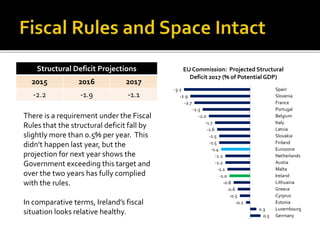
Structural Deficit Projections
2015 2016 2017
-2.2 -1.9 -1.1
There is a requirement under the Fiscal
Rules that the structural deficit fall by
slightly more than 0.5% per year. This
didn’t happen last year, but the
projection for next year shows the
Government exceeding this target and
over the two years has fully complied
with the rules.
In comparative terms, Ireland’s fiscal
situation looks relative healthy.
-3.2
-2.9
-2.7
-2.3
-2.0
-1.7
-1.6
-1.5
-1.5
-1.4
-1.2
-1.2
-1.1
-1.0
-0.8
-0.6
-0.5
-0.2
0.3
0.5
Spain
Slovenia
France
Portugal
Belgium
Italy
Latvia
Slovakia
Finland
Eurozone
Netherlands
Austia
Malta
Ireland
Lithuaina
Greece
Cyrprus
Estonia
Luxembourg
Germany
EU Commission: Projected Structural
Deficit 2017 (% of Potential GDP)
 The issue of fiscal space and fiscal rules has been
over-stated. But critics may have a point about
‘prudence’ even if they are missing the real
target.
 There is a sense of déjà vu about some of this.
 Erosion of tax base
 Pumping property prices
 Reliance of revenue bubbles
 Ill-prepared by Brexit
 Never mind mentioning the ‘A’ word
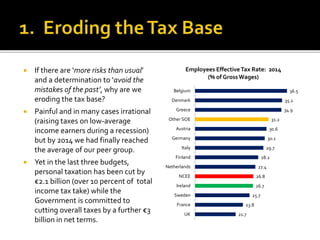
 If there are ‘more risks than usual’
and a determination to ‘avoid the
mistakes of the past’, why are we
eroding the tax base?
 Painful and in many cases irrational
(raising taxes on low-average
income earners during a recession)
but by 2014 we had finally reached
the average of our peer group.
 Yet in the last three budgets,
personal taxation has been cut by
€2.1 billion (over 10 percent of total
income tax take) while the
Government is committed to
cutting overall taxes by a further €3
billion in net terms.
36.5
35.1
34.9
31.2
30.6
30.1
29.7
28.2
27.4
26.8
26.7
25.7
23.8
21.7
Belgium
Denmark
Greece
Other SOE
Austria
Germany
Italy
Finland
Netherlands
NCEE
Ireland
Sweden
France
UK
Employees EffectiveTax Rate: 2014
(% of GrossWages)
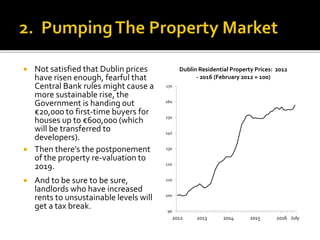
 Not satisfied that Dublin prices
have risen enough, fearful that
Central Bank rules might cause a
more sustainable rise, the
Government is handing out
€20,000 to first-time buyers for
houses up to €600,000 (which
will be transferred to
developers).
 Then there’s the postponement
of the property re-valuation to
2019.
 And to be sure to be sure,
landlords who have increased
rents to unsustainable levels will
get a tax break. 90
100
110
120
130
140
150
160
170
2012 2013 2014 2015 2016 July
Dublin Residential Property Prices: 2012
- 2016 (February 2012 = 100)
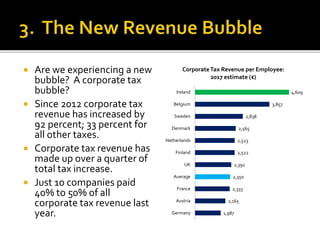
 Are we experiencing a new
bubble? A corporate tax
bubble?
 Since 2012 corporate tax
revenue has increased by
92 percent; 33 percent for
all other taxes.
 Corporate tax revenue has
made up over a quarter of
total tax increase.
 Just 10 companies paid
40% to 50% of all
corporate tax revenue last
year.
4,609
3,857
2,838
2,565
2,523
2,522
2,392
2,350
2,333
2,165
1,987
Ireland
Belgium
Sweden
Denmark
Netherlands
Finland
UK
Average
France
Austria
Germany
CorporateTax Revenue per Employee:
2017 estimate (€)
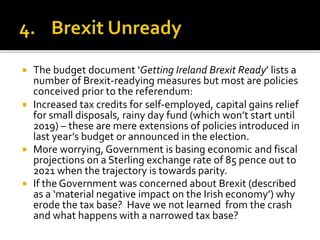
 The budget document ‘Getting Ireland Brexit Ready’ lists a
number of Brexit-readying measures but most are policies
conceived prior to the referendum:
 Increased tax credits for self-employed, capital gains relief
for small disposals, rainy day fund (which won’t start until
2019) – these are mere extensions of policies introduced in
last year’s budget or announced in the election.
 More worrying, Government is basing economic and fiscal
projections on a Sterling exchange rate of 85 pence out to
2021 when the trajectory is towards parity.
 If the Government was concerned about Brexit (described
as a ‘material negative impact on the Irish economy’) why
erode the tax base? Have we not learned from the crash
and what happens with a narrowed tax base?
 One of the biggest potential economic and fiscal impacts – the
Apple ruling - was not mentioned once. The award and the appeal
are a diversion from the real issue: the acceleration of European
coordination on corporate tax avoidance.
 Only weeks before the Apple ruling the EU Parliament
overwhelmingly (nearly 80%) passed a resolution on corporate tax
avoidance, calling for:
 EU register of beneficial owners of companies,
 Action against abuse of “patent box” regimes and transfer pricing
 A common consolidated corporate tax base (CCCTB)
 An EU-wide withholding tax and other measures
 Nessa Childers was the only Irish MEP to support it while the only
party grouping to oppose it was the far-right Europe of Freedom
and Direct Democracy co-chaired by Nigel Farage.
 European cooperation on corporate tax is coming down the
line. What are we going to do?
 Are we going to hide our heads in the sand – like we did
during the property boom – and hope the world doesn’t
notice us?
 Are we going to line up with the far-right in Europe and tax-
dodging multinationals?
 Or are we going to face this issue head-on and start
preparing new policies to attract FDI based on infrastructure,
education, affordable housing and investment?
 No one wins in the global tax avoidance game, it’s just that
some countries lose slower than others. We’re a very slow
loser but a loser nonetheless.
 Progressives have an opportunity to claim the ground of prudent,
rational and common sense fiscal policy.
 During the recession, progressives ceded the macro-economic ground
and did not challenge fiscal contraction on its terms. We mustn’t repeat
this in the battle over the recovery.
 Since the 1960s Ireland has spent more years in a domestic demand
recession than any other EU-15 country bar Spain.
 Right-wing led governments gave us fiscal irrationality prior to the crash;
inflicted irrationality during the recession; and is now preparing a third
wave of irrationality – tax erosion, pumping the property market,
revenue bubble, whistling Brexit and avoiding the tax avoidance train
coming down the line.
 This is our opportunity.
 We need to refine our analysis, ground it in a long-term
framework and, on the way, shed confusions and
misapprehensions. Here are some examples:
 1. The Fiscal Rules that shape fiscal policy are not EU rules
– they are constitutional rules. They cannot be broken.
 2..Let’s soak the rich or at least give them a darn good
splash. But this won’t buy us a free health service or free
education at all levels.
 Only 3% of income earners are above €100,000. And of all
the financial wealth 50% is in pensions/insurance and
another 37% is in highly mobile cash. Soak the rich but
don’t think it will fill a swimming pool.
 3. Is there an inconsistency in claiming we have a housing
emergency (which we do) and at the same time call for
abolition of the property tax and vote to cut property tax
at local level? LPT should be transformed into a
comprehensive property tax, including financial.
 4. We need to build lots of houses; we need to increase
and maintain water investment for a decade; we need to
bring rubbish collection back into public control – but we
can’t assume we can throw all the costs into the ‘general
taxation’ pile.
 We need to examine the full range of financing – tax,
charges, levies, SPVs – and select on the basis of economic
efficiency, social equity and opportunity costs.
 5.We need an honest conversation on personal taxes.
We had the nonsense of the ‘squeezed middle’ even
though the median income is between €27,000 and
€33,000 depending on how it is measured.
 Many claim we are high-taxed, citing the marginal tax
rate on average income earners (3rd highest in the EU-
15) but conveniently forget to mention that the
average tax rate on these same average earners is the
lowest in the EU-15.
 This points to a flaw in our tax system which some
commentators cynically exploit in the debate and
which progressives avoid.
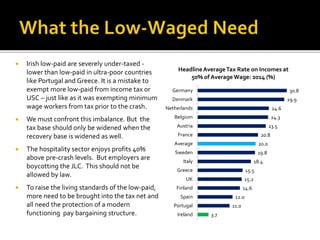
 Irish low-paid are severely under-taxed -
lower than low-paid in ultra-poor countries
like Portugal and Greece. It is a mistake to
exempt more low-paid from income tax or
USC – just like as it was exempting minimum
wage workers from tax prior to the crash.
 We must confront this imbalance. But the
tax base should only be widened when the
recovery base is widened as well.
 The hospitality sector enjoys profits 40%
above pre-crash levels. But employers are
boycotting the JLC. This should not be
allowed by law.
 To raise the living standards of the low-paid,
more need to be brought into the tax net and
all need the protection of a modern
functioning pay bargaining structure.
30.8
29.9
24.6
24.3
23.5
20.8
20.0
19.8
18.4
15.5
15.2
14.6
12.0
11.0
3.7
Germany
Denmark
Netherlands
Belgium
Austria
France
Average
Sweden
Italy
Greece
UK
Finland
Spain
Portugal
Ireland
HeadlineAverageTax Rate on Incomes at
50% of AverageWage: 2014 (%)
 We must abandon ‘welfarism’. We must not be content to allow
capital to create income and argue over how that income is
redistributed – through tax, wages and spending.
 We must enter the debate over the productive economy,
develop the enterprise policies, intervene in the markets with
new public, non-profit and investment-led enterprise models,
privileging labour in the decision-making process over how and
what goods and services should be produced.
 Business in Ireland is too important to be left to Irish business.
 If we develop a constructive, non-sectarian and innovative
debate about these and other issues, we stand a chance of
creating a new prudent Common Sense majority.

Michael taft presentation for post budget seminar 19 oct 16

  • 1.
  • 2.
     ‘We area small and very open economy in a world that has more risks than usual. It makes sense to complete the task we set ourselves and get to a balanced budget. It makes sense to continue reducing our debt to much lower levels and to build our capacity to withstand shocks. It makes sense to avoid the mistakes of the past that could lead to overheating our economy. It is an uncertain world full of risk and now is not the time to move away from the prudent and sensible fiscal policy we have been following.’ - Minister for Finance, Financial Statement, Budget 2017
  • 3.
     When wethink of prudence we immediately think of the conservative orthodoxy. For instance:  The day after the budget the Irish Fiscal Advisory Council was out with an instant judgement – claiming that the tax and spend numbers went ‘beyond what was prudent and was set to breach key EU rules’.  The IrishTimes was even more dramatic: ‘The notion of a prudent Budget appeared threadbare after Michael Noonan announced a package of measures in the Dáil stretching the so-called “fiscal space” to near- destruction.’
  • 4.
    Structural Deficit Projections 20152016 2017 -2.2 -1.9 -1.1 There is a requirement under the Fiscal Rules that the structural deficit fall by slightly more than 0.5% per year. This didn’t happen last year, but the projection for next year shows the Government exceeding this target and over the two years has fully complied with the rules. In comparative terms, Ireland’s fiscal situation looks relative healthy. -3.2 -2.9 -2.7 -2.3 -2.0 -1.7 -1.6 -1.5 -1.5 -1.4 -1.2 -1.2 -1.1 -1.0 -0.8 -0.6 -0.5 -0.2 0.3 0.5 Spain Slovenia France Portugal Belgium Italy Latvia Slovakia Finland Eurozone Netherlands Austia Malta Ireland Lithuaina Greece Cyrprus Estonia Luxembourg Germany EU Commission: Projected Structural Deficit 2017 (% of Potential GDP)
  • 5.
     The issueof fiscal space and fiscal rules has been over-stated. But critics may have a point about ‘prudence’ even if they are missing the real target.  There is a sense of déjà vu about some of this.  Erosion of tax base  Pumping property prices  Reliance of revenue bubbles  Ill-prepared by Brexit  Never mind mentioning the ‘A’ word
  • 6.
     If thereare ‘more risks than usual’ and a determination to ‘avoid the mistakes of the past’, why are we eroding the tax base?  Painful and in many cases irrational (raising taxes on low-average income earners during a recession) but by 2014 we had finally reached the average of our peer group.  Yet in the last three budgets, personal taxation has been cut by €2.1 billion (over 10 percent of total income tax take) while the Government is committed to cutting overall taxes by a further €3 billion in net terms. 36.5 35.1 34.9 31.2 30.6 30.1 29.7 28.2 27.4 26.8 26.7 25.7 23.8 21.7 Belgium Denmark Greece Other SOE Austria Germany Italy Finland Netherlands NCEE Ireland Sweden France UK Employees EffectiveTax Rate: 2014 (% of GrossWages)
  • 7.
     Not satisfiedthat Dublin prices have risen enough, fearful that Central Bank rules might cause a more sustainable rise, the Government is handing out €20,000 to first-time buyers for houses up to €600,000 (which will be transferred to developers).  Then there’s the postponement of the property re-valuation to 2019.  And to be sure to be sure, landlords who have increased rents to unsustainable levels will get a tax break. 90 100 110 120 130 140 150 160 170 2012 2013 2014 2015 2016 July Dublin Residential Property Prices: 2012 - 2016 (February 2012 = 100)
  • 8.
     Are weexperiencing a new bubble? A corporate tax bubble?  Since 2012 corporate tax revenue has increased by 92 percent; 33 percent for all other taxes.  Corporate tax revenue has made up over a quarter of total tax increase.  Just 10 companies paid 40% to 50% of all corporate tax revenue last year. 4,609 3,857 2,838 2,565 2,523 2,522 2,392 2,350 2,333 2,165 1,987 Ireland Belgium Sweden Denmark Netherlands Finland UK Average France Austria Germany CorporateTax Revenue per Employee: 2017 estimate (€)
  • 9.
     The budgetdocument ‘Getting Ireland Brexit Ready’ lists a number of Brexit-readying measures but most are policies conceived prior to the referendum:  Increased tax credits for self-employed, capital gains relief for small disposals, rainy day fund (which won’t start until 2019) – these are mere extensions of policies introduced in last year’s budget or announced in the election.  More worrying, Government is basing economic and fiscal projections on a Sterling exchange rate of 85 pence out to 2021 when the trajectory is towards parity.  If the Government was concerned about Brexit (described as a ‘material negative impact on the Irish economy’) why erode the tax base? Have we not learned from the crash and what happens with a narrowed tax base?
  • 10.
     One ofthe biggest potential economic and fiscal impacts – the Apple ruling - was not mentioned once. The award and the appeal are a diversion from the real issue: the acceleration of European coordination on corporate tax avoidance.  Only weeks before the Apple ruling the EU Parliament overwhelmingly (nearly 80%) passed a resolution on corporate tax avoidance, calling for:  EU register of beneficial owners of companies,  Action against abuse of “patent box” regimes and transfer pricing  A common consolidated corporate tax base (CCCTB)  An EU-wide withholding tax and other measures  Nessa Childers was the only Irish MEP to support it while the only party grouping to oppose it was the far-right Europe of Freedom and Direct Democracy co-chaired by Nigel Farage.
  • 11.
     European cooperationon corporate tax is coming down the line. What are we going to do?  Are we going to hide our heads in the sand – like we did during the property boom – and hope the world doesn’t notice us?  Are we going to line up with the far-right in Europe and tax- dodging multinationals?  Or are we going to face this issue head-on and start preparing new policies to attract FDI based on infrastructure, education, affordable housing and investment?  No one wins in the global tax avoidance game, it’s just that some countries lose slower than others. We’re a very slow loser but a loser nonetheless.
  • 12.
     Progressives havean opportunity to claim the ground of prudent, rational and common sense fiscal policy.  During the recession, progressives ceded the macro-economic ground and did not challenge fiscal contraction on its terms. We mustn’t repeat this in the battle over the recovery.  Since the 1960s Ireland has spent more years in a domestic demand recession than any other EU-15 country bar Spain.  Right-wing led governments gave us fiscal irrationality prior to the crash; inflicted irrationality during the recession; and is now preparing a third wave of irrationality – tax erosion, pumping the property market, revenue bubble, whistling Brexit and avoiding the tax avoidance train coming down the line.  This is our opportunity.
  • 13.
     We needto refine our analysis, ground it in a long-term framework and, on the way, shed confusions and misapprehensions. Here are some examples:  1. The Fiscal Rules that shape fiscal policy are not EU rules – they are constitutional rules. They cannot be broken.  2..Let’s soak the rich or at least give them a darn good splash. But this won’t buy us a free health service or free education at all levels.  Only 3% of income earners are above €100,000. And of all the financial wealth 50% is in pensions/insurance and another 37% is in highly mobile cash. Soak the rich but don’t think it will fill a swimming pool.
  • 14.
     3. Isthere an inconsistency in claiming we have a housing emergency (which we do) and at the same time call for abolition of the property tax and vote to cut property tax at local level? LPT should be transformed into a comprehensive property tax, including financial.  4. We need to build lots of houses; we need to increase and maintain water investment for a decade; we need to bring rubbish collection back into public control – but we can’t assume we can throw all the costs into the ‘general taxation’ pile.  We need to examine the full range of financing – tax, charges, levies, SPVs – and select on the basis of economic efficiency, social equity and opportunity costs.
  • 15.
     5.We needan honest conversation on personal taxes. We had the nonsense of the ‘squeezed middle’ even though the median income is between €27,000 and €33,000 depending on how it is measured.  Many claim we are high-taxed, citing the marginal tax rate on average income earners (3rd highest in the EU- 15) but conveniently forget to mention that the average tax rate on these same average earners is the lowest in the EU-15.  This points to a flaw in our tax system which some commentators cynically exploit in the debate and which progressives avoid.
  • 16.
     Irish low-paidare severely under-taxed - lower than low-paid in ultra-poor countries like Portugal and Greece. It is a mistake to exempt more low-paid from income tax or USC – just like as it was exempting minimum wage workers from tax prior to the crash.  We must confront this imbalance. But the tax base should only be widened when the recovery base is widened as well.  The hospitality sector enjoys profits 40% above pre-crash levels. But employers are boycotting the JLC. This should not be allowed by law.  To raise the living standards of the low-paid, more need to be brought into the tax net and all need the protection of a modern functioning pay bargaining structure. 30.8 29.9 24.6 24.3 23.5 20.8 20.0 19.8 18.4 15.5 15.2 14.6 12.0 11.0 3.7 Germany Denmark Netherlands Belgium Austria France Average Sweden Italy Greece UK Finland Spain Portugal Ireland HeadlineAverageTax Rate on Incomes at 50% of AverageWage: 2014 (%)
  • 17.
     We mustabandon ‘welfarism’. We must not be content to allow capital to create income and argue over how that income is redistributed – through tax, wages and spending.  We must enter the debate over the productive economy, develop the enterprise policies, intervene in the markets with new public, non-profit and investment-led enterprise models, privileging labour in the decision-making process over how and what goods and services should be produced.  Business in Ireland is too important to be left to Irish business.  If we develop a constructive, non-sectarian and innovative debate about these and other issues, we stand a chance of creating a new prudent Common Sense majority.