What makes personal income taxes 
progressive? A decomposition across 
European Countries using EUROMOD 
Gerlinde Verbist & Francesco Figari 
Centre for Social Policy, University of Antwerp 
University of Insubria & ISER – University of Essex 
Discussant: Richard Tonkin, UK Office for National Statistics
Introduction 
• EUROMOD used to compare redistributive 
effect of personal income taxes (PIT) in EU-15 
• Structure of paper/presentation: 
1) Inequality and redistributive impact of taxes 
2) Methods 
3) EUROMOD 
4) Results 
5) Conclusions
Inequality and redistributive impact of 
taxes 
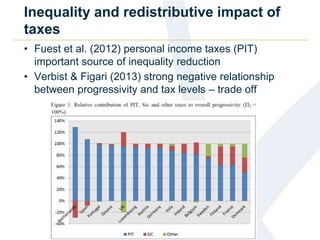
• Fuest et al. (2012) personal income taxes (PIT) 
important source of inequality reduction 
• Verbist & Figari (2013) strong negative relationship 
between progressivity and tax levels – trade off
Inequality and redistributive impact of 
taxes 
• What factors can influence redistributive effect 
of PIT? 
• Structure of bands 
• Tax rates 
• Exemptions, allowances deductions & credits 
• Changes to underlying income distribution 
• Consequences of tax reforms often less clear 
than may appear
Methods 
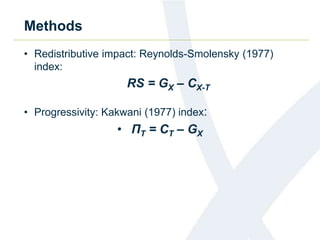
• Redistributive impact: Reynolds-Smolensky (1977) 
index: 
RS = GX – CX-T 
• Progressivity: Kakwani (1977) index: 
• ΠT = CT – GX
Methods 
• Progressivity can be decomposed over different 
factors: 
• Pre-tax income: X 
• Tax-exempt income: E 
• Tax allowances: A 
• Tax deductions: D(X) 
• Rate schedule: r(.) 
• Tax credits: K 
• Net income (N) defined as: 
N = X – [r(X – E – A – D(X)] – K] 
N = X – Tpit
Methods 
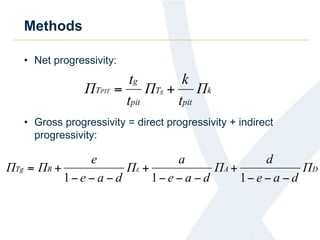
• Net progressivity: 
• Gross progressivity = direct progressivity + indirect 
progressivity:
EUROMOD 
• Europe-wide tax/benefit microsimulation model 
• Based on EU-SILC for most countries 
• Uses underlying data and tax/benefit rules to simulate: 
• Personal Income Taxes (PIT) 
• Social insurance contributions 
• Other direct taxes 
• Cash benefit entitlements 
• Allows identification of different tax components 
• Current paper focuses on PIT
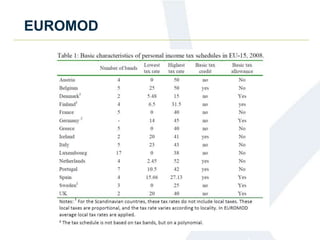
EUROMOD
EUROMOD 
• Assumptions and caveats: 
• Assume full tax compliance and 100% benefit take-up 
(how different would results be if this assumption 
changed?) 
• Don’t account for taxes paid on benefits (would this 
have a big impact in some countries?) 
• Behavioural decisions not considered 
• Look at redistribution at a fixed point in time
Results
Results 
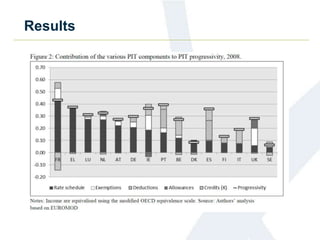
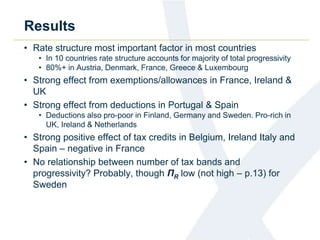
• Rate structure most important factor in most countries 
• In 10 countries rate structure accounts for majority of total progressivity 
• 80%+ in Austria, Denmark, France, Greece & Luxembourg 
• Strong effect from exemptions/allowances in France, Ireland & 
UK 
• Strong effect from deductions in Portugal & Spain 
• Deductions also pro-poor in Finland, Germany and Sweden. Pro-rich in 
UK, Ireland & Netherlands 
• Strong positive effect of tax credits in Belgium, Ireland Italy and 
Spain – negative in France 
• No relationship between number of tax bands and 
progressivity? Probably, though ΠR low (not high – p.13) for 
Sweden
Results 
• Three groups of countries: 
• Rate structure countries: Austria, Denmark, Finland, France 
Germany, Greece, Luxembourg & Netherlands 
• Tax base composition countries: Portugal, Sweden & UK 
• Mixed structure countries: Belgium, Ireland, Italy & Spain 
• Groupings changed from 1998 (Verbist, 1998)
Results – zero rate 
• Attempt to isolate effect of zero rate: 
• Basic allowance (e.g. UK) 
• Zero-band rate and allowance (e.g. Sweden) 
• Basic tax credit (e.g. Ireland) 
• No zero-taxed part (e.g. Italy) 
• 2 approaches: 
• Integrate zero-taxed part as zero-band rate 
• Split out zero-taxed part 
• Zero-rate in Ireland and UK have similar contribution to overall 
progressivity 
• In Sweden residual rate effect is primary driver
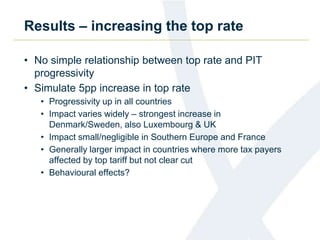
Results – increasing the top rate 
• No simple relationship between top rate and PIT 
progressivity 
• Simulate 5pp increase in top rate 
• Progressivity up in all countries 
• Impact varies widely – strongest increase in 
Denmark/Sweden, also Luxembourg & UK 
• Impact small/negligible in Southern Europe and France 
• Generally larger impact in countries where more tax payers 
affected by top tariff but not clear cut 
• Behavioural effects?
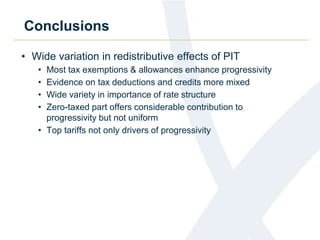
Conclusions 
• Wide variation in redistributive effects of PIT 
• Most tax exemptions & allowances enhance progressivity 
• Evidence on tax deductions and credits more mixed 
• Wide variety in importance of rate structure 
• Zero-taxed part offers considerable contribution to 
progressivity but not uniform 
• Top tariffs not only drivers of progressivity
Comments 
• Very interesting and informative paper 
• Well- written & clearly structured 
• How sensitive are the results to the assumptions made? 
• (e.g. Assuming 100% take-up/compliance, ignoring effect of taxes paid on benefits) 
• Would be good to see more on changes over time within countries 
• Is this distinction between rate structure and tax base composition 
countries slightly arbitrary? 
• E.g. Personal allowance in UK vs. zero-rate band in Austria or Greece 
• Can approach be extended to look at social insurance & other direct 
taxes simultaneously? 
• Compare impact on progressivity/redistribution of e.g. Increase in zero-rate 
coverage vs. other tax reforms 
• What do policy makers need to do (differently) as a result of this work?

Session 8 d verbist & figari session 8 d

  • 1.
    What makes personalincome taxes progressive? A decomposition across European Countries using EUROMOD Gerlinde Verbist & Francesco Figari Centre for Social Policy, University of Antwerp University of Insubria & ISER – University of Essex Discussant: Richard Tonkin, UK Office for National Statistics
  • 2.
    Introduction • EUROMODused to compare redistributive effect of personal income taxes (PIT) in EU-15 • Structure of paper/presentation: 1) Inequality and redistributive impact of taxes 2) Methods 3) EUROMOD 4) Results 5) Conclusions
  • 3.
    Inequality and redistributiveimpact of taxes • Fuest et al. (2012) personal income taxes (PIT) important source of inequality reduction • Verbist & Figari (2013) strong negative relationship between progressivity and tax levels – trade off
  • 4.
    Inequality and redistributiveimpact of taxes • What factors can influence redistributive effect of PIT? • Structure of bands • Tax rates • Exemptions, allowances deductions & credits • Changes to underlying income distribution • Consequences of tax reforms often less clear than may appear
  • 5.
    Methods • Redistributiveimpact: Reynolds-Smolensky (1977) index: RS = GX – CX-T • Progressivity: Kakwani (1977) index: • ΠT = CT – GX
  • 6.
    Methods • Progressivitycan be decomposed over different factors: • Pre-tax income: X • Tax-exempt income: E • Tax allowances: A • Tax deductions: D(X) • Rate schedule: r(.) • Tax credits: K • Net income (N) defined as: N = X – [r(X – E – A – D(X)] – K] N = X – Tpit
  • 7.
    Methods • Netprogressivity: • Gross progressivity = direct progressivity + indirect progressivity:
  • 8.
    EUROMOD • Europe-widetax/benefit microsimulation model • Based on EU-SILC for most countries • Uses underlying data and tax/benefit rules to simulate: • Personal Income Taxes (PIT) • Social insurance contributions • Other direct taxes • Cash benefit entitlements • Allows identification of different tax components • Current paper focuses on PIT
  • 9.
  • 10.
    EUROMOD • Assumptionsand caveats: • Assume full tax compliance and 100% benefit take-up (how different would results be if this assumption changed?) • Don’t account for taxes paid on benefits (would this have a big impact in some countries?) • Behavioural decisions not considered • Look at redistribution at a fixed point in time
  • 11.
  • 12.
    Results • Ratestructure most important factor in most countries • In 10 countries rate structure accounts for majority of total progressivity • 80%+ in Austria, Denmark, France, Greece & Luxembourg • Strong effect from exemptions/allowances in France, Ireland & UK • Strong effect from deductions in Portugal & Spain • Deductions also pro-poor in Finland, Germany and Sweden. Pro-rich in UK, Ireland & Netherlands • Strong positive effect of tax credits in Belgium, Ireland Italy and Spain – negative in France • No relationship between number of tax bands and progressivity? Probably, though ΠR low (not high – p.13) for Sweden
  • 13.
    Results • Threegroups of countries: • Rate structure countries: Austria, Denmark, Finland, France Germany, Greece, Luxembourg & Netherlands • Tax base composition countries: Portugal, Sweden & UK • Mixed structure countries: Belgium, Ireland, Italy & Spain • Groupings changed from 1998 (Verbist, 1998)
  • 14.
    Results – zerorate • Attempt to isolate effect of zero rate: • Basic allowance (e.g. UK) • Zero-band rate and allowance (e.g. Sweden) • Basic tax credit (e.g. Ireland) • No zero-taxed part (e.g. Italy) • 2 approaches: • Integrate zero-taxed part as zero-band rate • Split out zero-taxed part • Zero-rate in Ireland and UK have similar contribution to overall progressivity • In Sweden residual rate effect is primary driver
  • 15.
    Results – increasingthe top rate • No simple relationship between top rate and PIT progressivity • Simulate 5pp increase in top rate • Progressivity up in all countries • Impact varies widely – strongest increase in Denmark/Sweden, also Luxembourg & UK • Impact small/negligible in Southern Europe and France • Generally larger impact in countries where more tax payers affected by top tariff but not clear cut • Behavioural effects?
  • 16.
    Conclusions • Widevariation in redistributive effects of PIT • Most tax exemptions & allowances enhance progressivity • Evidence on tax deductions and credits more mixed • Wide variety in importance of rate structure • Zero-taxed part offers considerable contribution to progressivity but not uniform • Top tariffs not only drivers of progressivity
  • 17.
    Comments • Veryinteresting and informative paper • Well- written & clearly structured • How sensitive are the results to the assumptions made? • (e.g. Assuming 100% take-up/compliance, ignoring effect of taxes paid on benefits) • Would be good to see more on changes over time within countries • Is this distinction between rate structure and tax base composition countries slightly arbitrary? • E.g. Personal allowance in UK vs. zero-rate band in Austria or Greece • Can approach be extended to look at social insurance & other direct taxes simultaneously? • Compare impact on progressivity/redistribution of e.g. Increase in zero-rate coverage vs. other tax reforms • What do policy makers need to do (differently) as a result of this work?