











Motivational Interviewing in
         Neuropsychology

        Basic Principles and Methods
November 23, 2012 – 1:30pm – 5:00pm

Tad Gorske, Ph.D.
Clinical Assistant Professor
Director, Outpatient Neuropsychology
Division of Neuropsychology and Rehabilitation Psychology
University of Pittsburgh School of Medicine, Pittsburgh Pennsylvania, USA
The Challenge of Change
 42 year old male who suffers a TBI after an ATV accident
  where he is intoxicated. Makes a reasonably good
  recovery. History of extensive alcohol use. 6 months after
  inpatient TBI rehab has resumed drinking.
 24 year old female, mild concussion, having PCS
  symptoms one year later. Significant psychiatric history but
  doesn’t believe symptoms are related.
 56 year old male, suffers a stroke, continues to have mild
  to moderate cognitive deficits that are likely permanent.
  Doesn’t see need to reduce workload at a high stress, fast
  paced profession.
The Challenge of Change
 Community based rehabilitation is an effective
  strategy for increasing opportunities for people
  with disabilities to maximize their physical and
  mental functioning (World Health Organization).
 However, the benefits that might be accrued are
  all too often disrupted by individuals’ lack of
  participation in the rehabilitation process
  (Lequerica et al., 2006)
Motivation – Whose Job is it?
 The unmotivated client:
  – “When the client’s goals do not match those of
    the counselor” (Lane and Barry, 1970).
  – Others may hinder independence by
    inadvertently reinforcing dependence over self
    reliance (Wright, 1980).
3 Key elements underlying client motivation
  (Roessler, 1980/89):

1. The client’s perception of the value of the
  outcome of a change plan, including both benefits
  and costs;
2. The client’s perception of the probability of
  achieving a successful outcome;
3. The presence of environmental barriers and
  supports that inhibit or promote change.
Importance of Working Alliance
 There are strong links between patient-
  therapist collaboration and goal consensus
  in psychotherapy outcomes (Shick Tryon
  and Winograd, 2011).
 Working alliance and collaboration in
  rehabilitation is viewed as important but less
  well studied.
Working Alliance in Rehabilitation
 A positive relationship between working
  alliance and outcomes has been found.
  Working alliance defined as
 (a) the agreement between client and therapist on
  goals,
 (b) their agreement on how to achieve these goals
  (common work on tasks) and,
 (c) the development of a personal bond between
  client and therapist. (Shönberger et al. 2006).
Working Alliance in Rehabilitation
 A good working alliance can be created with both
  clients who experience many problems and clients
  who experience comparatively few problems, as
  long as they are aware of the consequences of
  their brain injury.
 Therapist’s experience of a good working alliance
  was influenced by the client’s experience of
  success. (Shönberger, et al., 2006).
Working Alliance in Rehabilitation
 Clients’ and therapists’ overall success ratings at
  program end were related to their emotional bond
  at program end.
 Early-therapy compliance and the average amount
  of compliance are predictive of subjective
  improvement. (Shönberger, et al., 2006).
Working Alliance: Some evidence
 Bieman-Copelan and Dywan (2000). Brain and
   Cognition, 44, 1-5.
  Behavioral therapy in context of a
   supportive/collaborative therapeutic alliance for
   anosognosia.
  Collaborative negotiation and trusting therapeutic
   relationship for behavioral goal setting.
  Results indicated a significant reduction in
   problematic behaviors despite no increase in
   insight or awareness of injury.
Pegg et al., 2005
 Evaluated the role of interpersonal relationship factors on
  patient outcomes with 28 patients with moderate to severe
  TBI admitted to an inpatient unit at a VAMC.
 Personalized information-provision intervention.
 Results:
   – Patients exerted greater effort in therapies
   – Patients increased satisfaction with rehabilitation
     treatment.
   – Significantly more improvement in cognitive FIM scores.
Interdisciplinary team working
   alliance (Evans, et al., 2008).
 Importance of therapeutic alliance in post acute brain injury
  rehabilitation (PABIR).
 Sherer et al., 2007 - poor working alliance was associated
  with high levels of family discord, greater discrepancy
  between family and clinician ratings of client functioning,
  and poor client participation in therapies.
 Treatment team members attended in-services that
  emphasized motivational interviewing philosophy and
  techniques, building rapport, reflective listening, dealing
  with patient resistance, making behavioral changes, stages
  of change, dealing with challenging clients, and
  assessment and treatment issues with depressed and/or
  suicidal patients (pg. 332).
Interdisciplinary team working
   alliance (Evans, et al., 2008).
 Treatment group had higher functional status and were
  more productive and had less dropouts, although the
  differences were not statistically significant.
Lane-Brown and Tate, 2010.
 Single case study that evaluated an
  intervention utilizing external
  compensation and motivational
  interviewing to initiate and sustain goal
  directed activity with a TBI patient.
 Demonstrated that treating specific and
  operationally defined goals through
  external compensation and motivational
  interviewing successfully decreased
  apathy.
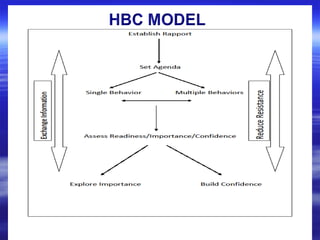
Health Behavior Change (HBC)
            Model
 A method of dialogue based on Motivational
  Interviewing Principles to enhance clients
  internal motivation for change versus trying
  to persuade them to change.
Behavior Change: Whose
     Problem Is It?
 The outcome of a consultation can be
  affected by providers consulting behavior.
 Behavior change, or lack of it, is not just a
  patient problem.
 Practitioner style can make matters better
  or worse.
  – (Rollnick, Mason, and Butler, 1999).
Foundations of HBC Model
Motivational Interviewing
 Counseling style (Miller, 1983)
  – Client-centered, directive method for enhancing
    intrinsic motivation to change by exploring and
    resolving ambivalence.
 An evolution of the client centered
  approach.
 Intentionally resolves ambivalence in the
  direction of change.
Four Motivational Interviewing
            Principles
1. Express Empathy

2. Develop Discrepancy

3. Roll with Resistance

4. Support Self Efficacy
What Motivates Change?
   Interpersonal Style
   Readiness, willingness, ability
   Intrinsic versus extrinsic factors
   Change Talk
   Commitment Language
Change Talk
 Categories of Change Talk
  – Desire: “I want to…”
  – Ability: “I can..”
  – Reason: “There are good reasons for me to..”
  – Need: “I really need to…”

  – Commitment: “I am going to…”
How MI theoretically works
1. MI approach leads to;
2. An increase in Desire, Ability, Reason,
   Need, which leads to;
3. An increased intensity of commitment
   which leads to;
4. Behavior Change
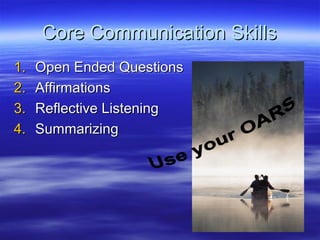
Core Communication Skills
1.   Open Ended Questions
2.   Affirmations
3.   Reflective Listening
4.   Summarizing
Maintaining a Patient Centered
              Approach
 Active – Reflective listening
 Encourage an expression of concerns
 Allow them to articulate what they need
 All them greater control over decision
  making
 Reach joint decisions
What is (The Spirit) of HBC
 Collaboration:      Two parties working
  together, listening, responding, progressing,
  and cooperating toward a common goal.
 Coercion:      Using force to cause
  something to occur; trying to persuade
  through debate or to have their points be
  heard
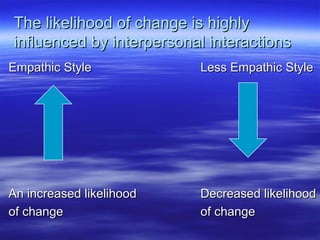
The likelihood of change is highly
influenced by interpersonal interactions
Empathic Style            Less Empathic Style


An increased likelihood   Decreased likelihood
of change                 of change
Collaborative Agenda Setting
   Presenting agenda setting chart;
   Transition to focus on problem areas
   Raising clinician concerns
   Summarize outcome – next step(s)
Agenda Setting Chart
Single vs Multiple Behaviors
 Elicit – Personal views and feelings about
  factors related to illness/injury/recovery;
  – “ie. You are about 4 months out of your traumatic brain
    injury, what are your major concerns about ongoing
    recovery?”
 Provide – Information about what is known
  about the issue presented
  – ie. “What we know is that most recovery happens in the
    first year to 18 months. There is no good way to predict
    what type of recovery will be made but there are some
    things that can help or hinder one’s recovery.”
Single vs Multiple Behaviors
 Elicit – Patient reactions to the information
  given .
  – ie. “How to you feel about your recovery so far and what
    things have been positive versus what has not gone so
    well?”
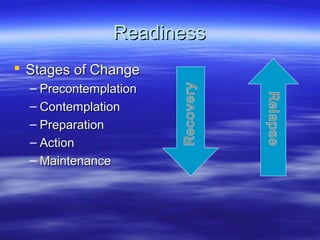
Readiness
 Stages of Change
  – Precontemplation
  – Contemplation
  – Preparation
  – Action
  – Maintenance
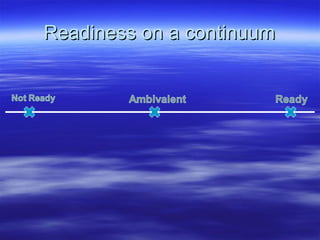
Readiness on a continuum
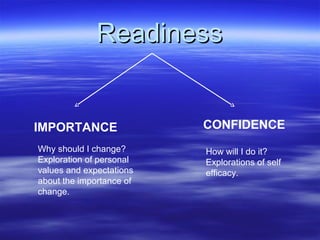
Readiness


IMPORTANCE                CONFIDENCE
Why should I change?      How will I do it?
Exploration of personal   Explorations of self
values and expectations   efficacy.
about the importance of
change.
Strategy
1. Identify behavior to discuss (Agenda
   setting, prioritize, identify behavior);
2. Assess readiness to change behavior;
  a) Introduce readiness ruler (formal or informal);
  b) Use OARS to clarify stage of change, level of
     readiness;
  c) Identify and explore issues of
     importance/confidence.
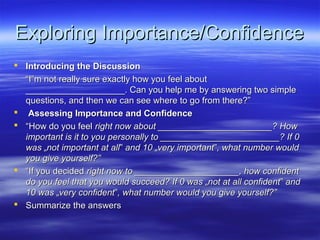
Exploring Importance/Confidence
 Introducing the Discussion
  “I‟m not really sure exactly how you feel about
  ____________________. Can you help me by answering two simple
  questions, and then we can see where to go from there?”
 Assessing Importance and Confidence
 “How do you feel right now about _______________________? How
  important is it to you personally to ________________________? If 0
  was „not important at all‟ and 10 „very important‟, what number would
  you give yourself?”
 “If you decided right now to _____________________, how confident
  do you feel that you would succeed? If 0 was „not at all confident‟ and
  10 was „very confident‟, what number would you give yourself?”
 Summarize the answers
Exploring Importance/Confidence

  Selecting the Focus
 If importance is low (<5), focus on importance first
 If both are about the same, focus on importance first
 If one number is distinctly lower than the other, focus on the lower
  number first
 If both are very low (<3), explore feelings about participating in
  discussion of the issue (‘all of this’)
EXAMINING PROS AND CONS
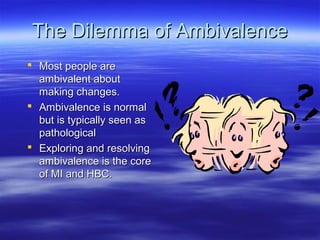
The Dilemma of Ambivalence
 Most people are
  ambivalent about
  making changes.
 Ambivalence is normal
  but is typically seen as
  pathological
 Exploring and resolving
  ambivalence is the core
  of MI and HBC.
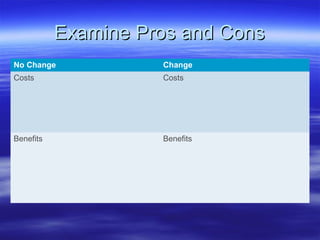
Examine Pros and Cons
No Change            Change
Costs                Costs


Benefits             Benefits
Examine Pros and Cons
1. Introduce the strategy: Ask the patient;
2. Review pros and cons of the behavior
   usually beginning with the side that
   supports the status quo (no change);
3. Throughout the interview use client
   centered/directive strategies, ie. OARS.
4. Summarize and look ahead to the next
   step.
Evocative Questions
   Problem recognition
   Concern
   Intention
   Optimism
Information Exchange
 Step 1:
  – Ask “does the patient want or need
    information?”
  – Distinguish between fact and personal opinion.
  – Present information in a neutral manner.
 Step 2:
  – Elicit – Readiness and interest in information;
  – Provide - Feedback in a neutral manner;
  – Elicit – Patient reactions and interpretations of
    information.
Information Exchange
 Step 3: Review and summarize.
 Step 4: Ask about the next step.
Resistance in HBC Model
Rolling with Resistance
 Resistance is not met head on or
  challenged directly.
 Resistance met with empathy and
  understanding where alternative viewpoints
  are invited but not imposed.
True Victory is Victory Over Oneself
One must first learn to control oneself
before attempting to harmonize and
control others.


                    Seidokan Aikido World Headquarters
Change/Resistance

 Causes of Resistance:
  – Patient brings conflict into the session;
  – Practitioner elicits it;
  – Combination of the two
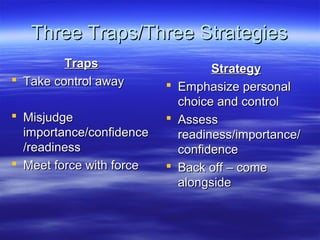
Three Traps/Three Strategies
         Traps                    Strategy
 Take control away        Emphasize personal
                            choice and control
 Misjudge                 Assess
  importance/confidence     readiness/importance/
  /readiness                confidence
 Meet force with force    Back off – come
                            alongside
Negotiating a Change Plan
   Setting Goals
   Considering Change Options
   Arriving at a Plan
   Eliciting Commitment
“The commitment to a change plan completes the
formal cycle of motivational interviewing.
Sometimes people proceed with change on their
own from here. It can also work well, however, to
transition from this initial motivational consultation
into action-focused counseling if the person so
chooses….MI can be used to facilitate change
throughout the process of counseling.
Ambivalence…rarely disappears on the first step
of a journey.” (Miller and Rollnick, 2002, p.139)
 My thanks to all the participants, Dr. Fiona
  Bardenhagen and the Australian
  Psychological Society for inviting me to your
  conference.
My contact information
  Tad T. Gorske, Ph.D
  Clinical Assistant Professor
  Division of Neuropsychology and Rehabilitation Psychology
  UPMC Mercy
  1400 Locust Street, Suite G138
  Pittsburgh, PA USA 15219
  Gorskett@upmc. edu

Motivational Interviewing Australia

  • 1.
    Motivational Interviewing in Neuropsychology Basic Principles and Methods November 23, 2012 – 1:30pm – 5:00pm Tad Gorske, Ph.D. Clinical Assistant Professor Director, Outpatient Neuropsychology Division of Neuropsychology and Rehabilitation Psychology University of Pittsburgh School of Medicine, Pittsburgh Pennsylvania, USA
  • 6.
    The Challenge ofChange  42 year old male who suffers a TBI after an ATV accident where he is intoxicated. Makes a reasonably good recovery. History of extensive alcohol use. 6 months after inpatient TBI rehab has resumed drinking.  24 year old female, mild concussion, having PCS symptoms one year later. Significant psychiatric history but doesn’t believe symptoms are related.  56 year old male, suffers a stroke, continues to have mild to moderate cognitive deficits that are likely permanent. Doesn’t see need to reduce workload at a high stress, fast paced profession.
  • 7.
    The Challenge ofChange  Community based rehabilitation is an effective strategy for increasing opportunities for people with disabilities to maximize their physical and mental functioning (World Health Organization).  However, the benefits that might be accrued are all too often disrupted by individuals’ lack of participation in the rehabilitation process (Lequerica et al., 2006)
  • 8.
    Motivation – WhoseJob is it?  The unmotivated client: – “When the client’s goals do not match those of the counselor” (Lane and Barry, 1970). – Others may hinder independence by inadvertently reinforcing dependence over self reliance (Wright, 1980).
  • 9.
    3 Key elementsunderlying client motivation (Roessler, 1980/89): 1. The client’s perception of the value of the outcome of a change plan, including both benefits and costs; 2. The client’s perception of the probability of achieving a successful outcome; 3. The presence of environmental barriers and supports that inhibit or promote change.
  • 10.
    Importance of WorkingAlliance  There are strong links between patient- therapist collaboration and goal consensus in psychotherapy outcomes (Shick Tryon and Winograd, 2011).  Working alliance and collaboration in rehabilitation is viewed as important but less well studied.
  • 11.
    Working Alliance inRehabilitation  A positive relationship between working alliance and outcomes has been found. Working alliance defined as  (a) the agreement between client and therapist on goals,  (b) their agreement on how to achieve these goals (common work on tasks) and,  (c) the development of a personal bond between client and therapist. (Shönberger et al. 2006).
  • 12.
    Working Alliance inRehabilitation  A good working alliance can be created with both clients who experience many problems and clients who experience comparatively few problems, as long as they are aware of the consequences of their brain injury.  Therapist’s experience of a good working alliance was influenced by the client’s experience of success. (Shönberger, et al., 2006).
  • 13.
    Working Alliance inRehabilitation  Clients’ and therapists’ overall success ratings at program end were related to their emotional bond at program end.  Early-therapy compliance and the average amount of compliance are predictive of subjective improvement. (Shönberger, et al., 2006).
  • 14.
    Working Alliance: Someevidence Bieman-Copelan and Dywan (2000). Brain and Cognition, 44, 1-5.  Behavioral therapy in context of a supportive/collaborative therapeutic alliance for anosognosia.  Collaborative negotiation and trusting therapeutic relationship for behavioral goal setting.  Results indicated a significant reduction in problematic behaviors despite no increase in insight or awareness of injury.
  • 15.
    Pegg et al.,2005  Evaluated the role of interpersonal relationship factors on patient outcomes with 28 patients with moderate to severe TBI admitted to an inpatient unit at a VAMC.  Personalized information-provision intervention.  Results: – Patients exerted greater effort in therapies – Patients increased satisfaction with rehabilitation treatment. – Significantly more improvement in cognitive FIM scores.
  • 16.
    Interdisciplinary team working alliance (Evans, et al., 2008).  Importance of therapeutic alliance in post acute brain injury rehabilitation (PABIR).  Sherer et al., 2007 - poor working alliance was associated with high levels of family discord, greater discrepancy between family and clinician ratings of client functioning, and poor client participation in therapies.  Treatment team members attended in-services that emphasized motivational interviewing philosophy and techniques, building rapport, reflective listening, dealing with patient resistance, making behavioral changes, stages of change, dealing with challenging clients, and assessment and treatment issues with depressed and/or suicidal patients (pg. 332).
  • 17.
    Interdisciplinary team working alliance (Evans, et al., 2008).  Treatment group had higher functional status and were more productive and had less dropouts, although the differences were not statistically significant.
  • 18.
    Lane-Brown and Tate,2010.  Single case study that evaluated an intervention utilizing external compensation and motivational interviewing to initiate and sustain goal directed activity with a TBI patient.  Demonstrated that treating specific and operationally defined goals through external compensation and motivational interviewing successfully decreased apathy.
  • 19.
    Health Behavior Change(HBC) Model  A method of dialogue based on Motivational Interviewing Principles to enhance clients internal motivation for change versus trying to persuade them to change.
  • 20.
  • 21.
     The outcomeof a consultation can be affected by providers consulting behavior.  Behavior change, or lack of it, is not just a patient problem.  Practitioner style can make matters better or worse. – (Rollnick, Mason, and Butler, 1999).
  • 22.
  • 23.
    Motivational Interviewing  Counselingstyle (Miller, 1983) – Client-centered, directive method for enhancing intrinsic motivation to change by exploring and resolving ambivalence.  An evolution of the client centered approach.  Intentionally resolves ambivalence in the direction of change.
  • 24.
    Four Motivational Interviewing Principles 1. Express Empathy 2. Develop Discrepancy 3. Roll with Resistance 4. Support Self Efficacy
  • 25.
    What Motivates Change?  Interpersonal Style  Readiness, willingness, ability  Intrinsic versus extrinsic factors  Change Talk  Commitment Language
  • 26.
    Change Talk  Categoriesof Change Talk – Desire: “I want to…” – Ability: “I can..” – Reason: “There are good reasons for me to..” – Need: “I really need to…” – Commitment: “I am going to…”
  • 27.
    How MI theoreticallyworks 1. MI approach leads to; 2. An increase in Desire, Ability, Reason, Need, which leads to; 3. An increased intensity of commitment which leads to; 4. Behavior Change
  • 28.
    Core Communication Skills 1. Open Ended Questions 2. Affirmations 3. Reflective Listening 4. Summarizing
  • 30.
    Maintaining a PatientCentered Approach  Active – Reflective listening  Encourage an expression of concerns  Allow them to articulate what they need  All them greater control over decision making  Reach joint decisions
  • 31.
    What is (TheSpirit) of HBC  Collaboration: Two parties working together, listening, responding, progressing, and cooperating toward a common goal.  Coercion: Using force to cause something to occur; trying to persuade through debate or to have their points be heard
  • 32.
    The likelihood ofchange is highly influenced by interpersonal interactions Empathic Style Less Empathic Style An increased likelihood Decreased likelihood of change of change
  • 33.
    Collaborative Agenda Setting  Presenting agenda setting chart;  Transition to focus on problem areas  Raising clinician concerns  Summarize outcome – next step(s)
  • 34.
  • 35.
    Single vs MultipleBehaviors  Elicit – Personal views and feelings about factors related to illness/injury/recovery; – “ie. You are about 4 months out of your traumatic brain injury, what are your major concerns about ongoing recovery?”  Provide – Information about what is known about the issue presented – ie. “What we know is that most recovery happens in the first year to 18 months. There is no good way to predict what type of recovery will be made but there are some things that can help or hinder one’s recovery.”
  • 36.
    Single vs MultipleBehaviors  Elicit – Patient reactions to the information given . – ie. “How to you feel about your recovery so far and what things have been positive versus what has not gone so well?”
  • 37.
    Readiness  Stages ofChange – Precontemplation – Contemplation – Preparation – Action – Maintenance
  • 38.
    Readiness on acontinuum
  • 39.
    Readiness IMPORTANCE CONFIDENCE Why should I change? How will I do it? Exploration of personal Explorations of self values and expectations efficacy. about the importance of change.
  • 40.
    Strategy 1. Identify behaviorto discuss (Agenda setting, prioritize, identify behavior); 2. Assess readiness to change behavior; a) Introduce readiness ruler (formal or informal); b) Use OARS to clarify stage of change, level of readiness; c) Identify and explore issues of importance/confidence.
  • 41.
    Exploring Importance/Confidence  Introducingthe Discussion “I‟m not really sure exactly how you feel about ____________________. Can you help me by answering two simple questions, and then we can see where to go from there?”  Assessing Importance and Confidence  “How do you feel right now about _______________________? How important is it to you personally to ________________________? If 0 was „not important at all‟ and 10 „very important‟, what number would you give yourself?”  “If you decided right now to _____________________, how confident do you feel that you would succeed? If 0 was „not at all confident‟ and 10 was „very confident‟, what number would you give yourself?”  Summarize the answers
  • 42.
    Exploring Importance/Confidence  Selecting the Focus  If importance is low (<5), focus on importance first  If both are about the same, focus on importance first  If one number is distinctly lower than the other, focus on the lower number first  If both are very low (<3), explore feelings about participating in discussion of the issue (‘all of this’)
  • 43.
  • 44.
    The Dilemma ofAmbivalence  Most people are ambivalent about making changes.  Ambivalence is normal but is typically seen as pathological  Exploring and resolving ambivalence is the core of MI and HBC.
  • 45.
    Examine Pros andCons No Change Change Costs Costs Benefits Benefits
  • 46.
    Examine Pros andCons 1. Introduce the strategy: Ask the patient; 2. Review pros and cons of the behavior usually beginning with the side that supports the status quo (no change); 3. Throughout the interview use client centered/directive strategies, ie. OARS. 4. Summarize and look ahead to the next step.
  • 47.
    Evocative Questions  Problem recognition  Concern  Intention  Optimism
  • 48.
    Information Exchange  Step1: – Ask “does the patient want or need information?” – Distinguish between fact and personal opinion. – Present information in a neutral manner.  Step 2: – Elicit – Readiness and interest in information; – Provide - Feedback in a neutral manner; – Elicit – Patient reactions and interpretations of information.
  • 49.
    Information Exchange  Step3: Review and summarize.  Step 4: Ask about the next step.
  • 50.
  • 51.
    Rolling with Resistance Resistance is not met head on or challenged directly.  Resistance met with empathy and understanding where alternative viewpoints are invited but not imposed.
  • 53.
    True Victory isVictory Over Oneself One must first learn to control oneself before attempting to harmonize and control others. Seidokan Aikido World Headquarters
  • 54.
    Change/Resistance  Causes ofResistance: – Patient brings conflict into the session; – Practitioner elicits it; – Combination of the two
  • 55.
    Three Traps/Three Strategies Traps Strategy  Take control away  Emphasize personal choice and control  Misjudge  Assess importance/confidence readiness/importance/ /readiness confidence  Meet force with force  Back off – come alongside
  • 56.
    Negotiating a ChangePlan  Setting Goals  Considering Change Options  Arriving at a Plan  Eliciting Commitment
  • 57.
    “The commitment toa change plan completes the formal cycle of motivational interviewing. Sometimes people proceed with change on their own from here. It can also work well, however, to transition from this initial motivational consultation into action-focused counseling if the person so chooses….MI can be used to facilitate change throughout the process of counseling. Ambivalence…rarely disappears on the first step of a journey.” (Miller and Rollnick, 2002, p.139)
  • 58.
     My thanksto all the participants, Dr. Fiona Bardenhagen and the Australian Psychological Society for inviting me to your conference. My contact information Tad T. Gorske, Ph.D Clinical Assistant Professor Division of Neuropsychology and Rehabilitation Psychology UPMC Mercy 1400 Locust Street, Suite G138 Pittsburgh, PA USA 15219 Gorskett@upmc. edu

Editor's Notes

  • #29 Core Communication Skills Handout (pg. 21)