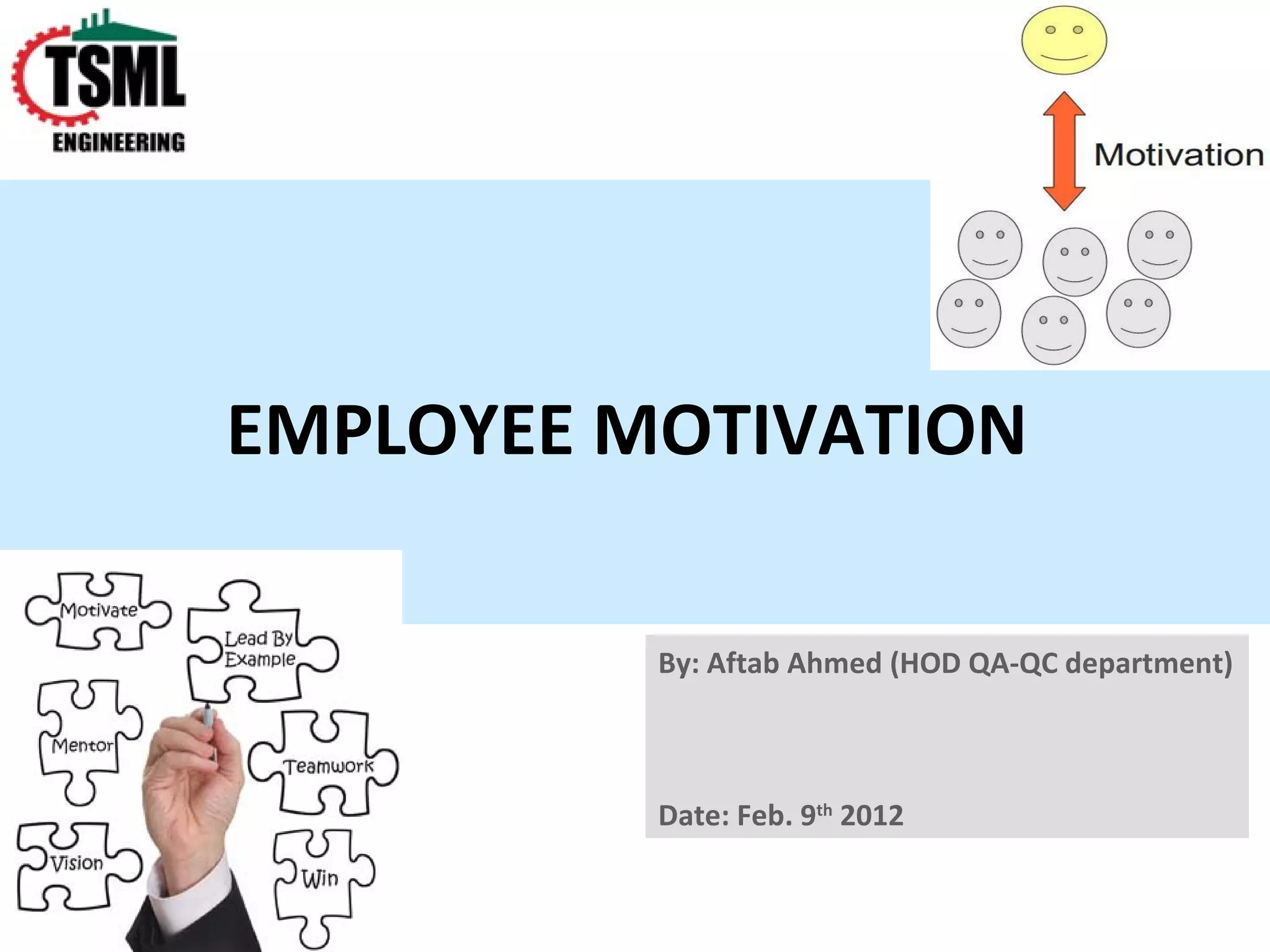
EMPLOYEE MOTIVATION

          By: Aftab Ahmed (HOD QA-QC department)


          Date: Feb. 9th 2012
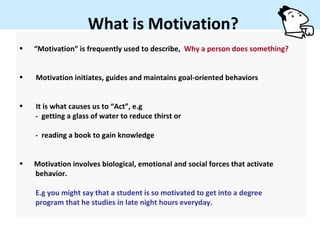
What is Motivation?
•   “Motivation” is frequently used to describe, Why a person does something?


•   Motivation initiates, guides and maintains goal-oriented behaviors


•   It is what causes us to “Act”, e.g
    - getting a glass of water to reduce thirst or

    - reading a book to gain knowledge


•   Motivation involves biological, emotional and social forces that activate
    behavior.

    E.g you might say that a student is so motivated to get into a degree
    program that he studies in late night hours everyday.
What is Motivation?
• Different types of motivation is based on:

  - Basic needs (e.g. food, sleep, etc.)

  - Personal needs (e.g. respect, self-esteem)

  - Social needs (e.g. to be accepted as part of a group).
Human Needs Satisfaction
• Social

       - Provision of communal facilities
       - Allowing informal communications


• Esteem

  - Recognition of achievements
  - Appropriate rewards


    • Self-realization

      - Training - people want to learn more
      - Giving Responsibility
Extrinsic Vs. Intrinsic Motivation
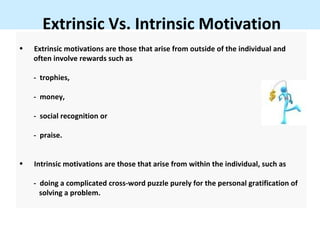
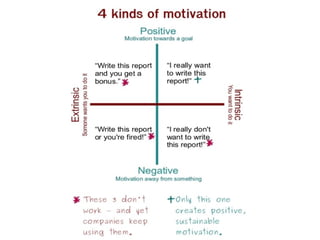
•   Extrinsic motivations are those that arise from outside of the individual and
    often involve rewards such as

    - trophies,

    - money,

    - social recognition or

    - praise.


•   Intrinsic motivations are those that arise from within the individual, such as

    - doing a complicated cross-word puzzle purely for the personal gratification of
      solving a problem.
Personality Types
•   Task-oriented

     – The motivation for doing the work is the work itself


•   Self-oriented

     – The work is a means to an end which is the achievement of individual goals -
       e.g. to get rich, to play tennis, to travel etc.


•   Interaction-oriented

     – The principal motivation is the presence and actions of co-workers. People
       go to work because they like to go to work.
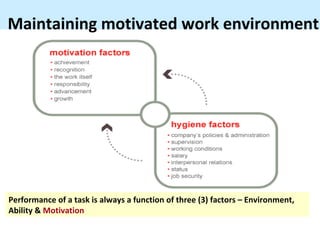
Maintaining motivated work environment


Performance of a task is always a function of three (3) factors – Environment,
Ability & Motivation
Barriers to Motivation
• An important role of a manager is to motivate the people working under their
  authority

  HOW??

  By Removing following common barriers to work motivation:

• Fear of failure, rejection, loss, conflict, humiliation, exploitation

• Distrust of management, favoritism, discrimination

• Work is not challenging or interesting

• Little recognition, respect, reward for job well done

• No authority and responsibility
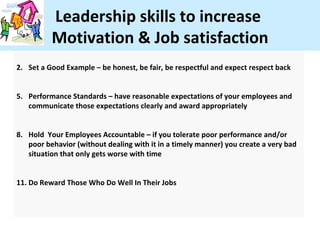
Leadership skills to increase
          Motivation & Job satisfaction
2. Set a Good Example – be honest, be fair, be respectful and expect respect back


5. Performance Standards – have reasonable expectations of your employees and
   communicate those expectations clearly and award appropriately


8. Hold Your Employees Accountable – if you tolerate poor performance and/or
   poor behavior (without dealing with it in a timely manner) you create a very bad
   situation that only gets worse with time


11. Do Reward Those Who Do Well In Their Jobs
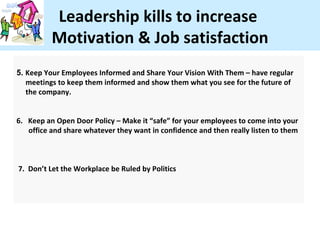
Leadership kills to increase
          Motivation & Job satisfaction
5. Keep Your Employees Informed and Share Your Vision With Them – have regular
   meetings to keep them informed and show them what you see for the future of
   the company.


6. Keep an Open Door Policy – Make it “safe” for your employees to come into your
   office and share whatever they want in confidence and then really listen to them


7. Don’t Let the Workplace be Ruled by Politics
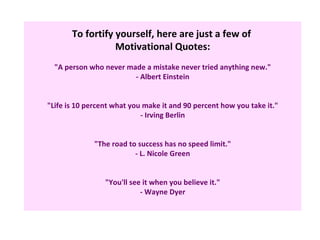
To fortify yourself, here are just a few of
                  Motivational Quotes:
  "A person who never made a mistake never tried anything new."
                        - Albert Einstein


"Life is 10 percent what you make it and 90 percent how you take it."
                            - Irving Berlin


              "The road to success has no speed limit."
                          - L. Nicole Green


                 "You'll see it when you believe it."
                            - Wayne Dyer

Motivation

  • 1.
    EMPLOYEE MOTIVATION By: Aftab Ahmed (HOD QA-QC department) Date: Feb. 9th 2012
  • 2.
    What is Motivation? • “Motivation” is frequently used to describe, Why a person does something? • Motivation initiates, guides and maintains goal-oriented behaviors • It is what causes us to “Act”, e.g - getting a glass of water to reduce thirst or - reading a book to gain knowledge • Motivation involves biological, emotional and social forces that activate behavior. E.g you might say that a student is so motivated to get into a degree program that he studies in late night hours everyday.
  • 3.
    What is Motivation? •Different types of motivation is based on: - Basic needs (e.g. food, sleep, etc.) - Personal needs (e.g. respect, self-esteem) - Social needs (e.g. to be accepted as part of a group).
  • 4.
    Human Needs Satisfaction •Social - Provision of communal facilities - Allowing informal communications • Esteem - Recognition of achievements - Appropriate rewards • Self-realization - Training - people want to learn more - Giving Responsibility
  • 5.
    Extrinsic Vs. IntrinsicMotivation • Extrinsic motivations are those that arise from outside of the individual and often involve rewards such as - trophies, - money, - social recognition or - praise. • Intrinsic motivations are those that arise from within the individual, such as - doing a complicated cross-word puzzle purely for the personal gratification of solving a problem.
  • 6.
    Personality Types • Task-oriented – The motivation for doing the work is the work itself • Self-oriented – The work is a means to an end which is the achievement of individual goals - e.g. to get rich, to play tennis, to travel etc. • Interaction-oriented – The principal motivation is the presence and actions of co-workers. People go to work because they like to go to work.
  • 8.
    Maintaining motivated workenvironment Performance of a task is always a function of three (3) factors – Environment, Ability & Motivation
  • 9.
    Barriers to Motivation •An important role of a manager is to motivate the people working under their authority HOW?? By Removing following common barriers to work motivation: • Fear of failure, rejection, loss, conflict, humiliation, exploitation • Distrust of management, favoritism, discrimination • Work is not challenging or interesting • Little recognition, respect, reward for job well done • No authority and responsibility
  • 10.
    Leadership skills toincrease Motivation & Job satisfaction 2. Set a Good Example – be honest, be fair, be respectful and expect respect back 5. Performance Standards – have reasonable expectations of your employees and communicate those expectations clearly and award appropriately 8. Hold Your Employees Accountable – if you tolerate poor performance and/or poor behavior (without dealing with it in a timely manner) you create a very bad situation that only gets worse with time 11. Do Reward Those Who Do Well In Their Jobs
  • 11.
    Leadership kills toincrease Motivation & Job satisfaction 5. Keep Your Employees Informed and Share Your Vision With Them – have regular meetings to keep them informed and show them what you see for the future of the company. 6. Keep an Open Door Policy – Make it “safe” for your employees to come into your office and share whatever they want in confidence and then really listen to them 7. Don’t Let the Workplace be Ruled by Politics
  • 12.
    To fortify yourself,here are just a few of Motivational Quotes: "A person who never made a mistake never tried anything new." - Albert Einstein "Life is 10 percent what you make it and 90 percent how you take it." - Irving Berlin "The road to success has no speed limit." - L. Nicole Green "You'll see it when you believe it." - Wayne Dyer