Structure and transport of vacancies in
MgO grain boundaries
with misfit dislocations
Kedarnath Kolluri and Blas Uberuaga
MST-8, Los Alamos National Lab, NM 87545
Acknowledgments:
Louis Vernon, Satyesh Yadav, Michael Demkowicz, John Hirth, Richard
Hoagland, Amit Misra, and Gopinath Subramanian
the
yers
The
nm.
ystal
hick
minal
ance
as a
ni.
ductrs at
are
con-

abrupt conductivity decrease when the thickness
ionic conductivity of this material, which imposes results (fig. S1), meaning that the ultrathin layer range or sd
changes from 30 to 62 nm is most likely due to
rather high operational temperatures around 800°C a of YSZ grows rotated by 45° around the c axis obtained fr
degraded search for alternative electrolytes has
(1–4). Theinterface structure when the YSZ layers and strains to match the STO lattice. Because the frequency p
exceed the critical thickness.
not yet been successful in reaching the conduc- bulk lattice constants of STO and YSZ are due to grai
tivity value of 0.01 S/cm desired for room temperature operation (1–4).
Only modest reductions in the operation
temperature of SOFCs (500° to 700°C) can be
anticipated with the recently proposed optimized
electrolytes such as gadolinia-doped ceria and
lanthanum gallates (8–11). On the other hand, the
one to two orders of magnitude increase of the
electrical conductivity reported (12–14) in nanocrystalline samples as compared with single crystals outlines the importance of processing as an
alternative route to increasing conductivity values
toward the desired levels. Because modern thin
film growth techniques allow a precise control of
layer thickness and morphology, they provide a
pathway for the production of solid electrolytes
with optimized properties. Maier et al. found a
substantial increase of the dc ionic conductivity
of superlattices of CaF2 and BaF2 when the Fig. 1. (A) Z-contrast scanning transmission electron microscopy (S
thickness of the individual layers was decreased the [YSZ1nm/STO10nm]9 superlattice (with nine repeats), obtain
J. assigned to a size effect due to microscope. 676 (2008)
down to 16 nm, Garcia-Barriocanal et. al., Science, 321,A yellow arrow marks the position of the YSZ layer. (In
the space charge regions being smaller than the in the VG Microscopes HB501UX column. In both cases a white arrow
layer thickness (15, 16). Kosacki et al. have spectra showing the O K edge obtained from the STO unit cell at the
reported enhanced conductivity in highly tex- into the STO layer (black squares). (Inset) Ti L2,3 edges for the same
tured thin films of YSZ with thicknesses between are the result of averaging four individual spectra at these position
60 and 15 nm, reaching 0.6 S/cm at 800°C (17).
Because reducing film thickness (and therefore Fig. 2. Real part of the lateral
increasing the fraction of material near the in- electrical conductivity versus fre-

Solid Interfaces can enhance mass transport

www.sciencemag.org on September 17, 2011

scaling,
ductance
the large
res orig-
ffusion cell. The growth rates of the films were monid by quartz crystal oscillators ͑QCOs͒. Al2O3͑0001͒
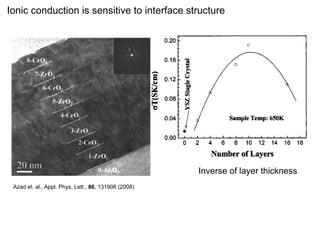
e crystal substrates were ultrasonically cleaned in acIonic conduction is sensitive to interface
131906-3

Azad et al.

structure

FIG. 4. Conductivities of Inverse ofYSZ ͑Ref. 14͒, two-, four-, eight-,
single crystal layer thickness
ten-, and sixteen-layer films at 650 K.
Azad et. al., Appl. Phys. Lett., 86, 131906 (2008)

reference missing!

1. TEM micrograph showing a cross sectional view of an eight-layer
was measured as a function of temperature using a four3-doped CeO2 and ZrO2 film grown on Al2O3͑0001͒.

probe van der Pauw technique.12 Since the electronic conductivity of Physics
© 2005 American Institute in these oxides is significantly less compared to
ionic conductivity, especially at low temperatures, ionic concopyright; see http://apl.aip.org/about/rights_and_permissions
ductivity dominates in these materials.13 As such, the total
conductivity will be identified as oxygen ionic conductivity
Goal: Relate interface structure to mass transport
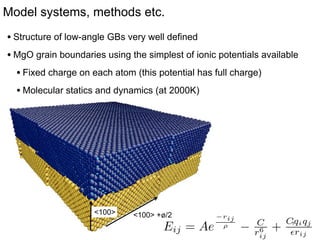
Model systems and methods
• Structure of low-angle GBs very well defined
1 nm

• MgO grain boundaries using the simplest of ionic potentials available
• Fixed charge on each atom (this potential has full charge)
• Molecular statics and dynamics (at 2000K)

2 different MgO slabs
(colors for clarity only)
One twisted wrt to other
by ø

Mg
O

<100>

<100> +ø/2

potential describing interatomic
interactions

Eij = Ae

rij
⇢

C
6
rij

+

Cqi qj
1
✏rij
Outline
1 nm
1. Grain boundary (GB) models

2. Ground-state structures of GBs
3. Structure and energetics of a vacancy at (and near) GBs

• compact and delocalized vacancies
4. Migrations of vacancies

• observations and postulated mechanisms
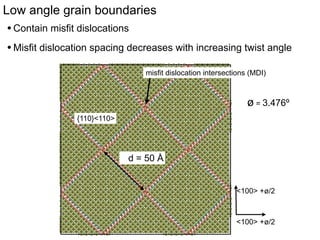
Low angle MgO grain boundaries
• Contain misfit dislocations
1 nm
• Misfit dislocation spacing decreases with increasing twist angle
misfit dislocation intersections (MDI)

ø = 3.476º
{110}<110>

d = 50 Å

atoms colored
by number of
neighbors
<100> +ø/2

Lateral view of the interface plane

<100> +ø/2
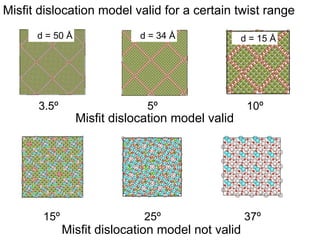
Misfit dislocation model valid for a certain twist range
d = 50 Å

3.5º

15º

d = 34 Å

d = 15 Å

5º

10º

25º

37º

Misfit dislocation model valid

Misfit dislocation model not valid
Outline
1 nm
1. Grain boundary (GB) models, potentials, and methods

2. Ground-state structures of GBs
3. Structure and energetics of a vacancy at (and near) GBs

• compact and delocalized vacancies
4. Transport of vacancies

• observations and postulated mechanisms
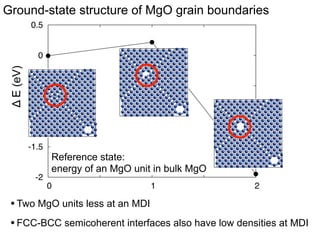
Ground-state structure of MgO grain boundaries
0.5

atoms colored by type
small is Oxygen, large is Mg

Δ E (eV)

0

-0.5

-1

-1.5

-2

Reference state:
energy of an MgO unit in bulk MgO
0

0.5

1

1.5

Number of MgO units removed

2

• Two MgO units less at an MDI
• FCC-BCC semicoherent interfaces also have low densities at MDI
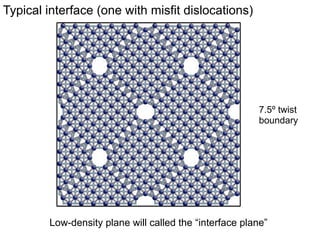
Typical interface for low-angle MgO twist boundaries
atoms colored by type
small is oxygen, large is Mg

7.5º twist
boundary

Low-density plane will called the “interface plane”
Outline
1 nm
1. Grain boundary (GB) models, potentials, and methods

2. Ground-state structures of GBs
3. Structure and energetics of a vacancy at GBs

• compact and delocalized vacancies
4. Transport of vacancies

• observations and postulated mechanisms
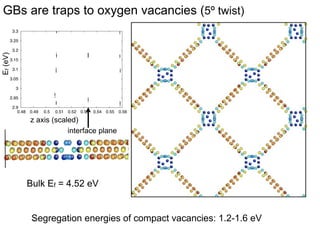
GBs are traps to oxygen vacancies (5º twist)
3.3

Ef (eV)

3.25
3.2
3.15
3.1
3.05
3
2.95
2.9
0.48

0.49

0.5

0.51

0.52

0.53

0.54

0.55

0.56

z axis (scaled)
interface plane

Bulk Ef = 4.52 eV

Atoms colored by excess energy

Segregation energies of “compact” vacancies: 1.2-1.6 eV
Structure of a compact vacancy - an Example
small is Oxygen, large is Mg

Atoms colored differently from blue are around a defect (vacancy)

Segregation energies of “compact” vacancies: 1.2-1.6 eV
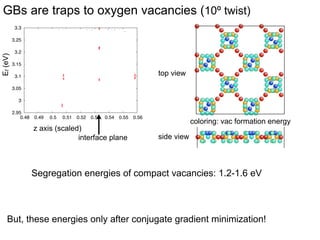
GBs are traps to oxygen vacancies (10º twist)
3.3

’atoms1.oxy_int’ using 3:16

Ef (eV)

3.25
3.2
3.15

top view

3.1
3.05
3
2.95
0.48

0.49

0.5

0.51

0.52

0.53

0.54

0.55

z axis (scaled)
interface plane

0.56

coloring: vac formation energy
side view

Segregation energies of compact vacancies: 1.2-1.6 eV

But, these energies only after conjugate gradient minimization!
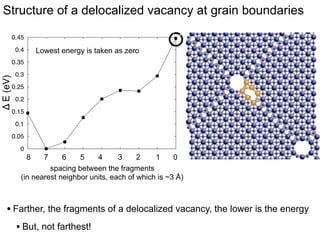
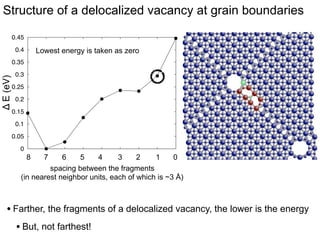
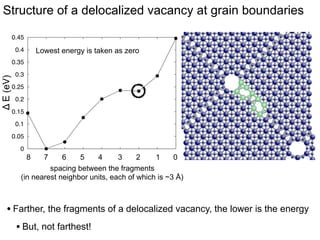
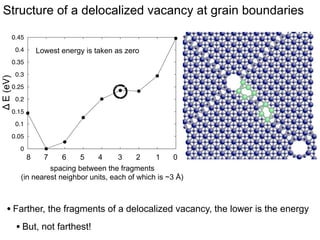
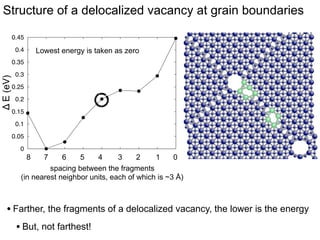
Structure of a delocalized Oxygen vacancy
0.15
0.1

Δ E (eV)

0.05

MDI

0

-0.05

Adjacent planes

-0.1

-0.15
-0.2
-0.25
-0.3

7
8
1 localized
at MD
atoms colored differently from blue
spacing between the fragments
are around a defect (vacancy)
(in nearest neighbor units, each of which is ~3 Å)
0
8

1
7

2
6

3
5

4
4

5
3

6
2

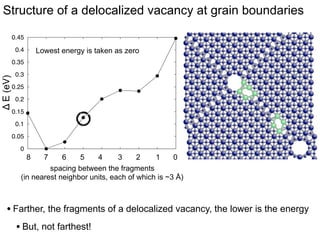
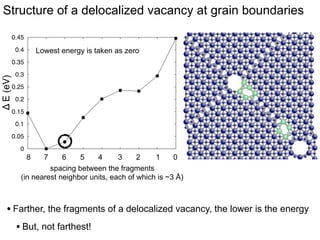
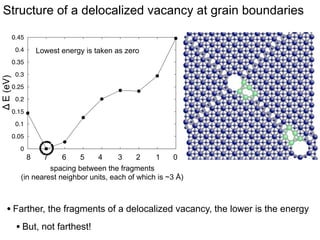
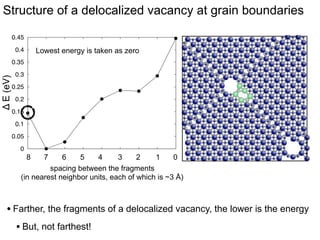
• Farther, the fragments of a delocalized vacancy, the lower is the energy
• But, not farthest!
Structure of a delocalized Oxygen vacancy
0.15
0.1

Δ E (eV)

0.05

MDI

0

-0.05

Adjacent planes

-0.1

-0.15
-0.2
-0.25
-0.3

7
8
1 localized
at MD
atoms colored differently from blue
spacing between the fragments
are around a defect (vacancy)
(in nearest neighbor units, each of which is ~3 Å)
0
8

1
7

2
6

3
5

4
4

5
3

6
2

• Farther, the fragments of a delocalized vacancy, the lower is the energy
• But, not farthest!
Structure of a delocalized Oxygen vacancy
0.15
0.1

Δ E (eV)

0.05

MDI

0

-0.05

Adjacent planes

-0.1

-0.15
-0.2
-0.25
-0.3

7
8
1 localized
at MD
atoms colored differently from blue
spacing between the fragments
are around a defect (vacancy)
(in nearest neighbor units, each of which is ~3 Å)
0
8

1
7

2
6

3
5

4
4

5
3

6
2

• Farther, the fragments of a delocalized vacancy, the lower is the energy
• But, not farthest!
Structure of a delocalized Oxygen vacancy
0.15
0.1

Δ E (eV)

0.05

MDI

0

-0.05

Adjacent planes

-0.1

-0.15
-0.2
-0.25
-0.3

7
8
1 localized
at MD
atoms colored differently from blue
spacing between the fragments
are around a defect (vacancy)
(in nearest neighbor units, each of which is ~3 Å)
0
8

1
7

2
6

3
5

4
4

5
3

6
2

• Farther, the fragments of a delocalized vacancy, the lower is the energy
• But, not farthest!
Structure of a delocalized Oxygen vacancy
0.15
0.1

Δ E (eV)

0.05

MDI

0

-0.05

Adjacent planes

-0.1

-0.15
-0.2
-0.25
-0.3

7
8
1 localized
at MD
atoms colored differently from blue
spacing between the fragments
are around a defect (vacancy)
(in nearest neighbor units, each of which is ~3 Å)
0
8

1
7

2
6

3
5

4
4

5
3

6
2

• Farther, the fragments of a delocalized vacancy, the lower is the energy
• But, not farthest!
Structure of a delocalized Oxygen vacancy
0.15
0.1

Δ E (eV)

0.05

MDI

0

-0.05

Adjacent planes

-0.1

-0.15
-0.2
-0.25
-0.3

7
8
1 localized
at MD
atoms colored differently from blue
spacing between the fragments
are around a defect (vacancy)
(in nearest neighbor units, each of which is ~3 Å)
0
8

1
7

2
6

3
5

4
4

5
3

6
2

• Farther, the fragments of a delocalized vacancy, the lower is the energy
• But, not farthest!
Structure of a delocalized Oxygen vacancy
0.15
0.1

Δ E (eV)

0.05

MDI

0

-0.05

Adjacent planes

-0.1

-0.15
-0.2
-0.25
-0.3

7
8
1 localized
at MD
atoms colored differently from blue
spacing between the fragments
are around a defect (vacancy)
(in nearest neighbor units, each of which is ~3 Å)
0
8

1
7

2
6

3
5

4
4

5
3

6
2

• Farther, the fragments of a delocalized vacancy, the lower is the energy
• But, not farthest!
Structure of a delocalized Oxygen vacancy
0.15
0.1

Δ E (eV)

0.05

MDI

0

-0.05

Adjacent planes

-0.1

-0.15
-0.2
-0.25
-0.3

7
8
1 localized
at MD
atoms colored differently from blue
spacing between the fragments
are around a defect (vacancy)
(in nearest neighbor units, each of which is ~3 Å)
0
8

1
7

2
6

3
5

4
4

5
3

6
2

• Farther, the fragments of a delocalized vacancy, the lower is the energy
• But, not farthest!
Structure of a delocalized Oxygen vacancy
0.15
0.1

Δ E (eV)

0.05

MDI

0

-0.05

Adjacent planes

-0.1

-0.15
-0.2
-0.25
-0.3

7
8
1 localized
at MD
atoms colored differently from blue
spacing between the fragments
are around a defect (vacancy)
(in nearest neighbor units, each of which is ~3 Å)
0
8

1
7

2
6

3
5

4
4

5
3

6
2

• Farther, the fragments of a delocalized vacancy, the lower is the energy
• But, not farthest!
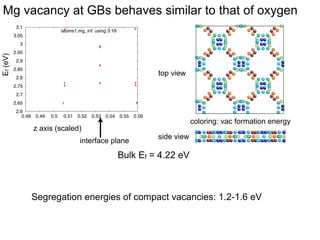
Mg vacancy at GBs behaves similar to that of oxygen
3.1

’atoms1.mg_int’ using 3:16

3.05

Ef (eV)

3
2.95
2.9
2.85

top view

2.8
2.75
2.7
2.65
2.6
0.48

0.49

0.5

0.51

0.52

0.53

0.54

0.55

z axis (scaled)
interface plane

0.56

coloring: vac formation energy
side view

Bulk Ef = 4.22 eV

Segregation energies of compact vacancies: 1.2-1.6 eV
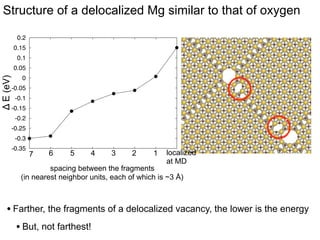
Structure of a delocalized Mg similar to that of oxygen
0.2
0.15
0.1

Δ E (eV)

0.05
0
-0.05
-0.1
-0.15
-0.2
-0.25
-0.3
-0.35

7
0

6
1

5
2

4
3

3
4

2
5

1
6

localized
7
at MD

spacing between the fragments
(in nearest neighbor units, each of which is ~3 Å)

• Farther, the fragments of a delocalized vacancy, the lower is the energy
• But, not farthest!
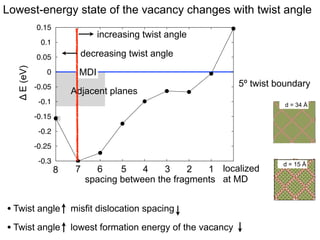
Lowest-energy state of the vacancy changes with twist angle
0.15

increasing twist angle

0.1

decreasing twist angle

Δ E (eV)

0.05

MDI

0
-0.05

5º twist boundary

Adjacent planes

-0.1

d = 34 Å

-0.15
-0.2
-0.25
-0.3

0
8

1
7

d = 34 Å

8
localized
spacing between the fragments at MD
2
6

3
5

4
4

5
3

6
2

7
1

• Twist angle

misfit dislocation spacing

• Twist angle

lowest formation energy of the vacancy

d = 15 Å
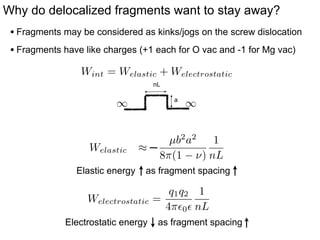
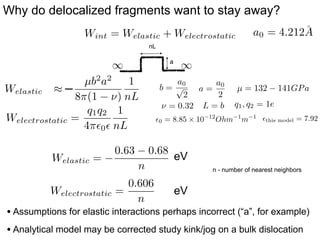
Why do delocalized fragments want to stay away?
• Fragments may be considered as kinks/jogs on the screw dislocation
• Fragments have like charges (+1 each for O vac and -1 for Mg vac)
Wint = Welastic + Welectrostatic
nL

1

a

1

µb2 a2
1
Welastic ⇡
8⇡(1 ⌫) nL
q1 q 2 1
Elastic energy as fragment spacing
Welectrostatic ⇡
4⇡✏0 nL
q1 q2 1
Welectrostatic =
4⇡✏0 ✏ nL
Electrostatic energy

as fragment spacing
Why do delocalized fragments want to stay away?
a0 = 4.212˚
A

Wint = Welastic + Welectrostatic
nL
a

1

µb2 a2
1
Welastic ⇡
8⇡(1 ⌫) nL
q1 1
q1 q 2 q 2 1
Welectrostatic
Welectrostatic ⇡ =
4⇡✏0 ✏
4⇡✏0 nLnL
Welastic =
Welectrostatic

0.63

1

a0
a0
b= p
a=
2
2
⌫ = 0.32 L = b
✏0 = 8.85 ⇥ 10

0.68
n

0.606
=
n

12

Ohm

µ = 132

141GP a

q1 , q2 = 1e
1

m

1

✏this model = 7.92

eV
n - number of nearest neighbors

eV

• Assumptions for elastic interactions perhaps incorrect (“a”, for example)
• Analytical model may be corrected study kink/jog on a bulk dislocation
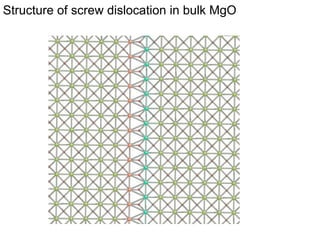
Structure of a screw dislocation in bulk MgO

atoms colored
by number of
neighbors
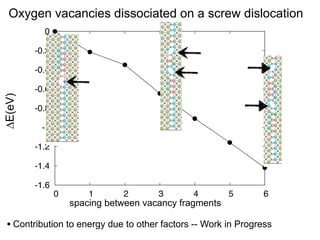
Oxygen vacancies dissociated on a screw dislocation
0
-0.2

∆E(eV)

-0.4
-0.6
-0.8
-1
-1.2
-1.4
-1.6
0

1

2

3

4

spacing between vacancy fragments

• Contribution to energy due to other factors

5

6

atoms colored
by number of
neighbors
Outline
1 nm
1. Grain boundary (GB) models, potentials, and methods

2. Ground-state structures of GBs
3. Structure and energetics of a vacancy at GBs

• compact and delocalized vacancies
4. Transport of vacancies

• observations and postulated mechanisms
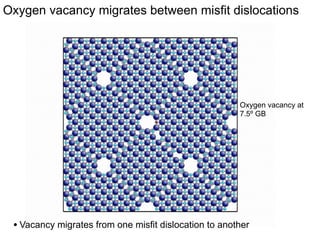
Oxygen vacancy migrates between misfit dislocations

Atoms are colored by
type and the grain to
which they belong
initially

Oxygen
vacancy at
7.5º GB

Mg
O

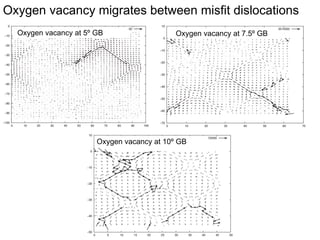
• Vacancy migrates from one misfit dislocation to another

This is a movie
Oxygen vacancy migrates between misfit dislocations
Oxygen vacancy at 5º GB

Oxygen vacancy at 7.5º GB

Oxygen vacancy at 10º GB
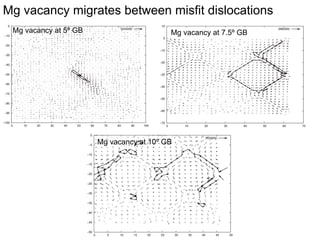
Mg vacancy migrates between misfit dislocations
Mg vacancy at 5º GB

Mg vacancy at 7.5º GB

Mg vacancy at 10º GB
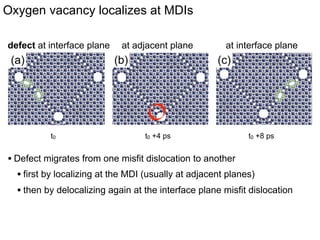
Oxygen vacancy localizes at MDIs
defect at interface plane

(a)

at adjacent plane

(b)

t0

at interface plane

(c)

t0 +4 ps

t0 +8 ps

• Defect migrates from one misfit dislocation to another
• first by localizing at the MDI (usually at adjacent planes)
• then by delocalizing again at the interface plane misfit dislocation
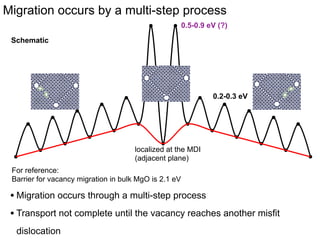
Migration occurs by a multi-step process
0.5-0.75 eV
Schematic

0.2-0.3 eV

localized at the MDI
(adjacent plane)
For reference:
Barrier for vacancy migration in bulk1MgO is 2.1 eV

• Migration occurs through a multi-step process
• Transport not complete until the vacancy reaches another misfit
dislocation
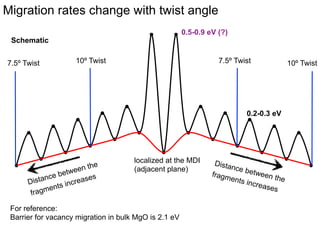
Migration rates change with twist angle
0.5-0.9 eV (?)

Schematic
10º Twist

7.5º Twist

7.5º Twist

0.2-0.3 eV

he
een t
tw
ce b e
n
es
Dista
creas
s in
ment
frag

localized at the MDI
(adjacent plane)

Dista

fragm

n ce b

ents i

1

For reference:
Barrier for vacancy migration in bulk MgO is 2.1 eV

etwee

n the
ncrea
ses

10º Twist
Summary: Vacancy at MgO GBs with misfit dislocations

• Grain boundaries are traps to vacancies of either species
• Several metastable states for vacancy to reside at the grain boundary
• In their lowest energy, they delocalize at misfit dislocations
• They migrate from one misfit dislocation to another
– In their intermediate, they localize in the vicinity of MDI

Fall MRS 2013 - MgO grain boundaries structure and transport

  • 1.
    Structure and transportof vacancies in MgO grain boundaries with misfit dislocations Kedarnath Kolluri and Blas Uberuaga MST-8, Los Alamos National Lab, NM 87545 Acknowledgments: Louis Vernon, Satyesh Yadav, Michael Demkowicz, John Hirth, Richard Hoagland, Amit Misra, and Gopinath Subramanian
  • 2.
    the yers The nm. ystal hick minal ance as a ni. ductrs at are con- abruptconductivity decrease when the thickness ionic conductivity of this material, which imposes results (fig. S1), meaning that the ultrathin layer range or sd changes from 30 to 62 nm is most likely due to rather high operational temperatures around 800°C a of YSZ grows rotated by 45° around the c axis obtained fr degraded search for alternative electrolytes has (1–4). Theinterface structure when the YSZ layers and strains to match the STO lattice. Because the frequency p exceed the critical thickness. not yet been successful in reaching the conduc- bulk lattice constants of STO and YSZ are due to grai tivity value of 0.01 S/cm desired for room temperature operation (1–4). Only modest reductions in the operation temperature of SOFCs (500° to 700°C) can be anticipated with the recently proposed optimized electrolytes such as gadolinia-doped ceria and lanthanum gallates (8–11). On the other hand, the one to two orders of magnitude increase of the electrical conductivity reported (12–14) in nanocrystalline samples as compared with single crystals outlines the importance of processing as an alternative route to increasing conductivity values toward the desired levels. Because modern thin film growth techniques allow a precise control of layer thickness and morphology, they provide a pathway for the production of solid electrolytes with optimized properties. Maier et al. found a substantial increase of the dc ionic conductivity of superlattices of CaF2 and BaF2 when the Fig. 1. (A) Z-contrast scanning transmission electron microscopy (S thickness of the individual layers was decreased the [YSZ1nm/STO10nm]9 superlattice (with nine repeats), obtain J. assigned to a size effect due to microscope. 676 (2008) down to 16 nm, Garcia-Barriocanal et. al., Science, 321,A yellow arrow marks the position of the YSZ layer. (In the space charge regions being smaller than the in the VG Microscopes HB501UX column. In both cases a white arrow layer thickness (15, 16). Kosacki et al. have spectra showing the O K edge obtained from the STO unit cell at the reported enhanced conductivity in highly tex- into the STO layer (black squares). (Inset) Ti L2,3 edges for the same tured thin films of YSZ with thicknesses between are the result of averaging four individual spectra at these position 60 and 15 nm, reaching 0.6 S/cm at 800°C (17). Because reducing film thickness (and therefore Fig. 2. Real part of the lateral increasing the fraction of material near the in- electrical conductivity versus fre- Solid Interfaces can enhance mass transport www.sciencemag.org on September 17, 2011 scaling, ductance the large res orig-
  • 3.
    ffusion cell. Thegrowth rates of the films were monid by quartz crystal oscillators ͑QCOs͒. Al2O3͑0001͒ e crystal substrates were ultrasonically cleaned in acIonic conduction is sensitive to interface 131906-3 Azad et al. structure FIG. 4. Conductivities of Inverse ofYSZ ͑Ref. 14͒, two-, four-, eight-, single crystal layer thickness ten-, and sixteen-layer films at 650 K. Azad et. al., Appl. Phys. Lett., 86, 131906 (2008) reference missing! 1. TEM micrograph showing a cross sectional view of an eight-layer was measured as a function of temperature using a four3-doped CeO2 and ZrO2 film grown on Al2O3͑0001͒. probe van der Pauw technique.12 Since the electronic conductivity of Physics © 2005 American Institute in these oxides is significantly less compared to ionic conductivity, especially at low temperatures, ionic concopyright; see http://apl.aip.org/about/rights_and_permissions ductivity dominates in these materials.13 As such, the total conductivity will be identified as oxygen ionic conductivity
  • 4.
    Goal: Relate interfacestructure to mass transport
  • 5.
    Model systems andmethods • Structure of low-angle GBs very well defined 1 nm • MgO grain boundaries using the simplest of ionic potentials available • Fixed charge on each atom (this potential has full charge) • Molecular statics and dynamics (at 2000K) 2 different MgO slabs (colors for clarity only) One twisted wrt to other by ø Mg O <100> <100> +ø/2 potential describing interatomic interactions Eij = Ae rij ⇢ C 6 rij + Cqi qj 1 ✏rij
  • 6.
    Outline 1 nm 1. Grainboundary (GB) models 2. Ground-state structures of GBs 3. Structure and energetics of a vacancy at (and near) GBs • compact and delocalized vacancies 4. Migrations of vacancies • observations and postulated mechanisms
  • 7.
    Low angle MgOgrain boundaries • Contain misfit dislocations 1 nm • Misfit dislocation spacing decreases with increasing twist angle misfit dislocation intersections (MDI) ø = 3.476º {110}<110> d = 50 Å atoms colored by number of neighbors <100> +ø/2 Lateral view of the interface plane <100> +ø/2
  • 8.
    Misfit dislocation modelvalid for a certain twist range d = 50 Å 3.5º 15º d = 34 Å d = 15 Å 5º 10º 25º 37º Misfit dislocation model valid Misfit dislocation model not valid
  • 9.
    Outline 1 nm 1. Grainboundary (GB) models, potentials, and methods 2. Ground-state structures of GBs 3. Structure and energetics of a vacancy at (and near) GBs • compact and delocalized vacancies 4. Transport of vacancies • observations and postulated mechanisms
  • 10.
    Ground-state structure ofMgO grain boundaries 0.5 atoms colored by type small is Oxygen, large is Mg Δ E (eV) 0 -0.5 -1 -1.5 -2 Reference state: energy of an MgO unit in bulk MgO 0 0.5 1 1.5 Number of MgO units removed 2 • Two MgO units less at an MDI • FCC-BCC semicoherent interfaces also have low densities at MDI
  • 11.
    Typical interface forlow-angle MgO twist boundaries atoms colored by type small is oxygen, large is Mg 7.5º twist boundary Low-density plane will called the “interface plane”
  • 12.
    Outline 1 nm 1. Grainboundary (GB) models, potentials, and methods 2. Ground-state structures of GBs 3. Structure and energetics of a vacancy at GBs • compact and delocalized vacancies 4. Transport of vacancies • observations and postulated mechanisms
  • 13.
    GBs are trapsto oxygen vacancies (5º twist) 3.3 Ef (eV) 3.25 3.2 3.15 3.1 3.05 3 2.95 2.9 0.48 0.49 0.5 0.51 0.52 0.53 0.54 0.55 0.56 z axis (scaled) interface plane Bulk Ef = 4.52 eV Atoms colored by excess energy Segregation energies of “compact” vacancies: 1.2-1.6 eV
  • 14.
    Structure of acompact vacancy - an Example small is Oxygen, large is Mg Atoms colored differently from blue are around a defect (vacancy) Segregation energies of “compact” vacancies: 1.2-1.6 eV
  • 15.
    GBs are trapsto oxygen vacancies (10º twist) 3.3 ’atoms1.oxy_int’ using 3:16 Ef (eV) 3.25 3.2 3.15 top view 3.1 3.05 3 2.95 0.48 0.49 0.5 0.51 0.52 0.53 0.54 0.55 z axis (scaled) interface plane 0.56 coloring: vac formation energy side view Segregation energies of compact vacancies: 1.2-1.6 eV But, these energies only after conjugate gradient minimization!
  • 16.
    Structure of adelocalized Oxygen vacancy 0.15 0.1 Δ E (eV) 0.05 MDI 0 -0.05 Adjacent planes -0.1 -0.15 -0.2 -0.25 -0.3 7 8 1 localized at MD atoms colored differently from blue spacing between the fragments are around a defect (vacancy) (in nearest neighbor units, each of which is ~3 Å) 0 8 1 7 2 6 3 5 4 4 5 3 6 2 • Farther, the fragments of a delocalized vacancy, the lower is the energy • But, not farthest!
  • 17.
    Structure of adelocalized Oxygen vacancy 0.15 0.1 Δ E (eV) 0.05 MDI 0 -0.05 Adjacent planes -0.1 -0.15 -0.2 -0.25 -0.3 7 8 1 localized at MD atoms colored differently from blue spacing between the fragments are around a defect (vacancy) (in nearest neighbor units, each of which is ~3 Å) 0 8 1 7 2 6 3 5 4 4 5 3 6 2 • Farther, the fragments of a delocalized vacancy, the lower is the energy • But, not farthest!
  • 18.
    Structure of adelocalized Oxygen vacancy 0.15 0.1 Δ E (eV) 0.05 MDI 0 -0.05 Adjacent planes -0.1 -0.15 -0.2 -0.25 -0.3 7 8 1 localized at MD atoms colored differently from blue spacing between the fragments are around a defect (vacancy) (in nearest neighbor units, each of which is ~3 Å) 0 8 1 7 2 6 3 5 4 4 5 3 6 2 • Farther, the fragments of a delocalized vacancy, the lower is the energy • But, not farthest!
  • 19.
    Structure of adelocalized Oxygen vacancy 0.15 0.1 Δ E (eV) 0.05 MDI 0 -0.05 Adjacent planes -0.1 -0.15 -0.2 -0.25 -0.3 7 8 1 localized at MD atoms colored differently from blue spacing between the fragments are around a defect (vacancy) (in nearest neighbor units, each of which is ~3 Å) 0 8 1 7 2 6 3 5 4 4 5 3 6 2 • Farther, the fragments of a delocalized vacancy, the lower is the energy • But, not farthest!
  • 20.
    Structure of adelocalized Oxygen vacancy 0.15 0.1 Δ E (eV) 0.05 MDI 0 -0.05 Adjacent planes -0.1 -0.15 -0.2 -0.25 -0.3 7 8 1 localized at MD atoms colored differently from blue spacing between the fragments are around a defect (vacancy) (in nearest neighbor units, each of which is ~3 Å) 0 8 1 7 2 6 3 5 4 4 5 3 6 2 • Farther, the fragments of a delocalized vacancy, the lower is the energy • But, not farthest!
  • 21.
    Structure of adelocalized Oxygen vacancy 0.15 0.1 Δ E (eV) 0.05 MDI 0 -0.05 Adjacent planes -0.1 -0.15 -0.2 -0.25 -0.3 7 8 1 localized at MD atoms colored differently from blue spacing between the fragments are around a defect (vacancy) (in nearest neighbor units, each of which is ~3 Å) 0 8 1 7 2 6 3 5 4 4 5 3 6 2 • Farther, the fragments of a delocalized vacancy, the lower is the energy • But, not farthest!
  • 22.
    Structure of adelocalized Oxygen vacancy 0.15 0.1 Δ E (eV) 0.05 MDI 0 -0.05 Adjacent planes -0.1 -0.15 -0.2 -0.25 -0.3 7 8 1 localized at MD atoms colored differently from blue spacing between the fragments are around a defect (vacancy) (in nearest neighbor units, each of which is ~3 Å) 0 8 1 7 2 6 3 5 4 4 5 3 6 2 • Farther, the fragments of a delocalized vacancy, the lower is the energy • But, not farthest!
  • 23.
    Structure of adelocalized Oxygen vacancy 0.15 0.1 Δ E (eV) 0.05 MDI 0 -0.05 Adjacent planes -0.1 -0.15 -0.2 -0.25 -0.3 7 8 1 localized at MD atoms colored differently from blue spacing between the fragments are around a defect (vacancy) (in nearest neighbor units, each of which is ~3 Å) 0 8 1 7 2 6 3 5 4 4 5 3 6 2 • Farther, the fragments of a delocalized vacancy, the lower is the energy • But, not farthest!
  • 24.
    Structure of adelocalized Oxygen vacancy 0.15 0.1 Δ E (eV) 0.05 MDI 0 -0.05 Adjacent planes -0.1 -0.15 -0.2 -0.25 -0.3 7 8 1 localized at MD atoms colored differently from blue spacing between the fragments are around a defect (vacancy) (in nearest neighbor units, each of which is ~3 Å) 0 8 1 7 2 6 3 5 4 4 5 3 6 2 • Farther, the fragments of a delocalized vacancy, the lower is the energy • But, not farthest!
  • 25.
    Mg vacancy atGBs behaves similar to that of oxygen 3.1 ’atoms1.mg_int’ using 3:16 3.05 Ef (eV) 3 2.95 2.9 2.85 top view 2.8 2.75 2.7 2.65 2.6 0.48 0.49 0.5 0.51 0.52 0.53 0.54 0.55 z axis (scaled) interface plane 0.56 coloring: vac formation energy side view Bulk Ef = 4.22 eV Segregation energies of compact vacancies: 1.2-1.6 eV
  • 26.
    Structure of adelocalized Mg similar to that of oxygen 0.2 0.15 0.1 Δ E (eV) 0.05 0 -0.05 -0.1 -0.15 -0.2 -0.25 -0.3 -0.35 7 0 6 1 5 2 4 3 3 4 2 5 1 6 localized 7 at MD spacing between the fragments (in nearest neighbor units, each of which is ~3 Å) • Farther, the fragments of a delocalized vacancy, the lower is the energy • But, not farthest!
  • 27.
    Lowest-energy state ofthe vacancy changes with twist angle 0.15 increasing twist angle 0.1 decreasing twist angle Δ E (eV) 0.05 MDI 0 -0.05 5º twist boundary Adjacent planes -0.1 d = 34 Å -0.15 -0.2 -0.25 -0.3 0 8 1 7 d = 34 Å 8 localized spacing between the fragments at MD 2 6 3 5 4 4 5 3 6 2 7 1 • Twist angle misfit dislocation spacing • Twist angle lowest formation energy of the vacancy d = 15 Å
  • 28.
    Why do delocalizedfragments want to stay away? • Fragments may be considered as kinks/jogs on the screw dislocation • Fragments have like charges (+1 each for O vac and -1 for Mg vac) Wint = Welastic + Welectrostatic nL 1 a 1 µb2 a2 1 Welastic ⇡ 8⇡(1 ⌫) nL q1 q 2 1 Elastic energy as fragment spacing Welectrostatic ⇡ 4⇡✏0 nL q1 q2 1 Welectrostatic = 4⇡✏0 ✏ nL Electrostatic energy as fragment spacing
  • 29.
    Why do delocalizedfragments want to stay away? a0 = 4.212˚ A Wint = Welastic + Welectrostatic nL a 1 µb2 a2 1 Welastic ⇡ 8⇡(1 ⌫) nL q1 1 q1 q 2 q 2 1 Welectrostatic Welectrostatic ⇡ = 4⇡✏0 ✏ 4⇡✏0 nLnL Welastic = Welectrostatic 0.63 1 a0 a0 b= p a= 2 2 ⌫ = 0.32 L = b ✏0 = 8.85 ⇥ 10 0.68 n 0.606 = n 12 Ohm µ = 132 141GP a q1 , q2 = 1e 1 m 1 ✏this model = 7.92 eV n - number of nearest neighbors eV • Assumptions for elastic interactions perhaps incorrect (“a”, for example) • Analytical model may be corrected study kink/jog on a bulk dislocation
  • 30.
    Structure of ascrew dislocation in bulk MgO atoms colored by number of neighbors
  • 31.
    Oxygen vacancies dissociatedon a screw dislocation 0 -0.2 ∆E(eV) -0.4 -0.6 -0.8 -1 -1.2 -1.4 -1.6 0 1 2 3 4 spacing between vacancy fragments • Contribution to energy due to other factors 5 6 atoms colored by number of neighbors
  • 32.
    Outline 1 nm 1. Grainboundary (GB) models, potentials, and methods 2. Ground-state structures of GBs 3. Structure and energetics of a vacancy at GBs • compact and delocalized vacancies 4. Transport of vacancies • observations and postulated mechanisms
  • 33.
    Oxygen vacancy migratesbetween misfit dislocations Atoms are colored by type and the grain to which they belong initially Oxygen vacancy at 7.5º GB Mg O • Vacancy migrates from one misfit dislocation to another This is a movie
  • 34.
    Oxygen vacancy migratesbetween misfit dislocations Oxygen vacancy at 5º GB Oxygen vacancy at 5º GB Oxygen vacancy at 7.5º GB Oxygen vacancy at 10º GB
  • 35.
    Mg vacancy migratesbetween misfit dislocations Mg vacancy at 5º GB Mg vacancy at 7.5º GB Mg vacancy at 10º GB
  • 36.
    Oxygen vacancy localizesat MDIs defect at interface plane (a) at adjacent plane (b) t0 at interface plane (c) t0 +4 ps t0 +8 ps • Defect migrates from one misfit dislocation to another • first by localizing at the MDI (usually at adjacent planes) • then by delocalizing again at the interface plane misfit dislocation
  • 37.
    Migration occurs bya multi-step process 0.5-0.75 eV Schematic 0.2-0.3 eV localized at the MDI (adjacent plane) For reference: Barrier for vacancy migration in bulk1MgO is 2.1 eV • Migration occurs through a multi-step process • Transport not complete until the vacancy reaches another misfit dislocation
  • 38.
    Migration rates changewith twist angle 0.5-0.9 eV (?) Schematic 10º Twist 7.5º Twist 7.5º Twist 0.2-0.3 eV he een t tw ce b e n es Dista creas s in ment frag localized at the MDI (adjacent plane) Dista fragm n ce b ents i 1 For reference: Barrier for vacancy migration in bulk MgO is 2.1 eV etwee n the ncrea ses 10º Twist
  • 39.
    Summary: Vacancy atMgO GBs with misfit dislocations • Grain boundaries are traps to vacancies of either species • Several metastable states for vacancy to reside at the grain boundary • In their lowest energy, they delocalize at misfit dislocations • They migrate from one misfit dislocation to another – In their intermediate, they localize in the vicinity of MDI