Characterizing misfit dislocations at interfaces:
Yet Another Method!
Kedarnath Kolluri, M. J. Demkowicz
Acknowledgments:
A. Kashinath, A. Vattré, B. Uberuaga, X.-Y. Liu, A. Caro, and A. Misra

Financial Support:
Center for Materials at Irradiation and Mechanical Extremes (CMIME) at LANL,
an Energy Frontier Research Center (EFRC) funded by
U.S. Department of Energy, Office of Science, Office of Basic Energy Sciences
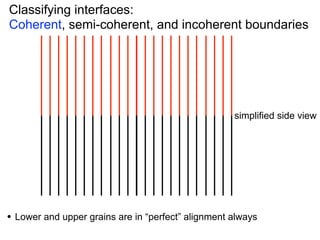
Classifying interfaces:
Coherent, semi-coherent, and incoherent boundaries

simplified side view

•

Lower and upper grains are in “perfect” alignment always
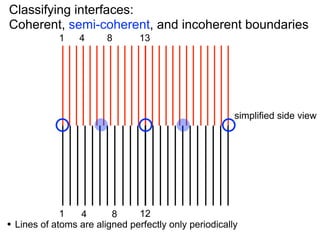
Classifying interfaces:
Coherent, semi-coherent, and incoherent boundaries
1

4

8

13

simplified side view

•

1
12
4
8
Lines of atoms are aligned perfectly only periodically
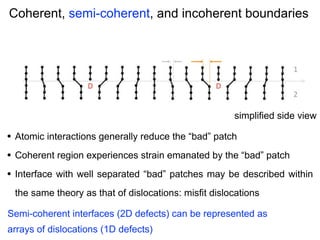
Coherent, semi-coherent, and incoherent boundaries

simplified side view

•

Atomic interactions generally reduce the “bad” patch

•

Coherent region experiences strain emanated by the “bad” patch

•

Interface with well separated “bad” patches may be described within
the same theory as that of dislocations: misfit dislocations

Semi-coherent interfaces (2D defects) can be represented as
arrays of dislocations (1D defects)
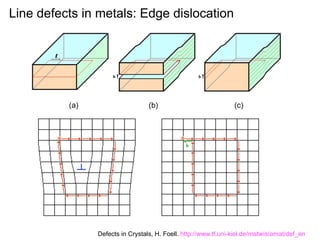
Line defects in metals: Edge dislocation

Defects in Crystals, H. Foell. http://www.tf.uni-kiel.de/matwis/amat/def_en
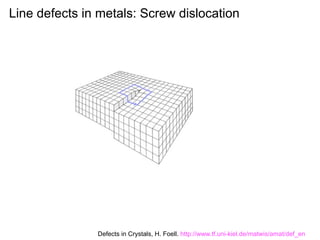
Line defects in metals: Screw dislocation

Defects in Crystals, H. Foell. http://www.tf.uni-kiel.de/matwis/amat/def_en
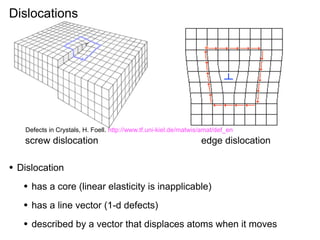
Dislocations

Defects in Crystals, H. Foell. http://www.tf.uni-kiel.de/matwis/amat/def_en

screw dislocation

•

edge dislocation

Dislocation

•

has a core (linear elasticity is inapplicable)

•

has a line vector (1-d defects)
•

described by a vector that displaces atoms when it moves
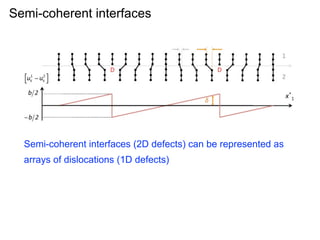
Semi-coherent interfaces

Semi-coherent interfaces (2D defects) can be represented as
arrays of dislocations (1D defects)
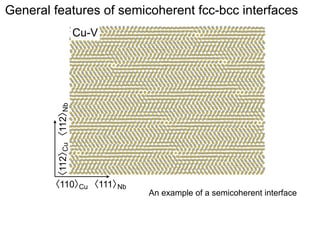
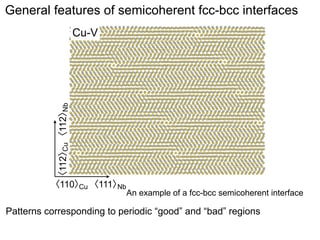
General features of semicoherent fcc-bcc interfaces

〈112〉 〈112〉
Cu
Nb

Cu-V

〈110〉 〈111〉
Cu
Nb

An example of a semicoherent interface
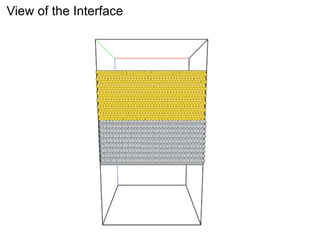
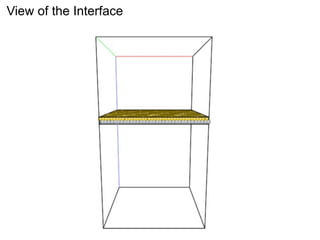
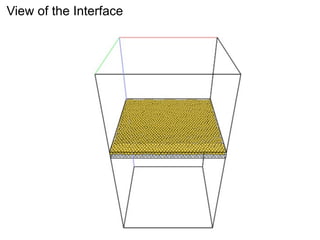
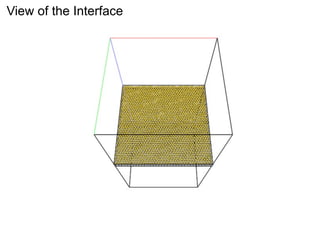
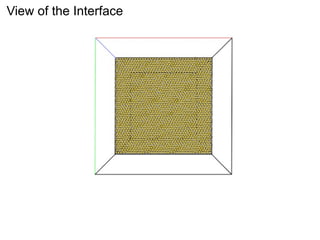
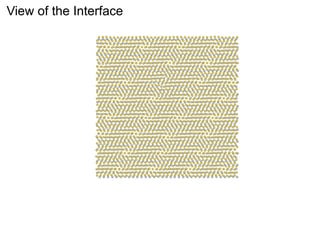
View of the Interface
General features of semicoherent fcc-bcc interfaces

〈112〉 〈112〉
Cu
Nb

Cu-V

〈110〉 〈111〉
Cu
Nb

An example of a fcc-bcc semicoherent interface

Patterns corresponding to periodic “good” and “bad” regions
General features of semicoherent fcc-bcc interfaces

〈112〉 〈112〉
Cu
Nb

Cu-V

〈110〉 〈111〉
Cu
Nb

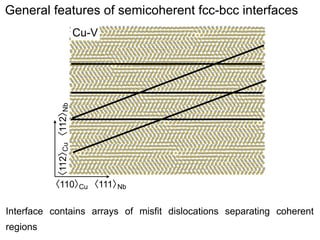
Interface contains arrays of misfit dislocations separating coherent
regions
〈112〉 〈112〉
Cu
Nb

General features of semicoherent fcc-bcc interfaces

Cu-Nb

〈110〉 〈111〉
Cu
Nb

Cu-V

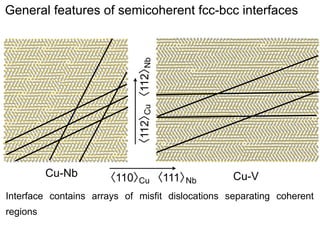
Interface contains arrays of misfit dislocations separating coherent
regions
MDI
1 nm

〈112〉
Cu

General features of semicoherent fcc-bcc interfaces

Cu-Nb KS 〈110〉
Cu

Cu-V KS

•

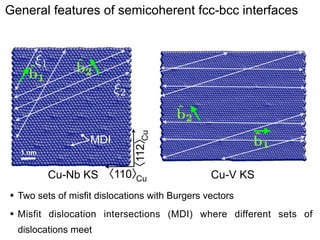
Two sets of misfit dislocations with Burgers vectors

•

Misfit dislocation intersections (MDI) where different sets of
dislocations meet
Sideviews often used to identify dislocation spacing
d = 2.55 nm
1
1
1
1

22
22

33

44
33

66

55
44

55

77
66

88
77

99

CuNb KS
10
10

88

99

<110>Cu || <111>Nb
<110>Cu || <111>Nb
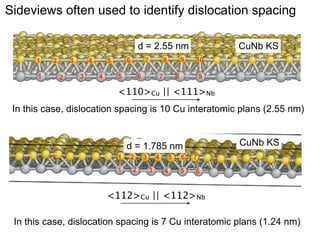
In this case, dislocation spacing is 10 Cu interatomic plans (2.55 nm)
CuNb KS

d = 1.785 nm
11 22 33 4 4 5 5 6 6 7 7
11

22

33

44

55

66

<112>Cu || <112>Nb
<112>Cu || <112>Nb
In this case, dislocation spacing is 7 Cu interatomic plans (1.24 nm)
<112>Cu || <112>Nb

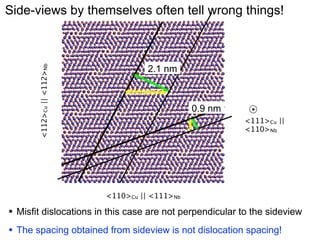
Side-views by themselves often tell wrong things!

2.1 nm

0.9 nm
<111>Cu ||
<110>Nb

<110>Cu || <111>Nb

•

12
Misfit dislocations in this case are not perpendicular to the sideview

•

The spacing obtained from sideview is not dislocation spacing!
Yet another method for finding dislocations
at fcc-bcc interfaces
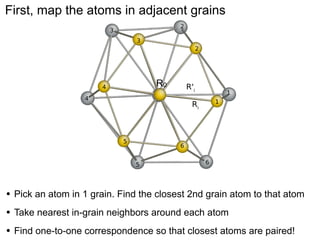
First, map the atoms in adjacent grains
2

3
3

2

Cu-Fe NW

R0

4

R'i

4

1
1

Ri

5

6
5

6

Compute vectors R'i-Ri where the vectors are the lines joining
the closest
an atom in fcc and bcc atoms closest corresponding nearest
1 grain. Find the to their 2nd grain atom to that
neighbors

•

Pick

•

Take nearest in-grain neighbors around each atom

•

Find one-to-one correspondence so that closest atoms are paired!

atom
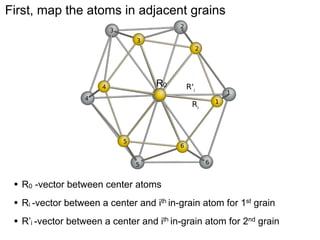
First, map the atoms in adjacent grains
2

3
3

2

Cu-Fe NW

R0

4

R'i

4

1

Ri

5

6
5

•

1

6

Compute vectors R'i-Ri where the
R0 -vector between center atoms vectors are the lines joining

•

the closest fcc and bcc atoms to their corresponding nearest
neighbors
Ri -vector between a center and ith in-grain atom for 1st grain

•

R’i -vector between a center and ith in-grain atom for 2nd grain
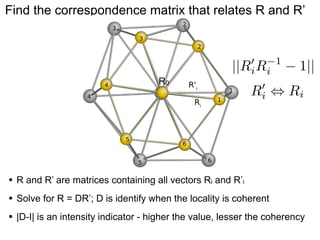
Find the correspondence matrix that relates R and R’
2

3
3

2

0
||Ri Ri

Cu-Fe NW

R0

4

R'i

4

1

Ri

5

0
Ri

1||

, Ri

6
5

•

1

1

6

Compute vectors containing all vectors Ri the R’i
R and R’ are matricesR'i-Ri where the vectors areand lines joining

•

the closest fcc and bcc atoms to their corresponding nearest
Solveneighbors
for R = DR’; D is identify when the locality is coherent

•

|D-I| is an intensity indicator - higher the value, lesser the coherency
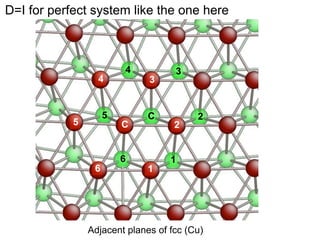
D=I for perfect system like the one here

4

5

5

6

4

C
6

3

C

1

3

2

2

1

Adjacent planes of fcc (Cu)
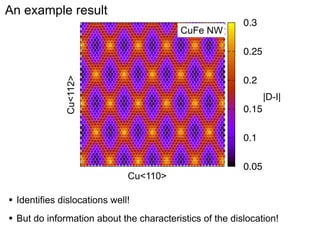
An example result

NW

0.3

CuFe NW

0.25

0.4

Cu<112>

fcc<112>

0.35

0.3

0.2

0.55

0.1

0.6

0.05

0.45

Cu-Fe
|D-I|
0.15

0.5

Cu<110>
0.3 0.35 0.4 0.45 0.5 0.55 0.6

fcc<110>

•

Identifies dislocations well!

•

But do information about the characteristics of the dislocation!
Structure of interfaces: Misfit dislocations

•

A general method to identify dislocation line and Burgers vectors
•

Assumption: A coherent patch exists at the interface

•

Advantage: Reference structure not required

•

Limitations: Dislocation core thickness cannot be determined (yet)
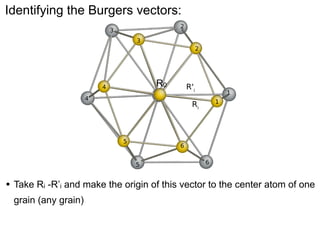
Identifying the Burgers vectors:
2

3
3

2

Cu-Fe NW

R0

4

R'i

4

1

Ri

5

6
5

•

1

6

Compute vectors
Take Ri -R’i and makeR'i-Riorigin of this vector tothe lines joining of one
the where the vectors are the center atom
grain

the closest fcc and bcc atoms to their corresponding nearest
neighbors
(any grain)
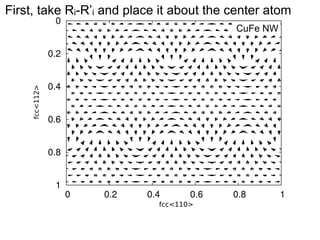
First, take Ri-R’i and place it about the center atom

fcc<112>

CuFe NW

fcc<110>

The computed vectors are plotted. The vectors all originate at
the location of the center atom shown in slide 1
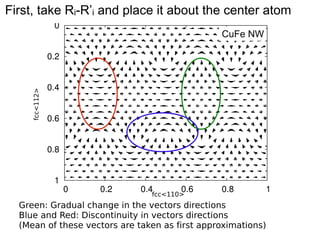
First, take Ri-R’i and place it about the center atom

fcc<112>

CuFe NW

fcc<110>

Green: Gradual change in the vectors directions
Blue and Red: Discontinuity in vectors directions
(Mean of these vectors are taken as first approximations)
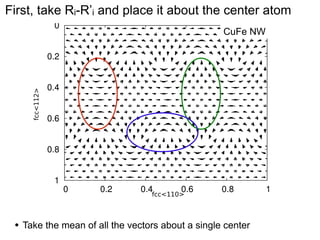
First, take Ri-R’i and place it about the center atom

fcc<112>

CuFe NW

fcc<110>

Green: Gradual change in the vectors directions
Blue and Red: Discontinuity in vectors directions
Take of mean of all the vectors as first approximations)
•(Meanthe these vectors are takenabout a single center
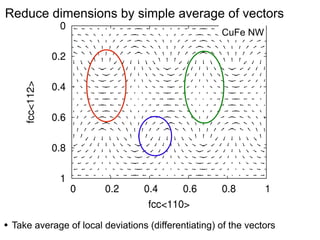
Reduce dimensions by simple average of vectors
CuFe NW

•

Take average of local deviations (differentiating) of the vectors
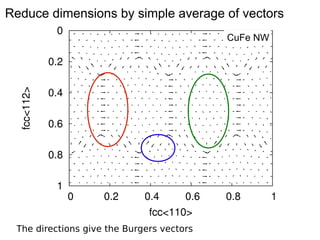
Reduce dimensions by simple average of vectors
CuFe NW

The directions give the Burgers vectors
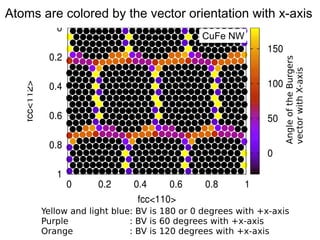
Atoms are colored by the vector orientation with x-axis

Angle of the Burgers
vector with X-axis

CuFe NW

Yellow and light blue: BV is 180 or 0 degrees with +x-axis
Purple
: BV is 60 degrees with +x-axis
Orange
: BV is 120 degrees with +x-axis
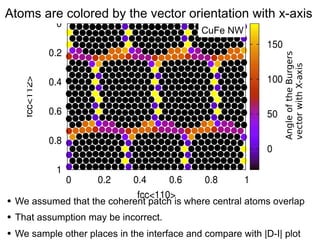
Atoms are colored by the vector orientation with x-axis
Angle of the Burgers
vector with X-axis

CuFe NW

•
•
•

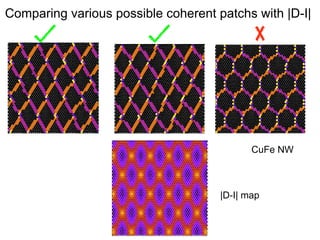
We assumed that the coherent patch is where central atoms overlap
Yellow and light blue: BV is 180 or 0 degrees with +x-axis
Purple
: BV is 60
That assumption may be incorrect. degrees with +x-axis
Orange
: BV is 120 degrees with +x-axis

We sample other places in the interface and compare with |D-I| plot
Comparing various possible coherent patchs with |D-I|
NW

NW

.3

NW

0.3

150
0.35
0.4
100

45

.5

55

50
0.5
0.550

Cu-Fe

0.4

100

1
Cu-Fe

0.45
0.5

1

50

5

0.55 0

0

NW
0.6
0.6
0.3 0.35 0.4 0.45 0.5 0.55 0.6 0.3 0.35 0.4 0.45 0.5 0.55 0.6 0.30.3
0.35 0.4 0.45 0.5 0.55 0.6
0.3
fcc<110>
fcc<110>
fcc<110> NW
CuFe
0.35

fcc<112>

.6

0.45

0.35 150
fcc<112>

.4

fcc<112>

35

0.3

0.4
0.45
0.5

0.25
0.2
Cu-Fe

|D-I|
0.15

0.55

0.1

0.6

0.05

map
0.4
.2

0.6
0.4

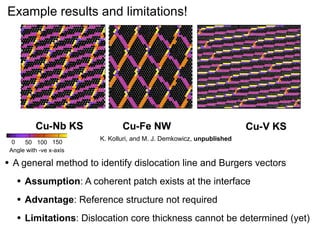
Example results and limitations!

0.8
0.6

1
0.8
150
0

0.45

0.4

0.35

0.3

0.25

0.2

0 0.5

0.2

100
0.4

0.8

1 0.15

0.6
50

0

1

0

0.2

0.4

0.6

0.8

1
0
0.2
0.4
0.6
0.8
1

0.28
0.26
150
0.24
0.22
0.2
100
0.18
0.16
50
0.14
0.12
0.1
0
0.08
0.06

0
50 100 150
Angle with -ve x-axis

0

0

0.2

0.4

1

0.6

A general method to identify dislocation line and Burgers vectors
0.8

•

Angle with -ve x axis

K. Kolluri, and M. J. Demkowicz, unpublished

•

Assumption: A coherent patch exists at the interface

•

Advantage: Reference structure not required

•

Limitations: Dislocation core thickness cannot be determined (yet)

misfitdislocations-another-method

  • 1.
    Characterizing misfit dislocationsat interfaces: Yet Another Method! Kedarnath Kolluri, M. J. Demkowicz Acknowledgments: A. Kashinath, A. Vattré, B. Uberuaga, X.-Y. Liu, A. Caro, and A. Misra Financial Support: Center for Materials at Irradiation and Mechanical Extremes (CMIME) at LANL, an Energy Frontier Research Center (EFRC) funded by U.S. Department of Energy, Office of Science, Office of Basic Energy Sciences
  • 2.
    Classifying interfaces: Coherent, semi-coherent,and incoherent boundaries simplified side view • Lower and upper grains are in “perfect” alignment always
  • 3.
    Classifying interfaces: Coherent, semi-coherent,and incoherent boundaries 1 4 8 13 simplified side view • 1 12 4 8 Lines of atoms are aligned perfectly only periodically
  • 4.
    Coherent, semi-coherent, andincoherent boundaries simplified side view • Atomic interactions generally reduce the “bad” patch • Coherent region experiences strain emanated by the “bad” patch • Interface with well separated “bad” patches may be described within the same theory as that of dislocations: misfit dislocations Semi-coherent interfaces (2D defects) can be represented as arrays of dislocations (1D defects)
  • 5.
    Line defects inmetals: Edge dislocation Defects in Crystals, H. Foell. http://www.tf.uni-kiel.de/matwis/amat/def_en
  • 6.
    Line defects inmetals: Screw dislocation Defects in Crystals, H. Foell. http://www.tf.uni-kiel.de/matwis/amat/def_en
  • 7.
    Dislocations Defects in Crystals,H. Foell. http://www.tf.uni-kiel.de/matwis/amat/def_en screw dislocation • edge dislocation Dislocation • has a core (linear elasticity is inapplicable) • has a line vector (1-d defects) • described by a vector that displaces atoms when it moves
  • 8.
    Semi-coherent interfaces Semi-coherent interfaces(2D defects) can be represented as arrays of dislocations (1D defects)
  • 9.
    General features ofsemicoherent fcc-bcc interfaces 〈112〉 〈112〉 Cu Nb Cu-V 〈110〉 〈111〉 Cu Nb An example of a semicoherent interface
  • 10.
    View of theInterface
  • 11.
    View of theInterface
  • 12.
    View of theInterface
  • 13.
    View of theInterface
  • 14.
    View of theInterface
  • 15.
    View of theInterface
  • 16.
    General features ofsemicoherent fcc-bcc interfaces 〈112〉 〈112〉 Cu Nb Cu-V 〈110〉 〈111〉 Cu Nb An example of a fcc-bcc semicoherent interface Patterns corresponding to periodic “good” and “bad” regions
  • 17.
    General features ofsemicoherent fcc-bcc interfaces 〈112〉 〈112〉 Cu Nb Cu-V 〈110〉 〈111〉 Cu Nb Interface contains arrays of misfit dislocations separating coherent regions
  • 18.
    〈112〉 〈112〉 Cu Nb General featuresof semicoherent fcc-bcc interfaces Cu-Nb 〈110〉 〈111〉 Cu Nb Cu-V Interface contains arrays of misfit dislocations separating coherent regions
  • 19.
    MDI 1 nm 〈112〉 Cu General featuresof semicoherent fcc-bcc interfaces Cu-Nb KS 〈110〉 Cu Cu-V KS • Two sets of misfit dislocations with Burgers vectors • Misfit dislocation intersections (MDI) where different sets of dislocations meet
  • 20.
    Sideviews often usedto identify dislocation spacing d = 2.55 nm 1 1 1 1 22 22 33 44 33 66 55 44 55 77 66 88 77 99 CuNb KS 10 10 88 99 <110>Cu || <111>Nb <110>Cu || <111>Nb In this case, dislocation spacing is 10 Cu interatomic plans (2.55 nm) CuNb KS d = 1.785 nm 11 22 33 4 4 5 5 6 6 7 7 11 22 33 44 55 66 <112>Cu || <112>Nb <112>Cu || <112>Nb In this case, dislocation spacing is 7 Cu interatomic plans (1.24 nm)
  • 21.
    <112>Cu || <112>Nb Side-viewsby themselves often tell wrong things! 2.1 nm 0.9 nm <111>Cu || <110>Nb <110>Cu || <111>Nb • 12 Misfit dislocations in this case are not perpendicular to the sideview • The spacing obtained from sideview is not dislocation spacing!
  • 22.
    Yet another methodfor finding dislocations at fcc-bcc interfaces
  • 23.
    First, map theatoms in adjacent grains 2 3 3 2 Cu-Fe NW R0 4 R'i 4 1 1 Ri 5 6 5 6 Compute vectors R'i-Ri where the vectors are the lines joining the closest an atom in fcc and bcc atoms closest corresponding nearest 1 grain. Find the to their 2nd grain atom to that neighbors • Pick • Take nearest in-grain neighbors around each atom • Find one-to-one correspondence so that closest atoms are paired! atom
  • 24.
    First, map theatoms in adjacent grains 2 3 3 2 Cu-Fe NW R0 4 R'i 4 1 Ri 5 6 5 • 1 6 Compute vectors R'i-Ri where the R0 -vector between center atoms vectors are the lines joining • the closest fcc and bcc atoms to their corresponding nearest neighbors Ri -vector between a center and ith in-grain atom for 1st grain • R’i -vector between a center and ith in-grain atom for 2nd grain
  • 25.
    Find the correspondencematrix that relates R and R’ 2 3 3 2 0 ||Ri Ri Cu-Fe NW R0 4 R'i 4 1 Ri 5 0 Ri 1|| , Ri 6 5 • 1 1 6 Compute vectors containing all vectors Ri the R’i R and R’ are matricesR'i-Ri where the vectors areand lines joining • the closest fcc and bcc atoms to their corresponding nearest Solveneighbors for R = DR’; D is identify when the locality is coherent • |D-I| is an intensity indicator - higher the value, lesser the coherency
  • 26.
    D=I for perfectsystem like the one here 4 5 5 6 4 C 6 3 C 1 3 2 2 1 Adjacent planes of fcc (Cu)
  • 27.
    An example result NW 0.3 CuFeNW 0.25 0.4 Cu<112> fcc<112> 0.35 0.3 0.2 0.55 0.1 0.6 0.05 0.45 Cu-Fe |D-I| 0.15 0.5 Cu<110> 0.3 0.35 0.4 0.45 0.5 0.55 0.6 fcc<110> • Identifies dislocations well! • But do information about the characteristics of the dislocation!
  • 28.
    Structure of interfaces:Misfit dislocations • A general method to identify dislocation line and Burgers vectors • Assumption: A coherent patch exists at the interface • Advantage: Reference structure not required • Limitations: Dislocation core thickness cannot be determined (yet)
  • 29.
    Identifying the Burgersvectors: 2 3 3 2 Cu-Fe NW R0 4 R'i 4 1 Ri 5 6 5 • 1 6 Compute vectors Take Ri -R’i and makeR'i-Riorigin of this vector tothe lines joining of one the where the vectors are the center atom grain the closest fcc and bcc atoms to their corresponding nearest neighbors (any grain)
  • 30.
    First, take Ri-R’iand place it about the center atom fcc<112> CuFe NW fcc<110> The computed vectors are plotted. The vectors all originate at the location of the center atom shown in slide 1
  • 31.
    First, take Ri-R’iand place it about the center atom fcc<112> CuFe NW fcc<110> Green: Gradual change in the vectors directions Blue and Red: Discontinuity in vectors directions (Mean of these vectors are taken as first approximations)
  • 32.
    First, take Ri-R’iand place it about the center atom fcc<112> CuFe NW fcc<110> Green: Gradual change in the vectors directions Blue and Red: Discontinuity in vectors directions Take of mean of all the vectors as first approximations) •(Meanthe these vectors are takenabout a single center
  • 33.
    Reduce dimensions bysimple average of vectors CuFe NW • Take average of local deviations (differentiating) of the vectors
  • 34.
    Reduce dimensions bysimple average of vectors CuFe NW The directions give the Burgers vectors
  • 35.
    Atoms are coloredby the vector orientation with x-axis Angle of the Burgers vector with X-axis CuFe NW Yellow and light blue: BV is 180 or 0 degrees with +x-axis Purple : BV is 60 degrees with +x-axis Orange : BV is 120 degrees with +x-axis
  • 36.
    Atoms are coloredby the vector orientation with x-axis Angle of the Burgers vector with X-axis CuFe NW • • • We assumed that the coherent patch is where central atoms overlap Yellow and light blue: BV is 180 or 0 degrees with +x-axis Purple : BV is 60 That assumption may be incorrect. degrees with +x-axis Orange : BV is 120 degrees with +x-axis We sample other places in the interface and compare with |D-I| plot
  • 37.
    Comparing various possiblecoherent patchs with |D-I| NW NW .3 NW 0.3 150 0.35 0.4 100 45 .5 55 50 0.5 0.550 Cu-Fe 0.4 100 1 Cu-Fe 0.45 0.5 1 50 5 0.55 0 0 NW 0.6 0.6 0.3 0.35 0.4 0.45 0.5 0.55 0.6 0.3 0.35 0.4 0.45 0.5 0.55 0.6 0.30.3 0.35 0.4 0.45 0.5 0.55 0.6 0.3 fcc<110> fcc<110> fcc<110> NW CuFe 0.35 fcc<112> .6 0.45 0.35 150 fcc<112> .4 fcc<112> 35 0.3 0.4 0.45 0.5 0.25 0.2 Cu-Fe |D-I| 0.15 0.55 0.1 0.6 0.05 map
  • 38.
    0.4 .2 0.6 0.4 Example results andlimitations! 0.8 0.6 1 0.8 150 0 0.45 0.4 0.35 0.3 0.25 0.2 0 0.5 0.2 100 0.4 0.8 1 0.15 0.6 50 0 1 0 0.2 0.4 0.6 0.8 1 0 0.2 0.4 0.6 0.8 1 0.28 0.26 150 0.24 0.22 0.2 100 0.18 0.16 50 0.14 0.12 0.1 0 0.08 0.06 0 50 100 150 Angle with -ve x-axis 0 0 0.2 0.4 1 0.6 A general method to identify dislocation line and Burgers vectors 0.8 • Angle with -ve x axis K. Kolluri, and M. J. Demkowicz, unpublished • Assumption: A coherent patch exists at the interface • Advantage: Reference structure not required • Limitations: Dislocation core thickness cannot be determined (yet)