On the Factors Governing the Sink Strength of
Semicoherent fcc-bcc Interfaces
Kedarnath Kolluri and Michael Demkowicz
Acknowledgments:
B. P. Uberuaga, A. Kashinath, A. Vattré, X.-Y. Liu, A. Misra, R. G. Hoagland, J. P. Hirth, M. A.
Nastasi, and A. Caro

Financial Support:
Center for Materials at Irradiation and Mechanical Extremes (CMIME) at LANL,
an Energy Frontier Research Center (EFRC) funded by
U.S. Department of Energy, Office of Science, Office of Basic Energy Sciences
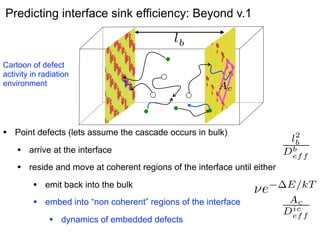
Predicting interface sink efficiency: Beyond v.1

Cartoon of defect
activity in radiation
environment

•

2
lb
b
Def f

Ac
ic
Def f

Point defects (lets assume the cascade occurs in bulk)

2
lb
b
Def f

•

arrive at the interface

•

reside and move at coherent regions of the interface until either

•

emit back into the bulk

•

embed into “non coherent” regions of the interface

•

dynamics of embedded defects

⌫e

E/kT
Ac
ic
Def f
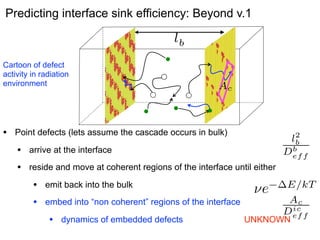
Predicting interface sink efficiency: Beyond v.1

Cartoon of defect
activity in radiation
environment

•

2
lb
b
Def f

Ac
ic
Def f

Point defects (lets assume the cascade occurs in bulk)

2
lb
b
Def f

•

arrive at the interface

•

reside and move at coherent regions of the interface until either

•

emit back into the bulk

•

embed into “non coherent” regions of the interface

•

dynamics of embedded defects

⌫e

E/kT
Ac
ic
Def f

UNKNOWN
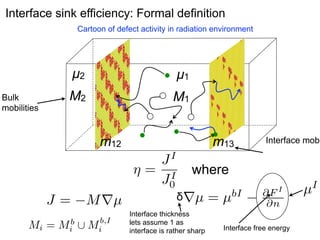
Interface sink efficiency: Formal definition
Cartoon of defect activity in radiation environment

µ2
Bulk
mobilities

µ1

M2

M1
m12

m13

JI
⌘= I
J0

J=

M rµ

Mi = Mib [ Mib,I

Interface mobi

where
δrµ

Interface thickness
lets assume 1 as
interface is rather sharp

=µ

bI

I

@F
@n

Interface free energy

µI
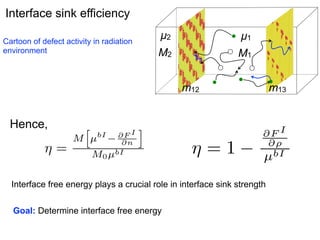
Interface sink efficiency
µ2

µ1

µ3

M2

Cartoon of defect activity in radiation
environment

M1

M3

m12

Hence,

⌘=

M

h

bI
@F I
µ
@n
M0 µbI

i

⌘=1

m13

@F I
@⇢
µbI

Interface free energy plays a crucial role in interface sink strength
Goal: Determine interface free energy
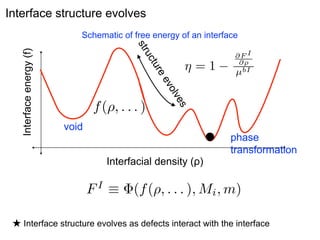
Interface structure evolves

uc

str

⌘=1

e
tur

@F I
@⇢
µbI

olv

ev

f (⇢, . . . )

es

Interface energy (f)

Schematic of free energy of an interface

void
Interfacial density (ρ)

FI ⌘

phase
transformation

(f (⇢, . . . ), Mi , m)

★ Interface structure evolves as defects interact with the interface
str

µ3

M2

M1

M3

m12

es

v
bulk

f (⇢, . . . )
i

µ bulk
Interfacial density (ρ)
I

F ⌘

m13

olv

µ
void

µ1

ev

@F I
@⇢
µbI

⌘=1

µ2

e
tur
uc

Interface energy (f)

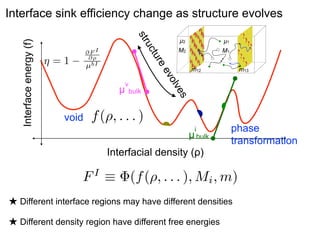
Interface sink efficiency change as structure evolves

phase
transformation

(f (⇢, . . . ), Mi , m)

★ Different interface regions may have different densities
★ Different density region have different free energies
m12

f (⇢, . . . )
i

µ bulk

m13

Point defect activity under radiation

⌘(t) = 1

void

@F I
@⇢
µbI

v
bulk

es

M3

µ

olv

M1

ev

M2

e
tur

µ3

uc

µ1

str

µ2

Interface energy (f)

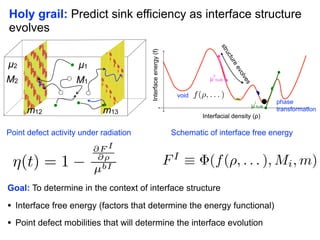
Holy grail: Predict sink efficiency as interface structure
evolves

Interfacial density (ρ)

phase
transformation

Schematic of interface free energy

FI ⌘

(f (⇢, . . . ), Mi , m)

Goal: To determine in the context of interface structure

•

Interface free energy (factors that determine the energy functional)

•

Point defect mobilities that will determine the interface evolution
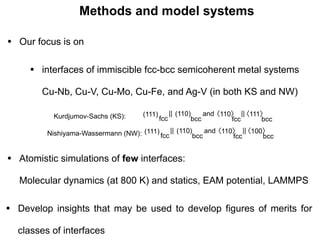
Methods and model systems
•

Our focus is on

•

interfaces of immiscible fcc-bcc semicoherent metal systems
Cu-Nb, Cu-V, Cu-Mo, Cu-Fe, and Ag-V (in both KS and NW)
Kurdjumov-Sachs (KS):

(111)

fcc

|| (110)
and〈110〉 ||
〈111〉
bcc
fcc
bcc

〈100〉
Nishiyama-Wassermann (NW): (111) fcc || (110)bcc and〈110〉 ||
fcc
bcc

•

Atomistic simulations of few interfaces:
Molecular dynamics (at 800 K) and statics, EAM potential, LAMMPS

•

Develop insights that may be used to develop figures of merits for
classes of interfaces
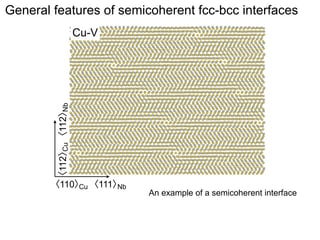
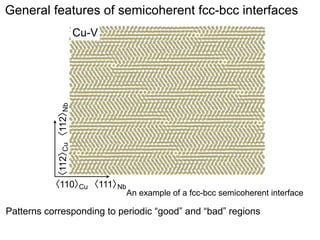
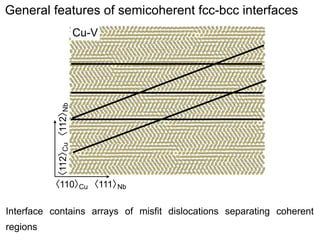
General features of semicoherent fcc-bcc interfaces

〈112〉 〈112〉
Cu
Nb

Cu-V

〈110〉 〈111〉
Cu
Nb

An example of a semicoherent interface
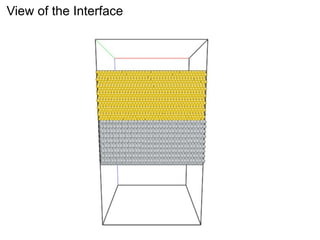
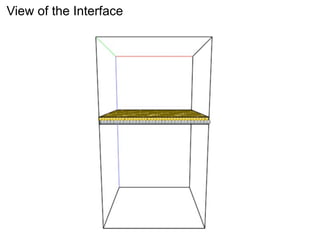
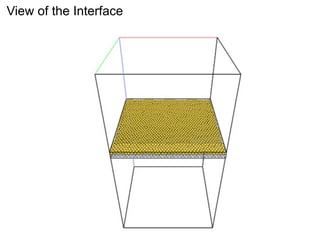
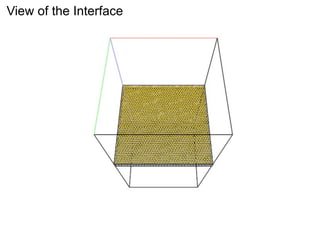
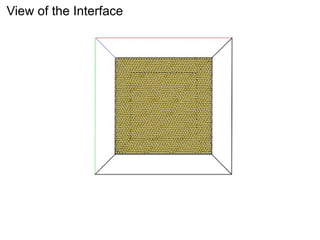
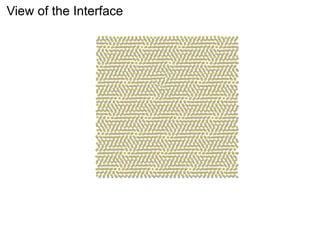
View of the Interface
General features of semicoherent fcc-bcc interfaces

〈112〉 〈112〉
Cu
Nb

Cu-V

〈110〉 〈111〉
Cu
Nb

An example of a fcc-bcc semicoherent interface

Patterns corresponding to periodic “good” and “bad” regions
General features of semicoherent fcc-bcc interfaces

〈112〉 〈112〉
Cu
Nb

Cu-V

〈110〉 〈111〉
Cu
Nb

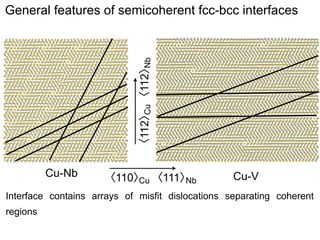
Interface contains arrays of misfit dislocations separating coherent
regions
〈112〉 〈112〉
Cu
Nb

General features of semicoherent fcc-bcc interfaces

Cu-Nb

〈110〉 〈111〉
Cu
Nb

Cu-V

Interface contains arrays of misfit dislocations separating coherent
regions
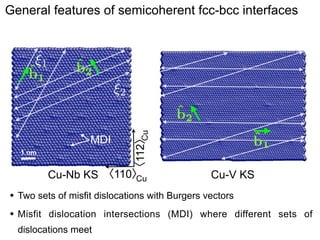
MDI
1 nm

〈112〉
Cu

General features of semicoherent fcc-bcc interfaces

Cu-Nb KS 〈110〉
Cu

Cu-V KS

•

Two sets of misfit dislocations with Burgers vectors

•

Misfit dislocation intersections (MDI) where different sets of
dislocations meet
0 0

00

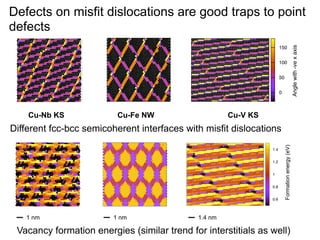
Defects on misfit dislocations are good traps to point
defects
150
150

0.2
0.2
0.4
0.4

100
100

0.6
0.6

50
50

0.8
0.8

0

0

1
10
0

0.2
0.2

0.4
0.4

0.6
0.6

Cu-Nb KS
Cu-Nb KS

0.8
0.8

1
1

0.28
0.28
0.26
150 0.45
1500.26
0.24
150
0.2 0.2
0.2
150
0.2 0.45
0.24
0.2 0.2
0.2
0.2
0.22
0.4
0.22
0.4
0.2
100
1000.2
0.4 0.4
0.4 0.35 0.4
100
100
0.4 0.4
0.18
0.4 0.35 0.4
0.18
0.16
0.3 0.6
0.6 0.6
0.6 0.3
50
50 0.16
0.14
0.6 0.6
0.6
0.6
50
50
0.14
0.25
0.12
0.8 0.8
0.8
0.8 0.25
0.1 0.12
0 0.8
0 0.1
0.8 0.8
0.8
0.2
0.08
0
0
0.2
1
0.060.08
1 0.15 1
1
0
0.2 0.2
0.4 0.4
0.6 0.6
0.8 0.8
1
0
0.2
0.8
1
1
0.06
1 0.15 0.2
0
1
0
0.4 0.4 0.6 0.8
0.6
11
1
0
0.2 0.2
0.4 0.4
0.6 0.6
0.8 0.8
1
0
0.2
0.4
0.6 0.8
0.8
0
1
0
0.2
0.4
0.6
11
0

0

0
0 0.5
0
0 0.5

0

0

Angle with -ve x axis

0

0
0

Cu-Fe NW
Cu-Fe NW

0.2
0.4
0.6
0.8

Cu-V KS
Cu-V KS

0

0

0

0.2

1.2

0.4
0.6

1

0.6

0.8

1.2

0.6

0.8
0

0.2

0.4

0

0.2
1 nm 0.4
1 nm

0.6

0.6

0.8

0.8

0.6

1

1

1.4

0.2

1.2

1.2
0.4

1.2

0.4

1

1

1

1
0.6

0.6

0.8

0.6

0.8

0.6

0.8
0.8

0.8 0.8

0.8

1

0.2

0.4

1

1.4

1.4
0.2

1.2 0.4

0.4

0

1.4

1.4 0.2

0.2

1

0
0

1.4

0.8
1
0.6
0
1

1
0
1

0.8
0.6

0.6

0.8
0.2

0

0.4

10.2 0.4
nm
1 nm

0.6

0.6

0.8

0.8

1

1

Formation energy (eV)

Different fcc-bcc semicoherent interfaces with misfit dislocations

0.2

0

0.4

0.2
1.4 nm 0.4
1.4 nm

0.6

0.8

0.6

0.6

1

0.8

1

Vacancy formation energies (similar trend for interstitials as well)

1

0
0.2
0.4
0.6
0.8
01

0

0
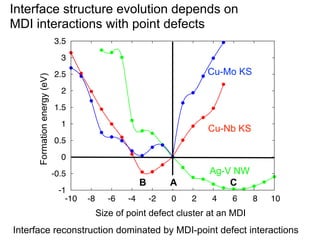
Interface structure evolution depends on
MDI interactions with point defects
3.5

Formation energy (eV)

3

Cu-Mo KS

2.5
2
1.5
1

Cu-Nb KS

0.5
0
-0.5
-1
-10

B
-8

-6

-4

Ag-V NW
C

A
-2

0

2

4

6

8

10

Size of point defect cluster at an MDI

Interface reconstruction dominated by MDI-point defect interactions
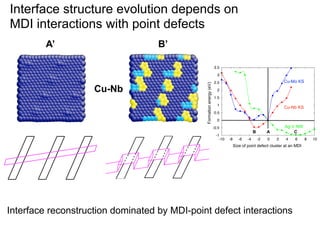
Interface structure evolution depends on
MDI interactions with point defects
A’

B’
3.5

Cu-Nb

Formation energy (eV)

3

Cu-Mo KS

2.5
2
1.5
1

Cu-Nb KS

0.5
0
-0.5
-1
-10

B
-8

-6

-4

Ag-V NW
C

A
-2

0

2

4

6

Size of point defect cluster at an MDI

Interface reconstruction dominated by MDI-point defect interactions

8

10
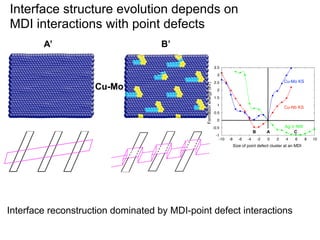
Interface structure evolution depends on
MDI interactions with point defects
A’

B’
3.5

Cu-Mo

Formation energy (eV)

3

Cu-Mo KS

2.5
2
1.5
1

Cu-Nb KS

0.5
0
-0.5
-1
-10

B
-8

-6

-4

Ag-V NW
C

A
-2

0

2

4

6

Size of point defect cluster at an MDI

Interface reconstruction dominated by MDI-point defect interactions

8

10
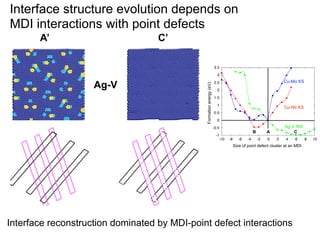
Interface structure evolution depends on
MDI interactions with point defects
A’

C’
3.5

Ag-V

Formation energy (eV)

3

Cu-Mo KS

2.5
2
1.5
1

Cu-Nb KS

0.5
0
-0.5
-1
-10

B
-8

-6

-4

Ag-V NW
C

A
-2

0

2

4

6

Size of point defect cluster at an MDI

Interface reconstruction dominated by MDI-point defect interactions

8

10
m12

void

f (⇢, . . . )
i

µ bulk

m13

Point defect activity under radiation
P
@F I
Mi @⇢
P
Mi µ I
i

⌘=1

v
bulk

es

M3

µ

olv

M1

ev

M2

e
tur

µ3

uc

µ1

str

µ2

Interface energy (f)

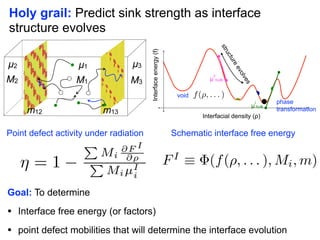
Holy grail: Predict sink strength as interface
structure evolves

Interfacial density (ρ)

phase
transformation

Schematic interface free energy

FI ⌘

(f (⇢, . . . ), Mi , m)

Goal: To determine

•

Interface free energy (or factors)

•

point defect mobilities that will determine the interface evolution
0
0
0.55
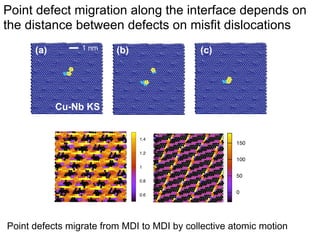
Point defect migration along the interface depends on
0
0.5
150
0.2
0.45
0.2
the distance between defects0.2on misfit dislocations
0.4
150

0.45
0.2
0.2
0.4

100
0.4

0.4
0.4
0.35

1 nm

(a)

0.6
0.6 0.3 0.6
50

0
0.8
0.6

1
0.8

0.8

(b)

0.25
0.8
0.8
0.2

1 0.15 1 1
0.2
0.4 0.6
0.8 111
0 0 0.2 0.4 0.4 0.6 0.6 0.8
0.8
0
0.2

1

W

0.28 0
0.26
150
0.24
0.2
0.22
0.2
100
100 0.4
0.18
0.16
0.6
5050
0.14
0.12
0.1 0.8
0 0
0.08
0.06 1

0

Angle with -ve x axis

0.5 0 0

150

0.45

0.2

0.6

100
0.4

0.4
0.6

(c)

0.6
50

0.35
0.3

0.35
0.3
0.25
0.2
0.15
0.1
0.05
0.2
0.
0.4 0.4
0.6 0.6 0.8

0.4
0.6

0.25

0.8

Cu-V KS
Cu-Nb KS

0.2

0.4

0.4

0

0

0.5

1

0.8

0.2
0

1

0
0.4
0.2
0

0.6
0.4
0.2

0.8

0.8 0.8 0.6 1
0.6
0.4 1

0.8
0.2

1 0.15
0.8
0

Cu-Fe NW

0
1

0
1
0.2

Cu-V KS

0

Cu-Nb KS

1.4
0.2

0.2
1.2
1.2

0.4

0.4

0.2

0.2

1.2

0.4
0.4

0.4
1 1

1

0.6

0.6

0.6

0.6
0.6

0.8
0.8

0.8

0.8

0.8

0.8

0.8
0.8

0.6
0.6

0.6

1
1

0

1.4
1.4

0.2

0.8

0

0

0

1

0 0.2 0.2 0.4 0.4

1.4 1 nm
nm

0.6
0.6

0.8

11

1
0

1
1

0

Formation energy (eV)

0

0

0

0

0.2

0.2

0.4

0.4

0.6

0.6

0.8

0.8

1.4

150
150
0.2
1.2

100
0.4
100
1

0.6
5050
0.8

0.8
0 0
0.6
1

00
0.2
0.4
0.2 0.2 0.4 0.4

1 nm

0.6
0.6
0.6

0.8
0.8
0.8

1
11

0

1
0.2
0

1

0.2
00.4

1.4 nm

Point defects migrate from MDI to MDI by collective atomic motion

0.40.6 0.6 0.8
0.2
0.4 0.
150

0.45

0

0.2

0.4

100
0.4

(a)

0.6
50

0.35
0.3

0.4

1 nm

(b)

0.6

0.25
0
0.8
0.6

0.8

0.8
0.2

1 0.15
1
0

1
0.8

1
0
0.2

0.2
0.4

NW

0.6

0.28
0.26
0.24
0.22
0.2
0.18
0.16
50
0.14
0.12
0.1
0
0.08
0.06

0.4
0.6 0.6

0.8
0.8

0.4

0.8
1

11

(c)

0.6

0

0

0.2

0.4

0.6

0.8

1

0.35
0.3
0.25
0.2
0.15
0.1
0.05

Cu-V KS
Cu-V KS
0

0

1.4

1.4

0.2

0.2
1.2

1.2

0.4

0.4
1

1

0.6

0.6

0.8

0.8

0.8

0.8

0.6

0.6

1
0.8

1

1
0

0.2

0.4

1.4 nm

0.6

0.8

1

0

Formation energy (eV)

0.6
.4

0.5

Angle with -ve x axis

0
0
0.55
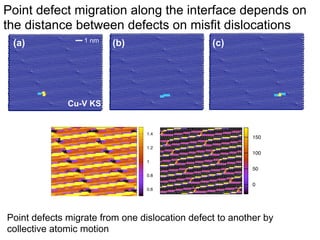
Point defect migration along the interface depends on
0.5
150
0.2
0.2
0.45
the distance between defects on misfit dislocations
0.4
100

0

150

0.2

100

0.4

50

0.6

0
0.2

0.4

0.6

0.8

1

Point defects migrate from one dislocation defect to another by
collective atomic motion

0.8
1
0

0.2
100
0.4

0.4
0.35
100 0.4

0.3 0.6
0.6
50
0.25
0.8
0.8
0.8
0
0.2
0

0.6
50

1 0.15
0

150
0.24
150 0.45
0.2
0.22
0.2 0.4
100
100
0.18
0.4 0.35
0.16
50
0.6 0.3
500.14
0.12
0.25
0.1
0.8
0 0 0.2
0.08

0.2
0.4

1 nm

0.6
0.8

1
1

0
0.2
0.4
0.6 0.8
0.8 1
0.2 1 0.2 0.2 0.60.6 0.8 0.8 1
1
0
0 0.4 0.4 0.4
0.6

0.2
0.4
0.6

0.2
0.4
0.6

0.8

0.8

1

1

0.06
1 0.15
1
0

0
0.2

0
0.2
0.4

Cu-V KS
Cu-Fe NW

KS

0.6
0.8

0.2

0

1.4

0

0.2

1.2
1.2
0.4

0.4

1 1

0.6
0.6

0.6

0.6

1

1
0

1.2

100
100
1

5050
0.8

0.80.8 0.8

0.8

0.8

1

0.8
0.8

0.8

0.8

150
150

0.60.6 0.6

0.6

0.6

1.4

0.40.4 0.4

1

1

0

0.20.2 0.2

1.2

1.2

0.8
1

1.4
1.4

0
0.2

0.2 0.4 0.4 0.6
0.6

1 nm
1.4 nm

0.8
0.8

11

0

1 1 1
0.2
0.4
0.6
0.6
0 0 00.2 0.2 0.40.4 0.6

1.4 nm

0.8
0.8
0.8

0.2

0.4

0

0 0 0

1.4

0.2

0.6
11

0.45
0.2
0.4
0.35
0.4
0.3
0.25
0.6
0.2
0.15
0.8
0.1
0
0.05
1
0.8
1
0

Cu-V KS

Cu-Fe NW
0

0.2 0.60.4 0.8
0.4
0.6
0.8

0.28
0.26
150
0.24
0.22
0.2
100
0.18
0.16
50
0.14
0.12
0.1
0
0.08
0.06

11 1

0 0.6

0

0.2

0.2

0.4

0.4

0.6

0.6

0.8

0.8

Formation energy (eV)

0.4

1
1

0

0.45

0.2 150 0.2

1
0.8
0.8

0.28
0.260.5

Angle with -ve x axis

150

0
0

Formation energy (eV)

0.8
.6
0.6

0.5

Angle with -ve x axis

0
0.55
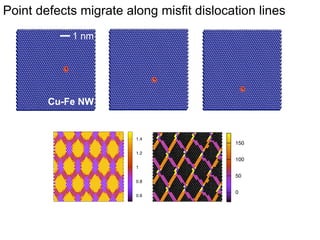
Point0 defects migrate along misfit dislocation lines
0
0
0.5

1

0

1

0.2
0

0.4
0.2

0.6
0.4 0.8
Summary
• Interface sink strength is a dynamic, evolving property of the interface
• In semicoherent fcc-bcc interfaces, interface sink strength depends on
– Density of misfit dislocation intersections and other dislocation defects
– The ability of the misfit dislocation intersections to trap point defects
– Point defect transport along the interfaces
• Distance between misfit dislocation defects
• character of the misfit dislocations

TMS 2012

  • 1.
    On the FactorsGoverning the Sink Strength of Semicoherent fcc-bcc Interfaces Kedarnath Kolluri and Michael Demkowicz Acknowledgments: B. P. Uberuaga, A. Kashinath, A. Vattré, X.-Y. Liu, A. Misra, R. G. Hoagland, J. P. Hirth, M. A. Nastasi, and A. Caro Financial Support: Center for Materials at Irradiation and Mechanical Extremes (CMIME) at LANL, an Energy Frontier Research Center (EFRC) funded by U.S. Department of Energy, Office of Science, Office of Basic Energy Sciences
  • 2.
    Predicting interface sinkefficiency: Beyond v.1 Cartoon of defect activity in radiation environment • 2 lb b Def f Ac ic Def f Point defects (lets assume the cascade occurs in bulk) 2 lb b Def f • arrive at the interface • reside and move at coherent regions of the interface until either • emit back into the bulk • embed into “non coherent” regions of the interface • dynamics of embedded defects ⌫e E/kT Ac ic Def f
  • 3.
    Predicting interface sinkefficiency: Beyond v.1 Cartoon of defect activity in radiation environment • 2 lb b Def f Ac ic Def f Point defects (lets assume the cascade occurs in bulk) 2 lb b Def f • arrive at the interface • reside and move at coherent regions of the interface until either • emit back into the bulk • embed into “non coherent” regions of the interface • dynamics of embedded defects ⌫e E/kT Ac ic Def f UNKNOWN
  • 4.
    Interface sink efficiency:Formal definition Cartoon of defect activity in radiation environment µ2 Bulk mobilities µ1 M2 M1 m12 m13 JI ⌘= I J0 J= M rµ Mi = Mib [ Mib,I Interface mobi where δrµ Interface thickness lets assume 1 as interface is rather sharp =µ bI I @F @n Interface free energy µI
  • 5.
    Interface sink efficiency µ2 µ1 µ3 M2 Cartoonof defect activity in radiation environment M1 M3 m12 Hence, ⌘= M h bI @F I µ @n M0 µbI i ⌘=1 m13 @F I @⇢ µbI Interface free energy plays a crucial role in interface sink strength Goal: Determine interface free energy
  • 6.
    Interface structure evolves uc str ⌘=1 e tur @FI @⇢ µbI olv ev f (⇢, . . . ) es Interface energy (f) Schematic of free energy of an interface void Interfacial density (ρ) FI ⌘ phase transformation (f (⇢, . . . ), Mi , m) ★ Interface structure evolves as defects interact with the interface
  • 7.
    str µ3 M2 M1 M3 m12 es v bulk f (⇢, .. . ) i µ bulk Interfacial density (ρ) I F ⌘ m13 olv µ void µ1 ev @F I @⇢ µbI ⌘=1 µ2 e tur uc Interface energy (f) Interface sink efficiency change as structure evolves phase transformation (f (⇢, . . . ), Mi , m) ★ Different interface regions may have different densities ★ Different density region have different free energies
  • 8.
    m12 f (⇢, .. . ) i µ bulk m13 Point defect activity under radiation ⌘(t) = 1 void @F I @⇢ µbI v bulk es M3 µ olv M1 ev M2 e tur µ3 uc µ1 str µ2 Interface energy (f) Holy grail: Predict sink efficiency as interface structure evolves Interfacial density (ρ) phase transformation Schematic of interface free energy FI ⌘ (f (⇢, . . . ), Mi , m) Goal: To determine in the context of interface structure • Interface free energy (factors that determine the energy functional) • Point defect mobilities that will determine the interface evolution
  • 9.
    Methods and modelsystems • Our focus is on • interfaces of immiscible fcc-bcc semicoherent metal systems Cu-Nb, Cu-V, Cu-Mo, Cu-Fe, and Ag-V (in both KS and NW) Kurdjumov-Sachs (KS): (111) fcc || (110) and〈110〉 || 〈111〉 bcc fcc bcc 〈100〉 Nishiyama-Wassermann (NW): (111) fcc || (110)bcc and〈110〉 || fcc bcc • Atomistic simulations of few interfaces: Molecular dynamics (at 800 K) and statics, EAM potential, LAMMPS • Develop insights that may be used to develop figures of merits for classes of interfaces
  • 10.
    General features ofsemicoherent fcc-bcc interfaces 〈112〉 〈112〉 Cu Nb Cu-V 〈110〉 〈111〉 Cu Nb An example of a semicoherent interface
  • 11.
    View of theInterface
  • 12.
    View of theInterface
  • 13.
    View of theInterface
  • 14.
    View of theInterface
  • 15.
    View of theInterface
  • 16.
    View of theInterface
  • 17.
    General features ofsemicoherent fcc-bcc interfaces 〈112〉 〈112〉 Cu Nb Cu-V 〈110〉 〈111〉 Cu Nb An example of a fcc-bcc semicoherent interface Patterns corresponding to periodic “good” and “bad” regions
  • 18.
    General features ofsemicoherent fcc-bcc interfaces 〈112〉 〈112〉 Cu Nb Cu-V 〈110〉 〈111〉 Cu Nb Interface contains arrays of misfit dislocations separating coherent regions
  • 19.
    〈112〉 〈112〉 Cu Nb General featuresof semicoherent fcc-bcc interfaces Cu-Nb 〈110〉 〈111〉 Cu Nb Cu-V Interface contains arrays of misfit dislocations separating coherent regions
  • 20.
    MDI 1 nm 〈112〉 Cu General featuresof semicoherent fcc-bcc interfaces Cu-Nb KS 〈110〉 Cu Cu-V KS • Two sets of misfit dislocations with Burgers vectors • Misfit dislocation intersections (MDI) where different sets of dislocations meet
  • 21.
    0 0 00 Defects onmisfit dislocations are good traps to point defects 150 150 0.2 0.2 0.4 0.4 100 100 0.6 0.6 50 50 0.8 0.8 0 0 1 10 0 0.2 0.2 0.4 0.4 0.6 0.6 Cu-Nb KS Cu-Nb KS 0.8 0.8 1 1 0.28 0.28 0.26 150 0.45 1500.26 0.24 150 0.2 0.2 0.2 150 0.2 0.45 0.24 0.2 0.2 0.2 0.2 0.22 0.4 0.22 0.4 0.2 100 1000.2 0.4 0.4 0.4 0.35 0.4 100 100 0.4 0.4 0.18 0.4 0.35 0.4 0.18 0.16 0.3 0.6 0.6 0.6 0.6 0.3 50 50 0.16 0.14 0.6 0.6 0.6 0.6 50 50 0.14 0.25 0.12 0.8 0.8 0.8 0.8 0.25 0.1 0.12 0 0.8 0 0.1 0.8 0.8 0.8 0.2 0.08 0 0 0.2 1 0.060.08 1 0.15 1 1 0 0.2 0.2 0.4 0.4 0.6 0.6 0.8 0.8 1 0 0.2 0.8 1 1 0.06 1 0.15 0.2 0 1 0 0.4 0.4 0.6 0.8 0.6 11 1 0 0.2 0.2 0.4 0.4 0.6 0.6 0.8 0.8 1 0 0.2 0.4 0.6 0.8 0.8 0 1 0 0.2 0.4 0.6 11 0 0 0 0 0.5 0 0 0.5 0 0 Angle with -ve x axis Angle with -ve x axis 0 0 0 Cu-Fe NW Cu-Fe NW 0.2 0.4 0.6 0.8 Cu-V KS Cu-V KS 0 0 0 0.2 1.2 0.4 0.6 1 0.6 0.8 1.2 0.6 0.8 0 0.2 0.4 0 0.2 1 nm 0.4 1 nm 0.6 0.6 0.8 0.8 0.6 1 1 1.4 0.2 1.2 1.2 0.4 1.2 0.4 1 1 1 1 0.6 0.6 0.8 0.6 0.8 0.6 0.8 0.8 0.8 0.8 0.8 1 0.2 0.4 1 1.4 1.4 0.2 1.2 0.4 0.4 0 1.4 1.4 0.2 0.2 1 0 0 1.4 0.8 1 0.6 0 1 1 0 1 0.8 0.6 0.6 0.8 0.2 0 0.4 10.2 0.4 nm 1 nm 0.6 0.6 0.8 0.8 1 1 Formation energy (eV) Formation energy (eV) Different fcc-bcc semicoherent interfaces with misfit dislocations 0.2 0 0.4 0.2 1.4 nm 0.4 1.4 nm 0.6 0.8 0.6 0.6 1 0.8 1 Vacancy formation energies (similar trend for interstitials as well) 1 0 0.2 0.4 0.6 0.8 01 0 0
  • 22.
    Interface structure evolutiondepends on MDI interactions with point defects 3.5 Formation energy (eV) 3 Cu-Mo KS 2.5 2 1.5 1 Cu-Nb KS 0.5 0 -0.5 -1 -10 B -8 -6 -4 Ag-V NW C A -2 0 2 4 6 8 10 Size of point defect cluster at an MDI Interface reconstruction dominated by MDI-point defect interactions
  • 23.
    Interface structure evolutiondepends on MDI interactions with point defects A’ B’ 3.5 Cu-Nb Formation energy (eV) 3 Cu-Mo KS 2.5 2 1.5 1 Cu-Nb KS 0.5 0 -0.5 -1 -10 B -8 -6 -4 Ag-V NW C A -2 0 2 4 6 Size of point defect cluster at an MDI Interface reconstruction dominated by MDI-point defect interactions 8 10
  • 24.
    Interface structure evolutiondepends on MDI interactions with point defects A’ B’ 3.5 Cu-Mo Formation energy (eV) 3 Cu-Mo KS 2.5 2 1.5 1 Cu-Nb KS 0.5 0 -0.5 -1 -10 B -8 -6 -4 Ag-V NW C A -2 0 2 4 6 Size of point defect cluster at an MDI Interface reconstruction dominated by MDI-point defect interactions 8 10
  • 25.
    Interface structure evolutiondepends on MDI interactions with point defects A’ C’ 3.5 Ag-V Formation energy (eV) 3 Cu-Mo KS 2.5 2 1.5 1 Cu-Nb KS 0.5 0 -0.5 -1 -10 B -8 -6 -4 Ag-V NW C A -2 0 2 4 6 Size of point defect cluster at an MDI Interface reconstruction dominated by MDI-point defect interactions 8 10
  • 26.
    m12 void f (⇢, .. . ) i µ bulk m13 Point defect activity under radiation P @F I Mi @⇢ P Mi µ I i ⌘=1 v bulk es M3 µ olv M1 ev M2 e tur µ3 uc µ1 str µ2 Interface energy (f) Holy grail: Predict sink strength as interface structure evolves Interfacial density (ρ) phase transformation Schematic interface free energy FI ⌘ (f (⇢, . . . ), Mi , m) Goal: To determine • Interface free energy (or factors) • point defect mobilities that will determine the interface evolution
  • 27.
    0 0 0.55 Point defect migrationalong the interface depends on 0 0.5 150 0.2 0.45 0.2 the distance between defects0.2on misfit dislocations 0.4 150 0.45 0.2 0.2 0.4 100 0.4 0.4 0.4 0.35 1 nm (a) 0.6 0.6 0.3 0.6 50 0 0.8 0.6 1 0.8 0.8 (b) 0.25 0.8 0.8 0.2 1 0.15 1 1 0.2 0.4 0.6 0.8 111 0 0 0.2 0.4 0.4 0.6 0.6 0.8 0.8 0 0.2 1 W 0.28 0 0.26 150 0.24 0.2 0.22 0.2 100 100 0.4 0.18 0.16 0.6 5050 0.14 0.12 0.1 0.8 0 0 0.08 0.06 1 0 Angle with -ve x axis 0.5 0 0 150 0.45 0.2 0.6 100 0.4 0.4 0.6 (c) 0.6 50 0.35 0.3 0.35 0.3 0.25 0.2 0.15 0.1 0.05 0.2 0. 0.4 0.4 0.6 0.6 0.8 0.4 0.6 0.25 0.8 Cu-V KS Cu-Nb KS 0.2 0.4 0.4 0 0 0.5 1 0.8 0.2 0 1 0 0.4 0.2 0 0.6 0.4 0.2 0.8 0.8 0.8 0.6 1 0.6 0.4 1 0.8 0.2 1 0.15 0.8 0 Cu-Fe NW 0 1 0 1 0.2 Cu-V KS 0 Cu-Nb KS 1.4 0.2 0.2 1.2 1.2 0.4 0.4 0.2 0.2 1.2 0.4 0.4 0.4 1 1 1 0.6 0.6 0.6 0.6 0.6 0.8 0.8 0.8 0.8 0.8 0.8 0.8 0.8 0.6 0.6 0.6 1 1 0 1.4 1.4 0.2 0.8 0 0 0 1 0 0.2 0.2 0.4 0.4 1.4 1 nm nm 0.6 0.6 0.8 11 1 0 1 1 0 Formation energy (eV) 0 0 0 0 0.2 0.2 0.4 0.4 0.6 0.6 0.8 0.8 1.4 150 150 0.2 1.2 100 0.4 100 1 0.6 5050 0.8 0.8 0 0 0.6 1 00 0.2 0.4 0.2 0.2 0.4 0.4 1 nm 0.6 0.6 0.6 0.8 0.8 0.8 1 11 0 1 0.2 0 1 0.2 00.4 1.4 nm Point defects migrate from MDI to MDI by collective atomic motion 0.40.6 0.6 0.8 0.2 0.4 0.
  • 28.
    150 0.45 0 0.2 0.4 100 0.4 (a) 0.6 50 0.35 0.3 0.4 1 nm (b) 0.6 0.25 0 0.8 0.6 0.8 0.8 0.2 1 0.15 1 0 1 0.8 1 0 0.2 0.2 0.4 NW 0.6 0.28 0.26 0.24 0.22 0.2 0.18 0.16 50 0.14 0.12 0.1 0 0.08 0.06 0.4 0.60.6 0.8 0.8 0.4 0.8 1 11 (c) 0.6 0 0 0.2 0.4 0.6 0.8 1 0.35 0.3 0.25 0.2 0.15 0.1 0.05 Cu-V KS Cu-V KS 0 0 1.4 1.4 0.2 0.2 1.2 1.2 0.4 0.4 1 1 0.6 0.6 0.8 0.8 0.8 0.8 0.6 0.6 1 0.8 1 1 0 0.2 0.4 1.4 nm 0.6 0.8 1 0 Formation energy (eV) 0.6 .4 0.5 Angle with -ve x axis 0 0 0.55 Point defect migration along the interface depends on 0.5 150 0.2 0.2 0.45 the distance between defects on misfit dislocations 0.4 100 0 150 0.2 100 0.4 50 0.6 0 0.2 0.4 0.6 0.8 1 Point defects migrate from one dislocation defect to another by collective atomic motion 0.8 1 0 0.2
  • 29.
    100 0.4 0.4 0.35 100 0.4 0.3 0.6 0.6 50 0.25 0.8 0.8 0.8 0 0.2 0 0.6 50 10.15 0 150 0.24 150 0.45 0.2 0.22 0.2 0.4 100 100 0.18 0.4 0.35 0.16 50 0.6 0.3 500.14 0.12 0.25 0.1 0.8 0 0 0.2 0.08 0.2 0.4 1 nm 0.6 0.8 1 1 0 0.2 0.4 0.6 0.8 0.8 1 0.2 1 0.2 0.2 0.60.6 0.8 0.8 1 1 0 0 0.4 0.4 0.4 0.6 0.2 0.4 0.6 0.2 0.4 0.6 0.8 0.8 1 1 0.06 1 0.15 1 0 0 0.2 0 0.2 0.4 Cu-V KS Cu-Fe NW KS 0.6 0.8 0.2 0 1.4 0 0.2 1.2 1.2 0.4 0.4 1 1 0.6 0.6 0.6 0.6 1 1 0 1.2 100 100 1 5050 0.8 0.80.8 0.8 0.8 0.8 1 0.8 0.8 0.8 0.8 150 150 0.60.6 0.6 0.6 0.6 1.4 0.40.4 0.4 1 1 0 0.20.2 0.2 1.2 1.2 0.8 1 1.4 1.4 0 0.2 0.2 0.4 0.4 0.6 0.6 1 nm 1.4 nm 0.8 0.8 11 0 1 1 1 0.2 0.4 0.6 0.6 0 0 00.2 0.2 0.40.4 0.6 1.4 nm 0.8 0.8 0.8 0.2 0.4 0 0 0 0 1.4 0.2 0.6 11 0.45 0.2 0.4 0.35 0.4 0.3 0.25 0.6 0.2 0.15 0.8 0.1 0 0.05 1 0.8 1 0 Cu-V KS Cu-Fe NW 0 0.2 0.60.4 0.8 0.4 0.6 0.8 0.28 0.26 150 0.24 0.22 0.2 100 0.18 0.16 50 0.14 0.12 0.1 0 0.08 0.06 11 1 0 0.6 0 0.2 0.2 0.4 0.4 0.6 0.6 0.8 0.8 Formation energy (eV) 0.4 1 1 0 0.45 0.2 150 0.2 1 0.8 0.8 0.28 0.260.5 Angle with -ve x axis 150 0 0 Formation energy (eV) 0.8 .6 0.6 0.5 Angle with -ve x axis 0 0.55 Point0 defects migrate along misfit dislocation lines 0 0 0.5 1 0 1 0.2 0 0.4 0.2 0.6 0.4 0.8
  • 30.
    Summary • Interface sinkstrength is a dynamic, evolving property of the interface • In semicoherent fcc-bcc interfaces, interface sink strength depends on – Density of misfit dislocation intersections and other dislocation defects – The ability of the misfit dislocation intersections to trap point defects – Point defect transport along the interfaces • Distance between misfit dislocation defects • character of the misfit dislocations