The Importance of Business Ethics C H A P T E R  1
Why Study Business Ethics? Business decisions under great scrutiny Global financial crisis created diminished stakeholder trust Deals with questions about whether practices are acceptable No universally-accepted approach for resolving issues Source:  © Jack Hollingsworth/Corbis
Business Ethics   Comprises principles, values, and standards that guide behavior in the world of business Principles : Specific boundaries for behavior that are universal and absolute Freedom of speech, civil liberties  Values : Used to develop socially enforced norms Integrity, accountability, trust
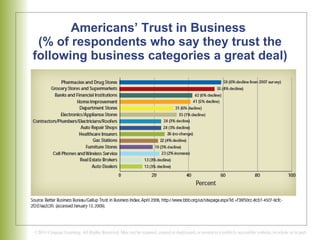
Americans’ Trust in Business  (% of respondents who say they trust the following business categories a great deal)
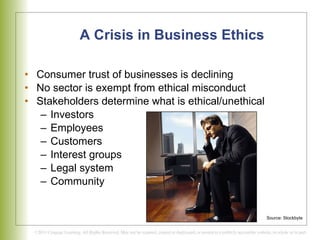
A Crisis in Business Ethics Consumer trust of businesses is declining No sector is exempt from ethical misconduct Stakeholders determine what is ethical/unethical Investors Employees Customers Interest groups Legal system Community Source: Stockbyte
Why Study Business Ethics? Reports of unethical behavior are on the rise Society’s evaluation of right or wrong affects its ability to achieve its business goals Studying business ethics is a response to Sarbanes-Oxley, FSGO, and stakeholder demands for ethics initiatives Individual ethics alone is not sufficient Studying business ethics helps identify  ethical issues to key stakeholders
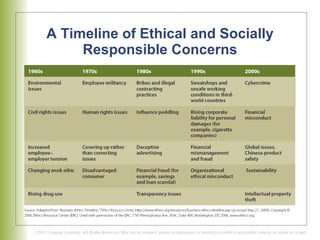
A Timeline of Ethical and Socially Responsible Concerns
Before 1960: Ethics in Business Theological discussions of ethics emerged Catholic social ethics included a concern for morality in business, workers’ rights and living wages Protestants developed ethics courses in their seminaries and schools of theology The Protestant work ethic encouraged hard work
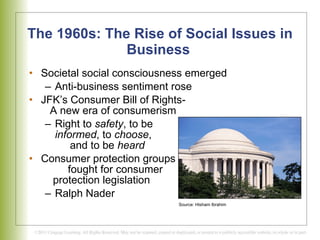
The 1960s: The Rise of Social Issues in Business   Societal social consciousness emerged Anti-business sentiment rose JFK’s Consumer Bill of Rights-  A new era of consumerism Right to  safety , to be  informed , to  choose ,  and to be  heard Consumer protection groups  fought for consumer  protection legislation Ralph Nader Source: Hisham Ibrahim
The 1970s: Business Ethics as an Emerging Field   Business professors began to write about  social responsibility An organization’s obligation to maximize positive impact and minimize negative impact on stakeholders Philosophers became involved Businesses became concerned with public image Conferences were held and centers developed Issues:  Bribery  – Product safety Deceptive advertising  – Environment Price collusion
The 1980s: Consolidation Membership in business ethics organizations increased Ethics centers provided: Publications, courses, conferences and seminars Firms established ethics committees Defense Industry Initiative on Business Ethics and Conduct (DII) emerged  Foundation for the Federal Sentencing Guidelines for Organizations Corporate support for ethics
The 1990s: Institutionalization of Business Ethics   The Federal Sentencing Guidelines for Organizations (FSGO) Set tone for compliance Preventative actions against misconduct A company could avoid/minimize potential penalties
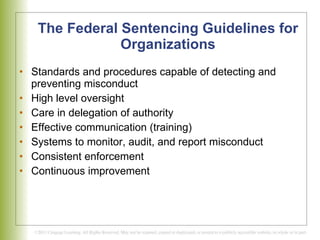
The Federal Sentencing Guidelines for Organizations Standards and procedures capable of detecting and preventing misconduct High level oversight Care in delegation of authority Effective communication (training) Systems to monitor, audit, and report misconduct Consistent enforcement Continuous improvement
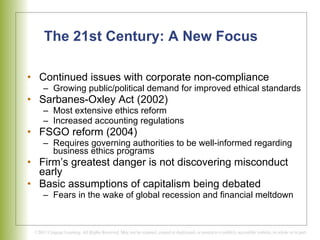
The 21st Century: A New Focus Continued issues with corporate non-compliance Growing public/political demand for improved ethical standards Sarbanes-Oxley Act (2002) Most extensive ethics reform Increased accounting regulations FSGO reform (2004) Requires governing authorities to be well-informed regarding business ethics programs Firm’s greatest danger is not discovering misconduct early Basic assumptions of capitalism being debated Fears in the wake of global recession and financial meltdown
Organizational and Global Ethical Culture Ethical culture  describes the component of corporate culture that  captures the values and norms that an organization defines as appropriate conduct Creates shared values Goal is to: Minimize need for  enforced compliance Maximize utilization of  principles/ ethical  reasoning Source: Triangle Images
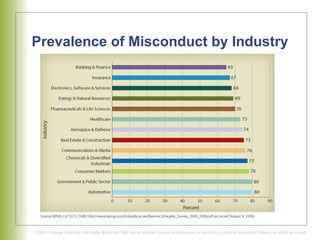
Prevalence of Misconduct by Industry
Ethics Contributes to Employee Commitment Comes from employees who believe their future is tied to the organization’s  Are willing to make personal sacrifices for the organization The more dedication on the part of the company, the greater the employee dedication Concerns include a safe work environment, competitive salaries and benefit packages, and fulfillment of contractual obligations
Ethics Contributes to Investor Loyalty Companies perceived by their employees as having a high level of honesty and integrity are more profitable than companies with a low level of honesty and integrity Ethical climates in organizations provide platform for: Efficiency Productivity Profitability
Ethics Contributes to Customer Satisfaction Consumers respond positively to socially concerned businesses Being good can be extremely profitable Customer satisfaction dictates business success A strong organizational ethical climate  places customers’ interests first Research shows a strong relationship between ethical behavior and customer satisfaction
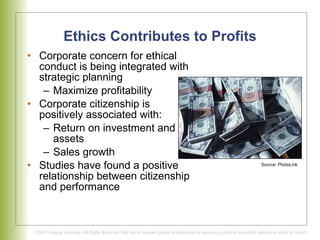
Ethics Contributes to Profits Corporate concern for ethical conduct is being integrated with strategic planning Maximize profitability Corporate citizenship is  positively associated with: Return on investment and assets Sales growth Studies have found a positive relationship between citizenship and performance Source: PhotoLink

MGMT 374 Week 1 Lecture PowerPoint

  • 1.
    The Importance ofBusiness Ethics C H A P T E R 1
  • 2.
    Why Study BusinessEthics? Business decisions under great scrutiny Global financial crisis created diminished stakeholder trust Deals with questions about whether practices are acceptable No universally-accepted approach for resolving issues Source: © Jack Hollingsworth/Corbis
  • 3.
    Business Ethics Comprises principles, values, and standards that guide behavior in the world of business Principles : Specific boundaries for behavior that are universal and absolute Freedom of speech, civil liberties Values : Used to develop socially enforced norms Integrity, accountability, trust
  • 4.
    Americans’ Trust inBusiness (% of respondents who say they trust the following business categories a great deal)
  • 5.
    A Crisis inBusiness Ethics Consumer trust of businesses is declining No sector is exempt from ethical misconduct Stakeholders determine what is ethical/unethical Investors Employees Customers Interest groups Legal system Community Source: Stockbyte
  • 6.
    Why Study BusinessEthics? Reports of unethical behavior are on the rise Society’s evaluation of right or wrong affects its ability to achieve its business goals Studying business ethics is a response to Sarbanes-Oxley, FSGO, and stakeholder demands for ethics initiatives Individual ethics alone is not sufficient Studying business ethics helps identify ethical issues to key stakeholders
  • 7.
    A Timeline ofEthical and Socially Responsible Concerns
  • 8.
    Before 1960: Ethicsin Business Theological discussions of ethics emerged Catholic social ethics included a concern for morality in business, workers’ rights and living wages Protestants developed ethics courses in their seminaries and schools of theology The Protestant work ethic encouraged hard work
  • 9.
    The 1960s: TheRise of Social Issues in Business Societal social consciousness emerged Anti-business sentiment rose JFK’s Consumer Bill of Rights- A new era of consumerism Right to safety , to be informed , to choose , and to be heard Consumer protection groups fought for consumer protection legislation Ralph Nader Source: Hisham Ibrahim
  • 10.
    The 1970s: BusinessEthics as an Emerging Field Business professors began to write about social responsibility An organization’s obligation to maximize positive impact and minimize negative impact on stakeholders Philosophers became involved Businesses became concerned with public image Conferences were held and centers developed Issues: Bribery – Product safety Deceptive advertising – Environment Price collusion
  • 11.
    The 1980s: ConsolidationMembership in business ethics organizations increased Ethics centers provided: Publications, courses, conferences and seminars Firms established ethics committees Defense Industry Initiative on Business Ethics and Conduct (DII) emerged Foundation for the Federal Sentencing Guidelines for Organizations Corporate support for ethics
  • 12.
    The 1990s: Institutionalizationof Business Ethics The Federal Sentencing Guidelines for Organizations (FSGO) Set tone for compliance Preventative actions against misconduct A company could avoid/minimize potential penalties
  • 13.
    The Federal SentencingGuidelines for Organizations Standards and procedures capable of detecting and preventing misconduct High level oversight Care in delegation of authority Effective communication (training) Systems to monitor, audit, and report misconduct Consistent enforcement Continuous improvement
  • 14.
    The 21st Century:A New Focus Continued issues with corporate non-compliance Growing public/political demand for improved ethical standards Sarbanes-Oxley Act (2002) Most extensive ethics reform Increased accounting regulations FSGO reform (2004) Requires governing authorities to be well-informed regarding business ethics programs Firm’s greatest danger is not discovering misconduct early Basic assumptions of capitalism being debated Fears in the wake of global recession and financial meltdown
  • 15.
    Organizational and GlobalEthical Culture Ethical culture describes the component of corporate culture that captures the values and norms that an organization defines as appropriate conduct Creates shared values Goal is to: Minimize need for enforced compliance Maximize utilization of principles/ ethical reasoning Source: Triangle Images
  • 16.
  • 17.
    Ethics Contributes toEmployee Commitment Comes from employees who believe their future is tied to the organization’s Are willing to make personal sacrifices for the organization The more dedication on the part of the company, the greater the employee dedication Concerns include a safe work environment, competitive salaries and benefit packages, and fulfillment of contractual obligations
  • 18.
    Ethics Contributes toInvestor Loyalty Companies perceived by their employees as having a high level of honesty and integrity are more profitable than companies with a low level of honesty and integrity Ethical climates in organizations provide platform for: Efficiency Productivity Profitability
  • 19.
    Ethics Contributes toCustomer Satisfaction Consumers respond positively to socially concerned businesses Being good can be extremely profitable Customer satisfaction dictates business success A strong organizational ethical climate places customers’ interests first Research shows a strong relationship between ethical behavior and customer satisfaction
  • 20.
    Ethics Contributes toProfits Corporate concern for ethical conduct is being integrated with strategic planning Maximize profitability Corporate citizenship is positively associated with: Return on investment and assets Sales growth Studies have found a positive relationship between citizenship and performance Source: PhotoLink

Editor's Notes

  • #5 Increased awareness of ethical issues in the following industries: Accounting fraud Insider trading of stocks and bonds Falsifying of organizational documents Deceptive advertising Defective products Bribery Employee theft
  • #7 Due to the need for professional experience and understanding the complexities of the legal environment. Even a person with good personal ethics will need business ethics training to confront complex ethical situations in the workplace.