The Importance of
Business Ethics
Ethical Behavior
• Conducting one’s life in complete accord with
a firmly held set of values and principles
• These principles may be derived from religious
beliefs, philosophical understanding, etc.
• Application should be in all areas of one’s life:
personal, family, business, social, etc.
• “Integrity” is the consistent application of ethical
behavior.
Business Ethics as a Movement
• Business ethics as a movement refers to the
development of structures internal to the
corporation that help it and its employees act
ethically, as opposed to structures that
provide incentives to act unethically.

• The structures may include clear lines of
responsibility, a corporate ethics code, an
ethics training program, an ombudsman or a
corporate ethics officer, a hot or help line, a
means of transmitting values within the firm
and maintaining a certain corporate culture,
and so on.
Business Ethics as a Movement
• The U. S. Civil Rights Act of 1964 was the first piece of legislation to
start the business ethics movement. The Act prohibited
discrimination of the basis of race, color, religion or national origin in
public establishments connected to interstate commerce, as well as
places of public accommodation and entertainment.
• Many corporations added Equal Opportunity Offices to their human
resources department to ensure compliance, and in general the
consciousness of business about discrimination, equal opportunity,
and equal pay for equal work came to the fore.
• This in turn led to more consciousness of workers' rights in general,
and of corporate America's need to respect them.
• The U. S. Occupational Safety and Health Act of 1970 enforced the
mandate to take those aspects of workers' rights seriously. In the
same year the Environmental Protection Act forced business to start
internalizing the costs of what had previously been considered
externalities—such as the discharge of toxic effluents from factory
smokestacks.
Business Ethics as a Movement
• In 1977, following a series of scandals involving bribery by U. S. firms
abroad including the Lockheed $12 million bribery case that led to
the fall of the Japanese government at the time, the U. S.
government passed the Foreign Corrupt Practices Act. The Act was
historic because it was the first piece of legislation that attempted to
control the actions of U.S. corporations in foreign countries. The Act
prohibited U. S. companies from paying large sums of money (or their
equivalent) to high level government officials of other countries to
obtain special treatment.
• A number of companies prior to the Act had already adopted the
policy of refusing to pay bribes as a matter of ethical principle. IBM,
among others, was known for adherence to this policy, as was
Motorola. The Act forced all companies to live up to the already
existing ethical norm. Its critics complained, however, that it put U. S.
companies at an unfair disadvantage vis-à-vis companies from other
countries that were permitted to pay bribes. The U. S. government
applied what pressure it could to encourage other countries to follow
its lead, and finally twenty years later the OECD countries agreed to
adopt similar legislation.
Business Ethics as a Movement
• In 1978 General Motors and a group of other U. S.
companies adopted what are known as the Sullivan
Principles, which governed their actions in South Africa.
The signatories agreed that they would not follow the
discriminatory and repressive apartheid legislation in South
Africa and would take affirmative action to try to
undermine apartheid not only by not following the existing
South African apartheid statutes, but also by lobbying the
South African government for change. Adherence to the
Principles was seen as a way by which American companies
could ethically justify doing business in South Africa. They
were adopted in part as a response to public pressure on
the companies to leave South Africa. The Principles have
become a model for other voluntary codes of ethical
conduct by companies in a variety of other ethically
questionable circumstances.
Business Ethics as a Movement
• By the 1980s many companies had started reacting to calls for ethical
structures, and more and more started adopting ethical codes and
instituting ethics training for their employees. Each wave of scandals,
which seemed to occur every ten years or so, resulted in more
pressure for companies to incorporate ethics into their structures.
• In 1984 the Union Carbide disaster at its plant in Bhopal, India, which
killed thousands of people and injured several hundred thousand,
focused world attention on the chemical industry. This led to the
chemical industry's adopting a voluntary code of ethical conduct
known as Responsible Care, which became a model for other
industries.
• In 1986, in response to a series of reported irregularities in defense
contracts, a special Commission Report on the situation led to the
establishment of the Defense Industry Initiative (DII) on Business
Ethics and Conduct, signed by thirty-two (it soon increased to fifty)
major defense contractors. Each signatory agreed to have a written
code of ethics, establish appropriate ethics training programs for
their employees, establish monitoring mechanisms to detect
improper activity, share their best practices, and be accountable to
the public.
Business Ethics as a Movement
• The DII became the model for what has been the most significant
governmental impetus to the business ethics movement, namely, the
1991 U. S. Federal Sentencing Guidelines for Corporations. That law
took the approach of providing an incentive for corporations to
incorporate ethical structures within their organizations. If a company
could show that it had taken appropriate measures to prevent and
detect illegal and unethical behavior, its sentence, if found guilty of
illegal behavior, would be reduced considerably. Appropriate
measures included having a code of ethics or of conduct, a highplaced officer in charge of oversight, an ethics training program, a
monitoring and reporting system (such as a "hotline"), and an
enforcement and response system. Fines that could reach up to $290
million could be reduced by up to 95 percent if a company could
show bona fide institutional structures that were in place to help
prevent unethical and illegal conduct.
• The result was a concerted effort on the part of most large
companies to incorporate into their organizations the structures
required. This led to the development of a corporate position known
as the Corporate Ethics Officer, and in 1992 to the establishment of
the Corporate Ethics Officer Association.
- The most recent legislative incentive to incorporate ethics in the
corporation came in the Sarbanes-Oxley Act of 2002, passed as a result
of a rash of scandals involving Enron, WorldCom, Arthur Andersen and
other prominent corporations. The Act requires, among other things,
that the CEO and CFO certify the fairness and accuracy of corporate
financial statements (with criminal penalties for knowing violations) and
a code of ethics for the corporation's senior financial officers, as well as
requiring a great deal more public disclosure.
- Corporations have responded to legislative and popular pressure in a
variety of ways. The language of social responsibility rather than
explicitly ethical language is still probably the most commonly used.
Self-monitoring of adherence to a corporation's stated principles and
self-adopted standards is becoming more common, and some
companies have voluntarily adopted monitoring of their practices,
policies and plants by independent auditors. The notion of a Triple
Bottom Line, which involves financial, social and environmental
corporate reporting, has been adopted by a number of companies.
Other popular reporting mechanisms include corporate environmental
sustainability reports and social audits, which vary considerably in what
is reported and how it is reported. Ethical investing is another aspect of
the movement, and mangers of ethical investment funds have begun
proposing stockholder proposals as a means of encouraging more
ethical behavior on the part of corporations in which they own stock.
Business Ethics as a Movement
• Not only the business ethics movement confined to the Unites States
but other countries have also adopted legislation similar to that of
the United States.
• The UN has developed a voluntary Global Compact for Corporations.
The Compact, which was endorsed by all governments, contains nine
guiding principles, which focus on human rights, labor standards, and
the protection of the environment. Over 1,500 companies world wide
have joined the compact, and it seems likely that more and more will
feel the pressure to become signatories and to abide by the required
standards.
• The business ethics movement, like business ethics itself, has become
firmly entrenched. The concern for ethics in business continues.
Business ethics as an academic field contributes discussion forums,
research and teaching that inform both ethics in business and the
business ethics movement. The business ethics movement is
responsive to the other two and in turn has interacted with them. All
three together make up the history of business ethics in its broadest
sense.
Foundations of Ethical Behavior
• Treat others as you would be treated
–Respect
–Honesty
–Trust
Is There a Universal Ethical Standard? Yes—In Principle and
Taught in All Cultures
Judaism: What you hate, do not do to anyone.
Islam: No one of you is a believer until he loves for his brother what he
loves for himself.
Hinduism: Do nothing to thy neighbor which thou wouldst not have him
do to thee.
Sikhism: Treat others as you would be treated yourself.
Buddhism: Hurt not others with that which pains thyself.
Confucius: What you do not want done to yourself, do not do to others.
Aristotle: We should behave to our friends as we wish our friends to
behave to us.
Plato: May I do to others as I would that they should do unto me.

Christian principle: The Golden Rule
“Do unto others as you would have them do unto you.” Luke 6:29-38
“Thou shalt love thy neighbor as thyself.”
Luke 10:27
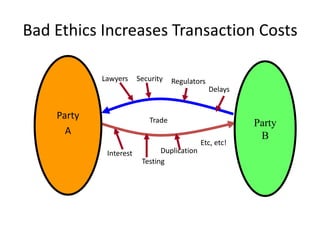
Bad Ethics Increases Transaction Costs
Lawyers

Party
A

Security

Regulators

Delays

Trade

Interest

Duplication
Testing

Etc, etc!

Party
B
Societal Costs of Unethical Behavior
1. Law enforcement and other security personnel
2. Physical protection (locks, electronic security, fences,
vaults, etc.)
3. A substantial portion of attorney and court system costs
4. Some welfare costs
5. Costs of collecting taxes
6. Wasted/misused investment funds
7. A substantial portion of accounting/auditing costs
8. A large fraction of costs for regulators and examiners
9. Some marketing/advertising costs
10. Costs for institutions like better business bureaus,
consumer protection agencies
11. Some costs of bankruptcy
12. Lack of investment from outside investors, tourists
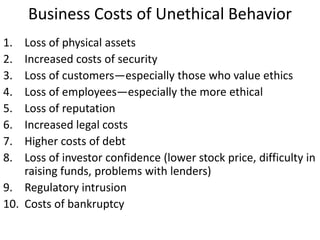
Business Costs of Unethical Behavior
1.
2.
3.
4.
5.
6.
7.
8.

Loss of physical assets
Increased costs of security
Loss of customers—especially those who value ethics
Loss of employees—especially the more ethical
Loss of reputation
Increased legal costs
Higher costs of debt
Loss of investor confidence (lower stock price, difficulty in
raising funds, problems with lenders)
9. Regulatory intrusion
10. Costs of bankruptcy
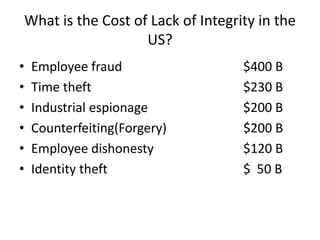
What is the Cost of Lack of Integrity in the
US?
•
•
•
•
•
•

Employee fraud
Time theft
Industrial espionage
Counterfeiting(Forgery)
Employee dishonesty
Identity theft

$400 B
$230 B
$200 B
$200 B
$120 B
$ 50 B
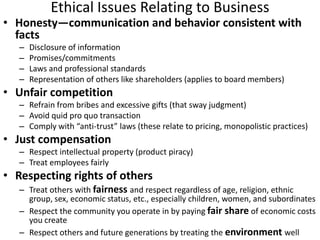
Ethical Issues Relating to Business

• Honesty—communication and behavior consistent with
facts
–
–
–
–

Disclosure of information
Promises/commitments
Laws and professional standards
Representation of others like shareholders (applies to board members)

• Unfair competition
– Refrain from bribes and excessive gifts (that sway judgment)
– Avoid quid pro quo transaction
– Comply with “anti-trust” laws (these relate to pricing, monopolistic practices)

• Just compensation
– Respect intellectual property (product piracy)
– Treat employees fairly

• Respecting rights of others
– Treat others with fairness and respect regardless of age, religion, ethnic
group, sex, economic status, etc., especially children, women, and subordinates
– Respect the community you operate in by paying fair share of economic costs
you create
– Respect others and future generations by treating the environment well
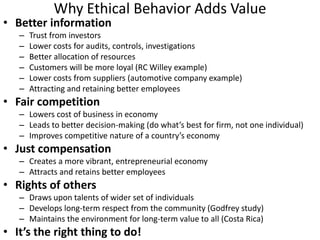
Why Ethical Behavior Adds Value

• Better information
–
–
–
–
–
–

Trust from investors
Lower costs for audits, controls, investigations
Better allocation of resources
Customers will be more loyal (RC Willey example)
Lower costs from suppliers (automotive company example)
Attracting and retaining better employees

• Fair competition
– Lowers cost of business in economy
– Leads to better decision-making (do what’s best for firm, not one individual)
– Improves competitive nature of a country’s economy

• Just compensation
– Creates a more vibrant, entrepreneurial economy
– Attracts and retains better employees

• Rights of others
– Draws upon talents of wider set of individuals
– Develops long-term respect from the community (Godfrey study)
– Maintains the environment for long-term value to all (Costa Rica)

• It’s the right thing to do!
Short-Term vs. Long-Term
• One party may gain temporary advantage by
unethical behavior
– Enron
– Livedoor
– Ghana Airways
– Arthur Anderson
– Bears and Stern

• But in the long-term, individuals, companies
and society are hurt
Application of Ethics to Business Situations
• Fraudulent practices, misleading advertising, unfairness
• Can be taught in management education and
organizations—provided students have a personal
understanding of ethics
• Taught by modeling (cases and personal example are
helpful)
• Can be reinforced by policies, codes of ethics, training

• Businesses can teach through proper modeling:
“Companies also have to further strengthen ethics
management and social responsibility activities to
improve their public image’’
Korean Commerce-Industry-Energy Minister Lee Hee - beom
Ethical Courage
• It is not sufficient to simply understand ethical
principles
• One must have the courage to pay a price for being
ethical
• Examples can be helpful—case studies showing
people willing to stand up for ethical principles
• Again, it helps to have “practiced” ethical behavior
over many years—especially in small things
Ethical Leadership
• The ability and willingness to encourage
others to behave ethically
• Can be taught through cases, problem solving,
study of successful organizations
• Includes
– Developing an organizational climate that fosters
ethical behavior
– Structuring policies that encourages ethics
– Behaving ethically while facing the pressures of
leadership
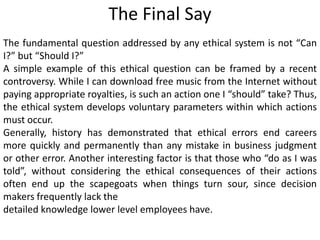
The Final Say
The fundamental question addressed by any ethical system is not “Can
I?” but “Should I?”
A simple example of this ethical question can be framed by a recent
controversy. While I can download free music from the Internet without
paying appropriate royalties, is such an action one I “should” take? Thus,
the ethical system develops voluntary parameters within which actions
must occur.
Generally, history has demonstrated that ethical errors end careers
more quickly and permanently than any mistake in business judgment
or other error. Another interesting factor is that those who “do as I was
told”, without considering the ethical consequences of their actions
often end up the scapegoats when things turn sour, since decision
makers frequently lack the
detailed knowledge lower level employees have.
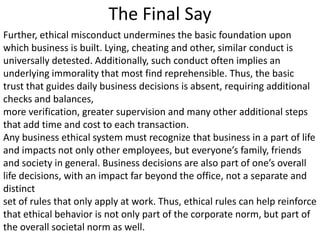
The Final Say
Further, ethical misconduct undermines the basic foundation upon
which business is built. Lying, cheating and other, similar conduct is
universally detested. Additionally, such conduct often implies an
underlying immorality that most find reprehensible. Thus, the basic
trust that guides daily business decisions is absent, requiring additional
checks and balances,
more verification, greater supervision and many other additional steps
that add time and cost to each transaction.
Any business ethical system must recognize that business in a part of life
and impacts not only other employees, but everyone’s family, friends
and society in general. Business decisions are also part of one’s overall
life decisions, with an impact far beyond the office, not a separate and
distinct
set of rules that only apply at work. Thus, ethical rules can help reinforce
that ethical behavior is not only part of the corporate norm, but part of
the overall societal norm as well.
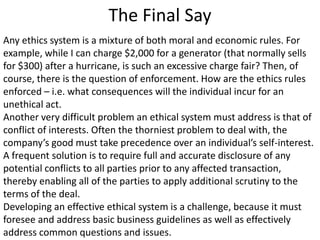
The Final Say
Any ethics system is a mixture of both moral and economic rules. For
example, while I can charge $2,000 for a generator (that normally sells
for $300) after a hurricane, is such an excessive charge fair? Then, of
course, there is the question of enforcement. How are the ethics rules
enforced – i.e. what consequences will the individual incur for an
unethical act.
Another very difficult problem an ethical system must address is that of
conflict of interests. Often the thorniest problem to deal with, the
company’s good must take precedence over an individual’s self-interest.
A frequent solution is to require full and accurate disclosure of any
potential conflicts to all parties prior to any affected transaction,
thereby enabling all of the parties to apply additional scrutiny to the
terms of the deal.
Developing an effective ethical system is a challenge, because it must
foresee and address basic business guidelines as well as effectively
address common questions and issues.

Business ethics

  • 1.
  • 2.
    Ethical Behavior • Conductingone’s life in complete accord with a firmly held set of values and principles • These principles may be derived from religious beliefs, philosophical understanding, etc. • Application should be in all areas of one’s life: personal, family, business, social, etc. • “Integrity” is the consistent application of ethical behavior.
  • 3.
    Business Ethics asa Movement • Business ethics as a movement refers to the development of structures internal to the corporation that help it and its employees act ethically, as opposed to structures that provide incentives to act unethically. • The structures may include clear lines of responsibility, a corporate ethics code, an ethics training program, an ombudsman or a corporate ethics officer, a hot or help line, a means of transmitting values within the firm and maintaining a certain corporate culture, and so on.
  • 4.
    Business Ethics asa Movement • The U. S. Civil Rights Act of 1964 was the first piece of legislation to start the business ethics movement. The Act prohibited discrimination of the basis of race, color, religion or national origin in public establishments connected to interstate commerce, as well as places of public accommodation and entertainment. • Many corporations added Equal Opportunity Offices to their human resources department to ensure compliance, and in general the consciousness of business about discrimination, equal opportunity, and equal pay for equal work came to the fore. • This in turn led to more consciousness of workers' rights in general, and of corporate America's need to respect them. • The U. S. Occupational Safety and Health Act of 1970 enforced the mandate to take those aspects of workers' rights seriously. In the same year the Environmental Protection Act forced business to start internalizing the costs of what had previously been considered externalities—such as the discharge of toxic effluents from factory smokestacks.
  • 5.
    Business Ethics asa Movement • In 1977, following a series of scandals involving bribery by U. S. firms abroad including the Lockheed $12 million bribery case that led to the fall of the Japanese government at the time, the U. S. government passed the Foreign Corrupt Practices Act. The Act was historic because it was the first piece of legislation that attempted to control the actions of U.S. corporations in foreign countries. The Act prohibited U. S. companies from paying large sums of money (or their equivalent) to high level government officials of other countries to obtain special treatment. • A number of companies prior to the Act had already adopted the policy of refusing to pay bribes as a matter of ethical principle. IBM, among others, was known for adherence to this policy, as was Motorola. The Act forced all companies to live up to the already existing ethical norm. Its critics complained, however, that it put U. S. companies at an unfair disadvantage vis-à-vis companies from other countries that were permitted to pay bribes. The U. S. government applied what pressure it could to encourage other countries to follow its lead, and finally twenty years later the OECD countries agreed to adopt similar legislation.
  • 6.
    Business Ethics asa Movement • In 1978 General Motors and a group of other U. S. companies adopted what are known as the Sullivan Principles, which governed their actions in South Africa. The signatories agreed that they would not follow the discriminatory and repressive apartheid legislation in South Africa and would take affirmative action to try to undermine apartheid not only by not following the existing South African apartheid statutes, but also by lobbying the South African government for change. Adherence to the Principles was seen as a way by which American companies could ethically justify doing business in South Africa. They were adopted in part as a response to public pressure on the companies to leave South Africa. The Principles have become a model for other voluntary codes of ethical conduct by companies in a variety of other ethically questionable circumstances.
  • 7.
    Business Ethics asa Movement • By the 1980s many companies had started reacting to calls for ethical structures, and more and more started adopting ethical codes and instituting ethics training for their employees. Each wave of scandals, which seemed to occur every ten years or so, resulted in more pressure for companies to incorporate ethics into their structures. • In 1984 the Union Carbide disaster at its plant in Bhopal, India, which killed thousands of people and injured several hundred thousand, focused world attention on the chemical industry. This led to the chemical industry's adopting a voluntary code of ethical conduct known as Responsible Care, which became a model for other industries. • In 1986, in response to a series of reported irregularities in defense contracts, a special Commission Report on the situation led to the establishment of the Defense Industry Initiative (DII) on Business Ethics and Conduct, signed by thirty-two (it soon increased to fifty) major defense contractors. Each signatory agreed to have a written code of ethics, establish appropriate ethics training programs for their employees, establish monitoring mechanisms to detect improper activity, share their best practices, and be accountable to the public.
  • 8.
    Business Ethics asa Movement • The DII became the model for what has been the most significant governmental impetus to the business ethics movement, namely, the 1991 U. S. Federal Sentencing Guidelines for Corporations. That law took the approach of providing an incentive for corporations to incorporate ethical structures within their organizations. If a company could show that it had taken appropriate measures to prevent and detect illegal and unethical behavior, its sentence, if found guilty of illegal behavior, would be reduced considerably. Appropriate measures included having a code of ethics or of conduct, a highplaced officer in charge of oversight, an ethics training program, a monitoring and reporting system (such as a "hotline"), and an enforcement and response system. Fines that could reach up to $290 million could be reduced by up to 95 percent if a company could show bona fide institutional structures that were in place to help prevent unethical and illegal conduct. • The result was a concerted effort on the part of most large companies to incorporate into their organizations the structures required. This led to the development of a corporate position known as the Corporate Ethics Officer, and in 1992 to the establishment of the Corporate Ethics Officer Association.
  • 9.
    - The mostrecent legislative incentive to incorporate ethics in the corporation came in the Sarbanes-Oxley Act of 2002, passed as a result of a rash of scandals involving Enron, WorldCom, Arthur Andersen and other prominent corporations. The Act requires, among other things, that the CEO and CFO certify the fairness and accuracy of corporate financial statements (with criminal penalties for knowing violations) and a code of ethics for the corporation's senior financial officers, as well as requiring a great deal more public disclosure. - Corporations have responded to legislative and popular pressure in a variety of ways. The language of social responsibility rather than explicitly ethical language is still probably the most commonly used. Self-monitoring of adherence to a corporation's stated principles and self-adopted standards is becoming more common, and some companies have voluntarily adopted monitoring of their practices, policies and plants by independent auditors. The notion of a Triple Bottom Line, which involves financial, social and environmental corporate reporting, has been adopted by a number of companies. Other popular reporting mechanisms include corporate environmental sustainability reports and social audits, which vary considerably in what is reported and how it is reported. Ethical investing is another aspect of the movement, and mangers of ethical investment funds have begun proposing stockholder proposals as a means of encouraging more ethical behavior on the part of corporations in which they own stock.
  • 10.
    Business Ethics asa Movement • Not only the business ethics movement confined to the Unites States but other countries have also adopted legislation similar to that of the United States. • The UN has developed a voluntary Global Compact for Corporations. The Compact, which was endorsed by all governments, contains nine guiding principles, which focus on human rights, labor standards, and the protection of the environment. Over 1,500 companies world wide have joined the compact, and it seems likely that more and more will feel the pressure to become signatories and to abide by the required standards. • The business ethics movement, like business ethics itself, has become firmly entrenched. The concern for ethics in business continues. Business ethics as an academic field contributes discussion forums, research and teaching that inform both ethics in business and the business ethics movement. The business ethics movement is responsive to the other two and in turn has interacted with them. All three together make up the history of business ethics in its broadest sense.
  • 11.
    Foundations of EthicalBehavior • Treat others as you would be treated –Respect –Honesty –Trust
  • 12.
    Is There aUniversal Ethical Standard? Yes—In Principle and Taught in All Cultures Judaism: What you hate, do not do to anyone. Islam: No one of you is a believer until he loves for his brother what he loves for himself. Hinduism: Do nothing to thy neighbor which thou wouldst not have him do to thee. Sikhism: Treat others as you would be treated yourself. Buddhism: Hurt not others with that which pains thyself. Confucius: What you do not want done to yourself, do not do to others. Aristotle: We should behave to our friends as we wish our friends to behave to us. Plato: May I do to others as I would that they should do unto me. Christian principle: The Golden Rule “Do unto others as you would have them do unto you.” Luke 6:29-38 “Thou shalt love thy neighbor as thyself.” Luke 10:27
  • 13.
    Bad Ethics IncreasesTransaction Costs Lawyers Party A Security Regulators Delays Trade Interest Duplication Testing Etc, etc! Party B
  • 14.
    Societal Costs ofUnethical Behavior 1. Law enforcement and other security personnel 2. Physical protection (locks, electronic security, fences, vaults, etc.) 3. A substantial portion of attorney and court system costs 4. Some welfare costs 5. Costs of collecting taxes 6. Wasted/misused investment funds 7. A substantial portion of accounting/auditing costs 8. A large fraction of costs for regulators and examiners 9. Some marketing/advertising costs 10. Costs for institutions like better business bureaus, consumer protection agencies 11. Some costs of bankruptcy 12. Lack of investment from outside investors, tourists
  • 15.
    Business Costs ofUnethical Behavior 1. 2. 3. 4. 5. 6. 7. 8. Loss of physical assets Increased costs of security Loss of customers—especially those who value ethics Loss of employees—especially the more ethical Loss of reputation Increased legal costs Higher costs of debt Loss of investor confidence (lower stock price, difficulty in raising funds, problems with lenders) 9. Regulatory intrusion 10. Costs of bankruptcy
  • 16.
    What is theCost of Lack of Integrity in the US? • • • • • • Employee fraud Time theft Industrial espionage Counterfeiting(Forgery) Employee dishonesty Identity theft $400 B $230 B $200 B $200 B $120 B $ 50 B
  • 17.
    Ethical Issues Relatingto Business • Honesty—communication and behavior consistent with facts – – – – Disclosure of information Promises/commitments Laws and professional standards Representation of others like shareholders (applies to board members) • Unfair competition – Refrain from bribes and excessive gifts (that sway judgment) – Avoid quid pro quo transaction – Comply with “anti-trust” laws (these relate to pricing, monopolistic practices) • Just compensation – Respect intellectual property (product piracy) – Treat employees fairly • Respecting rights of others – Treat others with fairness and respect regardless of age, religion, ethnic group, sex, economic status, etc., especially children, women, and subordinates – Respect the community you operate in by paying fair share of economic costs you create – Respect others and future generations by treating the environment well
  • 18.
    Why Ethical BehaviorAdds Value • Better information – – – – – – Trust from investors Lower costs for audits, controls, investigations Better allocation of resources Customers will be more loyal (RC Willey example) Lower costs from suppliers (automotive company example) Attracting and retaining better employees • Fair competition – Lowers cost of business in economy – Leads to better decision-making (do what’s best for firm, not one individual) – Improves competitive nature of a country’s economy • Just compensation – Creates a more vibrant, entrepreneurial economy – Attracts and retains better employees • Rights of others – Draws upon talents of wider set of individuals – Develops long-term respect from the community (Godfrey study) – Maintains the environment for long-term value to all (Costa Rica) • It’s the right thing to do!
  • 19.
    Short-Term vs. Long-Term •One party may gain temporary advantage by unethical behavior – Enron – Livedoor – Ghana Airways – Arthur Anderson – Bears and Stern • But in the long-term, individuals, companies and society are hurt
  • 20.
    Application of Ethicsto Business Situations • Fraudulent practices, misleading advertising, unfairness • Can be taught in management education and organizations—provided students have a personal understanding of ethics • Taught by modeling (cases and personal example are helpful) • Can be reinforced by policies, codes of ethics, training • Businesses can teach through proper modeling: “Companies also have to further strengthen ethics management and social responsibility activities to improve their public image’’ Korean Commerce-Industry-Energy Minister Lee Hee - beom
  • 21.
    Ethical Courage • Itis not sufficient to simply understand ethical principles • One must have the courage to pay a price for being ethical • Examples can be helpful—case studies showing people willing to stand up for ethical principles • Again, it helps to have “practiced” ethical behavior over many years—especially in small things
  • 22.
    Ethical Leadership • Theability and willingness to encourage others to behave ethically • Can be taught through cases, problem solving, study of successful organizations • Includes – Developing an organizational climate that fosters ethical behavior – Structuring policies that encourages ethics – Behaving ethically while facing the pressures of leadership
  • 23.
    The Final Say Thefundamental question addressed by any ethical system is not “Can I?” but “Should I?” A simple example of this ethical question can be framed by a recent controversy. While I can download free music from the Internet without paying appropriate royalties, is such an action one I “should” take? Thus, the ethical system develops voluntary parameters within which actions must occur. Generally, history has demonstrated that ethical errors end careers more quickly and permanently than any mistake in business judgment or other error. Another interesting factor is that those who “do as I was told”, without considering the ethical consequences of their actions often end up the scapegoats when things turn sour, since decision makers frequently lack the detailed knowledge lower level employees have.
  • 24.
    The Final Say Further,ethical misconduct undermines the basic foundation upon which business is built. Lying, cheating and other, similar conduct is universally detested. Additionally, such conduct often implies an underlying immorality that most find reprehensible. Thus, the basic trust that guides daily business decisions is absent, requiring additional checks and balances, more verification, greater supervision and many other additional steps that add time and cost to each transaction. Any business ethical system must recognize that business in a part of life and impacts not only other employees, but everyone’s family, friends and society in general. Business decisions are also part of one’s overall life decisions, with an impact far beyond the office, not a separate and distinct set of rules that only apply at work. Thus, ethical rules can help reinforce that ethical behavior is not only part of the corporate norm, but part of the overall societal norm as well.
  • 25.
    The Final Say Anyethics system is a mixture of both moral and economic rules. For example, while I can charge $2,000 for a generator (that normally sells for $300) after a hurricane, is such an excessive charge fair? Then, of course, there is the question of enforcement. How are the ethics rules enforced – i.e. what consequences will the individual incur for an unethical act. Another very difficult problem an ethical system must address is that of conflict of interests. Often the thorniest problem to deal with, the company’s good must take precedence over an individual’s self-interest. A frequent solution is to require full and accurate disclosure of any potential conflicts to all parties prior to any affected transaction, thereby enabling all of the parties to apply additional scrutiny to the terms of the deal. Developing an effective ethical system is a challenge, because it must foresee and address basic business guidelines as well as effectively address common questions and issues.