Chapter 3:
                                    Emerging Business Ethics
                                    Issues

                                                Part Two:
                                                Ethical Issues and the
                                                Institutionalization of Business
                                                Ethics

© 2013 Cengage Learning. All Rights Reserved.                                      1
Recognizing an Ethical Issue

                            An ethical issue is a problem, situation, or
                            opportunity that requires an individual or
                            group to choose among actions
                             New ethical issues are emerging constantly
                             Can be difficult to recognize ethical issues
                                       Failure to do so puts corporations at risk
                                       •        Is a problem in industries where winning is
                                                perceived to be a game


© 2013 Cengage Learning. All Rights Reserved.                                                 2
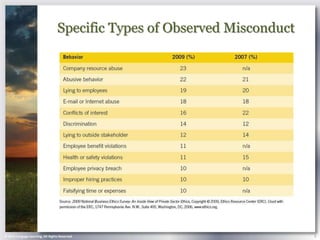
Specific Types of Observed Misconduct


© 2013 Cengage Learning. All Rights Reserved.                             3
Honesty

                            Honesty: Truthfulness or trustworthiness
                             Telling the truth to the best of your knowledge
                             Dishonesty: A lack of integrity, incomplete
                              disclosure, or an unwillingness to tell the truth

                                       Issues related to honesty arise when people
                                       perceive business as something where
                                       normal rules do not apply

© 2013 Cengage Learning. All Rights Reserved.                                        4
Fairness and Integrity

                             Fairness: The quality of being just,
                              equitable, and impartial
                                        Equality: How wealth or income is distributed
                                        Reciprocity: Occurs when an action that has an effect
                                         upon another is returned
                                        Optimization: The tradeoff between equity and
                                         efficiency
                             Integrity: Uncompromising adherence to
                              ethical values
                                        One of the most important terms relating to virtue

© 2013 Cengage Learning. All Rights Reserved.                                                    5
Ethical Issues and Dilemmas in
                                                   Business


                             An ethical dilemma is a problem, situation, or
                              opportunity that requires an individual or
                              group to chose among several wrong or
                              unethical actions
                                        There is no ethical choice


© 2013 Cengage Learning. All Rights Reserved.                                  6
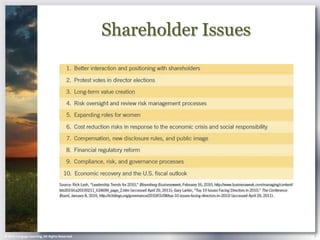
Shareholder Issues


© 2013 Cengage Learning. All Rights Reserved.                        7
Misuse of Company Resources


                            The leading form of observed misconduct
                             Can range from unauthorized use of
                              equipment and computers to embezzling
                              company funds
                             Time theft costs organizations hundreds of
                              billions in lost productivity annually


© 2013 Cengage Learning. All Rights Reserved.                              8
Abusive or Intimidating Behavior


                            One of the most common ethical problems
                             Can be physical threats, false accusations,
                              profanity, insults, harshness, ignoring
                              someone, or unreasonableness
                                        Intent is important in determining abuse


                                       Bullying is a growing problem
                                       •        Is associated with a hostile workplace


© 2013 Cengage Learning. All Rights Reserved.                                            9
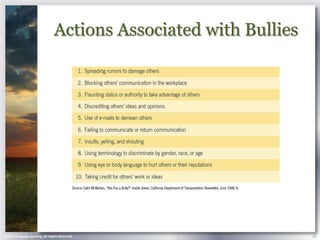
Actions Associated with Bullies


© 2013 Cengage Learning. All Rights Reserved.                     10
Lying

                            Three types of lies
                             Joking without malice
                             Commission lying is creating a false perception
                              with words that deceive the receiver
                                        Creating noise
                             Omission lying is intentionally not informing
                              channel members of problems relating to a
                              product that affects awareness, intention, or
                              behavior

© 2013 Cengage Learning. All Rights Reserved.                                   11
Conflicts of Interest


                            Exist when an individual must choose
                            whether to advance his/her personal
                            interests, those of the organization, or
                            some other group
                             Individuals must separate personal interests
                              from business dealings


© 2013 Cengage Learning. All Rights Reserved.                                12
Bribery

                            The practice of offering something in order
                            to gain an illicit advantage
                             Different types of bribery
                                        Active bribery: The person who promises or gives
                                         the bribe commits the offense
                                        Passive bribery: An offense committed by the
                                         official who receives the bribe
                                       Facilitation payments: Legal as long as they
                                       are small

© 2013 Cengage Learning. All Rights Reserved.                                               13
Corporate Intelligence
                            The collection and analysis of
                            information on
                                      Markets
                                      Technologies
                                      Customers and competitors
                                      Socioeconomic and external political trends
                            Three intelligence models
                                       •        Passive monitoring system for early warning
                                       •        Tactical field support
                                       •        Support dedicated to top management strategy
© 2013 Cengage Learning. All Rights Reserved.                                                  14
Corporate Intelligence
                             Hacking
                                        System hacking
                                        Remote hacking
                                        Physical hacking
                                      Social engineering
                                      Shoulder surfing
                                      Password guessing
                                      Dumpster diving
                                      Whacking
                                      Phone eavesdropping
© 2013 Cengage Learning. All Rights Reserved.                            15
Discrimination

                            Is illegal in the U.S.
                             A company can be sued for discrimination if it
                                        Refuses to hire an individual for discriminatory
                                         reasons
                                        Unreasonably excludes an individual from
                                         employment
                                        Unreasonably discharges an individual
                                        Discriminates against an individual with respect to
                                         hiring, employment terms, promotion, or privileges


© 2013 Cengage Learning. All Rights Reserved.                                                  16
Discrimination (continued)


                             Equal Employment Opportunity Commission
                              (EEOC)
                             The Age Discrimination in Employment Act
                             Affirmative Action Programs
                                        Efforts to recruit, hire, train, and promote qualified
                                         individuals from groups that have traditionally
                                         been discriminated against


© 2013 Cengage Learning. All Rights Reserved.                                                     17
Sexual Harassment

                            A repeated, unwanted behavior of a sexual
                            nature perpetrated upon an individual by
                            another
                             Hostile work environment
                                        The conduct was unwelcome
                                        The conduct was severe, pervasive, and regarded
                                         by claimant as hostile/offensive
                                        The conduct was such that a reasonable person
                                         would find it hostile or offensive


© 2013 Cengage Learning. All Rights Reserved.                                              18
Dual Relationship

                            A personal, loving, and/or sexual
                            relationship with someone with whom you
                            share professional responsibilities
                             A key ethical issue in sexual harassment

                                       Unethical dual relationship: The
                                       relationship causes a conflict of interest or
                                       impairment of professional judgment

© 2013 Cengage Learning. All Rights Reserved.                                          19
To Avoid Sexual Misconduct, a
                                                  Firm Needs
                            1. Statement of policy
                            2. Definition of sexual harassment
                            3. Non-retaliation policy
                            4. Specific procedures for prevention
                            5. Establish, enforce, and encourage victims to
                               report
                            6. Establish a reporting procedure
                            7. Timely reporting requirements to the proper
                               authorities

© 2013 Cengage Learning. All Rights Reserved.                                 20
Environmental Issues

                            Are becoming significant concerns in
                            business
                             Air pollution: Gases and particulates in the air that
                              can linger or be carried long distances by winds
                                        The Kyoto Protocol: An international treaty on climate
                                         change that commits nations to reducing greenhouse
                                         gas emissions
                             Water pollution: Results from dumping sewage
                              and toxic chemicals in places where they can filter
                              into water supplies

© 2013 Cengage Learning. All Rights Reserved.                                                     21
Environmental Issues (continued)
                              Recycling: The reprocessing of materials,
                               especially steel, aluminum, paper, glass,
                               rubber, and some plastics
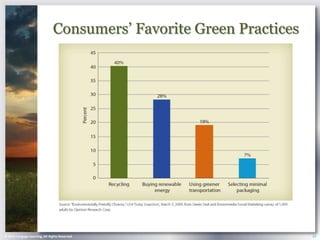
                                         Consumers consider recycling to be the most
                                          important thing they can do to live “greener” lives
                              Alternative energy: Is considered “green”
                               because it produces fewer emissions and
                               creates less pollution
                                                 Wind            Hydropower
                                                 Solar           Biofuels
                                                 Geothermal      Nuclear
© 2013 Cengage Learning . All rights reserved.                                                  22
Consumers’ Favorite Green Practices


© 2013 Cengage Learning. All Rights Reserved.                        23
Fraud

                            Any purposeful communication that
                            deceives, manipulates, or conceals facts in
                            order to create a false impression
                             Accounting fraud
                                        Misrepresentation of company’s financial reports
                                        Dramatic changes in accounting field
                                        Increased competition and pressures to perform
                                         can create opportunities for misconduct
                                        Accountants should abide by a strict code of ethics

© 2013 Cengage Learning. All Rights Reserved.                                                  24
Marketing Fraud
                            The process of dishonestly creating,
                            distributing, promoting, and pricing
                            products
                             Puffery: Exaggerated advertising claims,
                              blustering, and boasting
                                        Can be difficult to distinguish from fraud
                             Implied falsity: An advertising message that
                              misleads, confuses, or deceives the public
                             Literally false: Claims can be divided into tests
                              prove and bald assertions (non-establishment
                              claims)

© 2013 Cengage Learning. All Rights Reserved.                                         25
Consumer Fraud

                             When consumers attempt to deceive
                              businesses for personal gain
                                        Price tag switching, item switching, or lying to
                                         obtain discounts
                             Collusion involves an employee who helps a
                              consumer commit fraud
                             Duplicity involves a consumer duping a store
                             Guile is associated with a person who uses
                              tricks to obtain an unfair advantage

© 2013 Cengage Learning. All Rights Reserved.                                               26
Financial Misconduct
                             The failure to understand and manage ethical
                              risks was a key problem in the recent financial
                              crisis
                                        Many firms rewarded risk-taking
                                        Difficult-to-understand financial instruments and
                                         murky accounting played roles
                             Government calls for reform
                                        Stricter controls on hedge funds and other
                                         instruments
                                        Greater transparency
                                        Dodd-Frank Wall Street Reform and Consumer
                                         Protection Act

© 2013 Cengage Learning. All Rights Reserved.                                                27
Insider Trading


                             Two types of insider trading
                                        Legal insider trading: Involves legally buying
                                         and selling stock in an insider’s own company,
                                         but not all the time
                                        Illegal insider trading: The buying or selling of
                                         stocks by insiders who possess material that is
                                         not public


© 2013 Cengage Learning. All Rights Reserved.                                                28
Intellectual Property Rights and
                                                   Privacy
                            Involve the legal protection of intellectual
                            properties
                                        Books, movies, software
                                        Can be difficult to enforce
                             Many privacy issues in the business world
                                        Employee use of technology
                                        Consumer privacy
                                        Can be challenging for businesses today to meet
                                         the needs of consumers while protecting privacy
                                       Identity theft is a growing problem
© 2013 Cengage Learning. All Rights Reserved.                                              29
The Challenge of Determining
                                             Ethical Issues in Business

                             Most ethical issues become visible through
                              stakeholder concerns
                             Determining ethical issues is a challenge
                                        Changing societal standards over time


                                       The ethical decision making process starts
                                       when ethical issue awareness occurs and a
                                       discussion begins


© 2013 Cengage Learning. All Rights Reserved.                                       30

ARC MGMT 374 Week 3 Presentation

  • 1.
    Chapter 3: Emerging Business Ethics Issues Part Two: Ethical Issues and the Institutionalization of Business Ethics © 2013 Cengage Learning. All Rights Reserved. 1
  • 2.
    Recognizing an EthicalIssue An ethical issue is a problem, situation, or opportunity that requires an individual or group to choose among actions  New ethical issues are emerging constantly  Can be difficult to recognize ethical issues Failure to do so puts corporations at risk • Is a problem in industries where winning is perceived to be a game © 2013 Cengage Learning. All Rights Reserved. 2
  • 3.
    Specific Types ofObserved Misconduct © 2013 Cengage Learning. All Rights Reserved. 3
  • 4.
    Honesty Honesty: Truthfulness or trustworthiness  Telling the truth to the best of your knowledge  Dishonesty: A lack of integrity, incomplete disclosure, or an unwillingness to tell the truth Issues related to honesty arise when people perceive business as something where normal rules do not apply © 2013 Cengage Learning. All Rights Reserved. 4
  • 5.
    Fairness and Integrity  Fairness: The quality of being just, equitable, and impartial  Equality: How wealth or income is distributed  Reciprocity: Occurs when an action that has an effect upon another is returned  Optimization: The tradeoff between equity and efficiency  Integrity: Uncompromising adherence to ethical values  One of the most important terms relating to virtue © 2013 Cengage Learning. All Rights Reserved. 5
  • 6.
    Ethical Issues andDilemmas in Business  An ethical dilemma is a problem, situation, or opportunity that requires an individual or group to chose among several wrong or unethical actions  There is no ethical choice © 2013 Cengage Learning. All Rights Reserved. 6
  • 7.
    Shareholder Issues © 2013Cengage Learning. All Rights Reserved. 7
  • 8.
    Misuse of CompanyResources The leading form of observed misconduct  Can range from unauthorized use of equipment and computers to embezzling company funds  Time theft costs organizations hundreds of billions in lost productivity annually © 2013 Cengage Learning. All Rights Reserved. 8
  • 9.
    Abusive or IntimidatingBehavior One of the most common ethical problems  Can be physical threats, false accusations, profanity, insults, harshness, ignoring someone, or unreasonableness  Intent is important in determining abuse Bullying is a growing problem • Is associated with a hostile workplace © 2013 Cengage Learning. All Rights Reserved. 9
  • 10.
    Actions Associated withBullies © 2013 Cengage Learning. All Rights Reserved. 10
  • 11.
    Lying Three types of lies  Joking without malice  Commission lying is creating a false perception with words that deceive the receiver  Creating noise  Omission lying is intentionally not informing channel members of problems relating to a product that affects awareness, intention, or behavior © 2013 Cengage Learning. All Rights Reserved. 11
  • 12.
    Conflicts of Interest Exist when an individual must choose whether to advance his/her personal interests, those of the organization, or some other group  Individuals must separate personal interests from business dealings © 2013 Cengage Learning. All Rights Reserved. 12
  • 13.
    Bribery The practice of offering something in order to gain an illicit advantage  Different types of bribery  Active bribery: The person who promises or gives the bribe commits the offense  Passive bribery: An offense committed by the official who receives the bribe Facilitation payments: Legal as long as they are small © 2013 Cengage Learning. All Rights Reserved. 13
  • 14.
    Corporate Intelligence The collection and analysis of information on  Markets  Technologies  Customers and competitors  Socioeconomic and external political trends Three intelligence models • Passive monitoring system for early warning • Tactical field support • Support dedicated to top management strategy © 2013 Cengage Learning. All Rights Reserved. 14
  • 15.
    Corporate Intelligence  Hacking  System hacking  Remote hacking  Physical hacking  Social engineering  Shoulder surfing  Password guessing  Dumpster diving  Whacking  Phone eavesdropping © 2013 Cengage Learning. All Rights Reserved. 15
  • 16.
    Discrimination Is illegal in the U.S.  A company can be sued for discrimination if it  Refuses to hire an individual for discriminatory reasons  Unreasonably excludes an individual from employment  Unreasonably discharges an individual  Discriminates against an individual with respect to hiring, employment terms, promotion, or privileges © 2013 Cengage Learning. All Rights Reserved. 16
  • 17.
    Discrimination (continued)  Equal Employment Opportunity Commission (EEOC)  The Age Discrimination in Employment Act  Affirmative Action Programs  Efforts to recruit, hire, train, and promote qualified individuals from groups that have traditionally been discriminated against © 2013 Cengage Learning. All Rights Reserved. 17
  • 18.
    Sexual Harassment A repeated, unwanted behavior of a sexual nature perpetrated upon an individual by another  Hostile work environment  The conduct was unwelcome  The conduct was severe, pervasive, and regarded by claimant as hostile/offensive  The conduct was such that a reasonable person would find it hostile or offensive © 2013 Cengage Learning. All Rights Reserved. 18
  • 19.
    Dual Relationship A personal, loving, and/or sexual relationship with someone with whom you share professional responsibilities  A key ethical issue in sexual harassment Unethical dual relationship: The relationship causes a conflict of interest or impairment of professional judgment © 2013 Cengage Learning. All Rights Reserved. 19
  • 20.
    To Avoid SexualMisconduct, a Firm Needs 1. Statement of policy 2. Definition of sexual harassment 3. Non-retaliation policy 4. Specific procedures for prevention 5. Establish, enforce, and encourage victims to report 6. Establish a reporting procedure 7. Timely reporting requirements to the proper authorities © 2013 Cengage Learning. All Rights Reserved. 20
  • 21.
    Environmental Issues Are becoming significant concerns in business  Air pollution: Gases and particulates in the air that can linger or be carried long distances by winds  The Kyoto Protocol: An international treaty on climate change that commits nations to reducing greenhouse gas emissions  Water pollution: Results from dumping sewage and toxic chemicals in places where they can filter into water supplies © 2013 Cengage Learning. All Rights Reserved. 21
  • 22.
    Environmental Issues (continued)  Recycling: The reprocessing of materials, especially steel, aluminum, paper, glass, rubber, and some plastics  Consumers consider recycling to be the most important thing they can do to live “greener” lives  Alternative energy: Is considered “green” because it produces fewer emissions and creates less pollution Wind Hydropower Solar Biofuels Geothermal Nuclear © 2013 Cengage Learning . All rights reserved. 22
  • 23.
    Consumers’ Favorite GreenPractices © 2013 Cengage Learning. All Rights Reserved. 23
  • 24.
    Fraud Any purposeful communication that deceives, manipulates, or conceals facts in order to create a false impression  Accounting fraud  Misrepresentation of company’s financial reports  Dramatic changes in accounting field  Increased competition and pressures to perform can create opportunities for misconduct  Accountants should abide by a strict code of ethics © 2013 Cengage Learning. All Rights Reserved. 24
  • 25.
    Marketing Fraud The process of dishonestly creating, distributing, promoting, and pricing products  Puffery: Exaggerated advertising claims, blustering, and boasting  Can be difficult to distinguish from fraud  Implied falsity: An advertising message that misleads, confuses, or deceives the public  Literally false: Claims can be divided into tests prove and bald assertions (non-establishment claims) © 2013 Cengage Learning. All Rights Reserved. 25
  • 26.
    Consumer Fraud  When consumers attempt to deceive businesses for personal gain  Price tag switching, item switching, or lying to obtain discounts  Collusion involves an employee who helps a consumer commit fraud  Duplicity involves a consumer duping a store  Guile is associated with a person who uses tricks to obtain an unfair advantage © 2013 Cengage Learning. All Rights Reserved. 26
  • 27.
    Financial Misconduct  The failure to understand and manage ethical risks was a key problem in the recent financial crisis  Many firms rewarded risk-taking  Difficult-to-understand financial instruments and murky accounting played roles  Government calls for reform  Stricter controls on hedge funds and other instruments  Greater transparency  Dodd-Frank Wall Street Reform and Consumer Protection Act © 2013 Cengage Learning. All Rights Reserved. 27
  • 28.
    Insider Trading  Two types of insider trading  Legal insider trading: Involves legally buying and selling stock in an insider’s own company, but not all the time  Illegal insider trading: The buying or selling of stocks by insiders who possess material that is not public © 2013 Cengage Learning. All Rights Reserved. 28
  • 29.
    Intellectual Property Rightsand Privacy Involve the legal protection of intellectual properties  Books, movies, software  Can be difficult to enforce  Many privacy issues in the business world  Employee use of technology  Consumer privacy  Can be challenging for businesses today to meet the needs of consumers while protecting privacy Identity theft is a growing problem © 2013 Cengage Learning. All Rights Reserved. 29
  • 30.
    The Challenge ofDetermining Ethical Issues in Business  Most ethical issues become visible through stakeholder concerns  Determining ethical issues is a challenge  Changing societal standards over time The ethical decision making process starts when ethical issue awareness occurs and a discussion begins © 2013 Cengage Learning. All Rights Reserved. 30