Business in a
Changing World
McGraw-Hill/Irwin Copyright © 2009 by the McGraw-Hill Companies, Inc. All rights reserved.
Chapter 2
Business Ethics and Social
Responsibility
2-3
Ethisphere links ethics to profits
Publication that illuminates the
relationship between ethics and
profits.
2-4
Business Ethics & Social Responsibility
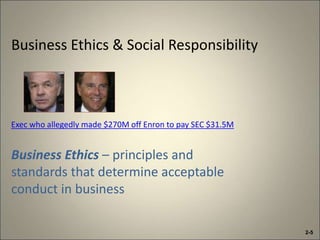
Exec who allegedly made $270M off Enron to pay SEC $31.5M
Business Ethics – principles and
standards that determine acceptable
conduct in business
2-5
Business Ethics & Social Responsibility
A Timeline of Ethical and Socially Responsible Concerns
2-6
Business Ethics & Social Responsibility
Social responsibility– business’s obligation to
maximize its positive impact and minimize its
negative impact on society
2-7
Business Ethics & Social Responsibility
Laws and regulations encourage businesses to
conform to society’s standards, values, and
attitudes. Sarbanes-Oxley Act - 2002
2-8
The Role of Ethics in Business
Concern about unethical business
practices continue –
HealthSouth’s accounting improprieties
and securities fraud
2-9
The Role of Ethics in Business
Unethical and/or Illegal
•Accounting fraud
•Deceptive advertising
•Unfair competitive practices
•Internet theft
2-10
The Role of Ethics in Business
Ethical Conduct
•Builds trust
•Promotes confidence
•Validates relationships
Learn how to recognize and resolve
ethical issues
2-11
Recognizing Ethical Issues in Business
Ethical issue –
an identifiable problem,
situation, or opportunity that requires
a person to choose from among several
actions that may be evaluated as right
or wrong, ethical or unethical.
2-12
Recognizing Ethical Issues in Business
How to judge the ethics of a
situation –
examine the situation from your
stakeholders’ position, including
customers and competitors
2-13
Types and Incidences of Observed Misconduct
Many business issues may seem straightforward and easy to resolve on the
surface, but are in reality very complex.
Recognizing Ethical Issues in Business
2-14
1. Overly aggressive financial or business
objectives
2. Abusive & intimidating behavior
3. Conflict of interest
4. Fairness & honesty
5. Communications
6. Business relationships
Sources of Unethical Behavior in Organizations
2-15
Sources of Unethical Behavior
Abusive and intimidating behavior
“Bullies” behavior:
2-16
Conflict of interest –
– the most common ethical issue identified
by employees.
– Advance personal interests over others’
interests
– Benefit self at the expense of the company
Sources of Unethical Behavior in Organizations
2-17
Least Corrupt Countries
2-18
Business Ethics
Fairness & honesty – the heart of
business ethics
•How employees use resources
•No harm to customers
•Accurate representations
•Disclosure
2-19
Business Ethics
Most Popular Office Supplies Employees Pilfer
“More Employees Taking Supplies,” The News Journal
2-20
Personal Ethics
25,000 high school students:
•62% cheated on exams at least once
•35% copied documents from Internet
•27% shoplifted
•23% cheated to win at sports
Honesty?
2-21
Ethical Concerns
•False/misleading advertising
•Deceptive personal selling tactics
•Product safety and quality
•Unsubstantiated claims
•Product labeling
Communications
2-22
Ethical Concerns
•Relationships with customers
•Relationships with suppliers
•Relationships with co-workers
Business Relationships
2-23
Ethical Concerns
The act of taking someone else’s work
and presenting it as your own without
mentioning the source
Plagiarism
2-24
Making Decisions About Ethical Issues
Questions to Consider in Determining Whether an
Action Is Ethical
Open discussion of ethical issues does not eliminate ethical
problems; it does promote trust and learning in an
organization.
2-25
Improving Ethical Behavior in Business
Ethical decisions in an organizations are
influenced by three key factors
2-26
Improving Ethical Behavior in Business
Codes of Ethics –
Formalized rules and standards that describe
what a company expects of its employees.
2-27
Improving Ethical Behavior in Business
Key Things to Consider in Developing a Code of Ethics
2-28
Codes of Ethics
According to the NBES, employees in
organizations with written standards of conduct
are more likely to report misconduct when they
observe it.
National Business Ethics Survey (NBES)
2-29
Codes of Ethics
The act of an employee exposing an employer’s
wrongdoing to outsiders, such as the media or
government regulatory agencies.
Whistleblowing
2-30
Business Ethics – Taking Responsibility
2-31
Nature of Social Responsibility
1. Economic
2. Legal
3. Ethical
4. Voluntary (philanthropic)
4 Dimensions
2-32
Pyramid of Social Responsibility
2-33
Nature of Social Responsibility
The extent to which businesses meet the legal,
ethical, economic, and voluntary responsibilities
placed on them by their stakeholders.
Corporate Citizenship
2-34
Nature of Social Responsibility
1. Intel Corporation
2. Eaton Corporation
3. Nike Inc.
4. Deere and Co.
Best Corporate Citizens
2-35
Nature of Social Responsibility
Arguments For and
Against Social
Responsibility
2-36
Social Responsibility Issues
• Primary concern with profit or ROI
• Financial community at large
• Proper accounting procedures
• Protecting owner’s rights and investments
Owners & Stockholders
2-37
Social Responsibility Issues
• Provide a safe workplace
• Adequate compensation
• Listen to grievances
• Fair treatment
Employee Relations
2-38
Social Responsibility Issues
Consumerism – the activities that independent
individuals, groups, and organizations
undertake to protect their rights as
consumers.
Consumer Relations
2-39
Social Responsibility Issues
• Animal rights
• Pollution
• Going Green
Environmental Issues
2-40
Social Responsibility Issues
•General community and global welfare
•Hardcore unemployed
•Charitable contributions (United Way)
•Avon’s Breast Cancer Awareness Crusade
Community Relations
2-41

ETHICAL

  • 2.
    Business in a ChangingWorld McGraw-Hill/Irwin Copyright © 2009 by the McGraw-Hill Companies, Inc. All rights reserved. Chapter 2 Business Ethics and Social Responsibility
  • 3.
  • 4.
    Ethisphere links ethicsto profits Publication that illuminates the relationship between ethics and profits. 2-4
  • 5.
    Business Ethics &Social Responsibility Exec who allegedly made $270M off Enron to pay SEC $31.5M Business Ethics – principles and standards that determine acceptable conduct in business 2-5
  • 6.
    Business Ethics &Social Responsibility A Timeline of Ethical and Socially Responsible Concerns 2-6
  • 7.
    Business Ethics &Social Responsibility Social responsibility– business’s obligation to maximize its positive impact and minimize its negative impact on society 2-7
  • 8.
    Business Ethics &Social Responsibility Laws and regulations encourage businesses to conform to society’s standards, values, and attitudes. Sarbanes-Oxley Act - 2002 2-8
  • 9.
    The Role ofEthics in Business Concern about unethical business practices continue – HealthSouth’s accounting improprieties and securities fraud 2-9
  • 10.
    The Role ofEthics in Business Unethical and/or Illegal •Accounting fraud •Deceptive advertising •Unfair competitive practices •Internet theft 2-10
  • 11.
    The Role ofEthics in Business Ethical Conduct •Builds trust •Promotes confidence •Validates relationships Learn how to recognize and resolve ethical issues 2-11
  • 12.
    Recognizing Ethical Issuesin Business Ethical issue – an identifiable problem, situation, or opportunity that requires a person to choose from among several actions that may be evaluated as right or wrong, ethical or unethical. 2-12
  • 13.
    Recognizing Ethical Issuesin Business How to judge the ethics of a situation – examine the situation from your stakeholders’ position, including customers and competitors 2-13
  • 14.
    Types and Incidencesof Observed Misconduct Many business issues may seem straightforward and easy to resolve on the surface, but are in reality very complex. Recognizing Ethical Issues in Business 2-14
  • 15.
    1. Overly aggressivefinancial or business objectives 2. Abusive & intimidating behavior 3. Conflict of interest 4. Fairness & honesty 5. Communications 6. Business relationships Sources of Unethical Behavior in Organizations 2-15
  • 16.
    Sources of UnethicalBehavior Abusive and intimidating behavior “Bullies” behavior: 2-16
  • 17.
    Conflict of interest– – the most common ethical issue identified by employees. – Advance personal interests over others’ interests – Benefit self at the expense of the company Sources of Unethical Behavior in Organizations 2-17
  • 18.
  • 19.
    Business Ethics Fairness &honesty – the heart of business ethics •How employees use resources •No harm to customers •Accurate representations •Disclosure 2-19
  • 20.
    Business Ethics Most PopularOffice Supplies Employees Pilfer “More Employees Taking Supplies,” The News Journal 2-20
  • 21.
    Personal Ethics 25,000 highschool students: •62% cheated on exams at least once •35% copied documents from Internet •27% shoplifted •23% cheated to win at sports Honesty? 2-21
  • 22.
    Ethical Concerns •False/misleading advertising •Deceptivepersonal selling tactics •Product safety and quality •Unsubstantiated claims •Product labeling Communications 2-22
  • 23.
    Ethical Concerns •Relationships withcustomers •Relationships with suppliers •Relationships with co-workers Business Relationships 2-23
  • 24.
    Ethical Concerns The actof taking someone else’s work and presenting it as your own without mentioning the source Plagiarism 2-24
  • 25.
    Making Decisions AboutEthical Issues Questions to Consider in Determining Whether an Action Is Ethical Open discussion of ethical issues does not eliminate ethical problems; it does promote trust and learning in an organization. 2-25
  • 26.
    Improving Ethical Behaviorin Business Ethical decisions in an organizations are influenced by three key factors 2-26
  • 27.
    Improving Ethical Behaviorin Business Codes of Ethics – Formalized rules and standards that describe what a company expects of its employees. 2-27
  • 28.
    Improving Ethical Behaviorin Business Key Things to Consider in Developing a Code of Ethics 2-28
  • 29.
    Codes of Ethics Accordingto the NBES, employees in organizations with written standards of conduct are more likely to report misconduct when they observe it. National Business Ethics Survey (NBES) 2-29
  • 30.
    Codes of Ethics Theact of an employee exposing an employer’s wrongdoing to outsiders, such as the media or government regulatory agencies. Whistleblowing 2-30
  • 31.
    Business Ethics –Taking Responsibility 2-31
  • 32.
    Nature of SocialResponsibility 1. Economic 2. Legal 3. Ethical 4. Voluntary (philanthropic) 4 Dimensions 2-32
  • 33.
    Pyramid of SocialResponsibility 2-33
  • 34.
    Nature of SocialResponsibility The extent to which businesses meet the legal, ethical, economic, and voluntary responsibilities placed on them by their stakeholders. Corporate Citizenship 2-34
  • 35.
    Nature of SocialResponsibility 1. Intel Corporation 2. Eaton Corporation 3. Nike Inc. 4. Deere and Co. Best Corporate Citizens 2-35
  • 36.
    Nature of SocialResponsibility Arguments For and Against Social Responsibility 2-36
  • 37.
    Social Responsibility Issues •Primary concern with profit or ROI • Financial community at large • Proper accounting procedures • Protecting owner’s rights and investments Owners & Stockholders 2-37
  • 38.
    Social Responsibility Issues •Provide a safe workplace • Adequate compensation • Listen to grievances • Fair treatment Employee Relations 2-38
  • 39.
    Social Responsibility Issues Consumerism– the activities that independent individuals, groups, and organizations undertake to protect their rights as consumers. Consumer Relations 2-39
  • 40.
    Social Responsibility Issues •Animal rights • Pollution • Going Green Environmental Issues 2-40
  • 41.
    Social Responsibility Issues •Generalcommunity and global welfare •Hardcore unemployed •Charitable contributions (United Way) •Avon’s Breast Cancer Awareness Crusade Community Relations 2-41