MEXICO
May 2015
RENEWABLE ENERGY PROSPECTS:
Copyright © IRENA 2015
Unless otherwise indicated, the material in this publication may be used freely, shared or reprinted, so long
as IRENA is acknowledged as the source.
About IRENA
The International Renewable Energy Agency (IRENA) is an intergovernmental organisation that supports
countries in their transition to a sustainable energy future, and serves as the principal platform for inter-
national cooperation, a centre of excellence, and a repository of policy, technology, resource and financial
knowledge on renewable energy. IRENA promotes the widespread adoption and sustainable use of all
forms of renewable energy, including bioenergy, geothermal, hydropower, ocean, solar and wind energy, in
the pursuit of sustainable development, energy access, energy security and low-carbon economic growth
and prosperity.
About SENER
The Mexican Ministry of Energy (SENER) is the institution in charge of driving the country’s energy policy,
within the national constitutional framework, to ensure an economically viable competitive supply of, suf-
ficient, high quality, and environmentally sustainable energy. With the vision of achieving a country with
universal access to modern energy at competitive prices, provided securely by public and private compa-
nies of the highest world standards, and with the extensive promotion of the implementation of Energy
Efficiency and Renewable Energy.
Acknowledgements
The report has benefited from valuable comments and guidance provided by our collaborators from
SENER Leonardo Beltrán, José María Valenzuela, Alejandro Amerena and especially to Efraín Villanueva
and Margott Galván because of their kind and dedicated support along the development of the country
report. Additional external review was provided by the Federal Electricity Commission (CFE) and the Energy
Regulatory Commission (CRE), Isabel Studer (Global Institute for Sustainability, EGADE Business School),
as well as by reviewers from the industry sector, Víctor Cervantes (SunEdison) and Stanislav Palacios
(Tracsa). Valuable comments were provided by IRENA colleagues Rabia Ferroukhi, Ghislaine Kieffer, Alvaro
López-Peña, Shunichi Nakada and Jeffrey Skeer. This report was also reviewed during the discussions of the
REmap Workshop at the 8th Council in November 2014 and at the Renewable Energy in Latin America pre-
Assembly event of IRENA’s 5th Assembly in January 2015, in Abu Dhabi. Lucille Langlois was the technical
editor of this report.
Authors:
Dolf Gielen (IRENA), Deger Saygin (IRENA), Nicholas Wagner (IRENA), Laura Isabel Gutiérrez (IRENA),
Eduardo René Narváez Torres (SENER).
For further information or to provide feedback, please contact the REmap team.
E-mail: REmap@irena.org
Report citation
IRENA (2015), Renewable Energy Prospects: Mexico, REmap 2030 analysis. IRENA, Abu Dhabi.
www.irena.org/remap
Disclaimer
This publication does not represent the official view of the Mexican government or the Mexican Energy
Secretariat (SENER); rather it is an academic study designed to contribute a credible perspective for energy
planning and policymaking purposes.
While this publication promotes the adoption and use of renewable energy, IRENA does not endorse any
particular project, product or service provider. The designations employed and the presentation of materi-
als herein do not imply the expression of any opinion whatsoever on the part of the IRENA concerning the
legal status of any country, territory city or area or of its authorities, or concerning their authorities or the
delimitation of their frontiers or boundaries.
REmap 2030 outlines how countries can work together to double the share of renewable
energy in the global energy mix by 2030. It represents an unprecedented international ef-
fort that brings together the work of more than 90 national experts in nearly 60 countries.
Following the global REmap report released in June 2014, the International Renewable
Energy Agency (IRENA) is now releasing a series of country-specific reports built on the
same detailed analysis.
As the second largest energy consumer in Latin America, Mexico is committed to contributing to the global transition
to a sustainable energy future. Mexico is one of the world’s largest crude oil and natural gas producers, but its natural
gas imports are rising. Mexico has the opportunity to exploit its rich potential in renewables to diversify its energy sup-
ply, reduce its greenhouse-gas emissions, lower health dangers, create jobs and combat energy poverty.
Mexico is seizing the chance and reshaping its energy policy to promote renewables. It has recently enacted a major
reform that opens energy markets to competition, creating new opportunities for renewable energy development. The
country is fast emerging as a leader of a Latin American energy transformation.
This REmap 2030 report shows how the country can achieve the transition to renewable energy, suggesting specific
and practical pathways that would result in a clean and secure energy system. Mexico can achieve this through con-
certed actions to take advantage of its excellent renewable resource potential, building upon the progress made so far.
If Mexico continues on its path towards a sustainable energy future, it will be recognised as a leader not just in Latin
America but also in the rest of the world.
Adnan Z. Amin
Director-General
International Renewable Energy Agency
In Paris later this year, the 21st
United Nations Climate Change Conference (COP 21) will take
place against a background of scientific agreement, that alterations in the planet´s climate
system have been induced by human activity. If we are to change our path, we will have to
move towards a sustainable energy economy, by scaling up the use of clean technologies.
To make the transition to a low-carbon economy, the first step is to match demand for en-
ergy services with a sustainable energy supply.
Mexico has set the process in motion by establishing a consultative council on renewable
energy, including representatives from academia, industry, the public sector and the legis-
lature. The council has sole responsibility for advising on the development of sector-specific
public policies. Its first task was to assess the country’s renewable energy resources, result-
ing in the creation of the National Renewable Energy Inventory.
As part of Mexico’s commitment to the sustainability of the energy sector, we are publishing our experiences of devel-
oping this inventory. We have also joined forces with IRENA in developing REmap 2030, which promotes international
cooperation to enable a doubling of the share of renewables in the energy mix.
If we are to double the renewable energy share in Latin America by 2030, countries in the region must work together.
All of us need to promote energy trade, exchanges of expertise and harmonisation of standards. We must create the
physical interconnections, as well as market interactions, to move towards a low-carbon energy future.
As this report emphasises, Mexico has the potential to lead such a shift.
Leonardo Beltrán Rodriguez
Undersecretary for Planning and Energy Transition
Energy Secretariat
Mexico
FOREWORD
Renewable Energy Prospects: Mexicoii
Renewable Energy Prospects: Mexico iii
CONTENTS
FOREWORD����������������������������������������������������������������������������������������������������������������������������������������������������������������������������������������I
LIST OF FIGURES����������������������������������������������������������������������������������������������������������������������������������������������������������������������������V
LIST OF TABLES����������������������������������������������������������������������������������������������������������������������������������������������������������������������������VII
LIST OF BOXES���������������������������������������������������������������������������������������������������������������������������������������������������������������������������� VIII
EXECUTIVE SUMMARY�������������������������������������������������������������������������������������������������������������������������������������������������������������������1
HIGHLIGHTS����������������������������������������������������������������������������������������������������������������������������������������������������������������������������������������1
1	INTRODUCTION������������������������������������������������������������������������������������������������������������������������������������������������������������������������ 6
2	METHODOLOGY AND DATA SOURCES���������������������������������������������������������������������������������������������������������������������������8
3	 RECENT TRENDS���������������������������������������������������������������������������������������������������������������������������������������������������������������������12
3.1	Recent trends in renewables and in Mexico’s total energy system������������������������������������������������������������12
3.2	 Base year energy status����������������������������������������������������������������������������������������������������������������������������������������������18
4	REFERENCE CASE DEVELOPMENTS TO 2030����������������������������������������������������������������������������������������������������������27
5	 CURRENT POLICY FRAMEWORK�����������������������������������������������������������������������������������������������������������������������������������30
5.1	 Energy sector reform���������������������������������������������������������������������������������������������������������������������������������������������������30
5.2	 Renewable energy law������������������������������������������������������������������������������������������������������������������������������������������������34
5.3	 Bioenergy legal framework���������������������������������������������������������������������������������������������������������������������������������������35
6	RENEWABLE POTENTIALS AND COSTS����������������������������������������������������������������������������������������������������������������������37
7	 REMAP OPTIONS FOR MEXICO����������������������������������������������������������������������������������������������������������������������������������������39
7.1	Renewable energy technologies in 2030����������������������������������������������������������������������������������������������������������� 40
7.2	 Roadmap table���������������������������������������������������������������������������������������������������������������������������������������������������������������46
7.3	Summary of REmap Options: cost-supply curves��������������������������������������������������������������������������������������������51
7.4	Discussion of REmap Options and implementation challenges���������������������������������������������������������������� 60
8	BARRIERS AND OPPORTUNITIES FOR A RENEWABLE ENERGY TRANSITION����������������������������������������69
9	SUGGESTIONS FOR ACCELERATED RENEWABLE ENERGY UPTAKE�����������������������������������������������������������73
REFERENCES����������������������������������������������������������������������������������������������������������������������������������������������������������������������������������78
LIST OF ABBREVIATIONS���������������������������������������������������������������������������������������������������������������������������������������������������������83
ANNEX A:
Energy prices����������������������������������������������������������������������������������������������������������������������������������������������������������������������������87
ANNEX B:
Technology portfolio��������������������������������������������������������������������������������������������������������������������������������������������������������������88
Renewable Energy Prospects: Mexicoiv
ANNEX C:
Data for cost-supply curve from the business and the government perspective����������������������������������������89
ANNEX D:
Overview of production cost of end-use renewable energy and
conventional technologies in 2030, business perspective��������������������������������������������������������������������������������������91
ANNEX E:
Capital and operation and maintenance costs������������������������������������������������������������������������������������������������������������92
ANNEX F:
Detailed roadmap table��������������������������������������������������������������������������������������������������������������������������������������������������������93
Renewable Energy Prospects: Mexico v
List of Figures
Figure 1: Contribution of the 26 individual countries in REmap 2030
to total global renewable energy use..................................................................................................................................7
Figure 2: Total final energy consumption in Mexico, breakdown by energy carrier, 2013..................................13
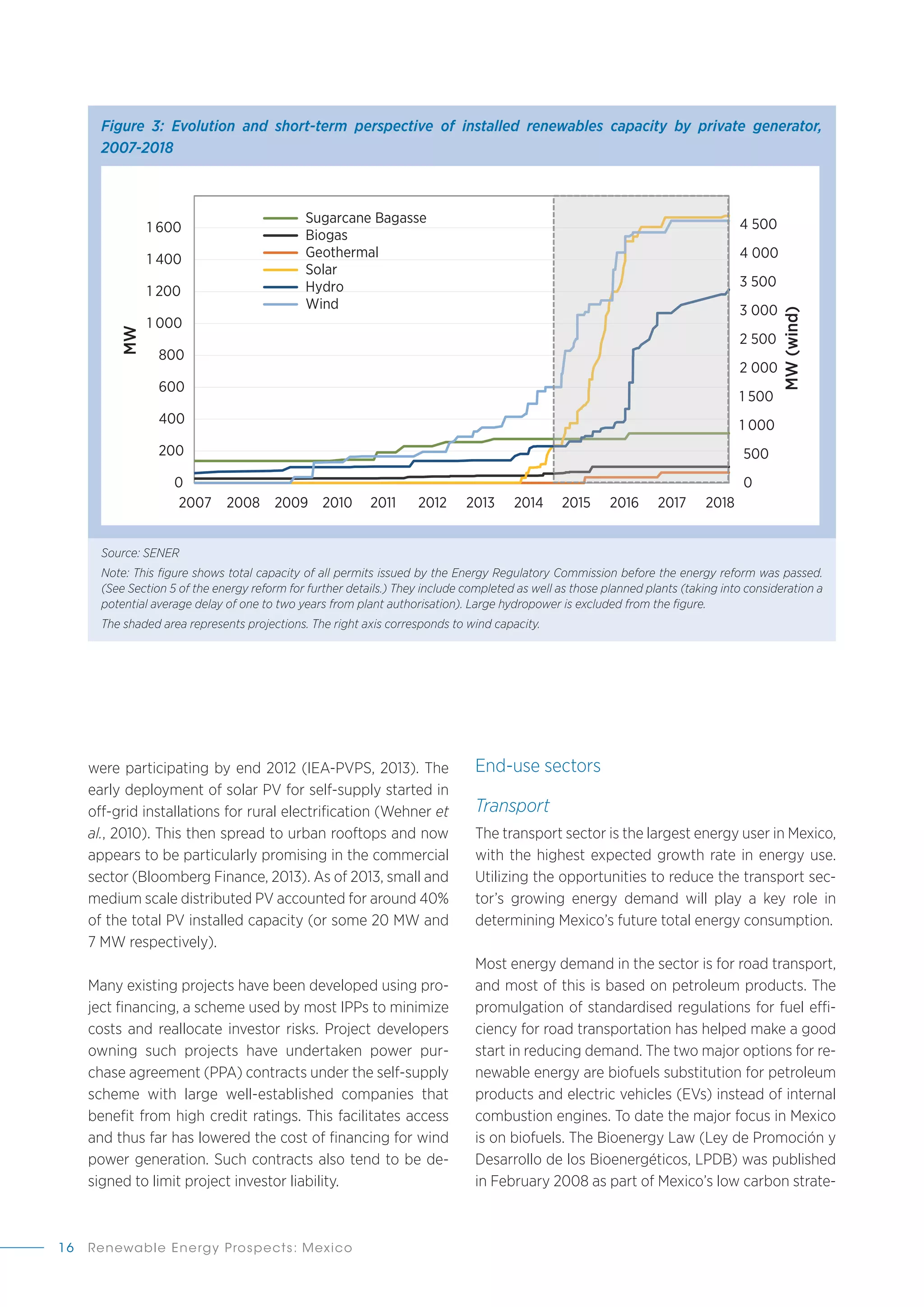
Figure 3: Evolution and short-term perspective of installed renewables capacity
by private generator, 2007-2018.........................................................................................................................................16
Figure 4: Geothermal fields for direct uses...........................................................................................................................18
Figure 5: Total final energy consumption by sector, 2010...............................................................................................19
Figure 6: Total final energy consumption by industrial subsector, 2010..................................................................20
Figure 7: Breakdown of residential sector energy use for thermal applications
and electricity, 2008................................................................................................................................................................21
Figure 8: Users of woodfuel per locality...............................................................................................................................22
Figure 9: Natural gas demand by sector, 2012...................................................................................................................23
Figure 10: Natural gas demand forecast, 2013-2027........................................................................................................24
Figure 11: Mexico’s electricity regions.....................................................................................................................................25
Figure 12: Mexico Reference Case, renewable energy shares in TFEC by sector, 2010-2030.........................27
Figure 13: Reference Case renewable power generation growth, 2010-2030.......................................................28
Figure 14: Reference Case growth of renewable energy use in the end-use sectors, 2010-2030.................29
Figure 15: Sustainable wood supply potential for energy..............................................................................................38
Figure 16: Dedicated energy crop supply potential..........................................................................................................38
Figure 17: Renewable energy economic potential for power generation by 2020,
planned capacity and capacity deployed by June 2014...........................................................................................41
Figure 18: Annual mean wind speed at 50 metre height................................................................................................42
Figure 19: Solar resource..............................................................................................................................................................43
Figure 20: Geothermal resource potential...........................................................................................................................44
Figure 21: Primary bioenergy demand by sector in REmap 2030..............................................................................46
Figure 22: Increases in renewable energy consumption in TFEC by resource......................................................47
Figure 23: Breakdown of renewable energy use by application and sector in final energy
in 2010 and under REmap 2030........................................................................................................................................48
Figure 24: Renewables offset against fossil fuels as primary energy source,
REmap 2030 compared to Reference Case..................................................................................................................49
Renewable Energy Prospects: Mexicovi
Figure 25: Power capacity development by renewable energy technology...........................................................51
Figure 26: REmap Options cost-supply curve, business perspective, by resource.............................................52
Figure 27: REmap Options cost-supply curve, business perspective, by sector..................................................53
Figure 28: REmap Options cost-supply curve, government perspective, by resource......................................54
Figure 29: REmap Options cost-supply curve, government perspective, by sector...........................................55
Figure 30: Renewable energy technology options under
REmap 2030, REmap-E and REmap-U, 2030.............................................................................................................67
Renewable Energy Prospects: Mexico vii
List of Tables
Table 1: Total installed capacity breakdown, by source and generation scheme, 2013��������������������������������������13
Table 2: Power generation breakdown, by source and generation scheme, 2013�����������������������������������������������15
Table 3: Ethanol and biodiesel production and storage capacity�������������������������������������������������������������������������������17
Table 4: Total final energy consumption by energy carrier, 2010��������������������������������������������������������������������������������18
Table 5: Total final energy consumption in the transport sector, 2010���������������������������������������������������������������������19
Table 6: New regulatory framework���������������������������������������������������������������������������������������������������������������������������������������31
Table 7: Main characteristics of the clean energy certificate scheme����������������������������������������������������������������������33
Table 8: Clean power generation goals��������������������������������������������������������������������������������������������������������������������������������35
Table 9: Bioenergy permit types���������������������������������������������������������������������������������������������������������������������������������������������36
Table 10: Renewable energy resource potential for power generation�������������������������������������������������������������������37
Table 11: Breakdown of total biomass supply potential in 2030����������������������������������������������������������������������������������38
Table 12: Breakdown of renewable energy share by sector�����������������������������������������������������������������������������������������47
Table 13: Mexico REmap 2030 overview������������������������������������������������������������������������������������������������������������������������������50
Table 14: Overview of the average cost of substitution for the REmap Options�������������������������������������������������56
Table 15: Comparison of national levelised costs of power generation in REmap 2030����������������������������������57
Table 16: Avoided CO2 emissions resulting from REmap Options������������������������������������������������������������������������������57
Table 17: Overview of job estimates related to renewable energy in Mexico��������������������������������������������������������58
Table 18: REmap Options financial indicators based on government perspective���������������������������������������������58
Table 19: Valuation of human health externalities for power generation technologies�������������������������������������59
Renewable Energy Prospects: Mexicoviii
Renewable Energy Prospects: Mexico 1
EXECUTIVE SUMMARY
HIGHLIGHTS
●● Mexico has a large and diverse renewable energy resource base. Given the right mix of policies, Mexico
has the potential to attract large-scale investment in renewables that can help diversify its energy
supply. Increased renewable energy use would also set Mexico on a pathway toward significantly
reducing its greenhouse gas (GHG) emissions. However, development has been limited so far.
●● Under current plans, the share of modern renewable energy in total final energy consumption (TFEC) is
forecast to increase from 4.4% in 2010 (base year of this analysis) to 10% in 2030. According to REmap
2030, Mexico has the potential to increase this share to 21% by 2030. This implies a threefold growth in
total renewable energy use in absolute terms from 0.5 exajoules (EJ) to 1.5 EJ in 2010-30.
●● By 2030, Mexico could generate up to 46% of its electricity each year, or 280 terawatt-hours (TWh),
from renewable sources. This compares with 18% using business-as-usual developments (116 TWh/
year). To achieve a 46% share of renewables in electricity generation, the country is likely to see the
greatest deployment in wind (30 gigawatts (GW)) and solar photovoltaic (PV) (30 GW). Together
these could account for 26% of total power generation in 2030. Small and large hydropower (26 GW)
could contribute 12% of total power generation, with geothermal energy supplying 5% (4.5 GW) and
biomass 2.5% (4 GW).
●● If renewables uptake were accelerated, all traditional uses of biomass for cooking or heating in the
buildings sector would be replaced by modern forms of renewable energy. Total biomass consumption
in all end-use sectors for heating or as transport fuels could reach 685 petajoules (PJ) by 2030. This
represents more than one third of total renewable energy use. Total installed capacity of solar thermal
applications for heating/cooling in buildings and industry would amount to 33 GW, making up almost
one tenth of the country’s renewable energy consumption.
●● Renewables can be an important driver for diversifying Mexico’s energy supply. Renewable energy has
the potential to reduce Mexico’s total coal demand by 62%, natural gas by 21% and oil by 6% compared
to business as usual to 2030. As a result, total natural gas demand would grow by 115% in 2010-2030
compared to 175% under business as usual.
●● Accelerating Mexico’s uptake of renewable energy could result in savings of 7.2 US dollars (USD) per
megawatt-hour (MWh) compared to the equivalent new capacity with conventional generation. This
saving would equate to 9% of the production cost of natural gas-fired power generation in 2030.
●● The result of this higher renewable energy uptake is an annual net savings of USD 1.6 billion in Mexico’s
total energy system cost by 2030. Meanwhile, if the benefits resulting from lower harm to health
and reduced carbon dioxide (CO2) emissions are taken into account, savings could amount to USD
4.6 billion and 11.6 billion respectively each year.
●● To achieve such gains, policy changes in the power market are needed. Planning is essential for
transmission, expansion and grid integration to accommodate the full range of renewable power
technologies.
●● New policies are also needed to promote the uptake of renewable energy for heat and fuel applications
in the buildings, industry and transport sectors.
Renewable Energy Prospects: Mexico2
Building a renewable energy market
Mexico accounts for one fifth of all energy use in Latin
America, and demand is growing fast. Business-as-
usual growth will result in an increase of installed power
generation capacity from 64 GW in 2013 to 118 GW in
2030. Mexico is the world’s tenth largest oil and natural
gas producer. However, natural gas and coal imports are
growing, and its dependence on natural gas for power
generation has become a major concern. To address
these and other challenges, Mexico enacted a series of
energy reforms in December 2013. These opened up the
energy sector to new players and new ideas, and are
set to gradually remove subsidies for oil products and
electricity tariffs over the coming years.
In order to fulfil its international GHG reduction pledges,
Mexico has also set a clean energy power generation
target for 2050. The aim is to reach a share of as much
as 40% in power generation from zero or low-emission
energy types by 2035, and 50% by 2050. This includes
renewables as well as nuclear and fossil fuels with carbon
capture and storage. Renewable energy also offers great
potential for fostering social and economic development
in Mexico’s relatively remote and poorer regions. Mexico is
taking measures to provide modern energy to nearly three
million people in rural areas who lack access to electricity,
and to reduce the use of traditional biomass in cooking.
These trends have boosted the case for renewable en-
ergy deployment. Mexico has a large and diverse renew-
able energy resource base. However, development has
been limited, so that significant opportunities remain.
With the right mix of policies, Mexico can attract large-
scale investment in renewables.
REmap 2030: Mexico’s renewable
energy potential
The International Renewable Energy Agency (IRENA) has
developed a global renewable energy roadmap called
REmap 2030. This shows how the share of renewables in
the global energy mix can be doubled by 2030, both real-
istically and cost-effectively. This is in line with one of the
key objectives of the Sustainable Energy for All (SE4All)
initiative led by the United Nations (UN). REmap 2030
is the result of a collaborative process between IRENA,
national experts within each of the 26 countries covered
by the analysis to date and other stakeholders.
This study is the joint work of IRENA and the Mexican
Ministry of Energy (SENER). It identifies the country’s
possible development path to increase the use of re-
newables across its entire energy system by 2030. This
is one of the first country reports to be released in the
REmap 2030 series as part of the IRENA roadmap for
doubling the global share of renewables.
Mexico is only just beginning to draw on its large re-
newable energy potential. As of 2013, total renewable
energy capacity in the power sector was 14.2 GW out of
64 GW total system capacity. This share was composed
mainly of hydropower (18% of total installed capacity),
followed by wind and geothermal (with a combined
total of around 4%).
Meanwhile, the renewable energy share in the industry
and transport sectors in 2010 (the base year of this
analysis) was 5% and 0.8%, respectively. This was largely
derived from the combustion of bagasse by-products for
industrial process heat generation based on bioenergy,
as well as from liquid biofuels. Although the renewables
share was higher in the building sector, more than a
quarter of that was attributable to the traditional use of
biomass (firewood and forestry residues). This is often
not sustainably sourced and is not considered a modern
form of renewable energy for the purpose of this analysis.
According to SENER and Asia-Pacific Economic Coop-
eration (APEC) predictions, Mexico’s share of modern-
ised renewable energy will only reach 10% of TFEC by
2030 under business as usual. This amounts to more
than twice the proportion of 4.4% in 2010. Considered in
the light of a 64% growth expected in TFEC, this means
a substantial renewable energy scale-up with a signifi-
cant acceleration compared to historic trends. Even so,
the REmap analysis shows far more is possible.
REmap 2030 estimates a portfolio of technology op-
tions to accelerate renewable energy deployment across
Mexico’s entire energy system that could raise the 2030
share to 21%. This implies a threefold increase in total
renewable energy use in the same period.
Renewable power generation: wind
and solar take the lead
Based on REmap 2030, more than half of Mexico’s total
renewable energy use would be in the electricity sector.
Renewable Energy Prospects: Mexico 3
Mexico has the potential to generate 280 TWh of renew-
able power by 2030, representing a sixfold increase over
today’s level of 48 TWh. Achieving this would require
a diversified mix of wind, solar, hydro, geothermal and
biomass power technologies.
Wind and solar PV combined would account for nearly
60% of Mexico’s renewable power generation, and
26% of total generation in 2030. Reaching this level
of deployment requires policies that take into account
Mexico’s major land area, in which demand and supply
are often far apart. The country has the potential for sig-
nificant power generation from biomass and geother-
mal sources, which are also some of the least expensive
power supply options.
Wind power represents a major opportunity across
both the north and the south of Mexico, with the po-
tential to produce 92 TWh of electricity per year by
2030. Nearly all of this would be derived from onshore
wind. In the context of the country’s total installed wind
power capacity of 1.7 GW in 2013, a total of 30 GW in
2030 would require an average annual installation rate
of 1.7 GW.
Solar PV could contribute 30 GW of power capacity,
generating 66 TWh of electricity per year in 2030. This
would require an average annual installation rate of
1.5 GW. A quarter of the total installed capacity in 2030
would be in the form of distributed PV and mini-grid ap-
plications for street lighting, agricultural water pumping
and mobile phone towers (7 GW). An additional 1.5 GW
would come from concentrated solar power (CSP).
Bioenergy for power generation would amount to
around 4 GW of capacity. Approximately 1 GW of this
would come from biomass co-firing in coal plants and
1.8 GW from combined heat and power (CHP) in the
manufacturing industry.
Mexico already has the world’s fifth largest geothermal
power installed capacity after the US, the Philippines,
Indonesia and New Zealand, and could utilise its high-
temperature reservoir potential to reach 4.5 GW in
2030.
Under current plans, Mexico would reach 17 GW of large
hydropower capacity by 2030. According to REmap, a
further 6.5 GW could be installed. Small hydropower
capacity is already forecast to reach 1.8 GW, equivalent
to an annual addition of 90 megawatts (MW) in 2015-
30, or about ten small hydropower plants per year. Total
installed hydropower capacity would reach 26 GW un-
der REmap 2030.
System integration and expansion of transmission ca-
pacity will be essential to ensure the smooth integration
of renewables. This is particularly true given the 26%
share of variable renewable energy estimated in the ac-
celerated case in REmap 2030. Additional transmission
capacity must be planned to exploit wind and solar PV
capacity in the northern and western parts of Mexico,
which are distant from population centres and industrial
activity. The first step will be to fulfil plans to connect
Baja California and Baja California Sur to the main grid,
both of which have significant resources of solar and
wind. It will also be important to plan for rooftop dis-
tributed generation. Mexico covers a large area and has
many scattered communities. This means mini-grid and
rural electrification will play a crucial role, particularly in
helping diminish the challenge of grid integration and
transmission capacity expansion.
Using renewables to meet transport,
buildings and industry energy needs
The other half of total renewable energy use in REmap
2030 would come from non-electricity needs in the
transport, buildings and industry end-use sectors.
Modern renewables for heating, cooling and cooking
in buildings and industry offer the greatest growth
potential, although their use is limited today. Renew-
able energy use for heating is currently dominated by
traditional biomass use, with a small share of bagasse
combustion used for industrial process heat and power
generation. Solar water heating for buildings is also
limited, but there is great potential to replace liquefied
petroleum gas (LPG) in this market segment as LPG
subsidies are phased out.
REmap 2030 estimates that solar thermal capacity for
heating and cooling could reach 33 GW. This includes
13 GW of heating in the manufacturing industry, which
represent 6% of heat demand. The buildings sector would
account for 20 GW of solar water heaters, contributing
25% of water heating demand. About 5 TWh of power to-
day is used in the residential sector for space cooling, and
this is estimated to rise to about 20 TWh/year in REmap
Renewable Energy Prospects: Mexico4
2030. To help meet this need, buildings provide an esti-
mated 4 GW of solar cooling potential. This would reduce
total power demand for cooling in the household sector
by 5% in REmap 2030. Industry offers the potential for
7 GW of solar thermal use for low-temperature process
heat applications (textiles, food production and some
chemical processes). There is also potential for more than
2 GW for medium-temperature process heat applications
using concentrated solar thermal systems (mainly in
chemicals production). Some niche applications already
exist in Mexico today in the food sector.
Under current plans, traditional biomass used for cook-
ing will account for 17% of total biomass use in buildings
in 2030. REmap estimates traditional uses of biomass
will be replaced by modern and efficient cook stoves
that use wood for cooking.
Under current policies, only limited growth for renew-
able energy is forecast for Mexico’s transport sector.
This is due to rise from 0.8% in 2010 to 2.4% by 2030. In
REmap 2030 this could climb to 4.2% in 2030 with the
introduction of about six billion litres of liquid biofuels.
This would constitute an important step in raising the re-
newables share in the transport sector, which accounts
for nearly half of Mexico’s total energy demand today.
Dedicated policies based on renewables are needed,
both to increase biofuels uptake and to promote mass
transportation and electric transport.
In REmap 2030, total use of primary biomass would
reach 810 PJ/year, mostly for heating in industry and
buildings. This volume is as much as 10% of Mexico’s
total primary energy supply in 2010.
Cost and benefits of REmap 2030
Increasing the renewable energy share to 21% of Mexico’s
total final energy mix would result in financial savings.
The cost and benefits of renewables are presented in the
REmap analysis from both business and government
perspectives. The former is based on the national cost of
capital and commodity prices that include local taxes or
subsidies. The international or government perspective
is based on standard international commodity prices
and a fixed 10% discount rate.
The results from REmap 2030 show that more than half
of all renewable energy technology options could be de-
ployed with cost savings when compared to conventional
technology options. From the business perspective, this
translates into savings of USD 0.4/MWh (USD  0.1 per
gigajoule (GJ)). From a government perspective, this
results in savings of USD 7.2/MWh (USD 2/GJ). These
estimates are based on 2030 capital cost projections
for energy technologies and assume an increase of 50%
in fossil fuel prices between 2010 and 2030. These cost
savings, however, do not account for infrastructure (e.g.,
additional generation or transmission capacity) and ena-
bling technology costs (e.g., grid integration).
Savings related to socio-economic benefits arise from
increasing the share of renewables as estimated in this
study. When accounting for externalities resulting from
reduced health effects and CO2 emissions, total savings
could be USD 4.6 billion-11.6 billion in 2030. The health
savings are estimated based on the unit external costs
of sulphur dioxide (SO2), mono-nitrogen oxides (NOx)
and particulate matter (PM2.5) emissions. These cause
outdoor air pollution from fossil fuel combustion in pow-
er generation, heating and transport, as well as through
traditional biomass use resulting in indoor pollution in
Mexico. In addition, a price range was assumed of USD
20-80 per tonne of CO2, with the same range applied to
all other countries in the REmap study.
The replacement of conventional technologies by re-
newable energy in REmap 2030 cuts fossil fuel demand
by almost 1.5 EJ by 2030 compared to business as usual.
Lower fossil fuel demand leads to an estimated reduc-
tion of 102 megatonnes (Mt) per year of CO2 emitted by
2030. This amounts to a 17% reduction compared to the
business-as-usual case in 2030. Three quarters of that
total mitigation potential comes from the power sector.
Implementing all the options indicated by REmap would
more than halve Mexico’s total coal demand by 2030
compared to 2010 levels. REmap Options also represent
an opportunity to reduce total demand for natural gas
by 21% compared to current policies for 2030. Savings in
oil products are lower – about a 6% reduction. Two thirds
of these savings are located in the manufacturing sector.
Policies to accelerate renewable
energy
Recent progress in renewable energy uptake indicates
that the country has begun to deploy its high renewable
Renewable Energy Prospects: Mexico 5
ent renewable energy technologies is accompanied by
three main challenges:
●● building and paying for enabling grid infrastruc-
ture to address variability
●● planning for the most effective use of solar roof-
tops in buildings
●● securing bioenergy supplies, and replacing the
use of traditional biomass
Creating and managing knowledge: improving in-
formation on renewable energy among policy makers,
manufacturers, project developers/installers and users
is essential. Applying appropriate system models to
create knowledge of Mexico’s power system will provide
insight into how higher shares of variable renewable
power generation can be accommodated in terms of
transmission, demand-side resources and grid opera-
tion.
Unleashing innovation: technology innovation will play
a key role in realizing Mexico’s renewable energy poten-
tial. Mexican Energy Innovation Centres have started to
make important contributions. Expanding these further
could help the sector to break down barriers related to
the costs and availability of technologies that have so
far seen only limited growth. A number of issues are
under examination in these and other similar centres.
They include, for instance, construction, testing and
certification of medium-scale and grid-friendly wind
turbine concepts, industrial solar thermal innovations,
and solar-powered cooling systems.
energy potential. But further policies are still needed
to ensure progress. These recommendations can be
categorised into five core areas in which action can be
taken to achieve higher renewable energy shares.
Planning transition pathways: planning for renewable
power generation capacity needs to go hand in hand
with planning for related infrastructure. There is a need
for clear and adequate market operation rules and
codes for grid connection and access. These need to
guarantee renewable power capacity development. The
major low-cost renewable energy potential in the end-
use sectors needs to be more fully extracted through
targeted renewable energy policies. There is a need
to accelerate the uptake of solar water heating and
biomass-fired CHP capacity, and new policies will be
essential to make use of biofuels in Mexico’s transport
sector.
Creating an enabling business environment: improv-
ing cost-effectiveness starts with reducing risks for
investors in renewable energy, as well as deploying
new capacity. Suitable policy frameworks are needed
to implement effective economic, financial and fiscal
incentives to accelerate investments. Furthermore, the
market needs mechanisms to account for externalities.
Continuing the discussion around fossil fuel and renew-
able subsidies for transport and electricity will also be
important.
Ensuring smooth integration of renewables into the
system: the integration of a major proportion of differ-
Renewable Energy Prospects: Mexico6
1	INTRODUCTION
individual countries, as well as other stakeholders. The
current report focuses on the actual and potential role
of renewable energy in Mexico, the second largest en-
ergy consumer in Latin America after Brazil. In 2010 (the
base year of this analysis), Mexico’s TFEC was 4.5 EJ,
equivalent to 1.4% of global TFEC (SENER, 2012a) (IEA,
2013). Half of Mexico’s TFEC in 2010 was consumed in
the transport sector. Energy consumption in industry
followed with 30%, 20% in the buildings sector. Finally,
3% of TFEC was consumed in the agriculture sector.
TFEC in Mexico is projected to increase significantly,
growing from 4.5 EJ in 2010 to 7.4 EJ in 2030, an in-
crease of nearly 70%. In the same time period, the Ref-
erence Case for this study shows that Mexico’s modern
renewable energy share in TFEC will grow only from
4.4% (0.2 EJ) in 2010 to 10% (0.74 EJ) in 20302
. This is
based on current policies.
Mexico has significant potential to go beyond its Ref-
erence Case developments. According to the REmap
analysis Mexico could reach a total 1.5 EJ of final renew-
able energy use, or a 21% renewable energy share in
TFEC by 2030. This depends on whether the realisable
potential of all renewable energy technologies identified
in REmap is deployed. These additional technology po-
tentials are called the REmap Options. Available renew-
able energy resources include mainly solar, geothermal,
biomass, wind and hydropower. The first three can be
used either for power or heat generation, depending
on resource availability and on the technologies imple-
mented.
This national potential would also contribute to the
global renewable energy share. Figure 1 provides a
breakdown of total renewable energy use among the
26 countries that have developed REmap Options. Six
of these countries account for over half the total ad-
ditional renewable energy potential and the worldwide
REmap Options. Mexico accounts for 1% of the renew-
able energy potential identified in the Remap 26 coun-
try grouping.
2	 These shares exclude the use of traditional biomass that, if in-
cluded, would raise the renewable energy share in TFEC to 10%.
In 2011, the UN Secretary-General launched the SE4All
initiative with three interlinked objectives to be achieved
by 2030: (i) ensure universal energy access to modern
energy services (ii) double the rate of improvement in
energy efficiency (iii) double the share of renewable
energy in the global energy mix. In this context, IRENA
developed a global renewable energy roadmap (REmap
2030). This is a bottom-up analysis applied to indi-
vidual countries. It shows how accelerated penetration
of renewable energy in each case could help double the
share of renewables in the global energy mix by 2030.
Key factors to achieve this goal are biomass for heat-
ing, power generation and biofuels, wind, solar PV and
greater electrification of the energy sector. Based on
an analysis of 26 countries1
, REmap 2030 suggests that
renewable energy expansion, as currently planned, will
result in a 21% share of renewables worldwide in 2030
(IRENA, 2014a). This leaves a 15 percentage-point gap
to achieving a 36% renewable energy share in 2030 as
indicated in the SE4All Global Tracking Report (Baner-
jee et al., 2013). REmap 2030 notes specific measures to
facilitate meeting this target.
REmap 2030 is the result of a collaborative process
between IRENA and national REmap experts within the
1	 The analysis published in June 2014 included 26 countries that
account for three quarters of global TFEC. Another 14 coun-
tries are being added in 2014/2015 that raise the global cov-
erage to 80%. TFEC includes the total combustible and non-
combustible energy use from all energy carriers as fuel (for
the transport sector) and to generate heat (for industry and
the building sectors) as well as electricity and district heat.
It excludes non-energy use. This report uses this indicator to
measure the renewable energy share, consistent with the Glob-
al Tracking Framework report (Banerjee et al., 2013).	
TFEC includes the consumption of industry (including blast fur-
naces and coke ovens, but excluding petroleum refineries), build-
ings (residential and commercial), transport, agricultural, forestry,
fishing and other small sectors. The potential of renewables is
estimated for the industry, buildings and transport sectors ac-
counting for about 97% of TFEC in 2010. In that same year, the
non-energy use in Mexico was about 7% of total final consumption,
which includes both the energy and non-energy use of energy car-
riers. Final non-energetic consumption registers the primary and
secondary energy consumption as a commodity. This occurs in
the processes that use inputs for the elaboration of non-energetic
goods. For example, Mexican Petroleums (PEMEX), a petrochemi-
cals company, uses dry gas and oil derivatives for the production
of plastics, solvents, polymers, rubber etc. Consumption of sugar
cane bagasse used for paper production, bonded boards and cat-
tle feed in other sectors are included.
Renewable Energy Prospects: Mexico 7
of the sector brought about through these reforms is
opening up participation in energy sector activities
to new players. Section 6 shows Mexico’s renewables
potential. Section 7, the core of the report, quantifies
the potential of the REmap Options. This is followed
by a discussion of the opportunities for and barriers
to renewable energy in Mexico (Section 8). Section 9
provides policy recommendations for an accelerated re-
newable energy uptake for Mexico. This study assumes
that all renewable energy options are taken together
by 2030. However, the last section also includes a dis-
cussion of energy sector and policy recommendations
related to the transition period from now to 2030.
The objective of this report is to provide detailed back-
ground data, present the results of Mexico’s REmap
country analysis, and suggest how these results could
be translated into action.
The report starts with a brief description of the REmap
2030 methodology (Section 2). It continues by explain-
ing the present energy situation in Mexico and recent
trends in renewable energy use (Section 3). Section 4
provides the details of the Mexico Reference Case. Sec-
tion 5 discusses the current policy framework and the
details of Mexico’s energy reform launched in December
2013. This is important given that the transformation
Figure 1: Contribution of the 26 individual countries in REmap 2030 to total global renewable energy use
Note: the contribution of the 26 REmap countries represents 75% of global final energy consumption.
While six countries account for half the global potential, the other half is located in other
countries where Mexico plays a key role.
Rest of the World
(traditional uses of biomass)
10%
Renewable Energy Prospects: Mexico8
This section explains the REmap 2030 methodology,
and summarises details about the background data
used for this Mexican analysis. These background data
are listed in greater detail in the annexes.
REmap is an analytical approach for assessing the gap
between current national renewable energy plans, ad-
ditional potential renewable technology options in 2030
and the SE4All objective to double the global renewable
energy share by 2030.
REmap 2030 assessments for 26 countries were com-
pleted in June 2014, These were Australia, Brazil, Can-
ada, China, Denmark, Ecuador, France, Germany, India,
Indonesia, Italy, Japan, Malaysia, Mexico (the present
analysis), Morocco, Nigeria, Russia, Saudi Arabia, South
Africa, South Korea, Tonga, Turkey, Ukraine, the United
Arab Emirates, the United Kingdom and the United
States.
The analysis is based on data covering both national
energy consumption in end-use sectors (buildings, in-
dustry and transport) and power generation3
. 2010 is
the base year for this analysis4
. This base year data for
Mexico originates from the national energy balance
(SENER, 2012a)5
.
The Reference Case is the business-as-usual energy sce-
nario for 2030. It reflects policies in place or under con-
sideration, including energy efficiency improvements.
The Reference Case includes the TFEC of each end-use
sector and the total generation of the power sector,
with a breakdown by energy carrier for 2010–2030. The
Reference Case for Mexico was based on the following
sources:
3	 Mexico has no district heat generation sector.
4	 Subject to data availability, information for more recent years (i.e.,
2012, 2013) is provided where relevant.
5	 Some numbers were adjusted according the International Energy
Agency (IEA) balances or the APEC Energy Demand and Supply
Outlook for 2010. These related to energy consumption in the do-
mestic aviation and maritime sector, and biofuels use. The power
sector numbers have been adjusted according to SENER projec-
tions (see Section 3).
●● Business-as-usual scenario of the Energy De-
mand Supply Outlook 2013 by APEC (2013a) for
final energy consumption in the Mexican end-use
sectors6
.
●● National projections from SENER for power gen-
eration and consumption from the report ‘Power
Sector Perspectives’ (Prospectiva del Sector
Eléctrico), issues 2012-2026 (SENER, 2012b) and
2013-2027 (SENER, 2013a), and from data pro-
vided directly by SENER.
●● ‘Renewable Energy Perspectives’ (Prospectiva de
Energías Renovables), issues 2012-2026 (SENER,
2012c) and 2013-2027 (SENER, 2013b). These de-
termine the expected deployment of solar water
heaters (for buildings and industry), based on
business-as-usual scenario.
●● A prospective study of bioenergy use in Mexico
(Islas, Manzini,  Masera, 2006), to establish the
proportion of traditional and modern uses of
biomass in the household sector. This is also used
to establish the proportion of traditional and
modern forms of biomass in the base year 2010.
●● SENER and IEA (2011) data on energy efficiency
indicators to show the breakdown for energy
end-use by application in buildings.
Once the Reference Case was prepared, further poten-
tial renewable energy technology options were identi-
fied. These renewable energy additions are defined as
REmap Options. A scenario approach was rejected in
favour of an options approach. This is because REmap
2030 is an exploratory study, not a target-setting exer-
cise.
REmap Options for Mexico originated from a variety of
sources outlined below:
●● Renewable Energy Perspectives 2012-26 ­(SENER,
2012c) and the National Commission for Effi-
cient Energy Use (Comisión Nacional para el Uso
Eficiente de la Energía) (CONUEE) study for
the promotion of solar water heaters in Mexico
(CONUEE, 2007) to set a potential high solar
6	 APEC forecasts for electricity demand in 2030 were adjusted ac-
cording to projections provided by SENER.
2	METHODOLOGY AND DATA SOURCES
Renewable Energy Prospects: Mexico 9
water heating penetration scenario for the build-
ings sector.
●● National Energy Strategy 2013-27 (SENER,
2013c) to assess the economic potential of wind,
geothermal, mini-hydro power and solar PV by
2020.
●● Power Sector Perspectives 2013-27 (SENER,
2013a) for additional wind developments by
2027, according to the ‘alternative’ (high renew-
able development) scenario, to produce 35% of
power generation from “clean technologies” by
2024.
●● National Renewable Energy Inventory (Inven-
tario Nacional de Energías Renovables) (INERE)
(SENER, 2014a) to assess the technical potential
of solar, wind, geothermal power and small hy-
dropower.
●● Hydropower  Dams, World Atlas 2014 (Hydro-
power  Dams, 2014) to establish the economic
potential of hydropower.
●● Biomass supply potential and cost estimations
by IRENA (2014b) for power and heat generation
and for biofuels production (IRENA, 2013a).
●● Bioenergy in Mexico, current status and perspec-
tives by the Mexican Network for Bioenergy (Red
Mexicana de Bioenergía) (REMBIO) (2011) as
reference for biomass supply potential.
●● IRENA Roadmap (IRENA, 2014c) on renewables
for industry for solar and geothermal heat gen-
eration in Industry.
IRENA developed a REmap tool that allows staff and
external experts to input data in an energy balance for
2010, 2020 and 2030. They can then assess technology
options that could be deployed by 2030 in line with
an accelerated renewable energy deployment. In ad-
dition to the information in the annexes of this report,
a detailed list of these technologies and the related
background data is provided online7
. The tool includes
the costs (capital, operation and maintenance) and
technical performance of renewable and conventional
technologies (fossil fuel, nuclear and traditional use of
biomass) for each sector analysed. The technical per-
formance is worked out as the reference capacity of
installation, capacity factor and conversion efficiency.
Sectors covered include industry, buildings, transport
and power.
7	 www.irena.org/remap.
Each renewable energy technology is characterised
by its costs, and the cost of each REmap Option is
represented by its substitution cost. Substitution costs
are the difference between the annualised cost of the
REmap Option and of a conventional technology used
to produce the same amount of energy. This is divided
by the total renewable energy use in final energy terms
(in 2010 USD/GJ8
of final renewable energy). This indica-
tor provides a comparable metric for all renewable en-
ergy technologies identified in each sector. Substitution
costs are the key indicators for assessing the economic
viability of REmap Options. They depend on the type
of conventional technology replaced, energy prices and
the characteristics of the REmap Option. The cost can
be positive (incremental) or negative (savings). This is
because certain renewable energy technologies are or
could be cost-effective compared to conventional tech-
nologies by 2030 as a result of technological learning
and economies of scale.
Country cost-supply curves were developed from the
perspective of government and business for the year
2030. They were based on the substitution cost and the
potential of each REmap Option.
In the government perspective, energy prices exclude
taxes and subsidies, and a standard 10% discount rate is
used. This allows for comparison of the costs and ben-
efits across all REmap countries. This calculation shows
the cost of doubling the global renewable energy share
as governments would calculate it.
In the business perspective, the process was repeated
using national energy prices including taxes and sub-
sidies.9
A national cost of capital of 10% was used for
Mexico. The use of these combined parameters serves
to generate a national cost curve. This approach shows
the cost of the transition as businesses and investors
would calculate it.
Assessment of all additional costs related to comple-
mentary infrastructure, such as transmission lines, re-
serve power needs and energy storage or fuel stations,
are excluded from this study. However, where relevant,
8	 1 GJ = 0.0238 tonnes of oil equivalent (toe) = 278 kilowatt-hour
(kWh) = 0.175 barrels of oil equivalent = 0.947 million British ther-
mal units. In 2010, 1 USD was equivalent to 12.645 Mexican Pesos.
9	 In the case of Mexico, all subsidies which exist today are assumed
to be phased out by 2030.
Renewable Energy Prospects: Mexico10
the implications of infrastructure needs on total system
costs are discussed on the basis of a literature review.
Throughout this study, the renewable energy share is
estimated relative to TFEC. Based on TFEC, the renew-
able energy share can be estimated for the total of all
end-use sectors of Mexico or for each end-use sector
(with or without the contribution of renewable electric-
ity). The share of renewable power generation is also
calculated. Further details of the REmap 2030 method-
ology can be found online in IRENA’s REmap webpage
at: www.irena.org/remap.
This report also discusses the financing needs and
avoided externalities related to increased renewable en-
ergy deployment. Three financial indicators are devised
– the net incremental system costs, net incremental
investment needs and subsidy needs. These indicators
are briefly defined below:
1)	 Net incremental system costs: this is the sum of
the differences between the total capital (in USD/
year) and operating expenditures (in USD/year)
of all energy technologies. This is based on their
deployment in REmap 2030 and the Reference
Case for each year in 2010-2030.
2)	 Net incremental investment needs: this is the
difference between the annual investment needs
of all REmap Options and the investment needs
of the conventional technologies being replaced.
Investment needs for renewable energy capac-
ity are estimated by calculating the total de-
ployment of each technology in kilowatts (kW)
or MW10
to deliver the same energy service as
conventional capacity. This is multiplied by the
investment costs (in USD/kW) for 2010-2030.
This total is then annualised for the number of
years covered in the analysis.
3)	 Subsidy needs: total subsidy requirements for
renewables are the difference between the deliv-
ered energy service costs for the REmap Option
(in USD/GJ final energy) and the delivered costs
of its conventional counterpart. This is multiplied
by its deployment in a given year (in PJ/year).
Externalities have been estimated related to GHG emis-
sion reductions as well as improvements in outdoor and
indoor air pollution from the decreased use of fossil
fuels. For each sector and energy carrier, GHG emissions
10	 1 GW = 1 000 MW = 1 000 000 kW = 1 000 000 000 watts.
from fossil fuel combustion are estimated as a first step.
For this purpose, the energy content of each type of
fossil fuel was multiplied by its default emission factors
based on lower heating values provided by the Intergov-
ernmental Panel on Climate Change (IPCC) (Eggleston
et al, 2006). Emissions were estimated separately for
the Reference Case and REmap 2030. The difference
between the two estimates yields the total net GHG
emissions reduction due to increased renewable energy
use. To evaluate the external costs related to carbon
emissions, a carbon price range of USD 20-80 per tonne
CO2 is assumed (IPCC, 2007). This range was applied
only to CO2 emissions and not to other GHG. Accord-
ing to IPCC (2007), the carbon price should reflect the
social cost of mitigating one tonne of CO2 equivalent
GHG emissions.
The external costs related to human health are estimat-
ed in a separate step, which excludes any effect related
to GHG emissions. Outdoor air pollution is evaluated
from the following sources:
1)	 outdoor emissions of SO2, NOx and PM2.5
11 from
fossil fuel-based power plant operation,
2)	 outdoor emissions of NOx and PM2.5 from road
vehicles.
To evaluate the external costs related to outdoor emis-
sion of SO2, NOx and PM2.5 from fossil power plant opera-
tion, the following parameters for respective pollutants
were used:
a)	 emission factor (i.e. tonne per kilowatt-hour
(kWh) for 2010 and 2030 taken from the
International Institute for Applied Systems
Analysis (IIASA) Greenhouse Gas and Air
Pollution Interaction and Synergies (GAINS)
database (ECLIPSE scenario (IIASA, 2014))
b)	 unit external costs i.e. Euro average/tonne
for the European Union (EU), adapted for
Mexico from the EU Clean Air for Europe
11	 PM emissions come in different sizes. Particles smaller than 10 mi-
crometres can enter lungs, resulting in health problems. Particles
smaller than 2.5 micrometres originate from various types of fossil
fuel combustion, including power plants, stationary (e.g. steam
boilers) and mobile (e.g. vehicles) emission sources. Emissions
with particle size of 2.5-10 millimetres (PM10) originate also from
crushing, grinding or dust that comes off the road as vehicles pass
by. With the introduction of modern filtering systems, emissions of
this size have been reduced. This study therefore focuses on emis-
sions of particulate matter size of less than 2.5 millimetres.
Renewable Energy Prospects: Mexico 11
(CAFE) project (AEA Technology Environ-
ment, 2005). Potential differences in external
effects between the EU and Mexico values are
accounted for on the basis of the difference in
gross domestic product (GDP) values12
.
An extended version of the methodology of the REmap
analysis can be found online13
.
12	 These factors are specific to the location. They include, for in-
stance, climate and geographical conditions that contribute to the
impacts of air pollution and are excluded from GDP. Furthermore,
air pollution impacts may differ within a country, particularly in
cases like Mexico, which cover a large territory. None of these dif-
ferences and potential impacts was considered in this study. As a
result, the externality estimates in this study can be considered
conservative.
13	 www.irena.org/remap.
Renewable Energy Prospects: Mexico12
The following section discusses the energy situation in
Mexico at aggregate level. It also provides a brief over-
view of the latest renewable energy developments and
capacity additions.
3.1	Recent trends in renewables
and in Mexico’s total energy
system
Mexico produces fossil fuels. It is the world’s tenth
largest oil and natural gas producer. Given that oil
and gas production has a major impact on Mexico’s
economic wellbeing, the commitment to developing
renewable energy sources is especially noteworthy.
According to the National Energy Balance 2013, TFEC for
2013 was about 4.9 EJ, 90% of which consisted of fossil
fuels. The total share of renewable energy, including
electricity, was 8.9% of TFEC. Biomass comprises over
70% of this total, or around 318 PJ, of which 255 PJ is
traditional use of biomass from firewood and other
forestry residues (SENER, 2014b). If traditional use of
biomass is excluded, the share of modern renewable
energy falls to 3.8%.
Power sector
At the end of 2013, the national power system largely
relied on natural gas-fired combined cycle gas turbine
(CCGT) plants. Fossil fuel power generation capacity
dominates the system with some 72% (46,234 MW) of
total installed capacity. Yet renewable power already
has a respectable capacity share of 22% (14 177 MW).
In 2013, this included hydropower (82.1% or around
11.6 GW), wind (11.6% or 1.6 GW), geothermal (5.8% or
823 MW), biogas (0.3% or 44 MW) and solar PV (0.3%
or 40 MW) (see Table 1).
Total installed small hydropower (SHP) capacity
(30 MW) is 453 MW, of which 354 MW corresponds to
plants with installed capacity of up to 10 MW. The Fed-
eral Electricity Commission (Comisión Federal de Elec-
3	 RECENT TRENDS
KEY POINTS
●● The share of total renewable energy in Mexico
was 8.9% (or around 440 PJ) of TFEC in 2013.
Nearly 60% of this was traditional use of bio-
mass (255 PJ). Mexico still has major potential
to deploy renewable energy in its transport and
other end-use sectors.
●● Renewable energy accounted for 22% of in-
stalled capacity in the power system in 2013
(14 GW).
●● The transport sector is the largest energy end-
user in Mexico, accounting for half of Mexico’s
TFEC in 2010.
●● Water heating and space cooling are the appli-
cations with the greatest energy consumption
in Mexico’s buildings sector.
●● Within the next decade, the Mexican govern-
ment aims to provide electricity to the 40-50%
of rural communities that lack power access
today.
●● Mexico is the world’s tenth largest crude oil and
natural gas producer, but natural gas imports
for power generation are increasing.
●● The US accounted for nearly 60% of Mexico’s
total electricity exports in 2013 via 11 intercon-
nections. Mexico’s electricity exports represent
3% of its total consumption.
●● Energy subsidies have been an integral part of
Mexico’s energy system to support various sec-
tors of the economy. As in other oil-producing
countries, this provides the general population
with a share in the wealth from national oil and
gas production. The energy reforms aim inter
alia to reduce market distortions and improve
energy efficiency in part by reducing subsidies.
Renewable Energy Prospects: Mexico 13
Figure 2: Total final energy consumption in Mexico, breakdown by energy carrier, 2013
6%
7%
12%
13%
16%
17%
29%
TFEC-4.9 EJ
Coal and cokes
Renewables
Other oil derivatives
Natural gas
Diesel
Power
Gasoline
Source: National Energy Balance 2013 (SENER, 2014b)
The share of total renewable energy (including renewable power) in Mexico was 8.9% (or
around 440 PJ) of TFEC in 2013. Nearly 60% of this was traditional use of biomass. Mexico
still has major potential to deploy renewable energy in its transport and other end-use
sectors.
Table 1: Total installed capacity breakdown, by source and generation scheme, 2013
  Installed capacity (MW) Installed capacity (%)
Total 64 412 100%
Fossil 48 834 75.8%
Gas (CCGT) 22 477 34.9%
Others 23 757 36.9%
Coal 2 600 4.0%
Nuclear 1 400 2.2%
Renewables 14 177 22.0%
Hydropower 11 632 18.1%
CFE 11 508 17.9%
Self-supply 124 0.2%
Biogas 44 0.1%
Self-supply 22 0.0%
Cogeneration 20 0.0%
Geothermal 823 1.3%
CFE 823 1.3%
Photovoltaic 39 0.1%
CFE 6 0.0%
Self-supply 3 0.0%
Renewable Energy Prospects: Mexico14
tricidad, CFE) owns 42 small hydropower plants with a
total capacity of 301 MW (Liu, Masera,  Esser, 2013).
Renewable power generation in 2013 provided 42 213
GWh out of a 296 343 GWh total, a share of 14.2%14
.
Renewable electricity was produced primarily from hy-
dropower (77.6% of the renewable share), followed by
geothermal (11.2%), wind power (10.6%), biogas (0.5%)
and solar PV (0.2%) (see Table 2).
The recent development of renewables in electricity
generation began in late 2008 when Mexico’s gov-
ernment enacted the Law for the Use of Renewable
Energies and the Financing for the Energy Transition
(Ley para el Aprovechamiento de las Energías Reno-
vables y el Financiamiento de la Transición Energética,
­LAERFTE). Its objective was to regulate the use of re-
14	 Renewable energy share in power generation in 2013 is lower than
18.5%, the 2010 level, because total power generation grew faster
than power generation from renewables.
newable energy sources and clean technologies15
gen-
erating electricity not meant for public service (i.e., self-
supply outside the CFE grid). Since then, private sector
interest in developing renewable energy has increased,
as indicated by the rise in applications for renewable
energy generation permits. This is shown in Figure 316
.
Renewable power deployment for self-supply is eco-
nomically appealing in many cases. This accounted
for around 11.5% of total electricity generated from
15	 According to the Electricity Industry Law (August 2014), clean
energy includes energy sources and power generation processes
for which emissions or residues are below a predefined threshold
set by national regulation. Besides renewable energy sources, the
term clean energy mainly includes power generated using hydro-
gen, nuclear power, efficient CHP and thermal power stations with
carbon capture and storage (SEGOB, 2014a).
16	 There is no guarantee that this capacity will be deployed. This
is due to the uncertainties related to the transition as the sector
goes through the energy reform coupled with the lack of economic
profitability for many projects under the previous legislative frame-
work. For instance, as of September 2014, there were approxi-
mately 1.2 GW of permits issued for solar PV projects under small
producer generation scheme (CRE, 2014) representing almost
98% of total planned capacity for PV technology. In many cases,
the economic compensation they would receive (linked to Costos
totales de corto plazo (CTCP)) is simply not attractive enough.
  Installed capacity (MW) Installed capacity (%)
Small Producers 30 0.0%
Wind 1 638 2.5%
CFE 87 0.1%
Self-supply 1 035 1.6%
IPP 511 0.8%
Small producers 5 0.0%
Source: SENER (2014b)
Note: Total installed generation capacity for renewables excludes distributed generation of 29.2 MW in 2013. Solar PV installations accounted
for 90% of total distributed generation.
In addition to CFE, the table provides four other categories in Mexico which depend on power generating electricity for national consumption
prior to the energy reform. They are listed below:
1)	 	 Independent Power Producers (IPPs), are limited to contracting bilaterally with CFE to match its energy supply needs.
2)		 Self-suppliers, which generate electricity for their own consumption – typically industries and large commercial consumers.
3)		 Small Producers (30 MW) allowed to sell renewable electricity to CFE at a fixed rate of 98% of the total short-term cost at the point of
connection (equivalent to a nodal price);
4)		 CHP plants.
Under this regulatory framework, CFE was the single buyer for the electricity generated by IPPs according to its energy supply needs. When a
renewable energy producer was seeking a large customer other than CFE for its electricity, the only possibility was through the legal constitu-
tion of a civil self-supply trade association.
Under the new legislation, these four specific types of generation will no longer be available. Other production and consumption schemes
will be in place as the new energy market opens up to competition. This also means that the conditions and benefits that were applicable
for private renewable energy generators under these modalities will be modified. In some cases they will be ended. See section 5 for further
details on the reform.
Renewable energy accounted for 22% of installed capacity in the power system in 2013
(14 GW).
Renewable Energy Prospects: Mexico 15
renewable sources in 2013, mostly from wind (see table
2). The levelised cost of electricity (LCOE)17
of certain
distributed generation technologies was already lower
than the average electricity tariffs for residential and
large industrial consumers in 2010 at around USD 0.09/
kWh. For commercial consumers LCOE was around USD
0.20/kWh according to a study published by the Inter-
American Development Bank (2011) (Gischler  Janson,
2011). However, deployment so far has been limited for
various reasons. These include limited experience with
renewables in the sector and the limited availability of
17	 The LCOE of a given technology is the ratio of lifetime costs to
lifetime electricity generation. These are both discounted back to
a common year using a discount rate that reflects the average cost
of capital.
suitable financing or incentives to improve profitability,
especially for plants not yet cost-competitive.
High solar irradiation levels mean small-scale distributed
solar PV can provide energy bill savings for commercial
sector consumers and for residential users subject to
the DAC tariff18
. These two types of customers now pay
USD 0.2-0.28/kWh (CFE, 2014). Deployment of this ap-
plication has been further supported by the introduction
of a net-metering scheme in 2007, which has until now
been administered by CFE. Around 1 600 consumers
18	The doméstico de alto consumo (DAC) tariff is the highest
electricity tariff paid in the residential sector, applicable for
consumers with high electricity demand.
Table 2: Power generation breakdown, by source and generation scheme, 2013
Generation (GWh/yr) Generation (%)
Total 296 343 100%
Fossil 243 638 82.2%
Combined cycle 141 261 47.7%
Others 86 333 29.1%
Coal 16 044 5.4%
Nuclear 11 800 4.0%
Renewables 40 905 13.8%
Hydropower 28 710 9.7%
CFE 28 029 9.5%
Self-supply 681 0.2%
Biogas 261 0.1%
Self-supply 132 0.0%
Cogeneration 129 0.0%
Geothermal 6 069 2.0%
CFE 6 069 2.0%
PV 110 0.0%
CFE 13 0.0%
Self-supply 10 0.0%
Small producers 86 0.0%
Wind 5 755 1.9%
CFE 190 0.1%
Self-supply 3 867 1.3%
IPP 1 677 0.6%
Small producers 22 0.0%
Source: SENER
Note: Generation excludes distributed generation of 8.5 GWh in 2013, of which three quarters was derived from small-scale solar PV.
The renewable energy power generation share in 2013 was 13.8%.
Renewable Energy Prospects: Mexico16
were participating by end 2012 (IEA-PVPS, 2013). The
early deployment of solar PV for self-supply started in
off-grid installations for rural electrification (Wehner et
al., 2010). This then spread to urban rooftops and now
appears to be particularly promising in the commercial
sector (Bloomberg Finance, 2013). As of 2013, small and
medium scale distributed PV accounted for around 40%
of the total PV installed capacity (or some 20 MW and
7 MW respectively).
Many existing projects have been developed using pro-
ject financing, a scheme used by most IPPs to minimize
costs and reallocate investor risks. Project developers
owning such projects have undertaken power pur-
chase agreement (PPA) contracts under the self-supply
scheme with large well-established companies that
benefit from high credit ratings. This facilitates access
and thus far has lowered the cost of financing for wind
power generation. Such contracts also tend to be de-
signed to limit project investor liability.
End-use sectors
Transport
The transport sector is the largest energy user in Mexico,
with the highest expected growth rate in energy use.
Utilizing the opportunities to reduce the transport sec-
tor’s growing energy demand will play a key role in
determining Mexico’s future total energy consumption.
Most energy demand in the sector is for road transport,
and most of this is based on petroleum products. The
promulgation of standardised regulations for fuel effi-
ciency for road transportation has helped make a good
start in reducing demand. The two major options for re-
newable energy are biofuels substitution for petroleum
products and electric vehicles (EVs) instead of internal
combustion engines. To date the major focus in Mexico
is on biofuels. The Bioenergy Law (Ley de Promoción y
Desarrollo de los Bioenergéticos, LPDB) was published
in February 2008 as part of Mexico’s low carbon strate-
Figure 3: Evolution and short-term perspective of installed renewables capacity by private generator,
2007-2018
0
500
1 000
1 500
2 000
2 500
3 000
3 500
4 000
4 500
0
200
400
600
800
1 000
1 200
1 400
1 600
2007 2008 2009 2010 2011 2012 2013 2014 2015 2016 2017 2018
MW(wind)
MW
Sugarcane Bagasse
Biogas
Geothermal
Solar
Hydro
Wind
Source: SENER
Note: This figure shows total capacity of all permits issued by the Energy Regulatory Commission before the energy reform was passed.
(See Section 5 of the energy reform for further details.) They include completed as well as those planned plants (taking into consideration a
potential average delay of one to two years from plant authorisation). Large hydropower is excluded from the figure.
The shaded area represents projections. The right axis corresponds to wind capacity.
Renewable Energy Prospects: Mexico 17
gy. Since then, the Ministry of Energy has issued permits
for the production, storage, transportation and market-
ing of biofuels such as anhydrous ethanol or biodiesel.
However, actual biofuels deployment has been limited
by market size and structure: for example, a high stand-
ard grade of diesel/biodiesel needs to be developed and
introduced.19
Today ethanol production in Mexico is derived from four
main crops: sugar cane, grain sorghum, sweet sorghum
and sugar beet. Of these crops, sugar cane is the only
one with a production surplus. Grain sorghum is the
cereal with the most productive potential for ethanol
production, and sweet sorghum could have the highest
yield of litres per hectare. Nevertheless it is not a com-
mercial crop. Biofuel production from corn is banned
due to a policy assuring the protection and primacy of
food production.
The production of biodiesel was supported in 2007-2011
through economic incentives granted for cultivating oil
palm and jatropha curcas. Four biodiesel pilot plants
were built. As a result, 49 200 litres of biodiesel were
produced from oil plant plantations in 2010 and almost
60 000 litres in 2011. The support for jatropha curcas
was intended to result in 2.4 million litres of annual
production, but this has not yet materialised (SEGOB,
2014b).
The current production capacity of bioenergy (ethanol
and biodiesel) in Mexico is shown in Table 3.
19	 To date, there are no standardised quality regulations for diesel
fuel. The market is too small to justify the cost of the upgrades
needed to meet tougher standards. In addition, there are no fuel
efficiency standards or emission controls for heavy trucks.
There is a growing interest in developing a more sus-
tainable automotive market including market incentives
and adequate infrastructure for introducing hybrid and
electric vehicles. Since Mexico has a rapidly growing
motor vehicles manufacturing and export industry, it is
well placed to design, produce and introduce EVs in the
domestic market.
Heating/cooling sector
In 2012, total installed solar water heater capacity in
Mexico was 1.5 GW (over 2 million square metres (m2
)).
More than 40% of the total installed capacity was flat
plate collectors. Unglazed collectors (582 MW) and
evacuated tube collectors (228 MW) accounted for the
rest (Mauthner  Weiss, 2014). About 40% of solar wa-
ter heaters were used for swimming pool heating (0.8
million m2
installed capacity in Mexico City) with the
remaining 60% for domestic hot water production. The
market for solar water heaters is growing fast at a rate of
about 11% per year. This trend is also in progress in other
Latin American countries such as Brazil or Chile.
An IEA preliminary assessment in its Solar Heat for In-
dustrial Processes database on concentrated solar heat-
ing shows 32 countries have introduced concentrated
solar thermal technology in some 139 projects (AEE
INTEC, 2014). Mexico contains six such heat generat-
ing facilities built with parabolic trough-collectors with
a total of 600 kW of installed capacity. This is roughly
equivalent to a collector area of 600 m2
(AEE INTEC,
2014). These projects are at present supplying process
heat for the manufacture of dairy products.
Direct use of geothermal for heating has been largely
overlooked in the buildings and industry sectors, as
opposed to its use for power generation. Direct geo-
Table 3: Ethanol and biodiesel production and storage capacity
Type Maximum production capacity Maximum storage capacity
1 Ethanol production permit1
25 000 litres per day 30 000 litres per day
15 biodiesel exception notices2
7 500 litres per day 15 000 litres per day
1 ethanol exception notice 500 litres per day 1 000 litres per day
Total 33 000 litres per day 46 000 litres per day
Source: SENER
1	Production plant construction authorised under the permit is under way and is expected to start producing anhydrous
ethanol in early 2015.
2	According to the Bioenergy Law, exception notices are given when the maximum production capacity of any given plant
reaches 500 litres, and maximum storage reaches 1 000 litres.
Renewable Energy Prospects: Mexico18
thermal uses in Mexico have a total installed capacity of
550 PJ (or 156 MW) scattered across 19 states in about
165 sites. These sites produced some 2.6 PJ of heat in
2010 mainly for recreational purposes such as baths or
spas (Figure 4) (IEA-GIA, 2013) (GEA, 2013). However,
many locations in Mexico have major potential for use
beyond the current focus.
3.2	 Base year energy status
Sectoral breakdown
The base year chosen for all the REmap analysis pre-
sented here is 2010. According to Mexico’s 2010 national
energy balance, TFEC was 4 610 PJ (see Table 4). This
was only 0.4% higher than in 2009, when TFEC was
4 59020
.
Petroleum products (including condensates) accounted
for two thirds of TFEC in Mexico in 2010. Natural gas ac-
counts for another quarter. Modernised forms of renew-
able energy in national TFEC (excluding international
aviation and including electricity consumption from
renewables) represented 4.4% or 200 PJ. This share
goes up to almost 10% if traditional biomass use is con-
sidered. Three quarters of the modern renewable en-
ergy proportion is related to renewable electricity con-
sumption. One quarter is biomass use for process heat
generation in the industry sector, biofuels (800 million
20	TFEC expresses total use of energy resources for energy uses.
TFEC includes energy use for international aviation, which is
excluded for in the rest of this study.
litres of ethanol); and for solar water heaters in buildings
(1 078 MW installed capacity).
Transportation was the largest component of TFEC,
followed by the industry and buildings sectors. The sec-
toral breakdown is changing. In the early 1990s, industry
and transport sector had similar shares at around 35-
40% of TFEC. Since then, transport sector demand has
almost doubled. Today the transport sector accounts for
about half of Mexico’s TFEC while demand for energy in
industry remains roughly the same. Over the same pe-
riod the buildings sector’s total energy demand grew by
about 35% but still accounts for about the same 20-25%
of Mexico’s TFEC (SENER, 2012a).
In the transport sector, energy statistics on automotive
transport include the energy consumed by transporta-
tion for people and freight. Air transportation considers
the fuels used by domestic and international flights
without including the purchases that any airline makes
abroad. Railways include the consumption made by
the different train concessions. Marine transportation
includes domestic fuels sales to the merchant marine,
the army, fishing companies and vessels in general.
Electric transport takes into account the total amount
of electricity consumed by public transport.
Figure 4: Geothermal fields for direct uses
Geothermal field
Possible direct use
location
Source: Arrubarrena  Pelayo (2012)
Table 4: Total final energy consumption by energy
carrier, 2010
2010 (PJ/yr) Share in 2010
TFEC 4 609.9 100.00%
Coal 5.5 0.1%
Biomass 297.0 6.4%
Solar 4.9 0.1%
Coal coke 62.8 1.4%
Petroleum coke 80.6 1.7%
Fuel oil 57.9 1.3%
Kerosene 114.6 2.5%
LPG 448.6 9.7%
Diesel 759.9 16.5%
Gasoline  naphtha 1 492.3 32.3%
Natural gas 528.8 11.5%
Electricity 764.0 16.5%
Source: National Energy Balance 2011 (SENER, 2012a), IEA Energy
Balance (IEA, 2013)
Note: TFEC is 4 503 PJ in 2010 excluding international aviation and
adjusting consumption for maritime transportation, taken from IEA
energy balance (IEA, 2013).
TFEC from kerosene includes energy use for international aviation,
which is excluded in the rest of this study.
Renewable Energy Prospects: Mexico 19
Figure 5: Total final energy consumption by sector, 2010
Transport
49%
Industry
28%
Buildings
20%
Agriculture
3%
4610 PJ
Source: Energy Information System, SENER
The transport sector is the largest energy end-user in Mexico, accounting for half of
Mexico’s TFEC in 2010.
Table 5: Total final energy consumption in the transport sector, 2010
2010 (PJ/year)
Change (%) Share (%) Share (%)
2010/2009 2009 2010
Total Transport1
2 245.2 0.9 100 100
Automotive 2 070.3 0.6 92.4 92.1
Liquefied gas 41.4 1.7 2.0 2.0
Gasoline 1 491.4 -0.4 72.8 72.0
Diesel 537.1 3.5 25.2 25.9
Gas 0.5 -7.4 0.0 0.0
Aviation 114.3 3.1 5.0 5.1
Gasoline 0.9 -1.1 0.8 0.8
Kerosene 113.4 3.2 99.2 99.2
Navigation 30.0 -4.4 1.4 1.3
Diesel 28.1 5.7 84.8 93.7
Fuel Oil 1.9 -60.2 15.2 6.3
Railways 26.5 11.0 1.1 1.2
Diesel 26.4 11.0 99.4 99.5
Electricity 0.1 0.0 0.6 0.5
Electricity 4.1 7.3 0.2 0.2
Electricity 4.1 7.3 100 100
Source: National Energy Balance 2010 (SENER, 2011).
1	 Data excludes international aviation (IEA, 2013).
Renewable Energy Prospects: Mexico20
In 2010, fuel consumption in the transport sector was
2 245 PJ (excluding international aviation). The break-
down by transport mode is as follows: automotive
2 070 PJ; air transport 1 PJ for domestic flights (113 PJ
for international aviation); maritime 30 PJ; railways 27 PJ
and electric transport 4 PJ.
In 2010, industry’s total demand was almost 1.3 EJ. The
largest industrial users of energy are steel, cement, pet-
rochemicals, mining and chemicals production. Such
bulk materials producers account for nearly 40% of
Mexico’s industrial TFEC. These sectors require a great
deal of heat at high temperatures. This creates obstacles
to fossil fuel substitution in these sectors by renewables.
Even using biomass, delivering process heat beyond
medium temperature conditions (400 degrees Celsius)
is difficult.
The remainder of Mexico’s industrial energy demand is
related to the production of food, glass, paper and to
the processes of other small industries. These plants
generally experience low and medium temperature
heat demand (often in the form of steam). This creates
a great potential for Mexico to transform its industrial
energy mix to renewables.
Figure 6 shows the energy utilisation by source (coal
and coking coal, sugar bagasse, oil products, gas, elec-
tricity and solar) in each of the main industry subsec-
tors. Oil and natural gas are the main sources of energy
to meet industrial demand. Electricity also has a sizeable
share (for fans, pumping, compressors etc.). Biomass is
the main type of renewable energy consumed in the in-
dustry sector. It takes the form of bagasse, a by-product
of the sugar industry. Bagasse was mainly consumed
for power generation by the industry sector for its own
consumption (SENER, 2013b).
Energy consumption in buildings is divided into resi-
dential, commercial and public. According to the na-
tional energy balance of Mexico, the residential sector
accounted for 17% of Mexico’s TFEC. The commercial
sector accounted for nearly 3% and the public sector
less than 1% in 2010. There is data available related to the
use of different energy carriers (e.g., coal, solar thermal)
in Mexico’s buildings sector. On the other hand, data
availability for energy use by type of application and
other statistics is limited. Thermal energy use is mainly
for cooking and water heating. In 2008, water heating
accounted for about half total energy demand in the
residential sector, and about two thirds of total buildings
thermal energy demand. Space heating accounts for a
lower share of total thermal energy demand in buildings
(about 1% in 2008). This is similar to other countries in
the region (SENER  IEA, 2011).
Total demand for electricity in the buildings sector is
around 70 TWh (255 PJ). Economic growth and rising
Figure 6: Total final energy consumption by industrial subsector, 2010
0% 10% 20% 30% 40% 50% 60% 70% 80% 90% 100%
Steel
Cement
Sugar
Pemex Petrochemistry
Chemistry
Mining
Pulp and Paper
Glass
Beer and Malt
Construction
Bottled Water
Automotive
Rubber
Aluminium
Fertilizers
Tobacco
Other industries
Coal and coke Sugar bagasse Oil products Natural gas Electricity Solar
Source: National Energy Balance 2010, SENER
Renewable Energy Prospects: Mexico 21
living standards result in an increasing share of electrici-
ty in the country’s total buildings sector energy mix. This
is due to various uses of household appliances as well as
space cooling.21
In 2010, electricity accounted for around
20% of the buildings sector’s total energy demand. Av-
erage per capita power demand in the residential sector
was 420 kWh per capita per year.22
This masks signifi-
cant differences. More than 20% of Mexico’s population
live in rural areas, where those with access to electricity
consumes on average 250 kWh power per capita per
year. The rest of Mexico’s population lives in urban ar-
eas and consumes on average 470 kWh electricity per
capita per year.
Wood and sugar cane bagasse (by households and in-
dustry, respectively) are the basis for thermal biomass
applications in the end-use sectors. Households are the
main users of wood fuel for cooking and heating, espe-
cially in rural areas. These are concentrated in central
and southern Mexico. Firewood used for cooking and
21	 According to the National Institute of Statistics and Geography,
Mexico had 28 million households in 2010 with an average of 3.9
occupants per household (INEGI, 2014).
22	 Calculated for the residential sector, considering 49.4 TWh of elec-
tricity consumption (SENER, 2012a), 30.3 million electricity users in
households (SENER, 2015) and a national average of 3.9 persons
per household (INEGI, 2014).
heating accounts for the vast majority of the biomass
consumption. In relative terms this represents one third
of Mexico’s buildings sector energy use (260 PJ of the
sector’s 747 PJ TFEC in 2010). The use of wood fuel
has created pressure on Mexico’s forests. Like agricul-
tural expansion and cattle breeding, it contributes to
deforestation (Islas, Manzini,  Masera, 2006). Forests
in Mexico today cover around 64.3 million hectares. An-
nual deforestation, however, is slowing down. It dropped
from 0.52% per year in 1990-2000 to 0.3% per year
in 2000-10. Mexico today leads in reducing emissions
related to deforestation, and in increasing afforestation.
This is achieved through a scheme providing financial
incentives to prevent deforestation in priority zones
(Höhne et al., 2012).
Apart from wood, small amounts of charcoal are used to
fuel inefficient earth ovens (12-20% efficiency ­(REMBIO,
2011)). Total consumption of charcoal was about 2.5 kilo-
tonnes (kt) in 2012, representing 8 terajoules (TJ). Figure
8 shows the geographical distribution of woodfuel us-
ers. Most demand is located in the southeastern central
zone.
In the early 1990s, PV rural electrification projects were
completed, and over 40 000 solar PV systems were in-
stalled. Most of these systems were in southern Mexico
Figure 7: Breakdown of residential sector energy use for thermal applications and electricity, 2008
Water heating
62%
Cooking
36%
Space heating
2%
Refrigeration
41%
Lighting
27%
Space cooling
9%
TV
10%
Other
13%
Source: SENER and IEA (2011)
Water heating in thermal uses and space cooling and refrigeration in electricity
use are the applications with the greatest energy consumption in Mexico’s building
sector
Renewable Energy Prospects: Mexico22
(12 000 in the state of Chiapas). Most stalled after only a
couple of years, and towards the late 1990s, the PV elec-
trification programme stopped. Problems were mainly
due to poor operational performance and poor quality
installation. Mexico now has about 80 000 off-grid solar
home systems (IRENA, 2013b).
In Mexico, less than three million people (about 675 000
homes) live without access to electricity. These inhab-
itants are concentrated mainly in southern parts of
Mexico. Poverty, distance from the existing grid, and
the small size and dispersion of communities, all pre-
clude efficient grid connection (World Bank, 2008).
This represents an opportunity for further PV off-grid
penetration.
There have been other uses of PV power, such as the
installation of more than 1 700 solar PV pumping sys-
tems in 1994-2005 throughout Mexico with an average
system size of 500 watts. These are to be found mainly
in the northern deserts of the country that suffer from
water shortages. They generate power for water pump-
ing in agricultural applications, and replace traditional
diesel/gasoline-engines. These systems are different
than the solar home systems described above, which
target household electrification. Other off-grid PV sys-
tems have also been built. One example is a commercial
ice-making system installed in 1999 for use in fisheries in
the remote desert community of Chorreras, Chihuahua.
This is the first such system in the world. There are also
a number of solar PV refrigeration systems, which were
first used in Chihuahua and Quintana Roo in 2000 (Cota
 Foster, 2010).
In addition to the existing solar home systems, around
500 systems have been installed to date. They provide
power to local communities and schools that previously
lacked electricity access (around 3 000 people). This is
in addition to solar water pumping systems also being
deployed (IRENA, 2015a). By 2016, around 40-50 000
rural families are scheduled to receive solar PV electric-
ity. Within the next decade, the government plans to
provide electricity to 40-50% of rural communities that
lack access to electricity at the moment (Horn, 2011)
(Alliance for Rural Electrification, 2013). At least 8% of
this will come from renewable energy (Crehueras, 2014).
Within the next decade, the Mexican
government aims to provide electricity to the
40-50% of rural communities that lack power
access today.
Conventional fuel markets
Mexico is the tenth largest producer of oil and natural
gas in the world. Crude oil and its products represent
45% of Mexico’s total primary energy supply. Mexico is
also a net exporter of crude oil. In 2013, oil exports were
2 737 PJ – 47.2% of total crude oil production. Major
types of crude exported include Maya (83%), Isthmus
(8.6%) and Olmeca (8.3%). Major export destinations
include the US (75% of the total), Spain (15%), India (7%)
and Canada (2%). Crude imports are marginal. However,
in terms of oil products, Mexico is a net importer. It ex-
ports 15% of its total refinery output and imports 28%
of its total oil product consumption. The net trade bal-
ance for primary energy – largely influenced by world
oil prices – was around 2 529 PJ in 2013, 7.9% below the
2012 level.23
The average price of Mexican crude in that
year was USD 98.5 per barrel – 3.3% below 201224
.
Mexico also produces coal and natural gas, but in smaller
volumes. In 2013, Mexico imported 217 PJ of coal. Of the
total imports in 2013, 48.5% came from Australia, 41.5%
from the US, 3.8% from South Africa and the remaining
6.2% from other countries.
23	Oil production in Mexico has steadily decreased since 2005 and
reached its lowest level in 2013; production continued to decline in
2014 (EIA, 2014).
24	The potential effects of the changing oil price since late 2014 on
the cost-effectiveness of renewables in Mexico is discussed in more
detailed in Section 7.
Figure 8: Users of woodfuel per locality
100 – 1,500
1,501 – 2,500
 2,500
Number of users per
locality
Source: Masera (2011)
Renewable Energy Prospects: Mexico 23
Demand for natural gas in 2013 was 6 678 million cubic
feet25
per day. In 2002-12, the average growth in de-
mand for natural gas was 4.2% per year. Nearly half is
used for electricity generation and one third in petro-
leum refineries. Much of the rest is used for industrial
process heat generation.
Mexico is the world’s tenth largest crude oil
and natural gas producer, but natural gas
imports for power generation are increasing.
Future demand for natural gas will be determined by
developments in economic activity and fuel prices.
Based on SENER projections, the final price of natural
gas is expected to average USD 7 per million Btu by
2030. Gas prices have now broken their historic tie to
crude oil prices, and it is unlikely that they will return to
that system. The development of transport and distribu-
tion infrastructure for natural gas is another important
factor affecting future demand forecasts. It is estimated
that average annual domestic demand for natural gas
will grow by 3.6% from 6 678 million cubic feet per
25	1 million cubic feet of natural gas (dry) = 1 027 000 British thermal
units.
day in 2012 to 11 425 million cubic feet per day in 2027
(SENER, 2013d).
Domestic natural gas production is finding it harder to
meet its growing domestic demand. In 2013, natural gas
imports equivalent to 993 PJ accounted for one third
of Mexico’s gross domestic gas supply. Imports came
mainly from the US (78%), and the rest from Peru, Qatar,
Nigeria, Hungary, Yemen, and Trinidad and Tobago.
Transmission grids
Mexico has a largely interconnected transmission sys-
tem. There are also two isolated systems, namely Baja
California Norte and Baja California Sur. There are plans
to connect these regions to the national grid by 2017
(Baja California Norte) and 2018 (Baja California Sur).
A 400 kilovolt (kV) transmission line 103 kilometres long
linking Mexico to Guatemala started commercial op-
eration in 2010. It allows energy transfers to the Central
American Electrical Interconnection System countries.
This increases the reliability of electric supply and pro-
motes investments in new electricity generating plants
to serve the regional electric market. It has an initial ex-
port capacity of 200 MW and an import capacity of 70
Figure 9: Natural gas demand by sector, 2012
Services
1%
Residential
1%
Industry
18%
Refineries
34%
Power
47%
Source: SENER, Natural Gas and Liquefied Petroleum Gas Perspectives, 2013-2027
Renewable Energy Prospects: Mexico24
MW. Mexico is connected to Belize through a 65 MW ca-
pacity transmission line. Mexico has 11 interconnections
with the US, all in Texas and California. Their capacities
are 36-800 MW. In 2013, 7.4 TWh of electricity was ex-
ported, creating a net export of 5.7 TWh. Of the exports,
4.3 TWh (58%) went to the US, 1.6 TWh to Belize (21%)
and 1.5 TWh to Guatemala (21%).
The US accounted for nearly 60% of Mexico’s
total electricity exports in 2013 via 11
interconnections. Mexico’s total electricity
exportsrepresent3%ofitstotalconsumption.
To meet expected demand growth, national state-
owned electric company CFE has identified necessary
transmission capacity improvements that will permit
the deployment of new renewable energy projects.
The energy reform so far has set up the framework and
guidelines for energy planning (see Section 5 for further
details) to be carried out in future by SENER and by the
National Centre for Energy Control (Centro Nacional
de Control de Energía, CENACE). According to SENER,
future investment needs for system enhancement (i.e.,
excluding self-generation and off-grid installations)
amount to USD 164.4 billion for 2014-28. Approximately
56% of this is for power generation, 21% for distribution,
12% for transmission and 11% for maintenance (SENER,
2013a).
Before the energy reform, the most significant mecha-
nism in Mexico geared to developing transmission for
renewable power generation was the “temporada abi-
erta” or open season. This served to reserve transmis-
sion capacity for renewable generation connection.
The scheme, coordinated by the Regulatory Energy
Commission (Comisión Reguladora de Energía, CRE),
enables the development of transmission infrastructure.
The aim was to meet the needs of CFE and of private
developers under the self-supply generation scheme
beyond plans in existence at the time. This allowed both
grid reinforcement and expansion.
In broader terms, the open season has allowed private
generators to reserve transmission capacity by com-
mitting to cover transmission costs. These costs are
paid proportionally by each participant according to
the reserved capacity. The reserved capacity is deter-
mined through a complex process, in which developers
provided credit guarantees of a specific share of their
Figure 10: Natural gas demand forecast, 2013-2027
6 500
7 500
8 500
9 500
10 500
11 500
12 500
Naturalgasdemand
(MCF/day)
2012
2013
2015
2016
2017
2018
2019
2020
2021
2022
2023
2024
2025
2026
2027
2014
Source: SENER, Natural Gas and Liquefied Petroleum Gas Perspectives, 2013-2027 (SENER, 2013d)
Note: One thousand cubic feet (MCF) is equivalent to one million BTU (MMBTU), or approximately 1 055 GJ
Renewable Energy Prospects: Mexico 25
costs at a final stage. In this way, CRE ensured that all
the participants expressing interest to the transmission
capacity are able to meet the associated costs.
The first open season process started in 2006 to allow
the deployment of wind in the Isthmus of Tehuantepec
in the state of Oaxaca. This first initiative resulted in a
plant with 2.6 GW of wind capacity (with an 40% aver-
age capacity factor) as well as the requisite supporting
transmission capacity. This was equivalent to a total
investment of USD 4.5 billion, including generation and
transmission capacity (CRE, 2012).
CENACE coordinates the operation of the national
power system to ensure economic dispatch, safe op-
eration and reliability of the system. CENACE is now
designated as independent system operator (ISO) (see
Section 5 for further details). The system is divided into
six interconnected regions, which permit the coordina-
tion of regional supply, demand and capacity reserves
across Mexico’s three different time zones. This enables
a more efficient and reliable system operation to deal
with a range of operational situations. As noted above,
the Baja California peninsula regions are an isolated part
of the national system (Figure 9).
Energy subsidies
Mexico has subsidies in place for the vast majority of
domestic and agricultural electricity consumption, and
regulated retail prices for gasoline, diesel and LPG. This
sometimes includes a subsidy.
In the power sector, there is a complex electricity tariff
structure with different rates depending on consump-
tion level and type of user. The tariffs applicable to the
agriculture and residential sectors include subsidies
(except for the DAC tariff19
). Residential subsidies are
calculated as a function of consumption based on
temperature zones. Consumers in regions with higher
temperatures have higher subsidised consumption. In-
dustrial, commercial and DAC tariffs are not subsidised,
and they tend to cover total electricity supply costs. In
some cases rates are even higher than costs, implying
the application of cross-subsidies.
As of June 2014, the average subsidy in the residential
and agricultural sectors amounted to 60% and around
74% of total generation costs respectively (CFE, 2015).
For commercial and industrial consumers, average pric-
es were 8% above the costs of the energy service they
Figure 11: Mexico’s electricity regions
1. Central
2. Eastern
3. Western
4. Northwest
5. North
6. Northeast
7. Baja California
8. Baja California Sur
9. Peninsular
Source: CFE
Renewable Energy Prospects: Mexico26
receive (CFE, 2015). The average weighted subsidy for
all consumers in the system represented 22% of total
generation costs including cross-subsidies (CFE, 2015).
Retail prices for gasoline, diesel and LPG are regulated
and set on a monthly basis. The existence of a subsidy
is determined by comparing the national regulated price
to an average international reference price. Gulf Coast
prices are used for gasoline and diesel (SENER, 2013e),
and Mont Belvieu for LPG (Monrroy, 2012)). So if the
national price is higher, there is no subsidy but if the
national price is lower than the international price, the
amount of the subsidy per unit is equivalent to the dif-
ference between the reference price and the regulated
one.
As the energy reform aims to liberalise national energy
markets,26
there are plans to eliminate all producer and
26	For further details regarding the energy reform, refer to Section 5.
consumer subsidies in principle, except for those that
apply to low-income consumers. A first step in this di-
rection is the deregulation of retail prices for gasoline,
diesel and LPG. This is due to be effective within the
next couple of years.
Energy subsidies have been an integral
part of Mexico’s energy system to
support various sectors of the economy.
As in other oil-producing countries, this
provides the general population with a
share in the wealth from national oil and
gas production. The energy reforms aim
inter alia to reduce market distortions
and improve energy efficiency in part by
reducing subsidies.
Renewable Energy Prospects: Mexico 27
The REmap analysis begins with a Reference Case.
This is an assessment of energy consumption projec-
tions and the uptake of renewable energy technology
in 2010-2030 in Mexico based on current policies. The
base year is 2010. This section describes the Reference
Case and how it was derived.
Detailed projections by the Mexican government on
final energy supply and demand up to 2027 are avail-
able. They cover the power sector, the development
of solar thermal energy use in buildings and biofuels
in transport for 2026 and 2027. These projections in
the Reference Case are based on data from two differ-
ent series of annual reports. These are entitled “Power
Sector Perspectives” (Prospectiva del Sector Eléctrico)
and ‘Renewable Energy Perspectives’ (Prospectiva de
Energías Renovables). Reference Case projections for
end-use sector demand were based on the business-
as-usual scenario in the APEC Energy Demand Supply
Outlook (APEC, 2013b). This contains energy predic-
tions to 2020 and 2030.
Adding these projections together produces an estimat-
ed TFEC of 7.4 EJ by 2030. This is a 64% increase over
2010. Almost 45% of TFEC will be in the transport sector
in 2030, a slightly smaller relative share than in 2010.
Industry in 2030 accounts for 33% of demand, four per-
centage points higher than in 2010. The buildings sector
demand share remains almost unchanged at 20% of
TFEC in 2030. Oil products and electricity continue to
be the energy carriers showing the greatest demand in
2030, followed by natural gas and renewables.
4	REFERENCE CASE DEVELOPMENTS TO
2030
Figure 12: Mexico Reference Case, renewable energy shares in TFEC by sector, 2010-2030
0%
5%
10%
15%
20%
25%
30%
2010 2020 2030
RenewableenergyshareinTFEC
Industry Buildings Transport Power Total
The buildings sector experiences the largest growth in renewable energy use in 2010-2030
in the Reference Case.
Renewable Energy Prospects: Mexico28
The share of modern renewable energy in Mexico’s
TFEC will increase from 4.4% in 2010 to 10% by 2030
in the Reference Case (see Figure 12). Total modern re-
newable energy consumption in absolute terms grows
almost fourfold by 2030, mostly in the power sector. Re-
newable electricity generation will grow by 140% from
48 TWh/year in 2010 to 116 TWh/year in 2030. Total
power generation is expected to grow at a similar rate
from 260 TWh/year in 2010 to 602 TWh/year in 2030.
Despite the significant increase in renewable power
generation, the renewable energy share in power gen-
eration remains almost unchanged from 18.5% in 2010 to
19.3% in 2030 (see Figure 12). This is because electricity
demand increases at the same rate.
Note that there is a peak in the share of renewable
electricity in 2020. This comes from SENER projections
which forecast accelerated growth for renewable power
in this first period and slower growth in 2020-2030.
SENER and APEC projections show the share
of modern renewable energy in Mexico’s
energy mix will reach 10% by 2030, up from
4.4% in 2010.
The Reference Case distinguishes energy use by con-
suming sector, technology and application. It also distin-
guishes between modernised and traditional renewable
energy. The highest demand for modern renewable
energy in 2030 will be in the buildings sector – 285 PJ
in end-use applications and approximately 105 PJ from
renewable electricity consumption. The total (390 PJ)
represents 27% of total sector energy demand, up from
only 5.6% in 2010. More than half of modern renewa-
bles included in TFEC (215 PJ) will be accounted for by
bioenergy for heat applications. These are used mainly
for cooking purposes. This is driven by the replacement
of traditional use of biomass for cooking with efficient
cook stoves (Islas, Manzini,  Masera, 2006). A major
increase in the use of solar thermal energy for water
heating is expected, amounting to approximately 70 PJ
in 2030.
Renewable energy in transport included in TFEC will
amount to about 75 PJ in 2030. This is mostly liquid bio-
fuels, and is a 350% increase over 2010 when the figure
stood at around 17 PJ.
Renewable energy in industry has an 11% share of total
sector demand (280 PJ) in 2030, compared to 10%
(125 PJ) in 2010. Most of the increase is due to greater
use of renewable electricity. Total final use for heat
generation remains unchanged, an increase in the use
of solar thermal roughly balancing out a decrease in the
use of biomass. The latter is partly associated with im-
provements in energy efficiency in industrial processes
(APEC, 2013b).
Figure 13: Reference Case renewable power generation growth, 2010-2030
0
10
20
30
40
50
60
Hydropower Wind Solid Biomass 
Biogas
Solar PV Geothermal
Powergeneration(TWh/year)
2010 2020 2030
Renewable Energy Prospects: Mexico 29
The forecasts show electricity generation from
renewable sources amounts to around 115 TWh/
year in 2030, an overall increase of 140% over 2010
(Figure 13). Of this, hydroelectricity accounts for
52  TWh, wind (the preferred technology for new
power projects) 38 TWh, solar PV 13 TWh, geothermal
9 TWh and biomass 3 TWh. The contributions of other
technologies such as biogas and CSP are fairly small
at around 140 GWh and only 15 GWh respectively.
Over the same time period, power generation based
on natural gas will grow from 120 TWh in 2010 to 400
TWh in 2030. Coal-fired power generation rises from
36 TWh to 54 TWh and nuclear power generation
increases from 6 TWh to 26 TWh.
For other renewable energy end-use applications
­(Figure 14) the Reference Case further differentiates use
by technology. For 2030, it shows no change in bioen-
ergy use for heat production (including traditional use
of biomass). This remains at around 290 PJ/year, some
90% of which is in the residential sector. This somewhat
masks a significant shift from traditional to modern
forms of biomass in the residential sector. However,
there still remains around 50 PJ of traditional biomass
use in 2030. In transport, liquid biofuels use increases
from 17 PJ to 75 PJ (equivalent to 3.5 billion litres of
ethanol in 2030).
In the buildings sector, solar thermal heat use increases
from only around 5 PJ in 2010 to 70 PJ in 2030. The
growth in renewables is significant, but these numbers
remain modest when compared to the amount of fossil
fuels used. This amounts to 590 PJ in 2030.
By 2030, non-electricity use of oil products in all end-
use sectors (excluding agriculture) will increase from
2 630 PJ to 4 075 PJ,27
and non-electricity use of natural
gas omit will increase from 529 PJ to 800 PJ.
27	Energy consumption from oil products in the agriculture sector
was 145 PJ in 2010 and is projected to be 142 PJ in 2030. No renew-
able energy option was identified for this sector in the rest of this
analysis.
Figure 14: Reference Case growth of renewable energy use in the end-use sectors, 2010-2030
0
50
100
150
200
250
300
Biomass heat/cooking (incl. traditional
biomass)
Solar Thermal Heat Liquid  Gaseous Biofuels
Fuelconsumptioninend-usesectors(PJ/year)
2010 2020 2030
Renewable Energy Prospects: Mexico30
5	 CURRENT POLICY FRAMEWORK
KEY POINTS
●● Planning and control of the national power
system, power transmission and distribution,
and petroleum and other hydrocarbon explo-
ration and extraction remain strategic areas
whose functions are performed exclusively by
the state. However, Mexico’s government may
now nonetheless enter into contracts with pri-
vate firms or persons to carry out these respon-
sibilities. This includes extending, modernizing,
financing and/or operating the power transmis-
sion and distribution networks.
●● According to the Electricity Industry Law (LIE
by its Spanish acronym), all the participants in
the newly created power market will compete
under equal circumstances for generation and
wholesale market activities. The exception is
nuclear power generation, the domain of CFE.
●● The new energy legislation creates a wholesale
electricity market, enabling the establishment
of electricity suppliers that can freely negotiate
power supply contracts and tariffs.
●● CENACE becomes the ISO managing the trans-
mission and distribution system in coordination
with SENER and CRE. CENACE coordinates the
wholesale electricity market, with the responsi-
bility to meet electricity demand at lowest cost
while guaranteeing the stability of the network.
●● No specific framework for the development of
geothermal energy by private players existed
prior to the energy sector reform. The Geother-
mal Energy Act now regulates the survey, ex-
ploration, development and exploitation stages
of geothermal resources for both power and
heat generation in line with international best
practice.
●● Targets to generate a share of total electricity
from clean energy technologies have been set
at 35% by 2024, 40% by 2035 and 50% by 2050.
●● The Bioenergy Interministerial Commission (Co-
misión Intersecretarial de Bioenergéticos) has
been created to analyse and dictate the guide-
lines for public policy in bioenergy.
●● The Bioenergy Law outlines regulations for
activities related to biomass, and seeks to con-
tribute to energy diversification and advance
sustainable development.
The following section discusses the current renewable
energy policy framework. It is important to bear in mind
that Mexico has centralised policies that are constitu-
tionally mandatory.
5.1	 Energy sector reform
Mexico has recently reformed its energy sector substan-
tially in order to increase the country’s productivity. The
purpose of two major reforms is to increase investments
and jobs and grant PEMEX and CFE more freedom to
modernise and work as productive enterprises.
For the oil and gas sectors, the reform aims to foster
greater output at more efficient cost, and to foster
competitive conditions in refining, transportation and
storage activities. It does so by allowing private com-
panies to participate under state regulation. The reform
seeks to modernise the power sector, promote lowest
reasonable costs of electricity, and deploy cleaner tech-
nologies.
In order to achieve these goals, it was necessary to modi-
fy certain constitutional articles that limited the potential
for competition in the oil and power markets. Specifically,
the constitutional reform decreed the following:
Renewable Energy Prospects: Mexico 31
The reforms also created a public trust called the Mexi-
can Fund of Petroleum for Stabilisation and Develop-
ment. This is to be maintained by the state with the
Central Bank (Banco de México) as trustee institution.
Its purpose will be to receive, administer and distribute
income derived from assignments and contracts indi-
cated in Article 27.
Several secondary laws were recently enacted as a
result of these constitutional reforms and the energy re-
form subsequently adopted in December 2013. Through
the Chamber of Deputies and Senate, Congress created
or modified 21 laws grouped in nine areas (Table 7). A
last piece of secondary legislation, the Energy Transition
Law, is still going through the legislative process and
should be enacted soon. This law would establish a new
legal framework for sustainable energy development
and for regulating power sector objectives for clean
energy production and emissions reduction (Mexico
Chamber of Deputies, 2014). Among others, it replaces
the current law regulating renewable energy.29 30
29	However, since this law is still not enacted, the renewable energy
policy will be described in this report as mandated by current
legislation, including the current law regulating renewable energy.
But it should be noted that this is likely to be modified in the near
future.
30	When this study was completed in January 2015, some other
regulatory measures were not yet published, such as power market
rules and the provisions for clean energy certificates.
●● Reform of Article 27: the nation will still own the
petroleum and solid, liquid or gaseous hydrocar-
bons in the subsoil. In this respect no concessions
will be granted.
●● In order to generate income for the state to
support long-term national development, it
will carry out the exploration and extraction of
hydrocarbons by assigning these activities to
its productive enterprises (all previously state-
owned companies). Alternatively, it can arrange
contracts with these or with private companies.
’State productive enterprises’28
may themselves
contract with private entities. These contracts
had not been possible in Mexico since the 1938
oil expropriation.
●● Reform of Article 28: planning and control of
the national power system, the public service
of electricity transmission and distribution, and
petroleum and other hydrocarbon exploration
and extraction now form part of the strategic
areas whose functions are performed exclusively
by the state. However, the state can now make
contracts with private persons.
28	A state productive enterprise is defined as the exclusive property
of the federal government, with its own legal personality and her-
itage. Furthermore, it is provided with technical, operational and
managerial autonomy. This newest term is unique for PEMEX and
CFE, both enterprises within the energy sector.
Table 6: New regulatory framework
New laws/acts Modified laws/acts
Hydrocarbons Law
Foreign Investment, Mining and Public-Private Part-
nerships Acts
Electricity Industry Law
Coordinated Energy Regulators Act Federal Public Administration Act
PEMEX Act
CFE Act
Federal State-Owned Companies and Procurement
for the Public Sector Acts and related laws for civil
works and services
National Agency of Industrial Safety and Environ-
mental Protection for the Hydrocarbon Sector Act
Geothermal Energy Act National Waters Act
Hydrocarbon Income Act Fiscal Coordination and Federal Rights Acts
Mexican Petroleum Fund for Stabilisation and Devel-
opment Act
Federal Budget and Fiscal Responsibility Acts
Source: SENER
Note: New regulatory framework including legislative acts passed as of December 2014
Renewable Energy Prospects: Mexico32
Planning and control of the national power
system, power transmission and distribution,
and petroleum and other hydrocarbon
exploration and extraction remain strategic
areas whose functions are performed
exclusively by the state. Mexico’s government
may now enter into contracts with private
firms to carry out these responsibilities
including extending, modernizing, financing
and/or operating the power transmission and
distribution networks.
The main provisions from the recently enacted laws
relevant to the development of renewable energy and
mainly concerning the power sector are now described
in detail. These are the Electricity Industry Law, the crea-
tion of an ISO for the power sector and the Geothermal
Energy Law.
Electricity Industry Law
The Electricity Industry Law was promulgated on 11
August 2014 to open power sector generation and the
wholesale market to competition. The law establishes
a new regulatory framework for Mexico´s electricity
sector, keeping the planning and control of the national
power system as strategic duties of the state. The trans-
mission and distribution of electricity will also be run
by the state through the state- owned CFE (SEGOB,
2014a). However, private entities are now allowed to
sign a range of different contracts with the state. This
potentially contributes technology, financing and exper-
tise to the expansion and improvement of the transmis-
sion and distribution networks.
The provisions of the Electricity Industry Law do not
particularly refer to renewable energy but rather all
forms of clean energy. This includes technologies other
than renewables. It establishes a Clean Energy Certifi-
cate (CEC) market to foster investments in clean energy
and encourage retirement of the less efficient power
plants. This is described more fully below.
According to the Electricity Industry Law
all the participants in the newly created
power market will compete under equal
circumstances for generation and wholesale
market activities. The exception is nuclear
power generation, the domain of CFE.
Under the Electricity Industry Law, all generators are
guaranteed the right to compete in the wholesale
market and to have open access to the grid. They can
sign contracts and sell their electricity in the wholesale
electricity market. The Electricity Industry Law affirms
that the state keeps exclusive authority over nuclear
generation through CFE, but all the participants in the
newly created power market will compete under equal
circumstances for generation and wholesale market
activities.
New energy legislation creates a
wholesale electricity market, enabling the
establishment of electricity suppliers that
can freely negotiate power supply contracts
and tariffs.
The new law distinguishes two kinds of electricity users
according to their level of consumption: qualified and
basic users. Qualified users are able to purchase energy
in the wholesale electricity market or directly from CFE
or other suppliers at previously and freely negotiated
rates. Basic supply users will purchase power from CFE
at regulated tariffs established by CRE.
The law also permits certain retailers to buy and sell
energy in the wholesale electricity market at prices
negotiated freely between generators, retailers and
qualified users. CFE will buy energy through auctions so
it can meet its power needs at competitive prices. In this
new scheme, suppliers can offer innovative prices and
services to compete for customers, but the Electricity
Industry Law does impose low-carbon objectives for the
power sector. This takes the form of renewable energy
quota obligations for qualified users and retail suppli-
ers to acquire CECs. CRE will regulate transmission and
distribution rates and corresponding subsidies to supply
basic users.
Independent System Operator
The Electricity Industry Law appoints CENACE as the
ISO. It will function as a decentralised public entity
under federal public administration, with its own legal
personality and assets. CENACE will primarily guarantee
the operation of the national electricity system in terms
of efficiency, reliability, continuity and safety. It has the
responsibility to meet electricity demand at lowest
reasonable cost while guaranteeing the stability of the
network.
Renewable Energy Prospects: Mexico 33
CENACE is now also in charge of ensuring open access
to the electricity grid for all market participants without
undue discrimination. It will coordinate the wholesale
electricity market, ensuring that power plants are dis-
patched under competitive conditions regardless of the
operating entity.
It will also have the power to propose the expansion of
the transmission grid to SENER. SENER has the power
to authorise the projects, while CRE will design and is-
sue the corresponding regulations in a clear, transparent
and equitable manner. Both transmission and distribu-
tion expansion will be planned by SENER in coordina-
tion with CRE and CENACE.
CENACE becomes the ISO managing the
transmission and distribution system
in coordination with SENER and CRE. It
coordinates the wholesale electricity market,
with the responsibility to meet electricity
demand at lowest cost while guaranteeing
the stability of the network.
Market mechanism to promote renewables in
the power sector: Clean Energy Certificates
The Electricity Industry Law creates a clean energy
quota obligation scheme to encourage renewable and
other clean energy uptake in the power sector. Its pur-
pose is to assure a growing share of total demand for
clean generation. It is similar to a tradable green certifi-
cate (or portfolio standard) scheme, but is broadened
to grant certificates for clean generation as opposed
to renewable energy alone. The characteristics of the
scheme already defined at time of writing are summa-
rised in Table 9.
The obliged parties must comply with a CEC quota.
This will be determined as a desired proportion of clean
energy power in total electricity consumed over a speci-
fied period at a particular load centre.
The CECs issued to clean generators may be traded by
interested parties in bilateral transactions and are valid
on condition that monitoring, reporting and verifica-
tion requirements established by CRE are met (SEGOB,
2014c). Sale agreements of this type are considered
commercial acts. Specific trading rules are yet to be de-
fined, as they will be tightly linked to the power market
rules. It can be initially inferred that CECs will be traded
in the power market either as part of a power purchase
agreement or as a separate commodity.
The CEC scheme entails the use of clean energy. When
fossil fuels are used in conjunction with it, the ‘clean
generators’ are entitled to receive a CEC for the share of
generation accounted for by clean energy. This scenario
is primarily relevant to CHP. For these purposes, the
proportion of clean energy free from fossil fuel will be
Table 7: Main characteristics of the clean energy certificate scheme
Target setting
The CEC scheme aims to support the achievement of the national clean en-
ergy generation goal of 35% by 2024.
Obliged parties
●● suppliers
●● qualified users participating in the power market
●● end-users who obtain electricity from an isolated supply
●● holders of Interconnection Agreement Legacies which include a load centre
Eligible technologies
All the clean energy sources as defined by the Electricity Industry Law. Clean
generators shall be entitled to receive a CEC for each unit of power they gen-
erate without the use of fossil fuels. For efficient cogeneration generators, they
will receive a given number of CECs according to the methodology defined
by CRE for clean energy accountability for this type of technology. A CEC has
permanent validity until it is cancelled to comply with a quota obligation.
Enforcement
Some economic penalty is considered to be in place to enforce compliance.
Nevertheless, penalties for non-compliance were still to be determined by the
CRE at time of writing.
Start of operation 2018
Source: information based on the Electricity Industry Law (SEGOB, 2014a) and the CEC scheme guidelines (SEGOB, 2014c).
Renewable Energy Prospects: Mexico34
No specific framework for the development
of geothermal energy by private players
existed prior to the energy sector reform.
The Geothermal Energy Act now regulates
the survey, exploration, development and
exploitation stages of geothermal resources
for both power and heat generation.
5.2	 Renewable energy law
The recent evolution of renewable energy policy in
Mexico was driven by the Law for the Use of Renew-
able Energies and Financing the Energy Transition.
This was published on 28 November 2008. Its goal was
to encourage the use of renewable energy and clean
technologies for electricity generation.32
It incorporated
a mandatory policy document known as the National
Strategy for Energy Transition and Sustainable Energy
Use. This included a discussion of acceptable instru-
ments to finance the energy transition.
The Law for the Use of Renewable Energies and Financ-
ing the Energy Transition was adopted to comply with
signed international agreements on GHG emissions re-
duction33
and clean energy power generation goals. The
2011 amendment to the law established a set of non-
fossil fuel generation goals for 2024, 2035 and 2050.34 35
The law was meant to define and regulate the use of
renewable energy mainly for power generation. It man-
32	Clean energy includes energy sources and power generation
processes for which emissions or residues are below a predefined
threshold set by national regulation. See footnote 15 for full defini-
tion.
33	Mexico has signed agreements for technical cooperation with
a number countries including the US and Denmark, as well as
international financial institutions such as the Inter-American De-
velopment Bank. Mexico has also been supported by international
cooperation agencies like USAID and the German Enterprise for
International Cooperation (Deutsche Gesellschaft für Internation-
ale Zusammenarbeit).
34	As mentioned above, new legislation to update the Law for the
Use of Renewable Energies and Financing the Energy Transition
following the energy reform is awaiting approval by the Mexican
Congress. This could then be accompanied by the modification of
these goals.
35	 These goals were also part of the mitigation measures to attain the
objectives of the Climate Change Law (Ley General del Cambio
Climático), whose objective is to cut emissions by 30% by 2020
and by 50% by 2050 compared to 2000. Fulfilling these aspira-
tional goals is subject to the availability of international financial
and technology support mechanisms for developing countries
(Congreso General de los Estados Unidos Mexicanos, 2012).
determined for each power plant according to a meth-
odology yet to be established by the CRE.
To prevent emissions reduction overestimation, any
clean energy generating plant registered under the
clean energy obligations scheme may not be registered
under any other type of GHG emissions reduction
scheme.
CRE will be in charge of certifying the clean energy frac-
tion, issuing certificates, administering and monitoring
the CEC scheme. Further detailed rules on how the CEC
scheme will operate and how the quotas will be allo-
cated are still to be defined by the CRE31
.
Geothermal Energy Law
The Geothermal Energy Act regulates the survey, ex-
ploration, development and exploitation of geothermal
resources for power and heat generation in accordance
with international best practices. It was promulgated
in line with the recent constitutional amendments. Its
objective is to use energy contained in the subsurface
of the national territory to generate electricity or other
thermal uses (SEGOB, 2014a). Before these changes,
there was no specific framework for geothermal devel-
opment, as activities of this kind were constitutionally
reserved for the state.
One of the main elements of the Geothermal Energy
Act is the definition of hydrothermal geothermal fields
in a way that differentiates them from conventional
aquifers, thus allowing specialised regulation. The dis-
tinction made between geothermal water and water for
human consumption is key in this respect. For additional
aquifer protection, additions and reforms were made to
the Water Act to establish closer coordination between
the Ministry of Energy and the National Water Commis-
sion. The Geothermal Act establishes binding technical
and hydrological requirements for the construction,
discharge and environmental impact of geothermal
activities. It grants permits for all such activities. Finally,
it takes into account efficient measures to maintain the
sustainability of the hydrothermal geothermic fields31
.
31	 In its 36th article, the Geothermal Energy Law establishes that geo-
thermal water arising from the exercise of a test well for a permit
or geothermal concession must be reinjected to the geothermal
area. This maintains its sustainability in terms of the applicable
provisions yet to be defined.
Renewable Energy Prospects: Mexico 35
dated SENER to develop a national renewable energy
inventory to provide reliable information on renewable
energy resources in Mexico. It established a set of instru-
ments like the Special Program for the use of renewable
energy, an energy transition strategy and an energy
transition fund, all of which are described below:
●● Special Program for the Use of Renewable
Energy: this introduces specific objectives and
goals for the use of renewable energy, as well as
renewable energy inclusion goals in electricity
generation. It defines the strategies and action
needed to achieve these goals, as well as strate-
gies to promote renewable energy projects to
generate electricity for rural communities.
●● National Inventory of Renewable Energy: this is
a system of statistical and geographical services
financed by the Fund for Energy Transition and
Sustainable Use of Energy. It collects information
on renewable energy potential and on electricity
generation projects using renewable sources and
makes the information publicly available. This
information is provided through the Mexican At-
las of Biomass Resources for Power Generation,
the first section of the National Wave Atlas, the
National Atlas of Waves and Wind, the Atlas of
Solar Radiation, the National Atlas of Geothermal
Resources, and the National Atlas of Small Scale
Hydropower Resources.36
●● The National Atlas of Feasible Areas: this atlas
provides geographical information needed to lo-
cate generation projects and resource potential.
This should facilitate the decision-making pro-
cesses for developing and authorizing renewable
energy generation projects.
●● Fund for the Energy Transition and Sustainable
Energy Use: this fund´s objectives are to finance
programmes and projects focused on four areas.
The first is the use and application of technolo-
gies for the use of renewable and clean energy.
36	Available at http://inere.energia.gob.mx/publica/version3.2/
The second is the promotion of energy efficiency
and power savings in the different sectors (resi-
dential, industrial, commercial, agricultural). The
third funding area is aimed at diversifying energy
sources as needed for the energy transition in
Mexico. Finally, it funds the collection, generation
and dissemination of information about renew-
able and clean energy potential in Mexico. The
fund also promotes power saving and the ef-
ficient use of energy in all kinds of processes and
activities, from generation to end-use. The fund is
formed by four ministries (Energy, Finance, Envi-
ronment and Natural Resources, and Agriculture)
alongside CFE and three research and develop-
ment institutes. These are the National Council
for Science and Technology, the Electric Power
Research Institute and the Mexican Oil Institute.
The resources allocated to the fund originate
from the national budget, amounting to a total of
more than USD 500 million in 2009-2014.
Targets to generate a share of total electricity
from clean energy technologies have been
set at 35% by 2024, 40% by 2035 and 50%
by 2050.
Both the Law for the Use of Renewable Energies and
Financing the Energy Transition and the provisions
described above are still in force. However, they will
be abrogated by the Energy Transition Law still going
through the legislative process. It is therefore most likely
that the mechanisms described above will be subject to
modification.
5.3	 Bioenergy legal framework
In February 2008, the Bioenergy Law was published
in the Federal Official Gazette. This law states that
activities related to bioenergy are considered to be
in the national interest, contribute to comprehensive
Table 8: Clean power generation goals
2024 2035 2050
Clean energy goal 35% 40% 50%
Source: SENER
Note: The percentage refers to the total power generation of the national power system. The law does not directly refer to renewables for
power generation, in spite of the definition of clean energy.
Renewable Energy Prospects: Mexico36
national development and help guarantee sustainable
development of the rural sector. This legal framework is
regulated by articles 25 and 27, fraction XX of the Mexi-
can constitution. The Bioenergy Law contributes to the
goals of energy diversification and sustainable develop-
ment. It does so by promoting the production of inputs
for biofuels and the production, commercialization and
efficient use of the biofuels themselves.
The Bioenergy Law created the Bioenergy Interministe-
rial Commission (Comisión Intersecretarial de Bioener-
géticos), composed of the heads of relevant ministries
with different interests in the matter. This commission
designs and dictates guidelines for public policy related
to bioenergy for further implementation by competent
authorities.
The Bioenergy Interministerial Commission
has been created to analyse and dictate the
guidelines for public policy in bioenergy.
The regulatory framework established by the Bioen-
ergy Law defines the requirements, procedures and
periods for granting permits for the production, storage,
transportation and commercialisation of bioenergy. It
specifies the measures that must be followed to protect
the environment during the industry’s development,
and dictates sanctions for the different offences as
stipulated in the legal framework. Failure to comply with
permitting requirements may mean a permit is revoked.
Guidelines defining the binding requirements for biofuel
permits are shown in Table 9.
The Bioenergy Law outlines the regulation
for activities related to biomass, and seeks
to contribute to energy diversification and
sustainable development.
Following the energy sector reform published in the
Federal Official Gazette, nine related laws were enacted
and 12 other laws were modified because they are linked
directly or indirectly with bioenergy. The laws directly
related to the bioenergy sector are the Coordinated
Energy Regulators Act, creating CRE, and the National
Agency of Industrial Safety and Environmental Protec-
tion for the Hydrocarbon Sector Act. This created a new
agency, the National Agency for Industrial Safety and
Environmental Protection of the Hydrocarbons Sector.
This is better known as the Agency for Safety, Energy
and Environment. This national agency is an administra-
tive body separate from the Environment and Natural
Resources Ministry. It is authorised to regulate and
supervise the production, transportation, storage and
industrial distribution of biofuels when they are directly
related to diesel and/or gasoline mixing or prepara-
tion processes. SENER is specifically authorised by the
Bioenergy Law to grant and revoke permits related to
production, storage, commercialisation, transportation
and biofuels distribution through pipelines (the latter in
conjunction with CRE).
Table 9: Bioenergy permit types
Type of Permit
1. Production and storage of bioenergy such as anhydrous ethanol and biodiesel.
2. Commercialisation of bioenergy such as anhydrous ethanol and biodiesel
3. Transportation of bioenergy such as anhydrous ethanol and biodiesel.
4. Notice of production and storage of bioenergy exception.*
Source: SENER
Note: This table is based on the sixth of a number of guidelines for the grant of permits for producing, storing, transporting and commercialis-
ing bioenergy such as ethanol anhydrous and biodiesel. This is directly related to the permit of production and storage of bioenergy.
* According to the Bioenergy Law, exception notices are given when the maximum production capacity of any given plant reaches 500 litres,
and maximum storage reaches 1 000 litres.
Renewable Energy Prospects: Mexico 37
Table 10 provides an overview of the possible capacity
of certain renewable energy technologies for power
generation. The table separately indicates the probable
capacity for geothermal and small hydropower (SENER,
2014a).
If probable capacity is considered, both geothermal and
small hydropower ( 30 MW) offer a major resource op-
portunity. According to the journal Hydropower  Dams,
the theoretical potential for hydropower in Mexico is
49 GW. However, the economic potential is estimated
at about half that at 27 GW based on today’s capacity
factor as calculated from a total generation potential of
72 TWh/yr. This economic potential is more than twice
the installed capacity in 2013. Thus another 15 GW could
be utilised. In Mexico today hydropower capacity of at
least 3.8 GW is planned (SENER, 2013a). In addition to
the values shown in Table 10, the estimated tidal energy
potential in the Gulf of California amounts to 26 GW
(SENER, 2012c).
The estimated bioenergy supply potential in Table 11 for
2030 is based on a study (REMBIO, 2011) prepared by
REMBIO and IRENA estimates (IRENA, 2014b). Accord-
ing to IRENA, Mexico’s total sustainable biomass supply
potential (only including residues and excluding culti-
vated biomass) through to 2030 is 626-1 012 PJ/year.
The REMBIO estimate of 3 569 PJ is much higher – 1 063-
1 515 PJ/year. This is because it also includes 1 063 PJ of
energy crops and 1 515 PJ of forest products in addition
to residues. According to REMBIO estimates, forests
present the highest bioenergy potential. Dedicated
energy crops based on food crops are not considered
in the IRENA analysis in view of the competition with
land and increasing food demand in Mexico to 2030.
Given Mexico’s efforts to reduce deforestation, only the
residue and waste streams of the forest products are
accounted for in the IRENA analysis.
The supply cost of biomass depends on the resource
type, where the resource is located, where it is delivered
and in which form it is transported. According to IRENA
estimates, biomass supply costs for Mexico (including
transportation costs of USD 2-3/GJ) range from USD
2.4/GJ for processing residues and biogas to around
USD 4.6/GJ for harvesting residues. Wood residues and
waste are estimated to cost around USD 3.3/GJ in 2030.
However, given the size of the country and resource
Table 10: Renewable energy resource potential for power generation
Possible Probable Installed
capacity
(June 2014) Gene­rationCapacity Generation Capacity Generation
(MW) (GWh/year) (MW) (GWh/year) (MW) (GWh/year)
Geothermal 7 422 52 013 5 730 45 175 823 6 168
Large hydropower (30 MW) 5 630 4 504 - - 12 038 36 559
Small hydropower (30 MW) - - 9 243 39 060 436 1 753
Wind 50 000 87 600 - - 1 899 4 546
Solar PV 5 000 000 6 500 000 - - 66 34
Source: National Renewable Energy Inventory (SENER, 2014a)
Note: The methodology used to determine this potential follows a similar approach to that employed to assess hydrocarbon reserves. Therefore
probable capacity is not a share of possible reserves. Instead, the potential is cumulative. It does not include the potential for which generation
permits have been granted nor resource already being exploited. It is estimated as follows:
●● Possible capacity refers to theoretical potential for power generation based on indirect studies and generic assumptions that do not state
any technical or economic feasibility.
●● Probable capacity denotes sites where some field studies have been carried out, but are not sufficient to prove technical and economic
viability.
6	RENEWABLE POTENTIALS AND COSTS
Renewable Energy Prospects: Mexico38
distribution, transportation costs may be higher in real-
ity than the assumed average value for the 26 countries
analysed in REmap.
The potential of sustainable wood supply is distributed
throughout the country. It is more concentrated in the
peninsular area in the South and in the Sierra Madre
Oriental and Sierra Madre Occidental mountain ranges
in north-eastern and western Mexico (see Figure 15).
These biomass resources are thus convenient to most
areas of demand.
According to REMBIO, dedicated energy crops are the
second largest source of biomass after wood. These
include eucalyptus, sugar cane, sugar beet, sweet sor-
ghum, palm oil and jatropha curcas – all resources highly
suitable for biofuels production. Figure 16 shows the
distribution of dedicated energy crops in Mexico.
Table 11: Breakdown of total biomass supply potential in 2030
IRENA1
REMBIO2
(PJ/year) (PJ/year)
Biogas 304 70
Energy crops - 1 063
Harvesting residue 129-350 427
Processing residue 55-216 494
Wood forest - 1 515
Wood residue 92-93 -
Wood waste 46 -
Total 626-1 012 3 569
Source: IRENA (2014b)  REMBIO (2011)
1	The difference between the low and high supply potential from IRENA estimates is due to different assumptions of factors such as develop-
ment in non-disturbed area allowed or not, land recovery rates, proportion of residues from food consumption; land development rate, etc.
(For further details, consult the Bioenergy Energy Paper (IRENA, 2014b)).
2	Technical potential for sustainable biomass-to-energy production.
Figure 16: Dedicated energy crop supply potential
Potential by
municipality
(TJ/year)
1 - 90
91 - 370
371 - 970
971 - 1800
1801 - 4900
Source: National Renewable Energy Inventory (SENER, 2014a)
Note: Energy crops include jatropha curcas, palm oil, sugar cane,
sugar beet, eucalyptus and sweet sorghum. The assessment of
the potential is based on the existing crops, assuming that all the
production could be dedicated to biodiesel or bioethanol produc-
tion. The estimates should therefore be viewed with caution as no
consideration of alternative commercial uses for these crops has
been taken into account.
Figure 15: Sustainable wood supply potential for
energy
Potential by municipality
(PJ/year)
 4.5
4.5- 20
20-50
50-130
130 - 160
Source: National Renewable Energy Inventory (SENER, 2014a)
Renewable Energy Prospects: Mexico 39
7	 REMAP OPTIONS FOR MEXICO
KEY POINTS
●● There is high quality wind resource potential for
up to 30 GW of onshore wind in 2030 with an
average capacity factor of 35%.
●● Given Mexico’s major solar resource potential,
installed solar PV capacity could rise from 5 GW
in the Reference Case to 30 GW in 2030 under
REmap 2030. This consists of 60% utility-scale
and 40% rooftop installations.
●● Compared to the Reference Case, significant so-
lar thermal potential is available for further de-
ployment, especially in industry, which benefits
from an additional 45 PJ under REmap Options.
●● In REmap 2030, total biomass use would be
three times as high as in 2010. Biomass in TFEC
would account for more than half total renew-
able energy use.
●● Heating applications account for half total bio-
mass demand in Mexico in 2030, with the other
half related to transport and power generation.
●● Compared to very limited use today, a quarter
of Mexico’s total heating sector energy demand
could be supplied from modern renewables.
●● Options have been identified that can triple
Mexico’s total final renewable energy use from
around 0.5 EJ in 2010 to 1.5 EJ by 2030.
●● Implementing REmap Options provides the op-
portunity to reduce Mexico’s total coal demand
by 62%, natural gas by 21% and oil by 6% in
2030 compared to the Reference Case. This
means natural gas demand would grow by 115%
between now and 2030. Under Reference Case,
this demand rises by 175%.
●● Installed solar PV and wind capacity account
for 74% of the REmap Options identified in the
power sector.
●● Mexico could be on track to meet its clean
energy objectives i.e 35% of power from clean
technologies by 2024 and 40% by 2035.
●● The major renewable energy potential for heat-
ing can be realised and result in savings at the
same time given the availability of low-priced
biomass residues and waste, and cost-compet-
itive solar water heaters.
●● Compared to equivalent new capacity using
conventional generation, accelerating Mexico’s
uptake of renewable energy could result in sav-
ings of USD 0.1/GJ (USD 0.4/MWh) using the
business perspective. It could result in savings
of USD 2.0/GJ (USD 7.2/MWh) using the gov-
ernment perspective.
●● Onshore wind, utility-scale solar PV and geo-
thermal would be cost-competitive with natural
gas power plants in 2030. However, this will
depend on the trajectory of natural gas prices.
●● REmap Options would reduce Mexico’s CO2
emission growth between 2010 and 2030, from
70% to 40%, or to 513 Mt CO2 emissions instead
of 615 Mt CO2 in 2030.
●● A 21% renewables share results in annual net
savings of USD 1.6 billion in Mexico’s total en-
ergy system by 2030. If savings from improved
human health from reduced air pollution and
lower CO2 emissions are also taken into account,
they amount to USD 4.6-11.6 billion annually.
●● Adequate long-term planning for grid devel-
opment is critical to meet the wind and solar
power generation potential under REmap 2030.
●● If Mexico fulfils its distributed electricity and
heating generation potential, 22% of the 38
million homes predicted for 2030 would have
solar water heating systems and 10% solar PV
rooftops by 2030.
●● Biomass supply potential needs to be fulfilled
and a biomass market created to connect sup-
ply and demand in order to obtain the 810 PJ
of primary biomass estimated under REmap
Options for 2030.
●● Adequate long-term planning for grid develop-
ment is essential to meet the wind and solar
power generation potential under REmap 2030.
Renewable Energy Prospects: Mexico40
The REmap analysis for Mexico uses a REmap tool
developed internally. This incorporates forecasts from
two sources, namely SENER for power sector and APEC
Energy Demand Supply Outlook 2013 business-as-usual
scenario (APEC, 2013b) for the Mexican end-use sec-
tors. The REmap analysis allows for commodity and
fuel prices specific to particular countries, as well as
localised renewable and conventional technology costs
and performance characteristics. The data, assump-
tions and approach used have been summarised in
Sections 2 and 4. The tool allows IRENA to enter ad-
ditional renewable energy options in the industry, build-
ings and transport end-use sectors as well as power
generation and district heat. However, the latter was
excluded from the scope of the present analysis as there
is no district heating in Mexico.
The procedure for using the tool to create REmap Op-
tions is as follows:
1)	 A Reference Case was created for 2020 and
2030. For 2010-2030, it was based on the busi-
ness-as-usual scenario in the APEC Energy De-
mand Supply Outlook 2013 for Mexican end-use
sectors, as well as projections from SENER for the
power sector.
2)	 Fuel prices were forecasted based on SENER na-
tional reports (for fuels other than biomass) and
IRENA estimates (for biomass).
3)	 Local technology cost and performance criteria
(e.g., capital costs and capacity factors) were
based on SENER reports and IRENA’s own esti-
mates.
4)	 Additional renewable energy options for all end-
use sectors and the power sector were analysed
and entered into the tool as appropriate.
The following studies have been used to identify addi-
tional renewable energy options beyond the Reference
Case:
●● Renewable Energy Perspectives 2012-2027 (SEN-
ER, 2013b) and CONUEE study for the promotion
of solar water heaters in Mexico (CONUEE, 2007).
These were used to set the potential for addi-
tional solar water heating in a high penetration
scenario in the buildings sector.
●● National Energy Strategy 2013-2027 (SENER,
2013c) was used to assess the economic poten-
tial of wind, geothermal and solar PV power by
2020.
●● Power Sector Perspectives 2013-2027 (SENER,
2013a) was used for additional wind develop-
ments by 2027 according to the alternative (high
renewable development) scenario. This aims for
a 35% power generation share using clean tech-
nologies by 2024.
●● National Renewable Energy Inventory (SENER,
2014a) was used to assess the technical poten-
tial of solar, wind, geothermal power and small
hydropower.
●● Hydropower  Dams, World Atlas 2014 (Hydro-
power  Dams, 2014) to establish the economic
potential of hydropower.
●● Biomass supply potential and cost estimates
originate from IRENA for power and heat gen-
eration and biofuel production (IRENA, 2014b)
(IRENA, 2013a).
●● Bioenergy in Mexico, Current Status and Per-
spectives (REMBIO, 2011) was the reference for
biomass supply potential.
●● The IRENA Renewables for Industry Roadmap
(IRENA, 2014c) was used for total heat genera-
tion and solar and geothermal heat generation
in Industry.
The following section is divided into five subsections.
Section 7.1 discusses the potential of different renewable
energy technologies in Mexico, as well as the regions
with greatest renewable resource availability. Section 7.2
provides a survey of the REmap Options. In Section 7.3,
detailed cost projections are provided, while Section 7.4
presents cost/supply curves for the REmap 2030 ener-
gy mix. Section 7.5 discusses these findings, challenges
and alternative cases.
7.1	Renewable energy
technologies in 2030
Mexico has significant and diverse renewable energy
resource potential (see Section 6). The National En-
ergy Strategy 2013-2027 (SENER, 2013c) outlines the
economic potential of renewable energy for the power
sector that could be realised by 2020. Figure 17 shows
the current status of renewable energy deployed and
planned as of June 2014.
Renewable Energy Prospects: Mexico 41
The potential, distribution and characteristics of each
renewable resource available for power, heat and bio-
fuels production are described in the following para-
graphs on specific technologies.
Wind
Onshore wind potential in Mexico is located mainly in
three regions: the Isthmus of Tehuantepec (southern
region), the states of Tamaulipas (eastern region) and
Baja California (northwestern zone). According to
INER, the total theoretical wind potential amounts to
50 GW (SENER, 2014a), while the economic potential
by 2020 amounts to 20 GW, as shown in Figure 17
(SENER, 2013c). The resource available in some zones
with high potential, like the Isthmus of Tehuantepec
in Oaxaca, is estimated to be capable of producing at
a capacity factor of more than 40%. Of the total 50
GW theoretical capacity, 20 GW of potential capacity
could be deployed with an average capacity factor of
35%. Another 10 GW could be deployed at an average
capacity factor of 27%. The remaining 20 GW could
be deployed with a 20% average capacity factor
(PWC, Climate Works Fundation, IMERE and WWF,
2013).
As shown in Figure 18, wind projects are being deployed
in locations with high wind resource potential. The Ref-
erence Case assumes the continuation of this trend to
2030 with 11 GW onshore wind capacity, where plants
with capacity factors of 40% are being deployed. An ad-
ditional 19 GW capacity is assumed under REmap 2030.
This option is derived from the alternative scenario
in the Power Sector Perspective 2013-2027 (SENER,
2013a), which increases onshore wind power capac-
ity penetration to around 30 GW by 2030. About half
the total capacity in REmap 2030 is assumed to be
deployed in low wind resource areas averaging a ca-
pacity factor of about 27% with the other half in areas
averaging a capacity factor of 35%. This represents 60%
of Mexico’s total theoretical wind potential of 50 GW as
outlined in Section 6 of this report.
REmap 2030 also assumes 1 GW offshore wind is de-
ployed in the Gulf of Mexico.
Solar PV/CSP
Mexico’s geographical location is ideal for the exploita-
tion of solar resources. The daily average solar irradia-
tion stands at 5.5 kWh/m2
.
Figure 17: Renewable energy economic potential for power generation by 2020, planned capacity and capac-
ity deployed by June 2014
9% 8% 7% 1% 21%
0
5
10
15
20
Wind Geothermal Small hydro PV Biomass
GW
Planned capacity Exploited by 2014 Potential to 2020
Source: National Energy Strategy 2013-2027 (SENER, 2013c), INERE (SENER, 2014a)
Note: Planned capacity is based on the proven potential according to INERE data (SENER, 2014b), which corresponds to power capacity
from generation permits approved for renewable energy projects. There is no guarantee that the projects related to such planning would
ultimately be deployed.
Renewable Energy Prospects: Mexico42
The solar PV resource potential is shown in Figure 19
with specific sites identified where solar developments
could be economically feasible. Northwestern Mexico
shows major potential for solar power generation. Daily
average irradiation in the region can exceed 8 kWh/
m2
in spring and summer (SENER, 2014a). Levels in
the region are similar to southwestern US, where many
utility-scale solar power plants are being built today. The
central region also has abundant solar resource, as does
the Baja California peninsula.
To date, solar resources in Mexico are barely exploited
on any large-scale or commercial basis. The Reference
Case considered an increase in solar PV capacity of only
5.6 GW by 2030, of which around 60% is utility-scale
and the remaining is rooftop solar. This represents an
annual growth of 300 MW in 2010-30, already much
higher than the annual installations of 31 MW in 2013 and
17 MW by September 2014 (CRE, 2014)37
.
37	 The low deployment of solar PV observed that year may have been
influenced by the series of regulatory changes initiated in Mexico.
The REmap Options include an addition of almost
25 GW of solar PV capacity, assuming the same share of
60% utility-scale and 40% residential/commercial appli-
cations as in the Reference Case. Total solar PV capacity
reaches 30 GW in REmap 2030. This capacity is as-
sumed to be deployed to a large extent in northwestern
Mexico which is distant from the most populated areas
in Mexico. Demand is in the centre and the southern
parts of the country. This distance between supply and
demand means planning will be needed for transmis-
sion infrastructure in coordination with solutions for grid
integration of renewables.
REmap also adds 285 MW solar PV rural electrification
systems to the Reference Case to arrive at a total of
860 MW. Some of these systems provide electricity to
households without access to grid power. Other systems
are mini-grids used to provide power for street lighting,
agricultural pumping, mobile phone towers etc. in addi-
tion to residential needs.
Solar resources for CSP power generation are abundant.
However, as yet no sizable additions of this technology
Figure 18: Annual mean wind speed at 50 metre height
0 - 5.3 m/s
5.4 - 6.1 m/s
6.2 - 6.7 m/s
6.8 - 7.3 m/s
7.4 - 7.7 m/s
7.8 - 8.5 m/s
above 8.5 m/s
Source: Global Atlas (IRENA, 2015b)
Note: In legend “m/s” is the annual mean wind speed in meters per second
There is a high quality wind resource potential for up to 30 GW of onshore wind in 2030
with an average capacity factor of 35%.
Renewable Energy Prospects: Mexico 43
are included in the Reference Case. By contrast, REmap
took into account an increase of 1.5 GW in CSP capacity.
Given Mexico’s major solar resource
potential, installed solar PV capacity could
rise from 5 GW in the Reference Case to 30
GW under REmap 2030. This consists of 60%
utility-scale and 40% rooftop installations.
Geothermal
Geothermal energy is also a major potential resource
for both electricity and heating projects. Mexico has
the fifth largest installed geothermal power capacity
after the US, the Philippines, Indonesia and New Zea-
land (IRENA, 2015c). Although it is expected that new
projects will go on-stream in the near future, some units
are also due to be decommissioned (GEA, 2013). Thus
a substantial net increase in capacity requires greater
effort. Considering the probable capacity alone means
neglecting a considerable amount of untapped geother-
mal energy for both electricity and heat generation, as
described in Section 6. The resource potential is spread
throughout the country, but concentrated in the central,
eastern and southern regions, as shown in Figure 20.
The REmap Options assume 3.2 GW in geothermal
electricity generation capacity in addition to the 1.1 GW
accumulated installed capacity envisaged in the Refer-
ence Case. In REmap 2030, total geothermal capacity
reaches 4.3 GW.
Mexico’s Electric Power Research Institute estimated
probable reserves of geothermal high-enthalpy reser-
voirs suitable for power generation at a minimum of
3.3 GW (Birkle, 2006). To achieve REmap 2030, all of
this would have to be utilised.
Biomass
The REmap Options for 2030 for power generation from
bioenergy amount to 2.8 GW, an addition of almost
1 GW to the Reference Case. Approximately 1 GW of this
increase corresponds to biomass co-firing in coal plants
and 1.8 GW of CHP located on site at industrial plants.
Biomass use at industrial CHP plants is halved between
bagasse and a range of solid biomass sources. The total
installed capacity in REmap 2030 is similar to the eco-
nomic potential for the year 2020.
Figure 19: Solar resource
77.957 W/m2
124.892 W/m2
145.328 W/m2
160.063 W/m2
172.654 W/m2
184.423 W/m2
196.192 W/m2
206.783 W/m2
236.519 W/m2
283.954 W/m2
368.164 W/m2
Source: Global Atlas (IRENA, 2015b)
Renewable Energy Prospects: Mexico44
Hydropower
Off-grid and distributed power is the most extensively
explored energy solution for most of Mexico’s isolated
communities. Small hydropower shows significant un-
tapped potential for this segment.
Hydroelectricity in Mexico is expected to continue to
grow both from large hydropower facilities and small,
mini and micro hydro projects (30 MW) under con-
struction or planned. An additional 6.5 GW is antici-
pated for large hydropower, based on the economic
potential presented in the report Hydropower and Dams
(Hydropower  Dams, 2014). The estimated potential
for small hydropower lies mainly on the rivers of the
Pacific Rim and in the states of Veracruz, Oaxaca and
Chiapas (SENER, 2014a). Mexico has a gross estimate of
3.2 GW in small hydropower potential (up to 10 MW)38
.
However, much of the economic potential has been
already developed or is in the pipeline. REmap 2030
therefore retains the 1.8 GW of total installed capacity
from the Reference Case in 2030.
38	This value is based on inferences from international statistics and
not on a resource assessment.
In the Reference Case, around 17 GW of large hydropow-
er and 1.8 GW of small hydropower are considered. Total
installed capacity reaches 25.3 GW in REmap 2030.
Potential in end-use sectors
Solar and geothermal use for heating and cooling, and
modernised forms of biomass in end-use sectors all of-
fer further potential.
For process heat generation, 80% of total solar thermal
REmap Options (10 GW) is to be found in the manufac-
turing industry. It serves 5% of total energy demand for
industrial process heat generation (IRENA, 2014c). Two
thirds of this potential would mainly be deployed in sec-
tors with low temperature heat demand, such as food
and textile production processes, as well as in certain
chemical production processes. The rest is mainly for
medium temperature applications for chemical pro-
duction processes using solar thermal concentration
technologies. Mexico has recently started to deploy
this technology, with some 600 kW of thermal capac-
ity in operation. This is used mainly in the food sector
(AEE INTEC, 2014).
Potential for solar cooling in industrial applications is
estimated as 23 MW. This would provide about 2-3%
Figure 20: Geothermal resource potential
100 150 200 250 300
Source: National Renewable Energy Inventory (SENER, 2014a)
Note: Scale corresponds to subsoil temperature in °C.
Renewable Energy Prospects: Mexico 45
of power demand in food production, replacing power
demand for refrigeration (IRENA, 2014c).
The remaining additions for heat concern solar water
heating in buildings. Water heating energy demand ac-
counts for 10% of buildings total thermal energy use in
Mexico in 2030. The Reference Case already considers
a significant addition of solar thermal – around 17 GW
from almost no use in 2010. A small addition of 1.5 GW
is included in REmap 2030, based on an extrapolation
of a high penetration scenario for solar water heating
systems (SENER, 2013b). Around 90% of the buildings
sector potential is in households, and the remaining
10% in the service sector (SENER, 2012c). An addition
of about 4 GW solar cooling can be a substitute for split
air conditioning use. This would replace about 1% of
total building electricity demand, or 5% of total electric-
ity demand for cooling. Total solar thermal capacity in
buildings thus amounts to more than 23 GW by 2030.
In total, solar thermal capacity estimated for both indus-
try and buildings amounts to almost 33 GW in REmap
2030. This would require around 2 GW of annual solar
thermal capacity additions in 2010-2030, a level ten
times higher than the annual additions in 2010-2012.
Compared to the Reference Case, significant
solar thermal potential is available for further
deployment, especially in industry, which
benefits from an additional 45 PJ under
REmap Options.
Low/middle temperature direct-use applications for
generating heat for industry, buildings or agriculture
offer a greater potential for expanded geothermal use
than is the case for power generation. However, very
little is happening at present in these promising appli-
cations. An addition of around 800 MW of geothermal
heat for the industry sector is considered under REmap
Options (about 1% of Mexico’s total energy demand for
process heat generation). This potential is realisable be-
cause a major part of deployable geothermal resources
for direct heating are close to manufacturing facilities
in Mexico.
Several forms of biomass could be used in Mexico, in-
cluding wood and wood products, agricultural and for-
est residues, and biogas from urban waste and manure.
The largest additional biomass use in 2030 takes place
in the transport sector in the form of liquid biofuels
and in the manufacturing sector for process steam and
power generation. These amount to 53 PJ and 175 PJ,
respectively, beyond the Reference Case. Within manu-
facturing, 29 PJ would be in cement manufacturing. The
biomass and waste component of this industry’s fuel
would rise by 20%. Combined with other measures, this
would put Mexico’s cement industry on a path to reduc-
ing its clinker production emissions by 45% compared
to 2010 (IEA, 2009). One third of the remaining 146 PJ is
related to steam generation in boilers and two thirds to
CHP for various production processes.
Fuel blending in the transport sector in both gasoline
and diesel was taken into account for REmap Options.
This assumes a 6% ethanol blend in gasoline, equivalent
to 86 PJ consumed per year in REmap 2030 versus
53 PJ in the Reference Case. A 5% biodiesel blend was
assumed39
for diesel. This is equivalent to 41 PJ/year
in REmap compared to 22 PJ in the Reference Case. A
30% blend of biokerosene in jet fuel for air transport
was assumed for domestic aviation only. However, the
definition of local transport varies greatly among dif-
ferent sources and needs to be improved. As a result of
these REmap Options, total primary biomass demand
in the transport and industry sectors reaches 257 PJ and
200 PJ, respectively in 2030.
REmap 2030 also replaces fossil fuels through transport
sector electrification. It includes a fleet of over 350 000
plug-in hybrid electric vehicles (PHEVs) and around
60 000 two-wheel EVs. This results in new electric-
ity demand of 1.5 TWh (assumed to be sourced from
renewable energy) and raises the sector’s electricity
demand by 40% compared to the 2030 Reference Case.
It replaces almost 9 PJ in oil products in 2030 based on
a 1% market penetration of the total motorcycle and
passenger vehicle stock estimated in 2030 (World Bank,
2009)40
.
All traditional use of biomass remaining in the buildings
sector in the Reference Case is replaced by modern
types of bioenergy. In total, 15 PJ of modern bioenergy
replaces 51 PJ of traditional biomass use. Around 4 PJ of
this potential is biogas and the remainder is solid bio-
39	The earlier 1% blend targeted for biodiesel has already been
achieved in the Reference Case and was therefore revised.
40	Total road vehicle stock is predicted to reach over 70 million units
in 2030, of which 50% are sedan cars and almost 10% are motor-
cycles.
Renewable Energy Prospects: Mexico46
mass. This adds another 590 000 modern cook stoves
to over 7 million considered in the Reference Case.
The total supply potential for biogas is about 300 PJ.
This mainly takes the form of urban waste across the
country, and manure in the northern and central western
regions. In the Reference Case, biogas use reaches 60 PJ
in 2030 in the buildings and industry sectors. In REmap
Options, an additional 4 PJ is assumed for cooking, and
about another 20 PJ for process heat generation. This
amounts to a deployment of around one third of the
total biogas supply potential.
Total biomass demand in end-use sectors as liquid bio-
fuels and for heating/cooking reaches 810 PJ in REmap
2030. This is almost halfway between IRENA minimum
and maximum estimates of total supply potential dis-
cussed above.
In REmap 2030, total biomass use would be
three times as high as in 2010. Biomass in
TFEC would account for more than half total
renewable energy use.
Biomass is used as a source for power, transport fuels
and heat technologies, therefore providing energy ser-
vices in all sectors. Figure 21 shows the distribution of
primary energy between end-use and power sectors.
The transport sector accounts for almost a third of total
demand followed by the buildings sector. Industry is
projected to consume about a quarter of total biomass
usage and the remaining is for power generation.
7.2	 Roadmap table
REmap 2030 results in a significant increase in the
amount of renewable energy use in TFEC. In 2010
around 200 PJ of modern renewable energy was used
in Mexico (about 460 PJ including traditional use of
biomass). In the Reference Case for 2030, about 748 PJ
originates from modern renewable energy, while REmap
Options amount to almost 790 PJ. Biomass remains the
largest source of renewable energy in REmap 2030.
However, solar PV shows the largest increase both in ab-
solute terms and in growth rate, with a fivefold increase
in generation between the Reference Case to REmap
2030. This is followed by wind, which almost doubles.
Renewable energy in TFEC could nearly double to 1.5 EJ
compared to the Reference Case (748 PJ). Figure 22
shows the anticipated Remap 2030 increase for each
renewable energy resource.
Figure 21: Primary bioenergy demand by sector in REmap 2030
Power, 15%
Industry and
Buildings, 53%
Transport, 32%
Power, 122 PJ
Transport, 257 PJ
Industry, 200 PJ
Buildings, 230 PJ
Total demand:
810 PJ/year
Heating applications account for half total biomass demand in Mexico in 2030, with the
other half related to transport and power generation.
Renewable Energy Prospects: Mexico 47
Table 12 and Figure 23 show the estimated breakdown of
renewable energy end-use by consuming sector for 2010
and 2030 for both the Reference Case and REmap 2030.
Mexico’s heating sector shows considerable potential
for renewables. The modern renewable energy share
of the buildings sector has the largest potential for
increase. It rises from about 6% in 2010 to 39% in 2030
under REmap 2030 as a result of significant deployment
of solar thermal and modernised cooking/heating appli-
ances using biomass. In the case of biomass, geother-
mal and solar thermal, the industry can triple its share of
renewable energy use in the same time period. By con-
trast, the transport sector experiences limited growth
in renewable energy share with the implementation of
REmap Options. Nevertheless, the renewable energy
share it can achieve under REmap 2030 is significant
compared to 2010. Given the sector’s total energy use
Figure 22: Increases in renewable energy consumption in TFEC by resource
0
100
200
300
400
500
600
700
Biomass* Solar Wind Hydro Geothermal
RenewableenergyinTFEC(PJ/year)
2010 2030 Reference Case REmap 2030
Note: Biomass includes traditional biomass uses of 260 PJ in 2010 and 51 PJ in the 2030 Reference Case.
Note: Incl. electricity consumption.
Table 12: Breakdown of renewable energy share by sector
2010
2030
Reference
Case
REmap
2030
RE use
REmap 2030
(PJ/year)
Industry
Heat Heat consumption 4.6% 3.2% 22.7% 273
incl. renewable electricity Sector TFEC 9.6% 11.3% 34.4% 841
Buildings
Heat only Heat consumption 0.7% 30.9% 34.8% 311
incl. renewable electricity Sector TFEC 5.6% 26.6% 38.9% 558
Transport
Fuels Fuel consumption 0.8% 2.3% 3.9% 128
Fuels  electricity Fuel TFEC 0.8% 2.4% 4.2% 136
Power Generation 18.5% 19.3% 45.7% 1 003
Total TFEC 4.4% 10.1% 20.9% 1 536
Compared to very limited use today, a quarter of Mexico’s total heating sector
energy demand could be supplied from modern renewables.
Renewable Energy Prospects: Mexico48
in Mexico’s TFEC, even low shares of renewable energy
make a significant impact in the country’s total renew-
able energy use.
The share of renewable energy in the power sector
more than doubles in REmap 2030 compared to the
Reference Case and compared to 2010. It increases from
just under 19% to almost 46%, or around 116 TWh and
280 TWh of renewable power generation respectively.
All the above renewable energy developments mean
the modern renewable energy share in TFEC reaches
21% in REmap 2030 compared to 4.4% in 2010. This sug-
gests Mexico could be in line to meet its clean energy
objectives to obtain 35% of power from clean technolo-
gies by 2024 and 40% by 2035. Under REmap 2030,
these targets can be achieved with renewables alone.
Renewable power represents 54% of total renewable
energy used in Mexico in REmap 2030. The other 46%
is related to end-use sector demand. Of this, around
82% is for heating and cooling applications in industry
and buildings, and 18% in transport biofuels. This differs
from 2010, when heating applications represented two
thirds of renewable energy use and renewable power
just under one third.
Various forms of bioenergy in power and end-use sec-
tors account for nearly 40% of the total renewable
energy use in REmap 2030. This is followed by solar PV
and solar thermal with 23% and wind with 18%. Solar
PV accounts for about 60% of the total solar use. Solar
thermal accounts for most of the rest, with CSP tech-
nology providing less than 1%. The remainder consists
of 14% hydropower and 6% geothermal, virtually all of
which is dedicated to power generation. The most obvi-
ous changes from 2010 include a decline in the share of
traditional biomass to zero in 2030 from almost 60%
in 2010. Meanwhile, the contributions of solar thermal,
solar PV and wind energy rise significantly.
Figure 24 shows how REmap Options would change
the primary41
energy fuel mix in 2030, with renewable
energy replacing conventional energy sources. There
are different ways to calculate the primary energy
equivalent of renewables, resulting in a range of esti-
41	 As shown in Figure 24, primary energy use estimates are based
on TFEC and primary energy use in power generation, including
energy derived from blast furnace and coke ovens. They exclude
non-energy uses, as well as energy for industry’s own use and for
oil and gas extraction.
Figure 23: Breakdown of renewable energy use by application and sector in final energy in 2010 and under
REmap 2030
Power 31%
Traditional
uses of
biomass
56%
Biomass Heat Industry*
8%
Solar Thermal Heat
1%
Biofuels Transport
4%
Biomass Power
2%
Hydroelectricity
24%
Wind
1%
Geothermal Power4%
2010-0.5 EJ
Transport
Fuels 4%
Biomass Heat Industry*
13%
Biomass Heat
Buildings
14%
Geothermal Heat
1%
Solar Thermal Heat
9%
Biofuels Transport
8%
Biomass Power
3%
Hydroelectricity
14%
Wind
18%
Solar PV
13%
CSP
1%
Geothermal Power
6%
REmap 2030-1.5 EJ
*incl. CHP
Heat 65%
Powesecto
End-uses
ector69%
r
r
r
r
Power 55%
Transport
Fuels 8%
Heat 37%
Powesecto
End-usesector45%
r
r
Options have been identified that can triple Mexico’s total final renewable energy use from
around 0.5 EJ in 2010 to 1.5 EJ by 2030.
Renewable Energy Prospects: Mexico 49
mates.42
The high renewable calculation uses the Energy
Information Administration partial substitution method
while the low calculation uses the IEA physical energy
content method. These do not represent different cases
or different levels of renewable energy consumption,
but rather differences in converting renewable electric-
ity and heat into primary equivalents.
In primary terms, renewable energy use in Remap 2030
increases by 68-103% over the 2030 Reference Case.
Coal demand falls most in relative terms by 62% (174 PJ)
to remain the lowest fossil fuel contributor to Mexico’s
primary energy mix. Natural gas – now the dominant
fuel for power generation – sees the largest reduction in
absolute terms (950 PJ), but only a 21% drop in relative
share. This is because gas-fired generation is replaced
by renewable power. Oil retains the largest share of pri-
mary energy (a little larger than natural gas) and sees
42	Different methods are applied to estimate total primary energy
demand. The two applied in this study are the physical energy
content and substitution methods. The physical energy content
method is used by IEA and Eurostat. These count renewable elec-
tricity and biofuels as primary energy at the same value as they
appear in the form of secondary energy. Meanwhile, geothermal,
CSP and nuclear are counted by converting average process effi-
ciencies into primary energy equivalents. The substitution method
converts renewable electricity and heat to primary energy. This
method uses the average efficiency of the fossil fuel power and
heat plants that would otherwise be required to produce these
quantities.
only a 6% reduction compared to its total consumption
in the Reference Case in 2030. Renewables take third
place as primary energy resource after oil and natural
gas if renewable technologies and uses are aggregated
under REmap 2030 as described above.
Table 13 provides more detail about the evolution of
the energy system envisioned in this study. It shows
the analysis base year 2010, the Reference Case for
2030 and REmap 2030. The renewable energy share
in TFEC grows from 4.4% in 2010 (200 PJ) to 10% in
2030 (748  PJ) in the Reference Case. The renewable
share more than doubles under REmap 2030, in which
total renewable energy use is 1 536 PJ/yr by 2030. This
consists of 128 PJ as liquid biofuels, 584 PJ as heat in
buildings and industry, and 824 PJ as renewable power
consumption.
Figure 25 provides an overview of capacity develop-
ments for the REmap Options in the power sector in
2013 (the year with the most recent data available), the
2030 Reference Case and REmap 2030. For each tech-
nology, there is a significant gap between the 2030 Ref-
erence Case and REmap 2030. This indicates that the
level of potential renewables use is significantly higher
than projected in current plans. Under Remap 2030,
solar PV would have the largest renewable power gen-
eration capacity by 2030 and would require the largest
Figure 24: Renewables offset against fossil fuels as primary energy source, REmap 2030 compared to Refer-
ence Case
Primaryenergyin2030(EJ/year)
0
1
2
3
4
5
Coal Oil Natural Gas Nuclear RE low RE high
62% Reduction
6% Reduction
21 % Reduction
68% Increase
103% Increase
No change
Reduction in REmap 2030Primary energy in 2012 Increase in REmap 2030
Implementing the REmap Options provides the opportunity to reduce Mexico’s total coal
demand by 62%, natural gas by 21% and oil by 6% in 2030 compared to the Reference Case.
This means natural gas demand would grow by 115% between now and 2030. Under the
Reference Case, this demand rises by 175%.
Renewable Energy Prospects: Mexico50
growth in capacity deployment to 2030. Onshore wind
would rank second in installed capacity followed by
hydropower.
With the addition of 163 TWh of renewable power gen-
eration in REmap Options, renewable power generation
grows to 280 TWh by 2030, a 46% share of total gen-
eration. This is more than double the Reference Case.
Annual renewable generation consists of 65 TWh in
Table 13: Mexico REmap 2030 overview
1. Electricity Unit 2010
Reference
Case 2030
REmap 2030
Power
capacity
Renewable energy GW 13.0 37.8 95.8
Hydropower GW 11.5 19.0 25.5
Onshore wind GW 0.1 11.1 29.4
Offshore wind GW 0.0 0.0 1.0
Bioenergy (incl. CHP) GW 0.42 0.9 3.8
Solar PV – utility GW 0.0 3.5 18.9
Solar PV – rooftop GW 0.1 2.1 11.4
Solar CSP GW 0.0 0.01 1.5
Geothermal GW 1.0 1.2 4.3
Electricity
Generation
Renewable energy TWh 47.9 116.2 279.1
Hydropower TWh 37.3 52.0 72.0
Onshore wind TWh 1.1 38.4 88.0
Offshore wind TWh 0.0 0.0 3.5
Bioenergy (incl. CHP) TWh 2.7 3.5 15.0
Solar PV – utility TWh 0.0 8.1 44.5
Solar PV – rooftop TWh 0.1 4.8 21.0
Solar CSP TWh 0.0 0.01 3.6
Geothermal TWh 6.7 9.4 31.5
2. Heat
Solar heating (buildings) PJ 1 70 77
Solar cooling (buildings) PJ 0 0 4
Solar heating (industry) PJ 0.2 13 58
Solar cooling (industry) PJ 0 0 0.2
Geothermal heat (industry) PJ 0 0 14
Biomass buildings (modern) PJ 0 216 230
Biomass industrial PJ 38 25 200
Total PJ 39 325 584
3. Transport
EVs
Mln 0.0 0.0 0.4
TWh 0.0 0.0 1.5
Biofuels PJ 17 75 128
4. Ratio of electricity generation
Gross power generation TWh 259 602 610
Generation ratio of renewables % 18 19 46
5. TFEC
TFEC PJ 4 503 7 383 7 337
All renewable energy PJ 200 748 1 536
Renewable heat and fuel PJ 59 400 712
Renewable power PJ 141 348 824
Ratio – renewables/TFEC % 4.4% 10% 21%
Renewable Energy Prospects: Mexico 51
solar PV, 92 TWh in wind and approximately 23 TWh in
geothermal, making a total 32 TWh.
Hydropower contributes a total 72 TWh in REmap 2030,
including an additional 20 TWh for large hydropower
installations (greater than 30 MW). Bioenergy options
for power generation show a 11 TWh increase in addi-
tion to the 3.5 TWh in the Reference Case. Finally there
is practically no use of CSP in the Reference Case, but
CSP power generation amounts to almost 4 TWh in
REmap 2030.
Total power generation in REmap 2030 includes a sig-
nificant share from variable renewables (wind and solar)
amounting to 26% – or 157 TWh per year. The challenges
associated with intermittent power sources of these
kinds are discussed in Section 7.4.
Mexico could be on track to meet its clean
energy objectives i.e. 35% of power from
clean technologies by 2024 and 40% by 2035.
7.3	Summary of REmap Options:
cost-supply curves
Previous sections have discussed the technology op-
tions available for accelerated renewable energy devel-
opment in Mexico by 2030. In this section these options
are coupled with their respective technology costs and
ranked in terms of cost-effectiveness. This aggregation
represents an overall cost-supply curve of the achiev-
able renewable energy deployment under REmap Op-
tions.
The REmap Options represent a portfolio of technolo-
gies considered applicable for accelerated renewable
energy deployment in the power and end-use sectors
(buildings, industry and transport). This is based primar-
ily on technical factors and resource availability. This
portfolio is not an allocation of the global additional
potential based on Mexico’s GDP or on the experience
of the other 25 REmap countries, nor does it represent
extrapolations. Further technology portfolios can be
Figure 25: Power capacity development by renewable energy technology
0
1
2
3
4
5
0
5
10
15
20
25
30
35
Installedcapacity(GW)
2012 2030 Reference Case REmap 2030
Hydro
Bioenegy
Wind
(onshore)
Wind
(offshore)
SolarPV
SolarCSP
Geothermal(theleft y-axis) (the right y-axis)
Installed solar PV and wind capacity account for 74% of the REmap Options identified in
the power sector.
Renewable Energy Prospects: Mexico52
generated on the basis of a different understanding of
the parameters that constitute REmap Options or other
studies looking at the specific case of Mexico.
The cost-supply curves discussed in this section are
an approximate representation of the realistic eco-
nomic potential of renewable energy technologies – the
­REmap Options – which can be deployed by 2030 in
addition to the Reference Case. The cost-supply curve
is not used a priori to develop the REmap 2030. Instead,
it is an ex post representation of the REmap Options
taken.
The results of the analysis are shown in the cost-supply
curves in Figure 26 through Figure 29 are based on local
technology costs and technical performance charac-
teristics (capacity factors, conversion efficiencies etc.)
There are two sets of curves. One is based on national
costs – the business perspective. It incorporates the na-
tional cost of capital using a 10% discount rate, energy
commodity prices including national taxes,43
as well as
subsidies. The second is the government perspective.
This is based on standard international energy com-
modity prices. For coal and natural gas, a distinction is
made between export and import countries. The gov-
ernment perspective uses a fixed 10% discount rate. The
business perspective reflects factors likely to influence
private investment decisions. The government perspec-
tive considers factors more relevant to government
decisions on policy and spending. The national cost-
supply curves are used to examine the costs and sav-
ings related to increased renewable energy uptake. The
standard international curve is used when considering
research and development needs. It compares renew-
43	A carbon tax for fuels is included in these national parameters. It
is equivalent to USD 0.007/litre for gasoline, USD 0.009/litre for
diesel and USD 0.004-0.005 for natural gas.
Figure 26: REmap Options cost-supply curve, business perspective, by resource
6% 8% 10% 12% 16%14% 18% 20%
Average weighted cost of
substitution (-0.1 USD/GJ)
-20
-15
-10
-5
0
5
10
15
20
25
30
Averagesubstitutioncost(USD
2010
/GJTFEC)
Renewable energy share in TFEC
Biomass heat (industry)
Battery electric two-wheeler
Solar cooling (buildings)
Solar PV (rooftop)
Wind onshore
Plug-in hybrid vehicles
Solar CSP
Solar thermal heat(buildings)
Wind onshore (efficient)
Biodiesel
Biomass heat(CHP)
Biomass power (CHP)
Solar PV (utility)
Solar thermal CST (industry)
Geothermal heat (industry)
Reference Case developments
4.4% - 10%
Decrease in TFEC
resulting from
REmap Options
Solar thermal heat (industry)
Wind offshore
Geothermal power
PV SHS (off-grid)
Hydro (large)
Cooking biogas
Bioethanol (conventional)
Cooking biomass
Biomass co-firing
Bioethanol (advanced)
Solar PV
CSP
Solar thermal
Biomass traditional
Biomass other
Biofuel
Biogas
Geothermal
Wind onshore
Wind offshore
Hydro
Ocean
Transport with renewable electricity
Note: The renewable energy share in the Reference Case increases from 4.4% in 2010 to 10% in 2030. However the Reference Case bar in this
figure starts at 6% in order to show REmap technology options more clearly.
Renewable Energy Prospects: Mexico 53
Figure 27: REmap Options cost-supply curve, business perspective, by sector
6% 8% 10% 12% 16%14% 18% 20%
Average weighted cost of
substitution (-0.1 USD/GJ)
-20
-15
-10
-5
0
5
10
15
20
25
30
Averagesubstitutioncost(USD
2010
/GJTFEC)
Renewable energy share in TFEC
Biomass heat (industry)
Battery electric two-wheeler
Solar cooling (buildings)
Solar PV(rooftop)
Wind onshore
Plug-in hybrid vehicles
Solar CSP
Solar thermal heat (buildings)
Wind onshore (efficient)
Biodiesel
Biomass heat(CHP)
Biomass power (CHP)
Solar PV (utility)
Solar thermal CST (industry)
Geothermal heat (industry)
Reference Case developments
4.4% - 10%
Decrease in TFEC
resulting from
REmap Options
Solar thermal heat (industry)
Wind offshore
Geothermal power
PV SHS (off-grid)
Hydro (large)
Cooking biogas
Bioethanol (conventional)
Cooking biomass
Biomass co-firing
Bioethanol (advanced)
Power
Industry
Buildings
Transport (biofuels)
Transport (renewable electricity)
Note: The renewable energy share in the Reference Case increases from 4.4% in 2010 to 10% in 2030. However, the Reference Case bar in this
figure starts at 6% to show REmap technology options more clearly.
able potential and costs across regions or globally and
provides insight into cost differences between Mexico
and global markets resulting from policy decisions like
energy taxation.
Decision-makers will be tempted to pick low-cost op-
tions from the left end of the curve and to skip high-
cost options on the right side. However, the cost curves
should not be misinterpreted as a series of steps from
left to right showing costs in isolation that can be cho-
sen or rejected. Rather, there are synergies and inter-
actions, and all of these options need to be exercised
together to achieve the indicated level of costs and
renewable energy shares. The figure therefore gives a
perspective of the entire country and energy mix.
Nor should decision-makers assume that options rep-
resented by individual blocks in the supply curve are
homogenous in terms of substitution costs. Rather, the
blocks represent average values based on the deploy-
ments assumed in the REmap 2030. For instance, some
options produce savings or improvements in efficiency
that help reduce the costs of more expensive options
even further below those that would exist otherwise.
The focus on the cheapest individual options will not
result in the least expensive overall transition. That out-
come requires a holistic approach. This study finds that
only when all these options are pursued simultaneously
can the share of renewables in TFEC in Mexico be raised
to 21% by 2030.
The cost-supply curves for the business and govern-
ment perspective are presented twice. They are co-
loured once by resource and once by sector. In Figure
27 and Figure 29, the cost-supply curves are displayed
with the technologies coloured by sector. These show
that most of the identified potential involves renewable
energy options in the power sector.
In the REmap cost-supply curves, the Reference Case
growth in renewable energy in 2010-2030 is shown by
the first horizontal bar in grey. The results of the REmap
analysis and accelerated deployment of renewable en-
ergy (the REmap Options) are plotted on the curve as
Renewable Energy Prospects: Mexico54
Figure 28: REmap Options cost-supply curve, government perspective, by resource
6% 8% 10% 12% 16%14% 18% 20%
Average weighted cost of
substitution (-2 USD/GJ)
-20
-15
-10
-5
0
5
10
15
20
25
30
Averagesubstitutioncost(USD2010
/GJTFEC)
Renewable energy share in TFEC
Biomass heat (industry)
Battery electric two-wheeler
Solar cooling (buildings)
Solar PV(rooftop)
Wind onshore
Plug-in hybrid vehicles
Solar CSP
Solar thermal heat (buildings)
Wind onshore (efficient)
Biodiesel
Biomass heat(CHP)
Biomass power (CHP)
Solar PV (utility)
Solar thermal CST (industry)
Geothermal heat (industry)
Reference Case developments
4.4% - 10%
Decrease in TFEC
resulting from
REmap Options
Solar thermal heat (industry)
Wind offshore
Geothermal power
PV SHS (off-grid)
Hydro (large)
Cooking biogas
Bioethanol (conventional  advanced)
Cooking biomass
Biomass co-firing
Solar PV
CSP
Solar thermal
Biomass traditional
Biomass other
Biofuel
Biogas
Geothermal
Wind onshore
Wind offshore
Hydro
Ocean
Transport with renewable electricity
Note: The renewable energy share in the Reference Case increases from 4.4% in 2010 to 10% in 2030. However, the Reference Case bar in this
figure starts at 6% to show REmap technology options more clearly.
coloured bars. The x-axis shows the additional potential
of each technology, while the y-axis shows the average
incremental cost of substitution for deploying that tech-
nology in lieu of a conventional variant.
Cost-curve results by sector and technology
The results in Figure 26 are dependent on projections
of technology costs and fuel prices. An overview of the
assumptions underlying these projections is available
in Annexes A and E44
. The technology option mix and
costs vary according to sector. Costs associated with
the Reference Case are not quantified because they are
part of expected energy system developments and are
outside the boundaries of the REmap analysis.
When viewed from business (national prices) and gov-
ernment perspectives (international prices) the REmap
44	These estimates are based on 2030 capital cost projections for
energy technologies and assume an average increase in fossil fuel
prices of 50% in 2010-2030.
cost-supply curves show that a big share of REmap Op-
tions could be deployed with cost savings compared to
conventional technology alternatives.
The least expensive renewable energy options are
derived from biomass and geothermal sources. The
cost-competitiveness of industrial CHP using biomass
arises partly from an assumption that the corresponding
REmap Options use biomass residues. These are very
inexpensive (USD 2-5/GJ). Efficient combustion of
biomass residues in CHPs (including bagasse from sugar
cane production) can be a cost-effective alternative to
fossil fuels and a good way to phase in renewable
power. Furthermore, a mix of bioenergy, solar thermal
and geothermal can replace petroleum products in the
industry sector. These are typically used for process
heat generation in Mexico.45
45	If the REmap Options were to be compared using the fall in the oil
price experienced as this report was in progress, they would come
out as less cost-effective. This is particularly the case for industry
and transport, where petroleum products are being replaced.
Renewable Energy Prospects: Mexico 55
Figure 29: REmap Options cost-supply curve, government perspective, by sectorAveragesubstitutioncost(USD2010
/GJTFEC)
Average weighted cost of
substitution (-2 USD/GJ)
6% 8% 10% 12% 16%14% 18% 20%
-20
-15
-10
-5
0
5
10
15
20
25
30
Renewable energy share in TFEC
Biomass heat (industry)
Battery electric two-wheeler
Solar cooling (buildings)
Solar PV(rooftop)
Wind onshore
Plug-in hybrid vehicles
Solar CSP
Solar thermal heat (buildings)
Wind onshore (efficient)
Biodiesel
Biomass heat(CHP)
Biomass power (CHP)
Solar PV (utility)
Solar thermal CST (industry)
Geothermal heat (industry)
Reference Case developments
4.4% - 10%
Decrease in TFEC
resulting from
REmap Options
Solar thermal heat (industry)
Wind offshore
Geothermal power
PV SHS (off-grid)
Hydro (large)
Cooking biogas
Bioethanol (conventional  advanced)
Cooking biomass
Biomass co-firing
Power
Industry
Buildings
Transport (biofuels)
Transport (renewable electricity)
Note: The renewable energy share in the Reference Case increases from 4.4% in 2010 to 10% in 2030. However, the Reference Case bar in this
figure starts at 6% to show REmap technology options more clearly.
Substitution costs are also cost-competitive for heating
in both building and industry sectors. This is because
solar water heaters in Mexico have low capital cost and
high capacity factors. They are assumed to replace con-
ventional heating boilers mostly fed by expensive LPG
at forecast oil prices. Solar water heat would also be
cost-competitive if used in Mexico to replace natural gas
in process heat generation. However, petroleum prod-
ucts rather than gas are typically used for this process
in Mexico. Biomass and waste used in clinker production
to replace coal is also nearly cost-competitive with the
identified renewable energy technology options. In the
buildings sector, solar water heaters show a similar cost
advantage as process heat generation in the industry
sector. Replacing traditional biomass use with biogas
and residues is also cost-effective due to the high effi-
ciency of modern cook stoves and the low price of bio-
mass feedstock. However, solar cooling used to replace
electricity for air conditioners has a high substitution
cost due to the high capital costs and low annual utilisa-
tion rates of solar cooling units.
The outlook for biofuels and EVs in the transport sector
is more problematic. SENER forecasts that gasoline and
diesel prices will increase to around USD 30/GJ (around
30-40%) by 2030 compared to the 2010 level. These
projections incorporate an end to present subsidies
on petroleum products. This is in line with fuel market
liberalisation. However, price projections and assump-
tions on technology development show biofuels are still
expected to be slightly more expensive in 2030 than
their petroleum equivalents. This is described in the ap-
pendices to this report.
The major renewable energy potential for
heating can be realised and result in savings
at the same time given the availability of
low-priced biomass residues and waste, and
cost-competitive solar water heaters.
Average substitution costs are positive for power gen-
eration (i.e. above the average cost of conventional
power) even though they encompass a range of tech-
Renewable Energy Prospects: Mexico56
nologies including low-cost biomass. This is in part
because several of the various REmap Options (solar
PV rooftop, offshore wind, CSP) have fairly high capital
costs. They are assumed to replace inexpensive natural
gas generation. However, power from biomass, geother-
mal, utility-scale PV and onshore wind (in zones with
high resources) can save costs. The positive or negative
effects that the integration of this renewable energy
capacity would have on the system are not analysed in
this study.
Table 14 shows the average cost of substitution for each
end-use sector. Accelerating Mexico’s uptake of renew-
able energy could result in savings. These amount to
USD 0.1/GJ (USD 0.4/MWh) in the business perspective
and USD 2.0/GJ (USD 7.2/MWh) in the government per-
spective compared to developing the equivalent new
capacity with conventional generation.46
The savings in
the government perspective would equate to 9% of the
cost of natural gas power generation in 2030.
If viewed by technology, the substitution cost drivers
are evident. Table 15 provides an overview of the cur-
rent and projected LCOE for new capacity power plants.
This is based on technology and exploitation costs alone
46	SENER projections for installed power capacity and generation
in 2027 show coal power generation is run at a capacity factor of
60% (SENER, 2013a). This value has been considered as input for
performance data for coal generation. Given that some renewable
energy technologies are replacing this fossil fuel, average costs of
substitution would slightly increase, from USD -0.1 to USD 0.3 per
GJ in the business perspective, and from USD -2.0 to USD -1.6 per
GJ in the government perspective. This assumes the capacity fac-
tor is increased to 80%.
without accounting for any type of incentive. Accord-
ing to REmap 2030, around 15-20 GW of onshore wind
capacity in high wind resource sites (approximately
40% of the technical potential for wind) will be cost-
competitive with natural gas by 2030. In addition, util-
ity-scale solar PV, geothermal and power installations
fed with biomass residues are also expected to be cost-
competitive with natural gas generation in 2030. This
cost-competitiveness means that no economic incen-
tive is provided. All other technologies are estimated to
be more expensive than coal and natural gas, although
onshore wind with lower resource potential and large
hydropower are almost cost-competitive by 2030.
It is worth noting that rooftop PV is one of the only tech-
nologies that can produce electricity directly at point
of consumption. A comparison with generation costs
(e.g., LCOE) of alternative large-scale fossil fuel tech-
nologies is therefore not the most appropriate. Rather,
if viewed from a ‘plug-parity perspective’ i.e., compared
to the retail price of electricity, rooftop solar PV (whose
generation cost is estimated to average USD 0.11/kWh)
would provide savings. They need to be compared to
retail electricity tariffs of around USD 0.16-0.19/kWh
including the energy rate but excluding fixed charges.
As for any of the other technologies, the impact that
distributed solar PV could have on-grid costs (related to
power losses, flows or infrastructure) is not considered
in the analysis.
The costs of assuring system reliability for intermittent
power and variable renewable energy are also outside
the scope of this study. However, they could have a
Table 14: Overview of the average cost of substitution for the REmap Options
Business perspective
(national prices)
Government perspective
(international prices)
(USD/GJ) (USD/GJ)
Industry -2.4 -6.3
Buildings -2.0 -0.5
Transport 4.3 -2.8
Power 0.6 0.1
Average of all sectors -0.1 -2.0
Compared to equivalent new capacity using conventional generation, accelerating Mexico’s
uptake of renewable energy could result in savings of USD 0.1/GJ (USD 0.4/MWh) using
the business perspective. It could result in savings of USD 2.0/GJ (USD 7.2/MWh) using the
government perspective.
Renewable Energy Prospects: Mexico 57
major effect on power generation cost rankings. This
is especially true for Mexico where the variable renew-
able energy share could reach 26% by 2030. External
costs related to fossil fuel power generation are not ac-
counted for in these LCOE calculations.
Benefits of REmap Options
Economic arguments for increased renewable energy
are accompanied by strong environmental arguments.
The REmap Options would result in an estimated an-
nual reduction in CO2 of 102 million tonnes (Mt) per
year by 2030 (Table 16) from over 615 to 513 million
tonnes. Reductions in the power sector of 78 million
tonnes represent three quarters of total mitigation. If
all REmap Options were deployed, Mexico could reduce
the growth of CO2 emissions in 2010-2030 from 70% (in
the Reference Case) to 40%.
Socio-economic benefits are also anticipated from
increasing the renewables share in Mexico. Various
sources focusing on Mexico show the employment
Table 15: Comparison of national levelised costs of power generation in REmap 2030
LCOE in 2030
(USD/MWh)
Large hydropower 95-120
Onshore wind, low wind resource 85-115
Onshore wind, high wind resource 70-90
Offshore wind 115-145
Solar PV (rooftop) 100-125
Solar PV (utility) 70-90
Solar PV home systems (off-grid) 310-370
Solar CSP (no storage) 155-195
Biomass co-firing (residues) 65-80
Biomass CHP (residues) 40-50
Geothermal 55-75
Coal 90-110
Natural gas 70-90
Diesel gen-set 185-220
Note: The LCOE assumes a national discount rate of 10%. In the case of utility-scale and rooftop PV, LCOE is higher than costs in the US, for
instance, in zones with similar solar irradiance. This is due to higher discount rates in Mexico, combined with the fact that it is a young market.
Thus the annualised capital costs are higher (around 20-30% when compared the US).
Onshore wind, utility-scale solar PV and geothermal would be cost-competitive with natural
gas power plants in 2030. However, this will depend on the trajectory of natural gas prices.
Table 16: Avoided CO2 emissions resulting from REmap Options
2010 2030 Reference Case REmap 2030 Avoided
(Mt/yr) (Mt/yr) (Mt/yr) (Mt/yr)
Power 122 254 175 78
Industry 53 75 57 19
Transport 155 233 229 4
Buildings 29 42 42 0
Total 367 615 513 102
REmap Options would reduce Mexico’s CO2 emission growth in 2010-2030 from 70% to
40%, or to 513 Mt CO2 emissions instead of 615 Mt CO2 in 2030.
Renewable Energy Prospects: Mexico58
impacts already experienced as a result of renewable
energy (see Table 17). With increasing renewable energy
deployment, the total number of people employed in
the sector will continue to rise. SENER estimates that
175 000 direct, indirect and induced jobs could be cre-
ated in all renewable energy technologies combined
by 2020 (IRENA, 2013b). At the same time, however, it
must be recognised that jobs would be lost in the con-
ventional energy sector.
Furthermore, implementing all REmap Options could
halve Mexico’s total coal demand by 2030 compared to
2010. Based on steam coal national prices, this would
result in annual savings in Mexico’s energy bill of USD
1.4 billion by 2030. This is equivalent to the amount all
sectors paid for coal purchases in 2010. The savings on
expenditures for oil products in 2030 could be as high
as USD 4.2 billion per year, 60% of that in the industry
sector. Savings in natural gas consumption by the power
sector could be USD 6.6 billion per year accompanied
by decreasing dependence on imported natural gas.
These estimates assume no fossil fuel backup power ca-
pacity is needed. If accounted for, this would otherwise
reduce these fuel savings.
From a government perspective REmap Options iden-
tified in Mexico show a negative incremental system
cost47
, or cost savings of around USD 1.6 billion in 2030
(Table 18). This does not include benefits related to air
pollution reductions affecting health and CO2 emissions.
If such externalities were to be included, and depending
on how these are valued, full deployment of the REmap
Options could result in annual estimated reduced health
costs of USD 1 – 2 billion by 2030. These avoided exter-
47	Net incremental system costs are the sum of the differences be-
tween capital and operating expenditures of all energy technolo-
gies based on their deployment in REmap 2030 and the Reference
Case in 2030.
Table 17: Overview of job estimates related to renewable energy in Mexico
Recent developments
160 MW wind project built in 20121
500 jobs during construction phase of 2 years, plus 60
permanent jobs
Woodfuel production of 12 000 millions of Mexican
pesos per year2
417 000 jobs as of 2009
Projections in 2012-2030
1.5 GW solar PV power additions3
12 400 jobs
12 GW wind power additions4
48 000 direct and indirect jobs
1 GW biomass power additions5
31 000 jobs
2.2 GW geothermal power additions6
36 700 jobs
Bioethanol 6% blend (812 million litres per year)7
21 230 permanent jobs
Sources: 1 Wood et al. (2012); 2 REMBIO (2011); 3 SENER (2012d); 4 SENER (2012e); 5 SENER (2012f); 6 SENER (2012g); 7 SAGARPA ­(SAGARPA,
2013).
Table 18: REmap Options financial indicators based on government perspective
Changes in costs of the energy system (in 2030) (USD bn/yr)
Incremental system cost -1.6
Reduced human health externalities -1 to -2
Reduced CO2 externalities -2 to -8
Net cost-benefits -4.6 to -11.6
Incremental subsidy needs 0.4
Investments (average between today and 2030)
Incremental investment needs 6.6
Total investment needs (REmap Options) 6.9
Total renewable energy investment needs
(REmap Options and Reference Case)
11.8
Renewable Energy Prospects: Mexico 59
nal costs result from a reduction of health complications
caused by air pollution from fossil power plants, fuels in
the transport sector and biomass in the buildings sector.
Power and buildings enjoy 45% of the benefits, and less
than 10% goes to the transport sector.
If the emissions reductions of 102 million tonne CO2 are
taken into account, an additional USD 2-8 billion per
year could be saved by 2030.48
About three quarters of
these reductions are related to the power sector.
The aggregated benefit is an energy system cost reduc-
tion of USD 4.6-11.6 billion per year. Increasing the share
of modern renewable energy from 4.4% in 2010 to 21%
by 2030 produces significant savings if external costs
of fossil fuels are included. This depends on how these
are valued.
Modern forms of biomass result in similar emissions
when combusted. However, they are negligible com-
pared to the externalities from indoor air pollution
caused by traditional biomass use. In the case of power
generation, a considerable share of renewable power
originates from renewable energy sources that do not
result in any direct emissions. This includes solar PV,
wind or geothermal compared to coal or natural gas.
Despite the fact that modern forms of biomass also
create external costs, these avoided externalities from
fossil fuel combustion related to human health can be
considered realistic. Nevertheless, a comprehensive esti-
mate of replacement costs viewed from the government
perspective would need to net out external renewable
and fossil costs. Although this study only considers ex-
ternal costs related to air pollution, both renewables and
48	Efficient mitigation assumes that the cost of prevention does not
exceed the cost of the damages prevented.
fossil fuel also use water and land. These concerns could
be included in a more detailed and exhaustive external
cost review.
According to a 2014 World Bank analysis, external costs
related to SO2, NOx and PM10 emissions from power
generation have been estimated in other studies to
range from as low as USD 0.005/kWh to USD 0.027
– 0.036  kWh. These values arise in the critical pollu-
tion zones of Salamanca and Tula, respectively. This
depends on the methodology used (see Table 19 for a
comparison of the values by SENER, the World Bank
and IRENA). On an annual basis these external costs
would amount to USD 0.8-4.5 billion in 2030, given that
unit external costs exceed the REmap estimates. The
low end of this range is close to the REmap estimates of
USD 0.4-1 billion per year for the power sector. SENER
has published preliminary estimates of external costs
of power generation emissions (SENER, 2013b), based
on a CEPAL externalities study (CEPAL, 2007). This is
shown in Table 19.
Table 18 also shows that a 21% renewable energy share in
renewable energy technologies by 2030 would require
an average annual investment of USD 11.8 billion through
to 2030.49
Of this, USD 6.9 billion would come from the
REmap Options and USD 4.9 billion from investments
taking place in the Reference Case. Since the REmap
Options investments eliminate a USD 0.3 billion invest-
ment in conventional energy variants, the incremental
annual investment50
needed would be USD 6.6 billion.
49	Investments refer to gross rather than incremental investments
for all renewable energy technologies deployed between now and
2030.
50	Net incremental investment needs are the difference between the
annual investment needs of all REmap Options and the investment
needed otherwise for conventional technologies.
Table 19: Valuation of human health externalities for power generation technologies
 
Total (SENER) Total (World Bank) Total (IRENA)
(USD/MWh) (USD/MWh) (USD/MWh)
Coal 1.3
5-36
5-14
Fuel oil 2.3
12-35
Diesel 1.0
CCGT 0.05 1-3
Source: SENER (SENER, 2013b), (World Bank, 2014)
Note: All data is expressed in real USD for 2013. IRENA analysis included PM2.5 emissions as opposed to PM10 which are included by the SENER
and the World Bank analyses.
Renewable Energy Prospects: Mexico60
The table also shows that an annual subsidy of USD
0.4 billion would be required. This would make REmap
Options technologies with positive substitution costs
‘competitive’ with fossil technologies.
A 21% renewables share results in annual
net savings of USD 1.6 billion in Mexico’s
total energy system by 2030. If savings from
improved human health from reduced air
pollution and lower CO2 emissions are also
taken into account, they amount to USD 4.6-
11.6 billion annually.
7.4	Discussion of REmap Options
and implementation challenges
The energy generated in REmap 2030 draws on a va-
riety of renewable resources for electricity, heat and
biofuels, and includes a small contribution from electrifi-
cation in the transport sector. Renewable energy climbs
to almost 21% of the general energy mix and more than
doubles to 46% in the power sector. Realising this po-
tential means overcoming economic, deployment and
system integration challenges. This is particularly rele-
vant for technologies that make a major contribution to
renewable energy use. These are biomass (38% of total
final renewable energy use), solar power/heating (23%)
and wind (18%). The rest of this section covers the main
issues for each resource and for final use that could arise
from deploying REmap 2030.
Wind
Wind power is the dominant renewable energy technol-
ogy for power generation in REmap 2030 (92 TWh/
year in 2030). Total installed capacity in 2030 would be
31 GW. Total installed capacity for onshore wind in 2013
(the most recent year for which data are available) is
1.7 GW (SENER, 2014a). This would require an average
installation rate of 1.7 GW/year to realise the REmap
2030 potential. This would include exploiting 12 GW
already estimated to be economically feasible by 2020
(IEA Wind, 2012), as developed in the Reference Case.
It would include an additional 18 GW under REmap Op-
tions by 2030. Around 50% (9 GW) of these additions
are considered cost-effective compared to power gen-
eration based on natural gas in 2030.
The area with the largest onshore wind resource is in the
Isthmus of Tehuantepec in the state of Oaxaca where
the economically feasible potential is calculated to be
over 6 GW by 2020 (IEA Wind, 2012). La Rumorosa in
the state of Baja California is another area with great
resources. It benefits from more than 5 GW of poten-
tial that could be deployed (Secretariat of Economy,
2013). Exploitation of wind in these two regions would
already represent a third of the total capacity targeted
in REmap 2030.
Two obstacles need to be overcome. One is the need
for transmission capacity both in zones with high wind
potential and where investments are economically fea-
sible. The second is the implementation of measures to
integrate renewables into the power system. This will be
partly influenced by how cost sharing is worked out for
new connections and by grid expansion planning in new
legislation. The new regulatory framework permitting
the Mexican government to contract with private firms
is expected to alleviate the challenges of integrating
wind into the power grid.
Some measures have already been implemented to ex-
pand the grid. Transmission lines have been recently ex-
tended (IEA Wind, 2012) for the Isthmus of Tehuantepec
under the open season scheme (see section 3). A
subsequent open season round was run to add 2 GW
of transmission capacity in this zone and over 3 GW in
the Baja California and Tamaulipas states. This is still
under construction, and is to be deployed in the next
few years.
The subsystem for Baja California still lacks an intercon-
nection with the national grid, despite a long-stated
plan to complete one. At the moment, the first phase of
the interconnection is due to be ready by 2017 (SENER,
2013a) but expected capacity will be limited to around
300 MW (SENER, 2012h). Challenges arising from local
features in the landscape would also need to be ac-
counted for in planning, since not all high resource areas
will be easily accessible.
About 200 companies in Mexico are capable of supply-
ing some of the components of wind turbines. Experi-
enced engineering and construction firms (IEA Wind,
2012) in Mexico could become wind project developers
or work on engineering, procurement and construction.
Renewable Energy Prospects: Mexico 61
The government has created an inclusive national ini-
tiative for innovation in wind technology, the Mexican
Centre for Energy Innovation in Wind (Centro Mexicano
de Innovación en Energía). This is one of several energy
innovation centres. This centre’s main research areas in-
clude wind turbines, grid integration capacity develop-
ment, aerodynamics and aeroelasticity, wind resource,
artificial intelligence and mechatronics. The country’s
growing knowledge of both project and technology
development will be essential to realise the large wind
power potential.
Solar PV
In order to achieve the 30 GW of installed solar capacity
proposed for REmap 2030, an average 1.5 GW needs
to be installed each year between now and 2030. This
installation rate is 15 times higher than for similar recent
additions in Mexico. Specifically, annual additions of
1 GW are forecast to 2020, accelerating to 2 GW/year
in 2020-2030. This would allow annual installations
estimated at about 76 GW to make up 2-3% of total
peak demand in 2030. This is half the level of around 5%
seen in Germany in recent years. Experience in Germany
showed that these levels can be reached without signifi-
cant grid integration problems.
According to REmap 2030 estimates, distributed PV
generation (rooftop solar and off-grid solar home sys-
tems could account for 11.3 GW – 7% of total 2030 gen-
eration capacity. Off-grid solar home systems to meet
rural electrification needs will consist of less than 300
MW. If all the remainder were rooftop solar PV, panels
would be needed for less than 10% of total building roof
space. Opportunities will arise in new houses/buildings
in particular. Given the large capacity of solar thermal
already assumed for buildings in Mexico, it will be neces-
sary to consider competition with solar thermal for roof
availability. It is estimated that one in every six homes
will have solar water heater systems by 2030. This falls
to one in five if only households with firm rooftops are
considered, as discussed below.
In 2010, there were three international solar PV module
producers and two national companies assembling
modules in Mexico. Total module production capacity
of these manufacturers, operating at 84% capacity, was
275 MW. This was mostly aimed at the export market
(Huacuz  Agredano, 2011; IEA, 2010). Total produc-
tion capacity is now more than 300 MW, the highest
among Latin American countries (Secretariat of Econo-
my, 2013). Under these circumstances, 60% of solar PV
modules needed to achieve REmap estimates will need
to be imported (at least 90 million) unless local industry
is developed to meet this demand.
Solar thermal
Solar thermal is now the third largest renewable heat
resource after wood and sugar cane bagasse (SENER,
2013c). Yet current deployment is still low. In order to
achieve long-term development in line with REmap
2030, particular issues need to be considered in the
industry and buildings sectors.
The 14 GW solar thermal increase for manufacturing
uses by 2030 starting from a very low base in 2010,
means the annual installation of approximately 700
MW in solar thermal capacity in 2010-2030. Total solar
thermal generation would represent more than 4% of
industry’s total heating demand. An IRENA study on
the manufacturing industry (IRENA, 2014c) indicates
around 45% of heat demand in industrial processes
corresponds to low temperature heat that could be
provided by solar thermal technologies. It estimates
a techno-economic potential of about 3% worldwide
for solar thermal. A slightly higher share for a country
with high solar irradiation is thus found to be realistic.
The potential estimated solar cooling in food produc-
tion processes is less than 1% of total power demand
in 2030. Assuming about 5-10 MW capacity per pro-
duction plant, this would require about 1 500-3 000
production facilities to be equipped with solar thermal
plants. Solar thermal heat has high installation costs,
especially if built with concentrated solar thermal collec-
tors. These are now partly subsidised by more general
national financing programmes not specifically aimed
at renewables developments. More targeted financing
for renewables is one of the challenges to be resolved
to fulfil the REmap potential.
Solar thermal energy in buildings for solar water heating
systems is expected to experience significant growth
even in the Reference Case. The economics of solar
water heating systems are based on fuel savings. These
are a function of the price of the fuel being replaced as
well as installation costs. LPG is the main fuel used for
water heating, while Mexico enjoys high solar irradiation.
It already makes economic sense, therefore, to install
solar thermosiphon systems for water heating.
Renewable Energy Prospects: Mexico62
Under REmap 2030, 23% of total energy demand for
water heating (320 PJ) can be met by solar thermal
energy.51
This would imply adding 1.5 million m2
/year of
collector area in 2015-2030 (a fivefold increase when
compared to the 300 000 m2
added in 2011) for a total
cumulative capacity of 32 million m.2
According to a
CONUEE study, a solar thermal collector area of about
4 m2
is enough for the average household (CONUEE,
2007). This would imply installing 370 000 solar water
heaters per year in the residential sector in 2013-2030).
This is equivalent to equipping 20% of all homes with a
structurally sound roof with solar thermal (or approxi-
mately 5.5 million households) by 2030.52
Around ten
million new homes dwellings are expected to be con-
structed in 2010-2030. This creates the opportunity for
direct solar water heater integration instead of retrofit.
Realizing this potential will mean embedding technol-
ogy standards, certification and control of solar water
heater systems and installation. This is necessary to
assure quality performance and to attain maximum
efficiency of installation. At present a wide range of
systems exist with greatly varying quality and perfor-
mance. On occasions, unqualified developers undertake
projects.
Two barriers need to be overcome on the users’ side.
The first relates to awareness of the economic op-
portunity and benefits of solar water heating. The
second concerns finance availability to facilitate initial
investment by households. The government’s ‘green
mortgage’ programme in place since 2010 addresses
this issue. It aims to promote the use of clean and ef-
ficient technologies in households, including water and
energy services. Although it applies to all sectors, it
is intended mainly for low-income families. These can
make savings on their water and energy bills, reducing
costs while protecting the environment (BSHF, n.d.). The
programme provides both information and financial as-
51	 Solar thermal for water heating in 2010 provided 3% of energy
consumption.
52	This has been calculated using a 1.5% cumulative average growth
rate in dwellings (SENER, 2013c), which generates the total num-
ber for households for 2030. This is a conservative estimate
compared to the 2% historical cumulative average growth rate
in 2000-2010 (INEGI, 2014). Structurally sound roofs, which are
capable of accommodating solar water heating equipment, are
estimated in 70% of homes (SENER, 2013b). If all households are
considered, the total share of households with solar water heating
declines to 15%.
sistance to potential consumers of solar energy in end-
use sectors for purposes other than power generation.53
If Mexico fulfils its distributed electricity and
heating generation potential, 22% of the 38
million homes predicted for 2030 would have
solar water heating systems and 10% would
have solar PV rooftops by 2030.
Biomass
In REmap 2030, total primary biomass use reaches
810 PJ, which would exceed the low supply potential
estimates of 600 PJ. In order to ensure that demand
is met, Mexico may need to import biomass, reduce
demand needs through energy efficiency programmes
or deploy its full energy crop and forest wood potential.
These two biomass sources are not fully considered in
this low supply potential estimate. Energy crops, whose
potential is excluded from this study, could have further
potential for various uses in Mexico, either to generate
power/heat or as feedstock for liquid biofuels produc-
tion. However, the sustainability of energy crops is a
major concern, as is the ever-present potential competi-
tion with food production for land and water resources.
Most biomass used for power generation is sugar cane
bagasse used in the sugar industry. In 2013, this ac-
counted for nearly 90% of all biomass power generation,
followed by biogas power produced from agriculture,
industry and urban residues (SENER, 2013b). Industrial
CHP accounts for 50% of all biomass power generation
in 2030. Half of this is from bagasse and the other half a
mix of other solid biomass and waste. Today about half
the total bagasse generated is used for power genera-
tion. REmap 2030 assumes that all bagasse generated
would be efficiently utilised in industrial CHP plants.
Biomass use in buildings is virtually unchanged in 2030.
However, there is a significant shift to more efficient
biomass resource use in the most modern household
woodfuel cook stoves and in improved earth ovens for
charcoal production. The Reference Case still includes
53	The ‘green mortgage’ is a “housing finance scheme developed by
the Institute for the National Workers’ Housing Fund.” Families
purchasing homes using this fund are given an additional ‘green’
mortgage of up to USD 1 250 to cover the cost of additional eco-
technologies.” This is a credit on top of the actual mortgage credit
(BSHF, n.d.).
Renewable Energy Prospects: Mexico 63
20% of traditional biomass use in buildings for cook-
ing, while REmap 2030 requires all households burning
wood to install efficient wood cook stoves. It is most
likely that achieving 100% efficient biomass use will
need a certain level of government intervention to pro-
vide information, training and technical assistance as
well as financing. Several such government initiatives
to promote the increased use of the most modern cook
stoves are already underway54
.
Biomass use in transport under REmap 2030 is rather
conservative. Studies assessing biomass resource po-
tential estimate that the technical maximum sustainable
potential55
for dedicated energy crops for ethanol and
biodiesel production amounts to 540 PJ and 180 PJ per
year, respectively (REMBIO, 2011). In these studies, only
30% of sugar cane and sweet sorghum primary sup-
ply potential for bioethanol is exploited. In the case of
biodiesel, 40% of palm oil and jatropha curcas potential
would be utilised. Most of these dedicated energy crops
are spread along the coast of the Gulf of Mexico, where
flat land is accessible, and precipitation is favourable
(REMBIO, 2011). The bioenergy supply chain will need
to be improved by 2030. For liquid biofuels, production
plants can be constructed close to feedstock sources.
Since liquid biofuels will still need to be transported to
demand centres, advanced biofuel plants producing
high value biofuels will be needed to assure economic
transport and profitability.
In REmap 2030, nearly 90% of the total biomass supply
potential is related to agricultural residues and biogas.
Agricultural activity and cattle breeding are spread
across the country, but agricultural residues are mainly
located in the western and northern regions. They will
need to be transported for use in manufacturing located
mainly in central and southern regions, at least in part
for power co-generation. Transportation costs reported
in the literature range from as low as USD 2-3/GJ. This
may account for up to half the total supply costs of
biomass transported in long distances. For local use
54	These programmes have been in place for some decades already.
They address different issues, such as the design of more efficient
woodfuel cook stoves, awareness-raising programmes among
users, training for construction and subsidizing the total or a share
of the required investments (Masera, Díaz,  Berrueta, n.d.).
55	Sustainable supply is based on adequate land for harvesting each
of the specified crops. It excludes land with food crops, areas
covered by forest and tropical rainforests, natural conservation
areas, terrain with gradients over 4-12% depending on the crop,
and land that would require irrigation (REMBIO, 2011).
of biomass and for short distance transportation, the
contribution of transport costs to the total supply cost
is much lower.
Biogas from animal manure is generated mainly in the
northern and central parts of Mexico. It therefore has
limited potential to replace traditional biomass use,
centred mostly in Southern Mexico. A more likely re-
placement there will come from urban waste and local
forestry residues.
Biomass supply potential needs to be fulfilled
and a biomass market created to connect
supply and demand in order to obtain the
810 PJ of primary biomass estimated under
REmap Options for 2030.
Renewable electricity integration challenges
The development of renewable energy in the power sec-
tor will result in socio-economic and strategic benefits.
There are also benefits to the power system, such as the
increase in overall power supply security arising from
grid expansion. At a certain level of penetration, dis-
tributed generation can have a positive impact on con-
gestion due to changes in power flows. Nevertheless,
deploying high shares of variable renewables in power
systems poses simultaneous challenges to integration
in the existing energy mix, grid connection, and system
and market operation. These factors vary by country,
and there is no one-size-fits-all solution for integrating
renewable electricity into the power system.
Adequate long-term planning for grid
development is essential to meet the wind
and solar power generation potential under
REmap 2030.
REmap 2030 is a macro-level analysis that provides
technology options for Mexico to 2030. It does not
model the power system as a whole. To accelerate
renewable energy uptake in Mexico, REmap estimates
need to be supported with system-wide modelling to
understand how a share of variable renewable energy
estimated at 26% of total power generation in 2030
can be accommodated in Mexico’s power system. No
quantitative studies have yet been completed to assess
the impact of variable renewable energy in Mexico. This
Renewable Energy Prospects: Mexico64
makes it difficult to estimate the effects of 26% of varia-
ble renewable energy on the power system. Some avail-
able measurements related to the impacts of variable
renewable energy penetration in the system, particularly
from wind, are included points below.56
These are based
on the experience of other countries whose renewable
power penetration has reached significant levels. Put-
ting REmap results into context will be particularly nec-
essary for long-term power system planning in Mexico.
They will determine optimal solutions to ensure security
of generation supply, grid development and system
balancing. This concerns interrelated requirements from
long-term system adequacy until system reliability se-
cures real-time system operation. This translates into
having enough generation and transmission capacity
in place to efficiently meet demand needs. System bal-
ancing covers unexpected disturbances, variability and
forecast errors. The main challenges arising from these
and creating corresponding solutions are summarised
below.
1)	 To ensure generation adequacy, an adequate
level of reserve margin57
needs to be maintained,
as electricity demand increases by 2030 and so
will peak demand. It will therefore be necessary
to have enough available firm generation capac-
ity to cover peak demand, along with using other
solutions such as demand-side management or
larger interconnection capacity.
Capacity credit/value is typically used when dis-
cussing available firm capacity. This is the value
associated with the reliability of a technology
to generate during peak load. It is expressed as
a percentage of installed capacity to cover the
peak load. Peak demand in 2012 reached 38 GW
and is estimated at 77 GW in 203058
(SENER,
2013a).
56	These results should be treated carefully as they are not
representative of Mexico. Rather, they indicate the implications that
other countries have had to take into account when integrating
variable renewable energy.
57	The reserve margin is the difference between effective available
capacity and peak demand, expressed as a percentage of peak
demand.
58	Assuming the same in 2010 provided 3% of energy consumption.
This has been calculated using a 1.5% cumulative average growth
rate of 4.1% for peak demand in the national interconnected system
based on SENER (2013a) forecasts for the 2012-2027 period
In Mexico, wind capacity credit can reach to
20-25% at low penetration levels (GIZ, 2014).
Capacity credit decreases as penetration of wind
power increases. In REmap 2030, penetration
reaches 18%. Therefore, the capacity credit as-
sociated with this level of penetration could be
set at around 10%. To maintain the reserve margin
set in the Reference Case, a backup generation
capacity of 6 GW would be needed. Assuming
that this is built with gas, this implies an ad-
ditional investment of around USD 300 million
per year (less than 3% of total renewable energy
investment needs of REmap 2030). This has not
been considered in the cost/benefit analysis in
REmap 2030.
No capacity credit values were available for so-
lar PV. Given the 13% penetration level for total
installed solar PV, it can be expected that the
additional costs for backup generation capacity
will not be large when compared to total system
costs. This is the case for wind.
Appropriate market signals are needed to incen-
tivise the construction of conventional power
plants to reach the required reserve margin given
the renewable energy share increase under REm-
ap 2030. They would be needed to cover peak
load, and would therefore experience lower hours
of operation.
2)	 Transmission capacity expansion will have a ma-
jor impact on integrating variable renewable
energy into the grid. Additional transmission
capacity will be needed for wind and solar PV in
northern and western Mexico, sparsely populated
areas remote from industrial activity. Effective
transmission expansion planning will be neces-
sary where supply and demand are far apart.
Construction and investments required for new
capacity can take a long time.
IEA estimates the incremental costs of renewable
integration into the grid at USD 2-13/MWh. This
is a minor increase of 2-15% compared to LCOE
for wind generation, to which costs of this type
are allocated. Typically a transmission system
operator (TSO) would consider three drivers for
grid expansion: renewable interconnection, mar-
ket condition improvement and supply security.
Renewable Energy Prospects: Mexico 65
These are not necessarily driven by resources but
they aim to meet consumer demand in the most
reliable and affordable way. The grid is used by all
types of power generation technologies. Hence,
additional costs would be allocated among both
conventional and renewable forms of power gen-
eration.
3)	 Grid codes will need to be defined on the services
renewable power generators should provide to
the network. Examples are fault ride-through
capabilities,59
reactive power supply or contribu-
tion to system operation with output and ramp-
ing60
controls.
CENACE will need to cope with planning and
operating more complex physical systems, in-
cluding wind and solar PV generation forecasts.
This is particularly important given challenges
to ensure grid stability and potential balancing
costs. Describing experience in other countries,
IEA Wind Task 25 estimates the increase in short-
term reserve requirements (from hourly to day-
ahead) at a 20% penetration (Holttinen et al.,
2013). This is similar to Mexico. Requirements
differ widely. They are 1% in Germany where fore-
cast errors are considered one hour ahead. In the
UK, where no forecasting is performed and the
analysis considers variability61
four hours ahead,
they are as much as 19% Thus far, this increase
in short-term reserves does not imply additional
generation capacity. It is purely a matter of how
existing power plants are utilised.
Balancing cost increases can be less than USD
1/MWh for a wind penetration of 20%, as is the
case in Scandinavia. By contrast, they are almost
USD 6/MWh in the US. These costs are minimal
and would represent 1-7% of average onshore
wind production costs.
59	This is an electrical device capability, especially for wind gen-
erators, and allows them to operate through periods of lower grid
voltage.
60	Ramping is the ability to rapidly increase or decrease generating
levels to maintain system stability when generation from other
sources drops off unexpectedly.
61	 The increment in short-term reserves significantly increases when
no wind is forecast as part of system operation (Holttinen et al.,
2011). This should give an idea of the level of complexity and varia-
tion of these estimates for different power systems. This points to
the need to carry out similar studies for Mexico.
4)	 It is important to adjust system and market op-
eration rules to prevent them obstructing renew-
able energy incentives. These include curtailment
rules, penalisation for deviations from committed
supply, and unit commitment time windows.62
5)	 The technical adequacy of existing and future
generation plant design needs to be assessed.
This informs planning for particular plant types,
such as highly efficient power plants or plants
with more ramping flexibility – especially in the
case of gas power. This is particularly impor-
tant as PV will have a large share of capacity. In
Mexico, this stops generating some time before
the evening peak. It is therefore crucial to ensure
the system has enough flexibility to handle high
upward ramping needs. As most of this capacity
in REmap 2030 is added to the Reference Case,
it will be necessary to adjust long-term flexibility
considerations to put optimal solutions in place.
To summarise, grid integration creates challenges. Flex-
ible operational practices, flexible generation and de-
mand side management are potential solutions. Im-
portant solutions relating to system operation include
greater interconnection capacity and balancing areas,
lower gate closure time frames, accurate forecasting
systems, and subhourly dispatch schedule updates.
The high penetration of renewables in the
power system in REmap 2030 will raise
challenges related to generation supply,
grid development and system balancing. The
integration and related solutions will largely
be a matter of adequate planning, and would
not entail significant integration costs.
Given Mexico’s large geographical area and dispersed
communities, mini-grids and rural electrification will
also play a crucial role. This will help limit grid integra-
tion challenges and transmission capacity expansion. In
urban areas, distributed generation on building rooftops
will also play a major role. Both of these have major po-
tential under REmap 2030. The expected deployment
of distributed generation will necessitate the manage-
ment of new challenges related to distribution grid
62	Implementing shorter intervals for unit commitment and dispatch
lowers the forecast errors.
Renewable Energy Prospects: Mexico66
operation. It will mean finding the best way to make use
of electricity generated by self-suppliers. This includes
the design of net-metering schemes, the potential use
of storage etc.
Electrification
The REmap analysis showed that biomass resources in
Mexico play an important role in increasing the renew-
able share. Bioenergy is responsible for more than a
third of the additional potential, primarily in the end-use
sectors. However, affordable and sustainable biomass
sourcing remains an important question. Deploying
alternative and complementary renewable energy re-
sources can help reduce potential dependence on bio-
mass.
Alternatives in heating are limited, especially for high
temperature process heat generation in the manufac-
turing sector. Thus far, this has only been generated
from biomass or fossil fuel. In the buildings sector, solar
thermal, heat pumps and geothermal are alternatives
to biomass, although onsite land availability, costs and
access to resources could be constraints.
There are many options in the power sector. Solar PV,
onshore/offshore wind, CSP, hydropower, geothermal
and marine technologies all have further potential be-
yond the REmap 2030 estimates.
In the transport sector, liquid biofuels play the most
important role in raising the sector’s renewable energy
share. Next to the use of biofuels, the contribution of EVs
is substantial, providing around 40% of the additional
renewable energy potential from a passenger-kilometre
perspective. In REmap 2030 no additional modal shifts
are assumed for transport beyond the Reference Case.
However, electrification options are commercially viable
and their deployment could be accelerated instead of or
alongside liquid biofuels growth.
An additional set of REmap Options was created called
REmap-E to further explore and clarify the additional
electricity potential in end-use sectors. This considers a
more radical electrification scheme than REmap 2030.
It replaces most biomass with electricity from renewa-
bles. In REmap-E, three technology strategies are used
to reduce biomass dependency and increase the share
of electricity in end-use sectors. Heat pumps instead of
biomass deliver the required heat in the buildings sec-
tor and low temperature process heat for industry. In
the transport sector, modal shifts (public trams, electric
buses and trains) replace liquid biofuels. The increased
electricity demand from these end-use sectors is sup-
plied by additional solar PV and on/offshore wind ca-
pacity. Additional solar PV and wind generation could
also replace power that would otherwise have been
generated by biomass.
In 2030, annual electricity demand rises from around
20 TWh to 27 TWh. This is the result of electrification in
the manufacturing industry and a switch from biomass
to heat pumps. In the transport sector a switch to differ-
ent forms of electric mass transit results in an increased
annual demand for electricity of 3 TWh. In buildings the
increased use of heat pumps results in an additional an-
nual electricity demand of 5 TWh.
In REmap-E, TFEC in 2030 is 6.8 EJ compared to 7.3 EJ
in REmap 2030. This saving of almost 7% is due mainly
to the higher technical efficiency of electrification tech-
nologies over combustion energy systems when viewed
in terms of final energy. For example, the efficiency of a
heat pump to deliver heat is three to four times higher
than that of a steam boiler. Efficiency differences relat-
ing to modal shift are even higher. They may be as much
as ten times higher when an electric tram is compared
to an internal combustion engine. REmap-E results in
almost 100 PJ less of renewables than REmap 2030
due to reduced biomass consumption. Yet the lower
TFEC means the relative share of renewables is similar
(20% versus 21%). This still amounts to a nearly fivefold
increase in renewables share in 2010-2030.
REmap-U presents an alternative case to REmap 2030.
It assumes all countries approach a 30% renewable
energy share by 2030 regardless of where they stand
today. It does not include individual national goals, but
assumes a broad mix of different renewable energy
technologies. In their Reference Cases, some countries
would need to substantially increase their renewable
energy shares to approach 30%. However, others would
meet or even exceed this level. Not all countries need to
achieve exactly 30% to contribute to the global 30% re-
newable energy share in REmap-U is met. For instance,
Mexico only achieves 27%.
A number of technology options and strategies are
required to meet this global goal of 30%. According to
REmap-U, the first strategy in all countries is to reduce
Renewable Energy Prospects: Mexico 67
energy demand by implementing ener­gy efficiency
measures. The reduction potential would differ for each
country, varying with the growth of energy consump-
tion and the present level and distribution of energy
intensity. For Mexico, an energy saving potential of 5%
was assumed over 2030 consumption levels.
The second strategy involves using in­creased electrifica-
tion technologies in countries that do not achieve a 30%
renewable energy share after both REmap Options and
energy efficiency improvements are exhausted. This
is the case for Mexico. The electrification technologies
chosen for Mexico are those used in REmap-E. Finally
to increase renewable energy even further, an annual
increase in both solid and liquid biomass imports of
around 240 PJ is assumed (wood fuel for heating and
biofuels for transport). As shown in Figure 30, REmap-U
takes the Mexican renewables share to 28%, a significant
increase over the 21% in REmap 2030.
Figure 30 compares the renewable energy share in
Mexico’s energy mix of 2030 under three possible fu-
Figure 30: Renewable energy technology options under REmap 2030, REmap-E and REmap-U, 2030
0
200
400
600
800
1000
1200
REmap 2030 REmap-E REmap-U
AdditionalrenewableenergyinTFEC(PJ/year)
Hydro
Wind offshore
Wind onshore
Geothermal (power)
Geothermal
CSP
Solar PV
Solar thermal
Biomass (power)
Modern biomass (liquid)
Modern biomass (solid)
20% RE share
27% RE share
21% RE share
Renewable Energy Prospects: Mexico68
tures for 2030. REmap 2030 and REmap-E are both
specific to Mexico. REmap-U shows how a 30% renew-
able energy share could be achieved on a global basis
if every country were to deploy even higher shares of
renewables than envisaged in REmap 2030.
Figure 30 also shows only minor additions of biomass
use in REmap-E. By contrast, the additions to solar PV
(yellow bars), onshore and offshore wind are higher
than under REmap 2030. This is due to electrification
in end-use sectors. The total capacity of solar PV and
wind reaches 25-30 GW and 38-42 GW, respectively in
REmap-E. This also further raises the variable renew-
able energy share, implying that even more efforts will
be required to ensure grid stability compared to REmap
2030.
The substitution costs of REmap-E and REmap-U are
estimated to be somewhat higher than for REmap 2030.
Among the three cases, REmap-E is the most expen-
sive. Its cost depends on the mix of renewable power
technologies employed to increase electrification, and
on the potential need for supporting infrastructure.
The cost increase is also driven by higher installation
or infrastructure costs for electrification technologies
(EVs, electric public transport and heat pumps). Under
REmap-U, the cost of substitution is higher than under
REmap 2030 but lower than under REmap-E. A lower
increase in REmap-E total electrification is realised in
REmap-U, and this explains the lower cost. In addition,
the assumed energy efficiency improvements yield
cost savings, since less renewable energy capacity is
required.
Renewable Energy Prospects: Mexico 69
The discussion that follows in this section introduces the
main barriers encountered so far in renewable power
development. This is practically the only sector that has
made any headway so far. Renewables use in the heat
and transport sectors was so far limited. By contrast,
power generation is the main focus of renewable
energy expansion in Mexico today. These barriers to
renewable energy development need to be resolved
in order to foster renewable energy uptake. Specific
recommendations to overcome them are presented
in the next section. It is worth mentioning that some
of these are already the subject of provisions in the
energy reforms. Once the liberalised energy markets
are operational, some barriers not affected by new
regulations may well be lowered. On the other hand,
new barriers may arise.
Barriers and opportunities in the
power sector
In the last 15 years Mexico has increasingly used natural
gas for power generation instead of oil or coal. How-
ever, oil and gas reserves are diminishing, and imports
continue to increase (EIA, 2013). This makes energy
production from fossil fuels more expensive, and sup-
ply alternatives potentially more attractive. The 2013
energy reform opens the oil, gas and electricity markets
to foreign and private investors and to alternative forms
of generation, ending the monopolies of state-owned
utilities PEMEX and CFE. This highlights the need to
establish a transmission system operator that assures
electricity market access to all generators.
Both the energy reform and national energy strategy
stress the importance of creating mechanisms and in-
centives for renewable energy. They aim to create ap-
propriate opportunities for renewables deployment in
Mexico. However, low-priced natural gas power genera-
tion will continue to provide economically competitive,
low-cost electricity. This paves the way for politically
attractive tariffs but may limit investment in renewables
deployment.
The CEC scheme described above is a leading measure
designed to accelerate renewable energy development.
In principle this scheme should encourage fossil fuel
power replacement with renewables. Yet it is unclear
how these certificates will work. This may now present
problems given the dominance of CFE in the market at
the moment. It is equally difficult now that the electricity
market is being opened up, but for different reasons.
8	BARRIERS AND OPPORTUNITIES FOR A
RENEWABLE ENERGY TRANSITION
KEY POINTS
●● In the last decade, Mexico had a strong prefer-
ence for natural gas power plant construction.
This trend can be altered in the future with
policy support that improves the business case
for renewables.
●● The lack of transmission capacity in areas with
high renewable energy resource potential has
acted as one of the major obstacles to large-
scale renewables deployment. The open season
has started to alleviate this problem, and it is
expected that investments in transmission will
follow more easily now that energy reforms
have been made.
●● Renewable energy projects are in many cases
not profitable. Prior to the reforms there were
no economic incentives to promote the devel-
opment of renewable energy technologies.
●● Regulatory certainty underpins the foundation
of a clear and transparent framework for power
sector operation, particularly since the energy
reforms.
Renewable Energy Prospects: Mexico70
Historical developments also affect the future of re-
newables. Both fossil fuel and nuclear power plants
have long plant life expectancy. In 2011, the average age
of Mexico’s coal and natural gas plants was 17 and 13
years, respectively. This reflects the strong preference
for gas in new plant construction in the last decade. It is
likely that little of the natural gas capacity added before
1980 (about 2.5 GW) can be retired by 2030, assuming
a lifetime of 50 years. The coal capacity that can be re-
tired by 2030 is about 6-7 GW. Hence, the replacement
of fossil fuel power plants by renewable technologies in
REmap 2030 does not assume fossil-fired capacity is
retired early. Nonetheless planned retirements permit
more than 2 GW of natural gas capacity to be included
in REmap 2030.
In the last decade, Mexico had a strong
preference for natural gas power plant
construction. This trend can be altered in
future with policy support that improves the
business case for renewables.
One of the main obstacles to the development of large-
scale renewable energy lies in the lack of transmission
capacity in areas with high renewable resource po-
tential. Grid expansion plans for both CFE and project
developers have historically been blocked by legal re-
strictions on how CFE should carry out investment in
new transmission. Project developers needed assured
transmission availability to commit to building a plant.
Under the prior regulatory framework in Mexico, plans
for transmission expansion required up to ten years.
This is longer than the time required for deploying an
average power plant. Some provisions in the energy
reform concern transmission expansion. It is therefore
expected that transmission planning schedules will be
more consistent with the needs of investors planning
additional generating capacity, especially in renewable
energy zones with high potential.
However, as noted in Section 3.2, nearly 2 000 MW
of wind power was deployed under the open season
mechanism63
(Wood, Lozano, Romero-Hernandez, 
Romero-Hernandez, 2012). Before this, there were no
clear and transparent rules on renewables grid connec-
tion and cost-sharing, which contributed to their limited
deployment. Final rules have not yet been established,
63	See the part of “Transmission grids” in Section 3.2 for further de-
tails.
but should further direct these access and cost-sharing
concerns to prevent discrimination. The Ministry of
Energy will now develop transmission expansion plans
in cooperation with CENACE and CRE. This will include
long-run expansion plans based on the principles of
sustainability and economic viability.
The government can now contract with private firms
to extend, modernise, finance and/or operate its trans-
mission projects, as well as modernise distribution net-
works. This eases the path of renewable energy deploy-
ment. New transmission lines can now be constructed
either with federal funding or by private sector conces-
sion, thus relieving pressure on the federal budget.
Risk allocation is every bit as important to investors as
cost-sharing. Risk allocation is a problem common to all
IPPs. For this reason, project finance is often used for
private investment in off-grid power generation. A few
other financing arrangements to limit risk and guaran-
tee profitability include long-term power contracts, high
credit ratings for power contract offtakers and engineer-
ing, procurement and construction contracts with highly
ranked firms. Some IPPs may seek to contract with a
group of industrial users under the rubric of electricity
generation associations. This permits larger and possi-
bly more efficient projects that benefit from economies
of scale and allow greater cost and risk-sharing.
Thelackoftransmissioncapacityinareaswith
high renewable energy resource potential
has acted as one of the major obstacles to
large-scale renewables deployment. The
open season has started to alleviate this
problem, and it is expected that investments
in transmission will follow more easily now
that energy reforms have been made.
Some non-utility and small-scale power projects may
experience difficulties in qualifying for or negotiating
reasonable finance despite the fact that installing these
systems creates major energy savings. Even if the en-
ergy reform foresees a wholesale market, at least in the
short to medium term, renewable energy developers
would thus still tend to establish bilateral contracts as-
suring profitability. It is hoped that eventually they can
compete on a more efficient basis.
Equally lacking is the public and political drive to com-
prehensively develop a national renewable power in-
Renewable Energy Prospects: Mexico 71
dustry. This would include a certain amount of domestic
renewable generation component manufacturing and
national renewable power technology development,
particularly for wind and solar PV. Spain, Germany and
Denmark have all taken this route (Juárez-Hernández 
León, 2014). Equipment production capacity exists to-
day to deliver technology and its components. However,
this would not suffice to meet growing demand, even
in the Reference Case, unless its growth were aligned
with plans for future renewable energy development
in Mexico. Staggering investments would be required
for Mexico to build its own entire equipment supply
industry capable of raising solar PV module production
from 300 today to 90 million. However, it might also be
appropriate to import a proportion of PV panels and
at the same time continue to build system design and
installation expertise at home.
Renewable energy development is slow for a number
of reasons, including the fact that many projects simple
are not profitable or cost-competitive when compared
to conventional generation technologies or reference
electricity prices. Only further improvements to its
economic efficiency or new economic incentives will
alter this. Renewable energy could not compete on cost
prior to the energy reform, when regulations limited the
potential for private investment in renewable power.
Even after the reform, they still cannot compete. Only
a few projects today are profitable. Some projects that
acquire permits for construction and generation cannot
not be deployed because they are not always economi-
cally viable without any further subsidy or financial sup-
port. Investorts would be reluctant to invest in schemes
that do not return the investment profitably.
Renewable energy projects are in many
cases unprofitable. Prior to the reforms there
were no economic incentives to promote
the development of renewable energy
technologies.
Since the energy reform was enacted, new invest-
ments are on hold. This is due to uncertainty and lack
of information about the rules of the wholesale market
and specific regulations to be issued following the
Electricity Industry Law and the Energy Transition Law.
In every case, regulatory certainty is essential for clear
and transparent framework underpinning power sector
operations.
The above sections dealt with the general character-
istics of Mexico’s energy system today, some major
administrative concerns, and particular cost and financ-
ing questions. All of these could create obstacles to
renewable energy expansion. The next section discusses
barriers to specific technologies, both by technology
and by resource.
Regulatory certainty underpins the founda-
tion of a clear and transparent framework for
power sector operation, particularly since
the energy reforms.
Wind
Wind power experienced the fastest growth in recent
years, largely under self-supply schemes, as large en-
ergy-intensive companies find some of these projects
economical. Nevertheless, much of the high quality
resource potential identified remains untapped, mainly
due to the lack of transmission capacity. The new regu-
lations for expansion planning conferred on CENACE
should help improve economic potential in windy re-
gions.
Wind power plant construction, particularly in southern
Mexico, has not always fully considered the interests of
indigenous communities in the area. This has thwarted
the construction of some approved wind projects. This
is because information and consent on contracts, land
lease agreements and compensations was withheld
from local communities.
Solar PV
Solar PV technology is still under development, and its
cost-competitiveness in most cases is limited. Neverthe-
less, solar PV electricity is used in some projects in Mex-
ico. As of 2013, distributed PV capacity made up 40% of
total installed solar PV capacity, or around 26 MW.
One of the main barriers to further penetration of dis-
tributed PV has been the lack of awareness among both
types of users. People in towns may lack information
on the benefits of solar PV rooftop installation, includ-
ing potential energy bill savings. Meanwhile, rural and
off-grid communities may lack information about the
possibilities for off-grid or mini-grid electrification. Net-
Renewable Energy Prospects: Mexico72
metering is included in the incentives remaining after
the energy reform. This emphasises the need to draw
up a specific plan for deploying smart grids to increase
the beneficial services self-suppliers can provide to the
system. This would help cut down barriers to rooftop
solar PV.
Biomass
Supply constraints are the main barrier to power or heat
generation from biomass. This starts with the complex
and slow procedures for authorizing wood resource
exploitation (REMBIO, 2011). Owners of wood resources,
particularly in community schemes, do not have the
training and organisation required to carry out the nec-
essary studies to apply for wood exploitation permits.
They may need to bear the extra cost of contracting
services from third parties.
Another barrier is the high cost of long-distance trans-
port, often making biomass unprofitable. This is exacer-
bated by the limited range of technologies for processing
solid biomass. These need to be capable of producing
biomass (chips, pellets etc.) with high calorific value,
and would make transport more economical. At present
there is a lack of finance for technology adaptations of
this type in Mexico (REMBIO, 2011). Agriculture residues
are susceptible to uncertainties due to variable seasonal
availability. They may also be diverted to other non-
energy uses such as fertilisers or livestock feed (REMBIO,
2011). Forest resource management in most parts of Latin
America needs to improve, as Central America has the
weakest record in sustainable forest management (FAO,
2010) in the world. Mexico has made substantial progress
against deforestation. However, this is still a critical issue if
further natural resource degradation is to be avoided and
sustainable feedstock supply improved.
Action needs to be taken to stimulate demand as well
as sustainable and affordable biomass supply. Without
clear and appropriate policies and targets, Mexico’s
end-use sectors will easily continue to rely on fossil
fuels. Hence realistic target-setting and new policies are
required to take full advantage of this growing potential
market for biomass and other renewables.
Geothermal
The main barrier to geothermal energy development is
the high exploration costs, especially those associated
with perforating wells needed to assess the technical
and economic potential of estimated resources.
Private geothermal development is now feasible. Prior
to the energy reform, geothermal exploration and pro-
duction were reserved exclusively for the state, and
private participation was restricted to obtaining conces-
sions. Environmental standards for water quality were
not clear or conducive to geothermal development. The
Geothermal Energy Law enacted as part of the energy
reform drew a distinction between geothermal and
drinking water supplies. It set a framework for private
entities to explore and exploit geothermal resources.
This will create a new opportunity for geothermal en-
ergy deployment.
Small hydropower
Small hydropower projects face several barriers. One
example is the lack of reliable assessments of genera-
tion potential. Another is high hydrological uncertainty
caused by the lack of adequate basic meteorological
and hydrometric information.
Administration and red tape gets in the way of permit
acquisition for small hydropower projects. This is cou-
pled with requirements for preliminary and feasibility
studies, and long and complex multiple licensing proce-
dures with federal, state and municipal authorities. The
cost of adequate pre-feasibility studies is another con-
cern, yet such studies are absolutely critical to clarifying
the economic and environmental viability of a project
before making an investment.
Renewable Energy Prospects: Mexico 73
This report has discussed the present energy situation,
existing policy framework and barriers to renewables in
Mexico. It has identified the potential to raise Mexico’s
renewable energy share to 21% of TFEC by 2030. Based
on these findings, this section provides a list of policy
recommendations in five areas after consulting the na-
tional experts. They are listed below.
●● establishing transition pathways for renewable
energy
●● creating an enabling business environment
●● ensuring smooth renewables integration into the
system
●● creating and managing knowledge
●● unleashing innovation
Planning transition pathways
Renewable energy development and use is a high prior-
ity for Mexico. The government has set clean energy
generation and GHG emission reductions targets. The
goals mandated by law for clean energy in the power
sector are as follows:
1)	 no more than 65% supply of total power genera-
tion using fossil fuels by 2024
2)	 a 40% minimum of total electricity from clean
energy by 2035
3)	 no more than 65% supply of total power genera-
tion using fossil fuels by 2050.
The first national targets for electricity generation by
the various renewable sources were established by the
Special Programme for the Development of Renewable
Energies 2009-12 and 2014-18.
The national energy strategy is the main instrument for
long-term planning in Mexico’s energy sector, prepared
jointly by the National Energy Board (Consejo Nacional
de Energía (CNE) and its Advisory Forum. It is subject to
approval by Congress. By law, this document is updated
every year, always with a 15 year time horizon.
Mexico’s energy policy went through a fundamental
redesign at the end of 2013, and a progressive policy
was put in place to accelerate renewable energy growth
in the power sector. The present study shows there is
potential to raise the share of modern renewable energy
to 21% in TFEC by 2030.
Mexico is actively pursuing clean energy policies, mainly
in the power sector, but this means overcoming an array
of challenges and barriers. Long-term planning for the
transmission grid is a major issue, especially as some of
the additional renewables potential is in areas distant
from the main national interconnected system. More­
over, annual installation rates for different technologies
estimated according to REmap 2030 are significant.
Equipment needs and the time required to install these
capacities should be planned in tandem with related
infrastructure development. This is especially impor-
tant given the long distances between solar and wind
resources and demand centres. Mexico has limited ca-
pacity of equipment manufacture today, a large share
of which is geared for export. At the same time, Mexico
imports a fair share of its renewables plant components.
With the anticipated growth in demand for new equip-
ment, it is hoped that domestic supply industries will
broaden out, and that this trade balance will change.
However, this will require massive investment. Policies
and planning will be essential to developing competitive
local players in the global market that base their growth
on innovation and a skilled workforce.
A complete transition to clean energy needs to cover
both the power and end-use sectors. As REmap
2030 demonstrates, end-use sectors also show
major renewable energy potential. Three quarters of
Mexico’s TFEC is still related to energy use for heating
and transport. Decisive investments in renewable
technologies for end-use applications are increasingly
possible as businesses invest in new manufacturing
capacity, building stock and new kinds of passenger
vehicles. But appropriate policies and incentives are
needed to take advantage of this growing potential
market.
9	SUGGESTIONS FOR ACCELERATED
RENEWABLE ENERGY UPTAKE
Renewable Energy Prospects: Mexico74
A considerable share of total renewable energy use in
2030 will rely on modern forms of biomass, which can
meet multiple industrial and residential energy needs.
Under Remap 2030, the traditional biomass predomi-
nantly used for cooking and water heating in Mexico will
be fully upgraded. The findings of this report yield the
suggestions listed below for planning transition path-
ways to 2030 in Mexico.
These incentives and special arrangements should in
principle only work during a transitional period and
should not create a permanently privileged class of
energy producers. The final objective is a permanently
competitive and profitable renewables industry.
Recommendations
●● Ensure that the Special Program for the Use of
Renewable Energy targets is pursued as a first
step to realizing REmap 2030 potential.
●● Develop an adequate, ambitious and timely elec-
tricity transmission plan that guarantees poten-
tial renewable power deployment.
●● Reinforce the recently enacted Geothermal En-
ergy Law with appropriate requirements for
sustainable long-term geothermal resource ex-
ploitation, incorporating the vast experience de-
veloped in geothermal exploitation by CFE.
●● Incentivise industry development to improve lo-
cal expertise and increase the national supply of
renewable energy technology components and
equipment.
●● Expand the current short-term modern cook
stove programme to a long-term strategy to
accelerate the full replacement of traditional bio-
mass, with an emphasis on financing schemes for
low-income users.
●● Set more ambitious liquid biofuels targets and
create programmes to create a business case
for EVs.
●● Set up a supportive policy, planning and regula-
tory framework to foster significant and afford-
able biomass supply for industrial CHP and solar
water heating.
●● Foster and extend policies that ensure the sus-
tainable development and use of biomass re-
sources.
●● Integrate green energy policies in regulations
for new buildings construction to facilitate the
extended adoption of PV and solar water heating
in this sector.
Creating an enabling business
environment
Policy support to improve the cost-effectiveness of
renewable energy technologies is a key step in sup-
porting their deployment during the transition period
from now until 2030. Improving cost-effectiveness can
start with the efficient reduction and allocation of costs
and risks and the related uncertainties in renewable
energy investments. Policy frameworks that create ap-
propriate conditions conducive to efficient investment
will increase the confidence of investors implement-
ing projects and attracting sources of finance at both
national and international levels. The most important
considerations in the long run are the need for efficient
investment and for renewable energy to truly compete
with fossil fuels without special considerations on either
side. Until such conditions predominate, a number of
measures could be taken during the transition period to
increase renewable energy attractiveness and engineer
a larger renewables market share by targeted policy
choices.
It will be important to ensure adequate conditions are
created for integrating small-scale projects into the
market and for diversifying ownership structure in the
energy sector. This will create local jobs and benefit
consumers. The financing challenges for smaller capac-
ity projects will need to be resolved in the short term as
an increasing share of investments is likely to be needed
for such capacity.
Appropriate subsidies are a sensitive issue when
defining the business environment. At the moment,
diesel and petrol used in transport, LPG, some
renewables and most electricity tariffs are in some way
subsidised. A policy rationale of some kind has been
used to justify each of these subsidies. For a country
trying to expand renewable energy deployment, the
balance of existing subsidies is a matter of concern.
The government is planning to revise its subsidies.
If this revision results in an economic balance, as
considered in the REmap 2030 business perspective,
this would make a significant impact on the business
case for renewables in Mexico.
Renewable Energy Prospects: Mexico 75
Recommendations
●● Through effective economic, financial and/or fis-
cal incentives, establish a market where renewa-
bles are cost-competitive to realise the medium
and long-term renewable energy objectives (i.e.
clean energy targets to 2018, 2024 etc.)
●● Ensure that the recently created CEC scheme is
fully up and running and effective to achieve the
targets set.
●● Design power exchange rules that support the ef-
ficient participation of renewable energy genera-
tors and ensure grid access for all technologies.
●● Draw up adequate rules for grid connection, ac-
cess and cost-sharing to guarantee renewable
power development.
●● Ensure that clear and publicly available informa-
tion on administrative procedures for renewable
energy development is effectively communicat-
ed across the whole stakeholder spectrum.
Ensuring smooth integration of
renewables into the system
Particular attention needs to be paid to the large-scale
integration of different renewable energy technologies
in different sectors. Three main challenges emerge here.
The first is the high share of variable renewables (wind
and solar PV) reaching about 25% of total power gen-
eration in REmap 2030. The second is the high share
of distributed solar PV capacity and solar thermal that
would require planning for the most effective use of
rooftops on Mexican buildings. The third is related to
ensuring an fully operational supply of modern biomass,
and its substitution for traditional biomass use.
Expanding transmission capacity will be essential to
deliver utility-scale generation from remote northern
areas rich in resources to demand hubs in central and
southern Mexico. Infrastructure related to grid integra-
tion of variable renewables in Mexico has not been
studied in detail using power system models. This will
need to be rectified in the years to come as the share
of variable renewables grows. Technological solutions,
suitable measures and the requisite policy support
appropriate to Mexico’s specific character need to be
better understood.
REmap 2030 estimates that up to three out of ten roofs
in Mexico by 2030 would need to be covered by either a
solar PV or solar water heating unit. This is an ambitious
share. However, if the right policy support and planning
is provided, and space efficiently shared between the
two technologies, it can be realised for new build be-
tween now and 2030.
Mexico’s total renewable energy mix does not include
much modern biomass. However, REmap 2030 shows
that it could account for one third of the total renew-
able energy use. Some of this is due to the substitution
of traditional biomass use with modern solid biomass
and biogas. The other factor is combined process heat
and power generation in the manufacturing industry
or in stand-alone separate heat and power generation
systems. This level of demand for modern biomass
applications does not exist in Mexico at the moment.
Effective and efficient use of modern biomass is largely
limited to plants whose byproducts are used on site
(e.g., bagasse). Unless new policies are put in place,
the cost-effective potential estimated in 2030 would
most likely not be deployed. Policies are also needed on
the supply side to address sustainable and affordable
biomass sourcing. The supply potential of bioenergy,
limited to biogas and a mix of agricultural and forest
residues, has been conservatively estimated. It would
be grossly insufficient to fully utilise the estimated vol-
ume of biomass use potential by 2030 identified in this
study. Instead, dedicated and sustainably grown energy
crops would need to supplement this residue supply
potential. This in turn would require an integrated policy
approach starting from water and land use planning to
changing agricultural practices. Policies would need to
orchestrate input from a variety of industries producing
relevant byproducts. Another strategy to make the best
use of limited biomass supply potential is to reduce
thermal energy demand by improving energy efficiency
or to increase the efficiency of renewable electricity
technology alternatives.
Recommendations
●● Build grid infrastructure that can accommodate
variable renewable energy shares up to 26%, and
secure the necessary financing for this task.
●● Set clear rules for power system operation, in-
cluding grid codes, rules for dispatch and curtail-
Renewable Energy Prospects: Mexico76
ment, ancillary services etc. that foster better
renewables deployment and dispatch.
●● Adjust power system operational practices to
give greater flexibility, implementing accurate
renewable generation forecast systems, shorter
gate closure timeframes, larger balancing areas
and subhourly updates of dispatch schedules.
●● Ensure the isolated Baja California and Baja Cali-
fornia Sur power systems are connected to the
national grid to make their solar and wind poten-
tial fully available.
●● Strengthen decentralised power generation
through appropriate legislative frameworks.
These need to allow diverse ownership struc-
tures and self-supplier involvement, simplified
administrative procedures, net-metering/billing
schemes and advanced metering infrastructure.
●● Draw up legislation and power market rules that
allow new players to participate in the energy
service market, permitting aggregation of gen-
eration, demand-side and storage.
●● Develop a working biomass feedstock market to
ensure sustainable and affordable supply by con-
sidering the nexus between sectors that (jointly)
produce, transport and use these feedstocks.
Develop the infrastructure to utilise the major
biogas potential to its full extent locally.
Creating and managing knowledge
Mexico is beginning to shape its energy system so
that it accepts more renewables. Policy changes and
long-term targets give great hope that Mexico’s large
solar, wind and bioenergy potential will be significantly
utilised. However, the sustainable transition to renew-
able energy, planning for renewables integration, and
the creation of a business environment conducive to
renewables require good knowledge management. This
means modern intelligence on renewable technologies,
market conditions and economic realities alongside
well-managed research. Knowledge and analysis of this
calibre is required for the entire renewables value chain.
This ranges from resource to impact assessments on the
environment or the economy.
Recommendations
●● Improve awareness of potential renewable ener-
gy use and energy efficiency in buildings among
manufacturers, users and project developers/
installers.
●● Develop a network integrating capacity-building
skills and human resources, linking and expand-
ing the science/technology/business axis.
●● Develop power system models incorporating
higher shares of variable renewable energy in
power generation, transmission and system op-
eration. This yields an understanding of the op-
timal solutions for ensuring security of power
generation supply in the long and short term.
●● Critically assess the socio-economic and envi-
ronmental impacts of renewable energy projects,
and communicate this clearly to all stakeholders.
●● Embed technology standards, certification and
control for component and equipment supply
and installation.
●● Improve the assessment of renewable energy
potential presented in INERE to ensure the best
data available by accounting for technical, eco-
nomic and sustainability constraints.
Unleashing innovation
Under REmap 2030, Mexico’s modern renewable energy
share can reach 21% with existing technologies. This com-
pares with 4.4% for 2010. This is an impressive growth
potential, especially since it can be reached using existing
technologies alone. However, there is no guarantee that
21% will be attained by 2030, which in any case is not the
final goal. There is potential to exceed this. Technology
innovation will play a key role in realizing the REmap
2030 potential. Innovation can lead to new technologies
with more efficient processes, enduring and better qual-
ity equipment that can help improve the profitability of
Renewable Energy Prospects: Mexico 77
renewable energy projects. Technology innovation can
also help commercialise new and emerging renewable
energy alternatives like advanced biofuels or energy and
wood crops in various end-use applications. Little or no
potential for these has been identified thus far.
Recommendations
●● Improve government support for innovation, re-
search and development to cut renewable en-
ergy costs and improve technical efficiencies.
●● Provide incentives for research and development
in renewables and extend the Energy Sustain-
ability Fund (Fondo Sectorial en Sustentabilidad
Energética, FSE) to exploit capacity building and
innovation in renewable energy
●● Continue consolidating partnerships for innova-
tion in wind, solar and geothermal.
●● Promote the activities of the various Mexican
Energy Innovation Centres. These investigate
scientific and technological solutions for admin-
istrative, logistical and economic problems af-
fecting sustainable energy expansion in Mexico.
●● Develop technologies to increase sustainable
energy crops and forest wood supply.
●● Improve energy efficiency and the electrification
of end-use sectors to reduce dependency on
biomass.
Renewable Energy Prospects: Mexico78
REFERENCES
Building and Social Housing Foundation (BSHF) (n.d.),
Winners and Finalists: Green Mortgage, Mexico. (B. a.
Foundation, Producer) Retrieved from World Habitat
Awards: http://www.worldhabitatawards.org/winners-
and-finalists/project-details.cfm?lang=00theProjectID
=9DA03455-15C5-F4C0-99170E7D631F50E9
Economic Commission for Latin America and the
Caribbean(CEPAL)(2007),EvaluacióndeExternalidades
Ambientales del Sector Energía en las Zonas Críticas de
Tula y Salamanca. Retrieved from http://www.cepal.
org/mexico/publicaciones/xml/7/33647/L788_Rev_1__
vf.pdf
Federal Electricity Commission (CFE) (2014), Tarifas
para el Suministro y Venta de Energía Eléctrica (2014 –
2015). Retrieved from Comisión Federal de Electricidad:
http://app.cfe.gob.mx/Aplicaciones/CCFE/Tarifas/
Tarifas/tarifas_casa.asp
CFE (2015), Tarifas y Relación Precio-Costo de Energía
Eléctrica por Sector de Consumo. Retrieved from datos.
gob.mx: http://catalogo.datos.gob.mx/dataset/mexico-
prospero-estadisticas-nacionales/resource/81541939-
d39b-430b-89b5-6ea603e3cfb8
Congreso General de los Estados Unidos Mexicanos
(2012), “Ley General de Cambio Climático,” Diario Oficial
de la Federación. Retrieved from http://www.inecc.gob.
mx/descargas/2012_lgcc.pdf
National Commission for Efficient Energy Use (CONUEE)
(2007), Programa para la Promoción de Calentadores
Solares de Agua en México (Procalsol), CONAE/ ANES/
GTZ, Mexico City. Retrieved from http://www.conae.gob.
mx/work/images/Procalsol.pdf
Cota, A., and Foster, R. (2010), “Photovoltaics for Rural
Development in Latin America: A Quarter Century of
Lessons Learned” in D. R. Manyala (ed.), Solar Collectors
and Panels, Theory and Applications (pp. 55-78).
InTech. Retrieved from http://cdn.intechopen.com/pdfs-
wm/12219.pdf
Regulatory Energy Commission (CRE) (2012), Memoria
Descriptiva: Temporadas Abiertas de Reserva de
Capacidad de Transmisión y Transformación, CRE,
Mexico City.
AEA Technology Environment (2005), Damages per
Tonne Emission of PM2.5, NH3, SO2, NOx and VOCs
from each EU25 Member State (excluding Cyprus) and
Surrounding Seas, Didcot: Clean Air for Europe (CAFE)
Programme. Retrieved from http://www.cafe-cba.org/
assets/marginal_damage_03-05.pdf
Institute for Sustainable Technologies (AEE INTEC),
(2014), SHIP Plants, retrieved November 2014, from
http://ship-plants.info/projects?country=Mexico
Asia-Pacific Economic Cooperation (APEC) (2013a),
“Detailed Results Tables and Graphs for Business-as-
Usual – Mexico BAU” In APEC Energy Demand and
Supply Outlook 5th Edition, Asia Pacific Energy Research
Center (APEC), Retrieved from http://aperc.ieej.or.jp/
publications/reports/outlook/5th/bau.html
APEC (2013b), “Outlook Volume 2 – Mexico Economy
Review” in APEC Energy Demand and Supply Outlook
5th Edition. Asia Pacific Energy Research Centre.
Retrieved from http://aperc.ieej.or.jp/publications/
reports/outlook/5th/volume2/EDSO5_V2_Mexico.pdf
Alliance for Rural Electrification (2013), Best Practises of
theAllianceforRuralElectrification.Retrievedfromhttp://
www.ruralelec.org/fileadmin/DATA/Documents/06_
Publications/ARE_Best_Practises_2013_FINAL.pdf
Arrubarrena, M. and Pelayo, L. (2012, Augus), “Potential
Development Zones for Geothermal Direct Uses in
Mexico with a Specific Site Recommendation,” GHC
Bulletin. Retrieved from http://geoheat.oit.edu/bulletin/
bull31-2/art2.pdf
Banerjee et al. (2013), “Global tracking framework,”
Vol. 3 of Global Tracking Framework, Sustainable
Energy for All, World Bank, Washington, DC.
Retrieved from . http://www-wds.worldbank.org/
external/default/WDSContentServer/WDSP/IB/20
13/05/28/000112742_20130528084417/Rendered/
PDF/778890GTF0full0report.pdf
Birkle, P. (2006), Development of Geothermal Energy
in Mexico and its Energetic Potential for the Future.
Instituto de Investigaciones Eléctricas (IIE).
Bloomberg Finance (2013), “Mexican Distributed Solar
on the Rise,” Solar Insight – Research note, Bloomberg
Finance.
Renewable Energy Prospects: Mexico 79
CRE (2014), Tabla de Permisos de Generación e
Importación de Energía Eléctrica Administrados al 30 de
Septiembre de 2014, CRE, Mexico City. Retrieved from
http://www.cre.gob.mx/documento/1565.pdf
Crehueras, S. (2014), El Futuro de la Energía Hoy,
SENER. Retrieved from http://www.pincc.unam.
mx/4tocongreso/sedes_html/IPN%204CNICC2014/
santiago_creuheras.pdf
Eggleston, H. S. (2006), “2006 HYPERLINK “http://
www.ipcc.ch/” Intergovernmental Panel on Climate
Change (IPCC) Guidelines,” in National Greenhouse
Gas Inventories Programmes,IPCC, Kanagawa. Retrieved
from www.ipcc-nggip.iges.or.jp/public/2006gl/
United States Energy Information Administration
(EIA) (2013), “Mexico Week: Record Mexican Natural
Gas Imports Include Higher Flows from U.S,” Today in
Energy, Washington, D.C. Retrieved May 13, 2014, from
http://www.eia.gov/todayinenergy/detail.cfm?id=11291
EIA (2014), Mexico Analysis: Overview,EIA, Washington,
D.C. Retrieved from http://www.eia.gov/countries/
analysisbriefs/Mexico/mexico.pdf
Food and Agriculture Organization of the United Nations
(FAO) (2010), Global Forest Resource Assessment 2010
– Main Report, FAO, Rome. Retrieved from http://www.
fao.org/docrep/013/i1757e/i1757e.pdf
Geothermal Energy Association (GEA) (2013), 2013
Geothermal Power: International Market Overview,GEA,
Washington DC. Retrieved from http://geo-energy.org/
events/2013%20International%20Report%20Final.pdf
Gischler, C.,  Janson, N. (2011), Perspectives for
Distributed Generation with Renewable Energy in Latin
America and the Caribbean: Analysis of Case Studies for
Jamaica, Barbados, Mexico and Chile. Inter-American
Development Bank.
German Federal Enterprise for International
Cooperation (GIZ) (2014), VRE Discussion Series – Paper
# 5: Technology, Power System Security in Developing
and Emerging Countries, GIZ. Retrieved from https://
energypedia.info/images/3/3b/VRE_Discussion_
Series_Technology_Paper5.pdf
Höhne, N. et al (2012), Assessment of Mexico’s
Policies Impacting its Greenhouse Gas Emissions
Profile, Ecofys and Climate Analytics. Retrieved from
http://climateactiontracker.org/assets/publications/
publications/WP1_MX_Country_report_2012.pdf
Holttinen, H. et al. (2013), Design and Operation of Power
Systems with Large Amounts of Wind Power: Final
Summary Report, IEA WIND Task 25, Phase Two 2009–
2011, VTT Technology,International Energy Agency (IEA)
Wind Task 25, IEA. Retrieved from http://www.ieawind.
org/task_25/PDF/HomePagePDF’s/T75.pdf
Holttinen, H. et al (2011), “Impacts of Large Amounts
of Wind Power on Design and Operation of Power
Systems, Results of IEA Collaboration,” Wind Energy,
Wind Energy 2011 (14), 179-192.
Horn, M. (2011), Latin American PV market – Case
Studies of Rural Electrification in Brazil, Mexico, Peru,
Inter Solar North America, San Francisco, July 2011,
National Engineering University. Retrieved from http://
fc.uni.edu.pe/mhorn/Latin%20American%20PV%20
market%20(2011).pdf
Huacuz, V. J. and Agredano, D. J. (2011), National
Survey Report of PV Power Applications in Mexico
2010. IIE, IEA. Retrieved from http://www.iea-pvps.
org/index.php?id=93no_cache=1tx_damfrontend_
pi1%5BshowUid%5D=740tx_damfrontend_
pi1%5BbackPid%5D=93
Hydropower  Dams (2014). World Atlas. http://www.
hydropower-dams.com/world-atlas-industry-guide.
php?c_id=159
International Energy Agency (IEA) (2009), Cement
Technology Roadmap 2009: Carbon Emissions
Reductions up to 2050, International Renewable
Energy Agency (IRENA) and World Business Council
for Sustainable Development. Retrieved from http://
www.iea.org/publications/freepublications/publication/
Cement.pdf
IEA (2010), National Survey Report of PV power
applications in Mexico, IEA.
IEA (2013), Extended Energy Balances, Organisation
for Economic Cooperation and Development (OECD)/
IEA, Paris.
IEA Wind (2012), Annual Report 2012 – Mexico, IEA
Wind, Paris. Retrieved from https://www.ieawind.org/
annual_reports_PDF/2012/Mexico.pdf
IEA Geothermal Implementing Agreement (GIA) (2013),
IEA Geothermal Implementing Agreement: Annual
Report 2011, IEA-GIA, Paris. Retrieved from http://iea-
gia.org/wp-content/uploads/2013/10/2011-GIA-Annual-
Report-Final-4Oct13.pdf
Renewable Energy Prospects: Mexico80
IEA Photovoltaic Power Systems Programme (PVPS)
(2013), Trends 2013 in PV Applications, IEA ,Paris.
International Institute for Applied Systems Analysis
(IIASA) (2014), GAINS Global, Laxenburg. Retrieved from
http://gains.iiasa.ac.at/gains/GOD/index.login?logout=1
National Institute of Statistics and Geography (INEGI)
(2014, November), 286 Indicadores Principales
del Banco de Información INEGI – Estadística (N. I.
Geography, Producer). Retrieved from México en Cifras:
http://www3.inegi.org.mx/sistemas/mexicocifras/
Metz , B. et al. (eds.) (2007), Summary for Policymakers,
Climate Change 2007: Mitigation. Contribution of
Working Group III to the Fourth Assessment, IPCC,
Cambridge University Press, Cambridge and New York.
Retrieved from http://www.ipcc.ch/pdf/assessment-
report/ar4/wg3/ar4-wg3-spm.pdf
International Renewable Energy Agency (IRENA)
(2013a), Road Transport: the Cost of Renewable
Solutions, IRENA, Abu Dhabi. Retrieved from http://
www.irena.org/DocumentDownloads/Publications/
Road_Transport.pdf
IRENA (2013b), Renewable Energy and Jobs, IRENA,
Abu Dhabi. Retrieved from http://www.irena.org/rejobs.
pdf
IRENA (2014a), RE Map 2030 – a Renewable Energy
Roadmap,IRENA, Abu Dhabi. Retrieved from http://
www.irena.org/REmap/REmap%20Summary%20of%20
findings_final_links.pdf
IRENA (2014b), Global Bioenergy Supply and Demand
Projections, working paper, IRENA, Abu Dhabi.
Retrieved from http://www.irena.org/remap/IRENA_
REmap_2030_Biomass_paper_2014.pdf
IRENA (2014c), Renewable Energy in Manufacturing,
a Technology Roadmap for RE Map 2030, IRENA,
Abu Dhabi. Retrieved from http://www.irena.org/
remap/REmap%202030%20Renewable-Energy-in-
Manufacturing.pdf
IRENA (2015a), Off-grid Renewable Energy Systems:
Status and Methodological Issues, IRENA, Abu
Dhabi. Retrieved from https://cop20.files.wordpress.
com/2015/01/off-grid-04.pdf
IRENA (2015b), Resource Maps,IRENA, Abu Dhabi.
Retrieved from Global Atlas for Renewable Energy:
http://globalatlas.irena.org/
IRENA (2015c), Renewable Power Generation Costs in
2014, IRENA, Abu Dhabi.
Islas, J., Manzini, F. and Masera, O. (2006), A Prospective
Study of Bioenergy Use in Mexico, Science Direct.
Juárez-Hernández, S. and León, G. (2014), “Wind Energy
in the Isthmus of Tehuantepec: Development, Actors and
Social Opposition,” Problemas del Desarrollo, Revista
Latinoamericana de Economía, 45(178). Retrieved
December 2014, from http://www.probdes.iiec.unam.
mx/en/revistas/v45n178/body/v45n178a6_1.php
Liu, H., Masera, D. and Esser, L. E. (2013), World Small
Hydropower Development Report 2013, United Nations
Industrial Development Organization, International
Center on Small Hydro Power. Retrieved from www.
smallhydroworld.org
Mexico Chamber of Deputies (2014), “Aprueban
Diputados Dictamen que Expide Ley de Transición
Energética,” Boletín N°. 4833. Retrieved from
Comunicación – Boletines 2014: http://www5.diputados.
gob.mx/index.php/esl/Comunicacion/Boletines/2014/
Diciembre/15/4833-Aprueban-diputados-dictamen-
que-expide-Ley-de-Transicion-Energetica
Masera, O. (2011), Patrones de Uso de Leña en México:
Situación Actual y Perspectivas a Largo Plazo, Centro de
Investigaciones en Ecosistemas, UNAM. Retrieved from
http://www.inecc.gob.mx/descargas/dgcenica/2011_
taller_estufas_pres_omasera.pdf
Masera, O., Díaz, R. and Berrueta, V. (n.d.), Programa
Para el Uso Sustentable de la Leña en México: de la
Construcción de Estufas a la Apropiación de Tecnología,
CONANP, Mexico City.
Mauthner, F. and Weiss, W. (2014), “Markets and
Contribution to the Energy Supply 2012,” in Solar Heat
Worldwide, AEE INTEC. Retrieved from http://www.aee-
intec.at/0uploads/dateien1016.pdf
Monrroy, M. M. (2012), Políticas de Subsidio a los
Combustibles en América Latina: El precio del GLP,
Organización Latinoamericana de Energía. Retrieved
from http://www.olade.org/sites/default/files/
publicaciones/Subsidios%20GLP%201%20Edicion.pdf
Price Waterhouse Coopers (PWC), Climate Works
Foundation, IMERE and WWF (2013), Plan Integral Para
el Desarrollo de las Energías Renovables en México 2013-
2018, PWC. Retrieved from http://awsassets.panda.org/
downloads/130222_plan_integral_para_desarrollo_de_
energias_renovables.pdf
Renewable Energy Prospects: Mexico 81
Red Mexicana de Bioenergía (REMBIO) (2011), La
Bioenergía en México. Situación Actual y Perspectivas,
REMBIO.
Secretariat of Agriculture, Livestock, Rural
Development, Fisheries and Food (SAGARPA) (2013),
Futuro de la Producción de Biocombustibles en México,
SAGARPA,Mexico City. Retrieved from http://www.
colpos.mx/wb_pdf/Notas/9%20Presentacion%20
Evento%20Colpos%20Chapingo%20291113.pdf
Secretariat of Economy (2013), Energías Renovables.
ProMéxico. Mexico City: Secretaría de Economía –
Unidad de Inteligencia de Negocios.
Mexican Secretariat of the Interior (SEGOB)(2014a),
DECRETO por el que se Expiden la Ley de la Industria
Eléctrica, la Ley de Energía Geotérmica y se Adicionan
y Reforman Diversas Disposiciones de la Ley de Aguas
Nacionales, SEGOB, Retrieved from Diario Oficial de la
Federación: http://www.dof.gob.mx/nota_detalle.php?c
odigo=5355986fecha=11/08/2014
SEGOB (2014b, April 28), Programa Especial para
el Aprovechamiento de Energías Renovables, Diario
Oficial de la Federacióin. Retrieved from http://www.
dof.gob.mx/nota_detalle.php?codigo=5342501fec
ha=28/04/2014
SEGOB (2014c, October 31), Lineamientos que
Establecen los Criterios Para el Otorgamiento de
Certificados de Energías Limpias y los Requisitos Para
su Adquisición, SEGOB, Retrieved from Diario Oficial de
la Federación: http://www.dof.gob.mx/nota_detalle.php
?codigo=5366674fecha=31/10/2014
Mexican Energy Secretariat (SENER) and IEA (2011),
Indicadores de Eficiencia Energética en México, SENER.
SENER (2011), Balance Nacional de Energía 2010,
SENER, Mexico City.
SENER (2012a), Balance Nacional de Energía 2011,
SENER, Mexico City.
SENER (2012b), Prospectiva del Sector Eléctrico 2012-
2026, SENER, Mexico City.
SENER (2012c), Prospectiva de Energías Renovables
2012-2026, SENER, Mexico City. Retrieved from http://
www.sener.gob.mx/res/PE_y_DT/pub/2012/PER_2012-
2026.pdf
SENER (2012d), Iniciativa Para el Desarrollo de las
Energías Renovables en México: Energía Solar FV,
SENER, Mexico City.
SENER (2012e), Iniciativa Para el Desarrollo de las
Energías Renovables en México: Energía Eólica,SENER,
Mexico City.
SENER (2012f), Iniciativa Para el Desarrollo de
las Energías Renovables en México: Energía de la
Biomasa, SENER, Mexico City. Retrieved from http://
www.pwc.com/es_MX/mx/industrias/infraestructura/
archivo/2013-06-iniciativa-renovable-sener-biomasa.
pdf
SENER (2012g), Iniciativa Para el Desarrollo de las
Energías Renovables en México: Energía Geotérmica,
SENER, Mexico City. Retrieved from http://www.energia.
gob.mx/res/0/D121122%20Iniciativa%20Renovable%20
SENER_Geotermia.pdf
SENER (2012h), Programa de Obras e Inversiones del
Sector Eléctrico, SENER, Mexico City.
SENER (2013a), Prospectiva del Sector Eléctrico 2013-
2027, SENER, Mexico City.
SENER (2013b), Prospectiva de Energías Renovables
2013-2027, SENER Mexico City.
SENER (2013c), Estrategia Nacional de Energía 2013-
2017, SENER, Mexico City.
SENER (2013d), Prospectiva Gas Natural y Gas LP 2013-
2027, SENER, Mexico City.
SENER (2013e), Prospectiva de Petróleo y Petrolíferos
2013-2027,. SENER, Mexico City.
SENER (2014a), National Renewable Energy Inventory,
(SENER, editor) Retrieved November 14, 2014, from
http://inere.energia.gob.mx/publica/version3.2/
SENER (2014b), National Energy Balance 201, SENER,
Mexico City. Retrieved from http://www.sener.gob.mx/
res/PE_y_DT/pub/2013/Balance_2013.pdf
SENER (2015), Usuarios de Energía Eléctrica,(CFE and
Luz y Fuerza del Centro). Retrieved December 2014,
from Estadísticas del Sector Eléctrico: http://egob2.
energia.gob.mx/portal/electricidad.html
Wehner, S. et al. (2010), Supported NAMA Design
Concept for Energy-Efficiency Measures in the Mexican
Residential Building Sector,final draft working paper,
Point Carbon Global Advisory Services  Perspectives,
Mexico City. Retrieved from http://www.perspectives.
cc/typo3home/groups/15/Publications/NAMA_Design_
Mexico_Working_Paper.pdf
Renewable Energy Prospects: Mexico82
Wood, D. et al (2012), Wind Energy Potential in Mexico’s
Northern Border States, ITAM, Woodrow Wilson
International Center for Scholars – Mexico Institute.
Retrieved from http://www.borderlegislators.org/pdfs/
Publications/Wind_Energy_Potential_in_Mexico.pdf
World Bank (2008), Designing Sustainable Off-Grid,
World Bank, Washington, DC. Retrieved from http://
siteresources.worldbank.org/EXTENERGY2/Resources/
OffgridGuidelines.pdf
World Bank (2009), Low-Carbon Development for
Mexico, International Bank for Reconstruction and
Development/ World Bank, Washington, DC. Retrieved
from http://siteresources.worldbank.org/INTLAC/
Resources/Medec_final_Oct15_2009_Eng.pdf
World Bank (2014), Leveling the Field for Renewables:
Mexico’s New Policy Framework for Incorporating
External Costs of Electricity Generation, World Bank,
Washington, DC.
Renewable Energy Prospects: Mexico 83
LIST OF ABBREVIATIONS
Abbreviation Description
°C degrees Celsius
AD anaerobic digestion
ASEA
National Safety, Energy and Environmental Agency (Agencia de Seguridad, Energía y Ambi-
ente)
ANSIPA
National Agency of Industrial Safety and Environmental Protection for the Hydrocarbon Sector
Act (Agencia Nacional de Seguridad Industrial y de Protección al Medio Ambiente del Sector
Hidrocarburos)
APEC Asia-Pacific Economic Cooperation
bbl barrel
BoE barrel of oil equivalent
CCGT combined cycle gas turbine
CCS carbon capture and storage
CEC clean energy certificate
CEMIE Mexican Centre for Wind Energy Innovation (Centro Mexicano de Innovación en Energía)
CENACE National Center for Energy Control (Centro Nacional de Control de Energía)
CEPAL Economic Commission for Latin America and the Caribbean
CF capacity factor
CFE Federal Electricity Commission (Comisión Federal de Electricidad)
CHP combined heat and power
CNE National Energy Board (Consejo Nacional de Energía)
CO2 carbon dioxide
CONACYT National Council for Science and Technology (Consejo Nacional de Ciencia y Tecnología)
CONUEE
National Commission for Efficient Energy Use (Comisión Nacional para el Uso Eficiente de la
Energía)
CRE Regulatory Energy Commission (Comisión Reguladora de Energía)
CSP concentrated solar power
CTCP total short-term cost (costo total de corto plazo)
DAC residential high consumption electricity tariff (doméstico de alto consumo)
DOF Federal Official Gazette (Diario Oficial de la Federación)
EIA Energy Information Administration
EJ exajoule
EPC Engineering, procurement and construction
ETC evacuated tube collector
EU European Union
EV electric vehicle
FOTEASE
Fund for Energy Transition and Sustainable Use of Energy (Fondo para la Transición Energé-
tica y el Aprovechamiento Sustentable de la Energía)
FPC flat plate collector
Renewable Energy Prospects: Mexico84
Abbreviation Description
FSE Energy Sustainability Fund (Fondo Sectorial en Sustentabilidad Energética)
GAINS Greenhouse Gas and Air Pollution Interactions and Synergies
Gcal gigacalories
GDP gross domestic product
GHG greenhouse gas
GHI global horizontal irradiation
GIS Geographical Informations System
GIZ
German Federal Enterprise for International Cooperation (Deutsche Gesellschaft für Interna-
tionale Zusammenarbeit)
GJ gigajoule
Gt gigatonne
GW gigawatt
GWe gigawatt-electric
GWth gigawatt-thermal
HHV higher heating value
IDB Inter-American Development Bank
IEA International Energy Agency
IGCC integrated gasification combined cycle
IIASA GAINS
International Institute for Applied Systems Analysis (IIASA) Greenhouse Gas and Air Pollution
Interaction and Synergies (GAINS)
IIE Electric power research institute (Instituto de Investigaciones Eléctricas)
INEGI National Institute of Statistics and Geography (Instituto Nacional de Estadística y Geografía)
INERE National Renewable Energy Inventory (Inventario Nacional de Energías Renovables)
INFONAVIT
National Workers’ Housing Fund (Instituto del Fondo Nacional de la Vivienda para los Traba-
jadores)
IPCC Intergovernmental Panel on Climate Change
IPP independent power producer
IRENA International Renewable Energy Agency
ISO independent system operator
km kilometre
kt kilotonne
kV kilovolt
kW kilowatt
kWe kilowatt-electric
kWh kilowatt-hour
LAERFTE
Law for the Use of Renewable Energies and the Financing for the Energy Transition (Ley para
el Aprovechamiento de las Energías Renovables y el Financiamiento de la Transición Energé-
tica)
LANSIPA
National Agency of Industrial Safety and Environmental Protection for the Hydrocarbon Sector
Act (Ley de la Agencia Nacional de Seguridad Industrial y de Protección al Medio Ambiente
del Sector Hidrocarburos)
LCOE levelised cost of electricity
LHV lower heating value
Renewable Energy Prospects: Mexico 85
Abbreviation Description
LIE Electricity Industry Law (Ley de la Industria Eléctrica)
LNG liquefied natural gas
LPDB Bioenergy Law (Ley de Promoción y Desarrollo de los Bioenergéticos)
LPG liquefied petroleum gas
LORCME
Coordinated Energy Regulators Act (Ley de los Órganos Reguladores Coordinados en Materia
Energética)
m2
square metre
MATS Mercury and Air Toxics Standard
MBtu million British thermal units
Mln million
MCF thousand cubic feet
Mt megatonne
MW megawatt
MWe megawatt-electric
MWh megawatt-hour
MWth megawatt-thermal
MXN Mexican peso
NOx mono-nitrogen oxide
OM operation and maintenance
OECD Organization for Economic Co-operation and Development
p-km passenger-kilometre
t-km tonnes-kilometre
PEAER
Special Program for the Use of Renewable Energy (Programa Especial para el Aprovechami-
ento de Energías Renovables)
PEMEX Mexican Petrolums (Petróleos Mexicanos)
PHEV plug-in hybrid electric vehicles
PJ petajoule
PM particulate matter
PPA Power Purchase Agreement
PTC Parabolic trough collector
PV photovoltaic
RD research and development
RDD research, development and deployment
REMBIO Mexican Network for Bioenergy (Red Mexicana de Bioenergía)
SAGARPA
Secretariat of Agriculture, Livestock, Rural Development, Fisheries and Food (Secretaría de
Agricultura, Ganadería, Desarrollo Rural, Pesca y Alimentación)
SE4All Sustainable Energy for All
SEMARNAT
Secretariat of Environment and Natural Resources (Secretaría de Medio Ambiente y Recursos
Naturales)
SENER Ministry of Energy (Secretaría de Energía)
SHS solar home system
Renewable Energy Prospects: Mexico86
Abbreviation Description
SIEPAC
Central American Electrical Interconnection System (Sistema de Interconexión Eléctrica de los
Países de América Central)
SO2 sulphur dioxide
SWH solar water heating
TFC total final consumption
TFEC total final energy consumption
TJ terajoule
toe tonnes of oil equivalent
TPED total primary energy demand
TSO transmission system operator
TWh terawatt-hour
UN United Nations
USD United States dollar
VRE variable renewable energy
yr year
Renewable Energy Prospects: Mexico 87
ANNEX A:
Energy prices
Commodity National energy price in 2030
Crude oil (USD/GJ) 21.9
Steam coal (USD/GJ) 4.4
Electricity (buildings ) (USD/kWh) 0.19
Electricity (industry) (USD/kWh) 0.10
LPG (buildings) (USD/GJ) 19.3
Natural gas (power generation) (USD/GJ) 7.3
Petroleum products (fuel oil) (USD/GJ) 12.1
Diesel (USD/GJ) 33.0
Gasoline (USD/GJ) 27.9
Kerosene (USD/GJ) 43.6
Biodiesel (USD/GJ) 37.5
Conventional bioethanol (USD/GJ) 31.4
Second generation bioethanol (USD/GJ) 29.7
Biokerosene (USD/GJ) 52.6
Primary biomass (forest surplus) (USD/GJ) 9.3
Biomass residues (harvesting residue) (USD/GJ) 4.6
Biomass residues (processing residue/biogas) (USD/GJ) 2.4
Biomass residues (wood waste) (USD/GJ) 3.3
Traditional biomass (USD/GJ) 1.5
Nuclear fuel (USD/GJ) 0.5
Discount rate (%) 10
Renewable Energy Prospects: Mexico88
Renewable energy deployment Reference Case REmap 2030
Power sector (incl. CHP)
(TWh/year)
Total electricity production 602 610
Hydropower 52 72
Geothermal 9 32
Solar PV 13 65
CSP 0.01 4
Wind 38 92
Bioenergy 4 15
Industry
(PJ/year)
Total consumption 2 450 2 448
Electricity consumption 1 243 1 244
Bioenergy 25 200
Solar thermal 13 59
Transport
(PJ/year)
Total consumption 3 278 3 276
Electricity consumption 13 18
Liquid  gaseous biofuels 75 128
Buildings
(PJ/year)
Total consumption 1 475 1 434
Electricity consumption 548 541
Bioenergy (modern biomass) 216 230
Solar thermal 70 80
ANNEX B:
Technology portfolio
Renewable Energy Prospects: Mexico 89
ANNEX C:
Data for cost-supply curve from the business and the government
perspective
Business perspective
REmap Option
Potential
(TJ /year)
Substitution cost
(USD2010/GJ TFEC)
Water heating: solar (thermosiphon) 6,300 -19.4
Self-suppliers, CHP electricity part (solid biomass) 28 027 -9.5
Geothermal 65 507 -9.0
Solar thermal 30 000 -8.1
Biomass co-firing (retrofit) 10 838 -6.9
Solar cooling 180 -5.6
Cooking biogas from anaerobic digestion 4 250 -4.6
Geothermal heat 14 358 -4.2
Self-suppliers, CHP heat part (solid biomass) 117 253 -2.8
Solid cooking biomass 10 250 -1.4
Solar PV (utility) 107 594 -0.7
Wind onshore (efficient) 82 814 -0.6
Biomass boilers 58 000 0.7
Solar thermal 15 000 1.3
Second generation bioethanol (passenger road vehicles) 16 601 2.5
Large hydropower 59 118 3.3
First generation bioethanol (passenger road vehicles) 16 601 4.1
Biodiesel (passenger road vehicles) 19 286 4.5
Onshore wind 63 880 5.1
Biofuels (passenger aviation) 422 9.0
Solar PV (residential/commercial) 46 810 9.1
Offshore wind 10 357 13.8
PHEV 2 389 16.1
Solar CSP PTC no storage 10 485 20.4
Self-suppliers: solar 3 562 30.0
Self-suppliers: offgrid PV 1 189 48.5
Battery electric two-wheeler (passenger road vehicle) 10 57.5
Note: 1 TJ = 1 000 GJ; 1 MWh = 3.6 GJ
Renewable Energy Prospects: Mexico90
Government perspective
REmap option
Potential
(TJ /year)
Substitution cost
(USD2010/GJ TFEC)
Solar water heating (buildings) 6 300 -14.4
Solar thermal heat (industry) 30 000 -13.3
Self-suppliers, CHP electricity (solid biomass) 28 027 -11.3
Biomass co-firing (retrofit) 10 838 -9.9
Geothermal heat 14 358 -9.3
Geothermal power 65 507 -9.2
Self-suppliers, CHP heat (solid biomass) 117 253 -8.0
Biofuels (passenger aviation) 422 -6.3
Biodiesel (passenger road vehicles) 19 286 -5.8
Concentrated solar thermal 15 000 -3.8
Cooking biogas 4 250 -3.6
Solar cooling (industry) 180 -3.3
Second generation bioethanol (passenger road vehicles) 16 601 -3.1
Cooking biomass (solid) 10 250 -1.3
First generation bioethanol (passenger road vehicles) 16 601 -1.1
Solar PV (utility) 107 594 -1.1
Wind onshore (efficient, CF: 35%) 82 814 -1.0
Biomass boilers 58 000 0.7
Large hydropower 59 118 3.0
Onshore wind 63 880 4.7
Solar PV (residential/commercial) 46 810 8.7
PHEV 2 389 11.8
Offshore wind (CF: 27%) 10 357 13.5
Solar CSP without storage 10 485 20.2
Space cooling: solar 3 562 30.0
Self-suppliers, offgrid PV 1 189 38.1
Battery electric two-wheeler 10 45.1
Note: 1 TJ = 1 000 GJ; 1 MWh = 3.6 GJ
Renewable Energy Prospects: Mexico 91
Renewable Fossil
  USD/GJ   USD/GJ
Industry
Self-suppliers, CHP electricity part (solid
biomass, residues)
11.7 Natural gas (steam boiler) 8.2
Self-suppliers, CHP heat (solid biomass,
residues)
11.8 Coal (furnace) 5.9
Solar thermal 7.2 Petroleum products (steam boiler) 15.3
Solar thermal 16.4    
Solar cooling 21.1    
Geothermal heat 11.1    
Biomass boilers 6.8    
Buildings
Water heating: solar
(thermosiphon)
4.4
Water heating: petroleum products
(boiler)
15.4
Space cooling: solar 30.0 Space cooling: air conditioner 30.0
Cooking biogas from anaerobic digestion 6.7 Cooking traditional biomass 16.4
Cooking biomass (solid) 11.8    
 
USD/p
or t-km
 
USD/p
or t-km
Transport
First generation bioethanol
(passenger road vehicles)
0.51
Petroleum products
(passenger road vehicles)
0.51
Second generation bioethanol (passenger
road vehicles)
0.51
Petroleum products
(passenger road – diesel)
0.54
Biodiesel
(passenger road vehicles)
0.55
Petroleum products two-wheeler
(passenger road vehicle)
0.25
Biokerosene 0.34
Petroleum products
(passenger aviation)
0.29
PHEV 0.52    
Battery electric two-wheeler 0.25    
Note: 1 MWh = 3.6 GJ
ANNEX D:
Overview of production cost of end-use renewable energy and conventional
technologies in 2030, business perspective
Renewable Energy Prospects: Mexico92
ANNEX E:
Capital and operation and maintenance costs
Capital costs
2030
(USD/kW)
Operation and main-
tenance costs 2030
(USD/kW/yr)
Capacity
factor 2030
(%, cap)
Efficiency
%
POWER
Renewables
Large hydropower 2 400 30 35 100
Onshore wind 1 500 66 27/35 100
Offshore wind 3 280 94 40 100
Solar PV (rooftop) 1 650 16 20 100
Solar PV (utility) 1 500 15 27 100
Solar PV home systems (off-grid) 4 000 40 16 100
Solar CSP, no storage 3 500 35 27 40
Biomass co-firing 530 53 40 42
Geothermal 3 000 135 80 18
Conventional
Coal 2 170 87 60 42
Natural gas 1 000 40 70 50
Diesel (gen-set) 2 120 53 65 42
INDUSTRY
Renewables
Electricity
Solid biomass – CHP 692 17 50 80
Solar cooling 1 060 16 20 100
Heat
Solar thermal 175 10 13 100
Concentrated solar thermal 490 50 20 100
Biomass boiler 580 15 85 88
Geothermal (heat) 1 500 38 55 100
Conventional
Heat
Coal (furnace) 200 5 85 90
Petroleum products (boiler) 200 5 85 85
BUILDINGS
Renewables
Heat
Solar thermal (thermosiphon) 100 4 13 100
Solar cooling 1 200 12 7 250
Biogas cooking 40 1 10 48
Biomass cooking 15 0.5 10 30
Conventional
Heat
Water heating: LPG 175 6 85 85
Space cooling: air conditioner 550 14 15 250
Traditional biomass cooking 10 0.25 10 10
Renewable Energy Prospects: Mexico 93
2010
Reference
Case 2030
REmap
2030
Total primary energy supply (PJ/year)  
  Coal 436 502 193
  Oil 3 166 4 261 4 017
  Gas 1 652 4 538 3 566
  Nuclear 64 286 286
  Hydropower 132 168 240
  Traditional biomass 259 51 0
  Modern bioenergy (incl. biogas, biofuels) 102 379 681
  Solar thermal 4.9 84 162
  Solar PV 3.6 468 656
  Wind 4.5 151 342
  Geothermal 150 210 461
  Total 5 974 11 090 10 603
Total final energy consumption (PJ/year)  
  Coal 149 75 19
  Oil 2 743 4 216 3 975
  Gas 529 800 792
  Traditional biomass 259 51 0
  Modern biomass (solid) 38 241 431
  Modern biomass (liquid) 17 75 128
  Solar thermal 5 84 124
  Geothermal 0 0 14
  Electricity 764 1 841 1 840
  District Heat 0.0 0 0
  Total 4 503 7 383 7 322
Gross electricity generation (TWh/year)  
  Coal 36 54 18.8
  Natural gas 121 401 267.9
  Oil 49 5 4.8
  Nuclear 6 26 26
  Hydropower 37.3 52.0 72.0
  Biomass (incl. biogas) 2.7 3.5 15.0
  Solar PV (utility) 0.1 8.1 44.5
Solar PV (rooftop) 0.0 4.8 21.0
  CSP 0.0 0.0 3.6
  Onshore wind 1.1 38.4 88.0
  Offshore wind 0.0 0.0 3.5
  Geothermal 6.7 9.4 31.5
  Total 259 602 596.8
ANNEX F:
Detailed roadmap table
Renewable Energy Prospects: Mexico94
2010
Reference
Case 2030
REmap
2030
Electricity capacity (GW)  
  Coal 5 10 4
  Natural gas 21 64 36
  Oil 21 2 2
  Nuclear 1.6 3 3
  Hydropower 12 19.0 25.5
  Biomass (incl. biogas) 0.4 1.0 3.8
  Solar PV (utility) 0.0 3.5 18.4
  Solar PV (rooftop) 0.1 2.1 11.4
  CSP 0.0 0.0 1.5
  Onshore wind 1.4 11.1 29.4
  Offshore wind 0.0 0.0 1.0
  Geothermal 1.0 1.2 4.3
  Total 53 118 139.1
P.O. Box 236, Abu Dhabi
United Arab Emirates
IRENA Innovation and
Technology Centre
Robert-Schuman-Platz 3
53175 Bonn
Germany
www.irena.org
IRENA Headquarters
www.irena.org
Copyright©IRENA 2015

Mexico Energy reform Renewable Energy Roadmap

  • 1.
  • 2.
    Copyright © IRENA2015 Unless otherwise indicated, the material in this publication may be used freely, shared or reprinted, so long as IRENA is acknowledged as the source. About IRENA The International Renewable Energy Agency (IRENA) is an intergovernmental organisation that supports countries in their transition to a sustainable energy future, and serves as the principal platform for inter- national cooperation, a centre of excellence, and a repository of policy, technology, resource and financial knowledge on renewable energy. IRENA promotes the widespread adoption and sustainable use of all forms of renewable energy, including bioenergy, geothermal, hydropower, ocean, solar and wind energy, in the pursuit of sustainable development, energy access, energy security and low-carbon economic growth and prosperity. About SENER The Mexican Ministry of Energy (SENER) is the institution in charge of driving the country’s energy policy, within the national constitutional framework, to ensure an economically viable competitive supply of, suf- ficient, high quality, and environmentally sustainable energy. With the vision of achieving a country with universal access to modern energy at competitive prices, provided securely by public and private compa- nies of the highest world standards, and with the extensive promotion of the implementation of Energy Efficiency and Renewable Energy. Acknowledgements The report has benefited from valuable comments and guidance provided by our collaborators from SENER Leonardo Beltrán, José María Valenzuela, Alejandro Amerena and especially to Efraín Villanueva and Margott Galván because of their kind and dedicated support along the development of the country report. Additional external review was provided by the Federal Electricity Commission (CFE) and the Energy Regulatory Commission (CRE), Isabel Studer (Global Institute for Sustainability, EGADE Business School), as well as by reviewers from the industry sector, Víctor Cervantes (SunEdison) and Stanislav Palacios (Tracsa). Valuable comments were provided by IRENA colleagues Rabia Ferroukhi, Ghislaine Kieffer, Alvaro López-Peña, Shunichi Nakada and Jeffrey Skeer. This report was also reviewed during the discussions of the REmap Workshop at the 8th Council in November 2014 and at the Renewable Energy in Latin America pre- Assembly event of IRENA’s 5th Assembly in January 2015, in Abu Dhabi. Lucille Langlois was the technical editor of this report. Authors: Dolf Gielen (IRENA), Deger Saygin (IRENA), Nicholas Wagner (IRENA), Laura Isabel Gutiérrez (IRENA), Eduardo René Narváez Torres (SENER). For further information or to provide feedback, please contact the REmap team. E-mail: REmap@irena.org Report citation IRENA (2015), Renewable Energy Prospects: Mexico, REmap 2030 analysis. IRENA, Abu Dhabi. www.irena.org/remap Disclaimer This publication does not represent the official view of the Mexican government or the Mexican Energy Secretariat (SENER); rather it is an academic study designed to contribute a credible perspective for energy planning and policymaking purposes. While this publication promotes the adoption and use of renewable energy, IRENA does not endorse any particular project, product or service provider. The designations employed and the presentation of materi- als herein do not imply the expression of any opinion whatsoever on the part of the IRENA concerning the legal status of any country, territory city or area or of its authorities, or concerning their authorities or the delimitation of their frontiers or boundaries.
  • 3.
    REmap 2030 outlineshow countries can work together to double the share of renewable energy in the global energy mix by 2030. It represents an unprecedented international ef- fort that brings together the work of more than 90 national experts in nearly 60 countries. Following the global REmap report released in June 2014, the International Renewable Energy Agency (IRENA) is now releasing a series of country-specific reports built on the same detailed analysis. As the second largest energy consumer in Latin America, Mexico is committed to contributing to the global transition to a sustainable energy future. Mexico is one of the world’s largest crude oil and natural gas producers, but its natural gas imports are rising. Mexico has the opportunity to exploit its rich potential in renewables to diversify its energy sup- ply, reduce its greenhouse-gas emissions, lower health dangers, create jobs and combat energy poverty. Mexico is seizing the chance and reshaping its energy policy to promote renewables. It has recently enacted a major reform that opens energy markets to competition, creating new opportunities for renewable energy development. The country is fast emerging as a leader of a Latin American energy transformation. This REmap 2030 report shows how the country can achieve the transition to renewable energy, suggesting specific and practical pathways that would result in a clean and secure energy system. Mexico can achieve this through con- certed actions to take advantage of its excellent renewable resource potential, building upon the progress made so far. If Mexico continues on its path towards a sustainable energy future, it will be recognised as a leader not just in Latin America but also in the rest of the world. Adnan Z. Amin Director-General International Renewable Energy Agency In Paris later this year, the 21st United Nations Climate Change Conference (COP 21) will take place against a background of scientific agreement, that alterations in the planet´s climate system have been induced by human activity. If we are to change our path, we will have to move towards a sustainable energy economy, by scaling up the use of clean technologies. To make the transition to a low-carbon economy, the first step is to match demand for en- ergy services with a sustainable energy supply. Mexico has set the process in motion by establishing a consultative council on renewable energy, including representatives from academia, industry, the public sector and the legis- lature. The council has sole responsibility for advising on the development of sector-specific public policies. Its first task was to assess the country’s renewable energy resources, result- ing in the creation of the National Renewable Energy Inventory. As part of Mexico’s commitment to the sustainability of the energy sector, we are publishing our experiences of devel- oping this inventory. We have also joined forces with IRENA in developing REmap 2030, which promotes international cooperation to enable a doubling of the share of renewables in the energy mix. If we are to double the renewable energy share in Latin America by 2030, countries in the region must work together. All of us need to promote energy trade, exchanges of expertise and harmonisation of standards. We must create the physical interconnections, as well as market interactions, to move towards a low-carbon energy future. As this report emphasises, Mexico has the potential to lead such a shift. Leonardo Beltrán Rodriguez Undersecretary for Planning and Energy Transition Energy Secretariat Mexico FOREWORD
  • 4.
  • 5.
    Renewable Energy Prospects:Mexico iii CONTENTS FOREWORD����������������������������������������������������������������������������������������������������������������������������������������������������������������������������������������I LIST OF FIGURES����������������������������������������������������������������������������������������������������������������������������������������������������������������������������V LIST OF TABLES����������������������������������������������������������������������������������������������������������������������������������������������������������������������������VII LIST OF BOXES���������������������������������������������������������������������������������������������������������������������������������������������������������������������������� VIII EXECUTIVE SUMMARY�������������������������������������������������������������������������������������������������������������������������������������������������������������������1 HIGHLIGHTS����������������������������������������������������������������������������������������������������������������������������������������������������������������������������������������1 1 INTRODUCTION������������������������������������������������������������������������������������������������������������������������������������������������������������������������ 6 2 METHODOLOGY AND DATA SOURCES���������������������������������������������������������������������������������������������������������������������������8 3 RECENT TRENDS���������������������������������������������������������������������������������������������������������������������������������������������������������������������12 3.1 Recent trends in renewables and in Mexico’s total energy system������������������������������������������������������������12 3.2 Base year energy status����������������������������������������������������������������������������������������������������������������������������������������������18 4 REFERENCE CASE DEVELOPMENTS TO 2030����������������������������������������������������������������������������������������������������������27 5 CURRENT POLICY FRAMEWORK�����������������������������������������������������������������������������������������������������������������������������������30 5.1 Energy sector reform���������������������������������������������������������������������������������������������������������������������������������������������������30 5.2 Renewable energy law������������������������������������������������������������������������������������������������������������������������������������������������34 5.3 Bioenergy legal framework���������������������������������������������������������������������������������������������������������������������������������������35 6 RENEWABLE POTENTIALS AND COSTS����������������������������������������������������������������������������������������������������������������������37 7 REMAP OPTIONS FOR MEXICO����������������������������������������������������������������������������������������������������������������������������������������39 7.1 Renewable energy technologies in 2030����������������������������������������������������������������������������������������������������������� 40 7.2 Roadmap table���������������������������������������������������������������������������������������������������������������������������������������������������������������46 7.3 Summary of REmap Options: cost-supply curves��������������������������������������������������������������������������������������������51 7.4 Discussion of REmap Options and implementation challenges���������������������������������������������������������������� 60 8 BARRIERS AND OPPORTUNITIES FOR A RENEWABLE ENERGY TRANSITION����������������������������������������69 9 SUGGESTIONS FOR ACCELERATED RENEWABLE ENERGY UPTAKE�����������������������������������������������������������73 REFERENCES����������������������������������������������������������������������������������������������������������������������������������������������������������������������������������78 LIST OF ABBREVIATIONS���������������������������������������������������������������������������������������������������������������������������������������������������������83 ANNEX A: Energy prices����������������������������������������������������������������������������������������������������������������������������������������������������������������������������87 ANNEX B: Technology portfolio��������������������������������������������������������������������������������������������������������������������������������������������������������������88
  • 6.
    Renewable Energy Prospects:Mexicoiv ANNEX C: Data for cost-supply curve from the business and the government perspective����������������������������������������89 ANNEX D: Overview of production cost of end-use renewable energy and conventional technologies in 2030, business perspective��������������������������������������������������������������������������������������91 ANNEX E: Capital and operation and maintenance costs������������������������������������������������������������������������������������������������������������92 ANNEX F: Detailed roadmap table��������������������������������������������������������������������������������������������������������������������������������������������������������93
  • 7.
    Renewable Energy Prospects:Mexico v List of Figures Figure 1: Contribution of the 26 individual countries in REmap 2030 to total global renewable energy use..................................................................................................................................7 Figure 2: Total final energy consumption in Mexico, breakdown by energy carrier, 2013..................................13 Figure 3: Evolution and short-term perspective of installed renewables capacity by private generator, 2007-2018.........................................................................................................................................16 Figure 4: Geothermal fields for direct uses...........................................................................................................................18 Figure 5: Total final energy consumption by sector, 2010...............................................................................................19 Figure 6: Total final energy consumption by industrial subsector, 2010..................................................................20 Figure 7: Breakdown of residential sector energy use for thermal applications and electricity, 2008................................................................................................................................................................21 Figure 8: Users of woodfuel per locality...............................................................................................................................22 Figure 9: Natural gas demand by sector, 2012...................................................................................................................23 Figure 10: Natural gas demand forecast, 2013-2027........................................................................................................24 Figure 11: Mexico’s electricity regions.....................................................................................................................................25 Figure 12: Mexico Reference Case, renewable energy shares in TFEC by sector, 2010-2030.........................27 Figure 13: Reference Case renewable power generation growth, 2010-2030.......................................................28 Figure 14: Reference Case growth of renewable energy use in the end-use sectors, 2010-2030.................29 Figure 15: Sustainable wood supply potential for energy..............................................................................................38 Figure 16: Dedicated energy crop supply potential..........................................................................................................38 Figure 17: Renewable energy economic potential for power generation by 2020, planned capacity and capacity deployed by June 2014...........................................................................................41 Figure 18: Annual mean wind speed at 50 metre height................................................................................................42 Figure 19: Solar resource..............................................................................................................................................................43 Figure 20: Geothermal resource potential...........................................................................................................................44 Figure 21: Primary bioenergy demand by sector in REmap 2030..............................................................................46 Figure 22: Increases in renewable energy consumption in TFEC by resource......................................................47 Figure 23: Breakdown of renewable energy use by application and sector in final energy in 2010 and under REmap 2030........................................................................................................................................48 Figure 24: Renewables offset against fossil fuels as primary energy source, REmap 2030 compared to Reference Case..................................................................................................................49
  • 8.
    Renewable Energy Prospects:Mexicovi Figure 25: Power capacity development by renewable energy technology...........................................................51 Figure 26: REmap Options cost-supply curve, business perspective, by resource.............................................52 Figure 27: REmap Options cost-supply curve, business perspective, by sector..................................................53 Figure 28: REmap Options cost-supply curve, government perspective, by resource......................................54 Figure 29: REmap Options cost-supply curve, government perspective, by sector...........................................55 Figure 30: Renewable energy technology options under REmap 2030, REmap-E and REmap-U, 2030.............................................................................................................67
  • 9.
    Renewable Energy Prospects:Mexico vii List of Tables Table 1: Total installed capacity breakdown, by source and generation scheme, 2013��������������������������������������13 Table 2: Power generation breakdown, by source and generation scheme, 2013�����������������������������������������������15 Table 3: Ethanol and biodiesel production and storage capacity�������������������������������������������������������������������������������17 Table 4: Total final energy consumption by energy carrier, 2010��������������������������������������������������������������������������������18 Table 5: Total final energy consumption in the transport sector, 2010���������������������������������������������������������������������19 Table 6: New regulatory framework���������������������������������������������������������������������������������������������������������������������������������������31 Table 7: Main characteristics of the clean energy certificate scheme����������������������������������������������������������������������33 Table 8: Clean power generation goals��������������������������������������������������������������������������������������������������������������������������������35 Table 9: Bioenergy permit types���������������������������������������������������������������������������������������������������������������������������������������������36 Table 10: Renewable energy resource potential for power generation�������������������������������������������������������������������37 Table 11: Breakdown of total biomass supply potential in 2030����������������������������������������������������������������������������������38 Table 12: Breakdown of renewable energy share by sector�����������������������������������������������������������������������������������������47 Table 13: Mexico REmap 2030 overview������������������������������������������������������������������������������������������������������������������������������50 Table 14: Overview of the average cost of substitution for the REmap Options�������������������������������������������������56 Table 15: Comparison of national levelised costs of power generation in REmap 2030����������������������������������57 Table 16: Avoided CO2 emissions resulting from REmap Options������������������������������������������������������������������������������57 Table 17: Overview of job estimates related to renewable energy in Mexico��������������������������������������������������������58 Table 18: REmap Options financial indicators based on government perspective���������������������������������������������58 Table 19: Valuation of human health externalities for power generation technologies�������������������������������������59
  • 10.
  • 11.
    Renewable Energy Prospects:Mexico 1 EXECUTIVE SUMMARY HIGHLIGHTS ●● Mexico has a large and diverse renewable energy resource base. Given the right mix of policies, Mexico has the potential to attract large-scale investment in renewables that can help diversify its energy supply. Increased renewable energy use would also set Mexico on a pathway toward significantly reducing its greenhouse gas (GHG) emissions. However, development has been limited so far. ●● Under current plans, the share of modern renewable energy in total final energy consumption (TFEC) is forecast to increase from 4.4% in 2010 (base year of this analysis) to 10% in 2030. According to REmap 2030, Mexico has the potential to increase this share to 21% by 2030. This implies a threefold growth in total renewable energy use in absolute terms from 0.5 exajoules (EJ) to 1.5 EJ in 2010-30. ●● By 2030, Mexico could generate up to 46% of its electricity each year, or 280 terawatt-hours (TWh), from renewable sources. This compares with 18% using business-as-usual developments (116 TWh/ year). To achieve a 46% share of renewables in electricity generation, the country is likely to see the greatest deployment in wind (30 gigawatts (GW)) and solar photovoltaic (PV) (30 GW). Together these could account for 26% of total power generation in 2030. Small and large hydropower (26 GW) could contribute 12% of total power generation, with geothermal energy supplying 5% (4.5 GW) and biomass 2.5% (4 GW). ●● If renewables uptake were accelerated, all traditional uses of biomass for cooking or heating in the buildings sector would be replaced by modern forms of renewable energy. Total biomass consumption in all end-use sectors for heating or as transport fuels could reach 685 petajoules (PJ) by 2030. This represents more than one third of total renewable energy use. Total installed capacity of solar thermal applications for heating/cooling in buildings and industry would amount to 33 GW, making up almost one tenth of the country’s renewable energy consumption. ●● Renewables can be an important driver for diversifying Mexico’s energy supply. Renewable energy has the potential to reduce Mexico’s total coal demand by 62%, natural gas by 21% and oil by 6% compared to business as usual to 2030. As a result, total natural gas demand would grow by 115% in 2010-2030 compared to 175% under business as usual. ●● Accelerating Mexico’s uptake of renewable energy could result in savings of 7.2 US dollars (USD) per megawatt-hour (MWh) compared to the equivalent new capacity with conventional generation. This saving would equate to 9% of the production cost of natural gas-fired power generation in 2030. ●● The result of this higher renewable energy uptake is an annual net savings of USD 1.6 billion in Mexico’s total energy system cost by 2030. Meanwhile, if the benefits resulting from lower harm to health and reduced carbon dioxide (CO2) emissions are taken into account, savings could amount to USD 4.6 billion and 11.6 billion respectively each year. ●● To achieve such gains, policy changes in the power market are needed. Planning is essential for transmission, expansion and grid integration to accommodate the full range of renewable power technologies. ●● New policies are also needed to promote the uptake of renewable energy for heat and fuel applications in the buildings, industry and transport sectors.
  • 12.
    Renewable Energy Prospects:Mexico2 Building a renewable energy market Mexico accounts for one fifth of all energy use in Latin America, and demand is growing fast. Business-as- usual growth will result in an increase of installed power generation capacity from 64 GW in 2013 to 118 GW in 2030. Mexico is the world’s tenth largest oil and natural gas producer. However, natural gas and coal imports are growing, and its dependence on natural gas for power generation has become a major concern. To address these and other challenges, Mexico enacted a series of energy reforms in December 2013. These opened up the energy sector to new players and new ideas, and are set to gradually remove subsidies for oil products and electricity tariffs over the coming years. In order to fulfil its international GHG reduction pledges, Mexico has also set a clean energy power generation target for 2050. The aim is to reach a share of as much as 40% in power generation from zero or low-emission energy types by 2035, and 50% by 2050. This includes renewables as well as nuclear and fossil fuels with carbon capture and storage. Renewable energy also offers great potential for fostering social and economic development in Mexico’s relatively remote and poorer regions. Mexico is taking measures to provide modern energy to nearly three million people in rural areas who lack access to electricity, and to reduce the use of traditional biomass in cooking. These trends have boosted the case for renewable en- ergy deployment. Mexico has a large and diverse renew- able energy resource base. However, development has been limited, so that significant opportunities remain. With the right mix of policies, Mexico can attract large- scale investment in renewables. REmap 2030: Mexico’s renewable energy potential The International Renewable Energy Agency (IRENA) has developed a global renewable energy roadmap called REmap 2030. This shows how the share of renewables in the global energy mix can be doubled by 2030, both real- istically and cost-effectively. This is in line with one of the key objectives of the Sustainable Energy for All (SE4All) initiative led by the United Nations (UN). REmap 2030 is the result of a collaborative process between IRENA, national experts within each of the 26 countries covered by the analysis to date and other stakeholders. This study is the joint work of IRENA and the Mexican Ministry of Energy (SENER). It identifies the country’s possible development path to increase the use of re- newables across its entire energy system by 2030. This is one of the first country reports to be released in the REmap 2030 series as part of the IRENA roadmap for doubling the global share of renewables. Mexico is only just beginning to draw on its large re- newable energy potential. As of 2013, total renewable energy capacity in the power sector was 14.2 GW out of 64 GW total system capacity. This share was composed mainly of hydropower (18% of total installed capacity), followed by wind and geothermal (with a combined total of around 4%). Meanwhile, the renewable energy share in the industry and transport sectors in 2010 (the base year of this analysis) was 5% and 0.8%, respectively. This was largely derived from the combustion of bagasse by-products for industrial process heat generation based on bioenergy, as well as from liquid biofuels. Although the renewables share was higher in the building sector, more than a quarter of that was attributable to the traditional use of biomass (firewood and forestry residues). This is often not sustainably sourced and is not considered a modern form of renewable energy for the purpose of this analysis. According to SENER and Asia-Pacific Economic Coop- eration (APEC) predictions, Mexico’s share of modern- ised renewable energy will only reach 10% of TFEC by 2030 under business as usual. This amounts to more than twice the proportion of 4.4% in 2010. Considered in the light of a 64% growth expected in TFEC, this means a substantial renewable energy scale-up with a signifi- cant acceleration compared to historic trends. Even so, the REmap analysis shows far more is possible. REmap 2030 estimates a portfolio of technology op- tions to accelerate renewable energy deployment across Mexico’s entire energy system that could raise the 2030 share to 21%. This implies a threefold increase in total renewable energy use in the same period. Renewable power generation: wind and solar take the lead Based on REmap 2030, more than half of Mexico’s total renewable energy use would be in the electricity sector.
  • 13.
    Renewable Energy Prospects:Mexico 3 Mexico has the potential to generate 280 TWh of renew- able power by 2030, representing a sixfold increase over today’s level of 48 TWh. Achieving this would require a diversified mix of wind, solar, hydro, geothermal and biomass power technologies. Wind and solar PV combined would account for nearly 60% of Mexico’s renewable power generation, and 26% of total generation in 2030. Reaching this level of deployment requires policies that take into account Mexico’s major land area, in which demand and supply are often far apart. The country has the potential for sig- nificant power generation from biomass and geother- mal sources, which are also some of the least expensive power supply options. Wind power represents a major opportunity across both the north and the south of Mexico, with the po- tential to produce 92 TWh of electricity per year by 2030. Nearly all of this would be derived from onshore wind. In the context of the country’s total installed wind power capacity of 1.7 GW in 2013, a total of 30 GW in 2030 would require an average annual installation rate of 1.7 GW. Solar PV could contribute 30 GW of power capacity, generating 66 TWh of electricity per year in 2030. This would require an average annual installation rate of 1.5 GW. A quarter of the total installed capacity in 2030 would be in the form of distributed PV and mini-grid ap- plications for street lighting, agricultural water pumping and mobile phone towers (7 GW). An additional 1.5 GW would come from concentrated solar power (CSP). Bioenergy for power generation would amount to around 4 GW of capacity. Approximately 1 GW of this would come from biomass co-firing in coal plants and 1.8 GW from combined heat and power (CHP) in the manufacturing industry. Mexico already has the world’s fifth largest geothermal power installed capacity after the US, the Philippines, Indonesia and New Zealand, and could utilise its high- temperature reservoir potential to reach 4.5 GW in 2030. Under current plans, Mexico would reach 17 GW of large hydropower capacity by 2030. According to REmap, a further 6.5 GW could be installed. Small hydropower capacity is already forecast to reach 1.8 GW, equivalent to an annual addition of 90 megawatts (MW) in 2015- 30, or about ten small hydropower plants per year. Total installed hydropower capacity would reach 26 GW un- der REmap 2030. System integration and expansion of transmission ca- pacity will be essential to ensure the smooth integration of renewables. This is particularly true given the 26% share of variable renewable energy estimated in the ac- celerated case in REmap 2030. Additional transmission capacity must be planned to exploit wind and solar PV capacity in the northern and western parts of Mexico, which are distant from population centres and industrial activity. The first step will be to fulfil plans to connect Baja California and Baja California Sur to the main grid, both of which have significant resources of solar and wind. It will also be important to plan for rooftop dis- tributed generation. Mexico covers a large area and has many scattered communities. This means mini-grid and rural electrification will play a crucial role, particularly in helping diminish the challenge of grid integration and transmission capacity expansion. Using renewables to meet transport, buildings and industry energy needs The other half of total renewable energy use in REmap 2030 would come from non-electricity needs in the transport, buildings and industry end-use sectors. Modern renewables for heating, cooling and cooking in buildings and industry offer the greatest growth potential, although their use is limited today. Renew- able energy use for heating is currently dominated by traditional biomass use, with a small share of bagasse combustion used for industrial process heat and power generation. Solar water heating for buildings is also limited, but there is great potential to replace liquefied petroleum gas (LPG) in this market segment as LPG subsidies are phased out. REmap 2030 estimates that solar thermal capacity for heating and cooling could reach 33 GW. This includes 13 GW of heating in the manufacturing industry, which represent 6% of heat demand. The buildings sector would account for 20 GW of solar water heaters, contributing 25% of water heating demand. About 5 TWh of power to- day is used in the residential sector for space cooling, and this is estimated to rise to about 20 TWh/year in REmap
  • 14.
    Renewable Energy Prospects:Mexico4 2030. To help meet this need, buildings provide an esti- mated 4 GW of solar cooling potential. This would reduce total power demand for cooling in the household sector by 5% in REmap 2030. Industry offers the potential for 7 GW of solar thermal use for low-temperature process heat applications (textiles, food production and some chemical processes). There is also potential for more than 2 GW for medium-temperature process heat applications using concentrated solar thermal systems (mainly in chemicals production). Some niche applications already exist in Mexico today in the food sector. Under current plans, traditional biomass used for cook- ing will account for 17% of total biomass use in buildings in 2030. REmap estimates traditional uses of biomass will be replaced by modern and efficient cook stoves that use wood for cooking. Under current policies, only limited growth for renew- able energy is forecast for Mexico’s transport sector. This is due to rise from 0.8% in 2010 to 2.4% by 2030. In REmap 2030 this could climb to 4.2% in 2030 with the introduction of about six billion litres of liquid biofuels. This would constitute an important step in raising the re- newables share in the transport sector, which accounts for nearly half of Mexico’s total energy demand today. Dedicated policies based on renewables are needed, both to increase biofuels uptake and to promote mass transportation and electric transport. In REmap 2030, total use of primary biomass would reach 810 PJ/year, mostly for heating in industry and buildings. This volume is as much as 10% of Mexico’s total primary energy supply in 2010. Cost and benefits of REmap 2030 Increasing the renewable energy share to 21% of Mexico’s total final energy mix would result in financial savings. The cost and benefits of renewables are presented in the REmap analysis from both business and government perspectives. The former is based on the national cost of capital and commodity prices that include local taxes or subsidies. The international or government perspective is based on standard international commodity prices and a fixed 10% discount rate. The results from REmap 2030 show that more than half of all renewable energy technology options could be de- ployed with cost savings when compared to conventional technology options. From the business perspective, this translates into savings of USD 0.4/MWh (USD  0.1 per gigajoule (GJ)). From a government perspective, this results in savings of USD 7.2/MWh (USD 2/GJ). These estimates are based on 2030 capital cost projections for energy technologies and assume an increase of 50% in fossil fuel prices between 2010 and 2030. These cost savings, however, do not account for infrastructure (e.g., additional generation or transmission capacity) and ena- bling technology costs (e.g., grid integration). Savings related to socio-economic benefits arise from increasing the share of renewables as estimated in this study. When accounting for externalities resulting from reduced health effects and CO2 emissions, total savings could be USD 4.6 billion-11.6 billion in 2030. The health savings are estimated based on the unit external costs of sulphur dioxide (SO2), mono-nitrogen oxides (NOx) and particulate matter (PM2.5) emissions. These cause outdoor air pollution from fossil fuel combustion in pow- er generation, heating and transport, as well as through traditional biomass use resulting in indoor pollution in Mexico. In addition, a price range was assumed of USD 20-80 per tonne of CO2, with the same range applied to all other countries in the REmap study. The replacement of conventional technologies by re- newable energy in REmap 2030 cuts fossil fuel demand by almost 1.5 EJ by 2030 compared to business as usual. Lower fossil fuel demand leads to an estimated reduc- tion of 102 megatonnes (Mt) per year of CO2 emitted by 2030. This amounts to a 17% reduction compared to the business-as-usual case in 2030. Three quarters of that total mitigation potential comes from the power sector. Implementing all the options indicated by REmap would more than halve Mexico’s total coal demand by 2030 compared to 2010 levels. REmap Options also represent an opportunity to reduce total demand for natural gas by 21% compared to current policies for 2030. Savings in oil products are lower – about a 6% reduction. Two thirds of these savings are located in the manufacturing sector. Policies to accelerate renewable energy Recent progress in renewable energy uptake indicates that the country has begun to deploy its high renewable
  • 15.
    Renewable Energy Prospects:Mexico 5 ent renewable energy technologies is accompanied by three main challenges: ●● building and paying for enabling grid infrastruc- ture to address variability ●● planning for the most effective use of solar roof- tops in buildings ●● securing bioenergy supplies, and replacing the use of traditional biomass Creating and managing knowledge: improving in- formation on renewable energy among policy makers, manufacturers, project developers/installers and users is essential. Applying appropriate system models to create knowledge of Mexico’s power system will provide insight into how higher shares of variable renewable power generation can be accommodated in terms of transmission, demand-side resources and grid opera- tion. Unleashing innovation: technology innovation will play a key role in realizing Mexico’s renewable energy poten- tial. Mexican Energy Innovation Centres have started to make important contributions. Expanding these further could help the sector to break down barriers related to the costs and availability of technologies that have so far seen only limited growth. A number of issues are under examination in these and other similar centres. They include, for instance, construction, testing and certification of medium-scale and grid-friendly wind turbine concepts, industrial solar thermal innovations, and solar-powered cooling systems. energy potential. But further policies are still needed to ensure progress. These recommendations can be categorised into five core areas in which action can be taken to achieve higher renewable energy shares. Planning transition pathways: planning for renewable power generation capacity needs to go hand in hand with planning for related infrastructure. There is a need for clear and adequate market operation rules and codes for grid connection and access. These need to guarantee renewable power capacity development. The major low-cost renewable energy potential in the end- use sectors needs to be more fully extracted through targeted renewable energy policies. There is a need to accelerate the uptake of solar water heating and biomass-fired CHP capacity, and new policies will be essential to make use of biofuels in Mexico’s transport sector. Creating an enabling business environment: improv- ing cost-effectiveness starts with reducing risks for investors in renewable energy, as well as deploying new capacity. Suitable policy frameworks are needed to implement effective economic, financial and fiscal incentives to accelerate investments. Furthermore, the market needs mechanisms to account for externalities. Continuing the discussion around fossil fuel and renew- able subsidies for transport and electricity will also be important. Ensuring smooth integration of renewables into the system: the integration of a major proportion of differ-
  • 16.
    Renewable Energy Prospects:Mexico6 1 INTRODUCTION individual countries, as well as other stakeholders. The current report focuses on the actual and potential role of renewable energy in Mexico, the second largest en- ergy consumer in Latin America after Brazil. In 2010 (the base year of this analysis), Mexico’s TFEC was 4.5 EJ, equivalent to 1.4% of global TFEC (SENER, 2012a) (IEA, 2013). Half of Mexico’s TFEC in 2010 was consumed in the transport sector. Energy consumption in industry followed with 30%, 20% in the buildings sector. Finally, 3% of TFEC was consumed in the agriculture sector. TFEC in Mexico is projected to increase significantly, growing from 4.5 EJ in 2010 to 7.4 EJ in 2030, an in- crease of nearly 70%. In the same time period, the Ref- erence Case for this study shows that Mexico’s modern renewable energy share in TFEC will grow only from 4.4% (0.2 EJ) in 2010 to 10% (0.74 EJ) in 20302 . This is based on current policies. Mexico has significant potential to go beyond its Ref- erence Case developments. According to the REmap analysis Mexico could reach a total 1.5 EJ of final renew- able energy use, or a 21% renewable energy share in TFEC by 2030. This depends on whether the realisable potential of all renewable energy technologies identified in REmap is deployed. These additional technology po- tentials are called the REmap Options. Available renew- able energy resources include mainly solar, geothermal, biomass, wind and hydropower. The first three can be used either for power or heat generation, depending on resource availability and on the technologies imple- mented. This national potential would also contribute to the global renewable energy share. Figure 1 provides a breakdown of total renewable energy use among the 26 countries that have developed REmap Options. Six of these countries account for over half the total ad- ditional renewable energy potential and the worldwide REmap Options. Mexico accounts for 1% of the renew- able energy potential identified in the Remap 26 coun- try grouping. 2 These shares exclude the use of traditional biomass that, if in- cluded, would raise the renewable energy share in TFEC to 10%. In 2011, the UN Secretary-General launched the SE4All initiative with three interlinked objectives to be achieved by 2030: (i) ensure universal energy access to modern energy services (ii) double the rate of improvement in energy efficiency (iii) double the share of renewable energy in the global energy mix. In this context, IRENA developed a global renewable energy roadmap (REmap 2030). This is a bottom-up analysis applied to indi- vidual countries. It shows how accelerated penetration of renewable energy in each case could help double the share of renewables in the global energy mix by 2030. Key factors to achieve this goal are biomass for heat- ing, power generation and biofuels, wind, solar PV and greater electrification of the energy sector. Based on an analysis of 26 countries1 , REmap 2030 suggests that renewable energy expansion, as currently planned, will result in a 21% share of renewables worldwide in 2030 (IRENA, 2014a). This leaves a 15 percentage-point gap to achieving a 36% renewable energy share in 2030 as indicated in the SE4All Global Tracking Report (Baner- jee et al., 2013). REmap 2030 notes specific measures to facilitate meeting this target. REmap 2030 is the result of a collaborative process between IRENA and national REmap experts within the 1 The analysis published in June 2014 included 26 countries that account for three quarters of global TFEC. Another 14 coun- tries are being added in 2014/2015 that raise the global cov- erage to 80%. TFEC includes the total combustible and non- combustible energy use from all energy carriers as fuel (for the transport sector) and to generate heat (for industry and the building sectors) as well as electricity and district heat. It excludes non-energy use. This report uses this indicator to measure the renewable energy share, consistent with the Glob- al Tracking Framework report (Banerjee et al., 2013). TFEC includes the consumption of industry (including blast fur- naces and coke ovens, but excluding petroleum refineries), build- ings (residential and commercial), transport, agricultural, forestry, fishing and other small sectors. The potential of renewables is estimated for the industry, buildings and transport sectors ac- counting for about 97% of TFEC in 2010. In that same year, the non-energy use in Mexico was about 7% of total final consumption, which includes both the energy and non-energy use of energy car- riers. Final non-energetic consumption registers the primary and secondary energy consumption as a commodity. This occurs in the processes that use inputs for the elaboration of non-energetic goods. For example, Mexican Petroleums (PEMEX), a petrochemi- cals company, uses dry gas and oil derivatives for the production of plastics, solvents, polymers, rubber etc. Consumption of sugar cane bagasse used for paper production, bonded boards and cat- tle feed in other sectors are included.
  • 17.
    Renewable Energy Prospects:Mexico 7 of the sector brought about through these reforms is opening up participation in energy sector activities to new players. Section 6 shows Mexico’s renewables potential. Section 7, the core of the report, quantifies the potential of the REmap Options. This is followed by a discussion of the opportunities for and barriers to renewable energy in Mexico (Section 8). Section 9 provides policy recommendations for an accelerated re- newable energy uptake for Mexico. This study assumes that all renewable energy options are taken together by 2030. However, the last section also includes a dis- cussion of energy sector and policy recommendations related to the transition period from now to 2030. The objective of this report is to provide detailed back- ground data, present the results of Mexico’s REmap country analysis, and suggest how these results could be translated into action. The report starts with a brief description of the REmap 2030 methodology (Section 2). It continues by explain- ing the present energy situation in Mexico and recent trends in renewable energy use (Section 3). Section 4 provides the details of the Mexico Reference Case. Sec- tion 5 discusses the current policy framework and the details of Mexico’s energy reform launched in December 2013. This is important given that the transformation Figure 1: Contribution of the 26 individual countries in REmap 2030 to total global renewable energy use Note: the contribution of the 26 REmap countries represents 75% of global final energy consumption. While six countries account for half the global potential, the other half is located in other countries where Mexico plays a key role. Rest of the World (traditional uses of biomass) 10%
  • 18.
    Renewable Energy Prospects:Mexico8 This section explains the REmap 2030 methodology, and summarises details about the background data used for this Mexican analysis. These background data are listed in greater detail in the annexes. REmap is an analytical approach for assessing the gap between current national renewable energy plans, ad- ditional potential renewable technology options in 2030 and the SE4All objective to double the global renewable energy share by 2030. REmap 2030 assessments for 26 countries were com- pleted in June 2014, These were Australia, Brazil, Can- ada, China, Denmark, Ecuador, France, Germany, India, Indonesia, Italy, Japan, Malaysia, Mexico (the present analysis), Morocco, Nigeria, Russia, Saudi Arabia, South Africa, South Korea, Tonga, Turkey, Ukraine, the United Arab Emirates, the United Kingdom and the United States. The analysis is based on data covering both national energy consumption in end-use sectors (buildings, in- dustry and transport) and power generation3 . 2010 is the base year for this analysis4 . This base year data for Mexico originates from the national energy balance (SENER, 2012a)5 . The Reference Case is the business-as-usual energy sce- nario for 2030. It reflects policies in place or under con- sideration, including energy efficiency improvements. The Reference Case includes the TFEC of each end-use sector and the total generation of the power sector, with a breakdown by energy carrier for 2010–2030. The Reference Case for Mexico was based on the following sources: 3 Mexico has no district heat generation sector. 4 Subject to data availability, information for more recent years (i.e., 2012, 2013) is provided where relevant. 5 Some numbers were adjusted according the International Energy Agency (IEA) balances or the APEC Energy Demand and Supply Outlook for 2010. These related to energy consumption in the do- mestic aviation and maritime sector, and biofuels use. The power sector numbers have been adjusted according to SENER projec- tions (see Section 3). ●● Business-as-usual scenario of the Energy De- mand Supply Outlook 2013 by APEC (2013a) for final energy consumption in the Mexican end-use sectors6 . ●● National projections from SENER for power gen- eration and consumption from the report ‘Power Sector Perspectives’ (Prospectiva del Sector Eléctrico), issues 2012-2026 (SENER, 2012b) and 2013-2027 (SENER, 2013a), and from data pro- vided directly by SENER. ●● ‘Renewable Energy Perspectives’ (Prospectiva de Energías Renovables), issues 2012-2026 (SENER, 2012c) and 2013-2027 (SENER, 2013b). These de- termine the expected deployment of solar water heaters (for buildings and industry), based on business-as-usual scenario. ●● A prospective study of bioenergy use in Mexico (Islas, Manzini, Masera, 2006), to establish the proportion of traditional and modern uses of biomass in the household sector. This is also used to establish the proportion of traditional and modern forms of biomass in the base year 2010. ●● SENER and IEA (2011) data on energy efficiency indicators to show the breakdown for energy end-use by application in buildings. Once the Reference Case was prepared, further poten- tial renewable energy technology options were identi- fied. These renewable energy additions are defined as REmap Options. A scenario approach was rejected in favour of an options approach. This is because REmap 2030 is an exploratory study, not a target-setting exer- cise. REmap Options for Mexico originated from a variety of sources outlined below: ●● Renewable Energy Perspectives 2012-26 ­(SENER, 2012c) and the National Commission for Effi- cient Energy Use (Comisión Nacional para el Uso Eficiente de la Energía) (CONUEE) study for the promotion of solar water heaters in Mexico (CONUEE, 2007) to set a potential high solar 6 APEC forecasts for electricity demand in 2030 were adjusted ac- cording to projections provided by SENER. 2 METHODOLOGY AND DATA SOURCES
  • 19.
    Renewable Energy Prospects:Mexico 9 water heating penetration scenario for the build- ings sector. ●● National Energy Strategy 2013-27 (SENER, 2013c) to assess the economic potential of wind, geothermal, mini-hydro power and solar PV by 2020. ●● Power Sector Perspectives 2013-27 (SENER, 2013a) for additional wind developments by 2027, according to the ‘alternative’ (high renew- able development) scenario, to produce 35% of power generation from “clean technologies” by 2024. ●● National Renewable Energy Inventory (Inven- tario Nacional de Energías Renovables) (INERE) (SENER, 2014a) to assess the technical potential of solar, wind, geothermal power and small hy- dropower. ●● Hydropower Dams, World Atlas 2014 (Hydro- power Dams, 2014) to establish the economic potential of hydropower. ●● Biomass supply potential and cost estimations by IRENA (2014b) for power and heat generation and for biofuels production (IRENA, 2013a). ●● Bioenergy in Mexico, current status and perspec- tives by the Mexican Network for Bioenergy (Red Mexicana de Bioenergía) (REMBIO) (2011) as reference for biomass supply potential. ●● IRENA Roadmap (IRENA, 2014c) on renewables for industry for solar and geothermal heat gen- eration in Industry. IRENA developed a REmap tool that allows staff and external experts to input data in an energy balance for 2010, 2020 and 2030. They can then assess technology options that could be deployed by 2030 in line with an accelerated renewable energy deployment. In ad- dition to the information in the annexes of this report, a detailed list of these technologies and the related background data is provided online7 . The tool includes the costs (capital, operation and maintenance) and technical performance of renewable and conventional technologies (fossil fuel, nuclear and traditional use of biomass) for each sector analysed. The technical per- formance is worked out as the reference capacity of installation, capacity factor and conversion efficiency. Sectors covered include industry, buildings, transport and power. 7 www.irena.org/remap. Each renewable energy technology is characterised by its costs, and the cost of each REmap Option is represented by its substitution cost. Substitution costs are the difference between the annualised cost of the REmap Option and of a conventional technology used to produce the same amount of energy. This is divided by the total renewable energy use in final energy terms (in 2010 USD/GJ8 of final renewable energy). This indica- tor provides a comparable metric for all renewable en- ergy technologies identified in each sector. Substitution costs are the key indicators for assessing the economic viability of REmap Options. They depend on the type of conventional technology replaced, energy prices and the characteristics of the REmap Option. The cost can be positive (incremental) or negative (savings). This is because certain renewable energy technologies are or could be cost-effective compared to conventional tech- nologies by 2030 as a result of technological learning and economies of scale. Country cost-supply curves were developed from the perspective of government and business for the year 2030. They were based on the substitution cost and the potential of each REmap Option. In the government perspective, energy prices exclude taxes and subsidies, and a standard 10% discount rate is used. This allows for comparison of the costs and ben- efits across all REmap countries. This calculation shows the cost of doubling the global renewable energy share as governments would calculate it. In the business perspective, the process was repeated using national energy prices including taxes and sub- sidies.9 A national cost of capital of 10% was used for Mexico. The use of these combined parameters serves to generate a national cost curve. This approach shows the cost of the transition as businesses and investors would calculate it. Assessment of all additional costs related to comple- mentary infrastructure, such as transmission lines, re- serve power needs and energy storage or fuel stations, are excluded from this study. However, where relevant, 8 1 GJ = 0.0238 tonnes of oil equivalent (toe) = 278 kilowatt-hour (kWh) = 0.175 barrels of oil equivalent = 0.947 million British ther- mal units. In 2010, 1 USD was equivalent to 12.645 Mexican Pesos. 9 In the case of Mexico, all subsidies which exist today are assumed to be phased out by 2030.
  • 20.
    Renewable Energy Prospects:Mexico10 the implications of infrastructure needs on total system costs are discussed on the basis of a literature review. Throughout this study, the renewable energy share is estimated relative to TFEC. Based on TFEC, the renew- able energy share can be estimated for the total of all end-use sectors of Mexico or for each end-use sector (with or without the contribution of renewable electric- ity). The share of renewable power generation is also calculated. Further details of the REmap 2030 method- ology can be found online in IRENA’s REmap webpage at: www.irena.org/remap. This report also discusses the financing needs and avoided externalities related to increased renewable en- ergy deployment. Three financial indicators are devised – the net incremental system costs, net incremental investment needs and subsidy needs. These indicators are briefly defined below: 1) Net incremental system costs: this is the sum of the differences between the total capital (in USD/ year) and operating expenditures (in USD/year) of all energy technologies. This is based on their deployment in REmap 2030 and the Reference Case for each year in 2010-2030. 2) Net incremental investment needs: this is the difference between the annual investment needs of all REmap Options and the investment needs of the conventional technologies being replaced. Investment needs for renewable energy capac- ity are estimated by calculating the total de- ployment of each technology in kilowatts (kW) or MW10 to deliver the same energy service as conventional capacity. This is multiplied by the investment costs (in USD/kW) for 2010-2030. This total is then annualised for the number of years covered in the analysis. 3) Subsidy needs: total subsidy requirements for renewables are the difference between the deliv- ered energy service costs for the REmap Option (in USD/GJ final energy) and the delivered costs of its conventional counterpart. This is multiplied by its deployment in a given year (in PJ/year). Externalities have been estimated related to GHG emis- sion reductions as well as improvements in outdoor and indoor air pollution from the decreased use of fossil fuels. For each sector and energy carrier, GHG emissions 10 1 GW = 1 000 MW = 1 000 000 kW = 1 000 000 000 watts. from fossil fuel combustion are estimated as a first step. For this purpose, the energy content of each type of fossil fuel was multiplied by its default emission factors based on lower heating values provided by the Intergov- ernmental Panel on Climate Change (IPCC) (Eggleston et al, 2006). Emissions were estimated separately for the Reference Case and REmap 2030. The difference between the two estimates yields the total net GHG emissions reduction due to increased renewable energy use. To evaluate the external costs related to carbon emissions, a carbon price range of USD 20-80 per tonne CO2 is assumed (IPCC, 2007). This range was applied only to CO2 emissions and not to other GHG. Accord- ing to IPCC (2007), the carbon price should reflect the social cost of mitigating one tonne of CO2 equivalent GHG emissions. The external costs related to human health are estimat- ed in a separate step, which excludes any effect related to GHG emissions. Outdoor air pollution is evaluated from the following sources: 1) outdoor emissions of SO2, NOx and PM2.5 11 from fossil fuel-based power plant operation, 2) outdoor emissions of NOx and PM2.5 from road vehicles. To evaluate the external costs related to outdoor emis- sion of SO2, NOx and PM2.5 from fossil power plant opera- tion, the following parameters for respective pollutants were used: a) emission factor (i.e. tonne per kilowatt-hour (kWh) for 2010 and 2030 taken from the International Institute for Applied Systems Analysis (IIASA) Greenhouse Gas and Air Pollution Interaction and Synergies (GAINS) database (ECLIPSE scenario (IIASA, 2014)) b) unit external costs i.e. Euro average/tonne for the European Union (EU), adapted for Mexico from the EU Clean Air for Europe 11 PM emissions come in different sizes. Particles smaller than 10 mi- crometres can enter lungs, resulting in health problems. Particles smaller than 2.5 micrometres originate from various types of fossil fuel combustion, including power plants, stationary (e.g. steam boilers) and mobile (e.g. vehicles) emission sources. Emissions with particle size of 2.5-10 millimetres (PM10) originate also from crushing, grinding or dust that comes off the road as vehicles pass by. With the introduction of modern filtering systems, emissions of this size have been reduced. This study therefore focuses on emis- sions of particulate matter size of less than 2.5 millimetres.
  • 21.
    Renewable Energy Prospects:Mexico 11 (CAFE) project (AEA Technology Environ- ment, 2005). Potential differences in external effects between the EU and Mexico values are accounted for on the basis of the difference in gross domestic product (GDP) values12 . An extended version of the methodology of the REmap analysis can be found online13 . 12 These factors are specific to the location. They include, for in- stance, climate and geographical conditions that contribute to the impacts of air pollution and are excluded from GDP. Furthermore, air pollution impacts may differ within a country, particularly in cases like Mexico, which cover a large territory. None of these dif- ferences and potential impacts was considered in this study. As a result, the externality estimates in this study can be considered conservative. 13 www.irena.org/remap.
  • 22.
    Renewable Energy Prospects:Mexico12 The following section discusses the energy situation in Mexico at aggregate level. It also provides a brief over- view of the latest renewable energy developments and capacity additions. 3.1 Recent trends in renewables and in Mexico’s total energy system Mexico produces fossil fuels. It is the world’s tenth largest oil and natural gas producer. Given that oil and gas production has a major impact on Mexico’s economic wellbeing, the commitment to developing renewable energy sources is especially noteworthy. According to the National Energy Balance 2013, TFEC for 2013 was about 4.9 EJ, 90% of which consisted of fossil fuels. The total share of renewable energy, including electricity, was 8.9% of TFEC. Biomass comprises over 70% of this total, or around 318 PJ, of which 255 PJ is traditional use of biomass from firewood and other forestry residues (SENER, 2014b). If traditional use of biomass is excluded, the share of modern renewable energy falls to 3.8%. Power sector At the end of 2013, the national power system largely relied on natural gas-fired combined cycle gas turbine (CCGT) plants. Fossil fuel power generation capacity dominates the system with some 72% (46,234 MW) of total installed capacity. Yet renewable power already has a respectable capacity share of 22% (14 177 MW). In 2013, this included hydropower (82.1% or around 11.6 GW), wind (11.6% or 1.6 GW), geothermal (5.8% or 823 MW), biogas (0.3% or 44 MW) and solar PV (0.3% or 40 MW) (see Table 1). Total installed small hydropower (SHP) capacity (30 MW) is 453 MW, of which 354 MW corresponds to plants with installed capacity of up to 10 MW. The Fed- eral Electricity Commission (Comisión Federal de Elec- 3 RECENT TRENDS KEY POINTS ●● The share of total renewable energy in Mexico was 8.9% (or around 440 PJ) of TFEC in 2013. Nearly 60% of this was traditional use of bio- mass (255 PJ). Mexico still has major potential to deploy renewable energy in its transport and other end-use sectors. ●● Renewable energy accounted for 22% of in- stalled capacity in the power system in 2013 (14 GW). ●● The transport sector is the largest energy end- user in Mexico, accounting for half of Mexico’s TFEC in 2010. ●● Water heating and space cooling are the appli- cations with the greatest energy consumption in Mexico’s buildings sector. ●● Within the next decade, the Mexican govern- ment aims to provide electricity to the 40-50% of rural communities that lack power access today. ●● Mexico is the world’s tenth largest crude oil and natural gas producer, but natural gas imports for power generation are increasing. ●● The US accounted for nearly 60% of Mexico’s total electricity exports in 2013 via 11 intercon- nections. Mexico’s electricity exports represent 3% of its total consumption. ●● Energy subsidies have been an integral part of Mexico’s energy system to support various sec- tors of the economy. As in other oil-producing countries, this provides the general population with a share in the wealth from national oil and gas production. The energy reforms aim inter alia to reduce market distortions and improve energy efficiency in part by reducing subsidies.
  • 23.
    Renewable Energy Prospects:Mexico 13 Figure 2: Total final energy consumption in Mexico, breakdown by energy carrier, 2013 6% 7% 12% 13% 16% 17% 29% TFEC-4.9 EJ Coal and cokes Renewables Other oil derivatives Natural gas Diesel Power Gasoline Source: National Energy Balance 2013 (SENER, 2014b) The share of total renewable energy (including renewable power) in Mexico was 8.9% (or around 440 PJ) of TFEC in 2013. Nearly 60% of this was traditional use of biomass. Mexico still has major potential to deploy renewable energy in its transport and other end-use sectors. Table 1: Total installed capacity breakdown, by source and generation scheme, 2013   Installed capacity (MW) Installed capacity (%) Total 64 412 100% Fossil 48 834 75.8% Gas (CCGT) 22 477 34.9% Others 23 757 36.9% Coal 2 600 4.0% Nuclear 1 400 2.2% Renewables 14 177 22.0% Hydropower 11 632 18.1% CFE 11 508 17.9% Self-supply 124 0.2% Biogas 44 0.1% Self-supply 22 0.0% Cogeneration 20 0.0% Geothermal 823 1.3% CFE 823 1.3% Photovoltaic 39 0.1% CFE 6 0.0% Self-supply 3 0.0%
  • 24.
    Renewable Energy Prospects:Mexico14 tricidad, CFE) owns 42 small hydropower plants with a total capacity of 301 MW (Liu, Masera, Esser, 2013). Renewable power generation in 2013 provided 42 213 GWh out of a 296 343 GWh total, a share of 14.2%14 . Renewable electricity was produced primarily from hy- dropower (77.6% of the renewable share), followed by geothermal (11.2%), wind power (10.6%), biogas (0.5%) and solar PV (0.2%) (see Table 2). The recent development of renewables in electricity generation began in late 2008 when Mexico’s gov- ernment enacted the Law for the Use of Renewable Energies and the Financing for the Energy Transition (Ley para el Aprovechamiento de las Energías Reno- vables y el Financiamiento de la Transición Energética, ­LAERFTE). Its objective was to regulate the use of re- 14 Renewable energy share in power generation in 2013 is lower than 18.5%, the 2010 level, because total power generation grew faster than power generation from renewables. newable energy sources and clean technologies15 gen- erating electricity not meant for public service (i.e., self- supply outside the CFE grid). Since then, private sector interest in developing renewable energy has increased, as indicated by the rise in applications for renewable energy generation permits. This is shown in Figure 316 . Renewable power deployment for self-supply is eco- nomically appealing in many cases. This accounted for around 11.5% of total electricity generated from 15 According to the Electricity Industry Law (August 2014), clean energy includes energy sources and power generation processes for which emissions or residues are below a predefined threshold set by national regulation. Besides renewable energy sources, the term clean energy mainly includes power generated using hydro- gen, nuclear power, efficient CHP and thermal power stations with carbon capture and storage (SEGOB, 2014a). 16 There is no guarantee that this capacity will be deployed. This is due to the uncertainties related to the transition as the sector goes through the energy reform coupled with the lack of economic profitability for many projects under the previous legislative frame- work. For instance, as of September 2014, there were approxi- mately 1.2 GW of permits issued for solar PV projects under small producer generation scheme (CRE, 2014) representing almost 98% of total planned capacity for PV technology. In many cases, the economic compensation they would receive (linked to Costos totales de corto plazo (CTCP)) is simply not attractive enough.   Installed capacity (MW) Installed capacity (%) Small Producers 30 0.0% Wind 1 638 2.5% CFE 87 0.1% Self-supply 1 035 1.6% IPP 511 0.8% Small producers 5 0.0% Source: SENER (2014b) Note: Total installed generation capacity for renewables excludes distributed generation of 29.2 MW in 2013. Solar PV installations accounted for 90% of total distributed generation. In addition to CFE, the table provides four other categories in Mexico which depend on power generating electricity for national consumption prior to the energy reform. They are listed below: 1) Independent Power Producers (IPPs), are limited to contracting bilaterally with CFE to match its energy supply needs. 2) Self-suppliers, which generate electricity for their own consumption – typically industries and large commercial consumers. 3) Small Producers (30 MW) allowed to sell renewable electricity to CFE at a fixed rate of 98% of the total short-term cost at the point of connection (equivalent to a nodal price); 4) CHP plants. Under this regulatory framework, CFE was the single buyer for the electricity generated by IPPs according to its energy supply needs. When a renewable energy producer was seeking a large customer other than CFE for its electricity, the only possibility was through the legal constitu- tion of a civil self-supply trade association. Under the new legislation, these four specific types of generation will no longer be available. Other production and consumption schemes will be in place as the new energy market opens up to competition. This also means that the conditions and benefits that were applicable for private renewable energy generators under these modalities will be modified. In some cases they will be ended. See section 5 for further details on the reform. Renewable energy accounted for 22% of installed capacity in the power system in 2013 (14 GW).
  • 25.
    Renewable Energy Prospects:Mexico 15 renewable sources in 2013, mostly from wind (see table 2). The levelised cost of electricity (LCOE)17 of certain distributed generation technologies was already lower than the average electricity tariffs for residential and large industrial consumers in 2010 at around USD 0.09/ kWh. For commercial consumers LCOE was around USD 0.20/kWh according to a study published by the Inter- American Development Bank (2011) (Gischler Janson, 2011). However, deployment so far has been limited for various reasons. These include limited experience with renewables in the sector and the limited availability of 17 The LCOE of a given technology is the ratio of lifetime costs to lifetime electricity generation. These are both discounted back to a common year using a discount rate that reflects the average cost of capital. suitable financing or incentives to improve profitability, especially for plants not yet cost-competitive. High solar irradiation levels mean small-scale distributed solar PV can provide energy bill savings for commercial sector consumers and for residential users subject to the DAC tariff18 . These two types of customers now pay USD 0.2-0.28/kWh (CFE, 2014). Deployment of this ap- plication has been further supported by the introduction of a net-metering scheme in 2007, which has until now been administered by CFE. Around 1 600 consumers 18 The doméstico de alto consumo (DAC) tariff is the highest electricity tariff paid in the residential sector, applicable for consumers with high electricity demand. Table 2: Power generation breakdown, by source and generation scheme, 2013 Generation (GWh/yr) Generation (%) Total 296 343 100% Fossil 243 638 82.2% Combined cycle 141 261 47.7% Others 86 333 29.1% Coal 16 044 5.4% Nuclear 11 800 4.0% Renewables 40 905 13.8% Hydropower 28 710 9.7% CFE 28 029 9.5% Self-supply 681 0.2% Biogas 261 0.1% Self-supply 132 0.0% Cogeneration 129 0.0% Geothermal 6 069 2.0% CFE 6 069 2.0% PV 110 0.0% CFE 13 0.0% Self-supply 10 0.0% Small producers 86 0.0% Wind 5 755 1.9% CFE 190 0.1% Self-supply 3 867 1.3% IPP 1 677 0.6% Small producers 22 0.0% Source: SENER Note: Generation excludes distributed generation of 8.5 GWh in 2013, of which three quarters was derived from small-scale solar PV. The renewable energy power generation share in 2013 was 13.8%.
  • 26.
    Renewable Energy Prospects:Mexico16 were participating by end 2012 (IEA-PVPS, 2013). The early deployment of solar PV for self-supply started in off-grid installations for rural electrification (Wehner et al., 2010). This then spread to urban rooftops and now appears to be particularly promising in the commercial sector (Bloomberg Finance, 2013). As of 2013, small and medium scale distributed PV accounted for around 40% of the total PV installed capacity (or some 20 MW and 7 MW respectively). Many existing projects have been developed using pro- ject financing, a scheme used by most IPPs to minimize costs and reallocate investor risks. Project developers owning such projects have undertaken power pur- chase agreement (PPA) contracts under the self-supply scheme with large well-established companies that benefit from high credit ratings. This facilitates access and thus far has lowered the cost of financing for wind power generation. Such contracts also tend to be de- signed to limit project investor liability. End-use sectors Transport The transport sector is the largest energy user in Mexico, with the highest expected growth rate in energy use. Utilizing the opportunities to reduce the transport sec- tor’s growing energy demand will play a key role in determining Mexico’s future total energy consumption. Most energy demand in the sector is for road transport, and most of this is based on petroleum products. The promulgation of standardised regulations for fuel effi- ciency for road transportation has helped make a good start in reducing demand. The two major options for re- newable energy are biofuels substitution for petroleum products and electric vehicles (EVs) instead of internal combustion engines. To date the major focus in Mexico is on biofuels. The Bioenergy Law (Ley de Promoción y Desarrollo de los Bioenergéticos, LPDB) was published in February 2008 as part of Mexico’s low carbon strate- Figure 3: Evolution and short-term perspective of installed renewables capacity by private generator, 2007-2018 0 500 1 000 1 500 2 000 2 500 3 000 3 500 4 000 4 500 0 200 400 600 800 1 000 1 200 1 400 1 600 2007 2008 2009 2010 2011 2012 2013 2014 2015 2016 2017 2018 MW(wind) MW Sugarcane Bagasse Biogas Geothermal Solar Hydro Wind Source: SENER Note: This figure shows total capacity of all permits issued by the Energy Regulatory Commission before the energy reform was passed. (See Section 5 of the energy reform for further details.) They include completed as well as those planned plants (taking into consideration a potential average delay of one to two years from plant authorisation). Large hydropower is excluded from the figure. The shaded area represents projections. The right axis corresponds to wind capacity.
  • 27.
    Renewable Energy Prospects:Mexico 17 gy. Since then, the Ministry of Energy has issued permits for the production, storage, transportation and market- ing of biofuels such as anhydrous ethanol or biodiesel. However, actual biofuels deployment has been limited by market size and structure: for example, a high stand- ard grade of diesel/biodiesel needs to be developed and introduced.19 Today ethanol production in Mexico is derived from four main crops: sugar cane, grain sorghum, sweet sorghum and sugar beet. Of these crops, sugar cane is the only one with a production surplus. Grain sorghum is the cereal with the most productive potential for ethanol production, and sweet sorghum could have the highest yield of litres per hectare. Nevertheless it is not a com- mercial crop. Biofuel production from corn is banned due to a policy assuring the protection and primacy of food production. The production of biodiesel was supported in 2007-2011 through economic incentives granted for cultivating oil palm and jatropha curcas. Four biodiesel pilot plants were built. As a result, 49 200 litres of biodiesel were produced from oil plant plantations in 2010 and almost 60 000 litres in 2011. The support for jatropha curcas was intended to result in 2.4 million litres of annual production, but this has not yet materialised (SEGOB, 2014b). The current production capacity of bioenergy (ethanol and biodiesel) in Mexico is shown in Table 3. 19 To date, there are no standardised quality regulations for diesel fuel. The market is too small to justify the cost of the upgrades needed to meet tougher standards. In addition, there are no fuel efficiency standards or emission controls for heavy trucks. There is a growing interest in developing a more sus- tainable automotive market including market incentives and adequate infrastructure for introducing hybrid and electric vehicles. Since Mexico has a rapidly growing motor vehicles manufacturing and export industry, it is well placed to design, produce and introduce EVs in the domestic market. Heating/cooling sector In 2012, total installed solar water heater capacity in Mexico was 1.5 GW (over 2 million square metres (m2 )). More than 40% of the total installed capacity was flat plate collectors. Unglazed collectors (582 MW) and evacuated tube collectors (228 MW) accounted for the rest (Mauthner Weiss, 2014). About 40% of solar wa- ter heaters were used for swimming pool heating (0.8 million m2 installed capacity in Mexico City) with the remaining 60% for domestic hot water production. The market for solar water heaters is growing fast at a rate of about 11% per year. This trend is also in progress in other Latin American countries such as Brazil or Chile. An IEA preliminary assessment in its Solar Heat for In- dustrial Processes database on concentrated solar heat- ing shows 32 countries have introduced concentrated solar thermal technology in some 139 projects (AEE INTEC, 2014). Mexico contains six such heat generat- ing facilities built with parabolic trough-collectors with a total of 600 kW of installed capacity. This is roughly equivalent to a collector area of 600 m2 (AEE INTEC, 2014). These projects are at present supplying process heat for the manufacture of dairy products. Direct use of geothermal for heating has been largely overlooked in the buildings and industry sectors, as opposed to its use for power generation. Direct geo- Table 3: Ethanol and biodiesel production and storage capacity Type Maximum production capacity Maximum storage capacity 1 Ethanol production permit1 25 000 litres per day 30 000 litres per day 15 biodiesel exception notices2 7 500 litres per day 15 000 litres per day 1 ethanol exception notice 500 litres per day 1 000 litres per day Total 33 000 litres per day 46 000 litres per day Source: SENER 1 Production plant construction authorised under the permit is under way and is expected to start producing anhydrous ethanol in early 2015. 2 According to the Bioenergy Law, exception notices are given when the maximum production capacity of any given plant reaches 500 litres, and maximum storage reaches 1 000 litres.
  • 28.
    Renewable Energy Prospects:Mexico18 thermal uses in Mexico have a total installed capacity of 550 PJ (or 156 MW) scattered across 19 states in about 165 sites. These sites produced some 2.6 PJ of heat in 2010 mainly for recreational purposes such as baths or spas (Figure 4) (IEA-GIA, 2013) (GEA, 2013). However, many locations in Mexico have major potential for use beyond the current focus. 3.2 Base year energy status Sectoral breakdown The base year chosen for all the REmap analysis pre- sented here is 2010. According to Mexico’s 2010 national energy balance, TFEC was 4 610 PJ (see Table 4). This was only 0.4% higher than in 2009, when TFEC was 4 59020 . Petroleum products (including condensates) accounted for two thirds of TFEC in Mexico in 2010. Natural gas ac- counts for another quarter. Modernised forms of renew- able energy in national TFEC (excluding international aviation and including electricity consumption from renewables) represented 4.4% or 200 PJ. This share goes up to almost 10% if traditional biomass use is con- sidered. Three quarters of the modern renewable en- ergy proportion is related to renewable electricity con- sumption. One quarter is biomass use for process heat generation in the industry sector, biofuels (800 million 20 TFEC expresses total use of energy resources for energy uses. TFEC includes energy use for international aviation, which is excluded for in the rest of this study. litres of ethanol); and for solar water heaters in buildings (1 078 MW installed capacity). Transportation was the largest component of TFEC, followed by the industry and buildings sectors. The sec- toral breakdown is changing. In the early 1990s, industry and transport sector had similar shares at around 35- 40% of TFEC. Since then, transport sector demand has almost doubled. Today the transport sector accounts for about half of Mexico’s TFEC while demand for energy in industry remains roughly the same. Over the same pe- riod the buildings sector’s total energy demand grew by about 35% but still accounts for about the same 20-25% of Mexico’s TFEC (SENER, 2012a). In the transport sector, energy statistics on automotive transport include the energy consumed by transporta- tion for people and freight. Air transportation considers the fuels used by domestic and international flights without including the purchases that any airline makes abroad. Railways include the consumption made by the different train concessions. Marine transportation includes domestic fuels sales to the merchant marine, the army, fishing companies and vessels in general. Electric transport takes into account the total amount of electricity consumed by public transport. Figure 4: Geothermal fields for direct uses Geothermal field Possible direct use location Source: Arrubarrena Pelayo (2012) Table 4: Total final energy consumption by energy carrier, 2010 2010 (PJ/yr) Share in 2010 TFEC 4 609.9 100.00% Coal 5.5 0.1% Biomass 297.0 6.4% Solar 4.9 0.1% Coal coke 62.8 1.4% Petroleum coke 80.6 1.7% Fuel oil 57.9 1.3% Kerosene 114.6 2.5% LPG 448.6 9.7% Diesel 759.9 16.5% Gasoline naphtha 1 492.3 32.3% Natural gas 528.8 11.5% Electricity 764.0 16.5% Source: National Energy Balance 2011 (SENER, 2012a), IEA Energy Balance (IEA, 2013) Note: TFEC is 4 503 PJ in 2010 excluding international aviation and adjusting consumption for maritime transportation, taken from IEA energy balance (IEA, 2013). TFEC from kerosene includes energy use for international aviation, which is excluded in the rest of this study.
  • 29.
    Renewable Energy Prospects:Mexico 19 Figure 5: Total final energy consumption by sector, 2010 Transport 49% Industry 28% Buildings 20% Agriculture 3% 4610 PJ Source: Energy Information System, SENER The transport sector is the largest energy end-user in Mexico, accounting for half of Mexico’s TFEC in 2010. Table 5: Total final energy consumption in the transport sector, 2010 2010 (PJ/year) Change (%) Share (%) Share (%) 2010/2009 2009 2010 Total Transport1 2 245.2 0.9 100 100 Automotive 2 070.3 0.6 92.4 92.1 Liquefied gas 41.4 1.7 2.0 2.0 Gasoline 1 491.4 -0.4 72.8 72.0 Diesel 537.1 3.5 25.2 25.9 Gas 0.5 -7.4 0.0 0.0 Aviation 114.3 3.1 5.0 5.1 Gasoline 0.9 -1.1 0.8 0.8 Kerosene 113.4 3.2 99.2 99.2 Navigation 30.0 -4.4 1.4 1.3 Diesel 28.1 5.7 84.8 93.7 Fuel Oil 1.9 -60.2 15.2 6.3 Railways 26.5 11.0 1.1 1.2 Diesel 26.4 11.0 99.4 99.5 Electricity 0.1 0.0 0.6 0.5 Electricity 4.1 7.3 0.2 0.2 Electricity 4.1 7.3 100 100 Source: National Energy Balance 2010 (SENER, 2011). 1 Data excludes international aviation (IEA, 2013).
  • 30.
    Renewable Energy Prospects:Mexico20 In 2010, fuel consumption in the transport sector was 2 245 PJ (excluding international aviation). The break- down by transport mode is as follows: automotive 2 070 PJ; air transport 1 PJ for domestic flights (113 PJ for international aviation); maritime 30 PJ; railways 27 PJ and electric transport 4 PJ. In 2010, industry’s total demand was almost 1.3 EJ. The largest industrial users of energy are steel, cement, pet- rochemicals, mining and chemicals production. Such bulk materials producers account for nearly 40% of Mexico’s industrial TFEC. These sectors require a great deal of heat at high temperatures. This creates obstacles to fossil fuel substitution in these sectors by renewables. Even using biomass, delivering process heat beyond medium temperature conditions (400 degrees Celsius) is difficult. The remainder of Mexico’s industrial energy demand is related to the production of food, glass, paper and to the processes of other small industries. These plants generally experience low and medium temperature heat demand (often in the form of steam). This creates a great potential for Mexico to transform its industrial energy mix to renewables. Figure 6 shows the energy utilisation by source (coal and coking coal, sugar bagasse, oil products, gas, elec- tricity and solar) in each of the main industry subsec- tors. Oil and natural gas are the main sources of energy to meet industrial demand. Electricity also has a sizeable share (for fans, pumping, compressors etc.). Biomass is the main type of renewable energy consumed in the in- dustry sector. It takes the form of bagasse, a by-product of the sugar industry. Bagasse was mainly consumed for power generation by the industry sector for its own consumption (SENER, 2013b). Energy consumption in buildings is divided into resi- dential, commercial and public. According to the na- tional energy balance of Mexico, the residential sector accounted for 17% of Mexico’s TFEC. The commercial sector accounted for nearly 3% and the public sector less than 1% in 2010. There is data available related to the use of different energy carriers (e.g., coal, solar thermal) in Mexico’s buildings sector. On the other hand, data availability for energy use by type of application and other statistics is limited. Thermal energy use is mainly for cooking and water heating. In 2008, water heating accounted for about half total energy demand in the residential sector, and about two thirds of total buildings thermal energy demand. Space heating accounts for a lower share of total thermal energy demand in buildings (about 1% in 2008). This is similar to other countries in the region (SENER IEA, 2011). Total demand for electricity in the buildings sector is around 70 TWh (255 PJ). Economic growth and rising Figure 6: Total final energy consumption by industrial subsector, 2010 0% 10% 20% 30% 40% 50% 60% 70% 80% 90% 100% Steel Cement Sugar Pemex Petrochemistry Chemistry Mining Pulp and Paper Glass Beer and Malt Construction Bottled Water Automotive Rubber Aluminium Fertilizers Tobacco Other industries Coal and coke Sugar bagasse Oil products Natural gas Electricity Solar Source: National Energy Balance 2010, SENER
  • 31.
    Renewable Energy Prospects:Mexico 21 living standards result in an increasing share of electrici- ty in the country’s total buildings sector energy mix. This is due to various uses of household appliances as well as space cooling.21 In 2010, electricity accounted for around 20% of the buildings sector’s total energy demand. Av- erage per capita power demand in the residential sector was 420 kWh per capita per year.22 This masks signifi- cant differences. More than 20% of Mexico’s population live in rural areas, where those with access to electricity consumes on average 250 kWh power per capita per year. The rest of Mexico’s population lives in urban ar- eas and consumes on average 470 kWh electricity per capita per year. Wood and sugar cane bagasse (by households and in- dustry, respectively) are the basis for thermal biomass applications in the end-use sectors. Households are the main users of wood fuel for cooking and heating, espe- cially in rural areas. These are concentrated in central and southern Mexico. Firewood used for cooking and 21 According to the National Institute of Statistics and Geography, Mexico had 28 million households in 2010 with an average of 3.9 occupants per household (INEGI, 2014). 22 Calculated for the residential sector, considering 49.4 TWh of elec- tricity consumption (SENER, 2012a), 30.3 million electricity users in households (SENER, 2015) and a national average of 3.9 persons per household (INEGI, 2014). heating accounts for the vast majority of the biomass consumption. In relative terms this represents one third of Mexico’s buildings sector energy use (260 PJ of the sector’s 747 PJ TFEC in 2010). The use of wood fuel has created pressure on Mexico’s forests. Like agricul- tural expansion and cattle breeding, it contributes to deforestation (Islas, Manzini, Masera, 2006). Forests in Mexico today cover around 64.3 million hectares. An- nual deforestation, however, is slowing down. It dropped from 0.52% per year in 1990-2000 to 0.3% per year in 2000-10. Mexico today leads in reducing emissions related to deforestation, and in increasing afforestation. This is achieved through a scheme providing financial incentives to prevent deforestation in priority zones (Höhne et al., 2012). Apart from wood, small amounts of charcoal are used to fuel inefficient earth ovens (12-20% efficiency ­(REMBIO, 2011)). Total consumption of charcoal was about 2.5 kilo- tonnes (kt) in 2012, representing 8 terajoules (TJ). Figure 8 shows the geographical distribution of woodfuel us- ers. Most demand is located in the southeastern central zone. In the early 1990s, PV rural electrification projects were completed, and over 40 000 solar PV systems were in- stalled. Most of these systems were in southern Mexico Figure 7: Breakdown of residential sector energy use for thermal applications and electricity, 2008 Water heating 62% Cooking 36% Space heating 2% Refrigeration 41% Lighting 27% Space cooling 9% TV 10% Other 13% Source: SENER and IEA (2011) Water heating in thermal uses and space cooling and refrigeration in electricity use are the applications with the greatest energy consumption in Mexico’s building sector
  • 32.
    Renewable Energy Prospects:Mexico22 (12 000 in the state of Chiapas). Most stalled after only a couple of years, and towards the late 1990s, the PV elec- trification programme stopped. Problems were mainly due to poor operational performance and poor quality installation. Mexico now has about 80 000 off-grid solar home systems (IRENA, 2013b). In Mexico, less than three million people (about 675 000 homes) live without access to electricity. These inhab- itants are concentrated mainly in southern parts of Mexico. Poverty, distance from the existing grid, and the small size and dispersion of communities, all pre- clude efficient grid connection (World Bank, 2008). This represents an opportunity for further PV off-grid penetration. There have been other uses of PV power, such as the installation of more than 1 700 solar PV pumping sys- tems in 1994-2005 throughout Mexico with an average system size of 500 watts. These are to be found mainly in the northern deserts of the country that suffer from water shortages. They generate power for water pump- ing in agricultural applications, and replace traditional diesel/gasoline-engines. These systems are different than the solar home systems described above, which target household electrification. Other off-grid PV sys- tems have also been built. One example is a commercial ice-making system installed in 1999 for use in fisheries in the remote desert community of Chorreras, Chihuahua. This is the first such system in the world. There are also a number of solar PV refrigeration systems, which were first used in Chihuahua and Quintana Roo in 2000 (Cota Foster, 2010). In addition to the existing solar home systems, around 500 systems have been installed to date. They provide power to local communities and schools that previously lacked electricity access (around 3 000 people). This is in addition to solar water pumping systems also being deployed (IRENA, 2015a). By 2016, around 40-50 000 rural families are scheduled to receive solar PV electric- ity. Within the next decade, the government plans to provide electricity to 40-50% of rural communities that lack access to electricity at the moment (Horn, 2011) (Alliance for Rural Electrification, 2013). At least 8% of this will come from renewable energy (Crehueras, 2014). Within the next decade, the Mexican government aims to provide electricity to the 40-50% of rural communities that lack power access today. Conventional fuel markets Mexico is the tenth largest producer of oil and natural gas in the world. Crude oil and its products represent 45% of Mexico’s total primary energy supply. Mexico is also a net exporter of crude oil. In 2013, oil exports were 2 737 PJ – 47.2% of total crude oil production. Major types of crude exported include Maya (83%), Isthmus (8.6%) and Olmeca (8.3%). Major export destinations include the US (75% of the total), Spain (15%), India (7%) and Canada (2%). Crude imports are marginal. However, in terms of oil products, Mexico is a net importer. It ex- ports 15% of its total refinery output and imports 28% of its total oil product consumption. The net trade bal- ance for primary energy – largely influenced by world oil prices – was around 2 529 PJ in 2013, 7.9% below the 2012 level.23 The average price of Mexican crude in that year was USD 98.5 per barrel – 3.3% below 201224 . Mexico also produces coal and natural gas, but in smaller volumes. In 2013, Mexico imported 217 PJ of coal. Of the total imports in 2013, 48.5% came from Australia, 41.5% from the US, 3.8% from South Africa and the remaining 6.2% from other countries. 23 Oil production in Mexico has steadily decreased since 2005 and reached its lowest level in 2013; production continued to decline in 2014 (EIA, 2014). 24 The potential effects of the changing oil price since late 2014 on the cost-effectiveness of renewables in Mexico is discussed in more detailed in Section 7. Figure 8: Users of woodfuel per locality 100 – 1,500 1,501 – 2,500 2,500 Number of users per locality Source: Masera (2011)
  • 33.
    Renewable Energy Prospects:Mexico 23 Demand for natural gas in 2013 was 6 678 million cubic feet25 per day. In 2002-12, the average growth in de- mand for natural gas was 4.2% per year. Nearly half is used for electricity generation and one third in petro- leum refineries. Much of the rest is used for industrial process heat generation. Mexico is the world’s tenth largest crude oil and natural gas producer, but natural gas imports for power generation are increasing. Future demand for natural gas will be determined by developments in economic activity and fuel prices. Based on SENER projections, the final price of natural gas is expected to average USD 7 per million Btu by 2030. Gas prices have now broken their historic tie to crude oil prices, and it is unlikely that they will return to that system. The development of transport and distribu- tion infrastructure for natural gas is another important factor affecting future demand forecasts. It is estimated that average annual domestic demand for natural gas will grow by 3.6% from 6 678 million cubic feet per 25 1 million cubic feet of natural gas (dry) = 1 027 000 British thermal units. day in 2012 to 11 425 million cubic feet per day in 2027 (SENER, 2013d). Domestic natural gas production is finding it harder to meet its growing domestic demand. In 2013, natural gas imports equivalent to 993 PJ accounted for one third of Mexico’s gross domestic gas supply. Imports came mainly from the US (78%), and the rest from Peru, Qatar, Nigeria, Hungary, Yemen, and Trinidad and Tobago. Transmission grids Mexico has a largely interconnected transmission sys- tem. There are also two isolated systems, namely Baja California Norte and Baja California Sur. There are plans to connect these regions to the national grid by 2017 (Baja California Norte) and 2018 (Baja California Sur). A 400 kilovolt (kV) transmission line 103 kilometres long linking Mexico to Guatemala started commercial op- eration in 2010. It allows energy transfers to the Central American Electrical Interconnection System countries. This increases the reliability of electric supply and pro- motes investments in new electricity generating plants to serve the regional electric market. It has an initial ex- port capacity of 200 MW and an import capacity of 70 Figure 9: Natural gas demand by sector, 2012 Services 1% Residential 1% Industry 18% Refineries 34% Power 47% Source: SENER, Natural Gas and Liquefied Petroleum Gas Perspectives, 2013-2027
  • 34.
    Renewable Energy Prospects:Mexico24 MW. Mexico is connected to Belize through a 65 MW ca- pacity transmission line. Mexico has 11 interconnections with the US, all in Texas and California. Their capacities are 36-800 MW. In 2013, 7.4 TWh of electricity was ex- ported, creating a net export of 5.7 TWh. Of the exports, 4.3 TWh (58%) went to the US, 1.6 TWh to Belize (21%) and 1.5 TWh to Guatemala (21%). The US accounted for nearly 60% of Mexico’s total electricity exports in 2013 via 11 interconnections. Mexico’s total electricity exportsrepresent3%ofitstotalconsumption. To meet expected demand growth, national state- owned electric company CFE has identified necessary transmission capacity improvements that will permit the deployment of new renewable energy projects. The energy reform so far has set up the framework and guidelines for energy planning (see Section 5 for further details) to be carried out in future by SENER and by the National Centre for Energy Control (Centro Nacional de Control de Energía, CENACE). According to SENER, future investment needs for system enhancement (i.e., excluding self-generation and off-grid installations) amount to USD 164.4 billion for 2014-28. Approximately 56% of this is for power generation, 21% for distribution, 12% for transmission and 11% for maintenance (SENER, 2013a). Before the energy reform, the most significant mecha- nism in Mexico geared to developing transmission for renewable power generation was the “temporada abi- erta” or open season. This served to reserve transmis- sion capacity for renewable generation connection. The scheme, coordinated by the Regulatory Energy Commission (Comisión Reguladora de Energía, CRE), enables the development of transmission infrastructure. The aim was to meet the needs of CFE and of private developers under the self-supply generation scheme beyond plans in existence at the time. This allowed both grid reinforcement and expansion. In broader terms, the open season has allowed private generators to reserve transmission capacity by com- mitting to cover transmission costs. These costs are paid proportionally by each participant according to the reserved capacity. The reserved capacity is deter- mined through a complex process, in which developers provided credit guarantees of a specific share of their Figure 10: Natural gas demand forecast, 2013-2027 6 500 7 500 8 500 9 500 10 500 11 500 12 500 Naturalgasdemand (MCF/day) 2012 2013 2015 2016 2017 2018 2019 2020 2021 2022 2023 2024 2025 2026 2027 2014 Source: SENER, Natural Gas and Liquefied Petroleum Gas Perspectives, 2013-2027 (SENER, 2013d) Note: One thousand cubic feet (MCF) is equivalent to one million BTU (MMBTU), or approximately 1 055 GJ
  • 35.
    Renewable Energy Prospects:Mexico 25 costs at a final stage. In this way, CRE ensured that all the participants expressing interest to the transmission capacity are able to meet the associated costs. The first open season process started in 2006 to allow the deployment of wind in the Isthmus of Tehuantepec in the state of Oaxaca. This first initiative resulted in a plant with 2.6 GW of wind capacity (with an 40% aver- age capacity factor) as well as the requisite supporting transmission capacity. This was equivalent to a total investment of USD 4.5 billion, including generation and transmission capacity (CRE, 2012). CENACE coordinates the operation of the national power system to ensure economic dispatch, safe op- eration and reliability of the system. CENACE is now designated as independent system operator (ISO) (see Section 5 for further details). The system is divided into six interconnected regions, which permit the coordina- tion of regional supply, demand and capacity reserves across Mexico’s three different time zones. This enables a more efficient and reliable system operation to deal with a range of operational situations. As noted above, the Baja California peninsula regions are an isolated part of the national system (Figure 9). Energy subsidies Mexico has subsidies in place for the vast majority of domestic and agricultural electricity consumption, and regulated retail prices for gasoline, diesel and LPG. This sometimes includes a subsidy. In the power sector, there is a complex electricity tariff structure with different rates depending on consump- tion level and type of user. The tariffs applicable to the agriculture and residential sectors include subsidies (except for the DAC tariff19 ). Residential subsidies are calculated as a function of consumption based on temperature zones. Consumers in regions with higher temperatures have higher subsidised consumption. In- dustrial, commercial and DAC tariffs are not subsidised, and they tend to cover total electricity supply costs. In some cases rates are even higher than costs, implying the application of cross-subsidies. As of June 2014, the average subsidy in the residential and agricultural sectors amounted to 60% and around 74% of total generation costs respectively (CFE, 2015). For commercial and industrial consumers, average pric- es were 8% above the costs of the energy service they Figure 11: Mexico’s electricity regions 1. Central 2. Eastern 3. Western 4. Northwest 5. North 6. Northeast 7. Baja California 8. Baja California Sur 9. Peninsular Source: CFE
  • 36.
    Renewable Energy Prospects:Mexico26 receive (CFE, 2015). The average weighted subsidy for all consumers in the system represented 22% of total generation costs including cross-subsidies (CFE, 2015). Retail prices for gasoline, diesel and LPG are regulated and set on a monthly basis. The existence of a subsidy is determined by comparing the national regulated price to an average international reference price. Gulf Coast prices are used for gasoline and diesel (SENER, 2013e), and Mont Belvieu for LPG (Monrroy, 2012)). So if the national price is higher, there is no subsidy but if the national price is lower than the international price, the amount of the subsidy per unit is equivalent to the dif- ference between the reference price and the regulated one. As the energy reform aims to liberalise national energy markets,26 there are plans to eliminate all producer and 26 For further details regarding the energy reform, refer to Section 5. consumer subsidies in principle, except for those that apply to low-income consumers. A first step in this di- rection is the deregulation of retail prices for gasoline, diesel and LPG. This is due to be effective within the next couple of years. Energy subsidies have been an integral part of Mexico’s energy system to support various sectors of the economy. As in other oil-producing countries, this provides the general population with a share in the wealth from national oil and gas production. The energy reforms aim inter alia to reduce market distortions and improve energy efficiency in part by reducing subsidies.
  • 37.
    Renewable Energy Prospects:Mexico 27 The REmap analysis begins with a Reference Case. This is an assessment of energy consumption projec- tions and the uptake of renewable energy technology in 2010-2030 in Mexico based on current policies. The base year is 2010. This section describes the Reference Case and how it was derived. Detailed projections by the Mexican government on final energy supply and demand up to 2027 are avail- able. They cover the power sector, the development of solar thermal energy use in buildings and biofuels in transport for 2026 and 2027. These projections in the Reference Case are based on data from two differ- ent series of annual reports. These are entitled “Power Sector Perspectives” (Prospectiva del Sector Eléctrico) and ‘Renewable Energy Perspectives’ (Prospectiva de Energías Renovables). Reference Case projections for end-use sector demand were based on the business- as-usual scenario in the APEC Energy Demand Supply Outlook (APEC, 2013b). This contains energy predic- tions to 2020 and 2030. Adding these projections together produces an estimat- ed TFEC of 7.4 EJ by 2030. This is a 64% increase over 2010. Almost 45% of TFEC will be in the transport sector in 2030, a slightly smaller relative share than in 2010. Industry in 2030 accounts for 33% of demand, four per- centage points higher than in 2010. The buildings sector demand share remains almost unchanged at 20% of TFEC in 2030. Oil products and electricity continue to be the energy carriers showing the greatest demand in 2030, followed by natural gas and renewables. 4 REFERENCE CASE DEVELOPMENTS TO 2030 Figure 12: Mexico Reference Case, renewable energy shares in TFEC by sector, 2010-2030 0% 5% 10% 15% 20% 25% 30% 2010 2020 2030 RenewableenergyshareinTFEC Industry Buildings Transport Power Total The buildings sector experiences the largest growth in renewable energy use in 2010-2030 in the Reference Case.
  • 38.
    Renewable Energy Prospects:Mexico28 The share of modern renewable energy in Mexico’s TFEC will increase from 4.4% in 2010 to 10% by 2030 in the Reference Case (see Figure 12). Total modern re- newable energy consumption in absolute terms grows almost fourfold by 2030, mostly in the power sector. Re- newable electricity generation will grow by 140% from 48 TWh/year in 2010 to 116 TWh/year in 2030. Total power generation is expected to grow at a similar rate from 260 TWh/year in 2010 to 602 TWh/year in 2030. Despite the significant increase in renewable power generation, the renewable energy share in power gen- eration remains almost unchanged from 18.5% in 2010 to 19.3% in 2030 (see Figure 12). This is because electricity demand increases at the same rate. Note that there is a peak in the share of renewable electricity in 2020. This comes from SENER projections which forecast accelerated growth for renewable power in this first period and slower growth in 2020-2030. SENER and APEC projections show the share of modern renewable energy in Mexico’s energy mix will reach 10% by 2030, up from 4.4% in 2010. The Reference Case distinguishes energy use by con- suming sector, technology and application. It also distin- guishes between modernised and traditional renewable energy. The highest demand for modern renewable energy in 2030 will be in the buildings sector – 285 PJ in end-use applications and approximately 105 PJ from renewable electricity consumption. The total (390 PJ) represents 27% of total sector energy demand, up from only 5.6% in 2010. More than half of modern renewa- bles included in TFEC (215 PJ) will be accounted for by bioenergy for heat applications. These are used mainly for cooking purposes. This is driven by the replacement of traditional use of biomass for cooking with efficient cook stoves (Islas, Manzini, Masera, 2006). A major increase in the use of solar thermal energy for water heating is expected, amounting to approximately 70 PJ in 2030. Renewable energy in transport included in TFEC will amount to about 75 PJ in 2030. This is mostly liquid bio- fuels, and is a 350% increase over 2010 when the figure stood at around 17 PJ. Renewable energy in industry has an 11% share of total sector demand (280 PJ) in 2030, compared to 10% (125 PJ) in 2010. Most of the increase is due to greater use of renewable electricity. Total final use for heat generation remains unchanged, an increase in the use of solar thermal roughly balancing out a decrease in the use of biomass. The latter is partly associated with im- provements in energy efficiency in industrial processes (APEC, 2013b). Figure 13: Reference Case renewable power generation growth, 2010-2030 0 10 20 30 40 50 60 Hydropower Wind Solid Biomass Biogas Solar PV Geothermal Powergeneration(TWh/year) 2010 2020 2030
  • 39.
    Renewable Energy Prospects:Mexico 29 The forecasts show electricity generation from renewable sources amounts to around 115 TWh/ year in 2030, an overall increase of 140% over 2010 (Figure 13). Of this, hydroelectricity accounts for 52  TWh, wind (the preferred technology for new power projects) 38 TWh, solar PV 13 TWh, geothermal 9 TWh and biomass 3 TWh. The contributions of other technologies such as biogas and CSP are fairly small at around 140 GWh and only 15 GWh respectively. Over the same time period, power generation based on natural gas will grow from 120 TWh in 2010 to 400 TWh in 2030. Coal-fired power generation rises from 36 TWh to 54 TWh and nuclear power generation increases from 6 TWh to 26 TWh. For other renewable energy end-use applications ­(Figure 14) the Reference Case further differentiates use by technology. For 2030, it shows no change in bioen- ergy use for heat production (including traditional use of biomass). This remains at around 290 PJ/year, some 90% of which is in the residential sector. This somewhat masks a significant shift from traditional to modern forms of biomass in the residential sector. However, there still remains around 50 PJ of traditional biomass use in 2030. In transport, liquid biofuels use increases from 17 PJ to 75 PJ (equivalent to 3.5 billion litres of ethanol in 2030). In the buildings sector, solar thermal heat use increases from only around 5 PJ in 2010 to 70 PJ in 2030. The growth in renewables is significant, but these numbers remain modest when compared to the amount of fossil fuels used. This amounts to 590 PJ in 2030. By 2030, non-electricity use of oil products in all end- use sectors (excluding agriculture) will increase from 2 630 PJ to 4 075 PJ,27 and non-electricity use of natural gas omit will increase from 529 PJ to 800 PJ. 27 Energy consumption from oil products in the agriculture sector was 145 PJ in 2010 and is projected to be 142 PJ in 2030. No renew- able energy option was identified for this sector in the rest of this analysis. Figure 14: Reference Case growth of renewable energy use in the end-use sectors, 2010-2030 0 50 100 150 200 250 300 Biomass heat/cooking (incl. traditional biomass) Solar Thermal Heat Liquid Gaseous Biofuels Fuelconsumptioninend-usesectors(PJ/year) 2010 2020 2030
  • 40.
    Renewable Energy Prospects:Mexico30 5 CURRENT POLICY FRAMEWORK KEY POINTS ●● Planning and control of the national power system, power transmission and distribution, and petroleum and other hydrocarbon explo- ration and extraction remain strategic areas whose functions are performed exclusively by the state. However, Mexico’s government may now nonetheless enter into contracts with pri- vate firms or persons to carry out these respon- sibilities. This includes extending, modernizing, financing and/or operating the power transmis- sion and distribution networks. ●● According to the Electricity Industry Law (LIE by its Spanish acronym), all the participants in the newly created power market will compete under equal circumstances for generation and wholesale market activities. The exception is nuclear power generation, the domain of CFE. ●● The new energy legislation creates a wholesale electricity market, enabling the establishment of electricity suppliers that can freely negotiate power supply contracts and tariffs. ●● CENACE becomes the ISO managing the trans- mission and distribution system in coordination with SENER and CRE. CENACE coordinates the wholesale electricity market, with the responsi- bility to meet electricity demand at lowest cost while guaranteeing the stability of the network. ●● No specific framework for the development of geothermal energy by private players existed prior to the energy sector reform. The Geother- mal Energy Act now regulates the survey, ex- ploration, development and exploitation stages of geothermal resources for both power and heat generation in line with international best practice. ●● Targets to generate a share of total electricity from clean energy technologies have been set at 35% by 2024, 40% by 2035 and 50% by 2050. ●● The Bioenergy Interministerial Commission (Co- misión Intersecretarial de Bioenergéticos) has been created to analyse and dictate the guide- lines for public policy in bioenergy. ●● The Bioenergy Law outlines regulations for activities related to biomass, and seeks to con- tribute to energy diversification and advance sustainable development. The following section discusses the current renewable energy policy framework. It is important to bear in mind that Mexico has centralised policies that are constitu- tionally mandatory. 5.1 Energy sector reform Mexico has recently reformed its energy sector substan- tially in order to increase the country’s productivity. The purpose of two major reforms is to increase investments and jobs and grant PEMEX and CFE more freedom to modernise and work as productive enterprises. For the oil and gas sectors, the reform aims to foster greater output at more efficient cost, and to foster competitive conditions in refining, transportation and storage activities. It does so by allowing private com- panies to participate under state regulation. The reform seeks to modernise the power sector, promote lowest reasonable costs of electricity, and deploy cleaner tech- nologies. In order to achieve these goals, it was necessary to modi- fy certain constitutional articles that limited the potential for competition in the oil and power markets. Specifically, the constitutional reform decreed the following:
  • 41.
    Renewable Energy Prospects:Mexico 31 The reforms also created a public trust called the Mexi- can Fund of Petroleum for Stabilisation and Develop- ment. This is to be maintained by the state with the Central Bank (Banco de México) as trustee institution. Its purpose will be to receive, administer and distribute income derived from assignments and contracts indi- cated in Article 27. Several secondary laws were recently enacted as a result of these constitutional reforms and the energy re- form subsequently adopted in December 2013. Through the Chamber of Deputies and Senate, Congress created or modified 21 laws grouped in nine areas (Table 7). A last piece of secondary legislation, the Energy Transition Law, is still going through the legislative process and should be enacted soon. This law would establish a new legal framework for sustainable energy development and for regulating power sector objectives for clean energy production and emissions reduction (Mexico Chamber of Deputies, 2014). Among others, it replaces the current law regulating renewable energy.29 30 29 However, since this law is still not enacted, the renewable energy policy will be described in this report as mandated by current legislation, including the current law regulating renewable energy. But it should be noted that this is likely to be modified in the near future. 30 When this study was completed in January 2015, some other regulatory measures were not yet published, such as power market rules and the provisions for clean energy certificates. ●● Reform of Article 27: the nation will still own the petroleum and solid, liquid or gaseous hydrocar- bons in the subsoil. In this respect no concessions will be granted. ●● In order to generate income for the state to support long-term national development, it will carry out the exploration and extraction of hydrocarbons by assigning these activities to its productive enterprises (all previously state- owned companies). Alternatively, it can arrange contracts with these or with private companies. ’State productive enterprises’28 may themselves contract with private entities. These contracts had not been possible in Mexico since the 1938 oil expropriation. ●● Reform of Article 28: planning and control of the national power system, the public service of electricity transmission and distribution, and petroleum and other hydrocarbon exploration and extraction now form part of the strategic areas whose functions are performed exclusively by the state. However, the state can now make contracts with private persons. 28 A state productive enterprise is defined as the exclusive property of the federal government, with its own legal personality and her- itage. Furthermore, it is provided with technical, operational and managerial autonomy. This newest term is unique for PEMEX and CFE, both enterprises within the energy sector. Table 6: New regulatory framework New laws/acts Modified laws/acts Hydrocarbons Law Foreign Investment, Mining and Public-Private Part- nerships Acts Electricity Industry Law Coordinated Energy Regulators Act Federal Public Administration Act PEMEX Act CFE Act Federal State-Owned Companies and Procurement for the Public Sector Acts and related laws for civil works and services National Agency of Industrial Safety and Environ- mental Protection for the Hydrocarbon Sector Act Geothermal Energy Act National Waters Act Hydrocarbon Income Act Fiscal Coordination and Federal Rights Acts Mexican Petroleum Fund for Stabilisation and Devel- opment Act Federal Budget and Fiscal Responsibility Acts Source: SENER Note: New regulatory framework including legislative acts passed as of December 2014
  • 42.
    Renewable Energy Prospects:Mexico32 Planning and control of the national power system, power transmission and distribution, and petroleum and other hydrocarbon exploration and extraction remain strategic areas whose functions are performed exclusively by the state. Mexico’s government may now enter into contracts with private firms to carry out these responsibilities including extending, modernizing, financing and/or operating the power transmission and distribution networks. The main provisions from the recently enacted laws relevant to the development of renewable energy and mainly concerning the power sector are now described in detail. These are the Electricity Industry Law, the crea- tion of an ISO for the power sector and the Geothermal Energy Law. Electricity Industry Law The Electricity Industry Law was promulgated on 11 August 2014 to open power sector generation and the wholesale market to competition. The law establishes a new regulatory framework for Mexico´s electricity sector, keeping the planning and control of the national power system as strategic duties of the state. The trans- mission and distribution of electricity will also be run by the state through the state- owned CFE (SEGOB, 2014a). However, private entities are now allowed to sign a range of different contracts with the state. This potentially contributes technology, financing and exper- tise to the expansion and improvement of the transmis- sion and distribution networks. The provisions of the Electricity Industry Law do not particularly refer to renewable energy but rather all forms of clean energy. This includes technologies other than renewables. It establishes a Clean Energy Certifi- cate (CEC) market to foster investments in clean energy and encourage retirement of the less efficient power plants. This is described more fully below. According to the Electricity Industry Law all the participants in the newly created power market will compete under equal circumstances for generation and wholesale market activities. The exception is nuclear power generation, the domain of CFE. Under the Electricity Industry Law, all generators are guaranteed the right to compete in the wholesale market and to have open access to the grid. They can sign contracts and sell their electricity in the wholesale electricity market. The Electricity Industry Law affirms that the state keeps exclusive authority over nuclear generation through CFE, but all the participants in the newly created power market will compete under equal circumstances for generation and wholesale market activities. New energy legislation creates a wholesale electricity market, enabling the establishment of electricity suppliers that can freely negotiate power supply contracts and tariffs. The new law distinguishes two kinds of electricity users according to their level of consumption: qualified and basic users. Qualified users are able to purchase energy in the wholesale electricity market or directly from CFE or other suppliers at previously and freely negotiated rates. Basic supply users will purchase power from CFE at regulated tariffs established by CRE. The law also permits certain retailers to buy and sell energy in the wholesale electricity market at prices negotiated freely between generators, retailers and qualified users. CFE will buy energy through auctions so it can meet its power needs at competitive prices. In this new scheme, suppliers can offer innovative prices and services to compete for customers, but the Electricity Industry Law does impose low-carbon objectives for the power sector. This takes the form of renewable energy quota obligations for qualified users and retail suppli- ers to acquire CECs. CRE will regulate transmission and distribution rates and corresponding subsidies to supply basic users. Independent System Operator The Electricity Industry Law appoints CENACE as the ISO. It will function as a decentralised public entity under federal public administration, with its own legal personality and assets. CENACE will primarily guarantee the operation of the national electricity system in terms of efficiency, reliability, continuity and safety. It has the responsibility to meet electricity demand at lowest reasonable cost while guaranteeing the stability of the network.
  • 43.
    Renewable Energy Prospects:Mexico 33 CENACE is now also in charge of ensuring open access to the electricity grid for all market participants without undue discrimination. It will coordinate the wholesale electricity market, ensuring that power plants are dis- patched under competitive conditions regardless of the operating entity. It will also have the power to propose the expansion of the transmission grid to SENER. SENER has the power to authorise the projects, while CRE will design and is- sue the corresponding regulations in a clear, transparent and equitable manner. Both transmission and distribu- tion expansion will be planned by SENER in coordina- tion with CRE and CENACE. CENACE becomes the ISO managing the transmission and distribution system in coordination with SENER and CRE. It coordinates the wholesale electricity market, with the responsibility to meet electricity demand at lowest cost while guaranteeing the stability of the network. Market mechanism to promote renewables in the power sector: Clean Energy Certificates The Electricity Industry Law creates a clean energy quota obligation scheme to encourage renewable and other clean energy uptake in the power sector. Its pur- pose is to assure a growing share of total demand for clean generation. It is similar to a tradable green certifi- cate (or portfolio standard) scheme, but is broadened to grant certificates for clean generation as opposed to renewable energy alone. The characteristics of the scheme already defined at time of writing are summa- rised in Table 9. The obliged parties must comply with a CEC quota. This will be determined as a desired proportion of clean energy power in total electricity consumed over a speci- fied period at a particular load centre. The CECs issued to clean generators may be traded by interested parties in bilateral transactions and are valid on condition that monitoring, reporting and verifica- tion requirements established by CRE are met (SEGOB, 2014c). Sale agreements of this type are considered commercial acts. Specific trading rules are yet to be de- fined, as they will be tightly linked to the power market rules. It can be initially inferred that CECs will be traded in the power market either as part of a power purchase agreement or as a separate commodity. The CEC scheme entails the use of clean energy. When fossil fuels are used in conjunction with it, the ‘clean generators’ are entitled to receive a CEC for the share of generation accounted for by clean energy. This scenario is primarily relevant to CHP. For these purposes, the proportion of clean energy free from fossil fuel will be Table 7: Main characteristics of the clean energy certificate scheme Target setting The CEC scheme aims to support the achievement of the national clean en- ergy generation goal of 35% by 2024. Obliged parties ●● suppliers ●● qualified users participating in the power market ●● end-users who obtain electricity from an isolated supply ●● holders of Interconnection Agreement Legacies which include a load centre Eligible technologies All the clean energy sources as defined by the Electricity Industry Law. Clean generators shall be entitled to receive a CEC for each unit of power they gen- erate without the use of fossil fuels. For efficient cogeneration generators, they will receive a given number of CECs according to the methodology defined by CRE for clean energy accountability for this type of technology. A CEC has permanent validity until it is cancelled to comply with a quota obligation. Enforcement Some economic penalty is considered to be in place to enforce compliance. Nevertheless, penalties for non-compliance were still to be determined by the CRE at time of writing. Start of operation 2018 Source: information based on the Electricity Industry Law (SEGOB, 2014a) and the CEC scheme guidelines (SEGOB, 2014c).
  • 44.
    Renewable Energy Prospects:Mexico34 No specific framework for the development of geothermal energy by private players existed prior to the energy sector reform. The Geothermal Energy Act now regulates the survey, exploration, development and exploitation stages of geothermal resources for both power and heat generation. 5.2 Renewable energy law The recent evolution of renewable energy policy in Mexico was driven by the Law for the Use of Renew- able Energies and Financing the Energy Transition. This was published on 28 November 2008. Its goal was to encourage the use of renewable energy and clean technologies for electricity generation.32 It incorporated a mandatory policy document known as the National Strategy for Energy Transition and Sustainable Energy Use. This included a discussion of acceptable instru- ments to finance the energy transition. The Law for the Use of Renewable Energies and Financ- ing the Energy Transition was adopted to comply with signed international agreements on GHG emissions re- duction33 and clean energy power generation goals. The 2011 amendment to the law established a set of non- fossil fuel generation goals for 2024, 2035 and 2050.34 35 The law was meant to define and regulate the use of renewable energy mainly for power generation. It man- 32 Clean energy includes energy sources and power generation processes for which emissions or residues are below a predefined threshold set by national regulation. See footnote 15 for full defini- tion. 33 Mexico has signed agreements for technical cooperation with a number countries including the US and Denmark, as well as international financial institutions such as the Inter-American De- velopment Bank. Mexico has also been supported by international cooperation agencies like USAID and the German Enterprise for International Cooperation (Deutsche Gesellschaft für Internation- ale Zusammenarbeit). 34 As mentioned above, new legislation to update the Law for the Use of Renewable Energies and Financing the Energy Transition following the energy reform is awaiting approval by the Mexican Congress. This could then be accompanied by the modification of these goals. 35 These goals were also part of the mitigation measures to attain the objectives of the Climate Change Law (Ley General del Cambio Climático), whose objective is to cut emissions by 30% by 2020 and by 50% by 2050 compared to 2000. Fulfilling these aspira- tional goals is subject to the availability of international financial and technology support mechanisms for developing countries (Congreso General de los Estados Unidos Mexicanos, 2012). determined for each power plant according to a meth- odology yet to be established by the CRE. To prevent emissions reduction overestimation, any clean energy generating plant registered under the clean energy obligations scheme may not be registered under any other type of GHG emissions reduction scheme. CRE will be in charge of certifying the clean energy frac- tion, issuing certificates, administering and monitoring the CEC scheme. Further detailed rules on how the CEC scheme will operate and how the quotas will be allo- cated are still to be defined by the CRE31 . Geothermal Energy Law The Geothermal Energy Act regulates the survey, ex- ploration, development and exploitation of geothermal resources for power and heat generation in accordance with international best practices. It was promulgated in line with the recent constitutional amendments. Its objective is to use energy contained in the subsurface of the national territory to generate electricity or other thermal uses (SEGOB, 2014a). Before these changes, there was no specific framework for geothermal devel- opment, as activities of this kind were constitutionally reserved for the state. One of the main elements of the Geothermal Energy Act is the definition of hydrothermal geothermal fields in a way that differentiates them from conventional aquifers, thus allowing specialised regulation. The dis- tinction made between geothermal water and water for human consumption is key in this respect. For additional aquifer protection, additions and reforms were made to the Water Act to establish closer coordination between the Ministry of Energy and the National Water Commis- sion. The Geothermal Act establishes binding technical and hydrological requirements for the construction, discharge and environmental impact of geothermal activities. It grants permits for all such activities. Finally, it takes into account efficient measures to maintain the sustainability of the hydrothermal geothermic fields31 . 31 In its 36th article, the Geothermal Energy Law establishes that geo- thermal water arising from the exercise of a test well for a permit or geothermal concession must be reinjected to the geothermal area. This maintains its sustainability in terms of the applicable provisions yet to be defined.
  • 45.
    Renewable Energy Prospects:Mexico 35 dated SENER to develop a national renewable energy inventory to provide reliable information on renewable energy resources in Mexico. It established a set of instru- ments like the Special Program for the use of renewable energy, an energy transition strategy and an energy transition fund, all of which are described below: ●● Special Program for the Use of Renewable Energy: this introduces specific objectives and goals for the use of renewable energy, as well as renewable energy inclusion goals in electricity generation. It defines the strategies and action needed to achieve these goals, as well as strate- gies to promote renewable energy projects to generate electricity for rural communities. ●● National Inventory of Renewable Energy: this is a system of statistical and geographical services financed by the Fund for Energy Transition and Sustainable Use of Energy. It collects information on renewable energy potential and on electricity generation projects using renewable sources and makes the information publicly available. This information is provided through the Mexican At- las of Biomass Resources for Power Generation, the first section of the National Wave Atlas, the National Atlas of Waves and Wind, the Atlas of Solar Radiation, the National Atlas of Geothermal Resources, and the National Atlas of Small Scale Hydropower Resources.36 ●● The National Atlas of Feasible Areas: this atlas provides geographical information needed to lo- cate generation projects and resource potential. This should facilitate the decision-making pro- cesses for developing and authorizing renewable energy generation projects. ●● Fund for the Energy Transition and Sustainable Energy Use: this fund´s objectives are to finance programmes and projects focused on four areas. The first is the use and application of technolo- gies for the use of renewable and clean energy. 36 Available at http://inere.energia.gob.mx/publica/version3.2/ The second is the promotion of energy efficiency and power savings in the different sectors (resi- dential, industrial, commercial, agricultural). The third funding area is aimed at diversifying energy sources as needed for the energy transition in Mexico. Finally, it funds the collection, generation and dissemination of information about renew- able and clean energy potential in Mexico. The fund also promotes power saving and the ef- ficient use of energy in all kinds of processes and activities, from generation to end-use. The fund is formed by four ministries (Energy, Finance, Envi- ronment and Natural Resources, and Agriculture) alongside CFE and three research and develop- ment institutes. These are the National Council for Science and Technology, the Electric Power Research Institute and the Mexican Oil Institute. The resources allocated to the fund originate from the national budget, amounting to a total of more than USD 500 million in 2009-2014. Targets to generate a share of total electricity from clean energy technologies have been set at 35% by 2024, 40% by 2035 and 50% by 2050. Both the Law for the Use of Renewable Energies and Financing the Energy Transition and the provisions described above are still in force. However, they will be abrogated by the Energy Transition Law still going through the legislative process. It is therefore most likely that the mechanisms described above will be subject to modification. 5.3 Bioenergy legal framework In February 2008, the Bioenergy Law was published in the Federal Official Gazette. This law states that activities related to bioenergy are considered to be in the national interest, contribute to comprehensive Table 8: Clean power generation goals 2024 2035 2050 Clean energy goal 35% 40% 50% Source: SENER Note: The percentage refers to the total power generation of the national power system. The law does not directly refer to renewables for power generation, in spite of the definition of clean energy.
  • 46.
    Renewable Energy Prospects:Mexico36 national development and help guarantee sustainable development of the rural sector. This legal framework is regulated by articles 25 and 27, fraction XX of the Mexi- can constitution. The Bioenergy Law contributes to the goals of energy diversification and sustainable develop- ment. It does so by promoting the production of inputs for biofuels and the production, commercialization and efficient use of the biofuels themselves. The Bioenergy Law created the Bioenergy Interministe- rial Commission (Comisión Intersecretarial de Bioener- géticos), composed of the heads of relevant ministries with different interests in the matter. This commission designs and dictates guidelines for public policy related to bioenergy for further implementation by competent authorities. The Bioenergy Interministerial Commission has been created to analyse and dictate the guidelines for public policy in bioenergy. The regulatory framework established by the Bioen- ergy Law defines the requirements, procedures and periods for granting permits for the production, storage, transportation and commercialisation of bioenergy. It specifies the measures that must be followed to protect the environment during the industry’s development, and dictates sanctions for the different offences as stipulated in the legal framework. Failure to comply with permitting requirements may mean a permit is revoked. Guidelines defining the binding requirements for biofuel permits are shown in Table 9. The Bioenergy Law outlines the regulation for activities related to biomass, and seeks to contribute to energy diversification and sustainable development. Following the energy sector reform published in the Federal Official Gazette, nine related laws were enacted and 12 other laws were modified because they are linked directly or indirectly with bioenergy. The laws directly related to the bioenergy sector are the Coordinated Energy Regulators Act, creating CRE, and the National Agency of Industrial Safety and Environmental Protec- tion for the Hydrocarbon Sector Act. This created a new agency, the National Agency for Industrial Safety and Environmental Protection of the Hydrocarbons Sector. This is better known as the Agency for Safety, Energy and Environment. This national agency is an administra- tive body separate from the Environment and Natural Resources Ministry. It is authorised to regulate and supervise the production, transportation, storage and industrial distribution of biofuels when they are directly related to diesel and/or gasoline mixing or prepara- tion processes. SENER is specifically authorised by the Bioenergy Law to grant and revoke permits related to production, storage, commercialisation, transportation and biofuels distribution through pipelines (the latter in conjunction with CRE). Table 9: Bioenergy permit types Type of Permit 1. Production and storage of bioenergy such as anhydrous ethanol and biodiesel. 2. Commercialisation of bioenergy such as anhydrous ethanol and biodiesel 3. Transportation of bioenergy such as anhydrous ethanol and biodiesel. 4. Notice of production and storage of bioenergy exception.* Source: SENER Note: This table is based on the sixth of a number of guidelines for the grant of permits for producing, storing, transporting and commercialis- ing bioenergy such as ethanol anhydrous and biodiesel. This is directly related to the permit of production and storage of bioenergy. * According to the Bioenergy Law, exception notices are given when the maximum production capacity of any given plant reaches 500 litres, and maximum storage reaches 1 000 litres.
  • 47.
    Renewable Energy Prospects:Mexico 37 Table 10 provides an overview of the possible capacity of certain renewable energy technologies for power generation. The table separately indicates the probable capacity for geothermal and small hydropower (SENER, 2014a). If probable capacity is considered, both geothermal and small hydropower ( 30 MW) offer a major resource op- portunity. According to the journal Hydropower Dams, the theoretical potential for hydropower in Mexico is 49 GW. However, the economic potential is estimated at about half that at 27 GW based on today’s capacity factor as calculated from a total generation potential of 72 TWh/yr. This economic potential is more than twice the installed capacity in 2013. Thus another 15 GW could be utilised. In Mexico today hydropower capacity of at least 3.8 GW is planned (SENER, 2013a). In addition to the values shown in Table 10, the estimated tidal energy potential in the Gulf of California amounts to 26 GW (SENER, 2012c). The estimated bioenergy supply potential in Table 11 for 2030 is based on a study (REMBIO, 2011) prepared by REMBIO and IRENA estimates (IRENA, 2014b). Accord- ing to IRENA, Mexico’s total sustainable biomass supply potential (only including residues and excluding culti- vated biomass) through to 2030 is 626-1 012 PJ/year. The REMBIO estimate of 3 569 PJ is much higher – 1 063- 1 515 PJ/year. This is because it also includes 1 063 PJ of energy crops and 1 515 PJ of forest products in addition to residues. According to REMBIO estimates, forests present the highest bioenergy potential. Dedicated energy crops based on food crops are not considered in the IRENA analysis in view of the competition with land and increasing food demand in Mexico to 2030. Given Mexico’s efforts to reduce deforestation, only the residue and waste streams of the forest products are accounted for in the IRENA analysis. The supply cost of biomass depends on the resource type, where the resource is located, where it is delivered and in which form it is transported. According to IRENA estimates, biomass supply costs for Mexico (including transportation costs of USD 2-3/GJ) range from USD 2.4/GJ for processing residues and biogas to around USD 4.6/GJ for harvesting residues. Wood residues and waste are estimated to cost around USD 3.3/GJ in 2030. However, given the size of the country and resource Table 10: Renewable energy resource potential for power generation Possible Probable Installed capacity (June 2014) Gene­rationCapacity Generation Capacity Generation (MW) (GWh/year) (MW) (GWh/year) (MW) (GWh/year) Geothermal 7 422 52 013 5 730 45 175 823 6 168 Large hydropower (30 MW) 5 630 4 504 - - 12 038 36 559 Small hydropower (30 MW) - - 9 243 39 060 436 1 753 Wind 50 000 87 600 - - 1 899 4 546 Solar PV 5 000 000 6 500 000 - - 66 34 Source: National Renewable Energy Inventory (SENER, 2014a) Note: The methodology used to determine this potential follows a similar approach to that employed to assess hydrocarbon reserves. Therefore probable capacity is not a share of possible reserves. Instead, the potential is cumulative. It does not include the potential for which generation permits have been granted nor resource already being exploited. It is estimated as follows: ●● Possible capacity refers to theoretical potential for power generation based on indirect studies and generic assumptions that do not state any technical or economic feasibility. ●● Probable capacity denotes sites where some field studies have been carried out, but are not sufficient to prove technical and economic viability. 6 RENEWABLE POTENTIALS AND COSTS
  • 48.
    Renewable Energy Prospects:Mexico38 distribution, transportation costs may be higher in real- ity than the assumed average value for the 26 countries analysed in REmap. The potential of sustainable wood supply is distributed throughout the country. It is more concentrated in the peninsular area in the South and in the Sierra Madre Oriental and Sierra Madre Occidental mountain ranges in north-eastern and western Mexico (see Figure 15). These biomass resources are thus convenient to most areas of demand. According to REMBIO, dedicated energy crops are the second largest source of biomass after wood. These include eucalyptus, sugar cane, sugar beet, sweet sor- ghum, palm oil and jatropha curcas – all resources highly suitable for biofuels production. Figure 16 shows the distribution of dedicated energy crops in Mexico. Table 11: Breakdown of total biomass supply potential in 2030 IRENA1 REMBIO2 (PJ/year) (PJ/year) Biogas 304 70 Energy crops - 1 063 Harvesting residue 129-350 427 Processing residue 55-216 494 Wood forest - 1 515 Wood residue 92-93 - Wood waste 46 - Total 626-1 012 3 569 Source: IRENA (2014b) REMBIO (2011) 1 The difference between the low and high supply potential from IRENA estimates is due to different assumptions of factors such as develop- ment in non-disturbed area allowed or not, land recovery rates, proportion of residues from food consumption; land development rate, etc. (For further details, consult the Bioenergy Energy Paper (IRENA, 2014b)). 2 Technical potential for sustainable biomass-to-energy production. Figure 16: Dedicated energy crop supply potential Potential by municipality (TJ/year) 1 - 90 91 - 370 371 - 970 971 - 1800 1801 - 4900 Source: National Renewable Energy Inventory (SENER, 2014a) Note: Energy crops include jatropha curcas, palm oil, sugar cane, sugar beet, eucalyptus and sweet sorghum. The assessment of the potential is based on the existing crops, assuming that all the production could be dedicated to biodiesel or bioethanol produc- tion. The estimates should therefore be viewed with caution as no consideration of alternative commercial uses for these crops has been taken into account. Figure 15: Sustainable wood supply potential for energy Potential by municipality (PJ/year) 4.5 4.5- 20 20-50 50-130 130 - 160 Source: National Renewable Energy Inventory (SENER, 2014a)
  • 49.
    Renewable Energy Prospects:Mexico 39 7 REMAP OPTIONS FOR MEXICO KEY POINTS ●● There is high quality wind resource potential for up to 30 GW of onshore wind in 2030 with an average capacity factor of 35%. ●● Given Mexico’s major solar resource potential, installed solar PV capacity could rise from 5 GW in the Reference Case to 30 GW in 2030 under REmap 2030. This consists of 60% utility-scale and 40% rooftop installations. ●● Compared to the Reference Case, significant so- lar thermal potential is available for further de- ployment, especially in industry, which benefits from an additional 45 PJ under REmap Options. ●● In REmap 2030, total biomass use would be three times as high as in 2010. Biomass in TFEC would account for more than half total renew- able energy use. ●● Heating applications account for half total bio- mass demand in Mexico in 2030, with the other half related to transport and power generation. ●● Compared to very limited use today, a quarter of Mexico’s total heating sector energy demand could be supplied from modern renewables. ●● Options have been identified that can triple Mexico’s total final renewable energy use from around 0.5 EJ in 2010 to 1.5 EJ by 2030. ●● Implementing REmap Options provides the op- portunity to reduce Mexico’s total coal demand by 62%, natural gas by 21% and oil by 6% in 2030 compared to the Reference Case. This means natural gas demand would grow by 115% between now and 2030. Under Reference Case, this demand rises by 175%. ●● Installed solar PV and wind capacity account for 74% of the REmap Options identified in the power sector. ●● Mexico could be on track to meet its clean energy objectives i.e 35% of power from clean technologies by 2024 and 40% by 2035. ●● The major renewable energy potential for heat- ing can be realised and result in savings at the same time given the availability of low-priced biomass residues and waste, and cost-compet- itive solar water heaters. ●● Compared to equivalent new capacity using conventional generation, accelerating Mexico’s uptake of renewable energy could result in sav- ings of USD 0.1/GJ (USD 0.4/MWh) using the business perspective. It could result in savings of USD 2.0/GJ (USD 7.2/MWh) using the gov- ernment perspective. ●● Onshore wind, utility-scale solar PV and geo- thermal would be cost-competitive with natural gas power plants in 2030. However, this will depend on the trajectory of natural gas prices. ●● REmap Options would reduce Mexico’s CO2 emission growth between 2010 and 2030, from 70% to 40%, or to 513 Mt CO2 emissions instead of 615 Mt CO2 in 2030. ●● A 21% renewables share results in annual net savings of USD 1.6 billion in Mexico’s total en- ergy system by 2030. If savings from improved human health from reduced air pollution and lower CO2 emissions are also taken into account, they amount to USD 4.6-11.6 billion annually. ●● Adequate long-term planning for grid devel- opment is critical to meet the wind and solar power generation potential under REmap 2030. ●● If Mexico fulfils its distributed electricity and heating generation potential, 22% of the 38 million homes predicted for 2030 would have solar water heating systems and 10% solar PV rooftops by 2030. ●● Biomass supply potential needs to be fulfilled and a biomass market created to connect sup- ply and demand in order to obtain the 810 PJ of primary biomass estimated under REmap Options for 2030. ●● Adequate long-term planning for grid develop- ment is essential to meet the wind and solar power generation potential under REmap 2030.
  • 50.
    Renewable Energy Prospects:Mexico40 The REmap analysis for Mexico uses a REmap tool developed internally. This incorporates forecasts from two sources, namely SENER for power sector and APEC Energy Demand Supply Outlook 2013 business-as-usual scenario (APEC, 2013b) for the Mexican end-use sec- tors. The REmap analysis allows for commodity and fuel prices specific to particular countries, as well as localised renewable and conventional technology costs and performance characteristics. The data, assump- tions and approach used have been summarised in Sections 2 and 4. The tool allows IRENA to enter ad- ditional renewable energy options in the industry, build- ings and transport end-use sectors as well as power generation and district heat. However, the latter was excluded from the scope of the present analysis as there is no district heating in Mexico. The procedure for using the tool to create REmap Op- tions is as follows: 1) A Reference Case was created for 2020 and 2030. For 2010-2030, it was based on the busi- ness-as-usual scenario in the APEC Energy De- mand Supply Outlook 2013 for Mexican end-use sectors, as well as projections from SENER for the power sector. 2) Fuel prices were forecasted based on SENER na- tional reports (for fuels other than biomass) and IRENA estimates (for biomass). 3) Local technology cost and performance criteria (e.g., capital costs and capacity factors) were based on SENER reports and IRENA’s own esti- mates. 4) Additional renewable energy options for all end- use sectors and the power sector were analysed and entered into the tool as appropriate. The following studies have been used to identify addi- tional renewable energy options beyond the Reference Case: ●● Renewable Energy Perspectives 2012-2027 (SEN- ER, 2013b) and CONUEE study for the promotion of solar water heaters in Mexico (CONUEE, 2007). These were used to set the potential for addi- tional solar water heating in a high penetration scenario in the buildings sector. ●● National Energy Strategy 2013-2027 (SENER, 2013c) was used to assess the economic poten- tial of wind, geothermal and solar PV power by 2020. ●● Power Sector Perspectives 2013-2027 (SENER, 2013a) was used for additional wind develop- ments by 2027 according to the alternative (high renewable development) scenario. This aims for a 35% power generation share using clean tech- nologies by 2024. ●● National Renewable Energy Inventory (SENER, 2014a) was used to assess the technical poten- tial of solar, wind, geothermal power and small hydropower. ●● Hydropower Dams, World Atlas 2014 (Hydro- power Dams, 2014) to establish the economic potential of hydropower. ●● Biomass supply potential and cost estimates originate from IRENA for power and heat gen- eration and biofuel production (IRENA, 2014b) (IRENA, 2013a). ●● Bioenergy in Mexico, Current Status and Per- spectives (REMBIO, 2011) was the reference for biomass supply potential. ●● The IRENA Renewables for Industry Roadmap (IRENA, 2014c) was used for total heat genera- tion and solar and geothermal heat generation in Industry. The following section is divided into five subsections. Section 7.1 discusses the potential of different renewable energy technologies in Mexico, as well as the regions with greatest renewable resource availability. Section 7.2 provides a survey of the REmap Options. In Section 7.3, detailed cost projections are provided, while Section 7.4 presents cost/supply curves for the REmap 2030 ener- gy mix. Section 7.5 discusses these findings, challenges and alternative cases. 7.1 Renewable energy technologies in 2030 Mexico has significant and diverse renewable energy resource potential (see Section 6). The National En- ergy Strategy 2013-2027 (SENER, 2013c) outlines the economic potential of renewable energy for the power sector that could be realised by 2020. Figure 17 shows the current status of renewable energy deployed and planned as of June 2014.
  • 51.
    Renewable Energy Prospects:Mexico 41 The potential, distribution and characteristics of each renewable resource available for power, heat and bio- fuels production are described in the following para- graphs on specific technologies. Wind Onshore wind potential in Mexico is located mainly in three regions: the Isthmus of Tehuantepec (southern region), the states of Tamaulipas (eastern region) and Baja California (northwestern zone). According to INER, the total theoretical wind potential amounts to 50 GW (SENER, 2014a), while the economic potential by 2020 amounts to 20 GW, as shown in Figure 17 (SENER, 2013c). The resource available in some zones with high potential, like the Isthmus of Tehuantepec in Oaxaca, is estimated to be capable of producing at a capacity factor of more than 40%. Of the total 50 GW theoretical capacity, 20 GW of potential capacity could be deployed with an average capacity factor of 35%. Another 10 GW could be deployed at an average capacity factor of 27%. The remaining 20 GW could be deployed with a 20% average capacity factor (PWC, Climate Works Fundation, IMERE and WWF, 2013). As shown in Figure 18, wind projects are being deployed in locations with high wind resource potential. The Ref- erence Case assumes the continuation of this trend to 2030 with 11 GW onshore wind capacity, where plants with capacity factors of 40% are being deployed. An ad- ditional 19 GW capacity is assumed under REmap 2030. This option is derived from the alternative scenario in the Power Sector Perspective 2013-2027 (SENER, 2013a), which increases onshore wind power capac- ity penetration to around 30 GW by 2030. About half the total capacity in REmap 2030 is assumed to be deployed in low wind resource areas averaging a ca- pacity factor of about 27% with the other half in areas averaging a capacity factor of 35%. This represents 60% of Mexico’s total theoretical wind potential of 50 GW as outlined in Section 6 of this report. REmap 2030 also assumes 1 GW offshore wind is de- ployed in the Gulf of Mexico. Solar PV/CSP Mexico’s geographical location is ideal for the exploita- tion of solar resources. The daily average solar irradia- tion stands at 5.5 kWh/m2 . Figure 17: Renewable energy economic potential for power generation by 2020, planned capacity and capac- ity deployed by June 2014 9% 8% 7% 1% 21% 0 5 10 15 20 Wind Geothermal Small hydro PV Biomass GW Planned capacity Exploited by 2014 Potential to 2020 Source: National Energy Strategy 2013-2027 (SENER, 2013c), INERE (SENER, 2014a) Note: Planned capacity is based on the proven potential according to INERE data (SENER, 2014b), which corresponds to power capacity from generation permits approved for renewable energy projects. There is no guarantee that the projects related to such planning would ultimately be deployed.
  • 52.
    Renewable Energy Prospects:Mexico42 The solar PV resource potential is shown in Figure 19 with specific sites identified where solar developments could be economically feasible. Northwestern Mexico shows major potential for solar power generation. Daily average irradiation in the region can exceed 8 kWh/ m2 in spring and summer (SENER, 2014a). Levels in the region are similar to southwestern US, where many utility-scale solar power plants are being built today. The central region also has abundant solar resource, as does the Baja California peninsula. To date, solar resources in Mexico are barely exploited on any large-scale or commercial basis. The Reference Case considered an increase in solar PV capacity of only 5.6 GW by 2030, of which around 60% is utility-scale and the remaining is rooftop solar. This represents an annual growth of 300 MW in 2010-30, already much higher than the annual installations of 31 MW in 2013 and 17 MW by September 2014 (CRE, 2014)37 . 37 The low deployment of solar PV observed that year may have been influenced by the series of regulatory changes initiated in Mexico. The REmap Options include an addition of almost 25 GW of solar PV capacity, assuming the same share of 60% utility-scale and 40% residential/commercial appli- cations as in the Reference Case. Total solar PV capacity reaches 30 GW in REmap 2030. This capacity is as- sumed to be deployed to a large extent in northwestern Mexico which is distant from the most populated areas in Mexico. Demand is in the centre and the southern parts of the country. This distance between supply and demand means planning will be needed for transmis- sion infrastructure in coordination with solutions for grid integration of renewables. REmap also adds 285 MW solar PV rural electrification systems to the Reference Case to arrive at a total of 860 MW. Some of these systems provide electricity to households without access to grid power. Other systems are mini-grids used to provide power for street lighting, agricultural pumping, mobile phone towers etc. in addi- tion to residential needs. Solar resources for CSP power generation are abundant. However, as yet no sizable additions of this technology Figure 18: Annual mean wind speed at 50 metre height 0 - 5.3 m/s 5.4 - 6.1 m/s 6.2 - 6.7 m/s 6.8 - 7.3 m/s 7.4 - 7.7 m/s 7.8 - 8.5 m/s above 8.5 m/s Source: Global Atlas (IRENA, 2015b) Note: In legend “m/s” is the annual mean wind speed in meters per second There is a high quality wind resource potential for up to 30 GW of onshore wind in 2030 with an average capacity factor of 35%.
  • 53.
    Renewable Energy Prospects:Mexico 43 are included in the Reference Case. By contrast, REmap took into account an increase of 1.5 GW in CSP capacity. Given Mexico’s major solar resource potential, installed solar PV capacity could rise from 5 GW in the Reference Case to 30 GW under REmap 2030. This consists of 60% utility-scale and 40% rooftop installations. Geothermal Geothermal energy is also a major potential resource for both electricity and heating projects. Mexico has the fifth largest installed geothermal power capacity after the US, the Philippines, Indonesia and New Zea- land (IRENA, 2015c). Although it is expected that new projects will go on-stream in the near future, some units are also due to be decommissioned (GEA, 2013). Thus a substantial net increase in capacity requires greater effort. Considering the probable capacity alone means neglecting a considerable amount of untapped geother- mal energy for both electricity and heat generation, as described in Section 6. The resource potential is spread throughout the country, but concentrated in the central, eastern and southern regions, as shown in Figure 20. The REmap Options assume 3.2 GW in geothermal electricity generation capacity in addition to the 1.1 GW accumulated installed capacity envisaged in the Refer- ence Case. In REmap 2030, total geothermal capacity reaches 4.3 GW. Mexico’s Electric Power Research Institute estimated probable reserves of geothermal high-enthalpy reser- voirs suitable for power generation at a minimum of 3.3 GW (Birkle, 2006). To achieve REmap 2030, all of this would have to be utilised. Biomass The REmap Options for 2030 for power generation from bioenergy amount to 2.8 GW, an addition of almost 1 GW to the Reference Case. Approximately 1 GW of this increase corresponds to biomass co-firing in coal plants and 1.8 GW of CHP located on site at industrial plants. Biomass use at industrial CHP plants is halved between bagasse and a range of solid biomass sources. The total installed capacity in REmap 2030 is similar to the eco- nomic potential for the year 2020. Figure 19: Solar resource 77.957 W/m2 124.892 W/m2 145.328 W/m2 160.063 W/m2 172.654 W/m2 184.423 W/m2 196.192 W/m2 206.783 W/m2 236.519 W/m2 283.954 W/m2 368.164 W/m2 Source: Global Atlas (IRENA, 2015b)
  • 54.
    Renewable Energy Prospects:Mexico44 Hydropower Off-grid and distributed power is the most extensively explored energy solution for most of Mexico’s isolated communities. Small hydropower shows significant un- tapped potential for this segment. Hydroelectricity in Mexico is expected to continue to grow both from large hydropower facilities and small, mini and micro hydro projects (30 MW) under con- struction or planned. An additional 6.5 GW is antici- pated for large hydropower, based on the economic potential presented in the report Hydropower and Dams (Hydropower Dams, 2014). The estimated potential for small hydropower lies mainly on the rivers of the Pacific Rim and in the states of Veracruz, Oaxaca and Chiapas (SENER, 2014a). Mexico has a gross estimate of 3.2 GW in small hydropower potential (up to 10 MW)38 . However, much of the economic potential has been already developed or is in the pipeline. REmap 2030 therefore retains the 1.8 GW of total installed capacity from the Reference Case in 2030. 38 This value is based on inferences from international statistics and not on a resource assessment. In the Reference Case, around 17 GW of large hydropow- er and 1.8 GW of small hydropower are considered. Total installed capacity reaches 25.3 GW in REmap 2030. Potential in end-use sectors Solar and geothermal use for heating and cooling, and modernised forms of biomass in end-use sectors all of- fer further potential. For process heat generation, 80% of total solar thermal REmap Options (10 GW) is to be found in the manufac- turing industry. It serves 5% of total energy demand for industrial process heat generation (IRENA, 2014c). Two thirds of this potential would mainly be deployed in sec- tors with low temperature heat demand, such as food and textile production processes, as well as in certain chemical production processes. The rest is mainly for medium temperature applications for chemical pro- duction processes using solar thermal concentration technologies. Mexico has recently started to deploy this technology, with some 600 kW of thermal capac- ity in operation. This is used mainly in the food sector (AEE INTEC, 2014). Potential for solar cooling in industrial applications is estimated as 23 MW. This would provide about 2-3% Figure 20: Geothermal resource potential 100 150 200 250 300 Source: National Renewable Energy Inventory (SENER, 2014a) Note: Scale corresponds to subsoil temperature in °C.
  • 55.
    Renewable Energy Prospects:Mexico 45 of power demand in food production, replacing power demand for refrigeration (IRENA, 2014c). The remaining additions for heat concern solar water heating in buildings. Water heating energy demand ac- counts for 10% of buildings total thermal energy use in Mexico in 2030. The Reference Case already considers a significant addition of solar thermal – around 17 GW from almost no use in 2010. A small addition of 1.5 GW is included in REmap 2030, based on an extrapolation of a high penetration scenario for solar water heating systems (SENER, 2013b). Around 90% of the buildings sector potential is in households, and the remaining 10% in the service sector (SENER, 2012c). An addition of about 4 GW solar cooling can be a substitute for split air conditioning use. This would replace about 1% of total building electricity demand, or 5% of total electric- ity demand for cooling. Total solar thermal capacity in buildings thus amounts to more than 23 GW by 2030. In total, solar thermal capacity estimated for both indus- try and buildings amounts to almost 33 GW in REmap 2030. This would require around 2 GW of annual solar thermal capacity additions in 2010-2030, a level ten times higher than the annual additions in 2010-2012. Compared to the Reference Case, significant solar thermal potential is available for further deployment, especially in industry, which benefits from an additional 45 PJ under REmap Options. Low/middle temperature direct-use applications for generating heat for industry, buildings or agriculture offer a greater potential for expanded geothermal use than is the case for power generation. However, very little is happening at present in these promising appli- cations. An addition of around 800 MW of geothermal heat for the industry sector is considered under REmap Options (about 1% of Mexico’s total energy demand for process heat generation). This potential is realisable be- cause a major part of deployable geothermal resources for direct heating are close to manufacturing facilities in Mexico. Several forms of biomass could be used in Mexico, in- cluding wood and wood products, agricultural and for- est residues, and biogas from urban waste and manure. The largest additional biomass use in 2030 takes place in the transport sector in the form of liquid biofuels and in the manufacturing sector for process steam and power generation. These amount to 53 PJ and 175 PJ, respectively, beyond the Reference Case. Within manu- facturing, 29 PJ would be in cement manufacturing. The biomass and waste component of this industry’s fuel would rise by 20%. Combined with other measures, this would put Mexico’s cement industry on a path to reduc- ing its clinker production emissions by 45% compared to 2010 (IEA, 2009). One third of the remaining 146 PJ is related to steam generation in boilers and two thirds to CHP for various production processes. Fuel blending in the transport sector in both gasoline and diesel was taken into account for REmap Options. This assumes a 6% ethanol blend in gasoline, equivalent to 86 PJ consumed per year in REmap 2030 versus 53 PJ in the Reference Case. A 5% biodiesel blend was assumed39 for diesel. This is equivalent to 41 PJ/year in REmap compared to 22 PJ in the Reference Case. A 30% blend of biokerosene in jet fuel for air transport was assumed for domestic aviation only. However, the definition of local transport varies greatly among dif- ferent sources and needs to be improved. As a result of these REmap Options, total primary biomass demand in the transport and industry sectors reaches 257 PJ and 200 PJ, respectively in 2030. REmap 2030 also replaces fossil fuels through transport sector electrification. It includes a fleet of over 350 000 plug-in hybrid electric vehicles (PHEVs) and around 60 000 two-wheel EVs. This results in new electric- ity demand of 1.5 TWh (assumed to be sourced from renewable energy) and raises the sector’s electricity demand by 40% compared to the 2030 Reference Case. It replaces almost 9 PJ in oil products in 2030 based on a 1% market penetration of the total motorcycle and passenger vehicle stock estimated in 2030 (World Bank, 2009)40 . All traditional use of biomass remaining in the buildings sector in the Reference Case is replaced by modern types of bioenergy. In total, 15 PJ of modern bioenergy replaces 51 PJ of traditional biomass use. Around 4 PJ of this potential is biogas and the remainder is solid bio- 39 The earlier 1% blend targeted for biodiesel has already been achieved in the Reference Case and was therefore revised. 40 Total road vehicle stock is predicted to reach over 70 million units in 2030, of which 50% are sedan cars and almost 10% are motor- cycles.
  • 56.
    Renewable Energy Prospects:Mexico46 mass. This adds another 590 000 modern cook stoves to over 7 million considered in the Reference Case. The total supply potential for biogas is about 300 PJ. This mainly takes the form of urban waste across the country, and manure in the northern and central western regions. In the Reference Case, biogas use reaches 60 PJ in 2030 in the buildings and industry sectors. In REmap Options, an additional 4 PJ is assumed for cooking, and about another 20 PJ for process heat generation. This amounts to a deployment of around one third of the total biogas supply potential. Total biomass demand in end-use sectors as liquid bio- fuels and for heating/cooking reaches 810 PJ in REmap 2030. This is almost halfway between IRENA minimum and maximum estimates of total supply potential dis- cussed above. In REmap 2030, total biomass use would be three times as high as in 2010. Biomass in TFEC would account for more than half total renewable energy use. Biomass is used as a source for power, transport fuels and heat technologies, therefore providing energy ser- vices in all sectors. Figure 21 shows the distribution of primary energy between end-use and power sectors. The transport sector accounts for almost a third of total demand followed by the buildings sector. Industry is projected to consume about a quarter of total biomass usage and the remaining is for power generation. 7.2 Roadmap table REmap 2030 results in a significant increase in the amount of renewable energy use in TFEC. In 2010 around 200 PJ of modern renewable energy was used in Mexico (about 460 PJ including traditional use of biomass). In the Reference Case for 2030, about 748 PJ originates from modern renewable energy, while REmap Options amount to almost 790 PJ. Biomass remains the largest source of renewable energy in REmap 2030. However, solar PV shows the largest increase both in ab- solute terms and in growth rate, with a fivefold increase in generation between the Reference Case to REmap 2030. This is followed by wind, which almost doubles. Renewable energy in TFEC could nearly double to 1.5 EJ compared to the Reference Case (748 PJ). Figure 22 shows the anticipated Remap 2030 increase for each renewable energy resource. Figure 21: Primary bioenergy demand by sector in REmap 2030 Power, 15% Industry and Buildings, 53% Transport, 32% Power, 122 PJ Transport, 257 PJ Industry, 200 PJ Buildings, 230 PJ Total demand: 810 PJ/year Heating applications account for half total biomass demand in Mexico in 2030, with the other half related to transport and power generation.
  • 57.
    Renewable Energy Prospects:Mexico 47 Table 12 and Figure 23 show the estimated breakdown of renewable energy end-use by consuming sector for 2010 and 2030 for both the Reference Case and REmap 2030. Mexico’s heating sector shows considerable potential for renewables. The modern renewable energy share of the buildings sector has the largest potential for increase. It rises from about 6% in 2010 to 39% in 2030 under REmap 2030 as a result of significant deployment of solar thermal and modernised cooking/heating appli- ances using biomass. In the case of biomass, geother- mal and solar thermal, the industry can triple its share of renewable energy use in the same time period. By con- trast, the transport sector experiences limited growth in renewable energy share with the implementation of REmap Options. Nevertheless, the renewable energy share it can achieve under REmap 2030 is significant compared to 2010. Given the sector’s total energy use Figure 22: Increases in renewable energy consumption in TFEC by resource 0 100 200 300 400 500 600 700 Biomass* Solar Wind Hydro Geothermal RenewableenergyinTFEC(PJ/year) 2010 2030 Reference Case REmap 2030 Note: Biomass includes traditional biomass uses of 260 PJ in 2010 and 51 PJ in the 2030 Reference Case. Note: Incl. electricity consumption. Table 12: Breakdown of renewable energy share by sector 2010 2030 Reference Case REmap 2030 RE use REmap 2030 (PJ/year) Industry Heat Heat consumption 4.6% 3.2% 22.7% 273 incl. renewable electricity Sector TFEC 9.6% 11.3% 34.4% 841 Buildings Heat only Heat consumption 0.7% 30.9% 34.8% 311 incl. renewable electricity Sector TFEC 5.6% 26.6% 38.9% 558 Transport Fuels Fuel consumption 0.8% 2.3% 3.9% 128 Fuels electricity Fuel TFEC 0.8% 2.4% 4.2% 136 Power Generation 18.5% 19.3% 45.7% 1 003 Total TFEC 4.4% 10.1% 20.9% 1 536 Compared to very limited use today, a quarter of Mexico’s total heating sector energy demand could be supplied from modern renewables.
  • 58.
    Renewable Energy Prospects:Mexico48 in Mexico’s TFEC, even low shares of renewable energy make a significant impact in the country’s total renew- able energy use. The share of renewable energy in the power sector more than doubles in REmap 2030 compared to the Reference Case and compared to 2010. It increases from just under 19% to almost 46%, or around 116 TWh and 280 TWh of renewable power generation respectively. All the above renewable energy developments mean the modern renewable energy share in TFEC reaches 21% in REmap 2030 compared to 4.4% in 2010. This sug- gests Mexico could be in line to meet its clean energy objectives to obtain 35% of power from clean technolo- gies by 2024 and 40% by 2035. Under REmap 2030, these targets can be achieved with renewables alone. Renewable power represents 54% of total renewable energy used in Mexico in REmap 2030. The other 46% is related to end-use sector demand. Of this, around 82% is for heating and cooling applications in industry and buildings, and 18% in transport biofuels. This differs from 2010, when heating applications represented two thirds of renewable energy use and renewable power just under one third. Various forms of bioenergy in power and end-use sec- tors account for nearly 40% of the total renewable energy use in REmap 2030. This is followed by solar PV and solar thermal with 23% and wind with 18%. Solar PV accounts for about 60% of the total solar use. Solar thermal accounts for most of the rest, with CSP tech- nology providing less than 1%. The remainder consists of 14% hydropower and 6% geothermal, virtually all of which is dedicated to power generation. The most obvi- ous changes from 2010 include a decline in the share of traditional biomass to zero in 2030 from almost 60% in 2010. Meanwhile, the contributions of solar thermal, solar PV and wind energy rise significantly. Figure 24 shows how REmap Options would change the primary41 energy fuel mix in 2030, with renewable energy replacing conventional energy sources. There are different ways to calculate the primary energy equivalent of renewables, resulting in a range of esti- 41 As shown in Figure 24, primary energy use estimates are based on TFEC and primary energy use in power generation, including energy derived from blast furnace and coke ovens. They exclude non-energy uses, as well as energy for industry’s own use and for oil and gas extraction. Figure 23: Breakdown of renewable energy use by application and sector in final energy in 2010 and under REmap 2030 Power 31% Traditional uses of biomass 56% Biomass Heat Industry* 8% Solar Thermal Heat 1% Biofuels Transport 4% Biomass Power 2% Hydroelectricity 24% Wind 1% Geothermal Power4% 2010-0.5 EJ Transport Fuels 4% Biomass Heat Industry* 13% Biomass Heat Buildings 14% Geothermal Heat 1% Solar Thermal Heat 9% Biofuels Transport 8% Biomass Power 3% Hydroelectricity 14% Wind 18% Solar PV 13% CSP 1% Geothermal Power 6% REmap 2030-1.5 EJ *incl. CHP Heat 65% Powesecto End-uses ector69% r r r r Power 55% Transport Fuels 8% Heat 37% Powesecto End-usesector45% r r Options have been identified that can triple Mexico’s total final renewable energy use from around 0.5 EJ in 2010 to 1.5 EJ by 2030.
  • 59.
    Renewable Energy Prospects:Mexico 49 mates.42 The high renewable calculation uses the Energy Information Administration partial substitution method while the low calculation uses the IEA physical energy content method. These do not represent different cases or different levels of renewable energy consumption, but rather differences in converting renewable electric- ity and heat into primary equivalents. In primary terms, renewable energy use in Remap 2030 increases by 68-103% over the 2030 Reference Case. Coal demand falls most in relative terms by 62% (174 PJ) to remain the lowest fossil fuel contributor to Mexico’s primary energy mix. Natural gas – now the dominant fuel for power generation – sees the largest reduction in absolute terms (950 PJ), but only a 21% drop in relative share. This is because gas-fired generation is replaced by renewable power. Oil retains the largest share of pri- mary energy (a little larger than natural gas) and sees 42 Different methods are applied to estimate total primary energy demand. The two applied in this study are the physical energy content and substitution methods. The physical energy content method is used by IEA and Eurostat. These count renewable elec- tricity and biofuels as primary energy at the same value as they appear in the form of secondary energy. Meanwhile, geothermal, CSP and nuclear are counted by converting average process effi- ciencies into primary energy equivalents. The substitution method converts renewable electricity and heat to primary energy. This method uses the average efficiency of the fossil fuel power and heat plants that would otherwise be required to produce these quantities. only a 6% reduction compared to its total consumption in the Reference Case in 2030. Renewables take third place as primary energy resource after oil and natural gas if renewable technologies and uses are aggregated under REmap 2030 as described above. Table 13 provides more detail about the evolution of the energy system envisioned in this study. It shows the analysis base year 2010, the Reference Case for 2030 and REmap 2030. The renewable energy share in TFEC grows from 4.4% in 2010 (200 PJ) to 10% in 2030 (748  PJ) in the Reference Case. The renewable share more than doubles under REmap 2030, in which total renewable energy use is 1 536 PJ/yr by 2030. This consists of 128 PJ as liquid biofuels, 584 PJ as heat in buildings and industry, and 824 PJ as renewable power consumption. Figure 25 provides an overview of capacity develop- ments for the REmap Options in the power sector in 2013 (the year with the most recent data available), the 2030 Reference Case and REmap 2030. For each tech- nology, there is a significant gap between the 2030 Ref- erence Case and REmap 2030. This indicates that the level of potential renewables use is significantly higher than projected in current plans. Under Remap 2030, solar PV would have the largest renewable power gen- eration capacity by 2030 and would require the largest Figure 24: Renewables offset against fossil fuels as primary energy source, REmap 2030 compared to Refer- ence Case Primaryenergyin2030(EJ/year) 0 1 2 3 4 5 Coal Oil Natural Gas Nuclear RE low RE high 62% Reduction 6% Reduction 21 % Reduction 68% Increase 103% Increase No change Reduction in REmap 2030Primary energy in 2012 Increase in REmap 2030 Implementing the REmap Options provides the opportunity to reduce Mexico’s total coal demand by 62%, natural gas by 21% and oil by 6% in 2030 compared to the Reference Case. This means natural gas demand would grow by 115% between now and 2030. Under the Reference Case, this demand rises by 175%.
  • 60.
    Renewable Energy Prospects:Mexico50 growth in capacity deployment to 2030. Onshore wind would rank second in installed capacity followed by hydropower. With the addition of 163 TWh of renewable power gen- eration in REmap Options, renewable power generation grows to 280 TWh by 2030, a 46% share of total gen- eration. This is more than double the Reference Case. Annual renewable generation consists of 65 TWh in Table 13: Mexico REmap 2030 overview 1. Electricity Unit 2010 Reference Case 2030 REmap 2030 Power capacity Renewable energy GW 13.0 37.8 95.8 Hydropower GW 11.5 19.0 25.5 Onshore wind GW 0.1 11.1 29.4 Offshore wind GW 0.0 0.0 1.0 Bioenergy (incl. CHP) GW 0.42 0.9 3.8 Solar PV – utility GW 0.0 3.5 18.9 Solar PV – rooftop GW 0.1 2.1 11.4 Solar CSP GW 0.0 0.01 1.5 Geothermal GW 1.0 1.2 4.3 Electricity Generation Renewable energy TWh 47.9 116.2 279.1 Hydropower TWh 37.3 52.0 72.0 Onshore wind TWh 1.1 38.4 88.0 Offshore wind TWh 0.0 0.0 3.5 Bioenergy (incl. CHP) TWh 2.7 3.5 15.0 Solar PV – utility TWh 0.0 8.1 44.5 Solar PV – rooftop TWh 0.1 4.8 21.0 Solar CSP TWh 0.0 0.01 3.6 Geothermal TWh 6.7 9.4 31.5 2. Heat Solar heating (buildings) PJ 1 70 77 Solar cooling (buildings) PJ 0 0 4 Solar heating (industry) PJ 0.2 13 58 Solar cooling (industry) PJ 0 0 0.2 Geothermal heat (industry) PJ 0 0 14 Biomass buildings (modern) PJ 0 216 230 Biomass industrial PJ 38 25 200 Total PJ 39 325 584 3. Transport EVs Mln 0.0 0.0 0.4 TWh 0.0 0.0 1.5 Biofuels PJ 17 75 128 4. Ratio of electricity generation Gross power generation TWh 259 602 610 Generation ratio of renewables % 18 19 46 5. TFEC TFEC PJ 4 503 7 383 7 337 All renewable energy PJ 200 748 1 536 Renewable heat and fuel PJ 59 400 712 Renewable power PJ 141 348 824 Ratio – renewables/TFEC % 4.4% 10% 21%
  • 61.
    Renewable Energy Prospects:Mexico 51 solar PV, 92 TWh in wind and approximately 23 TWh in geothermal, making a total 32 TWh. Hydropower contributes a total 72 TWh in REmap 2030, including an additional 20 TWh for large hydropower installations (greater than 30 MW). Bioenergy options for power generation show a 11 TWh increase in addi- tion to the 3.5 TWh in the Reference Case. Finally there is practically no use of CSP in the Reference Case, but CSP power generation amounts to almost 4 TWh in REmap 2030. Total power generation in REmap 2030 includes a sig- nificant share from variable renewables (wind and solar) amounting to 26% – or 157 TWh per year. The challenges associated with intermittent power sources of these kinds are discussed in Section 7.4. Mexico could be on track to meet its clean energy objectives i.e. 35% of power from clean technologies by 2024 and 40% by 2035. 7.3 Summary of REmap Options: cost-supply curves Previous sections have discussed the technology op- tions available for accelerated renewable energy devel- opment in Mexico by 2030. In this section these options are coupled with their respective technology costs and ranked in terms of cost-effectiveness. This aggregation represents an overall cost-supply curve of the achiev- able renewable energy deployment under REmap Op- tions. The REmap Options represent a portfolio of technolo- gies considered applicable for accelerated renewable energy deployment in the power and end-use sectors (buildings, industry and transport). This is based primar- ily on technical factors and resource availability. This portfolio is not an allocation of the global additional potential based on Mexico’s GDP or on the experience of the other 25 REmap countries, nor does it represent extrapolations. Further technology portfolios can be Figure 25: Power capacity development by renewable energy technology 0 1 2 3 4 5 0 5 10 15 20 25 30 35 Installedcapacity(GW) Installedcapacity(GW) 2012 2030 Reference Case REmap 2030 Hydro Bioenegy Wind (onshore) Wind (offshore) SolarPV SolarCSP Geothermal(theleft y-axis) (the right y-axis) Installed solar PV and wind capacity account for 74% of the REmap Options identified in the power sector.
  • 62.
    Renewable Energy Prospects:Mexico52 generated on the basis of a different understanding of the parameters that constitute REmap Options or other studies looking at the specific case of Mexico. The cost-supply curves discussed in this section are an approximate representation of the realistic eco- nomic potential of renewable energy technologies – the ­REmap Options – which can be deployed by 2030 in addition to the Reference Case. The cost-supply curve is not used a priori to develop the REmap 2030. Instead, it is an ex post representation of the REmap Options taken. The results of the analysis are shown in the cost-supply curves in Figure 26 through Figure 29 are based on local technology costs and technical performance charac- teristics (capacity factors, conversion efficiencies etc.) There are two sets of curves. One is based on national costs – the business perspective. It incorporates the na- tional cost of capital using a 10% discount rate, energy commodity prices including national taxes,43 as well as subsidies. The second is the government perspective. This is based on standard international energy com- modity prices. For coal and natural gas, a distinction is made between export and import countries. The gov- ernment perspective uses a fixed 10% discount rate. The business perspective reflects factors likely to influence private investment decisions. The government perspec- tive considers factors more relevant to government decisions on policy and spending. The national cost- supply curves are used to examine the costs and sav- ings related to increased renewable energy uptake. The standard international curve is used when considering research and development needs. It compares renew- 43 A carbon tax for fuels is included in these national parameters. It is equivalent to USD 0.007/litre for gasoline, USD 0.009/litre for diesel and USD 0.004-0.005 for natural gas. Figure 26: REmap Options cost-supply curve, business perspective, by resource 6% 8% 10% 12% 16%14% 18% 20% Average weighted cost of substitution (-0.1 USD/GJ) -20 -15 -10 -5 0 5 10 15 20 25 30 Averagesubstitutioncost(USD 2010 /GJTFEC) Renewable energy share in TFEC Biomass heat (industry) Battery electric two-wheeler Solar cooling (buildings) Solar PV (rooftop) Wind onshore Plug-in hybrid vehicles Solar CSP Solar thermal heat(buildings) Wind onshore (efficient) Biodiesel Biomass heat(CHP) Biomass power (CHP) Solar PV (utility) Solar thermal CST (industry) Geothermal heat (industry) Reference Case developments 4.4% - 10% Decrease in TFEC resulting from REmap Options Solar thermal heat (industry) Wind offshore Geothermal power PV SHS (off-grid) Hydro (large) Cooking biogas Bioethanol (conventional) Cooking biomass Biomass co-firing Bioethanol (advanced) Solar PV CSP Solar thermal Biomass traditional Biomass other Biofuel Biogas Geothermal Wind onshore Wind offshore Hydro Ocean Transport with renewable electricity Note: The renewable energy share in the Reference Case increases from 4.4% in 2010 to 10% in 2030. However the Reference Case bar in this figure starts at 6% in order to show REmap technology options more clearly.
  • 63.
    Renewable Energy Prospects:Mexico 53 Figure 27: REmap Options cost-supply curve, business perspective, by sector 6% 8% 10% 12% 16%14% 18% 20% Average weighted cost of substitution (-0.1 USD/GJ) -20 -15 -10 -5 0 5 10 15 20 25 30 Averagesubstitutioncost(USD 2010 /GJTFEC) Renewable energy share in TFEC Biomass heat (industry) Battery electric two-wheeler Solar cooling (buildings) Solar PV(rooftop) Wind onshore Plug-in hybrid vehicles Solar CSP Solar thermal heat (buildings) Wind onshore (efficient) Biodiesel Biomass heat(CHP) Biomass power (CHP) Solar PV (utility) Solar thermal CST (industry) Geothermal heat (industry) Reference Case developments 4.4% - 10% Decrease in TFEC resulting from REmap Options Solar thermal heat (industry) Wind offshore Geothermal power PV SHS (off-grid) Hydro (large) Cooking biogas Bioethanol (conventional) Cooking biomass Biomass co-firing Bioethanol (advanced) Power Industry Buildings Transport (biofuels) Transport (renewable electricity) Note: The renewable energy share in the Reference Case increases from 4.4% in 2010 to 10% in 2030. However, the Reference Case bar in this figure starts at 6% to show REmap technology options more clearly. able potential and costs across regions or globally and provides insight into cost differences between Mexico and global markets resulting from policy decisions like energy taxation. Decision-makers will be tempted to pick low-cost op- tions from the left end of the curve and to skip high- cost options on the right side. However, the cost curves should not be misinterpreted as a series of steps from left to right showing costs in isolation that can be cho- sen or rejected. Rather, there are synergies and inter- actions, and all of these options need to be exercised together to achieve the indicated level of costs and renewable energy shares. The figure therefore gives a perspective of the entire country and energy mix. Nor should decision-makers assume that options rep- resented by individual blocks in the supply curve are homogenous in terms of substitution costs. Rather, the blocks represent average values based on the deploy- ments assumed in the REmap 2030. For instance, some options produce savings or improvements in efficiency that help reduce the costs of more expensive options even further below those that would exist otherwise. The focus on the cheapest individual options will not result in the least expensive overall transition. That out- come requires a holistic approach. This study finds that only when all these options are pursued simultaneously can the share of renewables in TFEC in Mexico be raised to 21% by 2030. The cost-supply curves for the business and govern- ment perspective are presented twice. They are co- loured once by resource and once by sector. In Figure 27 and Figure 29, the cost-supply curves are displayed with the technologies coloured by sector. These show that most of the identified potential involves renewable energy options in the power sector. In the REmap cost-supply curves, the Reference Case growth in renewable energy in 2010-2030 is shown by the first horizontal bar in grey. The results of the REmap analysis and accelerated deployment of renewable en- ergy (the REmap Options) are plotted on the curve as
  • 64.
    Renewable Energy Prospects:Mexico54 Figure 28: REmap Options cost-supply curve, government perspective, by resource 6% 8% 10% 12% 16%14% 18% 20% Average weighted cost of substitution (-2 USD/GJ) -20 -15 -10 -5 0 5 10 15 20 25 30 Averagesubstitutioncost(USD2010 /GJTFEC) Renewable energy share in TFEC Biomass heat (industry) Battery electric two-wheeler Solar cooling (buildings) Solar PV(rooftop) Wind onshore Plug-in hybrid vehicles Solar CSP Solar thermal heat (buildings) Wind onshore (efficient) Biodiesel Biomass heat(CHP) Biomass power (CHP) Solar PV (utility) Solar thermal CST (industry) Geothermal heat (industry) Reference Case developments 4.4% - 10% Decrease in TFEC resulting from REmap Options Solar thermal heat (industry) Wind offshore Geothermal power PV SHS (off-grid) Hydro (large) Cooking biogas Bioethanol (conventional advanced) Cooking biomass Biomass co-firing Solar PV CSP Solar thermal Biomass traditional Biomass other Biofuel Biogas Geothermal Wind onshore Wind offshore Hydro Ocean Transport with renewable electricity Note: The renewable energy share in the Reference Case increases from 4.4% in 2010 to 10% in 2030. However, the Reference Case bar in this figure starts at 6% to show REmap technology options more clearly. coloured bars. The x-axis shows the additional potential of each technology, while the y-axis shows the average incremental cost of substitution for deploying that tech- nology in lieu of a conventional variant. Cost-curve results by sector and technology The results in Figure 26 are dependent on projections of technology costs and fuel prices. An overview of the assumptions underlying these projections is available in Annexes A and E44 . The technology option mix and costs vary according to sector. Costs associated with the Reference Case are not quantified because they are part of expected energy system developments and are outside the boundaries of the REmap analysis. When viewed from business (national prices) and gov- ernment perspectives (international prices) the REmap 44 These estimates are based on 2030 capital cost projections for energy technologies and assume an average increase in fossil fuel prices of 50% in 2010-2030. cost-supply curves show that a big share of REmap Op- tions could be deployed with cost savings compared to conventional technology alternatives. The least expensive renewable energy options are derived from biomass and geothermal sources. The cost-competitiveness of industrial CHP using biomass arises partly from an assumption that the corresponding REmap Options use biomass residues. These are very inexpensive (USD 2-5/GJ). Efficient combustion of biomass residues in CHPs (including bagasse from sugar cane production) can be a cost-effective alternative to fossil fuels and a good way to phase in renewable power. Furthermore, a mix of bioenergy, solar thermal and geothermal can replace petroleum products in the industry sector. These are typically used for process heat generation in Mexico.45 45 If the REmap Options were to be compared using the fall in the oil price experienced as this report was in progress, they would come out as less cost-effective. This is particularly the case for industry and transport, where petroleum products are being replaced.
  • 65.
    Renewable Energy Prospects:Mexico 55 Figure 29: REmap Options cost-supply curve, government perspective, by sectorAveragesubstitutioncost(USD2010 /GJTFEC) Average weighted cost of substitution (-2 USD/GJ) 6% 8% 10% 12% 16%14% 18% 20% -20 -15 -10 -5 0 5 10 15 20 25 30 Renewable energy share in TFEC Biomass heat (industry) Battery electric two-wheeler Solar cooling (buildings) Solar PV(rooftop) Wind onshore Plug-in hybrid vehicles Solar CSP Solar thermal heat (buildings) Wind onshore (efficient) Biodiesel Biomass heat(CHP) Biomass power (CHP) Solar PV (utility) Solar thermal CST (industry) Geothermal heat (industry) Reference Case developments 4.4% - 10% Decrease in TFEC resulting from REmap Options Solar thermal heat (industry) Wind offshore Geothermal power PV SHS (off-grid) Hydro (large) Cooking biogas Bioethanol (conventional advanced) Cooking biomass Biomass co-firing Power Industry Buildings Transport (biofuels) Transport (renewable electricity) Note: The renewable energy share in the Reference Case increases from 4.4% in 2010 to 10% in 2030. However, the Reference Case bar in this figure starts at 6% to show REmap technology options more clearly. Substitution costs are also cost-competitive for heating in both building and industry sectors. This is because solar water heaters in Mexico have low capital cost and high capacity factors. They are assumed to replace con- ventional heating boilers mostly fed by expensive LPG at forecast oil prices. Solar water heat would also be cost-competitive if used in Mexico to replace natural gas in process heat generation. However, petroleum prod- ucts rather than gas are typically used for this process in Mexico. Biomass and waste used in clinker production to replace coal is also nearly cost-competitive with the identified renewable energy technology options. In the buildings sector, solar water heaters show a similar cost advantage as process heat generation in the industry sector. Replacing traditional biomass use with biogas and residues is also cost-effective due to the high effi- ciency of modern cook stoves and the low price of bio- mass feedstock. However, solar cooling used to replace electricity for air conditioners has a high substitution cost due to the high capital costs and low annual utilisa- tion rates of solar cooling units. The outlook for biofuels and EVs in the transport sector is more problematic. SENER forecasts that gasoline and diesel prices will increase to around USD 30/GJ (around 30-40%) by 2030 compared to the 2010 level. These projections incorporate an end to present subsidies on petroleum products. This is in line with fuel market liberalisation. However, price projections and assump- tions on technology development show biofuels are still expected to be slightly more expensive in 2030 than their petroleum equivalents. This is described in the ap- pendices to this report. The major renewable energy potential for heating can be realised and result in savings at the same time given the availability of low-priced biomass residues and waste, and cost-competitive solar water heaters. Average substitution costs are positive for power gen- eration (i.e. above the average cost of conventional power) even though they encompass a range of tech-
  • 66.
    Renewable Energy Prospects:Mexico56 nologies including low-cost biomass. This is in part because several of the various REmap Options (solar PV rooftop, offshore wind, CSP) have fairly high capital costs. They are assumed to replace inexpensive natural gas generation. However, power from biomass, geother- mal, utility-scale PV and onshore wind (in zones with high resources) can save costs. The positive or negative effects that the integration of this renewable energy capacity would have on the system are not analysed in this study. Table 14 shows the average cost of substitution for each end-use sector. Accelerating Mexico’s uptake of renew- able energy could result in savings. These amount to USD 0.1/GJ (USD 0.4/MWh) in the business perspective and USD 2.0/GJ (USD 7.2/MWh) in the government per- spective compared to developing the equivalent new capacity with conventional generation.46 The savings in the government perspective would equate to 9% of the cost of natural gas power generation in 2030. If viewed by technology, the substitution cost drivers are evident. Table 15 provides an overview of the cur- rent and projected LCOE for new capacity power plants. This is based on technology and exploitation costs alone 46 SENER projections for installed power capacity and generation in 2027 show coal power generation is run at a capacity factor of 60% (SENER, 2013a). This value has been considered as input for performance data for coal generation. Given that some renewable energy technologies are replacing this fossil fuel, average costs of substitution would slightly increase, from USD -0.1 to USD 0.3 per GJ in the business perspective, and from USD -2.0 to USD -1.6 per GJ in the government perspective. This assumes the capacity fac- tor is increased to 80%. without accounting for any type of incentive. Accord- ing to REmap 2030, around 15-20 GW of onshore wind capacity in high wind resource sites (approximately 40% of the technical potential for wind) will be cost- competitive with natural gas by 2030. In addition, util- ity-scale solar PV, geothermal and power installations fed with biomass residues are also expected to be cost- competitive with natural gas generation in 2030. This cost-competitiveness means that no economic incen- tive is provided. All other technologies are estimated to be more expensive than coal and natural gas, although onshore wind with lower resource potential and large hydropower are almost cost-competitive by 2030. It is worth noting that rooftop PV is one of the only tech- nologies that can produce electricity directly at point of consumption. A comparison with generation costs (e.g., LCOE) of alternative large-scale fossil fuel tech- nologies is therefore not the most appropriate. Rather, if viewed from a ‘plug-parity perspective’ i.e., compared to the retail price of electricity, rooftop solar PV (whose generation cost is estimated to average USD 0.11/kWh) would provide savings. They need to be compared to retail electricity tariffs of around USD 0.16-0.19/kWh including the energy rate but excluding fixed charges. As for any of the other technologies, the impact that distributed solar PV could have on-grid costs (related to power losses, flows or infrastructure) is not considered in the analysis. The costs of assuring system reliability for intermittent power and variable renewable energy are also outside the scope of this study. However, they could have a Table 14: Overview of the average cost of substitution for the REmap Options Business perspective (national prices) Government perspective (international prices) (USD/GJ) (USD/GJ) Industry -2.4 -6.3 Buildings -2.0 -0.5 Transport 4.3 -2.8 Power 0.6 0.1 Average of all sectors -0.1 -2.0 Compared to equivalent new capacity using conventional generation, accelerating Mexico’s uptake of renewable energy could result in savings of USD 0.1/GJ (USD 0.4/MWh) using the business perspective. It could result in savings of USD 2.0/GJ (USD 7.2/MWh) using the government perspective.
  • 67.
    Renewable Energy Prospects:Mexico 57 major effect on power generation cost rankings. This is especially true for Mexico where the variable renew- able energy share could reach 26% by 2030. External costs related to fossil fuel power generation are not ac- counted for in these LCOE calculations. Benefits of REmap Options Economic arguments for increased renewable energy are accompanied by strong environmental arguments. The REmap Options would result in an estimated an- nual reduction in CO2 of 102 million tonnes (Mt) per year by 2030 (Table 16) from over 615 to 513 million tonnes. Reductions in the power sector of 78 million tonnes represent three quarters of total mitigation. If all REmap Options were deployed, Mexico could reduce the growth of CO2 emissions in 2010-2030 from 70% (in the Reference Case) to 40%. Socio-economic benefits are also anticipated from increasing the renewables share in Mexico. Various sources focusing on Mexico show the employment Table 15: Comparison of national levelised costs of power generation in REmap 2030 LCOE in 2030 (USD/MWh) Large hydropower 95-120 Onshore wind, low wind resource 85-115 Onshore wind, high wind resource 70-90 Offshore wind 115-145 Solar PV (rooftop) 100-125 Solar PV (utility) 70-90 Solar PV home systems (off-grid) 310-370 Solar CSP (no storage) 155-195 Biomass co-firing (residues) 65-80 Biomass CHP (residues) 40-50 Geothermal 55-75 Coal 90-110 Natural gas 70-90 Diesel gen-set 185-220 Note: The LCOE assumes a national discount rate of 10%. In the case of utility-scale and rooftop PV, LCOE is higher than costs in the US, for instance, in zones with similar solar irradiance. This is due to higher discount rates in Mexico, combined with the fact that it is a young market. Thus the annualised capital costs are higher (around 20-30% when compared the US). Onshore wind, utility-scale solar PV and geothermal would be cost-competitive with natural gas power plants in 2030. However, this will depend on the trajectory of natural gas prices. Table 16: Avoided CO2 emissions resulting from REmap Options 2010 2030 Reference Case REmap 2030 Avoided (Mt/yr) (Mt/yr) (Mt/yr) (Mt/yr) Power 122 254 175 78 Industry 53 75 57 19 Transport 155 233 229 4 Buildings 29 42 42 0 Total 367 615 513 102 REmap Options would reduce Mexico’s CO2 emission growth in 2010-2030 from 70% to 40%, or to 513 Mt CO2 emissions instead of 615 Mt CO2 in 2030.
  • 68.
    Renewable Energy Prospects:Mexico58 impacts already experienced as a result of renewable energy (see Table 17). With increasing renewable energy deployment, the total number of people employed in the sector will continue to rise. SENER estimates that 175 000 direct, indirect and induced jobs could be cre- ated in all renewable energy technologies combined by 2020 (IRENA, 2013b). At the same time, however, it must be recognised that jobs would be lost in the con- ventional energy sector. Furthermore, implementing all REmap Options could halve Mexico’s total coal demand by 2030 compared to 2010. Based on steam coal national prices, this would result in annual savings in Mexico’s energy bill of USD 1.4 billion by 2030. This is equivalent to the amount all sectors paid for coal purchases in 2010. The savings on expenditures for oil products in 2030 could be as high as USD 4.2 billion per year, 60% of that in the industry sector. Savings in natural gas consumption by the power sector could be USD 6.6 billion per year accompanied by decreasing dependence on imported natural gas. These estimates assume no fossil fuel backup power ca- pacity is needed. If accounted for, this would otherwise reduce these fuel savings. From a government perspective REmap Options iden- tified in Mexico show a negative incremental system cost47 , or cost savings of around USD 1.6 billion in 2030 (Table 18). This does not include benefits related to air pollution reductions affecting health and CO2 emissions. If such externalities were to be included, and depending on how these are valued, full deployment of the REmap Options could result in annual estimated reduced health costs of USD 1 – 2 billion by 2030. These avoided exter- 47 Net incremental system costs are the sum of the differences be- tween capital and operating expenditures of all energy technolo- gies based on their deployment in REmap 2030 and the Reference Case in 2030. Table 17: Overview of job estimates related to renewable energy in Mexico Recent developments 160 MW wind project built in 20121 500 jobs during construction phase of 2 years, plus 60 permanent jobs Woodfuel production of 12 000 millions of Mexican pesos per year2 417 000 jobs as of 2009 Projections in 2012-2030 1.5 GW solar PV power additions3 12 400 jobs 12 GW wind power additions4 48 000 direct and indirect jobs 1 GW biomass power additions5 31 000 jobs 2.2 GW geothermal power additions6 36 700 jobs Bioethanol 6% blend (812 million litres per year)7 21 230 permanent jobs Sources: 1 Wood et al. (2012); 2 REMBIO (2011); 3 SENER (2012d); 4 SENER (2012e); 5 SENER (2012f); 6 SENER (2012g); 7 SAGARPA ­(SAGARPA, 2013). Table 18: REmap Options financial indicators based on government perspective Changes in costs of the energy system (in 2030) (USD bn/yr) Incremental system cost -1.6 Reduced human health externalities -1 to -2 Reduced CO2 externalities -2 to -8 Net cost-benefits -4.6 to -11.6 Incremental subsidy needs 0.4 Investments (average between today and 2030) Incremental investment needs 6.6 Total investment needs (REmap Options) 6.9 Total renewable energy investment needs (REmap Options and Reference Case) 11.8
  • 69.
    Renewable Energy Prospects:Mexico 59 nal costs result from a reduction of health complications caused by air pollution from fossil power plants, fuels in the transport sector and biomass in the buildings sector. Power and buildings enjoy 45% of the benefits, and less than 10% goes to the transport sector. If the emissions reductions of 102 million tonne CO2 are taken into account, an additional USD 2-8 billion per year could be saved by 2030.48 About three quarters of these reductions are related to the power sector. The aggregated benefit is an energy system cost reduc- tion of USD 4.6-11.6 billion per year. Increasing the share of modern renewable energy from 4.4% in 2010 to 21% by 2030 produces significant savings if external costs of fossil fuels are included. This depends on how these are valued. Modern forms of biomass result in similar emissions when combusted. However, they are negligible com- pared to the externalities from indoor air pollution caused by traditional biomass use. In the case of power generation, a considerable share of renewable power originates from renewable energy sources that do not result in any direct emissions. This includes solar PV, wind or geothermal compared to coal or natural gas. Despite the fact that modern forms of biomass also create external costs, these avoided externalities from fossil fuel combustion related to human health can be considered realistic. Nevertheless, a comprehensive esti- mate of replacement costs viewed from the government perspective would need to net out external renewable and fossil costs. Although this study only considers ex- ternal costs related to air pollution, both renewables and 48 Efficient mitigation assumes that the cost of prevention does not exceed the cost of the damages prevented. fossil fuel also use water and land. These concerns could be included in a more detailed and exhaustive external cost review. According to a 2014 World Bank analysis, external costs related to SO2, NOx and PM10 emissions from power generation have been estimated in other studies to range from as low as USD 0.005/kWh to USD 0.027 – 0.036  kWh. These values arise in the critical pollu- tion zones of Salamanca and Tula, respectively. This depends on the methodology used (see Table 19 for a comparison of the values by SENER, the World Bank and IRENA). On an annual basis these external costs would amount to USD 0.8-4.5 billion in 2030, given that unit external costs exceed the REmap estimates. The low end of this range is close to the REmap estimates of USD 0.4-1 billion per year for the power sector. SENER has published preliminary estimates of external costs of power generation emissions (SENER, 2013b), based on a CEPAL externalities study (CEPAL, 2007). This is shown in Table 19. Table 18 also shows that a 21% renewable energy share in renewable energy technologies by 2030 would require an average annual investment of USD 11.8 billion through to 2030.49 Of this, USD 6.9 billion would come from the REmap Options and USD 4.9 billion from investments taking place in the Reference Case. Since the REmap Options investments eliminate a USD 0.3 billion invest- ment in conventional energy variants, the incremental annual investment50 needed would be USD 6.6 billion. 49 Investments refer to gross rather than incremental investments for all renewable energy technologies deployed between now and 2030. 50 Net incremental investment needs are the difference between the annual investment needs of all REmap Options and the investment needed otherwise for conventional technologies. Table 19: Valuation of human health externalities for power generation technologies   Total (SENER) Total (World Bank) Total (IRENA) (USD/MWh) (USD/MWh) (USD/MWh) Coal 1.3 5-36 5-14 Fuel oil 2.3 12-35 Diesel 1.0 CCGT 0.05 1-3 Source: SENER (SENER, 2013b), (World Bank, 2014) Note: All data is expressed in real USD for 2013. IRENA analysis included PM2.5 emissions as opposed to PM10 which are included by the SENER and the World Bank analyses.
  • 70.
    Renewable Energy Prospects:Mexico60 The table also shows that an annual subsidy of USD 0.4 billion would be required. This would make REmap Options technologies with positive substitution costs ‘competitive’ with fossil technologies. A 21% renewables share results in annual net savings of USD 1.6 billion in Mexico’s total energy system by 2030. If savings from improved human health from reduced air pollution and lower CO2 emissions are also taken into account, they amount to USD 4.6- 11.6 billion annually. 7.4 Discussion of REmap Options and implementation challenges The energy generated in REmap 2030 draws on a va- riety of renewable resources for electricity, heat and biofuels, and includes a small contribution from electrifi- cation in the transport sector. Renewable energy climbs to almost 21% of the general energy mix and more than doubles to 46% in the power sector. Realising this po- tential means overcoming economic, deployment and system integration challenges. This is particularly rele- vant for technologies that make a major contribution to renewable energy use. These are biomass (38% of total final renewable energy use), solar power/heating (23%) and wind (18%). The rest of this section covers the main issues for each resource and for final use that could arise from deploying REmap 2030. Wind Wind power is the dominant renewable energy technol- ogy for power generation in REmap 2030 (92 TWh/ year in 2030). Total installed capacity in 2030 would be 31 GW. Total installed capacity for onshore wind in 2013 (the most recent year for which data are available) is 1.7 GW (SENER, 2014a). This would require an average installation rate of 1.7 GW/year to realise the REmap 2030 potential. This would include exploiting 12 GW already estimated to be economically feasible by 2020 (IEA Wind, 2012), as developed in the Reference Case. It would include an additional 18 GW under REmap Op- tions by 2030. Around 50% (9 GW) of these additions are considered cost-effective compared to power gen- eration based on natural gas in 2030. The area with the largest onshore wind resource is in the Isthmus of Tehuantepec in the state of Oaxaca where the economically feasible potential is calculated to be over 6 GW by 2020 (IEA Wind, 2012). La Rumorosa in the state of Baja California is another area with great resources. It benefits from more than 5 GW of poten- tial that could be deployed (Secretariat of Economy, 2013). Exploitation of wind in these two regions would already represent a third of the total capacity targeted in REmap 2030. Two obstacles need to be overcome. One is the need for transmission capacity both in zones with high wind potential and where investments are economically fea- sible. The second is the implementation of measures to integrate renewables into the power system. This will be partly influenced by how cost sharing is worked out for new connections and by grid expansion planning in new legislation. The new regulatory framework permitting the Mexican government to contract with private firms is expected to alleviate the challenges of integrating wind into the power grid. Some measures have already been implemented to ex- pand the grid. Transmission lines have been recently ex- tended (IEA Wind, 2012) for the Isthmus of Tehuantepec under the open season scheme (see section 3). A subsequent open season round was run to add 2 GW of transmission capacity in this zone and over 3 GW in the Baja California and Tamaulipas states. This is still under construction, and is to be deployed in the next few years. The subsystem for Baja California still lacks an intercon- nection with the national grid, despite a long-stated plan to complete one. At the moment, the first phase of the interconnection is due to be ready by 2017 (SENER, 2013a) but expected capacity will be limited to around 300 MW (SENER, 2012h). Challenges arising from local features in the landscape would also need to be ac- counted for in planning, since not all high resource areas will be easily accessible. About 200 companies in Mexico are capable of supply- ing some of the components of wind turbines. Experi- enced engineering and construction firms (IEA Wind, 2012) in Mexico could become wind project developers or work on engineering, procurement and construction.
  • 71.
    Renewable Energy Prospects:Mexico 61 The government has created an inclusive national ini- tiative for innovation in wind technology, the Mexican Centre for Energy Innovation in Wind (Centro Mexicano de Innovación en Energía). This is one of several energy innovation centres. This centre’s main research areas in- clude wind turbines, grid integration capacity develop- ment, aerodynamics and aeroelasticity, wind resource, artificial intelligence and mechatronics. The country’s growing knowledge of both project and technology development will be essential to realise the large wind power potential. Solar PV In order to achieve the 30 GW of installed solar capacity proposed for REmap 2030, an average 1.5 GW needs to be installed each year between now and 2030. This installation rate is 15 times higher than for similar recent additions in Mexico. Specifically, annual additions of 1 GW are forecast to 2020, accelerating to 2 GW/year in 2020-2030. This would allow annual installations estimated at about 76 GW to make up 2-3% of total peak demand in 2030. This is half the level of around 5% seen in Germany in recent years. Experience in Germany showed that these levels can be reached without signifi- cant grid integration problems. According to REmap 2030 estimates, distributed PV generation (rooftop solar and off-grid solar home sys- tems could account for 11.3 GW – 7% of total 2030 gen- eration capacity. Off-grid solar home systems to meet rural electrification needs will consist of less than 300 MW. If all the remainder were rooftop solar PV, panels would be needed for less than 10% of total building roof space. Opportunities will arise in new houses/buildings in particular. Given the large capacity of solar thermal already assumed for buildings in Mexico, it will be neces- sary to consider competition with solar thermal for roof availability. It is estimated that one in every six homes will have solar water heater systems by 2030. This falls to one in five if only households with firm rooftops are considered, as discussed below. In 2010, there were three international solar PV module producers and two national companies assembling modules in Mexico. Total module production capacity of these manufacturers, operating at 84% capacity, was 275 MW. This was mostly aimed at the export market (Huacuz Agredano, 2011; IEA, 2010). Total produc- tion capacity is now more than 300 MW, the highest among Latin American countries (Secretariat of Econo- my, 2013). Under these circumstances, 60% of solar PV modules needed to achieve REmap estimates will need to be imported (at least 90 million) unless local industry is developed to meet this demand. Solar thermal Solar thermal is now the third largest renewable heat resource after wood and sugar cane bagasse (SENER, 2013c). Yet current deployment is still low. In order to achieve long-term development in line with REmap 2030, particular issues need to be considered in the industry and buildings sectors. The 14 GW solar thermal increase for manufacturing uses by 2030 starting from a very low base in 2010, means the annual installation of approximately 700 MW in solar thermal capacity in 2010-2030. Total solar thermal generation would represent more than 4% of industry’s total heating demand. An IRENA study on the manufacturing industry (IRENA, 2014c) indicates around 45% of heat demand in industrial processes corresponds to low temperature heat that could be provided by solar thermal technologies. It estimates a techno-economic potential of about 3% worldwide for solar thermal. A slightly higher share for a country with high solar irradiation is thus found to be realistic. The potential estimated solar cooling in food produc- tion processes is less than 1% of total power demand in 2030. Assuming about 5-10 MW capacity per pro- duction plant, this would require about 1 500-3 000 production facilities to be equipped with solar thermal plants. Solar thermal heat has high installation costs, especially if built with concentrated solar thermal collec- tors. These are now partly subsidised by more general national financing programmes not specifically aimed at renewables developments. More targeted financing for renewables is one of the challenges to be resolved to fulfil the REmap potential. Solar thermal energy in buildings for solar water heating systems is expected to experience significant growth even in the Reference Case. The economics of solar water heating systems are based on fuel savings. These are a function of the price of the fuel being replaced as well as installation costs. LPG is the main fuel used for water heating, while Mexico enjoys high solar irradiation. It already makes economic sense, therefore, to install solar thermosiphon systems for water heating.
  • 72.
    Renewable Energy Prospects:Mexico62 Under REmap 2030, 23% of total energy demand for water heating (320 PJ) can be met by solar thermal energy.51 This would imply adding 1.5 million m2 /year of collector area in 2015-2030 (a fivefold increase when compared to the 300 000 m2 added in 2011) for a total cumulative capacity of 32 million m.2 According to a CONUEE study, a solar thermal collector area of about 4 m2 is enough for the average household (CONUEE, 2007). This would imply installing 370 000 solar water heaters per year in the residential sector in 2013-2030). This is equivalent to equipping 20% of all homes with a structurally sound roof with solar thermal (or approxi- mately 5.5 million households) by 2030.52 Around ten million new homes dwellings are expected to be con- structed in 2010-2030. This creates the opportunity for direct solar water heater integration instead of retrofit. Realizing this potential will mean embedding technol- ogy standards, certification and control of solar water heater systems and installation. This is necessary to assure quality performance and to attain maximum efficiency of installation. At present a wide range of systems exist with greatly varying quality and perfor- mance. On occasions, unqualified developers undertake projects. Two barriers need to be overcome on the users’ side. The first relates to awareness of the economic op- portunity and benefits of solar water heating. The second concerns finance availability to facilitate initial investment by households. The government’s ‘green mortgage’ programme in place since 2010 addresses this issue. It aims to promote the use of clean and ef- ficient technologies in households, including water and energy services. Although it applies to all sectors, it is intended mainly for low-income families. These can make savings on their water and energy bills, reducing costs while protecting the environment (BSHF, n.d.). The programme provides both information and financial as- 51 Solar thermal for water heating in 2010 provided 3% of energy consumption. 52 This has been calculated using a 1.5% cumulative average growth rate in dwellings (SENER, 2013c), which generates the total num- ber for households for 2030. This is a conservative estimate compared to the 2% historical cumulative average growth rate in 2000-2010 (INEGI, 2014). Structurally sound roofs, which are capable of accommodating solar water heating equipment, are estimated in 70% of homes (SENER, 2013b). If all households are considered, the total share of households with solar water heating declines to 15%. sistance to potential consumers of solar energy in end- use sectors for purposes other than power generation.53 If Mexico fulfils its distributed electricity and heating generation potential, 22% of the 38 million homes predicted for 2030 would have solar water heating systems and 10% would have solar PV rooftops by 2030. Biomass In REmap 2030, total primary biomass use reaches 810 PJ, which would exceed the low supply potential estimates of 600 PJ. In order to ensure that demand is met, Mexico may need to import biomass, reduce demand needs through energy efficiency programmes or deploy its full energy crop and forest wood potential. These two biomass sources are not fully considered in this low supply potential estimate. Energy crops, whose potential is excluded from this study, could have further potential for various uses in Mexico, either to generate power/heat or as feedstock for liquid biofuels produc- tion. However, the sustainability of energy crops is a major concern, as is the ever-present potential competi- tion with food production for land and water resources. Most biomass used for power generation is sugar cane bagasse used in the sugar industry. In 2013, this ac- counted for nearly 90% of all biomass power generation, followed by biogas power produced from agriculture, industry and urban residues (SENER, 2013b). Industrial CHP accounts for 50% of all biomass power generation in 2030. Half of this is from bagasse and the other half a mix of other solid biomass and waste. Today about half the total bagasse generated is used for power genera- tion. REmap 2030 assumes that all bagasse generated would be efficiently utilised in industrial CHP plants. Biomass use in buildings is virtually unchanged in 2030. However, there is a significant shift to more efficient biomass resource use in the most modern household woodfuel cook stoves and in improved earth ovens for charcoal production. The Reference Case still includes 53 The ‘green mortgage’ is a “housing finance scheme developed by the Institute for the National Workers’ Housing Fund.” Families purchasing homes using this fund are given an additional ‘green’ mortgage of up to USD 1 250 to cover the cost of additional eco- technologies.” This is a credit on top of the actual mortgage credit (BSHF, n.d.).
  • 73.
    Renewable Energy Prospects:Mexico 63 20% of traditional biomass use in buildings for cook- ing, while REmap 2030 requires all households burning wood to install efficient wood cook stoves. It is most likely that achieving 100% efficient biomass use will need a certain level of government intervention to pro- vide information, training and technical assistance as well as financing. Several such government initiatives to promote the increased use of the most modern cook stoves are already underway54 . Biomass use in transport under REmap 2030 is rather conservative. Studies assessing biomass resource po- tential estimate that the technical maximum sustainable potential55 for dedicated energy crops for ethanol and biodiesel production amounts to 540 PJ and 180 PJ per year, respectively (REMBIO, 2011). In these studies, only 30% of sugar cane and sweet sorghum primary sup- ply potential for bioethanol is exploited. In the case of biodiesel, 40% of palm oil and jatropha curcas potential would be utilised. Most of these dedicated energy crops are spread along the coast of the Gulf of Mexico, where flat land is accessible, and precipitation is favourable (REMBIO, 2011). The bioenergy supply chain will need to be improved by 2030. For liquid biofuels, production plants can be constructed close to feedstock sources. Since liquid biofuels will still need to be transported to demand centres, advanced biofuel plants producing high value biofuels will be needed to assure economic transport and profitability. In REmap 2030, nearly 90% of the total biomass supply potential is related to agricultural residues and biogas. Agricultural activity and cattle breeding are spread across the country, but agricultural residues are mainly located in the western and northern regions. They will need to be transported for use in manufacturing located mainly in central and southern regions, at least in part for power co-generation. Transportation costs reported in the literature range from as low as USD 2-3/GJ. This may account for up to half the total supply costs of biomass transported in long distances. For local use 54 These programmes have been in place for some decades already. They address different issues, such as the design of more efficient woodfuel cook stoves, awareness-raising programmes among users, training for construction and subsidizing the total or a share of the required investments (Masera, Díaz, Berrueta, n.d.). 55 Sustainable supply is based on adequate land for harvesting each of the specified crops. It excludes land with food crops, areas covered by forest and tropical rainforests, natural conservation areas, terrain with gradients over 4-12% depending on the crop, and land that would require irrigation (REMBIO, 2011). of biomass and for short distance transportation, the contribution of transport costs to the total supply cost is much lower. Biogas from animal manure is generated mainly in the northern and central parts of Mexico. It therefore has limited potential to replace traditional biomass use, centred mostly in Southern Mexico. A more likely re- placement there will come from urban waste and local forestry residues. Biomass supply potential needs to be fulfilled and a biomass market created to connect supply and demand in order to obtain the 810 PJ of primary biomass estimated under REmap Options for 2030. Renewable electricity integration challenges The development of renewable energy in the power sec- tor will result in socio-economic and strategic benefits. There are also benefits to the power system, such as the increase in overall power supply security arising from grid expansion. At a certain level of penetration, dis- tributed generation can have a positive impact on con- gestion due to changes in power flows. Nevertheless, deploying high shares of variable renewables in power systems poses simultaneous challenges to integration in the existing energy mix, grid connection, and system and market operation. These factors vary by country, and there is no one-size-fits-all solution for integrating renewable electricity into the power system. Adequate long-term planning for grid development is essential to meet the wind and solar power generation potential under REmap 2030. REmap 2030 is a macro-level analysis that provides technology options for Mexico to 2030. It does not model the power system as a whole. To accelerate renewable energy uptake in Mexico, REmap estimates need to be supported with system-wide modelling to understand how a share of variable renewable energy estimated at 26% of total power generation in 2030 can be accommodated in Mexico’s power system. No quantitative studies have yet been completed to assess the impact of variable renewable energy in Mexico. This
  • 74.
    Renewable Energy Prospects:Mexico64 makes it difficult to estimate the effects of 26% of varia- ble renewable energy on the power system. Some avail- able measurements related to the impacts of variable renewable energy penetration in the system, particularly from wind, are included points below.56 These are based on the experience of other countries whose renewable power penetration has reached significant levels. Put- ting REmap results into context will be particularly nec- essary for long-term power system planning in Mexico. They will determine optimal solutions to ensure security of generation supply, grid development and system balancing. This concerns interrelated requirements from long-term system adequacy until system reliability se- cures real-time system operation. This translates into having enough generation and transmission capacity in place to efficiently meet demand needs. System bal- ancing covers unexpected disturbances, variability and forecast errors. The main challenges arising from these and creating corresponding solutions are summarised below. 1) To ensure generation adequacy, an adequate level of reserve margin57 needs to be maintained, as electricity demand increases by 2030 and so will peak demand. It will therefore be necessary to have enough available firm generation capac- ity to cover peak demand, along with using other solutions such as demand-side management or larger interconnection capacity. Capacity credit/value is typically used when dis- cussing available firm capacity. This is the value associated with the reliability of a technology to generate during peak load. It is expressed as a percentage of installed capacity to cover the peak load. Peak demand in 2012 reached 38 GW and is estimated at 77 GW in 203058 (SENER, 2013a). 56 These results should be treated carefully as they are not representative of Mexico. Rather, they indicate the implications that other countries have had to take into account when integrating variable renewable energy. 57 The reserve margin is the difference between effective available capacity and peak demand, expressed as a percentage of peak demand. 58 Assuming the same in 2010 provided 3% of energy consumption. This has been calculated using a 1.5% cumulative average growth rate of 4.1% for peak demand in the national interconnected system based on SENER (2013a) forecasts for the 2012-2027 period In Mexico, wind capacity credit can reach to 20-25% at low penetration levels (GIZ, 2014). Capacity credit decreases as penetration of wind power increases. In REmap 2030, penetration reaches 18%. Therefore, the capacity credit as- sociated with this level of penetration could be set at around 10%. To maintain the reserve margin set in the Reference Case, a backup generation capacity of 6 GW would be needed. Assuming that this is built with gas, this implies an ad- ditional investment of around USD 300 million per year (less than 3% of total renewable energy investment needs of REmap 2030). This has not been considered in the cost/benefit analysis in REmap 2030. No capacity credit values were available for so- lar PV. Given the 13% penetration level for total installed solar PV, it can be expected that the additional costs for backup generation capacity will not be large when compared to total system costs. This is the case for wind. Appropriate market signals are needed to incen- tivise the construction of conventional power plants to reach the required reserve margin given the renewable energy share increase under REm- ap 2030. They would be needed to cover peak load, and would therefore experience lower hours of operation. 2) Transmission capacity expansion will have a ma- jor impact on integrating variable renewable energy into the grid. Additional transmission capacity will be needed for wind and solar PV in northern and western Mexico, sparsely populated areas remote from industrial activity. Effective transmission expansion planning will be neces- sary where supply and demand are far apart. Construction and investments required for new capacity can take a long time. IEA estimates the incremental costs of renewable integration into the grid at USD 2-13/MWh. This is a minor increase of 2-15% compared to LCOE for wind generation, to which costs of this type are allocated. Typically a transmission system operator (TSO) would consider three drivers for grid expansion: renewable interconnection, mar- ket condition improvement and supply security.
  • 75.
    Renewable Energy Prospects:Mexico 65 These are not necessarily driven by resources but they aim to meet consumer demand in the most reliable and affordable way. The grid is used by all types of power generation technologies. Hence, additional costs would be allocated among both conventional and renewable forms of power gen- eration. 3) Grid codes will need to be defined on the services renewable power generators should provide to the network. Examples are fault ride-through capabilities,59 reactive power supply or contribu- tion to system operation with output and ramp- ing60 controls. CENACE will need to cope with planning and operating more complex physical systems, in- cluding wind and solar PV generation forecasts. This is particularly important given challenges to ensure grid stability and potential balancing costs. Describing experience in other countries, IEA Wind Task 25 estimates the increase in short- term reserve requirements (from hourly to day- ahead) at a 20% penetration (Holttinen et al., 2013). This is similar to Mexico. Requirements differ widely. They are 1% in Germany where fore- cast errors are considered one hour ahead. In the UK, where no forecasting is performed and the analysis considers variability61 four hours ahead, they are as much as 19% Thus far, this increase in short-term reserves does not imply additional generation capacity. It is purely a matter of how existing power plants are utilised. Balancing cost increases can be less than USD 1/MWh for a wind penetration of 20%, as is the case in Scandinavia. By contrast, they are almost USD 6/MWh in the US. These costs are minimal and would represent 1-7% of average onshore wind production costs. 59 This is an electrical device capability, especially for wind gen- erators, and allows them to operate through periods of lower grid voltage. 60 Ramping is the ability to rapidly increase or decrease generating levels to maintain system stability when generation from other sources drops off unexpectedly. 61 The increment in short-term reserves significantly increases when no wind is forecast as part of system operation (Holttinen et al., 2011). This should give an idea of the level of complexity and varia- tion of these estimates for different power systems. This points to the need to carry out similar studies for Mexico. 4) It is important to adjust system and market op- eration rules to prevent them obstructing renew- able energy incentives. These include curtailment rules, penalisation for deviations from committed supply, and unit commitment time windows.62 5) The technical adequacy of existing and future generation plant design needs to be assessed. This informs planning for particular plant types, such as highly efficient power plants or plants with more ramping flexibility – especially in the case of gas power. This is particularly impor- tant as PV will have a large share of capacity. In Mexico, this stops generating some time before the evening peak. It is therefore crucial to ensure the system has enough flexibility to handle high upward ramping needs. As most of this capacity in REmap 2030 is added to the Reference Case, it will be necessary to adjust long-term flexibility considerations to put optimal solutions in place. To summarise, grid integration creates challenges. Flex- ible operational practices, flexible generation and de- mand side management are potential solutions. Im- portant solutions relating to system operation include greater interconnection capacity and balancing areas, lower gate closure time frames, accurate forecasting systems, and subhourly dispatch schedule updates. The high penetration of renewables in the power system in REmap 2030 will raise challenges related to generation supply, grid development and system balancing. The integration and related solutions will largely be a matter of adequate planning, and would not entail significant integration costs. Given Mexico’s large geographical area and dispersed communities, mini-grids and rural electrification will also play a crucial role. This will help limit grid integra- tion challenges and transmission capacity expansion. In urban areas, distributed generation on building rooftops will also play a major role. Both of these have major po- tential under REmap 2030. The expected deployment of distributed generation will necessitate the manage- ment of new challenges related to distribution grid 62 Implementing shorter intervals for unit commitment and dispatch lowers the forecast errors.
  • 76.
    Renewable Energy Prospects:Mexico66 operation. It will mean finding the best way to make use of electricity generated by self-suppliers. This includes the design of net-metering schemes, the potential use of storage etc. Electrification The REmap analysis showed that biomass resources in Mexico play an important role in increasing the renew- able share. Bioenergy is responsible for more than a third of the additional potential, primarily in the end-use sectors. However, affordable and sustainable biomass sourcing remains an important question. Deploying alternative and complementary renewable energy re- sources can help reduce potential dependence on bio- mass. Alternatives in heating are limited, especially for high temperature process heat generation in the manufac- turing sector. Thus far, this has only been generated from biomass or fossil fuel. In the buildings sector, solar thermal, heat pumps and geothermal are alternatives to biomass, although onsite land availability, costs and access to resources could be constraints. There are many options in the power sector. Solar PV, onshore/offshore wind, CSP, hydropower, geothermal and marine technologies all have further potential be- yond the REmap 2030 estimates. In the transport sector, liquid biofuels play the most important role in raising the sector’s renewable energy share. Next to the use of biofuels, the contribution of EVs is substantial, providing around 40% of the additional renewable energy potential from a passenger-kilometre perspective. In REmap 2030 no additional modal shifts are assumed for transport beyond the Reference Case. However, electrification options are commercially viable and their deployment could be accelerated instead of or alongside liquid biofuels growth. An additional set of REmap Options was created called REmap-E to further explore and clarify the additional electricity potential in end-use sectors. This considers a more radical electrification scheme than REmap 2030. It replaces most biomass with electricity from renewa- bles. In REmap-E, three technology strategies are used to reduce biomass dependency and increase the share of electricity in end-use sectors. Heat pumps instead of biomass deliver the required heat in the buildings sec- tor and low temperature process heat for industry. In the transport sector, modal shifts (public trams, electric buses and trains) replace liquid biofuels. The increased electricity demand from these end-use sectors is sup- plied by additional solar PV and on/offshore wind ca- pacity. Additional solar PV and wind generation could also replace power that would otherwise have been generated by biomass. In 2030, annual electricity demand rises from around 20 TWh to 27 TWh. This is the result of electrification in the manufacturing industry and a switch from biomass to heat pumps. In the transport sector a switch to differ- ent forms of electric mass transit results in an increased annual demand for electricity of 3 TWh. In buildings the increased use of heat pumps results in an additional an- nual electricity demand of 5 TWh. In REmap-E, TFEC in 2030 is 6.8 EJ compared to 7.3 EJ in REmap 2030. This saving of almost 7% is due mainly to the higher technical efficiency of electrification tech- nologies over combustion energy systems when viewed in terms of final energy. For example, the efficiency of a heat pump to deliver heat is three to four times higher than that of a steam boiler. Efficiency differences relat- ing to modal shift are even higher. They may be as much as ten times higher when an electric tram is compared to an internal combustion engine. REmap-E results in almost 100 PJ less of renewables than REmap 2030 due to reduced biomass consumption. Yet the lower TFEC means the relative share of renewables is similar (20% versus 21%). This still amounts to a nearly fivefold increase in renewables share in 2010-2030. REmap-U presents an alternative case to REmap 2030. It assumes all countries approach a 30% renewable energy share by 2030 regardless of where they stand today. It does not include individual national goals, but assumes a broad mix of different renewable energy technologies. In their Reference Cases, some countries would need to substantially increase their renewable energy shares to approach 30%. However, others would meet or even exceed this level. Not all countries need to achieve exactly 30% to contribute to the global 30% re- newable energy share in REmap-U is met. For instance, Mexico only achieves 27%. A number of technology options and strategies are required to meet this global goal of 30%. According to REmap-U, the first strategy in all countries is to reduce
  • 77.
    Renewable Energy Prospects:Mexico 67 energy demand by implementing ener­gy efficiency measures. The reduction potential would differ for each country, varying with the growth of energy consump- tion and the present level and distribution of energy intensity. For Mexico, an energy saving potential of 5% was assumed over 2030 consumption levels. The second strategy involves using in­creased electrifica- tion technologies in countries that do not achieve a 30% renewable energy share after both REmap Options and energy efficiency improvements are exhausted. This is the case for Mexico. The electrification technologies chosen for Mexico are those used in REmap-E. Finally to increase renewable energy even further, an annual increase in both solid and liquid biomass imports of around 240 PJ is assumed (wood fuel for heating and biofuels for transport). As shown in Figure 30, REmap-U takes the Mexican renewables share to 28%, a significant increase over the 21% in REmap 2030. Figure 30 compares the renewable energy share in Mexico’s energy mix of 2030 under three possible fu- Figure 30: Renewable energy technology options under REmap 2030, REmap-E and REmap-U, 2030 0 200 400 600 800 1000 1200 REmap 2030 REmap-E REmap-U AdditionalrenewableenergyinTFEC(PJ/year) Hydro Wind offshore Wind onshore Geothermal (power) Geothermal CSP Solar PV Solar thermal Biomass (power) Modern biomass (liquid) Modern biomass (solid) 20% RE share 27% RE share 21% RE share
  • 78.
    Renewable Energy Prospects:Mexico68 tures for 2030. REmap 2030 and REmap-E are both specific to Mexico. REmap-U shows how a 30% renew- able energy share could be achieved on a global basis if every country were to deploy even higher shares of renewables than envisaged in REmap 2030. Figure 30 also shows only minor additions of biomass use in REmap-E. By contrast, the additions to solar PV (yellow bars), onshore and offshore wind are higher than under REmap 2030. This is due to electrification in end-use sectors. The total capacity of solar PV and wind reaches 25-30 GW and 38-42 GW, respectively in REmap-E. This also further raises the variable renew- able energy share, implying that even more efforts will be required to ensure grid stability compared to REmap 2030. The substitution costs of REmap-E and REmap-U are estimated to be somewhat higher than for REmap 2030. Among the three cases, REmap-E is the most expen- sive. Its cost depends on the mix of renewable power technologies employed to increase electrification, and on the potential need for supporting infrastructure. The cost increase is also driven by higher installation or infrastructure costs for electrification technologies (EVs, electric public transport and heat pumps). Under REmap-U, the cost of substitution is higher than under REmap 2030 but lower than under REmap-E. A lower increase in REmap-E total electrification is realised in REmap-U, and this explains the lower cost. In addition, the assumed energy efficiency improvements yield cost savings, since less renewable energy capacity is required.
  • 79.
    Renewable Energy Prospects:Mexico 69 The discussion that follows in this section introduces the main barriers encountered so far in renewable power development. This is practically the only sector that has made any headway so far. Renewables use in the heat and transport sectors was so far limited. By contrast, power generation is the main focus of renewable energy expansion in Mexico today. These barriers to renewable energy development need to be resolved in order to foster renewable energy uptake. Specific recommendations to overcome them are presented in the next section. It is worth mentioning that some of these are already the subject of provisions in the energy reforms. Once the liberalised energy markets are operational, some barriers not affected by new regulations may well be lowered. On the other hand, new barriers may arise. Barriers and opportunities in the power sector In the last 15 years Mexico has increasingly used natural gas for power generation instead of oil or coal. How- ever, oil and gas reserves are diminishing, and imports continue to increase (EIA, 2013). This makes energy production from fossil fuels more expensive, and sup- ply alternatives potentially more attractive. The 2013 energy reform opens the oil, gas and electricity markets to foreign and private investors and to alternative forms of generation, ending the monopolies of state-owned utilities PEMEX and CFE. This highlights the need to establish a transmission system operator that assures electricity market access to all generators. Both the energy reform and national energy strategy stress the importance of creating mechanisms and in- centives for renewable energy. They aim to create ap- propriate opportunities for renewables deployment in Mexico. However, low-priced natural gas power genera- tion will continue to provide economically competitive, low-cost electricity. This paves the way for politically attractive tariffs but may limit investment in renewables deployment. The CEC scheme described above is a leading measure designed to accelerate renewable energy development. In principle this scheme should encourage fossil fuel power replacement with renewables. Yet it is unclear how these certificates will work. This may now present problems given the dominance of CFE in the market at the moment. It is equally difficult now that the electricity market is being opened up, but for different reasons. 8 BARRIERS AND OPPORTUNITIES FOR A RENEWABLE ENERGY TRANSITION KEY POINTS ●● In the last decade, Mexico had a strong prefer- ence for natural gas power plant construction. This trend can be altered in the future with policy support that improves the business case for renewables. ●● The lack of transmission capacity in areas with high renewable energy resource potential has acted as one of the major obstacles to large- scale renewables deployment. The open season has started to alleviate this problem, and it is expected that investments in transmission will follow more easily now that energy reforms have been made. ●● Renewable energy projects are in many cases not profitable. Prior to the reforms there were no economic incentives to promote the devel- opment of renewable energy technologies. ●● Regulatory certainty underpins the foundation of a clear and transparent framework for power sector operation, particularly since the energy reforms.
  • 80.
    Renewable Energy Prospects:Mexico70 Historical developments also affect the future of re- newables. Both fossil fuel and nuclear power plants have long plant life expectancy. In 2011, the average age of Mexico’s coal and natural gas plants was 17 and 13 years, respectively. This reflects the strong preference for gas in new plant construction in the last decade. It is likely that little of the natural gas capacity added before 1980 (about 2.5 GW) can be retired by 2030, assuming a lifetime of 50 years. The coal capacity that can be re- tired by 2030 is about 6-7 GW. Hence, the replacement of fossil fuel power plants by renewable technologies in REmap 2030 does not assume fossil-fired capacity is retired early. Nonetheless planned retirements permit more than 2 GW of natural gas capacity to be included in REmap 2030. In the last decade, Mexico had a strong preference for natural gas power plant construction. This trend can be altered in future with policy support that improves the business case for renewables. One of the main obstacles to the development of large- scale renewable energy lies in the lack of transmission capacity in areas with high renewable resource po- tential. Grid expansion plans for both CFE and project developers have historically been blocked by legal re- strictions on how CFE should carry out investment in new transmission. Project developers needed assured transmission availability to commit to building a plant. Under the prior regulatory framework in Mexico, plans for transmission expansion required up to ten years. This is longer than the time required for deploying an average power plant. Some provisions in the energy reform concern transmission expansion. It is therefore expected that transmission planning schedules will be more consistent with the needs of investors planning additional generating capacity, especially in renewable energy zones with high potential. However, as noted in Section 3.2, nearly 2 000 MW of wind power was deployed under the open season mechanism63 (Wood, Lozano, Romero-Hernandez, Romero-Hernandez, 2012). Before this, there were no clear and transparent rules on renewables grid connec- tion and cost-sharing, which contributed to their limited deployment. Final rules have not yet been established, 63 See the part of “Transmission grids” in Section 3.2 for further de- tails. but should further direct these access and cost-sharing concerns to prevent discrimination. The Ministry of Energy will now develop transmission expansion plans in cooperation with CENACE and CRE. This will include long-run expansion plans based on the principles of sustainability and economic viability. The government can now contract with private firms to extend, modernise, finance and/or operate its trans- mission projects, as well as modernise distribution net- works. This eases the path of renewable energy deploy- ment. New transmission lines can now be constructed either with federal funding or by private sector conces- sion, thus relieving pressure on the federal budget. Risk allocation is every bit as important to investors as cost-sharing. Risk allocation is a problem common to all IPPs. For this reason, project finance is often used for private investment in off-grid power generation. A few other financing arrangements to limit risk and guaran- tee profitability include long-term power contracts, high credit ratings for power contract offtakers and engineer- ing, procurement and construction contracts with highly ranked firms. Some IPPs may seek to contract with a group of industrial users under the rubric of electricity generation associations. This permits larger and possi- bly more efficient projects that benefit from economies of scale and allow greater cost and risk-sharing. Thelackoftransmissioncapacityinareaswith high renewable energy resource potential has acted as one of the major obstacles to large-scale renewables deployment. The open season has started to alleviate this problem, and it is expected that investments in transmission will follow more easily now that energy reforms have been made. Some non-utility and small-scale power projects may experience difficulties in qualifying for or negotiating reasonable finance despite the fact that installing these systems creates major energy savings. Even if the en- ergy reform foresees a wholesale market, at least in the short to medium term, renewable energy developers would thus still tend to establish bilateral contracts as- suring profitability. It is hoped that eventually they can compete on a more efficient basis. Equally lacking is the public and political drive to com- prehensively develop a national renewable power in-
  • 81.
    Renewable Energy Prospects:Mexico 71 dustry. This would include a certain amount of domestic renewable generation component manufacturing and national renewable power technology development, particularly for wind and solar PV. Spain, Germany and Denmark have all taken this route (Juárez-Hernández León, 2014). Equipment production capacity exists to- day to deliver technology and its components. However, this would not suffice to meet growing demand, even in the Reference Case, unless its growth were aligned with plans for future renewable energy development in Mexico. Staggering investments would be required for Mexico to build its own entire equipment supply industry capable of raising solar PV module production from 300 today to 90 million. However, it might also be appropriate to import a proportion of PV panels and at the same time continue to build system design and installation expertise at home. Renewable energy development is slow for a number of reasons, including the fact that many projects simple are not profitable or cost-competitive when compared to conventional generation technologies or reference electricity prices. Only further improvements to its economic efficiency or new economic incentives will alter this. Renewable energy could not compete on cost prior to the energy reform, when regulations limited the potential for private investment in renewable power. Even after the reform, they still cannot compete. Only a few projects today are profitable. Some projects that acquire permits for construction and generation cannot not be deployed because they are not always economi- cally viable without any further subsidy or financial sup- port. Investorts would be reluctant to invest in schemes that do not return the investment profitably. Renewable energy projects are in many cases unprofitable. Prior to the reforms there were no economic incentives to promote the development of renewable energy technologies. Since the energy reform was enacted, new invest- ments are on hold. This is due to uncertainty and lack of information about the rules of the wholesale market and specific regulations to be issued following the Electricity Industry Law and the Energy Transition Law. In every case, regulatory certainty is essential for clear and transparent framework underpinning power sector operations. The above sections dealt with the general character- istics of Mexico’s energy system today, some major administrative concerns, and particular cost and financ- ing questions. All of these could create obstacles to renewable energy expansion. The next section discusses barriers to specific technologies, both by technology and by resource. Regulatory certainty underpins the founda- tion of a clear and transparent framework for power sector operation, particularly since the energy reforms. Wind Wind power experienced the fastest growth in recent years, largely under self-supply schemes, as large en- ergy-intensive companies find some of these projects economical. Nevertheless, much of the high quality resource potential identified remains untapped, mainly due to the lack of transmission capacity. The new regu- lations for expansion planning conferred on CENACE should help improve economic potential in windy re- gions. Wind power plant construction, particularly in southern Mexico, has not always fully considered the interests of indigenous communities in the area. This has thwarted the construction of some approved wind projects. This is because information and consent on contracts, land lease agreements and compensations was withheld from local communities. Solar PV Solar PV technology is still under development, and its cost-competitiveness in most cases is limited. Neverthe- less, solar PV electricity is used in some projects in Mex- ico. As of 2013, distributed PV capacity made up 40% of total installed solar PV capacity, or around 26 MW. One of the main barriers to further penetration of dis- tributed PV has been the lack of awareness among both types of users. People in towns may lack information on the benefits of solar PV rooftop installation, includ- ing potential energy bill savings. Meanwhile, rural and off-grid communities may lack information about the possibilities for off-grid or mini-grid electrification. Net-
  • 82.
    Renewable Energy Prospects:Mexico72 metering is included in the incentives remaining after the energy reform. This emphasises the need to draw up a specific plan for deploying smart grids to increase the beneficial services self-suppliers can provide to the system. This would help cut down barriers to rooftop solar PV. Biomass Supply constraints are the main barrier to power or heat generation from biomass. This starts with the complex and slow procedures for authorizing wood resource exploitation (REMBIO, 2011). Owners of wood resources, particularly in community schemes, do not have the training and organisation required to carry out the nec- essary studies to apply for wood exploitation permits. They may need to bear the extra cost of contracting services from third parties. Another barrier is the high cost of long-distance trans- port, often making biomass unprofitable. This is exacer- bated by the limited range of technologies for processing solid biomass. These need to be capable of producing biomass (chips, pellets etc.) with high calorific value, and would make transport more economical. At present there is a lack of finance for technology adaptations of this type in Mexico (REMBIO, 2011). Agriculture residues are susceptible to uncertainties due to variable seasonal availability. They may also be diverted to other non- energy uses such as fertilisers or livestock feed (REMBIO, 2011). Forest resource management in most parts of Latin America needs to improve, as Central America has the weakest record in sustainable forest management (FAO, 2010) in the world. Mexico has made substantial progress against deforestation. However, this is still a critical issue if further natural resource degradation is to be avoided and sustainable feedstock supply improved. Action needs to be taken to stimulate demand as well as sustainable and affordable biomass supply. Without clear and appropriate policies and targets, Mexico’s end-use sectors will easily continue to rely on fossil fuels. Hence realistic target-setting and new policies are required to take full advantage of this growing potential market for biomass and other renewables. Geothermal The main barrier to geothermal energy development is the high exploration costs, especially those associated with perforating wells needed to assess the technical and economic potential of estimated resources. Private geothermal development is now feasible. Prior to the energy reform, geothermal exploration and pro- duction were reserved exclusively for the state, and private participation was restricted to obtaining conces- sions. Environmental standards for water quality were not clear or conducive to geothermal development. The Geothermal Energy Law enacted as part of the energy reform drew a distinction between geothermal and drinking water supplies. It set a framework for private entities to explore and exploit geothermal resources. This will create a new opportunity for geothermal en- ergy deployment. Small hydropower Small hydropower projects face several barriers. One example is the lack of reliable assessments of genera- tion potential. Another is high hydrological uncertainty caused by the lack of adequate basic meteorological and hydrometric information. Administration and red tape gets in the way of permit acquisition for small hydropower projects. This is cou- pled with requirements for preliminary and feasibility studies, and long and complex multiple licensing proce- dures with federal, state and municipal authorities. The cost of adequate pre-feasibility studies is another con- cern, yet such studies are absolutely critical to clarifying the economic and environmental viability of a project before making an investment.
  • 83.
    Renewable Energy Prospects:Mexico 73 This report has discussed the present energy situation, existing policy framework and barriers to renewables in Mexico. It has identified the potential to raise Mexico’s renewable energy share to 21% of TFEC by 2030. Based on these findings, this section provides a list of policy recommendations in five areas after consulting the na- tional experts. They are listed below. ●● establishing transition pathways for renewable energy ●● creating an enabling business environment ●● ensuring smooth renewables integration into the system ●● creating and managing knowledge ●● unleashing innovation Planning transition pathways Renewable energy development and use is a high prior- ity for Mexico. The government has set clean energy generation and GHG emission reductions targets. The goals mandated by law for clean energy in the power sector are as follows: 1) no more than 65% supply of total power genera- tion using fossil fuels by 2024 2) a 40% minimum of total electricity from clean energy by 2035 3) no more than 65% supply of total power genera- tion using fossil fuels by 2050. The first national targets for electricity generation by the various renewable sources were established by the Special Programme for the Development of Renewable Energies 2009-12 and 2014-18. The national energy strategy is the main instrument for long-term planning in Mexico’s energy sector, prepared jointly by the National Energy Board (Consejo Nacional de Energía (CNE) and its Advisory Forum. It is subject to approval by Congress. By law, this document is updated every year, always with a 15 year time horizon. Mexico’s energy policy went through a fundamental redesign at the end of 2013, and a progressive policy was put in place to accelerate renewable energy growth in the power sector. The present study shows there is potential to raise the share of modern renewable energy to 21% in TFEC by 2030. Mexico is actively pursuing clean energy policies, mainly in the power sector, but this means overcoming an array of challenges and barriers. Long-term planning for the transmission grid is a major issue, especially as some of the additional renewables potential is in areas distant from the main national interconnected system. More­ over, annual installation rates for different technologies estimated according to REmap 2030 are significant. Equipment needs and the time required to install these capacities should be planned in tandem with related infrastructure development. This is especially impor- tant given the long distances between solar and wind resources and demand centres. Mexico has limited ca- pacity of equipment manufacture today, a large share of which is geared for export. At the same time, Mexico imports a fair share of its renewables plant components. With the anticipated growth in demand for new equip- ment, it is hoped that domestic supply industries will broaden out, and that this trade balance will change. However, this will require massive investment. Policies and planning will be essential to developing competitive local players in the global market that base their growth on innovation and a skilled workforce. A complete transition to clean energy needs to cover both the power and end-use sectors. As REmap 2030 demonstrates, end-use sectors also show major renewable energy potential. Three quarters of Mexico’s TFEC is still related to energy use for heating and transport. Decisive investments in renewable technologies for end-use applications are increasingly possible as businesses invest in new manufacturing capacity, building stock and new kinds of passenger vehicles. But appropriate policies and incentives are needed to take advantage of this growing potential market. 9 SUGGESTIONS FOR ACCELERATED RENEWABLE ENERGY UPTAKE
  • 84.
    Renewable Energy Prospects:Mexico74 A considerable share of total renewable energy use in 2030 will rely on modern forms of biomass, which can meet multiple industrial and residential energy needs. Under Remap 2030, the traditional biomass predomi- nantly used for cooking and water heating in Mexico will be fully upgraded. The findings of this report yield the suggestions listed below for planning transition path- ways to 2030 in Mexico. These incentives and special arrangements should in principle only work during a transitional period and should not create a permanently privileged class of energy producers. The final objective is a permanently competitive and profitable renewables industry. Recommendations ●● Ensure that the Special Program for the Use of Renewable Energy targets is pursued as a first step to realizing REmap 2030 potential. ●● Develop an adequate, ambitious and timely elec- tricity transmission plan that guarantees poten- tial renewable power deployment. ●● Reinforce the recently enacted Geothermal En- ergy Law with appropriate requirements for sustainable long-term geothermal resource ex- ploitation, incorporating the vast experience de- veloped in geothermal exploitation by CFE. ●● Incentivise industry development to improve lo- cal expertise and increase the national supply of renewable energy technology components and equipment. ●● Expand the current short-term modern cook stove programme to a long-term strategy to accelerate the full replacement of traditional bio- mass, with an emphasis on financing schemes for low-income users. ●● Set more ambitious liquid biofuels targets and create programmes to create a business case for EVs. ●● Set up a supportive policy, planning and regula- tory framework to foster significant and afford- able biomass supply for industrial CHP and solar water heating. ●● Foster and extend policies that ensure the sus- tainable development and use of biomass re- sources. ●● Integrate green energy policies in regulations for new buildings construction to facilitate the extended adoption of PV and solar water heating in this sector. Creating an enabling business environment Policy support to improve the cost-effectiveness of renewable energy technologies is a key step in sup- porting their deployment during the transition period from now until 2030. Improving cost-effectiveness can start with the efficient reduction and allocation of costs and risks and the related uncertainties in renewable energy investments. Policy frameworks that create ap- propriate conditions conducive to efficient investment will increase the confidence of investors implement- ing projects and attracting sources of finance at both national and international levels. The most important considerations in the long run are the need for efficient investment and for renewable energy to truly compete with fossil fuels without special considerations on either side. Until such conditions predominate, a number of measures could be taken during the transition period to increase renewable energy attractiveness and engineer a larger renewables market share by targeted policy choices. It will be important to ensure adequate conditions are created for integrating small-scale projects into the market and for diversifying ownership structure in the energy sector. This will create local jobs and benefit consumers. The financing challenges for smaller capac- ity projects will need to be resolved in the short term as an increasing share of investments is likely to be needed for such capacity. Appropriate subsidies are a sensitive issue when defining the business environment. At the moment, diesel and petrol used in transport, LPG, some renewables and most electricity tariffs are in some way subsidised. A policy rationale of some kind has been used to justify each of these subsidies. For a country trying to expand renewable energy deployment, the balance of existing subsidies is a matter of concern. The government is planning to revise its subsidies. If this revision results in an economic balance, as considered in the REmap 2030 business perspective, this would make a significant impact on the business case for renewables in Mexico.
  • 85.
    Renewable Energy Prospects:Mexico 75 Recommendations ●● Through effective economic, financial and/or fis- cal incentives, establish a market where renewa- bles are cost-competitive to realise the medium and long-term renewable energy objectives (i.e. clean energy targets to 2018, 2024 etc.) ●● Ensure that the recently created CEC scheme is fully up and running and effective to achieve the targets set. ●● Design power exchange rules that support the ef- ficient participation of renewable energy genera- tors and ensure grid access for all technologies. ●● Draw up adequate rules for grid connection, ac- cess and cost-sharing to guarantee renewable power development. ●● Ensure that clear and publicly available informa- tion on administrative procedures for renewable energy development is effectively communicat- ed across the whole stakeholder spectrum. Ensuring smooth integration of renewables into the system Particular attention needs to be paid to the large-scale integration of different renewable energy technologies in different sectors. Three main challenges emerge here. The first is the high share of variable renewables (wind and solar PV) reaching about 25% of total power gen- eration in REmap 2030. The second is the high share of distributed solar PV capacity and solar thermal that would require planning for the most effective use of rooftops on Mexican buildings. The third is related to ensuring an fully operational supply of modern biomass, and its substitution for traditional biomass use. Expanding transmission capacity will be essential to deliver utility-scale generation from remote northern areas rich in resources to demand hubs in central and southern Mexico. Infrastructure related to grid integra- tion of variable renewables in Mexico has not been studied in detail using power system models. This will need to be rectified in the years to come as the share of variable renewables grows. Technological solutions, suitable measures and the requisite policy support appropriate to Mexico’s specific character need to be better understood. REmap 2030 estimates that up to three out of ten roofs in Mexico by 2030 would need to be covered by either a solar PV or solar water heating unit. This is an ambitious share. However, if the right policy support and planning is provided, and space efficiently shared between the two technologies, it can be realised for new build be- tween now and 2030. Mexico’s total renewable energy mix does not include much modern biomass. However, REmap 2030 shows that it could account for one third of the total renew- able energy use. Some of this is due to the substitution of traditional biomass use with modern solid biomass and biogas. The other factor is combined process heat and power generation in the manufacturing industry or in stand-alone separate heat and power generation systems. This level of demand for modern biomass applications does not exist in Mexico at the moment. Effective and efficient use of modern biomass is largely limited to plants whose byproducts are used on site (e.g., bagasse). Unless new policies are put in place, the cost-effective potential estimated in 2030 would most likely not be deployed. Policies are also needed on the supply side to address sustainable and affordable biomass sourcing. The supply potential of bioenergy, limited to biogas and a mix of agricultural and forest residues, has been conservatively estimated. It would be grossly insufficient to fully utilise the estimated vol- ume of biomass use potential by 2030 identified in this study. Instead, dedicated and sustainably grown energy crops would need to supplement this residue supply potential. This in turn would require an integrated policy approach starting from water and land use planning to changing agricultural practices. Policies would need to orchestrate input from a variety of industries producing relevant byproducts. Another strategy to make the best use of limited biomass supply potential is to reduce thermal energy demand by improving energy efficiency or to increase the efficiency of renewable electricity technology alternatives. Recommendations ●● Build grid infrastructure that can accommodate variable renewable energy shares up to 26%, and secure the necessary financing for this task. ●● Set clear rules for power system operation, in- cluding grid codes, rules for dispatch and curtail-
  • 86.
    Renewable Energy Prospects:Mexico76 ment, ancillary services etc. that foster better renewables deployment and dispatch. ●● Adjust power system operational practices to give greater flexibility, implementing accurate renewable generation forecast systems, shorter gate closure timeframes, larger balancing areas and subhourly updates of dispatch schedules. ●● Ensure the isolated Baja California and Baja Cali- fornia Sur power systems are connected to the national grid to make their solar and wind poten- tial fully available. ●● Strengthen decentralised power generation through appropriate legislative frameworks. These need to allow diverse ownership struc- tures and self-supplier involvement, simplified administrative procedures, net-metering/billing schemes and advanced metering infrastructure. ●● Draw up legislation and power market rules that allow new players to participate in the energy service market, permitting aggregation of gen- eration, demand-side and storage. ●● Develop a working biomass feedstock market to ensure sustainable and affordable supply by con- sidering the nexus between sectors that (jointly) produce, transport and use these feedstocks. Develop the infrastructure to utilise the major biogas potential to its full extent locally. Creating and managing knowledge Mexico is beginning to shape its energy system so that it accepts more renewables. Policy changes and long-term targets give great hope that Mexico’s large solar, wind and bioenergy potential will be significantly utilised. However, the sustainable transition to renew- able energy, planning for renewables integration, and the creation of a business environment conducive to renewables require good knowledge management. This means modern intelligence on renewable technologies, market conditions and economic realities alongside well-managed research. Knowledge and analysis of this calibre is required for the entire renewables value chain. This ranges from resource to impact assessments on the environment or the economy. Recommendations ●● Improve awareness of potential renewable ener- gy use and energy efficiency in buildings among manufacturers, users and project developers/ installers. ●● Develop a network integrating capacity-building skills and human resources, linking and expand- ing the science/technology/business axis. ●● Develop power system models incorporating higher shares of variable renewable energy in power generation, transmission and system op- eration. This yields an understanding of the op- timal solutions for ensuring security of power generation supply in the long and short term. ●● Critically assess the socio-economic and envi- ronmental impacts of renewable energy projects, and communicate this clearly to all stakeholders. ●● Embed technology standards, certification and control for component and equipment supply and installation. ●● Improve the assessment of renewable energy potential presented in INERE to ensure the best data available by accounting for technical, eco- nomic and sustainability constraints. Unleashing innovation Under REmap 2030, Mexico’s modern renewable energy share can reach 21% with existing technologies. This com- pares with 4.4% for 2010. This is an impressive growth potential, especially since it can be reached using existing technologies alone. However, there is no guarantee that 21% will be attained by 2030, which in any case is not the final goal. There is potential to exceed this. Technology innovation will play a key role in realizing the REmap 2030 potential. Innovation can lead to new technologies with more efficient processes, enduring and better qual- ity equipment that can help improve the profitability of
  • 87.
    Renewable Energy Prospects:Mexico 77 renewable energy projects. Technology innovation can also help commercialise new and emerging renewable energy alternatives like advanced biofuels or energy and wood crops in various end-use applications. Little or no potential for these has been identified thus far. Recommendations ●● Improve government support for innovation, re- search and development to cut renewable en- ergy costs and improve technical efficiencies. ●● Provide incentives for research and development in renewables and extend the Energy Sustain- ability Fund (Fondo Sectorial en Sustentabilidad Energética, FSE) to exploit capacity building and innovation in renewable energy ●● Continue consolidating partnerships for innova- tion in wind, solar and geothermal. ●● Promote the activities of the various Mexican Energy Innovation Centres. These investigate scientific and technological solutions for admin- istrative, logistical and economic problems af- fecting sustainable energy expansion in Mexico. ●● Develop technologies to increase sustainable energy crops and forest wood supply. ●● Improve energy efficiency and the electrification of end-use sectors to reduce dependency on biomass.
  • 88.
    Renewable Energy Prospects:Mexico78 REFERENCES Building and Social Housing Foundation (BSHF) (n.d.), Winners and Finalists: Green Mortgage, Mexico. (B. a. Foundation, Producer) Retrieved from World Habitat Awards: http://www.worldhabitatawards.org/winners- and-finalists/project-details.cfm?lang=00theProjectID =9DA03455-15C5-F4C0-99170E7D631F50E9 Economic Commission for Latin America and the Caribbean(CEPAL)(2007),EvaluacióndeExternalidades Ambientales del Sector Energía en las Zonas Críticas de Tula y Salamanca. Retrieved from http://www.cepal. org/mexico/publicaciones/xml/7/33647/L788_Rev_1__ vf.pdf Federal Electricity Commission (CFE) (2014), Tarifas para el Suministro y Venta de Energía Eléctrica (2014 – 2015). Retrieved from Comisión Federal de Electricidad: http://app.cfe.gob.mx/Aplicaciones/CCFE/Tarifas/ Tarifas/tarifas_casa.asp CFE (2015), Tarifas y Relación Precio-Costo de Energía Eléctrica por Sector de Consumo. Retrieved from datos. gob.mx: http://catalogo.datos.gob.mx/dataset/mexico- prospero-estadisticas-nacionales/resource/81541939- d39b-430b-89b5-6ea603e3cfb8 Congreso General de los Estados Unidos Mexicanos (2012), “Ley General de Cambio Climático,” Diario Oficial de la Federación. Retrieved from http://www.inecc.gob. mx/descargas/2012_lgcc.pdf National Commission for Efficient Energy Use (CONUEE) (2007), Programa para la Promoción de Calentadores Solares de Agua en México (Procalsol), CONAE/ ANES/ GTZ, Mexico City. Retrieved from http://www.conae.gob. mx/work/images/Procalsol.pdf Cota, A., and Foster, R. (2010), “Photovoltaics for Rural Development in Latin America: A Quarter Century of Lessons Learned” in D. R. Manyala (ed.), Solar Collectors and Panels, Theory and Applications (pp. 55-78). InTech. Retrieved from http://cdn.intechopen.com/pdfs- wm/12219.pdf Regulatory Energy Commission (CRE) (2012), Memoria Descriptiva: Temporadas Abiertas de Reserva de Capacidad de Transmisión y Transformación, CRE, Mexico City. AEA Technology Environment (2005), Damages per Tonne Emission of PM2.5, NH3, SO2, NOx and VOCs from each EU25 Member State (excluding Cyprus) and Surrounding Seas, Didcot: Clean Air for Europe (CAFE) Programme. Retrieved from http://www.cafe-cba.org/ assets/marginal_damage_03-05.pdf Institute for Sustainable Technologies (AEE INTEC), (2014), SHIP Plants, retrieved November 2014, from http://ship-plants.info/projects?country=Mexico Asia-Pacific Economic Cooperation (APEC) (2013a), “Detailed Results Tables and Graphs for Business-as- Usual – Mexico BAU” In APEC Energy Demand and Supply Outlook 5th Edition, Asia Pacific Energy Research Center (APEC), Retrieved from http://aperc.ieej.or.jp/ publications/reports/outlook/5th/bau.html APEC (2013b), “Outlook Volume 2 – Mexico Economy Review” in APEC Energy Demand and Supply Outlook 5th Edition. Asia Pacific Energy Research Centre. Retrieved from http://aperc.ieej.or.jp/publications/ reports/outlook/5th/volume2/EDSO5_V2_Mexico.pdf Alliance for Rural Electrification (2013), Best Practises of theAllianceforRuralElectrification.Retrievedfromhttp:// www.ruralelec.org/fileadmin/DATA/Documents/06_ Publications/ARE_Best_Practises_2013_FINAL.pdf Arrubarrena, M. and Pelayo, L. (2012, Augus), “Potential Development Zones for Geothermal Direct Uses in Mexico with a Specific Site Recommendation,” GHC Bulletin. Retrieved from http://geoheat.oit.edu/bulletin/ bull31-2/art2.pdf Banerjee et al. (2013), “Global tracking framework,” Vol. 3 of Global Tracking Framework, Sustainable Energy for All, World Bank, Washington, DC. Retrieved from . http://www-wds.worldbank.org/ external/default/WDSContentServer/WDSP/IB/20 13/05/28/000112742_20130528084417/Rendered/ PDF/778890GTF0full0report.pdf Birkle, P. (2006), Development of Geothermal Energy in Mexico and its Energetic Potential for the Future. Instituto de Investigaciones Eléctricas (IIE). Bloomberg Finance (2013), “Mexican Distributed Solar on the Rise,” Solar Insight – Research note, Bloomberg Finance.
  • 89.
    Renewable Energy Prospects:Mexico 79 CRE (2014), Tabla de Permisos de Generación e Importación de Energía Eléctrica Administrados al 30 de Septiembre de 2014, CRE, Mexico City. Retrieved from http://www.cre.gob.mx/documento/1565.pdf Crehueras, S. (2014), El Futuro de la Energía Hoy, SENER. Retrieved from http://www.pincc.unam. mx/4tocongreso/sedes_html/IPN%204CNICC2014/ santiago_creuheras.pdf Eggleston, H. S. (2006), “2006 HYPERLINK “http:// www.ipcc.ch/” Intergovernmental Panel on Climate Change (IPCC) Guidelines,” in National Greenhouse Gas Inventories Programmes,IPCC, Kanagawa. Retrieved from www.ipcc-nggip.iges.or.jp/public/2006gl/ United States Energy Information Administration (EIA) (2013), “Mexico Week: Record Mexican Natural Gas Imports Include Higher Flows from U.S,” Today in Energy, Washington, D.C. Retrieved May 13, 2014, from http://www.eia.gov/todayinenergy/detail.cfm?id=11291 EIA (2014), Mexico Analysis: Overview,EIA, Washington, D.C. Retrieved from http://www.eia.gov/countries/ analysisbriefs/Mexico/mexico.pdf Food and Agriculture Organization of the United Nations (FAO) (2010), Global Forest Resource Assessment 2010 – Main Report, FAO, Rome. Retrieved from http://www. fao.org/docrep/013/i1757e/i1757e.pdf Geothermal Energy Association (GEA) (2013), 2013 Geothermal Power: International Market Overview,GEA, Washington DC. Retrieved from http://geo-energy.org/ events/2013%20International%20Report%20Final.pdf Gischler, C., Janson, N. (2011), Perspectives for Distributed Generation with Renewable Energy in Latin America and the Caribbean: Analysis of Case Studies for Jamaica, Barbados, Mexico and Chile. Inter-American Development Bank. German Federal Enterprise for International Cooperation (GIZ) (2014), VRE Discussion Series – Paper # 5: Technology, Power System Security in Developing and Emerging Countries, GIZ. Retrieved from https:// energypedia.info/images/3/3b/VRE_Discussion_ Series_Technology_Paper5.pdf Höhne, N. et al (2012), Assessment of Mexico’s Policies Impacting its Greenhouse Gas Emissions Profile, Ecofys and Climate Analytics. Retrieved from http://climateactiontracker.org/assets/publications/ publications/WP1_MX_Country_report_2012.pdf Holttinen, H. et al. (2013), Design and Operation of Power Systems with Large Amounts of Wind Power: Final Summary Report, IEA WIND Task 25, Phase Two 2009– 2011, VTT Technology,International Energy Agency (IEA) Wind Task 25, IEA. Retrieved from http://www.ieawind. org/task_25/PDF/HomePagePDF’s/T75.pdf Holttinen, H. et al (2011), “Impacts of Large Amounts of Wind Power on Design and Operation of Power Systems, Results of IEA Collaboration,” Wind Energy, Wind Energy 2011 (14), 179-192. Horn, M. (2011), Latin American PV market – Case Studies of Rural Electrification in Brazil, Mexico, Peru, Inter Solar North America, San Francisco, July 2011, National Engineering University. Retrieved from http:// fc.uni.edu.pe/mhorn/Latin%20American%20PV%20 market%20(2011).pdf Huacuz, V. J. and Agredano, D. J. (2011), National Survey Report of PV Power Applications in Mexico 2010. IIE, IEA. Retrieved from http://www.iea-pvps. org/index.php?id=93no_cache=1tx_damfrontend_ pi1%5BshowUid%5D=740tx_damfrontend_ pi1%5BbackPid%5D=93 Hydropower Dams (2014). World Atlas. http://www. hydropower-dams.com/world-atlas-industry-guide. php?c_id=159 International Energy Agency (IEA) (2009), Cement Technology Roadmap 2009: Carbon Emissions Reductions up to 2050, International Renewable Energy Agency (IRENA) and World Business Council for Sustainable Development. Retrieved from http:// www.iea.org/publications/freepublications/publication/ Cement.pdf IEA (2010), National Survey Report of PV power applications in Mexico, IEA. IEA (2013), Extended Energy Balances, Organisation for Economic Cooperation and Development (OECD)/ IEA, Paris. IEA Wind (2012), Annual Report 2012 – Mexico, IEA Wind, Paris. Retrieved from https://www.ieawind.org/ annual_reports_PDF/2012/Mexico.pdf IEA Geothermal Implementing Agreement (GIA) (2013), IEA Geothermal Implementing Agreement: Annual Report 2011, IEA-GIA, Paris. Retrieved from http://iea- gia.org/wp-content/uploads/2013/10/2011-GIA-Annual- Report-Final-4Oct13.pdf
  • 90.
    Renewable Energy Prospects:Mexico80 IEA Photovoltaic Power Systems Programme (PVPS) (2013), Trends 2013 in PV Applications, IEA ,Paris. International Institute for Applied Systems Analysis (IIASA) (2014), GAINS Global, Laxenburg. Retrieved from http://gains.iiasa.ac.at/gains/GOD/index.login?logout=1 National Institute of Statistics and Geography (INEGI) (2014, November), 286 Indicadores Principales del Banco de Información INEGI – Estadística (N. I. Geography, Producer). Retrieved from México en Cifras: http://www3.inegi.org.mx/sistemas/mexicocifras/ Metz , B. et al. (eds.) (2007), Summary for Policymakers, Climate Change 2007: Mitigation. Contribution of Working Group III to the Fourth Assessment, IPCC, Cambridge University Press, Cambridge and New York. Retrieved from http://www.ipcc.ch/pdf/assessment- report/ar4/wg3/ar4-wg3-spm.pdf International Renewable Energy Agency (IRENA) (2013a), Road Transport: the Cost of Renewable Solutions, IRENA, Abu Dhabi. Retrieved from http:// www.irena.org/DocumentDownloads/Publications/ Road_Transport.pdf IRENA (2013b), Renewable Energy and Jobs, IRENA, Abu Dhabi. Retrieved from http://www.irena.org/rejobs. pdf IRENA (2014a), RE Map 2030 – a Renewable Energy Roadmap,IRENA, Abu Dhabi. Retrieved from http:// www.irena.org/REmap/REmap%20Summary%20of%20 findings_final_links.pdf IRENA (2014b), Global Bioenergy Supply and Demand Projections, working paper, IRENA, Abu Dhabi. Retrieved from http://www.irena.org/remap/IRENA_ REmap_2030_Biomass_paper_2014.pdf IRENA (2014c), Renewable Energy in Manufacturing, a Technology Roadmap for RE Map 2030, IRENA, Abu Dhabi. Retrieved from http://www.irena.org/ remap/REmap%202030%20Renewable-Energy-in- Manufacturing.pdf IRENA (2015a), Off-grid Renewable Energy Systems: Status and Methodological Issues, IRENA, Abu Dhabi. Retrieved from https://cop20.files.wordpress. com/2015/01/off-grid-04.pdf IRENA (2015b), Resource Maps,IRENA, Abu Dhabi. Retrieved from Global Atlas for Renewable Energy: http://globalatlas.irena.org/ IRENA (2015c), Renewable Power Generation Costs in 2014, IRENA, Abu Dhabi. Islas, J., Manzini, F. and Masera, O. (2006), A Prospective Study of Bioenergy Use in Mexico, Science Direct. Juárez-Hernández, S. and León, G. (2014), “Wind Energy in the Isthmus of Tehuantepec: Development, Actors and Social Opposition,” Problemas del Desarrollo, Revista Latinoamericana de Economía, 45(178). Retrieved December 2014, from http://www.probdes.iiec.unam. mx/en/revistas/v45n178/body/v45n178a6_1.php Liu, H., Masera, D. and Esser, L. E. (2013), World Small Hydropower Development Report 2013, United Nations Industrial Development Organization, International Center on Small Hydro Power. Retrieved from www. smallhydroworld.org Mexico Chamber of Deputies (2014), “Aprueban Diputados Dictamen que Expide Ley de Transición Energética,” Boletín N°. 4833. Retrieved from Comunicación – Boletines 2014: http://www5.diputados. gob.mx/index.php/esl/Comunicacion/Boletines/2014/ Diciembre/15/4833-Aprueban-diputados-dictamen- que-expide-Ley-de-Transicion-Energetica Masera, O. (2011), Patrones de Uso de Leña en México: Situación Actual y Perspectivas a Largo Plazo, Centro de Investigaciones en Ecosistemas, UNAM. Retrieved from http://www.inecc.gob.mx/descargas/dgcenica/2011_ taller_estufas_pres_omasera.pdf Masera, O., Díaz, R. and Berrueta, V. (n.d.), Programa Para el Uso Sustentable de la Leña en México: de la Construcción de Estufas a la Apropiación de Tecnología, CONANP, Mexico City. Mauthner, F. and Weiss, W. (2014), “Markets and Contribution to the Energy Supply 2012,” in Solar Heat Worldwide, AEE INTEC. Retrieved from http://www.aee- intec.at/0uploads/dateien1016.pdf Monrroy, M. M. (2012), Políticas de Subsidio a los Combustibles en América Latina: El precio del GLP, Organización Latinoamericana de Energía. Retrieved from http://www.olade.org/sites/default/files/ publicaciones/Subsidios%20GLP%201%20Edicion.pdf Price Waterhouse Coopers (PWC), Climate Works Foundation, IMERE and WWF (2013), Plan Integral Para el Desarrollo de las Energías Renovables en México 2013- 2018, PWC. Retrieved from http://awsassets.panda.org/ downloads/130222_plan_integral_para_desarrollo_de_ energias_renovables.pdf
  • 91.
    Renewable Energy Prospects:Mexico 81 Red Mexicana de Bioenergía (REMBIO) (2011), La Bioenergía en México. Situación Actual y Perspectivas, REMBIO. Secretariat of Agriculture, Livestock, Rural Development, Fisheries and Food (SAGARPA) (2013), Futuro de la Producción de Biocombustibles en México, SAGARPA,Mexico City. Retrieved from http://www. colpos.mx/wb_pdf/Notas/9%20Presentacion%20 Evento%20Colpos%20Chapingo%20291113.pdf Secretariat of Economy (2013), Energías Renovables. ProMéxico. Mexico City: Secretaría de Economía – Unidad de Inteligencia de Negocios. Mexican Secretariat of the Interior (SEGOB)(2014a), DECRETO por el que se Expiden la Ley de la Industria Eléctrica, la Ley de Energía Geotérmica y se Adicionan y Reforman Diversas Disposiciones de la Ley de Aguas Nacionales, SEGOB, Retrieved from Diario Oficial de la Federación: http://www.dof.gob.mx/nota_detalle.php?c odigo=5355986fecha=11/08/2014 SEGOB (2014b, April 28), Programa Especial para el Aprovechamiento de Energías Renovables, Diario Oficial de la Federacióin. Retrieved from http://www. dof.gob.mx/nota_detalle.php?codigo=5342501fec ha=28/04/2014 SEGOB (2014c, October 31), Lineamientos que Establecen los Criterios Para el Otorgamiento de Certificados de Energías Limpias y los Requisitos Para su Adquisición, SEGOB, Retrieved from Diario Oficial de la Federación: http://www.dof.gob.mx/nota_detalle.php ?codigo=5366674fecha=31/10/2014 Mexican Energy Secretariat (SENER) and IEA (2011), Indicadores de Eficiencia Energética en México, SENER. SENER (2011), Balance Nacional de Energía 2010, SENER, Mexico City. SENER (2012a), Balance Nacional de Energía 2011, SENER, Mexico City. SENER (2012b), Prospectiva del Sector Eléctrico 2012- 2026, SENER, Mexico City. SENER (2012c), Prospectiva de Energías Renovables 2012-2026, SENER, Mexico City. Retrieved from http:// www.sener.gob.mx/res/PE_y_DT/pub/2012/PER_2012- 2026.pdf SENER (2012d), Iniciativa Para el Desarrollo de las Energías Renovables en México: Energía Solar FV, SENER, Mexico City. SENER (2012e), Iniciativa Para el Desarrollo de las Energías Renovables en México: Energía Eólica,SENER, Mexico City. SENER (2012f), Iniciativa Para el Desarrollo de las Energías Renovables en México: Energía de la Biomasa, SENER, Mexico City. Retrieved from http:// www.pwc.com/es_MX/mx/industrias/infraestructura/ archivo/2013-06-iniciativa-renovable-sener-biomasa. pdf SENER (2012g), Iniciativa Para el Desarrollo de las Energías Renovables en México: Energía Geotérmica, SENER, Mexico City. Retrieved from http://www.energia. gob.mx/res/0/D121122%20Iniciativa%20Renovable%20 SENER_Geotermia.pdf SENER (2012h), Programa de Obras e Inversiones del Sector Eléctrico, SENER, Mexico City. SENER (2013a), Prospectiva del Sector Eléctrico 2013- 2027, SENER, Mexico City. SENER (2013b), Prospectiva de Energías Renovables 2013-2027, SENER Mexico City. SENER (2013c), Estrategia Nacional de Energía 2013- 2017, SENER, Mexico City. SENER (2013d), Prospectiva Gas Natural y Gas LP 2013- 2027, SENER, Mexico City. SENER (2013e), Prospectiva de Petróleo y Petrolíferos 2013-2027,. SENER, Mexico City. SENER (2014a), National Renewable Energy Inventory, (SENER, editor) Retrieved November 14, 2014, from http://inere.energia.gob.mx/publica/version3.2/ SENER (2014b), National Energy Balance 201, SENER, Mexico City. Retrieved from http://www.sener.gob.mx/ res/PE_y_DT/pub/2013/Balance_2013.pdf SENER (2015), Usuarios de Energía Eléctrica,(CFE and Luz y Fuerza del Centro). Retrieved December 2014, from Estadísticas del Sector Eléctrico: http://egob2. energia.gob.mx/portal/electricidad.html Wehner, S. et al. (2010), Supported NAMA Design Concept for Energy-Efficiency Measures in the Mexican Residential Building Sector,final draft working paper, Point Carbon Global Advisory Services Perspectives, Mexico City. Retrieved from http://www.perspectives. cc/typo3home/groups/15/Publications/NAMA_Design_ Mexico_Working_Paper.pdf
  • 92.
    Renewable Energy Prospects:Mexico82 Wood, D. et al (2012), Wind Energy Potential in Mexico’s Northern Border States, ITAM, Woodrow Wilson International Center for Scholars – Mexico Institute. Retrieved from http://www.borderlegislators.org/pdfs/ Publications/Wind_Energy_Potential_in_Mexico.pdf World Bank (2008), Designing Sustainable Off-Grid, World Bank, Washington, DC. Retrieved from http:// siteresources.worldbank.org/EXTENERGY2/Resources/ OffgridGuidelines.pdf World Bank (2009), Low-Carbon Development for Mexico, International Bank for Reconstruction and Development/ World Bank, Washington, DC. Retrieved from http://siteresources.worldbank.org/INTLAC/ Resources/Medec_final_Oct15_2009_Eng.pdf World Bank (2014), Leveling the Field for Renewables: Mexico’s New Policy Framework for Incorporating External Costs of Electricity Generation, World Bank, Washington, DC.
  • 93.
    Renewable Energy Prospects:Mexico 83 LIST OF ABBREVIATIONS Abbreviation Description °C degrees Celsius AD anaerobic digestion ASEA National Safety, Energy and Environmental Agency (Agencia de Seguridad, Energía y Ambi- ente) ANSIPA National Agency of Industrial Safety and Environmental Protection for the Hydrocarbon Sector Act (Agencia Nacional de Seguridad Industrial y de Protección al Medio Ambiente del Sector Hidrocarburos) APEC Asia-Pacific Economic Cooperation bbl barrel BoE barrel of oil equivalent CCGT combined cycle gas turbine CCS carbon capture and storage CEC clean energy certificate CEMIE Mexican Centre for Wind Energy Innovation (Centro Mexicano de Innovación en Energía) CENACE National Center for Energy Control (Centro Nacional de Control de Energía) CEPAL Economic Commission for Latin America and the Caribbean CF capacity factor CFE Federal Electricity Commission (Comisión Federal de Electricidad) CHP combined heat and power CNE National Energy Board (Consejo Nacional de Energía) CO2 carbon dioxide CONACYT National Council for Science and Technology (Consejo Nacional de Ciencia y Tecnología) CONUEE National Commission for Efficient Energy Use (Comisión Nacional para el Uso Eficiente de la Energía) CRE Regulatory Energy Commission (Comisión Reguladora de Energía) CSP concentrated solar power CTCP total short-term cost (costo total de corto plazo) DAC residential high consumption electricity tariff (doméstico de alto consumo) DOF Federal Official Gazette (Diario Oficial de la Federación) EIA Energy Information Administration EJ exajoule EPC Engineering, procurement and construction ETC evacuated tube collector EU European Union EV electric vehicle FOTEASE Fund for Energy Transition and Sustainable Use of Energy (Fondo para la Transición Energé- tica y el Aprovechamiento Sustentable de la Energía) FPC flat plate collector
  • 94.
    Renewable Energy Prospects:Mexico84 Abbreviation Description FSE Energy Sustainability Fund (Fondo Sectorial en Sustentabilidad Energética) GAINS Greenhouse Gas and Air Pollution Interactions and Synergies Gcal gigacalories GDP gross domestic product GHG greenhouse gas GHI global horizontal irradiation GIS Geographical Informations System GIZ German Federal Enterprise for International Cooperation (Deutsche Gesellschaft für Interna- tionale Zusammenarbeit) GJ gigajoule Gt gigatonne GW gigawatt GWe gigawatt-electric GWth gigawatt-thermal HHV higher heating value IDB Inter-American Development Bank IEA International Energy Agency IGCC integrated gasification combined cycle IIASA GAINS International Institute for Applied Systems Analysis (IIASA) Greenhouse Gas and Air Pollution Interaction and Synergies (GAINS) IIE Electric power research institute (Instituto de Investigaciones Eléctricas) INEGI National Institute of Statistics and Geography (Instituto Nacional de Estadística y Geografía) INERE National Renewable Energy Inventory (Inventario Nacional de Energías Renovables) INFONAVIT National Workers’ Housing Fund (Instituto del Fondo Nacional de la Vivienda para los Traba- jadores) IPCC Intergovernmental Panel on Climate Change IPP independent power producer IRENA International Renewable Energy Agency ISO independent system operator km kilometre kt kilotonne kV kilovolt kW kilowatt kWe kilowatt-electric kWh kilowatt-hour LAERFTE Law for the Use of Renewable Energies and the Financing for the Energy Transition (Ley para el Aprovechamiento de las Energías Renovables y el Financiamiento de la Transición Energé- tica) LANSIPA National Agency of Industrial Safety and Environmental Protection for the Hydrocarbon Sector Act (Ley de la Agencia Nacional de Seguridad Industrial y de Protección al Medio Ambiente del Sector Hidrocarburos) LCOE levelised cost of electricity LHV lower heating value
  • 95.
    Renewable Energy Prospects:Mexico 85 Abbreviation Description LIE Electricity Industry Law (Ley de la Industria Eléctrica) LNG liquefied natural gas LPDB Bioenergy Law (Ley de Promoción y Desarrollo de los Bioenergéticos) LPG liquefied petroleum gas LORCME Coordinated Energy Regulators Act (Ley de los Órganos Reguladores Coordinados en Materia Energética) m2 square metre MATS Mercury and Air Toxics Standard MBtu million British thermal units Mln million MCF thousand cubic feet Mt megatonne MW megawatt MWe megawatt-electric MWh megawatt-hour MWth megawatt-thermal MXN Mexican peso NOx mono-nitrogen oxide OM operation and maintenance OECD Organization for Economic Co-operation and Development p-km passenger-kilometre t-km tonnes-kilometre PEAER Special Program for the Use of Renewable Energy (Programa Especial para el Aprovechami- ento de Energías Renovables) PEMEX Mexican Petrolums (Petróleos Mexicanos) PHEV plug-in hybrid electric vehicles PJ petajoule PM particulate matter PPA Power Purchase Agreement PTC Parabolic trough collector PV photovoltaic RD research and development RDD research, development and deployment REMBIO Mexican Network for Bioenergy (Red Mexicana de Bioenergía) SAGARPA Secretariat of Agriculture, Livestock, Rural Development, Fisheries and Food (Secretaría de Agricultura, Ganadería, Desarrollo Rural, Pesca y Alimentación) SE4All Sustainable Energy for All SEMARNAT Secretariat of Environment and Natural Resources (Secretaría de Medio Ambiente y Recursos Naturales) SENER Ministry of Energy (Secretaría de Energía) SHS solar home system
  • 96.
    Renewable Energy Prospects:Mexico86 Abbreviation Description SIEPAC Central American Electrical Interconnection System (Sistema de Interconexión Eléctrica de los Países de América Central) SO2 sulphur dioxide SWH solar water heating TFC total final consumption TFEC total final energy consumption TJ terajoule toe tonnes of oil equivalent TPED total primary energy demand TSO transmission system operator TWh terawatt-hour UN United Nations USD United States dollar VRE variable renewable energy yr year
  • 97.
    Renewable Energy Prospects:Mexico 87 ANNEX A: Energy prices Commodity National energy price in 2030 Crude oil (USD/GJ) 21.9 Steam coal (USD/GJ) 4.4 Electricity (buildings ) (USD/kWh) 0.19 Electricity (industry) (USD/kWh) 0.10 LPG (buildings) (USD/GJ) 19.3 Natural gas (power generation) (USD/GJ) 7.3 Petroleum products (fuel oil) (USD/GJ) 12.1 Diesel (USD/GJ) 33.0 Gasoline (USD/GJ) 27.9 Kerosene (USD/GJ) 43.6 Biodiesel (USD/GJ) 37.5 Conventional bioethanol (USD/GJ) 31.4 Second generation bioethanol (USD/GJ) 29.7 Biokerosene (USD/GJ) 52.6 Primary biomass (forest surplus) (USD/GJ) 9.3 Biomass residues (harvesting residue) (USD/GJ) 4.6 Biomass residues (processing residue/biogas) (USD/GJ) 2.4 Biomass residues (wood waste) (USD/GJ) 3.3 Traditional biomass (USD/GJ) 1.5 Nuclear fuel (USD/GJ) 0.5 Discount rate (%) 10
  • 98.
    Renewable Energy Prospects:Mexico88 Renewable energy deployment Reference Case REmap 2030 Power sector (incl. CHP) (TWh/year) Total electricity production 602 610 Hydropower 52 72 Geothermal 9 32 Solar PV 13 65 CSP 0.01 4 Wind 38 92 Bioenergy 4 15 Industry (PJ/year) Total consumption 2 450 2 448 Electricity consumption 1 243 1 244 Bioenergy 25 200 Solar thermal 13 59 Transport (PJ/year) Total consumption 3 278 3 276 Electricity consumption 13 18 Liquid gaseous biofuels 75 128 Buildings (PJ/year) Total consumption 1 475 1 434 Electricity consumption 548 541 Bioenergy (modern biomass) 216 230 Solar thermal 70 80 ANNEX B: Technology portfolio
  • 99.
    Renewable Energy Prospects:Mexico 89 ANNEX C: Data for cost-supply curve from the business and the government perspective Business perspective REmap Option Potential (TJ /year) Substitution cost (USD2010/GJ TFEC) Water heating: solar (thermosiphon) 6,300 -19.4 Self-suppliers, CHP electricity part (solid biomass) 28 027 -9.5 Geothermal 65 507 -9.0 Solar thermal 30 000 -8.1 Biomass co-firing (retrofit) 10 838 -6.9 Solar cooling 180 -5.6 Cooking biogas from anaerobic digestion 4 250 -4.6 Geothermal heat 14 358 -4.2 Self-suppliers, CHP heat part (solid biomass) 117 253 -2.8 Solid cooking biomass 10 250 -1.4 Solar PV (utility) 107 594 -0.7 Wind onshore (efficient) 82 814 -0.6 Biomass boilers 58 000 0.7 Solar thermal 15 000 1.3 Second generation bioethanol (passenger road vehicles) 16 601 2.5 Large hydropower 59 118 3.3 First generation bioethanol (passenger road vehicles) 16 601 4.1 Biodiesel (passenger road vehicles) 19 286 4.5 Onshore wind 63 880 5.1 Biofuels (passenger aviation) 422 9.0 Solar PV (residential/commercial) 46 810 9.1 Offshore wind 10 357 13.8 PHEV 2 389 16.1 Solar CSP PTC no storage 10 485 20.4 Self-suppliers: solar 3 562 30.0 Self-suppliers: offgrid PV 1 189 48.5 Battery electric two-wheeler (passenger road vehicle) 10 57.5 Note: 1 TJ = 1 000 GJ; 1 MWh = 3.6 GJ
  • 100.
    Renewable Energy Prospects:Mexico90 Government perspective REmap option Potential (TJ /year) Substitution cost (USD2010/GJ TFEC) Solar water heating (buildings) 6 300 -14.4 Solar thermal heat (industry) 30 000 -13.3 Self-suppliers, CHP electricity (solid biomass) 28 027 -11.3 Biomass co-firing (retrofit) 10 838 -9.9 Geothermal heat 14 358 -9.3 Geothermal power 65 507 -9.2 Self-suppliers, CHP heat (solid biomass) 117 253 -8.0 Biofuels (passenger aviation) 422 -6.3 Biodiesel (passenger road vehicles) 19 286 -5.8 Concentrated solar thermal 15 000 -3.8 Cooking biogas 4 250 -3.6 Solar cooling (industry) 180 -3.3 Second generation bioethanol (passenger road vehicles) 16 601 -3.1 Cooking biomass (solid) 10 250 -1.3 First generation bioethanol (passenger road vehicles) 16 601 -1.1 Solar PV (utility) 107 594 -1.1 Wind onshore (efficient, CF: 35%) 82 814 -1.0 Biomass boilers 58 000 0.7 Large hydropower 59 118 3.0 Onshore wind 63 880 4.7 Solar PV (residential/commercial) 46 810 8.7 PHEV 2 389 11.8 Offshore wind (CF: 27%) 10 357 13.5 Solar CSP without storage 10 485 20.2 Space cooling: solar 3 562 30.0 Self-suppliers, offgrid PV 1 189 38.1 Battery electric two-wheeler 10 45.1 Note: 1 TJ = 1 000 GJ; 1 MWh = 3.6 GJ
  • 101.
    Renewable Energy Prospects:Mexico 91 Renewable Fossil   USD/GJ   USD/GJ Industry Self-suppliers, CHP electricity part (solid biomass, residues) 11.7 Natural gas (steam boiler) 8.2 Self-suppliers, CHP heat (solid biomass, residues) 11.8 Coal (furnace) 5.9 Solar thermal 7.2 Petroleum products (steam boiler) 15.3 Solar thermal 16.4     Solar cooling 21.1     Geothermal heat 11.1     Biomass boilers 6.8     Buildings Water heating: solar (thermosiphon) 4.4 Water heating: petroleum products (boiler) 15.4 Space cooling: solar 30.0 Space cooling: air conditioner 30.0 Cooking biogas from anaerobic digestion 6.7 Cooking traditional biomass 16.4 Cooking biomass (solid) 11.8       USD/p or t-km   USD/p or t-km Transport First generation bioethanol (passenger road vehicles) 0.51 Petroleum products (passenger road vehicles) 0.51 Second generation bioethanol (passenger road vehicles) 0.51 Petroleum products (passenger road – diesel) 0.54 Biodiesel (passenger road vehicles) 0.55 Petroleum products two-wheeler (passenger road vehicle) 0.25 Biokerosene 0.34 Petroleum products (passenger aviation) 0.29 PHEV 0.52     Battery electric two-wheeler 0.25     Note: 1 MWh = 3.6 GJ ANNEX D: Overview of production cost of end-use renewable energy and conventional technologies in 2030, business perspective
  • 102.
    Renewable Energy Prospects:Mexico92 ANNEX E: Capital and operation and maintenance costs Capital costs 2030 (USD/kW) Operation and main- tenance costs 2030 (USD/kW/yr) Capacity factor 2030 (%, cap) Efficiency % POWER Renewables Large hydropower 2 400 30 35 100 Onshore wind 1 500 66 27/35 100 Offshore wind 3 280 94 40 100 Solar PV (rooftop) 1 650 16 20 100 Solar PV (utility) 1 500 15 27 100 Solar PV home systems (off-grid) 4 000 40 16 100 Solar CSP, no storage 3 500 35 27 40 Biomass co-firing 530 53 40 42 Geothermal 3 000 135 80 18 Conventional Coal 2 170 87 60 42 Natural gas 1 000 40 70 50 Diesel (gen-set) 2 120 53 65 42 INDUSTRY Renewables Electricity Solid biomass – CHP 692 17 50 80 Solar cooling 1 060 16 20 100 Heat Solar thermal 175 10 13 100 Concentrated solar thermal 490 50 20 100 Biomass boiler 580 15 85 88 Geothermal (heat) 1 500 38 55 100 Conventional Heat Coal (furnace) 200 5 85 90 Petroleum products (boiler) 200 5 85 85 BUILDINGS Renewables Heat Solar thermal (thermosiphon) 100 4 13 100 Solar cooling 1 200 12 7 250 Biogas cooking 40 1 10 48 Biomass cooking 15 0.5 10 30 Conventional Heat Water heating: LPG 175 6 85 85 Space cooling: air conditioner 550 14 15 250 Traditional biomass cooking 10 0.25 10 10
  • 103.
    Renewable Energy Prospects:Mexico 93 2010 Reference Case 2030 REmap 2030 Total primary energy supply (PJ/year)     Coal 436 502 193   Oil 3 166 4 261 4 017   Gas 1 652 4 538 3 566   Nuclear 64 286 286   Hydropower 132 168 240   Traditional biomass 259 51 0   Modern bioenergy (incl. biogas, biofuels) 102 379 681   Solar thermal 4.9 84 162   Solar PV 3.6 468 656   Wind 4.5 151 342   Geothermal 150 210 461   Total 5 974 11 090 10 603 Total final energy consumption (PJ/year)     Coal 149 75 19   Oil 2 743 4 216 3 975   Gas 529 800 792   Traditional biomass 259 51 0   Modern biomass (solid) 38 241 431   Modern biomass (liquid) 17 75 128   Solar thermal 5 84 124   Geothermal 0 0 14   Electricity 764 1 841 1 840   District Heat 0.0 0 0   Total 4 503 7 383 7 322 Gross electricity generation (TWh/year)     Coal 36 54 18.8   Natural gas 121 401 267.9   Oil 49 5 4.8   Nuclear 6 26 26   Hydropower 37.3 52.0 72.0   Biomass (incl. biogas) 2.7 3.5 15.0   Solar PV (utility) 0.1 8.1 44.5 Solar PV (rooftop) 0.0 4.8 21.0   CSP 0.0 0.0 3.6   Onshore wind 1.1 38.4 88.0   Offshore wind 0.0 0.0 3.5   Geothermal 6.7 9.4 31.5   Total 259 602 596.8 ANNEX F: Detailed roadmap table
  • 104.
    Renewable Energy Prospects:Mexico94 2010 Reference Case 2030 REmap 2030 Electricity capacity (GW)     Coal 5 10 4   Natural gas 21 64 36   Oil 21 2 2   Nuclear 1.6 3 3   Hydropower 12 19.0 25.5   Biomass (incl. biogas) 0.4 1.0 3.8   Solar PV (utility) 0.0 3.5 18.4   Solar PV (rooftop) 0.1 2.1 11.4   CSP 0.0 0.0 1.5   Onshore wind 1.4 11.1 29.4   Offshore wind 0.0 0.0 1.0   Geothermal 1.0 1.2 4.3   Total 53 118 139.1
  • 105.
    P.O. Box 236,Abu Dhabi United Arab Emirates IRENA Innovation and Technology Centre Robert-Schuman-Platz 3 53175 Bonn Germany www.irena.org IRENA Headquarters
  • 106.