Mr. Panagiotis Arkoumaneas [email_address] City of Athens
Climate change and the City of Athens About Athens Is the capital and largest city of Greece, dominates the Attica periphery.  Climate conditions: Mediterranean climate Population: 900.000 Administrative limits: 38 km2 The greatest amounts of precipitation mainly occurring from mid-October to mid-April; any precipitation is sparse during summer and it generally takes the form of showers and/or thunderstorms.  The highest level of precipitation is occurring during December and the lowest is occurring during August. The average water supply is 415.7 mm annually.  Average annual temperature:19.30C
Strategic Mission The Municipality of Athens recognizes the seriousness and complexity of climate change both as a global and a local issue.  It aims to become a catalyst organisation for implementing and promoting sustainable development through  direct management of its own activities, and the implementation of targeted initiatives within its established competencies through the implementation of specific measures, aiming to inform and guide through direct collaboration with other authorities For all these reasons  Municipality of Athens has committed to elaborate and implement a Strategic Plan for tackling climate change
Strategic Plan  I mplementation Strategic plan implementation priorities have been defined according to the best practice guide of  C40  initiative;  Actions are divided into eight (8) priority axis and three (3) horizontal ones: Priority axis  1- Buildings  2- Energy  3- Lighting  4- Renewables  5- Transport  6- Waste  7- Water  8- Green areas  Horizontal axes   1- Urban landscape planning  2- Green entrepreneurship  3- Supplement activities
Priority Axis 1: Buildings CHALLENGE:  High rates of energy consumption   The energy consumed comes largely from non-renewable resources Harmful to the environment buildings within the municipality materials  “ Urban Heat Island” effect AIM:  Reduce Athens’ building stock carbon footprint ACTIONS: Action 1. Installation of photovoltaic panels Action 2. Eco-buildings Action 3. Green Building Program Action 4. Internet-based CO2 emissions calculator
Priority Axis 2: Energy CHALLENGE:  Low energy efficiency of municipal and other buildings  Most Athenian households still rely on oil for central heating The significant percentage of buses, municipal vehicles and taxis that still run on diesel The extended use of non-efficient light bulbs for the external lighting of buildings and public spaces The limited pedestrian routes and almost no bicycle lanes  The mere inexistence of green roofs and green balconies AIM:  Increase performance in energy use across the municipality ACTIONS: Action 5. Expansion of natural gas use  Action 6. Expansion of network of pedestrian routes Action 7. Lower municipality fees for energy- efficient houses Action 8. Reduce Home Energy Use
Priority Axis 3: Lighting CHALLENGE:  The energy consumption for the external lighting of public buildings and other buildings within the city area is considerable There is significant electricity consumption for the lighting of public areas and for traffic lights Rapidly developing light pollution, along with other kinds of pollution AIM:  Reduce energy use for exterior lighting ACTIONS: Action 9. Replacing building light bulbs with LED  Action 10. Installation of lighting management systems Action 11. Information campaign  Action 12. Replacement of traffic lights  Action 13. Replacing street lights bulbs
Priority Axis 4: Renewables CHALLENGE:  The use of renewable energy resources in the city of Athens is poorly developed, usually due to the long, complicated and expensive bureaucratic permit procedures. Lack of an integrated scheme which would incorporate the installation of renewable resource systems (e.g. photovoltaics) into the construction of new public and other buildings Strong reactions from citizens and often municipalities AIM:  Increase renewables’ contribution to the Athens energy supply ACTIONS: Action 14. Expansion of photovoltaic system installation  Action 15. Education campaign
Priority Axis 5: Transport CHALLENGE:  Absence of cycle lanes  The public transport service is still inadequate and inefficient Almost half the vehicles utilised in public transport are classed as low emission Absence of eco-driving culture AIM:  Reduce GHG emissions from Athens transport and transport-related energy use ACTIONS: Action 16. Establishment of a trans-municipal cycle lane network  Action 17. Implementation of measures to improve the public transport Action 18. Upgrading the taxi fleet and motorcycle stock Action 19. Eco-Driving  Action 20. Free parking space for “green” cars
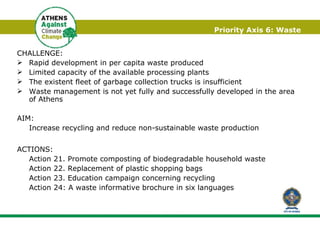
Priority Axis 6: Waste CHALLENGE:  Rapid development in per capita waste produced Limited capacity of the available processing plants  The existent fleet of garbage collection trucks is insufficient Waste management is not yet fully and successfully developed in the area of Athens AIM:  Increase recycling and reduce non-sustainable waste production ACTIONS: Action 21. Promote composting of biodegradable household waste Action 22. Replacement of plastic shopping bags Action 23. Education campaign concerning recycling Action 24: A waste informative brochure in six languages
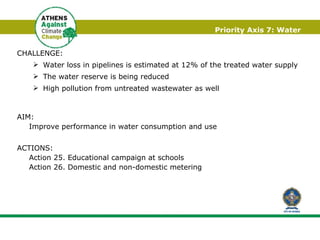
Priority Axis 7: Water CHALLENGE:  Water loss in pipelines is estimated at 12% of the treated water supply The water reserve is being reduced High pollution from untreated wastewater as well  AIM:  Improve performance in water consumption and use ACTIONS: Action 25. Educational campaign at schools Action 26. Domestic and non-domestic metering
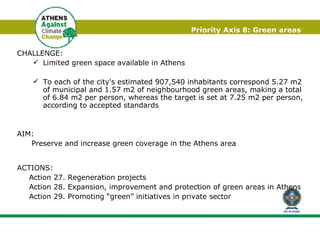
Priority Axis 8: Green areas CHALLENGE:  Limited green space available in Athens To each of the city's estimated 907,540 inhabitants correspond 5.27 m2 of municipal and 1.57 m2 of neighbourhood green areas, making a total of 6.84 m2 per person, whereas the target is set at 7.25 m2 per person, according to accepted standards AIM:    Preserve and increase green coverage in the Athens area ACTIONS: Action 27. Regeneration projects Action 28. Expansion, improvement and protection of green areas in Athens Action 29. Promoting “green” initiatives in private sector
Conclusion “ YOU HAVE TO BE THE CHANGE YOU WANT TO SEE” GANDHI
Thank You

Athens Against Climate Change

  • 1.
    Mr. Panagiotis Arkoumaneas[email_address] City of Athens
  • 2.
    Climate change andthe City of Athens About Athens Is the capital and largest city of Greece, dominates the Attica periphery. Climate conditions: Mediterranean climate Population: 900.000 Administrative limits: 38 km2 The greatest amounts of precipitation mainly occurring from mid-October to mid-April; any precipitation is sparse during summer and it generally takes the form of showers and/or thunderstorms. The highest level of precipitation is occurring during December and the lowest is occurring during August. The average water supply is 415.7 mm annually. Average annual temperature:19.30C
  • 3.
    Strategic Mission TheMunicipality of Athens recognizes the seriousness and complexity of climate change both as a global and a local issue. It aims to become a catalyst organisation for implementing and promoting sustainable development through direct management of its own activities, and the implementation of targeted initiatives within its established competencies through the implementation of specific measures, aiming to inform and guide through direct collaboration with other authorities For all these reasons Municipality of Athens has committed to elaborate and implement a Strategic Plan for tackling climate change
  • 4.
    Strategic Plan I mplementation Strategic plan implementation priorities have been defined according to the best practice guide of C40 initiative; Actions are divided into eight (8) priority axis and three (3) horizontal ones: Priority axis 1- Buildings 2- Energy 3- Lighting 4- Renewables 5- Transport 6- Waste 7- Water 8- Green areas Horizontal axes 1- Urban landscape planning 2- Green entrepreneurship 3- Supplement activities
  • 5.
    Priority Axis 1:Buildings CHALLENGE: High rates of energy consumption The energy consumed comes largely from non-renewable resources Harmful to the environment buildings within the municipality materials “ Urban Heat Island” effect AIM: Reduce Athens’ building stock carbon footprint ACTIONS: Action 1. Installation of photovoltaic panels Action 2. Eco-buildings Action 3. Green Building Program Action 4. Internet-based CO2 emissions calculator
  • 6.
    Priority Axis 2:Energy CHALLENGE: Low energy efficiency of municipal and other buildings Most Athenian households still rely on oil for central heating The significant percentage of buses, municipal vehicles and taxis that still run on diesel The extended use of non-efficient light bulbs for the external lighting of buildings and public spaces The limited pedestrian routes and almost no bicycle lanes The mere inexistence of green roofs and green balconies AIM: Increase performance in energy use across the municipality ACTIONS: Action 5. Expansion of natural gas use Action 6. Expansion of network of pedestrian routes Action 7. Lower municipality fees for energy- efficient houses Action 8. Reduce Home Energy Use
  • 7.
    Priority Axis 3:Lighting CHALLENGE: The energy consumption for the external lighting of public buildings and other buildings within the city area is considerable There is significant electricity consumption for the lighting of public areas and for traffic lights Rapidly developing light pollution, along with other kinds of pollution AIM: Reduce energy use for exterior lighting ACTIONS: Action 9. Replacing building light bulbs with LED Action 10. Installation of lighting management systems Action 11. Information campaign Action 12. Replacement of traffic lights Action 13. Replacing street lights bulbs
  • 8.
    Priority Axis 4:Renewables CHALLENGE: The use of renewable energy resources in the city of Athens is poorly developed, usually due to the long, complicated and expensive bureaucratic permit procedures. Lack of an integrated scheme which would incorporate the installation of renewable resource systems (e.g. photovoltaics) into the construction of new public and other buildings Strong reactions from citizens and often municipalities AIM: Increase renewables’ contribution to the Athens energy supply ACTIONS: Action 14. Expansion of photovoltaic system installation Action 15. Education campaign
  • 9.
    Priority Axis 5:Transport CHALLENGE: Absence of cycle lanes The public transport service is still inadequate and inefficient Almost half the vehicles utilised in public transport are classed as low emission Absence of eco-driving culture AIM: Reduce GHG emissions from Athens transport and transport-related energy use ACTIONS: Action 16. Establishment of a trans-municipal cycle lane network Action 17. Implementation of measures to improve the public transport Action 18. Upgrading the taxi fleet and motorcycle stock Action 19. Eco-Driving Action 20. Free parking space for “green” cars
  • 10.
    Priority Axis 6:Waste CHALLENGE: Rapid development in per capita waste produced Limited capacity of the available processing plants The existent fleet of garbage collection trucks is insufficient Waste management is not yet fully and successfully developed in the area of Athens AIM: Increase recycling and reduce non-sustainable waste production ACTIONS: Action 21. Promote composting of biodegradable household waste Action 22. Replacement of plastic shopping bags Action 23. Education campaign concerning recycling Action 24: A waste informative brochure in six languages
  • 11.
    Priority Axis 7:Water CHALLENGE: Water loss in pipelines is estimated at 12% of the treated water supply The water reserve is being reduced High pollution from untreated wastewater as well AIM: Improve performance in water consumption and use ACTIONS: Action 25. Educational campaign at schools Action 26. Domestic and non-domestic metering
  • 12.
    Priority Axis 8:Green areas CHALLENGE: Limited green space available in Athens To each of the city's estimated 907,540 inhabitants correspond 5.27 m2 of municipal and 1.57 m2 of neighbourhood green areas, making a total of 6.84 m2 per person, whereas the target is set at 7.25 m2 per person, according to accepted standards AIM: Preserve and increase green coverage in the Athens area ACTIONS: Action 27. Regeneration projects Action 28. Expansion, improvement and protection of green areas in Athens Action 29. Promoting “green” initiatives in private sector
  • 13.
    Conclusion “ YOUHAVE TO BE THE CHANGE YOU WANT TO SEE” GANDHI
  • 14.