

Colchicine for Post-operative Pericardial 
Effusion: The Post-Operative Pericardial Effusion 
(POPE-2) Study. 
A Multicenter, Double-blind, Randomized Trial 
P. Meurin1, S. Lelay-Kubas, B. Pierre, H. Pereira, B. Pavy, 
MC. Iliou, JL. Bussiere, H. Weber , JP. Beugin, T. Farrokhi, 
A.Bellemain-Appaix, L. Briota, JY. Tabet, 
for the French Society of Cardiology. 
ESC Barcelona 2014 
(1) Les Grands Prés, Villeneuve-Saint Denis. France 
Meurin
Disclosures 
 Concerning this study: no conflict of interest 
- All the authors/investigators worked for free 
- Main funding source: French Society of Cardiology 
- Mayoly-Spindler company provided the sudy’s drug 
and placebo 
 Other relationships with pharmaceutical companies: 
- Consultant for Servier 
- Research grant: Daïchi Sankyo 
Meurin
Background and 
Objectives 
Meurin
Post-Operative Pericardial Diseases 
 Before post-op day 7: Phase 1 
- Post-operative pericardial effusion (POPE): 50-80% 
patients 
• Early tamponades: haemopericardium: 0.5 to 1% of 
the patients 
 After post-op day 7: Phase 2 
- Post pericardiotomy syndrom (PPS): COPPS-11 and 2 
studies 
- Persisting moderate to large POPE: POPE-12 and 2 
studies 
(1) Meurin et al.POPE-1 Study. Ann Intern Med 2010. 
(2) Imazio et al.COPPS-1 Study. Eur heart J 2010 
Imazio M, (COPPS-1). Eur Heart J. 2010; 31:2749-54. (2) Meurin et al.POPE-1 Study. Ann Intern Meurin Med 2010; 152: 137-43
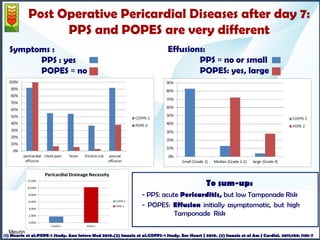
Post Operative Pericardial Diseases after day 7: 
PPS and POPES are very different 
Symptoms : 
PPS : yes 
POPES ≈ no 
Effusions: 
PPS ≈ no or small 
POPES: yes, large 
To sum-up: 
- PPS: acute Pericarditis, but low Tamponade Risk 
- POPES: Effusion initially asymptomatic, but high 
Tamponade Risk 
Meurin 
Meurin et al.POPE-1 Study. Ann Intern Med 2010.(2) Imazio et al.COPPS-1 Study. Eur heart J 2010. (3 )Imazio et al (1) Meurin et al.POPE-1 Study. Ann Intern Med 2010.(2) Imazio et al.COPPS-1 Study. Eur Heart J 2010. (3) Imazio et al Am J Ca Ardmio Jl. C20a1r1d;1io0l8. :2 1018131-7
Treatment of POPEs 
 Non Steroidal Anti Inflammatory Drugs (NSAIDs) are 
useless1 
 What about colchicine ? 
- Very efficient to treat acute pericarditis2 
• (Add-on NSAID or aspirin) 
- Efficient to prevent Post Pericardiotomy Syndrom3 
- Efficient to treat post operative pericardial effusions ? 
Meurin 
(1) Meurin et al. POPE-1 Study. Ann Intern Med 2010 ; (2) Imazio M; ICAP: A randomized trial of colchicine for acute pericarditis. N Engl J Med. 2013; 
369:1522-8 ; (3) Imazio M, (COPPS-1): Eur Heart J. 2010.
POPE-2 Study: Methods 
Meurin
POPE-2 Study: methods (1) 
 Objective: to assess whether colchicine was effective in 
reducing post operative pericardial effusion (POPE) 
volume. 
 Design: multicenter, randomized, double-blind, 
placebo-controlled study 
 Setting: Ten post operative cardiac rehabilitation 
centers (POCRC). 
 Patients: 197 patients at high risk of tamponade 
 Treatment administration: 14 days (colchicine or 
placebo) 
- Pts ≥ 70kg: 2.0 mg for the first day followed by a maintenance dose of 1 mg daily 
- Pts <70 kg 1 mg per day without a loading dose 
Meurin
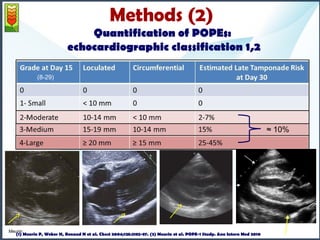
Methods (2) 
Quantification of POPEs: 
echocardiographic classification 1,2 
(8-29) 
(1) Meurin P, Weber H, Renaud N et al. Chest 2004;125:2182-87. (2) Meurin et al. POPE-1 Study. Ann Intern Med 2010 
≈ 10% 
Meurin
POPE-2 Study: Methods (3) 
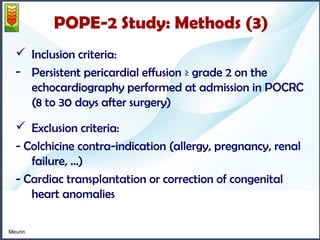
 Inclusion criteria: 
- Persistent pericardial effusion ≥ grade 2 on the 
echocardiography performed at admission in POCRC 
(8 to 30 days after surgery) 
 Exclusion criteria: 
- Colchicine contra-indication (allergy, pregnancy, renal 
failure, …) 
- Cardiac transplantation or correction of congenital 
heart anomalies 
Meurin
Methods (4) 
Quantification of POPEs Volume 
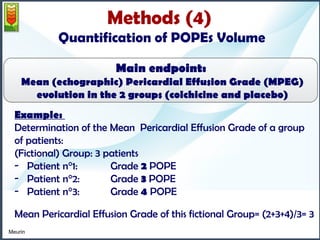
Main endpoint: 
Mean (echographic) Pericardial Effusion Grade (MPEG) 
evolution in the 2 groups (colchicine and placebo) 
Example: 
Determination of the Mean Pericardial Effusion Grade of a group 
of patients: 
(Fictional) Group: 3 patients 
- Patient n°1: Grade 2 POPE 
- Patient n°2: Grade 3 POPE 
- Patient n°3: Grade 4 POPE 
Mean Pericardial Effusion Grade of this fictional Group= (2+3+4)/3= 3 
Meurin
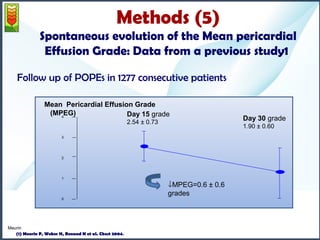
Methods (5) 
Spontaneous evolution of the Mean pericardial 
Effusion Grade: Data from a previous study1 
Follow up of POPEs in 1277 consecutive patients 
Mean Pericardial Effusion Grade 
(MPEG) Day 15 grade 
(1) Meurin P, Chest 2004;125: 2182E-8c7h. o 
4 
3 
2 
1 
0 
(1) Meurin P, Weber H, Renaud N et al. Chest 2004. 
2.54 ± 0.73 Day 30 grade 
1.90 ± 0.60 
¯MPEG=0.6 ± 0.6 
grades 
Meurin
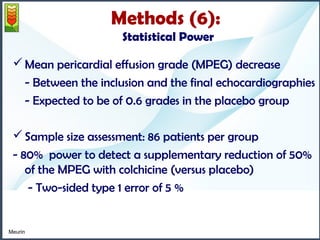
Methods (6): 
Statistical Power 
Mean pericardial effusion grade (MPEG) decrease 
- Between the inclusion and the final echocardiographies 
- Expected to be of 0.6 grades in the placebo group 
Sample size assessment: 86 patients per group 
- 80% power to detect a supplementary reduction of 50% 
of the MPEG with colchicine (versus placebo) 
- Two-sided type 1 error of 5 % 
Meurin
Results 
Meurin
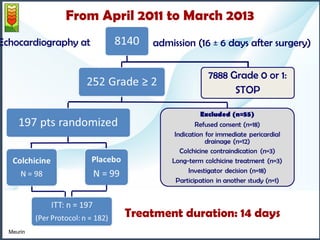
From April 2011 to March 2013 
Echocardiography at admission (16 ± 6 days after surgery) 
Treatment duration: 14 days 
Meurin
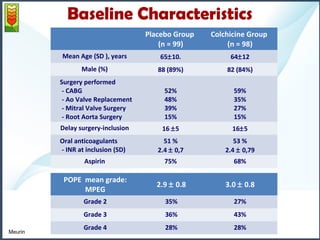
Baseline Characteristics 
Placebo Group 
(n = 99) 
Colchicine Group 
(n = 98) 
Mean Age (SD ), years 65±10. 64±12 
Male (%) 88 (89%) 82 (84%) 
Surgery performed 
- CABG 
- Ao Valve Replacement 
- Mitral Valve Surgery 
- Root Aorta Surgery 
52% 
48% 
39% 
15% 
59% 
35% 
27% 
15% 
Delay surgery-inclusion 16 ±5 16±5 
Oral anticoagulants 
- INR at inclusion (SD) 
51 % 
2.4 ± 0,7 
53 % 
2.4 ± 0,79 
Aspirin 75% 68% 
POPE mean grade: 
MPEG 
2.9 ± 0.8 3.0 ± 0.8 
Grade 2 35% 27% 
Grade 3 36% 43% 
Grade 4 28% 28% 
Meurin
Primary Endpoint: 
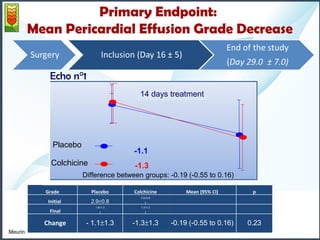
Mean Pericardial Effusion Grade Decrease 
4 
3 
2 
1 
Echo n°1 Echo n°2 
Placebo 
Colchicine 
14 days treatment 
-1.1 
-1.3 
5 Echo 
Grade Placebo Colchicine Mean (95% CI) p 
Initial 2.9±0.8 3.0±0.8 
) 
Final 
1.8±1.3 
) 
1.7±1.2 
) 
Change - 1.1±1.3 -1.3±1.3 -0.19 (-0.55 to 0.16) 0.23 
0 
Difference between groups: -0.19 (-0.55 to 0.16) 
Meurin
Secondary Endpoints 
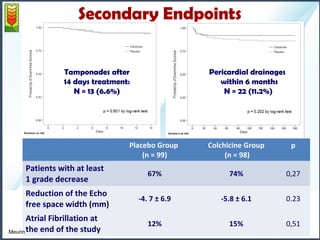
Tamponades after 
14 days treatment: 
N = 13 (6.6%) 
Pericardial drainages 
within 6 months 
N = 22 (11.2%) 
Placebo Group 
(n = 99) 
Colchicine Group 
(n = 98) 
p 
Patients with at least 
1 grade decrease 
67% 74% 0,27 
Reduction of the Echo 
free space width (mm) 
-4. 7 ± 6.9 -5.8 ± 6.1 0.23 
Atrial Fibrillation at 
the end of the study 
12% 15% 0,51 
Meurin
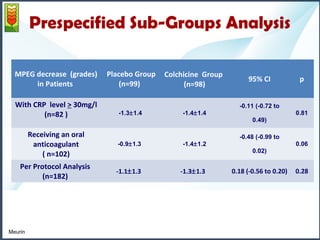
Prespecified Sub-Groups Analysis 
MPEG decrease (grades) 
in Patients 
Placebo Group 
(n=99) 
Colchicine Group 
(n=98) 
95% CI p 
With CRP level > 30mg/l 
(n=82 ) -1.3±1.4 -1.4±1.4 
-0.11 (-0.72 to 
0.49) 
0.81 
Receiving an oral 
anticoagulant 
( n=102) 
-0.9±1.3 -1.4±1.2 
-0.48 (-0.99 to 
0.02) 
0.06 
Per Protocol Analysis 
(n=182) 
-1.1±1.3 -1.3±1.3 0.18 (-0.56 to 0.20) 0.28 
Meurin
Conclusion: 
Moderate to large persisting (> 7 days) 
post operative pericardial effusion: 
What does this study add ? 
1- High risk patients: 11,5% reoperation within 6 months: 
- 6,6 % tamponades in the 2 following weeks 
- Another 5 % will require pericardial drainage within 6 months 
2- Colchicine administration seems to be useless 
[PS: NSAID administration seems to be useless (POPE-1 study)] 
Meurin
Thanks to 
POPE study investigators: 
• Les Grands Prés (CRCB): A Ben Driss, R Dumaine, A Grosdemouge, P Meurin, N Renaud, JY Tabet, H Weber. 
• HopitalCorentin Celton: MC Iliou. P Cristofini, Devaux N, Sissman J. 
• Hopital Bligny: T Farrokhi, S Corone, S Hardy, C Randolph, V Beaslay. 
• IRIS: B Pierre, JL Genoud, F Boucher, L Pacini, H Talpin. 
• Centre de Réadaptation Bois Gibert: S Le Lay-kubas, C Voyer, C Monpère. 
• Centre Hospitalier Loire Vendée Océan: B Pavy, A Tisseau. 
• Clinique de la Mitterie: J De Monte, JP Beuvin, C Defrance, ME Lopes. 
• Centre Dieuleufit santé: L Briota, R Brion, S Devaud, C Kugler-Chambron, R Auberger. 
• La Maison du Mineur: A Bellemain-appaix, H Chevassus-Lescaut. 
• Clinique de châtillon: JL Bussiere. 
 Patients 
Meurin

Meurin pope 2-esc-september 2014

  • 1.
    Colchicine for Post-operativePericardial Effusion: The Post-Operative Pericardial Effusion (POPE-2) Study. A Multicenter, Double-blind, Randomized Trial P. Meurin1, S. Lelay-Kubas, B. Pierre, H. Pereira, B. Pavy, MC. Iliou, JL. Bussiere, H. Weber , JP. Beugin, T. Farrokhi, A.Bellemain-Appaix, L. Briota, JY. Tabet, for the French Society of Cardiology. ESC Barcelona 2014 (1) Les Grands Prés, Villeneuve-Saint Denis. France Meurin
  • 2.
    Disclosures  Concerningthis study: no conflict of interest - All the authors/investigators worked for free - Main funding source: French Society of Cardiology - Mayoly-Spindler company provided the sudy’s drug and placebo  Other relationships with pharmaceutical companies: - Consultant for Servier - Research grant: Daïchi Sankyo Meurin
  • 3.
  • 4.
    Post-Operative Pericardial Diseases  Before post-op day 7: Phase 1 - Post-operative pericardial effusion (POPE): 50-80% patients • Early tamponades: haemopericardium: 0.5 to 1% of the patients  After post-op day 7: Phase 2 - Post pericardiotomy syndrom (PPS): COPPS-11 and 2 studies - Persisting moderate to large POPE: POPE-12 and 2 studies (1) Meurin et al.POPE-1 Study. Ann Intern Med 2010. (2) Imazio et al.COPPS-1 Study. Eur heart J 2010 Imazio M, (COPPS-1). Eur Heart J. 2010; 31:2749-54. (2) Meurin et al.POPE-1 Study. Ann Intern Meurin Med 2010; 152: 137-43
  • 5.
    Post Operative PericardialDiseases after day 7: PPS and POPES are very different Symptoms : PPS : yes POPES ≈ no Effusions: PPS ≈ no or small POPES: yes, large To sum-up: - PPS: acute Pericarditis, but low Tamponade Risk - POPES: Effusion initially asymptomatic, but high Tamponade Risk Meurin Meurin et al.POPE-1 Study. Ann Intern Med 2010.(2) Imazio et al.COPPS-1 Study. Eur heart J 2010. (3 )Imazio et al (1) Meurin et al.POPE-1 Study. Ann Intern Med 2010.(2) Imazio et al.COPPS-1 Study. Eur Heart J 2010. (3) Imazio et al Am J Ca Ardmio Jl. C20a1r1d;1io0l8. :2 1018131-7
  • 6.
    Treatment of POPEs  Non Steroidal Anti Inflammatory Drugs (NSAIDs) are useless1  What about colchicine ? - Very efficient to treat acute pericarditis2 • (Add-on NSAID or aspirin) - Efficient to prevent Post Pericardiotomy Syndrom3 - Efficient to treat post operative pericardial effusions ? Meurin (1) Meurin et al. POPE-1 Study. Ann Intern Med 2010 ; (2) Imazio M; ICAP: A randomized trial of colchicine for acute pericarditis. N Engl J Med. 2013; 369:1522-8 ; (3) Imazio M, (COPPS-1): Eur Heart J. 2010.
  • 7.
  • 8.
    POPE-2 Study: methods(1)  Objective: to assess whether colchicine was effective in reducing post operative pericardial effusion (POPE) volume.  Design: multicenter, randomized, double-blind, placebo-controlled study  Setting: Ten post operative cardiac rehabilitation centers (POCRC).  Patients: 197 patients at high risk of tamponade  Treatment administration: 14 days (colchicine or placebo) - Pts ≥ 70kg: 2.0 mg for the first day followed by a maintenance dose of 1 mg daily - Pts <70 kg 1 mg per day without a loading dose Meurin
  • 9.
    Methods (2) Quantificationof POPEs: echocardiographic classification 1,2 (8-29) (1) Meurin P, Weber H, Renaud N et al. Chest 2004;125:2182-87. (2) Meurin et al. POPE-1 Study. Ann Intern Med 2010 ≈ 10% Meurin
  • 10.
    POPE-2 Study: Methods(3)  Inclusion criteria: - Persistent pericardial effusion ≥ grade 2 on the echocardiography performed at admission in POCRC (8 to 30 days after surgery)  Exclusion criteria: - Colchicine contra-indication (allergy, pregnancy, renal failure, …) - Cardiac transplantation or correction of congenital heart anomalies Meurin
  • 11.
    Methods (4) Quantificationof POPEs Volume Main endpoint: Mean (echographic) Pericardial Effusion Grade (MPEG) evolution in the 2 groups (colchicine and placebo) Example: Determination of the Mean Pericardial Effusion Grade of a group of patients: (Fictional) Group: 3 patients - Patient n°1: Grade 2 POPE - Patient n°2: Grade 3 POPE - Patient n°3: Grade 4 POPE Mean Pericardial Effusion Grade of this fictional Group= (2+3+4)/3= 3 Meurin
  • 12.
    Methods (5) Spontaneousevolution of the Mean pericardial Effusion Grade: Data from a previous study1 Follow up of POPEs in 1277 consecutive patients Mean Pericardial Effusion Grade (MPEG) Day 15 grade (1) Meurin P, Chest 2004;125: 2182E-8c7h. o 4 3 2 1 0 (1) Meurin P, Weber H, Renaud N et al. Chest 2004. 2.54 ± 0.73 Day 30 grade 1.90 ± 0.60 ¯MPEG=0.6 ± 0.6 grades Meurin
  • 13.
    Methods (6): StatisticalPower Mean pericardial effusion grade (MPEG) decrease - Between the inclusion and the final echocardiographies - Expected to be of 0.6 grades in the placebo group Sample size assessment: 86 patients per group - 80% power to detect a supplementary reduction of 50% of the MPEG with colchicine (versus placebo) - Two-sided type 1 error of 5 % Meurin
  • 14.
  • 15.
    From April 2011to March 2013 Echocardiography at admission (16 ± 6 days after surgery) Treatment duration: 14 days Meurin
  • 16.
    Baseline Characteristics PlaceboGroup (n = 99) Colchicine Group (n = 98) Mean Age (SD ), years 65±10. 64±12 Male (%) 88 (89%) 82 (84%) Surgery performed - CABG - Ao Valve Replacement - Mitral Valve Surgery - Root Aorta Surgery 52% 48% 39% 15% 59% 35% 27% 15% Delay surgery-inclusion 16 ±5 16±5 Oral anticoagulants - INR at inclusion (SD) 51 % 2.4 ± 0,7 53 % 2.4 ± 0,79 Aspirin 75% 68% POPE mean grade: MPEG 2.9 ± 0.8 3.0 ± 0.8 Grade 2 35% 27% Grade 3 36% 43% Grade 4 28% 28% Meurin
  • 17.
    Primary Endpoint: MeanPericardial Effusion Grade Decrease 4 3 2 1 Echo n°1 Echo n°2 Placebo Colchicine 14 days treatment -1.1 -1.3 5 Echo Grade Placebo Colchicine Mean (95% CI) p Initial 2.9±0.8 3.0±0.8 ) Final 1.8±1.3 ) 1.7±1.2 ) Change - 1.1±1.3 -1.3±1.3 -0.19 (-0.55 to 0.16) 0.23 0 Difference between groups: -0.19 (-0.55 to 0.16) Meurin
  • 18.
    Secondary Endpoints Tamponadesafter 14 days treatment: N = 13 (6.6%) Pericardial drainages within 6 months N = 22 (11.2%) Placebo Group (n = 99) Colchicine Group (n = 98) p Patients with at least 1 grade decrease 67% 74% 0,27 Reduction of the Echo free space width (mm) -4. 7 ± 6.9 -5.8 ± 6.1 0.23 Atrial Fibrillation at the end of the study 12% 15% 0,51 Meurin
  • 19.
    Prespecified Sub-Groups Analysis MPEG decrease (grades) in Patients Placebo Group (n=99) Colchicine Group (n=98) 95% CI p With CRP level > 30mg/l (n=82 ) -1.3±1.4 -1.4±1.4 -0.11 (-0.72 to 0.49) 0.81 Receiving an oral anticoagulant ( n=102) -0.9±1.3 -1.4±1.2 -0.48 (-0.99 to 0.02) 0.06 Per Protocol Analysis (n=182) -1.1±1.3 -1.3±1.3 0.18 (-0.56 to 0.20) 0.28 Meurin
  • 20.
    Conclusion: Moderate tolarge persisting (> 7 days) post operative pericardial effusion: What does this study add ? 1- High risk patients: 11,5% reoperation within 6 months: - 6,6 % tamponades in the 2 following weeks - Another 5 % will require pericardial drainage within 6 months 2- Colchicine administration seems to be useless [PS: NSAID administration seems to be useless (POPE-1 study)] Meurin
  • 21.
    Thanks to POPEstudy investigators: • Les Grands Prés (CRCB): A Ben Driss, R Dumaine, A Grosdemouge, P Meurin, N Renaud, JY Tabet, H Weber. • HopitalCorentin Celton: MC Iliou. P Cristofini, Devaux N, Sissman J. • Hopital Bligny: T Farrokhi, S Corone, S Hardy, C Randolph, V Beaslay. • IRIS: B Pierre, JL Genoud, F Boucher, L Pacini, H Talpin. • Centre de Réadaptation Bois Gibert: S Le Lay-kubas, C Voyer, C Monpère. • Centre Hospitalier Loire Vendée Océan: B Pavy, A Tisseau. • Clinique de la Mitterie: J De Monte, JP Beuvin, C Defrance, ME Lopes. • Centre Dieuleufit santé: L Briota, R Brion, S Devaud, C Kugler-Chambron, R Auberger. • La Maison du Mineur: A Bellemain-appaix, H Chevassus-Lescaut. • Clinique de châtillon: JL Bussiere.  Patients Meurin