

Cardiac Rehabilitation after 
Mitral Valve Repair 
Ph Meurin, MC Iliou, A Bendriss, 
B Pierre, S Corone ,P Cristofini et JY 
Tabet 
On behalf of the Working group of 
Cardiac Rehabilitation 
of the French Society of Cardiology
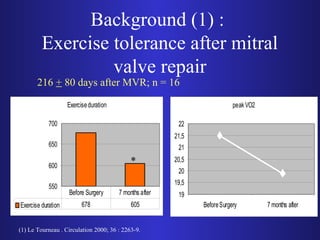
Background (1) : 
Exercise tolerance after mitral 
valve repair 
Exercise duration 
700 
650 
600 
550 
Before Surgery 7 months after 
Exercise duration 678 605 
(1) Le Tourneau . Circulation 2000; 36 : 2263-9. 
peak VO2 
22 
21,5 
21 
20,5 
20 
19,5 
19 
Before Surgery 7 months after 
216 + 80 days after MVR; n = 16 
*
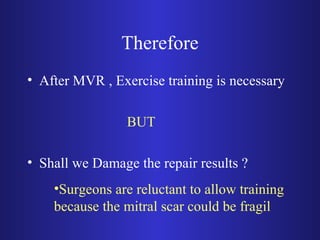
Therefore 
• After MVR , Exercise training is necessary 
BUT 
• Shall we Damage the repair results ? 
•Surgeons are reluctant to allow training 
because the mitral scar could be fragil
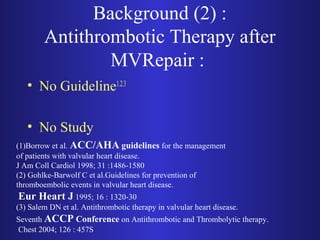
Background (2) : 
Antithrombotic Therapy after 
MVRepair : 
• No Guideline1.2.3 
• No Study 
(1)Borrow et al. ACC/AHA guidelines for the management 
of patients with valvular heart disease. 
J Am Coll Cardiol 1998; 31 :1486-1580 
(2) Gohlke-Barwolf C et al.Guidelines for prevention of 
thromboembolic events in valvular heart disease. 
Eur Heart J 1995; 16 : 1320-30 
(3) Salem DN et al. Antithrombotic therapy in valvular heart disease. 
Seventh ACCP Conference on Antithrombotic and Thrombolytic therapy. 
Chest 2004; 126 : 457S
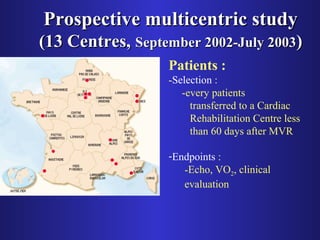
PPrroossppeeccttiivvee mmuullttiicceennttrriicc ssttuuddyy 
((1133 CCeennttrreess,, SSeepptteemmbbeerr 22000022--JJuullyy 22000033)) 
Patients : 
-Selection : 
-every patients 
transferred to a Cardiac 
Rehabilitation Centre less 
than 60 days after MVR 
-Endpoints : 
-Echo, VO2, clinical 
evaluation
Results
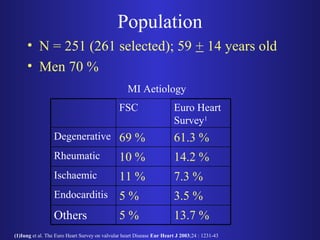
Population 
• N = 251 (261 selected); 59 + 14 years old 
• Men 70 % 
MI Aetiology 
Euro Heart 
Survey1 
FSC 
Degenerative 69 % 61.3 % 
Rheumatic 10 % 14.2 % 
Ischaemic 11 % 7.3 % 
Endocarditis 5 % 3.5 % 
Others 5 % 13.7 % 
(1)Iung et al. The Euro Heart Survey on valvular heart Disease Eur Heart J 2003;24 : 1231-43
60% 
50% 
40% 
30% 
20% 
10% 
0% 
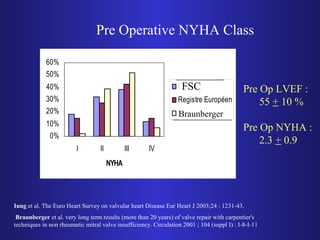
Pre Operative NYHA Class 
I II III IV 
NYHA 
REPLA 
Registre Européen 
Braunberger 
Pre Op LVEF : 
Iung et al. The Euro Heart Survey on valvular heart Disease Eur Heart J 2003;24 : 1231-43. 
Braunberger et al. very long term results (more than 20 years) of valve repair with carpentier's 
techniques in non rheumatic mitral valve insufficiency. Circulation 2001 ; 104 (suppl I) : I-8-I-11 
55 + 10 % 
Pre Op NYHA : 
2.3 + 0.9 
FSC
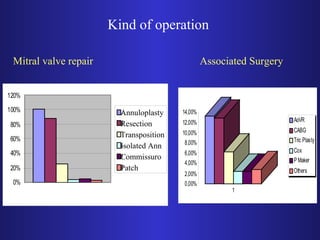
Mitral valve repair Associated Surgery 
120% 
100% 
80% 
60% 
40% 
20% 
0% 
1 
Kind of operation 
Anneau 
Resec 
Transpo 
Anneau seul 
Commissurotomie 
Patch 
Annuloplasty 
Resection 
Transposition 
Isolated Ann 
Commissuro 
Patch 
14,00% 
12,00% 
10,00% 
8,00% 
6,00% 
4,00% 
2,00% 
0,00% 
1 
AoVR 
CABG 
Tric Plasty 
Cox 
P Maker 
Others
Thromboembolic Events
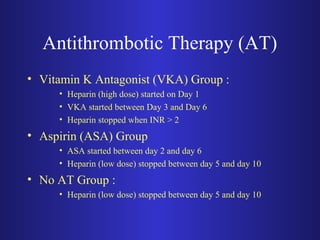
Antithrombotic Therapy (AT) 
• Vitamin K Antagonist (VKA) Group : 
• Heparin (high dose) started on Day 1 
• VKA started between Day 3 and Day 6 
• Heparin stopped when INR > 2 
• Aspirin (ASA) Group 
• ASA started between day 2 and day 6 
• Heparin (low dose) stopped between day 5 and day 10 
• No AT Group : 
• Heparin (low dose) stopped between day 5 and day 10
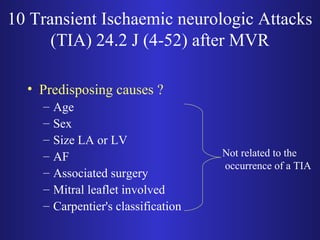
10 Transient Ischaemic neurologic Attacks 
(TIA) 24.2 J (4-52) after MVR 
• Predisposing causes ? 
– Age 
– Sex 
– Size LA or LV 
– AF 
– Associated surgery 
– Mitral leaflet involved 
– Carpentier's classification 
Not related to the 
occurrence of a TIA
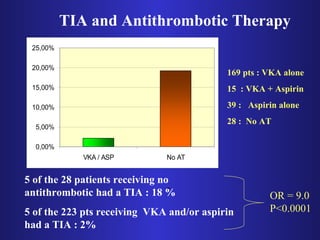
TIA and Antithrombotic Therapy 
- 
169 pts : VKA alone 
15 : VKA + Aspirin 
39 : Aspirin alone 
28 : No AT 
25,00% 
20,00% 
15,00% 
10,00% 
5,00% 
5 of the 28 patients receiving no 
antithrombotic had a TIA : 18 % 
5 of the 223 pts receiving VKA and/or aspirin 
had a TIA : 2% 
OR = 9.0 
P<0.0001 
0,00% 
VKA / ASP No AT
The real question : is an 
Antithrombotic therapy 
necessary after MV repair, 
even in patients in whom choice 
of AT is not influenced 
by a concomitant pathology ?
Population where the choice of 
AT is actually open 
• After excluding patients in whom AT 
indication was modified by a concomitant 
pathology 
– Concomitant surgery 
• AoVR, CABG … 
– Pre or post operative AF 
•Population available for the study n= 143
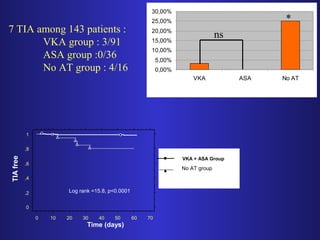
7 TIA among 143 patients : 
30,00% 
25,00% 
20,00% 
VKA group : 3/91 
ASA group :0/36 
No AT group : 4/16 * 
* 
* 
15,00% 
10,00% 
5,00% 
0,00% 
VKA ASA No AT 
1 
,8 
,6 
,4 
. 0 10 20 30 40 50 60 70 
,2 
0 
Time (days) 
VKA + ASA Group 
No AT group 
Log rank =15.8, p<0.0001 
TIA free 
ns
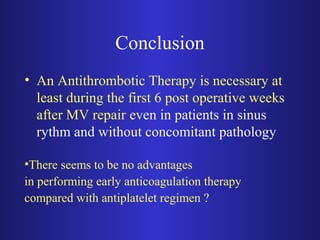
Conclusion 
• An Antithrombotic Therapy is necessary at 
least during the first 6 post operative weeks 
after MV repair even in patients in sinus 
rythm and without concomitant pathology 
•There seems to be no advantages 
in performing early anticoagulation therapy 
compared with antiplatelet regimen ?
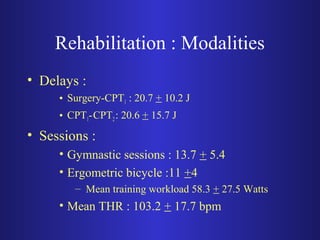
Rehabilitation : Modalities 
• Delays : 
• Surgery-CPT1 : 20.7 + 10.2 J 
• CPT1- CPT2 : 20.6 + 15.7 J 
• Sessions : 
• Gymnastic sessions : 13.7 + 5.4 
• Ergometric bicycle :11 +4 
– Mean training workload 58.3 + 27.5 Watts 
• Mean THR : 103.2 + 17.7 bpm
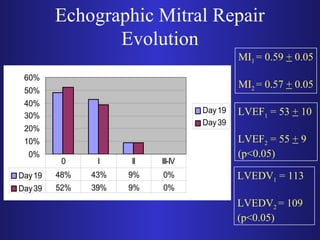
Echographic Mitral Repair 
Evolution 
MI1 = 0.59 + 0.05 
MI2 = 0.57 + 0.05 
60% 
50% 
40% 
30% 
20% 
10% 
0% 
Day 19 
Day 39 
0 I II III-IV 
Day 19 48% 43% 9% 0% 
Day 39 52% 39% 9% 0% 
LVEF1 = 53 + 10 
LVEF2 = 55 + 9 
(p<0.05) 
LVEDV1 = 113 
LVEDV2 = 109 
(p<0.05)
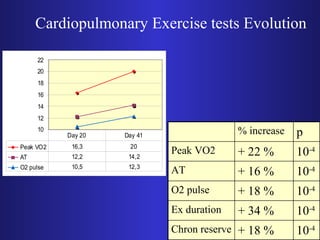
Cardiopulmonary Exercise tests Evolution 
22 
20 
18 
16 
14 
12 
10 
Day 20 Day 41 
Peak VO2 16,3 20 
AT 12,2 14,2 
O2 pulse 10,5 12,3 
% increase p 
Peak VO2 + 22 % 10-4 
AT + 16 % 10-4 
O2 pulse + 18 % 10-4 
Ex duration + 34 % 10-4 
Chron reserve + 18 % 10-4
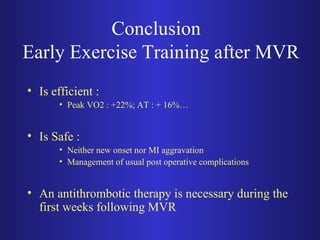
Conclusion 
Early Exercise Training after MVR 
• Is efficient : 
• Peak VO2 : +22%; AT : + 16%… 
• Is Safe : 
• Neither new onset nor MI aggravation 
• Management of usual post operative complications 
• An antithrombotic therapy is necessary during the 
first weeks following MVR

exercise training after mitral valve repair

  • 1.
    Cardiac Rehabilitation after Mitral Valve Repair Ph Meurin, MC Iliou, A Bendriss, B Pierre, S Corone ,P Cristofini et JY Tabet On behalf of the Working group of Cardiac Rehabilitation of the French Society of Cardiology
  • 2.
    Background (1) : Exercise tolerance after mitral valve repair Exercise duration 700 650 600 550 Before Surgery 7 months after Exercise duration 678 605 (1) Le Tourneau . Circulation 2000; 36 : 2263-9. peak VO2 22 21,5 21 20,5 20 19,5 19 Before Surgery 7 months after 216 + 80 days after MVR; n = 16 *
  • 3.
    Therefore • AfterMVR , Exercise training is necessary BUT • Shall we Damage the repair results ? •Surgeons are reluctant to allow training because the mitral scar could be fragil
  • 4.
    Background (2) : Antithrombotic Therapy after MVRepair : • No Guideline1.2.3 • No Study (1)Borrow et al. ACC/AHA guidelines for the management of patients with valvular heart disease. J Am Coll Cardiol 1998; 31 :1486-1580 (2) Gohlke-Barwolf C et al.Guidelines for prevention of thromboembolic events in valvular heart disease. Eur Heart J 1995; 16 : 1320-30 (3) Salem DN et al. Antithrombotic therapy in valvular heart disease. Seventh ACCP Conference on Antithrombotic and Thrombolytic therapy. Chest 2004; 126 : 457S
  • 5.
    PPrroossppeeccttiivvee mmuullttiicceennttrriicc ssttuuddyy ((1133 CCeennttrreess,, SSeepptteemmbbeerr 22000022--JJuullyy 22000033)) Patients : -Selection : -every patients transferred to a Cardiac Rehabilitation Centre less than 60 days after MVR -Endpoints : -Echo, VO2, clinical evaluation
  • 6.
  • 7.
    Population • N= 251 (261 selected); 59 + 14 years old • Men 70 % MI Aetiology Euro Heart Survey1 FSC Degenerative 69 % 61.3 % Rheumatic 10 % 14.2 % Ischaemic 11 % 7.3 % Endocarditis 5 % 3.5 % Others 5 % 13.7 % (1)Iung et al. The Euro Heart Survey on valvular heart Disease Eur Heart J 2003;24 : 1231-43
  • 8.
    60% 50% 40% 30% 20% 10% 0% Pre Operative NYHA Class I II III IV NYHA REPLA Registre Européen Braunberger Pre Op LVEF : Iung et al. The Euro Heart Survey on valvular heart Disease Eur Heart J 2003;24 : 1231-43. Braunberger et al. very long term results (more than 20 years) of valve repair with carpentier's techniques in non rheumatic mitral valve insufficiency. Circulation 2001 ; 104 (suppl I) : I-8-I-11 55 + 10 % Pre Op NYHA : 2.3 + 0.9 FSC
  • 9.
    Mitral valve repairAssociated Surgery 120% 100% 80% 60% 40% 20% 0% 1 Kind of operation Anneau Resec Transpo Anneau seul Commissurotomie Patch Annuloplasty Resection Transposition Isolated Ann Commissuro Patch 14,00% 12,00% 10,00% 8,00% 6,00% 4,00% 2,00% 0,00% 1 AoVR CABG Tric Plasty Cox P Maker Others
  • 10.
  • 11.
    Antithrombotic Therapy (AT) • Vitamin K Antagonist (VKA) Group : • Heparin (high dose) started on Day 1 • VKA started between Day 3 and Day 6 • Heparin stopped when INR > 2 • Aspirin (ASA) Group • ASA started between day 2 and day 6 • Heparin (low dose) stopped between day 5 and day 10 • No AT Group : • Heparin (low dose) stopped between day 5 and day 10
  • 12.
    10 Transient Ischaemicneurologic Attacks (TIA) 24.2 J (4-52) after MVR • Predisposing causes ? – Age – Sex – Size LA or LV – AF – Associated surgery – Mitral leaflet involved – Carpentier's classification Not related to the occurrence of a TIA
  • 13.
    TIA and AntithromboticTherapy - 169 pts : VKA alone 15 : VKA + Aspirin 39 : Aspirin alone 28 : No AT 25,00% 20,00% 15,00% 10,00% 5,00% 5 of the 28 patients receiving no antithrombotic had a TIA : 18 % 5 of the 223 pts receiving VKA and/or aspirin had a TIA : 2% OR = 9.0 P<0.0001 0,00% VKA / ASP No AT
  • 14.
    The real question: is an Antithrombotic therapy necessary after MV repair, even in patients in whom choice of AT is not influenced by a concomitant pathology ?
  • 15.
    Population where thechoice of AT is actually open • After excluding patients in whom AT indication was modified by a concomitant pathology – Concomitant surgery • AoVR, CABG … – Pre or post operative AF •Population available for the study n= 143
  • 16.
    7 TIA among143 patients : 30,00% 25,00% 20,00% VKA group : 3/91 ASA group :0/36 No AT group : 4/16 * * * 15,00% 10,00% 5,00% 0,00% VKA ASA No AT 1 ,8 ,6 ,4 . 0 10 20 30 40 50 60 70 ,2 0 Time (days) VKA + ASA Group No AT group Log rank =15.8, p<0.0001 TIA free ns
  • 17.
    Conclusion • AnAntithrombotic Therapy is necessary at least during the first 6 post operative weeks after MV repair even in patients in sinus rythm and without concomitant pathology •There seems to be no advantages in performing early anticoagulation therapy compared with antiplatelet regimen ?
  • 18.
    Rehabilitation : Modalities • Delays : • Surgery-CPT1 : 20.7 + 10.2 J • CPT1- CPT2 : 20.6 + 15.7 J • Sessions : • Gymnastic sessions : 13.7 + 5.4 • Ergometric bicycle :11 +4 – Mean training workload 58.3 + 27.5 Watts • Mean THR : 103.2 + 17.7 bpm
  • 19.
    Echographic Mitral Repair Evolution MI1 = 0.59 + 0.05 MI2 = 0.57 + 0.05 60% 50% 40% 30% 20% 10% 0% Day 19 Day 39 0 I II III-IV Day 19 48% 43% 9% 0% Day 39 52% 39% 9% 0% LVEF1 = 53 + 10 LVEF2 = 55 + 9 (p<0.05) LVEDV1 = 113 LVEDV2 = 109 (p<0.05)
  • 20.
    Cardiopulmonary Exercise testsEvolution 22 20 18 16 14 12 10 Day 20 Day 41 Peak VO2 16,3 20 AT 12,2 14,2 O2 pulse 10,5 12,3 % increase p Peak VO2 + 22 % 10-4 AT + 16 % 10-4 O2 pulse + 18 % 10-4 Ex duration + 34 % 10-4 Chron reserve + 18 % 10-4
  • 21.
    Conclusion Early ExerciseTraining after MVR • Is efficient : • Peak VO2 : +22%; AT : + 16%… • Is Safe : • Neither new onset nor MI aggravation • Management of usual post operative complications • An antithrombotic therapy is necessary during the first weeks following MVR