Improve Outcome in Major
Abdominal Surgery with ProAQT

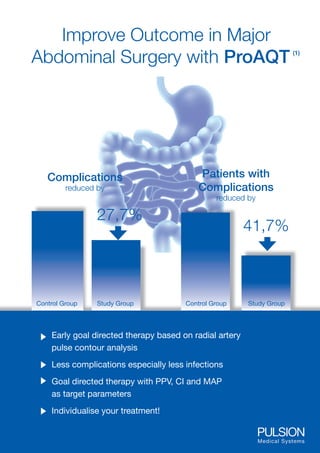
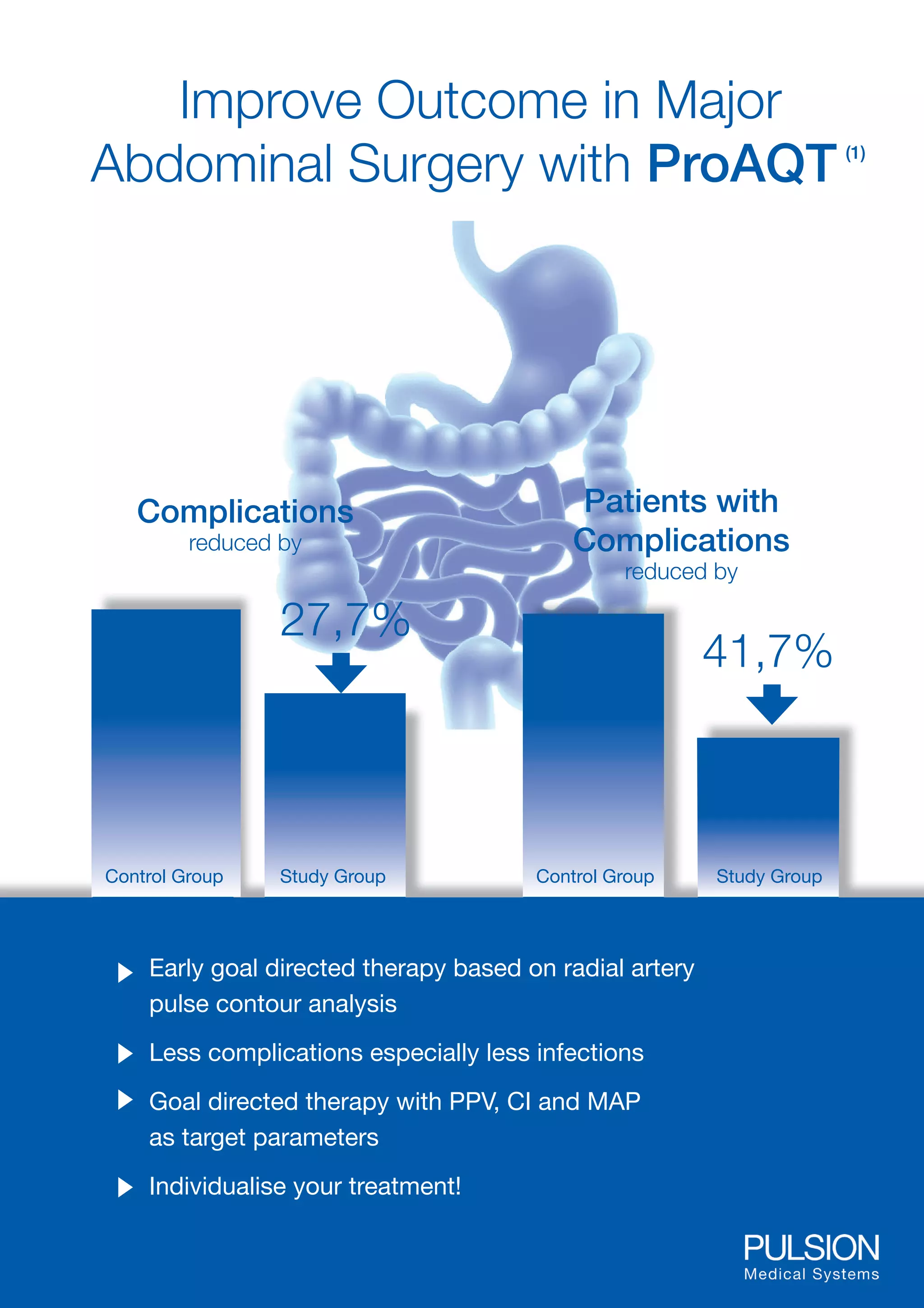
Complications
reduced by

27,7%

Control Group

Study Group

Patients with
Complications
reduced by

41,7%

Control Group

Early goal directed therapy based on radial artery
pulse contour analysis
Less complications especially less infections
Goal directed therapy with PPV, CI and MAP
as target parameters
Individualise your treatment!

Study Group

(1)
Goal Directed Therapy (GDT)

– A proven concept for outcome optimisation
In 1988 Shoemaker developed the first principles of goal directed therapy and its superiority regarding
outcome(2). This concept has been adopted ever since and new perioperative indications such as general, abdominal, cardiac, orthopaedic surgery have evolved. Improved outcome through GDT was proven in several
publications.

Benefits of GDT
*

A meta-analysis of Gurgel et al. analysed the impact of
GDT on mortality reduction in high-risk surgeries.
• Over all three defined mortality subgroups: Reduction of mortality by 33% in the GDT group(3).

• Surgical procedures with a mortality from 5% to 20%
in the control group: Reduction of mortality by 35%(4).

reduced
up to

• Surgical procedures with mortality > 20% in the control group: Reduction of mortality by 68%(3).

A meta-analysis of Hamilton et al. and Dalfino et al. analysed the impact of GDT on complications

reduced
by

• In general GDT resulted in a decline of complications
by 56% compared to the control group(5).

• Especially the numbers of infections were reduced
significantly by 60%(6).

A strong cochrane review of Grocott et al. analysed the
impact of GDT on Length of Stay (LoS) (7).

• Postoperative ICU stay: mean reduction by 0.45 days,

reduced
by

• Postoperative hospital stay: mean reduction by 1.16
days

Study or Subgroup

Odds Ratio
M-H, Fixed, 95% CI

Bishop, 1995 (26)

0.38 [0.16, 0.90]

Chytra, 2007(30)

0.69 [0.31, 1.52]

Boyd, 1993 (29)

Fleming, 1992 (32)
Lobo, 2000 (17)
Lobo, 2006 (35)

Lopes, 2007 (36)

Shoemaker, 1998 (4)
Shultz, 1985 (40)

*Forest plot: Comparison of GDT vs.
conventional treatment in surgical
procedures with a mortality > 20%(3)

Odds Ratio
M-H, Fixed, 95% CI

Total (95% CI)

0.21 [0.06, 0.79]
0.41 [0.14, 1.15]
0.19 [0.04, 0.88]
0.22 [0.04, 1.21]
0.29 [0.05, 1.80]
0.07 [0.01, 0.63]
0.07 [0.01, 0.61]
0.32 [0.21, 0.47]

0.1
0.2
0.5
Faverous experimental

1

2

5
10
Faverous control
High Risk Abdominal Surgery
Benefits most from GDT
Despite high standards in surgical and
anaesthesiological care in Europe, the
perioperative mortality rate is still higher
than expected(8).

High blood loss (> 20%) and volume shifts during
the procedure can result in hypo- or hypervolaemia

8
6
4
2
0

6,7

Oesophagectomy

•

10

Gastrectomy

Complex procedures with high-risk of intraand post-op complications

11,8

12

Colectomy

Long surgery time (>120 min)

•

14
Mortality [ % ]

•

15,1

16

Mortality rates for procedures in abdominal surgery, 1999 (9)

PulsioFlex – Your navigator in perioperative haemodynamic management
ProAQT

CeVOX

Radial arterial trend monitoring of
Cardiac Index - simply attached to
an arterial line

Central venous oxygen
saturation - simply attached to
a standard CVC

Parameters:

Parameters:
•

Cardiac Output:

CITrend

•

Volume responsiveness:

SVV, PPV

•

Afterload:

SVRI, MAP

•

Cardiac function:

dPmx, CPI

•

Central venous oxygenation

ScvO2

Oxygenation: DO2, VO2, O2ER (ProAQT combined with CeVOX)
1.
2.
3.
4.
5.
6.
7.
8.
9.

Salzwedel C et al., Perioperative goal-directed hemodynamic therapy based on radial arterial pulse pressure variation and continuous cardiac index trending reduces postoperative
complications after major abdominal surgery: a multi-center, prospective, randomized study. Crit Care 2013; 17(5): R191.
Shoemaker WC et al., Prospective trial of supranormal values of survivors as therapeutic goals in high-risk surgical patients. Chest 1988; 94(6): 1176-86.

Gurgel ST & do Nascimento P, Maintaining tissue perfusion in high-risk surgical patients: a systematic review of randomized clinical trials. Anesth Analg 2011; 112(6): 1384-91.
Cecconi M et al., Clinical review: Goal-directed therapy-what is the evidence in surgical patients? The effect on different risk groups. Crit Care 2013; 17(2): 209.
Rhodes A et al., Goal-directed therapy in high-risk surgical patients: a 15-year follow-up study. Intensive Care Med 2010; 36(8): 1327-1332.

Dalfino L et al., Haemodynamic goal-directed therapy and postoperative infections: earlier is better. A systematic review and meta-analysis. Crit Care 2011; 15(3): R154.

Grocott MP et al., Perioperative increase in global blood flow to explicit defined goals and outcomes after surgery: a Cochrane Systematic Review. Br J Anaesth 2013; 111: 535-48.
Pearse RM et al., Mortality after surgery in Europe: a 7 day cohort study. Lancet 2012; 380: 1059-1065.

Goodney PP et al., Is Surgery Getting Safer? National Trends in Operative Mortality. J Am Coll Surg 2002; 195: 219-27.
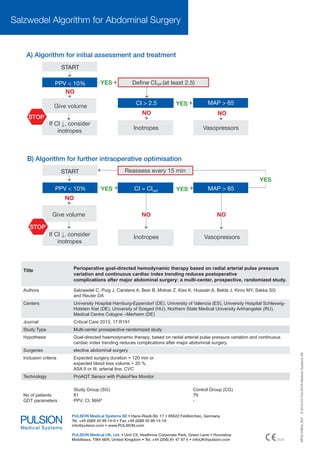
Salzwedel Algorithm for Abdominal Surgery

A) Algorithm for initial assessment and treatment
START
PPV < 10%
NO

YES

Define CIopt (at least 2.5)
CI > 2.5

Give volume
STOP

NO

If CI ↓, consider
inotropes

YES

Inotropes

MAP > 65
NO
Vasopressors

B) Algorithm for further intraoperative optimisation
Reassess every 15 min

START
PPV < 10%
NO

YES

CI = CIopt

YES

MAP > 65

Give volume
STOP

NO

NO

If CI ↓, consider
inotropes

Inotropes

YES

Vasopressors

Perioperative goal-directed hemodynamic therapy based on radial arterial pulse pressure
variation and continuous cardiac index trending reduces postoperative
complications after major abdominal surgery: a multi-center, prospective, randomized study.

Authors

Salzwedel C, Puig J, Carstens A, Bein B, Molnar Z, Kiss K, Hussain A, Belda J, Kirov MY, Sakka SG
and Reuter DA

Centers

University Hospital Hamburg-Eppendorf (DE), University of Valencia (ES), University Hospital SchleswigHolstein Kiel (DE), University of Szeged (HU), Northern State Medical University Arkhangelsk (RU),
Medical Centre Cologne –Merheim (DE)

Journal

Critical Care 2013, 17:R191

Study Type

Multi-center prosepective randomized study

Hypothesis

Goal-directed haemodynamic therapy, based on radial arterial pulse pressure variation and continuous
cardiac index trending reduces complications after major abdominal surgery.

Surgeries

elective abdominal surgery

Inclusion criteria

Expected surgery duration > 120 min or
expected blood loss volume > 20 %,
ASA II or III, arterial line, CVC

Technology

ProAQT Sensor with PulsioFlex Monitor

No of patients
GDT parameters

Study Group (SG)
81
PPV, CI, MAP

Control Group (CG)
79
-

PULSION Medical Systems SE • Hans-Riedl-Str. 17 • 85622 Feldkirchen, Germany
Tel. +49 (0)89 45 99 14-0 • Fax +49 (0)89 45 99 14-18
info@pulsion.com • www.PULSION.com
PULSION Medical UK, Ltd. • Unit C4, Heathrow Corporate Park, Green Lane • Hounslow
Middlesex, TW4 6ER, United Kingdom • Tel. +44 (208) 81 47 97 4 • infoUK@pulsion.com

MPI4109EN_R01 © 2014-03 PULSION Medical Systems SE

Title

Improve Outcome in Major Abdominal Surgery with ProAQT

  • 1.
    Improve Outcome inMajor Abdominal Surgery with ProAQT Complications reduced by 27,7% Control Group Study Group Patients with Complications reduced by 41,7% Control Group Early goal directed therapy based on radial artery pulse contour analysis Less complications especially less infections Goal directed therapy with PPV, CI and MAP as target parameters Individualise your treatment! Study Group (1)
  • 2.
    Goal Directed Therapy(GDT) – A proven concept for outcome optimisation In 1988 Shoemaker developed the first principles of goal directed therapy and its superiority regarding outcome(2). This concept has been adopted ever since and new perioperative indications such as general, abdominal, cardiac, orthopaedic surgery have evolved. Improved outcome through GDT was proven in several publications. Benefits of GDT * A meta-analysis of Gurgel et al. analysed the impact of GDT on mortality reduction in high-risk surgeries. • Over all three defined mortality subgroups: Reduction of mortality by 33% in the GDT group(3). • Surgical procedures with a mortality from 5% to 20% in the control group: Reduction of mortality by 35%(4). reduced up to • Surgical procedures with mortality > 20% in the control group: Reduction of mortality by 68%(3). A meta-analysis of Hamilton et al. and Dalfino et al. analysed the impact of GDT on complications reduced by • In general GDT resulted in a decline of complications by 56% compared to the control group(5). • Especially the numbers of infections were reduced significantly by 60%(6). A strong cochrane review of Grocott et al. analysed the impact of GDT on Length of Stay (LoS) (7). • Postoperative ICU stay: mean reduction by 0.45 days, reduced by • Postoperative hospital stay: mean reduction by 1.16 days Study or Subgroup Odds Ratio M-H, Fixed, 95% CI Bishop, 1995 (26) 0.38 [0.16, 0.90] Chytra, 2007(30) 0.69 [0.31, 1.52] Boyd, 1993 (29) Fleming, 1992 (32) Lobo, 2000 (17) Lobo, 2006 (35) Lopes, 2007 (36) Shoemaker, 1998 (4) Shultz, 1985 (40) *Forest plot: Comparison of GDT vs. conventional treatment in surgical procedures with a mortality > 20%(3) Odds Ratio M-H, Fixed, 95% CI Total (95% CI) 0.21 [0.06, 0.79] 0.41 [0.14, 1.15] 0.19 [0.04, 0.88] 0.22 [0.04, 1.21] 0.29 [0.05, 1.80] 0.07 [0.01, 0.63] 0.07 [0.01, 0.61] 0.32 [0.21, 0.47] 0.1 0.2 0.5 Faverous experimental 1 2 5 10 Faverous control
  • 3.
    High Risk AbdominalSurgery Benefits most from GDT Despite high standards in surgical and anaesthesiological care in Europe, the perioperative mortality rate is still higher than expected(8). High blood loss (> 20%) and volume shifts during the procedure can result in hypo- or hypervolaemia 8 6 4 2 0 6,7 Oesophagectomy • 10 Gastrectomy Complex procedures with high-risk of intraand post-op complications 11,8 12 Colectomy Long surgery time (>120 min) • 14 Mortality [ % ] • 15,1 16 Mortality rates for procedures in abdominal surgery, 1999 (9) PulsioFlex – Your navigator in perioperative haemodynamic management ProAQT CeVOX Radial arterial trend monitoring of Cardiac Index - simply attached to an arterial line Central venous oxygen saturation - simply attached to a standard CVC Parameters: Parameters: • Cardiac Output: CITrend • Volume responsiveness: SVV, PPV • Afterload: SVRI, MAP • Cardiac function: dPmx, CPI • Central venous oxygenation ScvO2 Oxygenation: DO2, VO2, O2ER (ProAQT combined with CeVOX) 1. 2. 3. 4. 5. 6. 7. 8. 9. Salzwedel C et al., Perioperative goal-directed hemodynamic therapy based on radial arterial pulse pressure variation and continuous cardiac index trending reduces postoperative complications after major abdominal surgery: a multi-center, prospective, randomized study. Crit Care 2013; 17(5): R191. Shoemaker WC et al., Prospective trial of supranormal values of survivors as therapeutic goals in high-risk surgical patients. Chest 1988; 94(6): 1176-86. Gurgel ST & do Nascimento P, Maintaining tissue perfusion in high-risk surgical patients: a systematic review of randomized clinical trials. Anesth Analg 2011; 112(6): 1384-91. Cecconi M et al., Clinical review: Goal-directed therapy-what is the evidence in surgical patients? The effect on different risk groups. Crit Care 2013; 17(2): 209. Rhodes A et al., Goal-directed therapy in high-risk surgical patients: a 15-year follow-up study. Intensive Care Med 2010; 36(8): 1327-1332. Dalfino L et al., Haemodynamic goal-directed therapy and postoperative infections: earlier is better. A systematic review and meta-analysis. Crit Care 2011; 15(3): R154. Grocott MP et al., Perioperative increase in global blood flow to explicit defined goals and outcomes after surgery: a Cochrane Systematic Review. Br J Anaesth 2013; 111: 535-48. Pearse RM et al., Mortality after surgery in Europe: a 7 day cohort study. Lancet 2012; 380: 1059-1065. Goodney PP et al., Is Surgery Getting Safer? National Trends in Operative Mortality. J Am Coll Surg 2002; 195: 219-27.
  • 4.
    Salzwedel Algorithm forAbdominal Surgery A) Algorithm for initial assessment and treatment START PPV < 10% NO YES Define CIopt (at least 2.5) CI > 2.5 Give volume STOP NO If CI ↓, consider inotropes YES Inotropes MAP > 65 NO Vasopressors B) Algorithm for further intraoperative optimisation Reassess every 15 min START PPV < 10% NO YES CI = CIopt YES MAP > 65 Give volume STOP NO NO If CI ↓, consider inotropes Inotropes YES Vasopressors Perioperative goal-directed hemodynamic therapy based on radial arterial pulse pressure variation and continuous cardiac index trending reduces postoperative complications after major abdominal surgery: a multi-center, prospective, randomized study. Authors Salzwedel C, Puig J, Carstens A, Bein B, Molnar Z, Kiss K, Hussain A, Belda J, Kirov MY, Sakka SG and Reuter DA Centers University Hospital Hamburg-Eppendorf (DE), University of Valencia (ES), University Hospital SchleswigHolstein Kiel (DE), University of Szeged (HU), Northern State Medical University Arkhangelsk (RU), Medical Centre Cologne –Merheim (DE) Journal Critical Care 2013, 17:R191 Study Type Multi-center prosepective randomized study Hypothesis Goal-directed haemodynamic therapy, based on radial arterial pulse pressure variation and continuous cardiac index trending reduces complications after major abdominal surgery. Surgeries elective abdominal surgery Inclusion criteria Expected surgery duration > 120 min or expected blood loss volume > 20 %, ASA II or III, arterial line, CVC Technology ProAQT Sensor with PulsioFlex Monitor No of patients GDT parameters Study Group (SG) 81 PPV, CI, MAP Control Group (CG) 79 - PULSION Medical Systems SE • Hans-Riedl-Str. 17 • 85622 Feldkirchen, Germany Tel. +49 (0)89 45 99 14-0 • Fax +49 (0)89 45 99 14-18 info@pulsion.com • www.PULSION.com PULSION Medical UK, Ltd. • Unit C4, Heathrow Corporate Park, Green Lane • Hounslow Middlesex, TW4 6ER, United Kingdom • Tel. +44 (208) 81 47 97 4 • infoUK@pulsion.com MPI4109EN_R01 © 2014-03 PULSION Medical Systems SE Title