ME 217
Machine Shop Theory and Practice
Chapter 4: Familiarization on the use of Machine
Tools and Equipment
4.1 Caliper
CALIPER
CALIPER
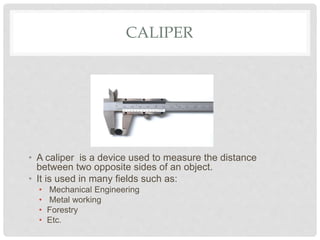
• A caliper is a device used to measure the distance
between two opposite sides of an object.
• It is used in many fields such as:
• Mechanical Engineering
• Metal working
• Forestry
• Etc.
WHEN WAS THE CALIPER INVENTED
• Caliper without a vernier scale originated in ancient
China as early as the qin dynasty
• The secondary scale, which contributed extra
precision, was invented in 1631 by french
mathematician Pierre Vernier (1580 – 1637)
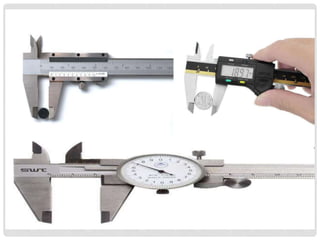
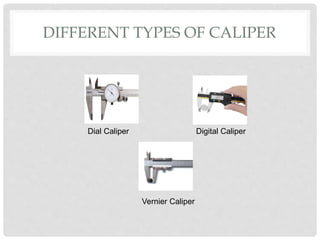
DIFFERENT TYPES OF CALIPER
Dial Caliper
Vernier Caliper
Digital Caliper
VERNIER CALIPER
• The vernier caliper was the original design and is still
the most rugged
• Skillful alignment of the tool and interpretation of the
reading is necessarry to achieve the measurement
tool’s accuracy.
DIAL CALIPER
• A dial caliper is the second generation caliper.
• Similar to the construction of the vernier caliper but have
a dial indicator.
• The dial caliper is a dual purpose tool for making either
direct or comparative measurements.
DIGITAL CALIPER
• Digital Caliper provide many features which make the
device easier to use.
• These include easy switching between inch and metric
units on the readout tolerance indications, digital output
to electronic data collection systems, zero setting
anywhere along the caliper’s range and retention of the
zero setting even when the caliper is turned off.
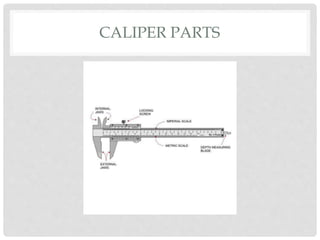
CALIPER PARTS
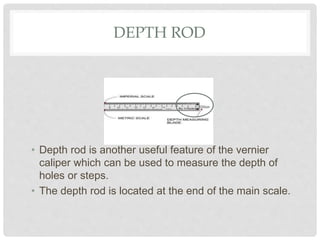
DEPTH ROD
• Depth rod is another useful feature of the vernier
caliper which can be used to measure the depth of
holes or steps.
• The depth rod is located at the end of the main scale.
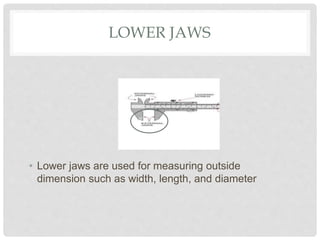
LOWER JAWS
• Lower jaws are used for measuring outside
dimension such as width, length, and diameter
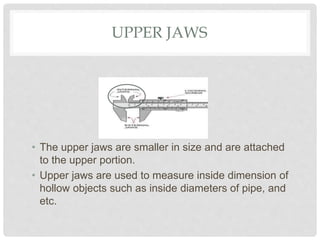
UPPER JAWS
• The upper jaws are smaller in size and are attached
to the upper portion.
• Upper jaws are used to measure inside dimension of
hollow objects such as inside diameters of pipe, and
etc.
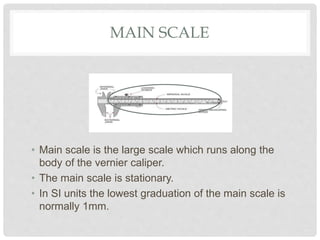
MAIN SCALE
• Main scale is the large scale which runs along the
body of the vernier caliper.
• The main scale is stationary.
• In SI units the lowest graduation of the main scale is
normally 1mm.
VERNIER SCALE
• Vernier scale is a smaller scale attached to the main
scale and can move along the main scale as the jaws
are opened or closed.
• Vernier scale provides accuracy to the reading of the
main scale by further dividing the lowest reading of
the main scale into increments.
THUMB SCREW
• The thumb screw is located at the bottom of the
vernier scale.
• The purpose of the thumb screw is to provide a grip.
LOCK SCREW
• The lock screw is used to fix the position of the jaws
once the object is positioned properly so that the
reading can be taken without the fear of spoiling the
position.

4.1 Caliper.pptx

  • 1.
    ME 217 Machine ShopTheory and Practice Chapter 4: Familiarization on the use of Machine Tools and Equipment 4.1 Caliper
  • 2.
  • 3.
    CALIPER • A caliperis a device used to measure the distance between two opposite sides of an object. • It is used in many fields such as: • Mechanical Engineering • Metal working • Forestry • Etc.
  • 4.
    WHEN WAS THECALIPER INVENTED • Caliper without a vernier scale originated in ancient China as early as the qin dynasty • The secondary scale, which contributed extra precision, was invented in 1631 by french mathematician Pierre Vernier (1580 – 1637)
  • 5.
    DIFFERENT TYPES OFCALIPER Dial Caliper Vernier Caliper Digital Caliper
  • 6.
    VERNIER CALIPER • Thevernier caliper was the original design and is still the most rugged • Skillful alignment of the tool and interpretation of the reading is necessarry to achieve the measurement tool’s accuracy.
  • 7.
    DIAL CALIPER • Adial caliper is the second generation caliper. • Similar to the construction of the vernier caliper but have a dial indicator. • The dial caliper is a dual purpose tool for making either direct or comparative measurements.
  • 8.
    DIGITAL CALIPER • DigitalCaliper provide many features which make the device easier to use. • These include easy switching between inch and metric units on the readout tolerance indications, digital output to electronic data collection systems, zero setting anywhere along the caliper’s range and retention of the zero setting even when the caliper is turned off.
  • 9.
  • 10.
    DEPTH ROD • Depthrod is another useful feature of the vernier caliper which can be used to measure the depth of holes or steps. • The depth rod is located at the end of the main scale.
  • 11.
    LOWER JAWS • Lowerjaws are used for measuring outside dimension such as width, length, and diameter
  • 12.
    UPPER JAWS • Theupper jaws are smaller in size and are attached to the upper portion. • Upper jaws are used to measure inside dimension of hollow objects such as inside diameters of pipe, and etc.
  • 13.
    MAIN SCALE • Mainscale is the large scale which runs along the body of the vernier caliper. • The main scale is stationary. • In SI units the lowest graduation of the main scale is normally 1mm.
  • 14.
    VERNIER SCALE • Vernierscale is a smaller scale attached to the main scale and can move along the main scale as the jaws are opened or closed. • Vernier scale provides accuracy to the reading of the main scale by further dividing the lowest reading of the main scale into increments.
  • 15.
    THUMB SCREW • Thethumb screw is located at the bottom of the vernier scale. • The purpose of the thumb screw is to provide a grip.
  • 16.
    LOCK SCREW • Thelock screw is used to fix the position of the jaws once the object is positioned properly so that the reading can be taken without the fear of spoiling the position.