METER Metre
The curfew tolls the knell of parting day. In the beginning God created heaven and earth.
What is  meter ? The rhythm of accented and unaccented syllables which are organized into patterns (called  feet ). The linguistic sound patterns of a verse. The recurrence of similar verse-factors.
Accent and Stress :  What’s the difference?
Word Accent The relatively greater force which is put upon one syllable over another is called  word accent . Syllables without primary or secondary accent are called  unaccented . Monosyllables may, for convenience, be regarded as single  accented  syllables.   so rrow   sub lime dem on stra tion cu mu la tive
Verse stress The ictus placed on certain syllables recurring at regular intervals in a verse of poetry. It determines the rhythm of the verse.
Does the verse-stress always coincide with the word-accent? -  /      -      /      -  /  - /   -   /   Ab sent  thee  from   fe li  ci ty   a while . -  -  /      -     -  /      -    -   / And the  light  thereof  hurled  and the  noise -  -  / thereof  rolled .
Guidelines The verse-stress never falls on an unaccented syllable; nor on a secondary accent, unless the primary accent of the same word is also stressed. But, the verse-stress does not necessarily fall on  every  accented syllable; that is, accented syllables may be unstressed in the verse. Monosyllables, since they are regarded as accented syllables, may receive verse-stress.
Put simply: Unaccented syllables are unstressed. Accented syllables, including monosyllables, may be stressed or unstressed.
METRICAL FOOT
What is metrical  foot ? A unit of meter. Any regular, single group of stressed and unstressed syllables.  In English, feet are named for the combination of accented and unaccented syllables.
How many feet are there in each of the following verses? -  /      -      /      -  /  - /   -   /   Ab sent  thee  from   fe li  ci ty   a while . -  -  /      -     -  /      -    -   / And the  light  thereof  hurled  and the  noise -  -  / thereof  rolled .
Four principal feet: Iambus   1 unstressed and  1 stressed Anapest 2 unstressed and  1 stressed Trochee 1 stressed and  1 unstressed Dactyl 1 stressed and  2 unstressed
" To  be  or  not   to  be .  -Hamlet (William Shakespeare) " Come  live  with  me  and  be  my  l ove .” -The Passionate Shepherd to His Love (Christopher Marlowe)
" By   the  shores  of  Git che Gu mee   By  the  shin ing  Big -Sea- wa ter.” - The Song of Hiawatha  (Henry Wadsworth Longfellow) " Dou ble,  dou ble,  toil  and  trou ble .” - Macbeth (William Shakespeare)
"Like a  child  from the  womb , like a  ghost  from the  tomb  I a rise  and un build  it a gain ."  - The Cloud (Percy Bysshe Shelley)
“ This   is the/   for est prim-/ ev al .  The  /  mur muring  /  pines   and the  /  hem l ocks , - Evangeline (Henry Wadsworth Longfellow)
What is   verse ? A line of poetry made up usually of several feet, but sometimes containing only one. A verse consisting of one foot is called a  monometer ; 2 feet,  dimeter ; 3 feet,  trimeter ; 4 feet,  tetrameter ; 5 feet,  pentameter ; 6 feet,  hexameter ; 7 feet,  heptameter ; 8 feet,  octameter .
What is  scansion ? The analysis of poetry's metrical and rhythmic patterns.  The analysis of a line of poetry for  foot  and  meter .  To "scan" a line of poetry means to  analyze it rhythmically.
Scan the following verses: 1.  Fair daffodils, we weep to see You haste away so soon. 2.  To a precipice goes, Where a leap from above Would soon finish his woes.
3.  Ah, distinctly I remember, it was in the bleak December. 4.  Still it kept flowing and flowing, and other streams ran to its bosom.
Answers: 1.  Fair  daf fo dils , we  weep  to  see You  haste  a way  so  soon .  (IAMBIC) 2.  To a  pre cipice  goes , Where a  leap  from a bove Would soon  fi nish his  woes .  (ANAPESTIC)
3.  Ah , dis tinc tly  I  re mem ber,  it  was  in  the  bleak  De cem ber.  (TROCHAIC) 4.  Still  it kept  flow ing and  flow ing, and  o ther streams  ran  to its  bo som.  (DACTYLIC)
Metrical Variations English verse does not adhere rigidly to a given type (i.e. the entire line is not always made up of a regular succession of iambi or anapests or trochees or dactyls.) Metrical variations are employed which help give the flexible quality of a verse.
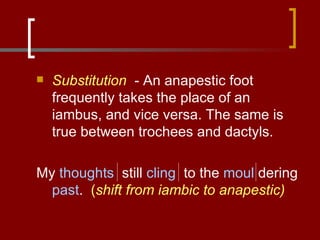
Substitution   - An anapestic foot frequently takes the place of an iambus, and vice versa. The same is true between trochees and dactyls. My  thoughts   still  cling   to the  moul  dering  past .  ( shift from iambic to anapestic)
Inversion   – Feet are sometimes inverted; that is, a trochee takes the place of an iambus; a dactyl of an anapest; and vice versa. Through  cav  erns  meas  ure less  to  man , Down  to a  sun  less  sea .  ( shift from iambic to trochaic)
Catalexis  –  The unstressed syllable (or syllables) beginning an iambic (or anapestic) verse may be omitted; similarly the unstressed syllable (or syllables) at the end of a trochaic (or dactylic) verse. The verse is said to be  catalectic .   ^   Who  would  be A  mer  man  bold , ^   Sit  ting a lone , ^   Sing  ing a lone , ^   Un  der the  sea .
Characteristic Effects of Various Feet and Metrical Variations 1.  Anapestic  and  dactylic  lines, containing as they do a large proportion of unaccented syllables, have a  lighter  and  more rapid movement  than iambic and trochaic lines. Hence, they are suited to fervid emotion, quick action, flowing melody.
2. Meters consisting of feet beginning with unstressed syllables ( iambi and anapests ) create the sense of an  upward movement , and the general impression tends to be  grave and conclusive .  Those that start with stressed syllables ( trochees and dactyls ) suggest a  downward movement , and give the impression of  lightness and expectancy .
3.  Perfect regularity  of meter gives the  character of steadiness , and suggests  quiet, unobtrusive emotion , sometimes lends a  formal dignity  to the verse.
Assignment  =) 1. Scan the poem “A Psalm of Life” by Henry Wadsworth Longfellow. 2. Research on the following  feet;  define and give an example of each: a. spondaic b. pyrrhic

Metre

  • 1.
  • 2.
    The curfew tollsthe knell of parting day. In the beginning God created heaven and earth.
  • 3.
    What is meter ? The rhythm of accented and unaccented syllables which are organized into patterns (called feet ). The linguistic sound patterns of a verse. The recurrence of similar verse-factors.
  • 4.
    Accent and Stress: What’s the difference?
  • 5.
    Word Accent Therelatively greater force which is put upon one syllable over another is called word accent . Syllables without primary or secondary accent are called unaccented . Monosyllables may, for convenience, be regarded as single accented syllables. so rrow sub lime dem on stra tion cu mu la tive
  • 6.
    Verse stress Theictus placed on certain syllables recurring at regular intervals in a verse of poetry. It determines the rhythm of the verse.
  • 7.
    Does the verse-stressalways coincide with the word-accent? - /     -     /     -  /  - /  -   / Ab sent thee from fe li ci ty a while . - - /     -     - /     -    -  / And the light thereof hurled and the noise - - / thereof rolled .
  • 8.
    Guidelines The verse-stressnever falls on an unaccented syllable; nor on a secondary accent, unless the primary accent of the same word is also stressed. But, the verse-stress does not necessarily fall on every accented syllable; that is, accented syllables may be unstressed in the verse. Monosyllables, since they are regarded as accented syllables, may receive verse-stress.
  • 9.
    Put simply: Unaccentedsyllables are unstressed. Accented syllables, including monosyllables, may be stressed or unstressed.
  • 10.
  • 11.
    What is metrical foot ? A unit of meter. Any regular, single group of stressed and unstressed syllables. In English, feet are named for the combination of accented and unaccented syllables.
  • 12.
    How many feetare there in each of the following verses? - /     -     /     -  /  - /  -   / Ab sent thee from fe li ci ty a while . - - /     -     - /     -    -  / And the light thereof hurled and the noise - - / thereof rolled .
  • 13.
    Four principal feet:Iambus 1 unstressed and 1 stressed Anapest 2 unstressed and 1 stressed Trochee 1 stressed and 1 unstressed Dactyl 1 stressed and 2 unstressed
  • 14.
    " To be or not to be . -Hamlet (William Shakespeare) " Come live with me and be my l ove .” -The Passionate Shepherd to His Love (Christopher Marlowe)
  • 15.
    " By the shores of Git che Gu mee By the shin ing Big -Sea- wa ter.” - The Song of Hiawatha (Henry Wadsworth Longfellow) " Dou ble, dou ble, toil and trou ble .” - Macbeth (William Shakespeare)
  • 16.
    "Like a child from the womb , like a ghost from the tomb I a rise and un build it a gain ." - The Cloud (Percy Bysshe Shelley)
  • 17.
    “ This is the/ for est prim-/ ev al . The / mur muring / pines and the / hem l ocks , - Evangeline (Henry Wadsworth Longfellow)
  • 18.
    What is verse ? A line of poetry made up usually of several feet, but sometimes containing only one. A verse consisting of one foot is called a monometer ; 2 feet, dimeter ; 3 feet, trimeter ; 4 feet, tetrameter ; 5 feet, pentameter ; 6 feet, hexameter ; 7 feet, heptameter ; 8 feet, octameter .
  • 19.
    What is scansion ? The analysis of poetry's metrical and rhythmic patterns. The analysis of a line of poetry for foot and meter . To "scan" a line of poetry means to analyze it rhythmically.
  • 20.
    Scan the followingverses: 1. Fair daffodils, we weep to see You haste away so soon. 2. To a precipice goes, Where a leap from above Would soon finish his woes.
  • 21.
    3. Ah,distinctly I remember, it was in the bleak December. 4. Still it kept flowing and flowing, and other streams ran to its bosom.
  • 22.
    Answers: 1. Fair daf fo dils , we weep to see You haste a way so soon . (IAMBIC) 2. To a pre cipice goes , Where a leap from a bove Would soon fi nish his woes . (ANAPESTIC)
  • 23.
    3. Ah, dis tinc tly I re mem ber, it was in the bleak De cem ber. (TROCHAIC) 4. Still it kept flow ing and flow ing, and o ther streams ran to its bo som. (DACTYLIC)
  • 24.
    Metrical Variations Englishverse does not adhere rigidly to a given type (i.e. the entire line is not always made up of a regular succession of iambi or anapests or trochees or dactyls.) Metrical variations are employed which help give the flexible quality of a verse.
  • 25.
    Substitution - An anapestic foot frequently takes the place of an iambus, and vice versa. The same is true between trochees and dactyls. My thoughts still cling to the moul dering past . ( shift from iambic to anapestic)
  • 26.
    Inversion – Feet are sometimes inverted; that is, a trochee takes the place of an iambus; a dactyl of an anapest; and vice versa. Through cav erns meas ure less to man , Down to a sun less sea . ( shift from iambic to trochaic)
  • 27.
    Catalexis – The unstressed syllable (or syllables) beginning an iambic (or anapestic) verse may be omitted; similarly the unstressed syllable (or syllables) at the end of a trochaic (or dactylic) verse. The verse is said to be catalectic . ^ Who would be A mer man bold , ^ Sit ting a lone , ^ Sing ing a lone , ^ Un der the sea .
  • 28.
    Characteristic Effects ofVarious Feet and Metrical Variations 1. Anapestic and dactylic lines, containing as they do a large proportion of unaccented syllables, have a lighter and more rapid movement than iambic and trochaic lines. Hence, they are suited to fervid emotion, quick action, flowing melody.
  • 29.
    2. Meters consistingof feet beginning with unstressed syllables ( iambi and anapests ) create the sense of an upward movement , and the general impression tends to be grave and conclusive . Those that start with stressed syllables ( trochees and dactyls ) suggest a downward movement , and give the impression of lightness and expectancy .
  • 30.
    3. Perfectregularity of meter gives the character of steadiness , and suggests quiet, unobtrusive emotion , sometimes lends a formal dignity to the verse.
  • 31.
    Assignment =)1. Scan the poem “A Psalm of Life” by Henry Wadsworth Longfellow. 2. Research on the following feet; define and give an example of each: a. spondaic b. pyrrhic