• FLOODWAYS
• FLOOD-PLAIN ZONING
• SPREADING GROUNDS
• SOIL CONSERVATION METHODS
EVANGELISTA, Ken Joshua G
Reporter:
FLOODWAYS
Floodways serve two functions in flood abatement;
• by providing an additional channel storage for storing
a portion of the flood water
• by opening up a new channel to carry a part of the
main stream flow.
FLOODWAYS
FLOODWAYS
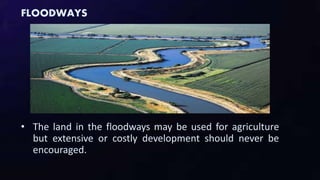
• The land in the floodways may be used for agriculture
but extensive or costly development should never be
encouraged.
FLOODWAYS
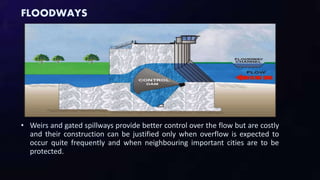
• Weirs and gated spillways provide better control over the flow but are costly
and their construction can be justified only when overflow is expected to
occur quite frequently and when neighbouring important cities are to be
protected.
FLOOD-PLAIN ZONING
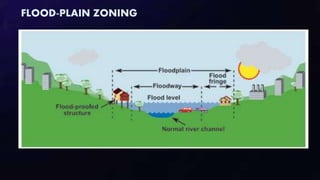
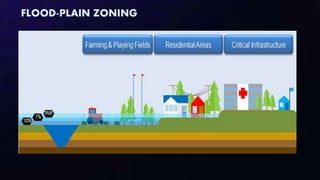
• Flood-plain zoning reduces the risk and cost of damages
flooding causes. Local governments may pass flood zone
laws that restrict land use. These laws prevent or limit
building and development in flood zones to lessen the
risks associated with flooding.
FLOOD-PLAIN ZONING
FLOOD-PLAIN ZONING
SPREADING GROUNDS
• Flood flows are sometimes diverted into large flat land
areas that are capable of absorbing water at relatively
higher rates.
SPREADING GROUNDS
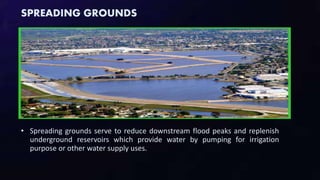
• Spreading grounds serve to reduce downstream flood peaks and replenish
underground reservoirs which provide water by pumping for irrigation
purpose or other water supply uses.
SOIL CONSERVATION METHODS
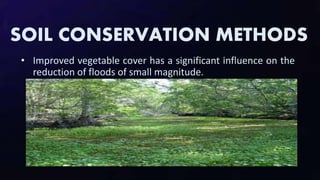
• Improved vegetable cover has a significant influence on the
reduction of floods of small magnitude.
Problems:
A stream channel whose shape can be approximated as a rectangle of base width
100 m carries a discharge of 450 m3/s. Its bed slope has been found to be 18 × 10–4
and its roughness in terms of Manning’s n equals 0.02. The stream is a tributary to a
river where the existing flood stage is 3 m above the normal depth in the stream.
Find the approximate backwater curve in the tributary.
Solution:
Given
Q = 450 m3/s, Sb = 0.0018
n = 0.02, B = 100 m
For a wide rectangular channel hydraulic radius can be approximated by the depth
in the calculation. Now equilibrium depth in the tributary can be calculated from
Problems:
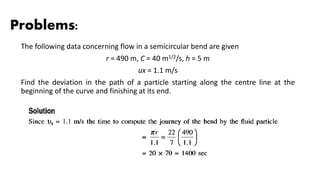
The following data concerning flow in a semicircular bend are given
r = 490 m, C = 40 m1/2/s, h = 5 m
ux = 1.1 m/s
Find the deviation in the path of a particle starting along the centre line at the
beginning of the curve and finishing at its end.
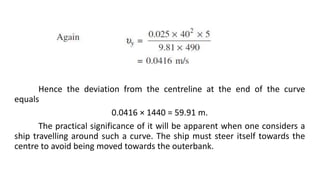
Hence the deviation from the centreline at the end of the curve
equals
0.0416 × 1440 = 59.91 m.
The practical significance of it will be apparent when one considers a
ship travelling around such a curve. The ship must steer itself towards the
centre to avoid being moved towards the outerbank.

Floodways

  • 1.
    • FLOODWAYS • FLOOD-PLAINZONING • SPREADING GROUNDS • SOIL CONSERVATION METHODS EVANGELISTA, Ken Joshua G Reporter:
  • 2.
    FLOODWAYS Floodways serve twofunctions in flood abatement; • by providing an additional channel storage for storing a portion of the flood water • by opening up a new channel to carry a part of the main stream flow.
  • 3.
  • 4.
    FLOODWAYS • The landin the floodways may be used for agriculture but extensive or costly development should never be encouraged.
  • 5.
    FLOODWAYS • Weirs andgated spillways provide better control over the flow but are costly and their construction can be justified only when overflow is expected to occur quite frequently and when neighbouring important cities are to be protected.
  • 6.
    FLOOD-PLAIN ZONING • Flood-plainzoning reduces the risk and cost of damages flooding causes. Local governments may pass flood zone laws that restrict land use. These laws prevent or limit building and development in flood zones to lessen the risks associated with flooding.
  • 7.
  • 8.
  • 9.
    SPREADING GROUNDS • Floodflows are sometimes diverted into large flat land areas that are capable of absorbing water at relatively higher rates.
  • 10.
    SPREADING GROUNDS • Spreadinggrounds serve to reduce downstream flood peaks and replenish underground reservoirs which provide water by pumping for irrigation purpose or other water supply uses.
  • 11.
    SOIL CONSERVATION METHODS •Improved vegetable cover has a significant influence on the reduction of floods of small magnitude.
  • 13.
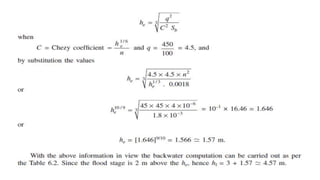
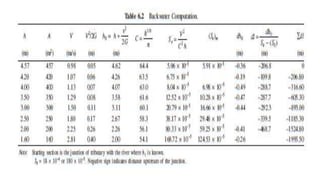
    Problems: A stream channelwhose shape can be approximated as a rectangle of base width 100 m carries a discharge of 450 m3/s. Its bed slope has been found to be 18 × 10–4 and its roughness in terms of Manning’s n equals 0.02. The stream is a tributary to a river where the existing flood stage is 3 m above the normal depth in the stream. Find the approximate backwater curve in the tributary. Solution: Given Q = 450 m3/s, Sb = 0.0018 n = 0.02, B = 100 m For a wide rectangular channel hydraulic radius can be approximated by the depth in the calculation. Now equilibrium depth in the tributary can be calculated from
  • 16.
    Problems: The following dataconcerning flow in a semicircular bend are given r = 490 m, C = 40 m1/2/s, h = 5 m ux = 1.1 m/s Find the deviation in the path of a particle starting along the centre line at the beginning of the curve and finishing at its end.
  • 17.
    Hence the deviationfrom the centreline at the end of the curve equals 0.0416 × 1440 = 59.91 m. The practical significance of it will be apparent when one considers a ship travelling around such a curve. The ship must steer itself towards the centre to avoid being moved towards the outerbank.

Editor's Notes

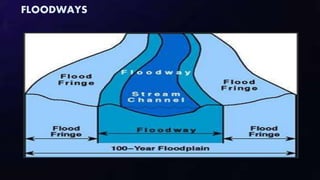
  • #4 floodway the channel and adjacent shore areas under water during a flood, especially as determined for a flood of a given height. Flood fringe the land area, which is outside of the stream's floodway, but is subject to periodic inundation by regular flooding.
  • #7 FLOOD PLAIN ZONING Flood zone designations identify areas at risk for potential flooding.
  • #9 PMF PMF stands for the Probable Maximum Flood. The frequency or chance of this flood occurring has been estimated to be 1 in 100,000 chance in any one year.
  • #11 Montebello 
  • #13 hydraulic radius is defined as the ratio of the channel's cross-sectional area of the flow to its wetted perimeter
  • #14 hydraulic radius is defined as the ratio of the channel's cross-sectional area of the flow to its wetted perimeter