HUMAN RESOURCE
MANAGEMENT
2ND semester --- 1ST Mid PPT
IMMANI CHANDRA SHEKAR
REGD. NO. :19K61E0020
SUBJECT CODE :18MS02T3
1
Mid Topic
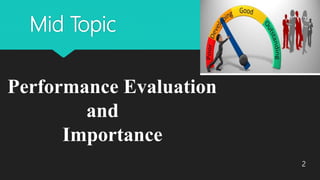
Performance Evaluation
and
Importance
2
Meaning :
Performance Evaluation is a
tool which is used to evaluate
the employees' performance
at the Workplace. It
generally includes qualitative
and quantitative dimensions
of employees' job
performance.
Definition :
According to Gomej-Mejia et
al., "Performance Evaluation
involves the identification,
measurement,and management
of human performance in
organisations".
3
Objectives of Performance Evaluation:
 Providing Feedback,
 Facilitating Promotion and Downsizing Decisions,
Motivating Superior Performance,
 Setting and Measuring Goals,
 Determining Compensation,
 Counselling Poor Performers,
 Encouraging Coaching and Mentoring,
 Supporting Manpower Planning,
 Determining Training and Development Needs, Validating
Hiring Decisions,
 Providing Legal Defensibility for Personnel Decisions,
 Improving Overall Organisational Performance
4
Process of Performance
Evaluation:
 Establish Performance Standards with Employees,
 Mutually Set Measurable Goals,
 Measure Actual Performance,
 Compare Actual Performance with Standards,
 Discuss the Appraisal with the Employee,
 If Necessary, Take Corrective Actions
5
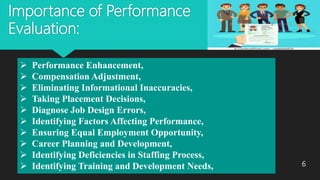
Importance of Performance
Evaluation:
 Performance Enhancement,
 Compensation Adjustment,
 Eliminating Informational Inaccuracies,
 Taking Placement Decisions,
 Diagnose Job Design Errors,
 Identifying Factors Affecting Performance,
 Ensuring Equal Employment Opportunity,
 Career Planning and Development,
 Identifying Deficiencies in Staffing Process,
 Identifying Training and Development Needs, 6
Conclusion:
 The ultimate goal of performance appraisal should be to
provide information that will best enable managers to
improve employee performance.
 The performance appraisal provides information to
help managers manage in such a way that employee
performance improves. 7
8

Human resource management- Performance Evaluation and Importance

  • 1.
    HUMAN RESOURCE MANAGEMENT 2ND semester--- 1ST Mid PPT IMMANI CHANDRA SHEKAR REGD. NO. :19K61E0020 SUBJECT CODE :18MS02T3 1
  • 2.
  • 3.
    Meaning : Performance Evaluationis a tool which is used to evaluate the employees' performance at the Workplace. It generally includes qualitative and quantitative dimensions of employees' job performance. Definition : According to Gomej-Mejia et al., "Performance Evaluation involves the identification, measurement,and management of human performance in organisations". 3
  • 4.
    Objectives of PerformanceEvaluation:  Providing Feedback,  Facilitating Promotion and Downsizing Decisions, Motivating Superior Performance,  Setting and Measuring Goals,  Determining Compensation,  Counselling Poor Performers,  Encouraging Coaching and Mentoring,  Supporting Manpower Planning,  Determining Training and Development Needs, Validating Hiring Decisions,  Providing Legal Defensibility for Personnel Decisions,  Improving Overall Organisational Performance 4
  • 5.
    Process of Performance Evaluation: Establish Performance Standards with Employees,  Mutually Set Measurable Goals,  Measure Actual Performance,  Compare Actual Performance with Standards,  Discuss the Appraisal with the Employee,  If Necessary, Take Corrective Actions 5
  • 6.
    Importance of Performance Evaluation: Performance Enhancement,  Compensation Adjustment,  Eliminating Informational Inaccuracies,  Taking Placement Decisions,  Diagnose Job Design Errors,  Identifying Factors Affecting Performance,  Ensuring Equal Employment Opportunity,  Career Planning and Development,  Identifying Deficiencies in Staffing Process,  Identifying Training and Development Needs, 6
  • 7.
    Conclusion:  The ultimategoal of performance appraisal should be to provide information that will best enable managers to improve employee performance.  The performance appraisal provides information to help managers manage in such a way that employee performance improves. 7
  • 8.