Performance management
Introduction
Performance management is the process through
which managers ensure that employee activities
and outputs are congruent with the organization's
goals.
Performance Appraisal is the process through
which an organization gets information on how
well an employee is doing his or her job.
Performance Feedback is the process of
providing employees information regarding their
performance effectiveness.
An Introduction to Appraising
Performance
1
Is useful in career planning.
Plays an integral role in performance management.
Why Appraise Performance?
Is basis for pay and promotion decisions.
Helps in correcting deficiencies and reinforcing good
performance.
2
3
4
Purposes of Performance
Management
Strategic
Developmental
Administrative
Purpose for performance appraisal
 Provide performance feed back
 Identify individual
strength/weakness
 Recognize individual
performance
 Assist in goal identification
 Evaluate goal achievement
 Identify indl trg needs
 Determine org trg needs
 Reinforce authority structure
 Allow employees to discuss
concerns
 Improve communication
 Document personnel decisions
 Determine promotion
candidates
 Determine transfers and
assignments
 Identify poor performance
 Decide retention or termination
 Decide on layoffs
 Validate selection criteria
 Meet legal requirements
 Evaluate training programs /
progress
 Personnel planning
 Make reward/ compensation
Developmental Administrative
Appraisal factors used in India
Performance Appraisal Roles
 Supervisors
 Usually do the actual
appraising.
 Must be familiar with basic
appraisal techniques.
 Must understand and avoid
problems that can cripple
appraisals.
 Must know how to conduct
appraisals fairly.
Performance Appraisal Roles (cont’d)
 The HR Department
 Serves a policy-making and advisory role.
 Provides advice and assistance regarding the
appraisal tool to use.
 Trains supervisors to improve their appraisal skills.
 Monitors the appraisal system effectiveness and
compliance with EEO laws.
Stages of the PM/ Steps
Specify relevant
aspects of
performance
Apprise performance
Provide
performance
feedback
Problem
solving
Rewards
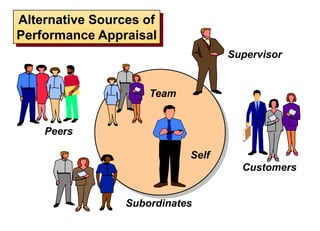
Alternative Sources of
Performance Appraisal
Supervisor
Subordinates
Peers
Team
Customers
Self
Performance Appraisal Methods
1
2
3
4
5
Confidential reports
Graphic Rating Scale
Method
Paired Comparison Method
Critical Incident Method
6
7
8
Behaviorally Anchored
Rating Scales (BARS)
Management by Objectives (MBO)
360 degree feedback
Assessment center
Appraisal Methodologies
Graphic scales
 A rating scale lists traits and range of performance
values for each trait. The supervisor rates each
subordinate by circling or checking the scores that best
describes his performance for each trait. The assigned
value is then totaled.
 Adv: easy to understand ,easy to use and permits a
statistical tabulation of scores of employee.
 Disadv: impose a heavy burden upon the supervisor,
difficult to decide about relative Weightage of different
traits and it may be difficult to ensure uniformity as
rating would differ with different raters.
Confidential report
 Used In government and pubic enterprises.
 Differ from dept to dept and level to level.
 Written for unit of one yr
 Relates to performance, ability and character of
the employee during that yr.
 Not data based
 subjective. No feed back is provided.
 Focus on evaluating rather than developing.
 Eg: Banks
Paired comparison
 Every person is compared trait wise with
other persons one at a time.
 The no of times one person is compared
with other is tallied on a piece of paper.
 These no help in yielding rank order of
employee
 Suitable only when the no of persons is
small.
FIGURE 9–7Ranking Employees by the Paired Comparison Method
Critical incident method
 Attempts to measure workers performance in terms of
certain events or incidents that occur in the course of
work.
 Assumption in this method is that the performance of
the employee on the happening of critical incident
determines his failure or success.
 The supervisor keeps record of critical incidents at
different times and then rates him on this basis.
 Avoids recency bias as raters record ratings throughout
rating period.
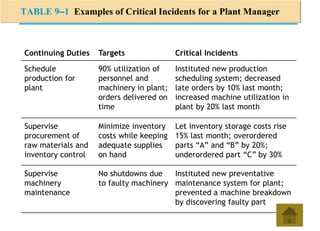
TABLE 9–1 Examples of Critical Incidents for a Plant Manager
Continuing Duties Targets Critical Incidents
Schedule
production for
plant
90% utilization of
personnel and
machinery in plant;
orders delivered on
time
Instituted new production
scheduling system; decreased
late orders by 10% last month;
increased machine utilization in
plant by 20% last month
Supervise
procurement of
raw materials and
inventory control
Minimize inventory
costs while keeping
adequate supplies
on hand
Let inventory storage costs rise
15% last month; overordered
parts “A” and “B” by 20%;
underordered part “C” by 30%
Supervise
machinery
maintenance
No shutdowns due
to faulty machinery
Instituted new preventative
maintenance system for plant;
prevented a machine breakdown
by discovering faulty part
BARS
 Combines the benefit of critical incidents and graphic
rating scales by anchoring a scale with specific behavioral
examples of good or poor performance.
 Steps in developing BARS
 Generate critical incidents
 Develop performance dimensions
 Reallocate incidents
 Scale incidents
 Develop final instrument
FIGURE 9–9
Example of a
Behaviorally
Anchored Rating
Scale for the
Dimension
Salesmanship Skills
Examples Of A Bars For Municipal Fire Companies
FIREFIGHTING STRATEGY: Knowledge of Fire Characteristics.
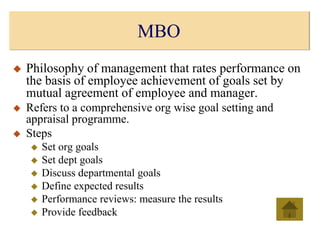
MBO
 Philosophy of management that rates performance on
the basis of employee achievement of goals set by
mutual agreement of employee and manager.
 Refers to a comprehensive org wise goal setting and
appraisal programme.
 Steps
 Set org goals
 Set dept goals
 Discuss departmental goals
 Define expected results
 Performance reviews: measure the results
 Provide feedback
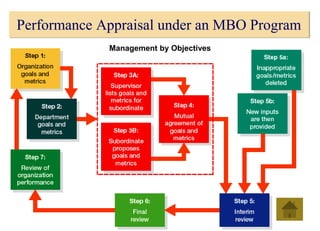
Performance Appraisal under an MBO Program
Management by Objectives
360 degree
 Involves a systematic collection of performance
data on an individual or group, derived from a no
of stake holders.
 Any one who has useful info may be one of the
appraisers . The appraiser should be capable of
determining what is more important and what is
relatively less important.
 Provides a broader perspective about an employee
performance.
720 degree feedback
 720 degree feedback is the name given by some companies
to the process of running a 360 degree feedback instrument
twice – the first time and then some nine to twelve months
after. This gives a pre- and a post-intervention result. The
pre-intervention result sets the baseline. The development
intervention is then done to improve the participant’s
behavior (e.g., training, coaching). The post-intervention
survey then shows the amount of improvement in the
results
Assessment centers
 the managers may come together to participate in job related exercises
evaluated by trained observers.
 The idea is to evaluate managers over a period of time, by observing
and later evaluating their behavior across a series of a select exercises
or work samples.
 Managers are asked to participate in in basket techniques, work
groups, computer stimulations, role playing and other activities. Which
requires attributes for successful performance as on actual job.
 After recording their observations the raters meet to discuss these
observations
 Self appraisal and peer evaluation are also used for final rating.
 Generally measures interpersonal skills, communication skills, ability
to plan and organize, self confidence, resistance to stress, mental
alertness.
 Time consuming and expensive method.
The Balanced Scorecard
The balance scorecard provides a clear prescription
as to what companies should measure in order to
balance the financial perspective
Management system that enables organization to
clarify their vision and strategy and translate them
into action
The Balanced
Scorecard
HRM 6
Source: Robert Kaplan and David
Norton, “Strategic Learning and the
Balanced Scorecard,” Strategy &
Leadership 24, no. 5 September/
October 1996): 18–24.
Recency errors
Leniency or strictness errors
Common rater-related errors
Error of central tendency
Similar-to-me errors
Contrast and halo errors
Insufficient
reward for
performance
Manager
lacks
information
Lack of
appraisal
skills
Manager not
taking
appraisal
seriously
Manager not
prepared
Manager not
being
honest or
sincere
Employee
not receiving
ongoing
feedback
Ineffective
discussion of
employee
development
Unclear
language
Performance
appraisals
fail
because…
Reasons for the
failure of PM
Improving Performance Feedback
Feedback should be given every day, not once a year.
Create the Right Context for Discussion.
Ask employees to rate their performance before the
session.
Encourage the subordinate to participate in the session.
Recognize effective performance through praise.
Focus on solving problems.
Focus feedback on behavior or results, not on the
person.
Minimize criticism.
Agree to specific goals and set a date to review progress.
Competency Approach to Human
Resource Management
A Competency is an underlying
characteristic of a person which enables
him /her to deliver superior performance
in a given job, role or a situation.
Set of SKILLS
Relates to the
ability to do,
Physical domain
Attribute
Relates to
qualitative
aspects
personal
Characteristics or
traits
KNOWLEDGE
Relates to information
Cognitive Domain
COMPETENCY
Outstanding
Performance of
tasks or activities
Competency Model
 A competency model is a valid, observable,
and measurable list of the knowledge, skills,
and attributes demonstrated through
behavior that results in outstanding
performance in a particular work context.
 Typically A competency model includes
 Competency titles
 Definitions of those titles
 Key Behaviour indicators
Steps in Model Building
 Background information about the organisation
 Decide on the Occupation / Job Position(s) that
require competency Model(s)
 Discuss the application of the competency model
 Select a data collection method and plan the approach
 Organize Data collected
 Identify main themes or patterns
 Build the model - Defining specific behaviour
Indicators
 Review the model
Analytical Thinking
 The ability to break problems into
component parts and consider or organize
parts in a systematic way; the process of
looking for underlying causes or thinking
through the consequence of different
courses of action.
Key Behaviour Indicators
 Independently researches for information and solutions
to issues
 Ability to know what needs to be done or find out
(research) and take steps to get it done
 Ask questions when not sure of what the problem is or to
gain more information.
 Able to identify the underlying or main problem.
 Shows willingness to experiment with new things.
 Develops a list of decision making guidelines to help
arrive at logical solutions.

perf mgmnt - BBA.ppt

  • 1.
  • 3.
    Introduction Performance management isthe process through which managers ensure that employee activities and outputs are congruent with the organization's goals. Performance Appraisal is the process through which an organization gets information on how well an employee is doing his or her job. Performance Feedback is the process of providing employees information regarding their performance effectiveness.
  • 4.
    An Introduction toAppraising Performance 1 Is useful in career planning. Plays an integral role in performance management. Why Appraise Performance? Is basis for pay and promotion decisions. Helps in correcting deficiencies and reinforcing good performance. 2 3 4
  • 5.
  • 6.
    Purpose for performanceappraisal  Provide performance feed back  Identify individual strength/weakness  Recognize individual performance  Assist in goal identification  Evaluate goal achievement  Identify indl trg needs  Determine org trg needs  Reinforce authority structure  Allow employees to discuss concerns  Improve communication  Document personnel decisions  Determine promotion candidates  Determine transfers and assignments  Identify poor performance  Decide retention or termination  Decide on layoffs  Validate selection criteria  Meet legal requirements  Evaluate training programs / progress  Personnel planning  Make reward/ compensation Developmental Administrative
  • 7.
  • 8.
    Performance Appraisal Roles Supervisors  Usually do the actual appraising.  Must be familiar with basic appraisal techniques.  Must understand and avoid problems that can cripple appraisals.  Must know how to conduct appraisals fairly.
  • 9.
    Performance Appraisal Roles(cont’d)  The HR Department  Serves a policy-making and advisory role.  Provides advice and assistance regarding the appraisal tool to use.  Trains supervisors to improve their appraisal skills.  Monitors the appraisal system effectiveness and compliance with EEO laws.
  • 10.
    Stages of thePM/ Steps Specify relevant aspects of performance Apprise performance Provide performance feedback Problem solving Rewards
  • 11.
    Alternative Sources of PerformanceAppraisal Supervisor Subordinates Peers Team Customers Self
  • 12.
  • 13.
    Performance Appraisal Methods 1 2 3 4 5 Confidentialreports Graphic Rating Scale Method Paired Comparison Method Critical Incident Method 6 7 8 Behaviorally Anchored Rating Scales (BARS) Management by Objectives (MBO) 360 degree feedback Assessment center Appraisal Methodologies
  • 14.
    Graphic scales  Arating scale lists traits and range of performance values for each trait. The supervisor rates each subordinate by circling or checking the scores that best describes his performance for each trait. The assigned value is then totaled.  Adv: easy to understand ,easy to use and permits a statistical tabulation of scores of employee.  Disadv: impose a heavy burden upon the supervisor, difficult to decide about relative Weightage of different traits and it may be difficult to ensure uniformity as rating would differ with different raters.
  • 15.
    Confidential report  UsedIn government and pubic enterprises.  Differ from dept to dept and level to level.  Written for unit of one yr  Relates to performance, ability and character of the employee during that yr.  Not data based  subjective. No feed back is provided.  Focus on evaluating rather than developing.  Eg: Banks
  • 16.
    Paired comparison  Everyperson is compared trait wise with other persons one at a time.  The no of times one person is compared with other is tallied on a piece of paper.  These no help in yielding rank order of employee  Suitable only when the no of persons is small.
  • 17.
    FIGURE 9–7Ranking Employeesby the Paired Comparison Method
  • 18.
    Critical incident method Attempts to measure workers performance in terms of certain events or incidents that occur in the course of work.  Assumption in this method is that the performance of the employee on the happening of critical incident determines his failure or success.  The supervisor keeps record of critical incidents at different times and then rates him on this basis.  Avoids recency bias as raters record ratings throughout rating period.
  • 19.
    TABLE 9–1 Examplesof Critical Incidents for a Plant Manager Continuing Duties Targets Critical Incidents Schedule production for plant 90% utilization of personnel and machinery in plant; orders delivered on time Instituted new production scheduling system; decreased late orders by 10% last month; increased machine utilization in plant by 20% last month Supervise procurement of raw materials and inventory control Minimize inventory costs while keeping adequate supplies on hand Let inventory storage costs rise 15% last month; overordered parts “A” and “B” by 20%; underordered part “C” by 30% Supervise machinery maintenance No shutdowns due to faulty machinery Instituted new preventative maintenance system for plant; prevented a machine breakdown by discovering faulty part
  • 20.
    BARS  Combines thebenefit of critical incidents and graphic rating scales by anchoring a scale with specific behavioral examples of good or poor performance.  Steps in developing BARS  Generate critical incidents  Develop performance dimensions  Reallocate incidents  Scale incidents  Develop final instrument
  • 21.
    FIGURE 9–9 Example ofa Behaviorally Anchored Rating Scale for the Dimension Salesmanship Skills
  • 22.
    Examples Of ABars For Municipal Fire Companies FIREFIGHTING STRATEGY: Knowledge of Fire Characteristics.
  • 23.
    MBO  Philosophy ofmanagement that rates performance on the basis of employee achievement of goals set by mutual agreement of employee and manager.  Refers to a comprehensive org wise goal setting and appraisal programme.  Steps  Set org goals  Set dept goals  Discuss departmental goals  Define expected results  Performance reviews: measure the results  Provide feedback
  • 24.
    Performance Appraisal underan MBO Program Management by Objectives
  • 25.
    360 degree  Involvesa systematic collection of performance data on an individual or group, derived from a no of stake holders.  Any one who has useful info may be one of the appraisers . The appraiser should be capable of determining what is more important and what is relatively less important.  Provides a broader perspective about an employee performance.
  • 26.
    720 degree feedback 720 degree feedback is the name given by some companies to the process of running a 360 degree feedback instrument twice – the first time and then some nine to twelve months after. This gives a pre- and a post-intervention result. The pre-intervention result sets the baseline. The development intervention is then done to improve the participant’s behavior (e.g., training, coaching). The post-intervention survey then shows the amount of improvement in the results
  • 27.
    Assessment centers  themanagers may come together to participate in job related exercises evaluated by trained observers.  The idea is to evaluate managers over a period of time, by observing and later evaluating their behavior across a series of a select exercises or work samples.  Managers are asked to participate in in basket techniques, work groups, computer stimulations, role playing and other activities. Which requires attributes for successful performance as on actual job.  After recording their observations the raters meet to discuss these observations  Self appraisal and peer evaluation are also used for final rating.  Generally measures interpersonal skills, communication skills, ability to plan and organize, self confidence, resistance to stress, mental alertness.  Time consuming and expensive method.
  • 28.
    The Balanced Scorecard Thebalance scorecard provides a clear prescription as to what companies should measure in order to balance the financial perspective Management system that enables organization to clarify their vision and strategy and translate them into action
  • 29.
    The Balanced Scorecard HRM 6 Source:Robert Kaplan and David Norton, “Strategic Learning and the Balanced Scorecard,” Strategy & Leadership 24, no. 5 September/ October 1996): 18–24.
  • 30.
    Recency errors Leniency orstrictness errors Common rater-related errors Error of central tendency Similar-to-me errors Contrast and halo errors
  • 31.
    Insufficient reward for performance Manager lacks information Lack of appraisal skills Managernot taking appraisal seriously Manager not prepared Manager not being honest or sincere Employee not receiving ongoing feedback Ineffective discussion of employee development Unclear language Performance appraisals fail because… Reasons for the failure of PM
  • 32.
    Improving Performance Feedback Feedbackshould be given every day, not once a year. Create the Right Context for Discussion. Ask employees to rate their performance before the session. Encourage the subordinate to participate in the session. Recognize effective performance through praise. Focus on solving problems. Focus feedback on behavior or results, not on the person. Minimize criticism. Agree to specific goals and set a date to review progress.
  • 33.
    Competency Approach toHuman Resource Management
  • 34.
    A Competency isan underlying characteristic of a person which enables him /her to deliver superior performance in a given job, role or a situation.
  • 35.
    Set of SKILLS Relatesto the ability to do, Physical domain Attribute Relates to qualitative aspects personal Characteristics or traits KNOWLEDGE Relates to information Cognitive Domain COMPETENCY Outstanding Performance of tasks or activities
  • 36.
    Competency Model  Acompetency model is a valid, observable, and measurable list of the knowledge, skills, and attributes demonstrated through behavior that results in outstanding performance in a particular work context.  Typically A competency model includes  Competency titles  Definitions of those titles  Key Behaviour indicators
  • 37.
    Steps in ModelBuilding  Background information about the organisation  Decide on the Occupation / Job Position(s) that require competency Model(s)  Discuss the application of the competency model  Select a data collection method and plan the approach  Organize Data collected  Identify main themes or patterns  Build the model - Defining specific behaviour Indicators  Review the model
  • 38.
    Analytical Thinking  Theability to break problems into component parts and consider or organize parts in a systematic way; the process of looking for underlying causes or thinking through the consequence of different courses of action.
  • 39.
    Key Behaviour Indicators Independently researches for information and solutions to issues  Ability to know what needs to be done or find out (research) and take steps to get it done  Ask questions when not sure of what the problem is or to gain more information.  Able to identify the underlying or main problem.  Shows willingness to experiment with new things.  Develops a list of decision making guidelines to help arrive at logical solutions.