Karthik G Kamath K
Associate Professor
Department of Biochemistry
Optimal method selection involves consideration of
medical need, analytical performance, and practical
criteria
In evaluation of the performance characteristics of a
candidate method
(1) precision,
(2) accuracy (trueness),
(3) analytical range,
(4) detection limit, and
(5) analytical specificity are of prime importance.
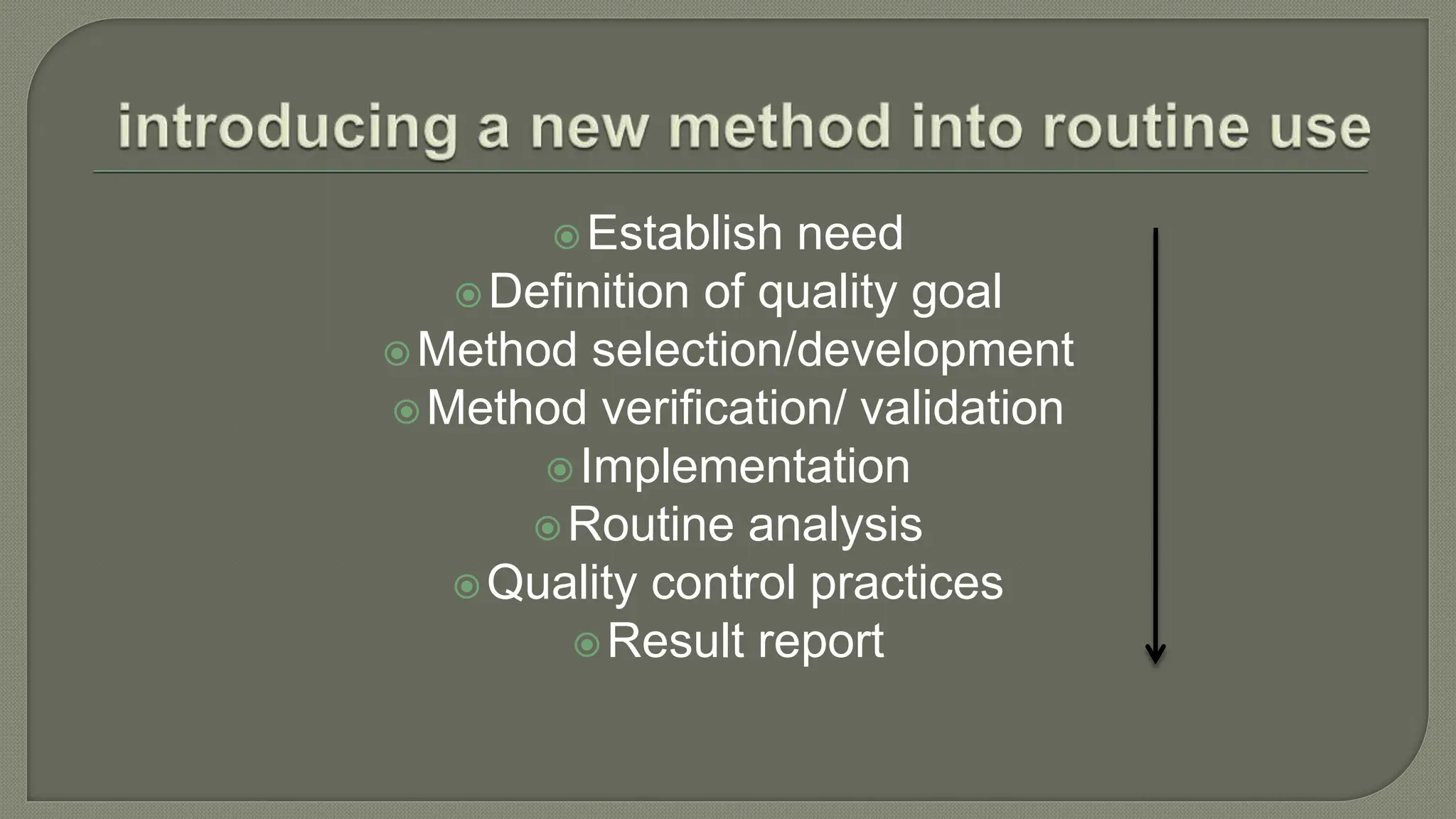
Establish need
Definition of quality goal
Method selection/development
Method verification/ validation
Implementation
Routine analysis
Quality control practices
Result report
water quality, calibration of analytical balances, calibration
of volumetric glassware and pipettes etc
should be monitored on a laboratory-wide basis
because they will affect many of the methods used in the
laboratory
initial evaluation of a method often takes place in a setting
somewhat more idealized than the production setting
it is desirable to have a startup laboratory before test
results are to be reported.
This period allows time to (1) discover any additional
problems,
(2) develop maintenance programs that alleviate those
problems, and
(3) train a sufficient number of analysts to support the
routine service operation.
Measure of degree to which a curve approximates a
straight line
Refers to overall system response
An attribute that is distinct for accuracy and precision
Measured by testing levels of an analyte that are known
relative to each other
When results are plotted against these values the degree
of curve’s comformance to straight line
Using samples containing analyte at 5 diff concentration
levels in 3x
A plot of signals is created, usually by means of
regression line
Correlation coefficient, y-intercept, slope, and residual
sum of squares must be calculated.
Several methods are available
application of an analytical procedure to an analyte of
known purity (e.g. reference material)
comparison of the results of the proposed analytical
procedure with those of a second well-characterised
procedure,
the accuracy of which is stated and/or defined
2 results must be compared
accuracy may be inferred once precision, linearity and
specificity have been established.
Repeatability –
A min. 9 determinations covering specified range of
procedure (3 concentrations / 3 replicates)
A min. 6 determinations at 100% of the test concentration
(the theoretical concentration of a testing substance when
you prepare a test solution)
Reproducibility –
By inter-laboratory trials (testing same sample by many
laboratories)
Standardization of an analytical procedure
Tietz textbook of Clinical chemistry and molecular
diagnostics
Wikipedia.org
Slideshare.net
Other internet resources

Method Selection - Selection of a prospective method for day to day laboratory use

  • 1.
    Karthik G KamathK Associate Professor Department of Biochemistry
  • 2.
    Optimal method selectioninvolves consideration of medical need, analytical performance, and practical criteria
  • 3.
    In evaluation ofthe performance characteristics of a candidate method (1) precision, (2) accuracy (trueness), (3) analytical range, (4) detection limit, and (5) analytical specificity are of prime importance.
  • 4.
    Establish need Definition ofquality goal Method selection/development Method verification/ validation Implementation Routine analysis Quality control practices Result report
  • 5.
    water quality, calibrationof analytical balances, calibration of volumetric glassware and pipettes etc should be monitored on a laboratory-wide basis because they will affect many of the methods used in the laboratory
  • 6.
    initial evaluation ofa method often takes place in a setting somewhat more idealized than the production setting
  • 7.
    it is desirableto have a startup laboratory before test results are to be reported. This period allows time to (1) discover any additional problems, (2) develop maintenance programs that alleviate those problems, and (3) train a sufficient number of analysts to support the routine service operation.
  • 8.
    Measure of degreeto which a curve approximates a straight line Refers to overall system response An attribute that is distinct for accuracy and precision Measured by testing levels of an analyte that are known relative to each other When results are plotted against these values the degree of curve’s comformance to straight line
  • 9.
    Using samples containinganalyte at 5 diff concentration levels in 3x A plot of signals is created, usually by means of regression line Correlation coefficient, y-intercept, slope, and residual sum of squares must be calculated.
  • 10.
    Several methods areavailable application of an analytical procedure to an analyte of known purity (e.g. reference material) comparison of the results of the proposed analytical procedure with those of a second well-characterised procedure, the accuracy of which is stated and/or defined 2 results must be compared accuracy may be inferred once precision, linearity and specificity have been established.
  • 11.
    Repeatability – A min.9 determinations covering specified range of procedure (3 concentrations / 3 replicates) A min. 6 determinations at 100% of the test concentration (the theoretical concentration of a testing substance when you prepare a test solution)
  • 12.
    Reproducibility – By inter-laboratorytrials (testing same sample by many laboratories) Standardization of an analytical procedure
  • 13.
    Tietz textbook ofClinical chemistry and molecular diagnostics Wikipedia.org Slideshare.net Other internet resources