PREPARED BY:-
AKSHITA SAXENA
ANUSHA SRIVASTAVA
S.MEGHANA
RISHIKA
SUPRIYA KACHHAP
INTRODUCTION
STRUCTURE
CLASSIFICATION OF METHANE HYDRATES
SOURCES AND RESERVES IN INDIA
EXTRACTION
CHALLENGES FACED
POTENTIAL IN FUTURE
APPLICATIONS
REFERENCES
What is methane hydrate
molecule?
When gas molecules are trapped in a lattice of water
molecules at temperature above zero degree celsius
and pressures above 1 atmosphere, they can form
stable solid. These solids are methane hydrates.
Sources of methane hydrate :-
Methane exist in the sea floor and arctic permafrost.
Uses:-
Methane hydrate is frozen natural gas and it is
currently estimated that there are far more energy
trapped in methane hydrate deposit than in all
known reserves of oil , gas and coal .
Forms a structure of hydrate with
two dodecahedral[12 vertices, thus
12 water molecules] and 6 tetra-
-decahedral[14 water molecules]
water cages per unit cell
A crystalline solid which consist of
methane molecule surrounded by a
cage of water molecules.
Stabilised by the gas molecule
with the cage of water molecules.
Formula:-
[4CH4.23H2O] OR
(CH4)8(H2O)46
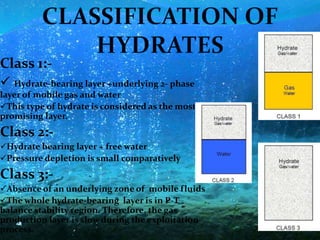
Class 1:-
 Hydrate-bearing layer +underlying 2- phase
layer of mobile gas and water
This type of hydrate is considered as the most
promising layer.
Class 2:-
Hydrate bearing layer + free water
Pressure depletion is small comparatively
Class 3:-
Absence of an underlying zone of mobile fluids
The whole hydrate-bearing layer is in P-T
balance stability region. Therefore, the gas
production layer is slow during the exploitation
process.
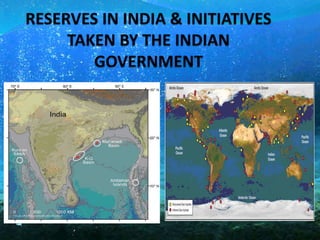
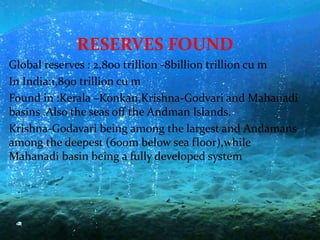
RESERVES FOUND
Global reserves : 2,800 trillion -8billion trillion cu m
In India:1,890 trillion cu m
Found in :Kerala –Konkan,Krishna-Godvari and Mahanadi
basins .Also the seas off the Andman Islands.
Krishna-Godavari being among the largest and Andamans
among the deepest (600m below sea floor),while
Mahanadi basin being a fully developed system
CURRENT PLANS ON GAS HYDRATES
National Gas Hydrate Programme (NGHP):
For exploration and development of gas hydrates resources of
the country
NGHP MoU with USDOE (United States Department Of Energy ):
To facilitate NGHP and USDOE scientists in data collection
,analysis and identification of sites for pilot production testing .
National Institute of Oceanography(NIO) and Japan
Agency for Marine –Earth and Science Technology will be
carrying out a joint survey using a Japanese drilling machine.
Geological Survey of India (GSI) and NIO : to locate gas
hydrate reserves off the East –Coast.
Ministry Of Earth Sciences (MoES) has received an
allowance of Rupees 1179 crore for research work including
research on gas hydrates.
Hydrocarbon Exploration and Licensing Policy :provides uniform
license for exploration and production of all forms of
conventional as well as unconventional oil and gas
EXTRACTION
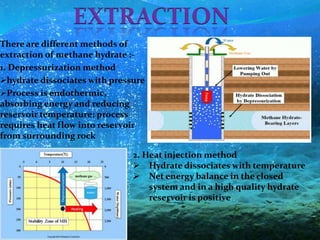
There are different methods of
extraction of methane hydrate :-
1. Depressurization method
hydrate dissociates with pressure
Process is endothermic,
absorbing energy and reducing
reservoir temperature; process
requires heat flow into reservoir
from surrounding rock
2. Heat injection method
 Hydrate dissociates with temperature
 Net energy balance in the closed
system and in a high quality hydrate
reservoir is positive
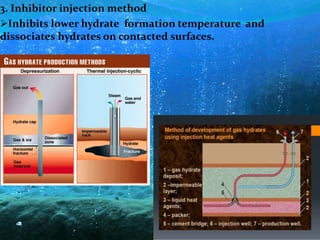
3. Inhibitor injection method
Inhibits lower hydrate formation temperature and
dissociates hydrates on contacted surfaces.
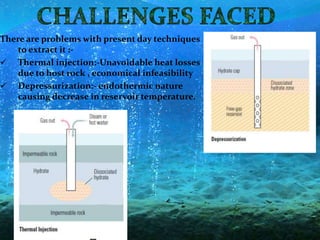
There are problems with present day techniques
to extract it :-
 Thermal injection:-Unavoidable heat losses
due to host rock , economical infeasibility
 Depressurization:- endothermic nature
causing decrease in reservoir temperature.
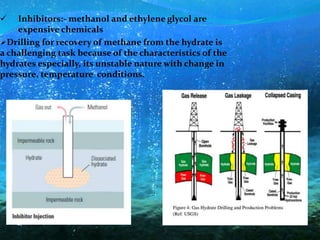
 Inhibitors:- methanol and ethylene glycol are
expensive chemicals
Drilling for recovery of methane from the hydrate is
a challenging task because of the characteristics of the
hydrates especially, its unstable nature with change in
pressure, temperature conditions.
HIGHLY CONCENTRATED METHANE
PRODUCED
1 UNIT OF GAS HYDRATES GIVE ABOUT 160
UNIT VOL OF METHANE
1 UNIT OFMETHANE IN GAS HYDRATES GIVE
ABOUT 1X10⁴ GIGATONS OF CARBON
Wikipedia.org/wiki/Methane_clathrate
Japantimes.co.jp/news/2014/12/25/business/ec
onomy-business/methane-hydrate-extracted-
sea-japan
mh21japan.gr.jp/english/mh21-1/3-2/
Methane hydrate ppt

Methane hydrate ppt

  • 2.
    PREPARED BY:- AKSHITA SAXENA ANUSHASRIVASTAVA S.MEGHANA RISHIKA SUPRIYA KACHHAP
  • 3.
    INTRODUCTION STRUCTURE CLASSIFICATION OF METHANEHYDRATES SOURCES AND RESERVES IN INDIA EXTRACTION CHALLENGES FACED POTENTIAL IN FUTURE APPLICATIONS REFERENCES
  • 4.
    What is methanehydrate molecule? When gas molecules are trapped in a lattice of water molecules at temperature above zero degree celsius and pressures above 1 atmosphere, they can form stable solid. These solids are methane hydrates. Sources of methane hydrate :- Methane exist in the sea floor and arctic permafrost. Uses:- Methane hydrate is frozen natural gas and it is currently estimated that there are far more energy trapped in methane hydrate deposit than in all known reserves of oil , gas and coal .
  • 5.
    Forms a structureof hydrate with two dodecahedral[12 vertices, thus 12 water molecules] and 6 tetra- -decahedral[14 water molecules] water cages per unit cell A crystalline solid which consist of methane molecule surrounded by a cage of water molecules. Stabilised by the gas molecule with the cage of water molecules. Formula:- [4CH4.23H2O] OR (CH4)8(H2O)46
  • 6.
    Class 1:-  Hydrate-bearinglayer +underlying 2- phase layer of mobile gas and water This type of hydrate is considered as the most promising layer. Class 2:- Hydrate bearing layer + free water Pressure depletion is small comparatively Class 3:- Absence of an underlying zone of mobile fluids The whole hydrate-bearing layer is in P-T balance stability region. Therefore, the gas production layer is slow during the exploitation process.
  • 8.
    RESERVES FOUND Global reserves: 2,800 trillion -8billion trillion cu m In India:1,890 trillion cu m Found in :Kerala –Konkan,Krishna-Godvari and Mahanadi basins .Also the seas off the Andman Islands. Krishna-Godavari being among the largest and Andamans among the deepest (600m below sea floor),while Mahanadi basin being a fully developed system
  • 9.
    CURRENT PLANS ONGAS HYDRATES National Gas Hydrate Programme (NGHP): For exploration and development of gas hydrates resources of the country NGHP MoU with USDOE (United States Department Of Energy ): To facilitate NGHP and USDOE scientists in data collection ,analysis and identification of sites for pilot production testing . National Institute of Oceanography(NIO) and Japan Agency for Marine –Earth and Science Technology will be carrying out a joint survey using a Japanese drilling machine. Geological Survey of India (GSI) and NIO : to locate gas hydrate reserves off the East –Coast. Ministry Of Earth Sciences (MoES) has received an allowance of Rupees 1179 crore for research work including research on gas hydrates. Hydrocarbon Exploration and Licensing Policy :provides uniform license for exploration and production of all forms of conventional as well as unconventional oil and gas
  • 10.
    EXTRACTION There are differentmethods of extraction of methane hydrate :- 1. Depressurization method hydrate dissociates with pressure Process is endothermic, absorbing energy and reducing reservoir temperature; process requires heat flow into reservoir from surrounding rock 2. Heat injection method  Hydrate dissociates with temperature  Net energy balance in the closed system and in a high quality hydrate reservoir is positive
  • 11.
    3. Inhibitor injectionmethod Inhibits lower hydrate formation temperature and dissociates hydrates on contacted surfaces.
  • 12.
    There are problemswith present day techniques to extract it :-  Thermal injection:-Unavoidable heat losses due to host rock , economical infeasibility  Depressurization:- endothermic nature causing decrease in reservoir temperature.
  • 13.
     Inhibitors:- methanoland ethylene glycol are expensive chemicals Drilling for recovery of methane from the hydrate is a challenging task because of the characteristics of the hydrates especially, its unstable nature with change in pressure, temperature conditions.
  • 14.
    HIGHLY CONCENTRATED METHANE PRODUCED 1UNIT OF GAS HYDRATES GIVE ABOUT 160 UNIT VOL OF METHANE 1 UNIT OFMETHANE IN GAS HYDRATES GIVE ABOUT 1X10⁴ GIGATONS OF CARBON
  • 17.