PRESENTED BY:
ARPIT I. POUNIKAR-(500089073)
DEVESH R. UMREDKAR-(500089769)
PUSHPAK R. LAKHE-(500089772)
CONTENTS
 INTRODUCTION
 WORLDWIDE OCCURENCE
 GAS HYDRATES IMAGES
 PHASE DIAGRAM
 TECHNIQUE FOR EXTRACTION
 MAJOR PLAYERS
 CHALLENGES
 PROBLEMS
 POLICIES
 FUTURE OF GAS HYDRATES
 REFERENCES
INTRODUCTION
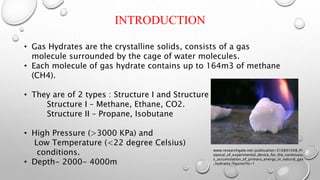
• Gas Hydrates are the crystalline solids, consists of a gas
molecule surrounded by the cage of water molecules.
• Each molecule of gas hydrate contains up to 164m3 of methane
(CH4).
• They are of 2 types : Structure I and Structure II.
Structure I – Methane, Ethane, CO2.
Structure II – Propane, Isobutane
• High Pressure (>3000 KPa) and
Low Temperature (<22 degree Celsius)
conditions.
• Depth- 2000- 4000m
www.researchgate.net/publication/316891048_Pr
oposal_of_experimental_device_for_the_continuou
s_accumulation_of_primary_energy_in_natural_gas
_hydrates/figures?lo=1
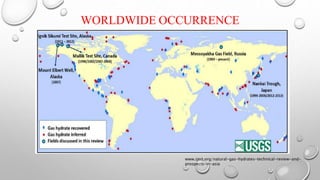
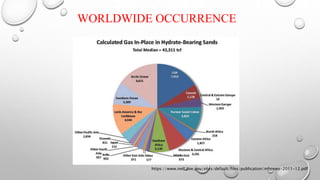
WORLDWIDE OCCURRENCE
www.ijert.org/natural-gas-hydrates-technical-review-and-
prospects-in-asia
https://www.netl.doe.gov/sites/default/files/publication/mhnews-2011-12.pdf
WORLDWIDE OCCURRENCE
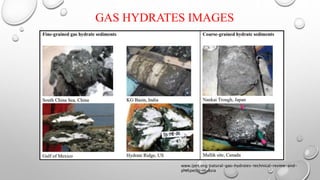
GAS HYDRATES IMAGES
www.ijert.org/natural-gas-hydrates-technical-review-and-
prospects-in-asia
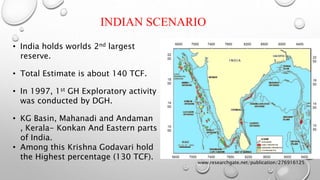
INDIAN SCENARIO
• India holds worlds 2nd largest
reserve.
• Total Estimate is about 140 TCF.
• In 1997, 1st GH Exploratory activity
was conducted by DGH.
• KG Basin, Mahanadi and Andaman
, Kerala- Konkan And Eastern parts
of India.
• Among this Krishna Godavari hold
the Highest percentage (130 TCF).
www.researchgate.net/publication/276916125
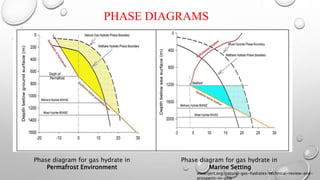
PHASE DIAGRAMS
www.ijert.org/natural-gas-hydrates-technical-review-and-
prospects-in-asia
Phase diagram for gas hydrate in
Permafrost Environment
Phase diagram for gas hydrate in
Marine Setting
TECHNIQUES FOR EXTRACTION
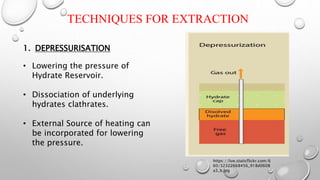
1. DEPRESSURISATION
• Lowering the pressure of
Hydrate Reservoir.
• Dissociation of underlying
hydrates clathrates.
• External Source of heating can
be incorporated for lowering
the pressure.
https://live.staticflickr.com/6
60/32322668456_918d0608
a3_b.jpg
TECHNIQUES FOR EXTRACTION
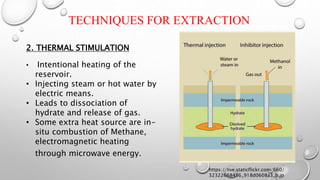
2. THERMAL STIMULATION
• Intentional heating of the
reservoir.
• Injecting steam or hot water by
electric means.
• Leads to dissociation of
hydrate and release of gas.
• Some extra heat source are in-
situ combustion of Methane,
electromagnetic heating
through microwave energy.
https://live.staticflickr.com/660/
32322668456_918d0608a3_b.jp
TECHNIQUES FOR EXTRACTION
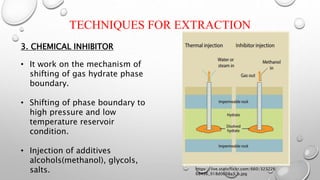
3. CHEMICAL INHIBITOR
• It work on the mechanism of
shifting of gas hydrate phase
boundary.
• Shifting of phase boundary to
high pressure and low
temperature reservoir
condition.
• Injection of additives
alcohols(methanol), glycols,
salts. https://live.staticflickr.com/660/323226
68456_918d0608a3_b.jpg
TECHNIQUES FOR EXTRACTION
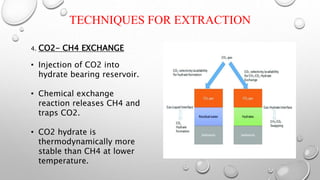
4. CO2- CH4 EXCHANGE
• Injection of CO2 into
hydrate bearing reservoir.
• Chemical exchange
reaction releases CH4 and
traps CO2.
• CO2 hydrate is
thermodynamically more
stable than CH4 at lower
temperature.
PROBLEMS
• Thermal Injection - Unavoidable heat loss due to
host rock.
• Depressurization - Endothermic nature causing
decrease in reservoir temperature.
• Inhibitors - Methanol and ethylene glycol are
expensive chemicals.
MAJOR PLAYERS IN GAS HYDRATE PRODUCTION
Some of the leading gas hydrates manufacturers include:
• Global Oil & Gas AG
• PetroChina
• Royal Dutch Shell
• Sinopec
• Total SA
• Valero Energy
• Marathon Petroleum Corporate
• Chevron
• Woodside Inc.
CHALLENGES
• Economic Challenges-
1. R&D program for gas hydrate requires high cost for extraction as it
will be only viable when conventional Hydrocarbon price increases.
2. Deep water and artic location cost more expenses and have high risk.
• Environmental Challenges-
1. Methane emission causes Global Warming and climate change.
2. Shallow depth hydrate deposits cause more ocean warming which
leads to climate change.
• Produced Water Disposal-
1. As produced water is contaminated , it should be treated properly.
2. This water can impact health and environmental hazard.
POLICIES
1. Open Acreage Licensing Policy (OALP)- This enables companies
to bid for oil and gas blocks without waiting for announcement
of Bidding.
2. Uniform Licensing Policy (ULP)- Both Unconventional and
Conventional resources can be exploited under same license
under Oilfields Regulation & Development (ORD) Act,1984.
3. National Exploration Licensing Policy(NELP)- It focuses on the
Foreign Direct Investment (FDI) in exploration & production
activities.
4. Hydrocarbon Exploration & Licensing Policy (HELP)- Single
License for all Hydrocarbon, Revenue Sharing Model stepping
towards improving the “Ease of Doing Business” in Indian E&P
Sector.
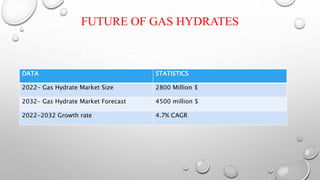
FUTURE OF GAS HYDRATES
DATA STATISTICS
2022- Gas Hydrate Market Size 2800 Million $
2032- Gas Hydrate Market Forecast 4500 million $
2022-2032 Growth rate 4.7% CAGR
REFERENCES
• www.usgs.gov/centers/central-energy-resources-science-
center/science/gas-hydrates
• www.sciencedirect.com/topics/earth-and-planetary-sciences/gas-
hydrate
• dghindia.org/index.php/page?pageId=39
• www.ndrdgh.gov.in/NDR/?page_id=11604
• spgindia.org/2010/141.pdf
• USGS. U.S. geological survey gas hydrates project
• www.researchgate.net/publication/343548107_Gas_Hydrates_in_Indi
a_-_Origin_Distribution_and_Economic_Potential
• https://www.slideshare.net/abhitgarg/gas-hydrates-69497564
• https://www.netl.doe.gov/sites/default/files/publication/mhnews-
2011-12.pdf
GAS HYDRATES.pptx

GAS HYDRATES.pptx

  • 1.
    PRESENTED BY: ARPIT I.POUNIKAR-(500089073) DEVESH R. UMREDKAR-(500089769) PUSHPAK R. LAKHE-(500089772)
  • 2.
    CONTENTS  INTRODUCTION  WORLDWIDEOCCURENCE  GAS HYDRATES IMAGES  PHASE DIAGRAM  TECHNIQUE FOR EXTRACTION  MAJOR PLAYERS  CHALLENGES  PROBLEMS  POLICIES  FUTURE OF GAS HYDRATES  REFERENCES
  • 3.
    INTRODUCTION • Gas Hydratesare the crystalline solids, consists of a gas molecule surrounded by the cage of water molecules. • Each molecule of gas hydrate contains up to 164m3 of methane (CH4). • They are of 2 types : Structure I and Structure II. Structure I – Methane, Ethane, CO2. Structure II – Propane, Isobutane • High Pressure (>3000 KPa) and Low Temperature (<22 degree Celsius) conditions. • Depth- 2000- 4000m www.researchgate.net/publication/316891048_Pr oposal_of_experimental_device_for_the_continuou s_accumulation_of_primary_energy_in_natural_gas _hydrates/figures?lo=1
  • 4.
  • 5.
  • 6.
  • 7.
    INDIAN SCENARIO • Indiaholds worlds 2nd largest reserve. • Total Estimate is about 140 TCF. • In 1997, 1st GH Exploratory activity was conducted by DGH. • KG Basin, Mahanadi and Andaman , Kerala- Konkan And Eastern parts of India. • Among this Krishna Godavari hold the Highest percentage (130 TCF). www.researchgate.net/publication/276916125
  • 8.
    PHASE DIAGRAMS www.ijert.org/natural-gas-hydrates-technical-review-and- prospects-in-asia Phase diagramfor gas hydrate in Permafrost Environment Phase diagram for gas hydrate in Marine Setting
  • 9.
    TECHNIQUES FOR EXTRACTION 1.DEPRESSURISATION • Lowering the pressure of Hydrate Reservoir. • Dissociation of underlying hydrates clathrates. • External Source of heating can be incorporated for lowering the pressure. https://live.staticflickr.com/6 60/32322668456_918d0608 a3_b.jpg
  • 10.
    TECHNIQUES FOR EXTRACTION 2.THERMAL STIMULATION • Intentional heating of the reservoir. • Injecting steam or hot water by electric means. • Leads to dissociation of hydrate and release of gas. • Some extra heat source are in- situ combustion of Methane, electromagnetic heating through microwave energy. https://live.staticflickr.com/660/ 32322668456_918d0608a3_b.jp
  • 11.
    TECHNIQUES FOR EXTRACTION 3.CHEMICAL INHIBITOR • It work on the mechanism of shifting of gas hydrate phase boundary. • Shifting of phase boundary to high pressure and low temperature reservoir condition. • Injection of additives alcohols(methanol), glycols, salts. https://live.staticflickr.com/660/323226 68456_918d0608a3_b.jpg
  • 12.
    TECHNIQUES FOR EXTRACTION 4.CO2- CH4 EXCHANGE • Injection of CO2 into hydrate bearing reservoir. • Chemical exchange reaction releases CH4 and traps CO2. • CO2 hydrate is thermodynamically more stable than CH4 at lower temperature.
  • 13.
    PROBLEMS • Thermal Injection- Unavoidable heat loss due to host rock. • Depressurization - Endothermic nature causing decrease in reservoir temperature. • Inhibitors - Methanol and ethylene glycol are expensive chemicals.
  • 14.
    MAJOR PLAYERS INGAS HYDRATE PRODUCTION Some of the leading gas hydrates manufacturers include: • Global Oil & Gas AG • PetroChina • Royal Dutch Shell • Sinopec • Total SA • Valero Energy • Marathon Petroleum Corporate • Chevron • Woodside Inc.
  • 15.
    CHALLENGES • Economic Challenges- 1.R&D program for gas hydrate requires high cost for extraction as it will be only viable when conventional Hydrocarbon price increases. 2. Deep water and artic location cost more expenses and have high risk. • Environmental Challenges- 1. Methane emission causes Global Warming and climate change. 2. Shallow depth hydrate deposits cause more ocean warming which leads to climate change. • Produced Water Disposal- 1. As produced water is contaminated , it should be treated properly. 2. This water can impact health and environmental hazard.
  • 16.
    POLICIES 1. Open AcreageLicensing Policy (OALP)- This enables companies to bid for oil and gas blocks without waiting for announcement of Bidding. 2. Uniform Licensing Policy (ULP)- Both Unconventional and Conventional resources can be exploited under same license under Oilfields Regulation & Development (ORD) Act,1984. 3. National Exploration Licensing Policy(NELP)- It focuses on the Foreign Direct Investment (FDI) in exploration & production activities. 4. Hydrocarbon Exploration & Licensing Policy (HELP)- Single License for all Hydrocarbon, Revenue Sharing Model stepping towards improving the “Ease of Doing Business” in Indian E&P Sector.
  • 17.
    FUTURE OF GASHYDRATES DATA STATISTICS 2022- Gas Hydrate Market Size 2800 Million $ 2032- Gas Hydrate Market Forecast 4500 million $ 2022-2032 Growth rate 4.7% CAGR
  • 18.
    REFERENCES • www.usgs.gov/centers/central-energy-resources-science- center/science/gas-hydrates • www.sciencedirect.com/topics/earth-and-planetary-sciences/gas- hydrate •dghindia.org/index.php/page?pageId=39 • www.ndrdgh.gov.in/NDR/?page_id=11604 • spgindia.org/2010/141.pdf • USGS. U.S. geological survey gas hydrates project • www.researchgate.net/publication/343548107_Gas_Hydrates_in_Indi a_-_Origin_Distribution_and_Economic_Potential • https://www.slideshare.net/abhitgarg/gas-hydrates-69497564 • https://www.netl.doe.gov/sites/default/files/publication/mhnews- 2011-12.pdf