Variability causes in Meiosis
1. Crossing over
3.Separation of sister
Chromatides during ANAPHASE II
2.Homologous Chromosomes
Separation during ANAPHASE I
**
p
q
Arm
Arm
The Centromere divides
each Chromatid in two
arms than can be equal
or different.
METAPHASIC CHROMOSOME STRUCTURE
Metacentric
p
q
Near the middle off Centre near one end at the end
Because the Centromere is not exactly in the centre of a Chromosome, each
chromosome has a sort arm and a long arm.
The short arm is designated with the letter p (for the French petite)
While the long arm is designated with q.
Metacentric
p
q
Near the middle off Centre near one end at the end
In Human Beings do not exist Telocentric Chromosomes
Metacentric
To classify the Human Chromosomes following the Centromeric location
we have to use The Chromosomic Indexes:
They are used to classify human chromosomes.
p
q
p
q
A photography of the
Metaphasic Chromosomes.
Without order.
Ordered Chromosomes
following Cytogenetic
Criteria.
G
BANDS
Types of banding
G-Banding is obtained with
Giemsa stain following
digestion of chromosomes
with trypsin. It yields a
series of light and dark
bands - the dark regions
tend to be
heterochromatic,
(DNA more condensed) and
AT rich. The light regions
tend to be euchromatic,
(Less condensed)and GC
rich. This method will
normally produce 300-400
bands in a normal, human
genome
PAINTING CHROMOSOMES USING SPECIFIC SOFTWARE
Phytohemagglutinin
In medicine this protein is useful and is used as a
mitogen to trigger lymphocytes cell division
BLOOD OR
BONE NARROW
Colchicine to stop Mitosis
Phytohemagglutinin
In medicine this protein is useful and is used as
a mitogen to trigger lymphocytes cell division
Colchicine is got from Colchicum autumnale.
Colchicine stops Mitosis in Metaphase.
To classify Chromosomes we use
three main criteria:
**
**
**
. For example,
.
Phytohemagglutinin
In medicine this protein is useful and is used as a
mitogen to trigger lymphocytes cell division
Amniocentesis
Chorionic villi Sampling
Amniocentesis
Chorionic villi Sampling
From fifteenth to seventeenth
week of pregnancy
From eighth to twelfth week of pregnancy
Risk of
Spontaneous
abortion 0.3%
Risk of
Spontaneous
abortion 0.8 %
Risk of Spontaneous
abortion 0.8 %
Risk of Spontaneous
abortion 0.8 %
From fifteenth to
seventeenth week of
pregnancy
Risk of
Spontaneous
abortion 0.3%
In human Beings , the Euploid
condition is two sets of 23
Chromosomes each; 46
Chromosomes.
The somatic cells are Diploid
Organisms with three or more sets of
Chromosomes are called POLYPLOID.
A Diploid organism is referred to as 2n, a Triploid
organism as 3n, a Tetraploid organism as 4n, and
so forth. Haploid individuals or cells are referred
as n.(only a set of chromosomes).
In Human beings Poliploids individuals are
extremely rare and only these individuals have
been got in abortions.
Observe the following figures because they are
cases of Triploid Human beings.
At A the Strawberry plant is exposed to a chemical called
Colchicine. At B due tho the effect of the drug, total no disjunction
produced Diploid gametes(2n). As a result, at C two Diploid gametes
fuse at fertilization . Finally at D a new polyploid plant is formed
Observe.........................
Julia Sáenz Hurtado
Servicio de Inmunología. Sección Genética
Hospital Infanta Cristina
Julia Sáenz Hurtado
Servicio de Inmunología. Sección Genética
Hospital Infanta Cristina
Observe again
The second way that chromosomes number varies
is a phenomenon called .
This refers to an alteration in the number of
particular Chromosomes, so that the total number
of chromosomes is not an exact multiple of a set.
In human beings Aneuploid individuals have a
chromosome number that is not an exact multiple
of the haploid number of 23.
The normal condition is the DISOMY (Two
chromosomes in a pair) but the abnormal condition
may be:
Normal Condition
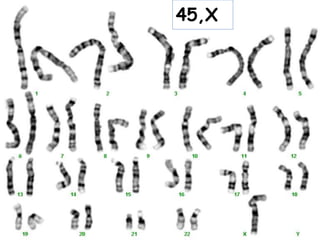
Embryos missing a chromosome usually die; hence,monosomy of
an autosome is extremely rare in living persons. About 97 % of
embryos lacking a sex chromosome also die, but some survive
and develop characteristics of TURNER SYNDROME or
XO.
45,X
TURNER SYNDROME
TURNER SYNDROME
LINDA HUNT
Meiosis Review
1. REDUCTION OF NUMBER
OF CHROMOSOMES BY
HALF
2.Meiosis only occurs
in germ cells.
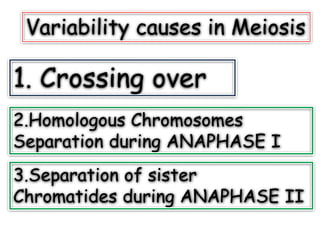
Variability causes in Meiosis
1. Crossing over
3.Separation of sister
Chromatides during ANAPHASE II
2.Homologous Chromosomes
Separation during ANAPHASE I
1. Crossing over
Exchange of Genetic Material between
Homologous Chromosomes
2.Homologous
Chromosomes
Separation during
ANAPHASE I
Either
or
A B
A B
A1
A2
A1 A2
A3 A4 A3
A4
ANAPHASE II
3.Separation of sister Chromatides during
ANAPHASE II
p
q
Sister Chromatids
Each one is a
Molecule of DNA
Arm
Arm
The Centromere divides
each Chromatid in two
arms than can be equal
or different.
METAPHASIC CHROMOSOME STRUCTURE
Based on Centromere location, each chromosome
is classified as:
Metacentric
p
q
Comparison of centromeric locations
Near the middle off Centre near one end at the end
To classify Chromosomes we use
three main criteria:
**
**
**
. For example,
.
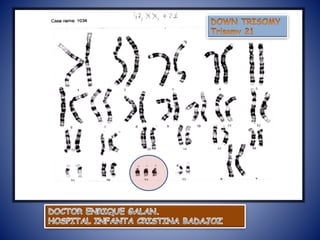
If three chromosomes are present instead of the usual pair.
The common cause of Trisomy is nondisjunction (no Homologous
separation) during the Meiosis(special division that suffer the
gametes).The result is a gamete (Ovum or Sperm) with 24
Chromosomes instead of 23 Chromosomes and, after the
fertilization the result is a Zygote with 47 chromosomes.
IMPORTANT: Autosomal Trisomies occur with
increasing frequency as maternal age
increases.
Nondisjunction DURING MEIOSIS
Translocation Down syndrome occurs when two
chromosomes, one of which must be a 21, join together
at their ends. Instead of having three independent,
separate number 21 chromosomes, a person with
translocation Down syndrome has two independent 21
chromosomes and a 21 chromosome that is attached to
another chromosome.
Observe as examples the Idiograms with a Tranlocation
21:21 and a Translocation 21:14.
Simian Crease
Simian Crease

biologia6

  • 4.
    Variability causes inMeiosis 1. Crossing over 3.Separation of sister Chromatides during ANAPHASE II 2.Homologous Chromosomes Separation during ANAPHASE I
  • 7.
  • 8.
    p q Arm Arm The Centromere divides eachChromatid in two arms than can be equal or different. METAPHASIC CHROMOSOME STRUCTURE
  • 9.
    Metacentric p q Near the middleoff Centre near one end at the end Because the Centromere is not exactly in the centre of a Chromosome, each chromosome has a sort arm and a long arm. The short arm is designated with the letter p (for the French petite) While the long arm is designated with q.
  • 10.
    Metacentric p q Near the middleoff Centre near one end at the end In Human Beings do not exist Telocentric Chromosomes
  • 11.
    Metacentric To classify theHuman Chromosomes following the Centromeric location we have to use The Chromosomic Indexes:
  • 12.
    They are usedto classify human chromosomes.
  • 13.
    They are usedto classify human chromosomes. p q
  • 15.
  • 16.
    A photography ofthe Metaphasic Chromosomes. Without order. Ordered Chromosomes following Cytogenetic Criteria.
  • 20.
  • 21.
    Types of banding G-Bandingis obtained with Giemsa stain following digestion of chromosomes with trypsin. It yields a series of light and dark bands - the dark regions tend to be heterochromatic, (DNA more condensed) and AT rich. The light regions tend to be euchromatic, (Less condensed)and GC rich. This method will normally produce 300-400 bands in a normal, human genome
  • 25.
    PAINTING CHROMOSOMES USINGSPECIFIC SOFTWARE
  • 33.
    Phytohemagglutinin In medicine thisprotein is useful and is used as a mitogen to trigger lymphocytes cell division
  • 34.
  • 36.
  • 37.
    Phytohemagglutinin In medicine thisprotein is useful and is used as a mitogen to trigger lymphocytes cell division
  • 38.
    Colchicine is gotfrom Colchicum autumnale. Colchicine stops Mitosis in Metaphase.
  • 39.
    To classify Chromosomeswe use three main criteria: ** ** ** . For example, .
  • 40.
    Phytohemagglutinin In medicine thisprotein is useful and is used as a mitogen to trigger lymphocytes cell division
  • 41.
  • 42.
    Amniocentesis Chorionic villi Sampling Fromfifteenth to seventeenth week of pregnancy From eighth to twelfth week of pregnancy Risk of Spontaneous abortion 0.3% Risk of Spontaneous abortion 0.8 %
  • 43.
  • 44.
  • 45.
    From fifteenth to seventeenthweek of pregnancy Risk of Spontaneous abortion 0.3%
  • 46.
    In human Beings, the Euploid condition is two sets of 23 Chromosomes each; 46 Chromosomes. The somatic cells are Diploid
  • 47.
    Organisms with threeor more sets of Chromosomes are called POLYPLOID. A Diploid organism is referred to as 2n, a Triploid organism as 3n, a Tetraploid organism as 4n, and so forth. Haploid individuals or cells are referred as n.(only a set of chromosomes). In Human beings Poliploids individuals are extremely rare and only these individuals have been got in abortions. Observe the following figures because they are cases of Triploid Human beings.
  • 48.
    At A theStrawberry plant is exposed to a chemical called Colchicine. At B due tho the effect of the drug, total no disjunction produced Diploid gametes(2n). As a result, at C two Diploid gametes fuse at fertilization . Finally at D a new polyploid plant is formed
  • 49.
    Observe......................... Julia Sáenz Hurtado Serviciode Inmunología. Sección Genética Hospital Infanta Cristina
  • 50.
    Julia Sáenz Hurtado Serviciode Inmunología. Sección Genética Hospital Infanta Cristina Observe again
  • 51.
    The second waythat chromosomes number varies is a phenomenon called . This refers to an alteration in the number of particular Chromosomes, so that the total number of chromosomes is not an exact multiple of a set. In human beings Aneuploid individuals have a chromosome number that is not an exact multiple of the haploid number of 23. The normal condition is the DISOMY (Two chromosomes in a pair) but the abnormal condition may be:
  • 52.
    Normal Condition Embryos missinga chromosome usually die; hence,monosomy of an autosome is extremely rare in living persons. About 97 % of embryos lacking a sex chromosome also die, but some survive and develop characteristics of TURNER SYNDROME or XO.
  • 53.
  • 54.
  • 55.
  • 56.
    Meiosis Review 1. REDUCTIONOF NUMBER OF CHROMOSOMES BY HALF 2.Meiosis only occurs in germ cells.
  • 57.
    Variability causes inMeiosis 1. Crossing over 3.Separation of sister Chromatides during ANAPHASE II 2.Homologous Chromosomes Separation during ANAPHASE I
  • 58.
    1. Crossing over Exchangeof Genetic Material between Homologous Chromosomes
  • 59.
  • 60.
    A1 A2 A1 A2 A3 A4A3 A4 ANAPHASE II 3.Separation of sister Chromatides during ANAPHASE II
  • 61.
    p q Sister Chromatids Each oneis a Molecule of DNA Arm Arm The Centromere divides each Chromatid in two arms than can be equal or different. METAPHASIC CHROMOSOME STRUCTURE
  • 62.
    Based on Centromerelocation, each chromosome is classified as: Metacentric p q Comparison of centromeric locations Near the middle off Centre near one end at the end
  • 63.
    To classify Chromosomeswe use three main criteria: ** ** ** . For example, .
  • 64.
    If three chromosomesare present instead of the usual pair. The common cause of Trisomy is nondisjunction (no Homologous separation) during the Meiosis(special division that suffer the gametes).The result is a gamete (Ovum or Sperm) with 24 Chromosomes instead of 23 Chromosomes and, after the fertilization the result is a Zygote with 47 chromosomes. IMPORTANT: Autosomal Trisomies occur with increasing frequency as maternal age increases.
  • 65.
  • 67.
    Translocation Down syndromeoccurs when two chromosomes, one of which must be a 21, join together at their ends. Instead of having three independent, separate number 21 chromosomes, a person with translocation Down syndrome has two independent 21 chromosomes and a 21 chromosome that is attached to another chromosome. Observe as examples the Idiograms with a Tranlocation 21:21 and a Translocation 21:14.
  • 75.
  • 77.