Metamorphism is the transformation of existing rock (the protolith) into a new rock type through the application of heat, pressure, or both, causing changes in mineral composition and/or texture. The resulting rocks are called metamorphic rocks
Similar to Metamorphism is the transformation of existing rock (the protolith) into a new rock type through the application of heat, pressure, or both, causing changes in mineral composition and/or texture. The resulting rocks are called metamorphic rocks
PPTX
Metamorphic Rocks ( Definition - Classification - Common Rocks )
Metamorphism is the transformation of existing rock (the protolith) into a new rock type through the application of heat, pressure, or both, causing changes in mineral composition and/or texture. The resulting rocks are called metamorphic rocks
Metamorphic rocks
Form whena rock's mineral composition
and texture change because of
metamorphism.
Metamorphism
The transformation of pre-exiting rocks
without melting, because of heat, pressure,
and/or fluid activity, produces metamorphic
rocks.
3.
During metamorphism, Theoriginal
rock is subjected to temperatures
greater than 150 to 200 °C and, often,
elevated pressure of 100 megapascals
or more, causing profound physical or
chemical changes.
Metamorphism occurs below the
melting point in the solid state.
4.
The effects ofMetamorphism
1. Formation of new minerals
2. Changes in shape and size of
mineral grains
3. Development of new structures in
the rock.
5.
Measurements of metamorphismintensity
1.Metamorphic Grade:
the degree of metamorphic change a rock has
undergone, usually listed as low, intermediate, or high.
2.Index Minerals:
Index minerals form only at certain temperatures and
pressures.
The presence of these minerals helps geologists
determine the metamorphic grade, which is a measure
of how intense the metamorphism was
7.
Metamorphic Grades:
Low Grade:~200–400°C; low pressure
Rocks may still show original features (like bedding)
Common minerals: chlorite, muscovite
Medium Grade: ~400–600°C
More new minerals grow; foliation becomes more
pronounced
Common minerals: biotite, garnet
High Grade: ~600–800+°C; high pressure
Original minerals often completely replaced
Common minerals: sillimanite, kyanite
Effects of Heatingon Metamorphism
Sources of heat include:
1. Lava
2. Magma
3. Deep burial
• Heating causes increase in bond length,
distortion of bonds, breaking of bonds, and
formation of new bonds.
Temperature increases
with depth. The
geothermal gradient
averages about
25oC/km.
10.
Metamorphism and PlateTectonics
• Metamorphism can occur at divergent and convergent
boundaries.
• Divergent boundaries are characterized by hydrothermal
metamorphism.
• Contact and regional metamorphism are common at
convergent boundaries.
Figs. 7.28b, 7.27b
11.
Pressure and Metamorphism
Manymetamorphic rocks form under
conditions of differential pressure, which
influences the development of metamorphic
structures and textures in significant ways.
12.
Pressure and Metamorphism
1.Confining pressure acts on a rock equally in all directions.
2. Directed pressure acts more strongly in one direction than in
others.
13.
Fluids and RockComposition
Sources of metamorphic fluids are:
• Fluid trapped in sedimentary rock.
• Fluid introduced by tectonic and igneous
processes.
• Fluid expelled when minerals react.
Metamorphic fluids include water and carbon dioxide.
Kyanite schist (parent rock = mudstone)
Amphibolite (parent rock = basalt)
14.
Types of Metamorphism
Thereare six main types of metamorphism:
1. Regional metamorphism
2. Contact metamorphism
3. Dynamic metamorphism
4. Shock metamorphism
5. Hydrothermal metamorphism
6. Burial metamorphism
15.
Regional Metamorphism
Occurs whenlarge regions of crustal rocks are
subjected to elevated temperatures and pressures;
takes place during mountain-building
16.
Contact Metamorphism
• Occursin rocks that are heated by nearby magma.
• Contact metamorphism affects rocks over a small
area.
• The degree of metamorphism decreases with
distance from the magma chamber.
Fig. 7.10
17.
• Occurs alongfractures in Earth’s crust where
significant movement has taken. It is associated
with faulting zones
Dynamic Metamorphism
18.
Shock Metamorphism
• Producedby the high-velocity impact of a
meteorite or an asteroid on Earth’s surface.
The Barringer impact crater (Meteor Crater)
Arizona
Shock
metamorphism is
characterized by
distinctive, high-
pressure
minerals.
Occurs when sedimentary
rocksare buried deeply
and subjected to increased
heat and pressure from
overlying sediments.
Burial metamorphism is a
type of low-grade
metamorphism
Burial Metamorphism
During Moutain buildind
After Erosion
Metamorphic Textures
• Thefabric of a metamorphic rock describes the geometric
arrangement of mineral grains.
• Metamorphic rocks textures are:
1. Foliated
2. Non-Foliated
.
23.
Planar (layered) structureformed by the alignment
of minerals, usually due to differential pressure or
shear forces during metamorphism.
Foliation Texture
Foliated rocks are classified based on grain size
and foliation.
24.
Foliated Metamorphic Rocks
•Slate, phyllite, schist, and gneiss are the four main types of
foliated metamorphic rock.
• As metamorphic grade increases, grain size increases.
Fig. 7.16
25.
Nonfoliated textures donot exhibit preferred
orientation of minerals.
The minerals are randomly oriented.
Nonfoliated Metamorphic Rocks
26.
Nonfoliated Metamorphic Rocks
•Nonfoliated rocks can be classified based on either origin or
composition.
• Hornfels, marble, quartzite, and amphibolite are common
examples of nonfoliated rocks.
Hornfels Marble Quartzite Amphibolite
Figs. 7.19, 7.20, 7.22, 7.23
27.
Distribution of MetamorphicRocks
1. Shields – oldest part of the continental crust
2. Cores of large mountain ranges
28.
Comparing Metamorphic, Igneous,
andSedimentary Rocks
• Metamorphic rocks form at higher temperatures
and pressures than sedimentary rocks.
• Metamorphic rocks form at lower temperatures
than igneous rocks.
• The rock does not melt.
• Metamorphic processes generally cannot be
observed directly.
29.
Importance of Metamorphism
1.Metamorphic rocks, including marble and
slate, are resources.
2. Metamorphic mineral resources include
graphite, talc, asbestos, and garnet.
Metamorphic mineral resourcesinclude
graphite, talc, asbestos, and garnet.
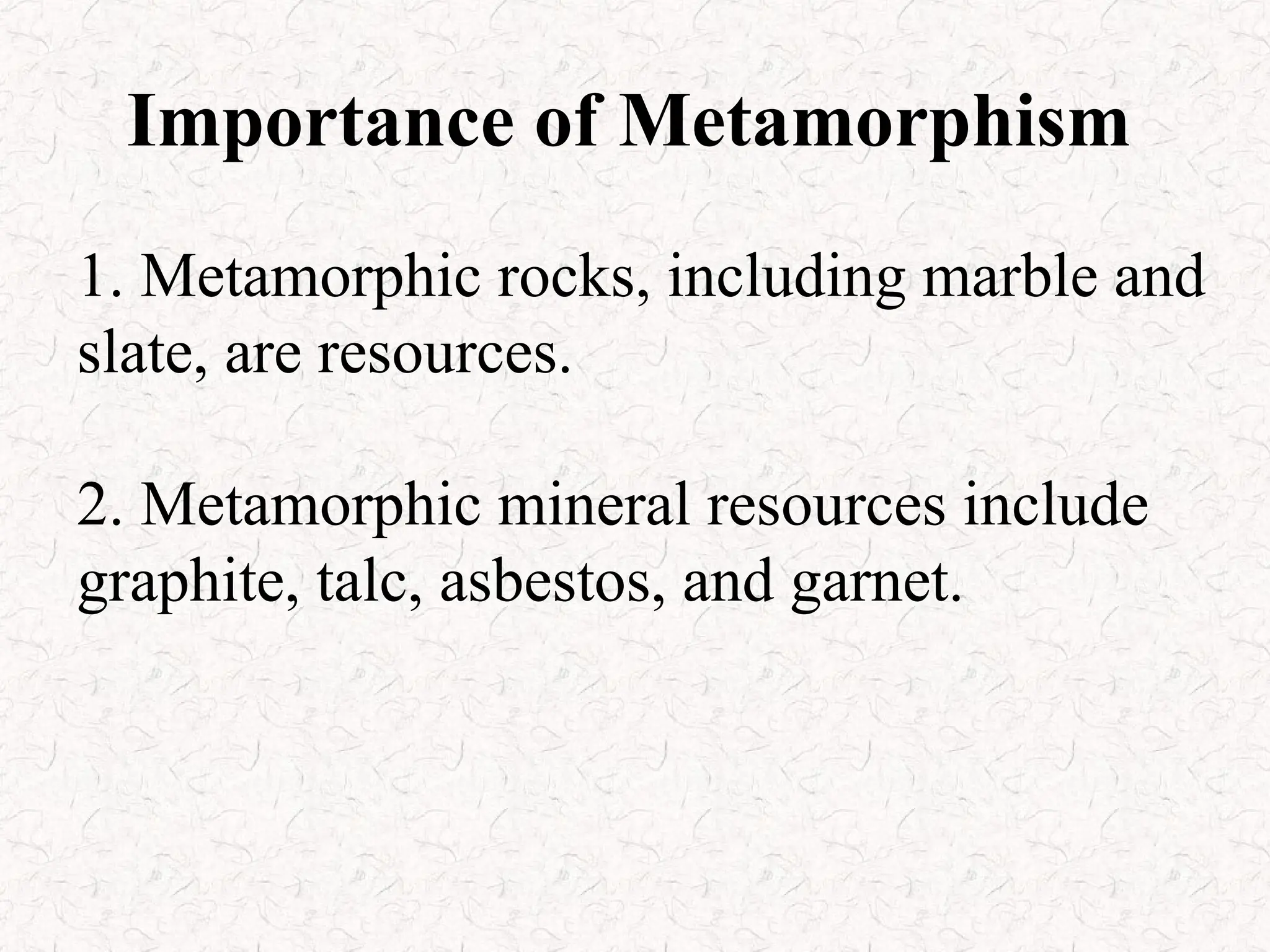
Graphite: Used in pencils
and lubricants
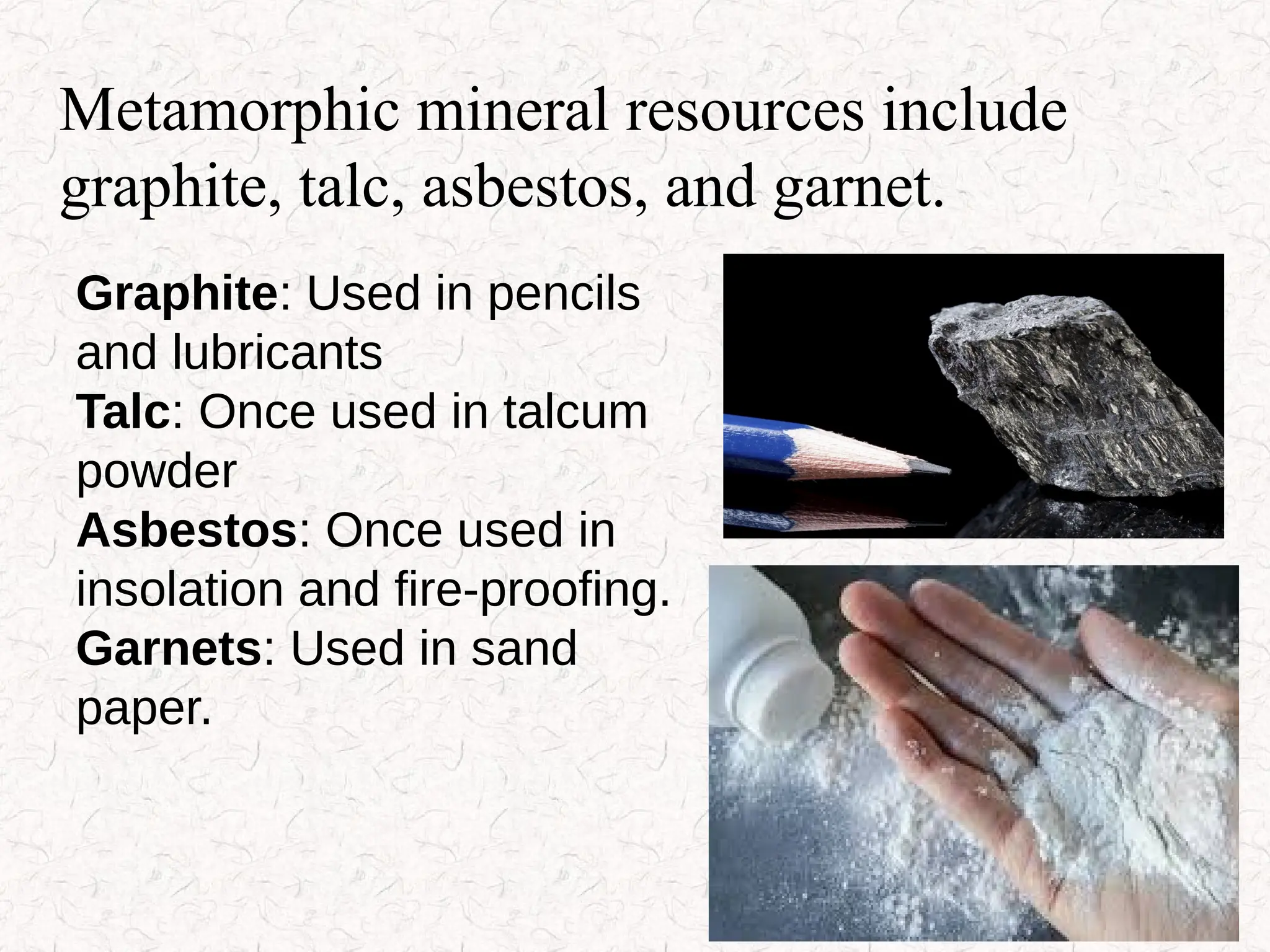
Talc: Once used in talcum
powder
Asbestos: Once used in
insolation and fire-proofing.
Garnets: Used in sand
paper.