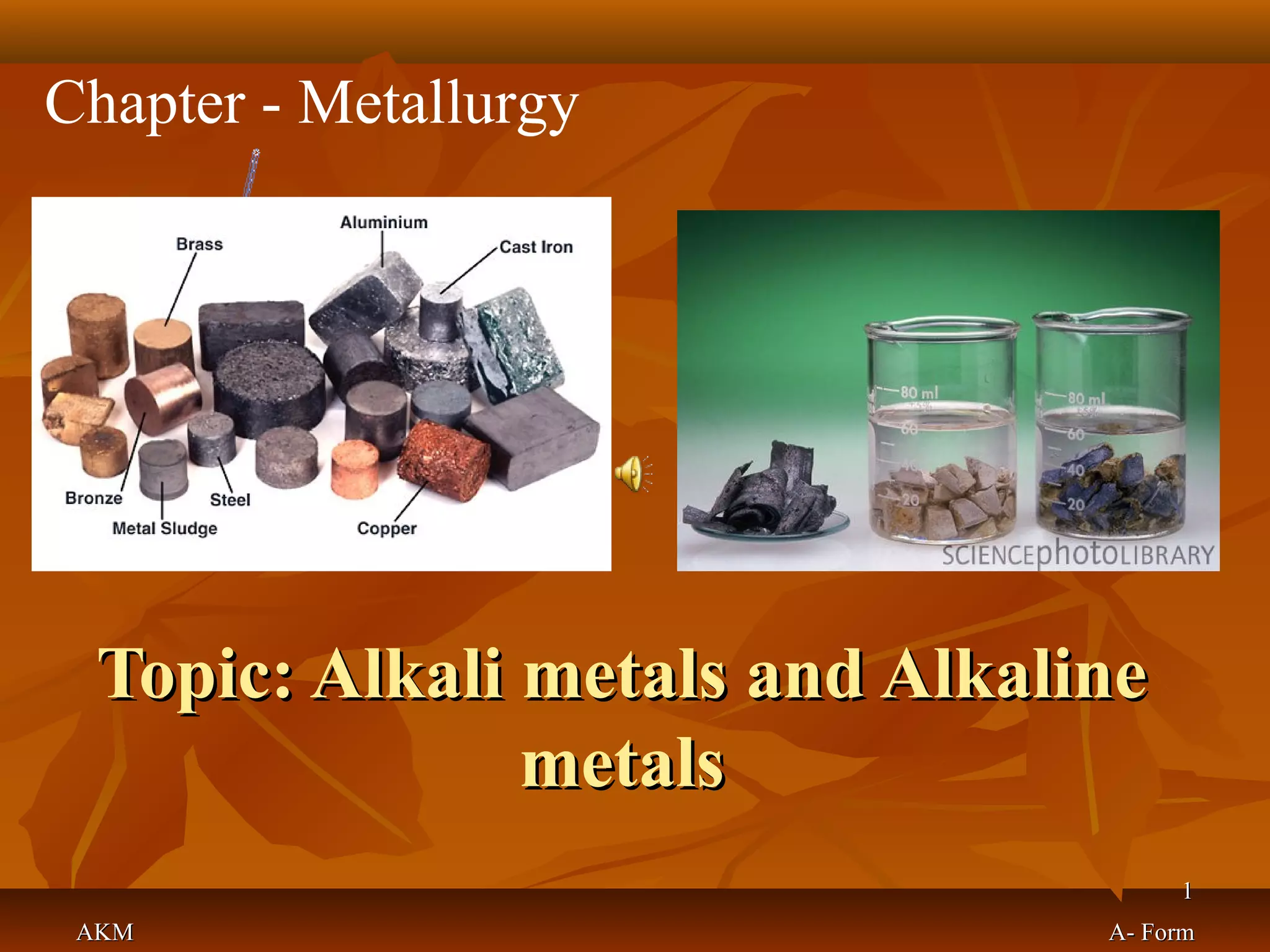
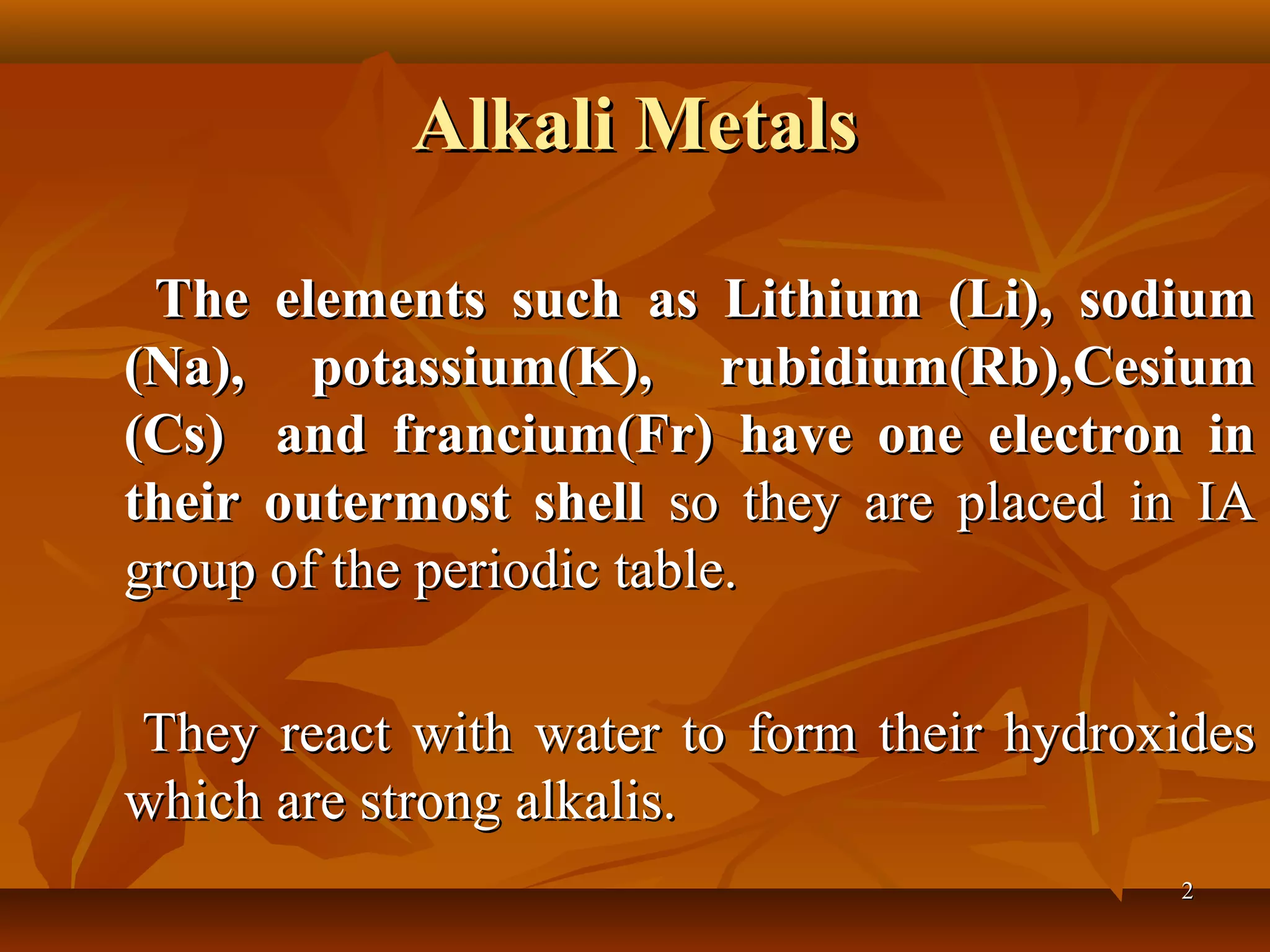

Topic: Alkali metals and AlkalineTopic: Alkali metals and Alkaline
metalsmetals
AKM A- FormAKM A- Form
Chapter - Metallurgy
11
Alkali MetalsAlkali Metals
The elements such as Lithium (Li), sodiumThe elements such as Lithium (Li), sodium
(Na), potassium(K), rubidium(Rb),Cesium(Na), potassium(K), rubidium(Rb),Cesium
(Cs) and francium(Fr) have one electron in(Cs) and francium(Fr) have one electron in
their outermost shelltheir outermost shell so they are placed in IAso they are placed in IA
group of the periodic table.group of the periodic table.
They react with water to form their hydroxidesThey react with water to form their hydroxides
which are strong alkalis.which are strong alkalis.
22
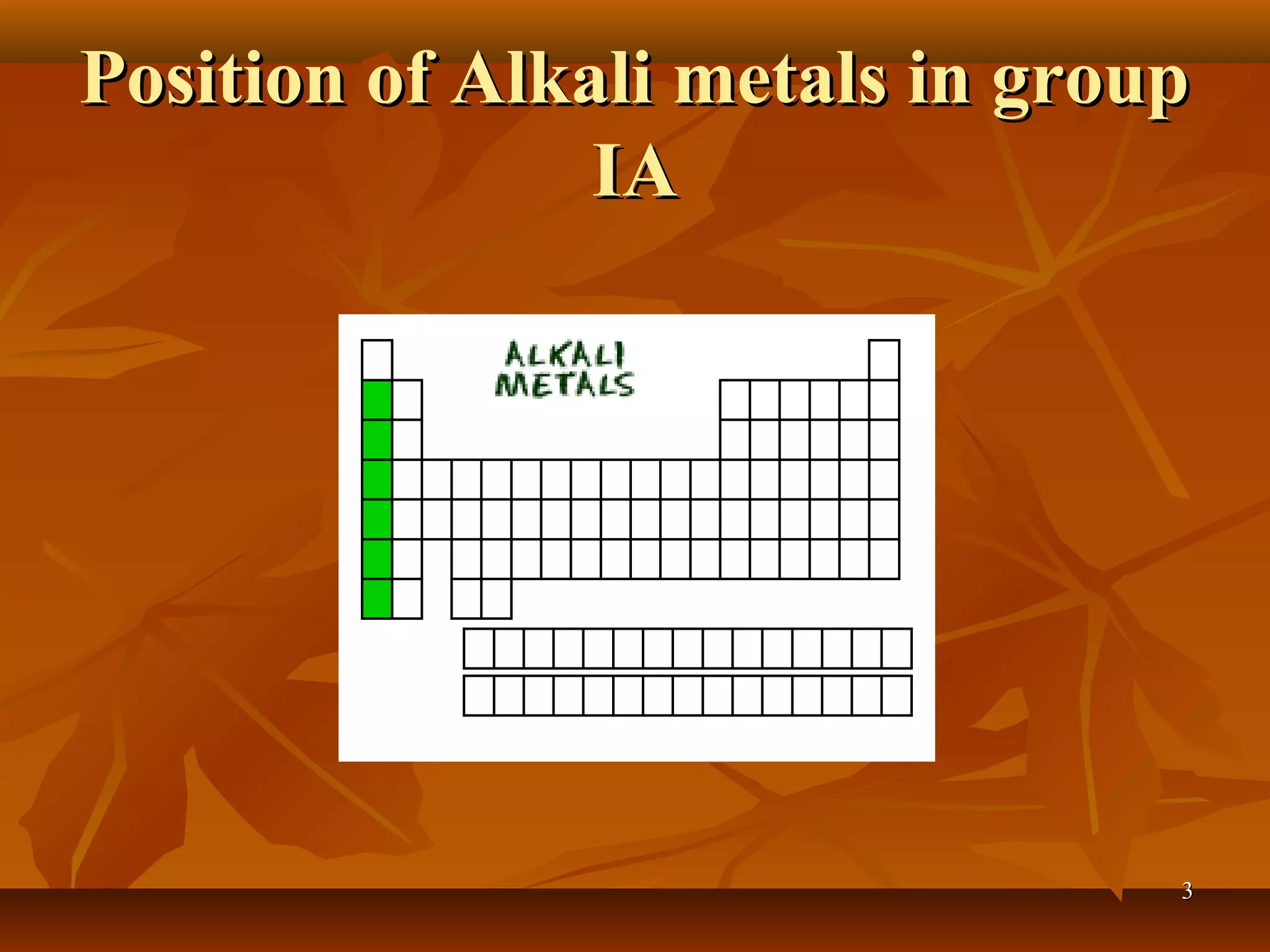
Position of Alkali metals in groupPosition of Alkali metals in group
IAIA
33
Characteristics of alkali metalsCharacteristics of alkali metals
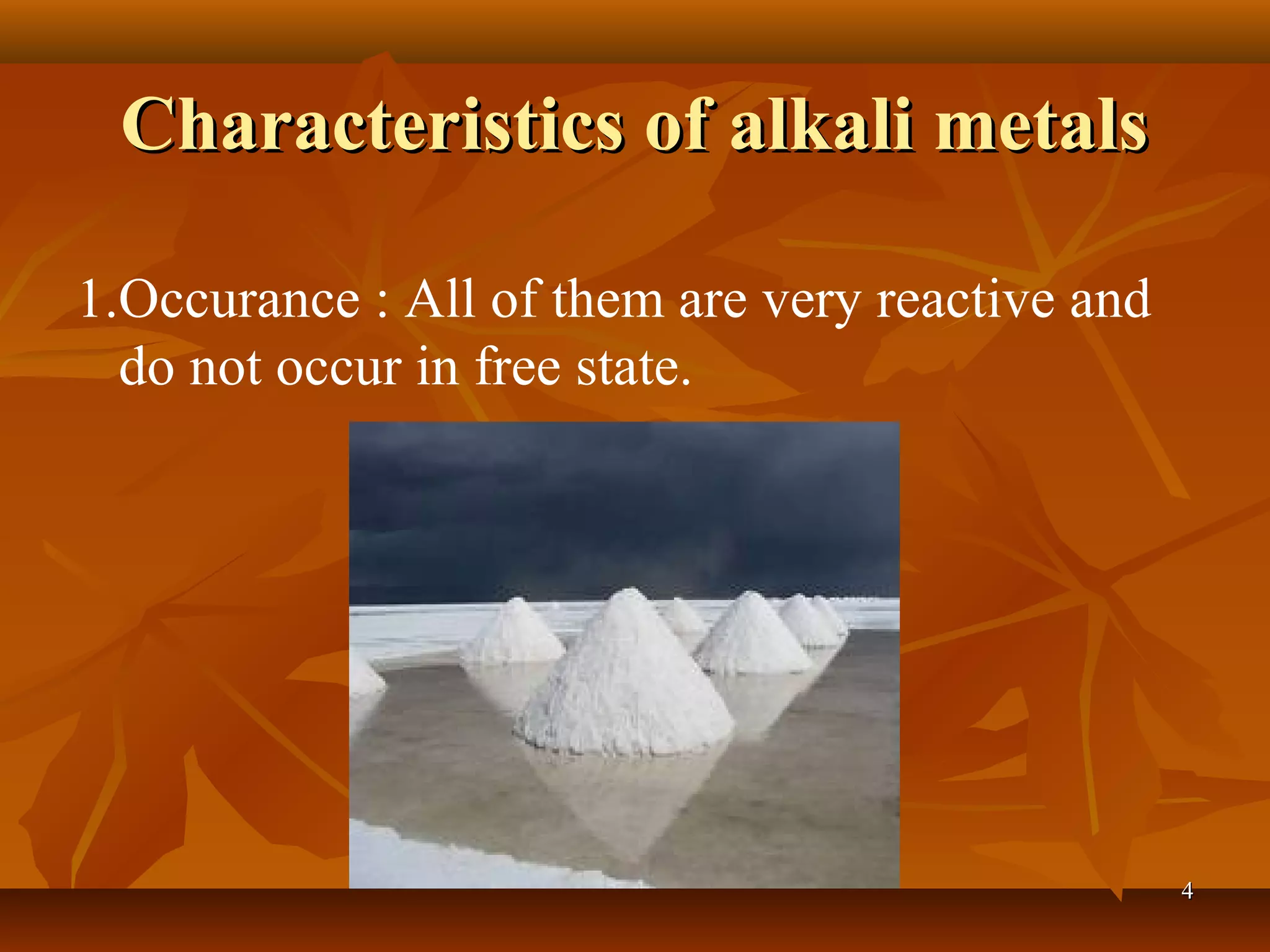
1.Occurance : All of them are very reactive and
do not occur in free state.
44
Characteristics of alkali metalsCharacteristics of alkali metals
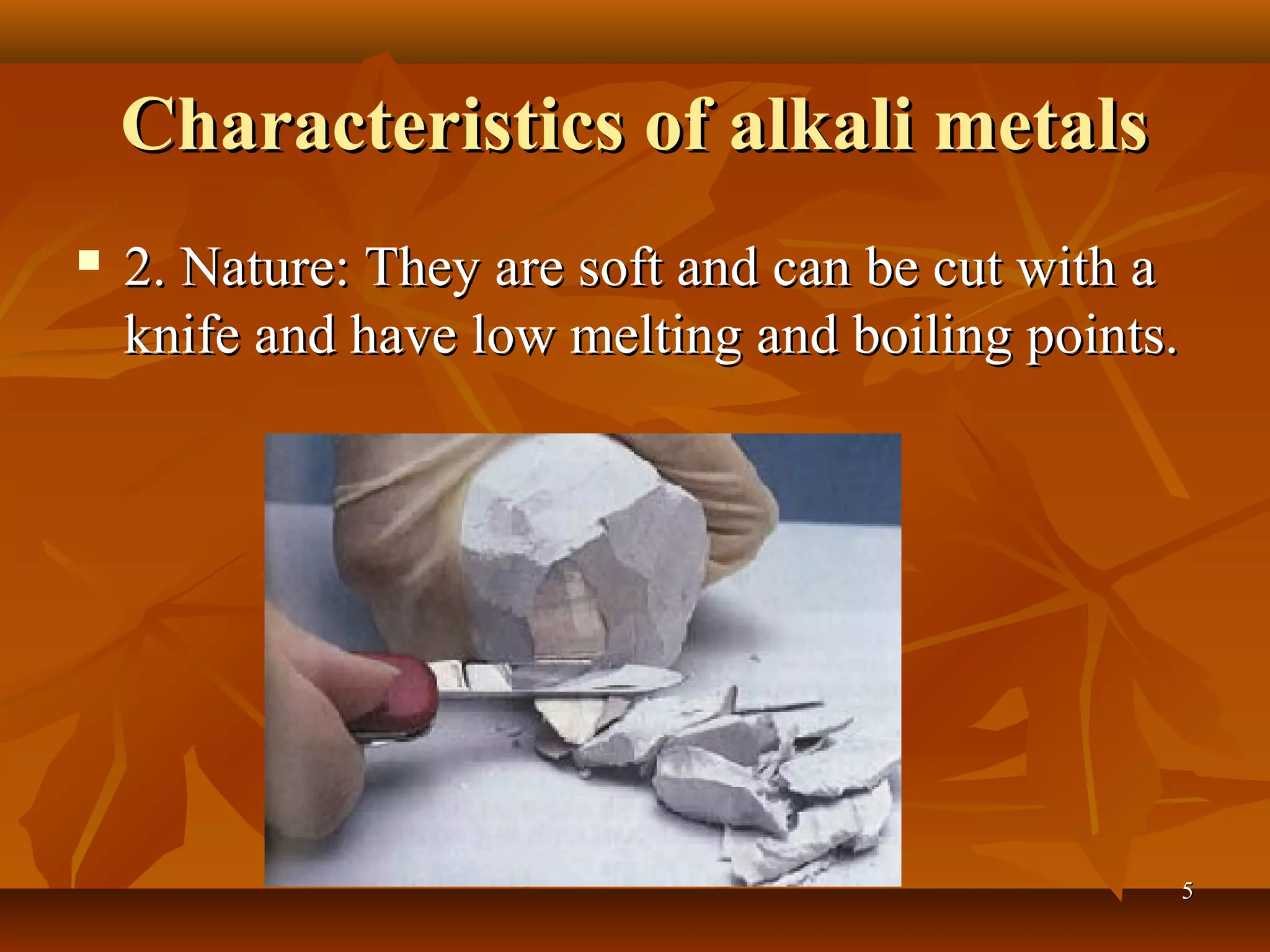
 2. Nature: They are soft and can be cut with a2. Nature: They are soft and can be cut with a
knife and have low melting and boiling points.knife and have low melting and boiling points.
55
Characteristics of alkali metalsCharacteristics of alkali metals
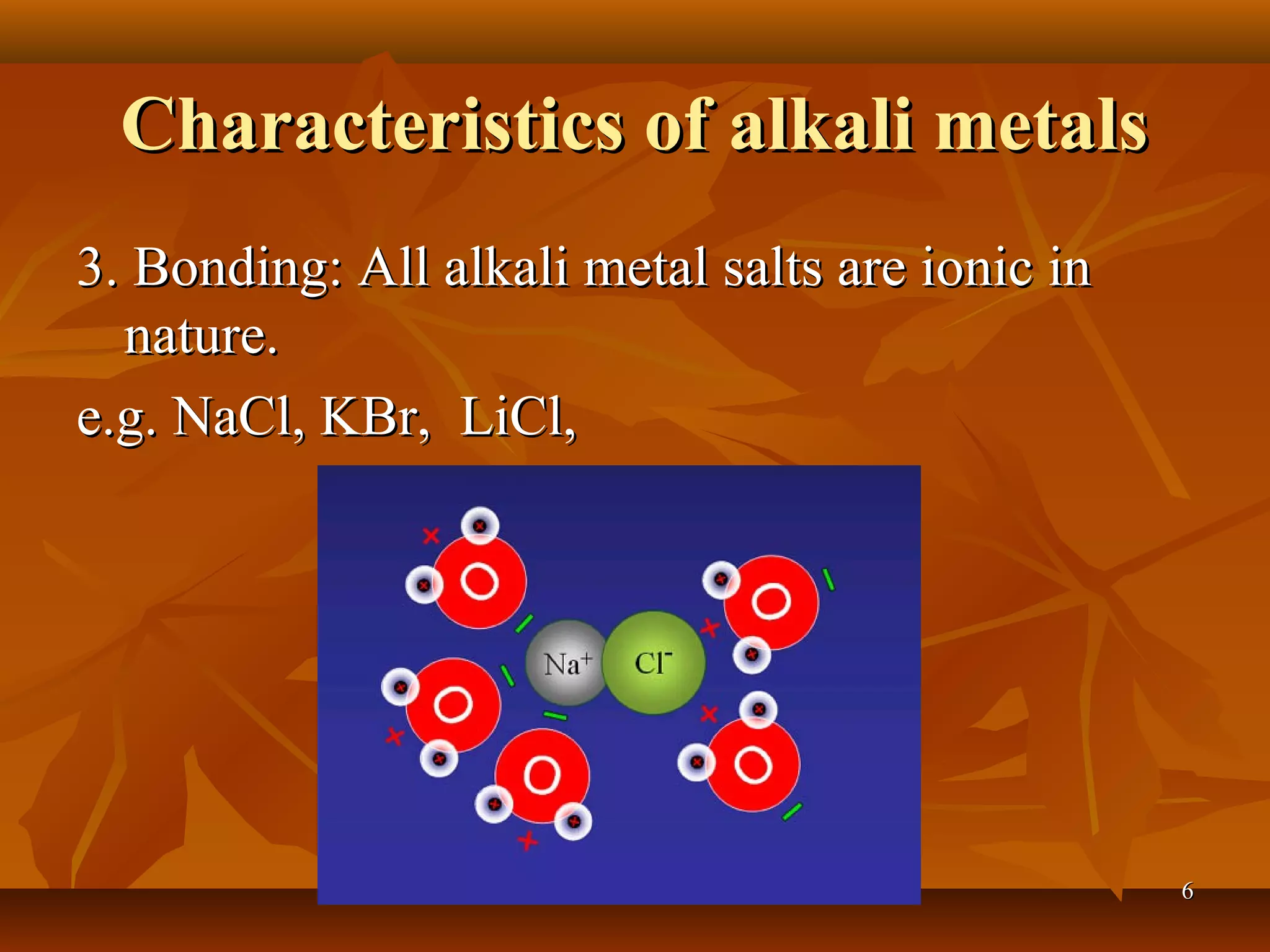
3. Bonding: All alkali metal salts are ionic in3. Bonding: All alkali metal salts are ionic in
nature.nature.
e.g. NaCl, KBr, LiCl,e.g. NaCl, KBr, LiCl,
66
Characteristics of alkali metalsCharacteristics of alkali metals
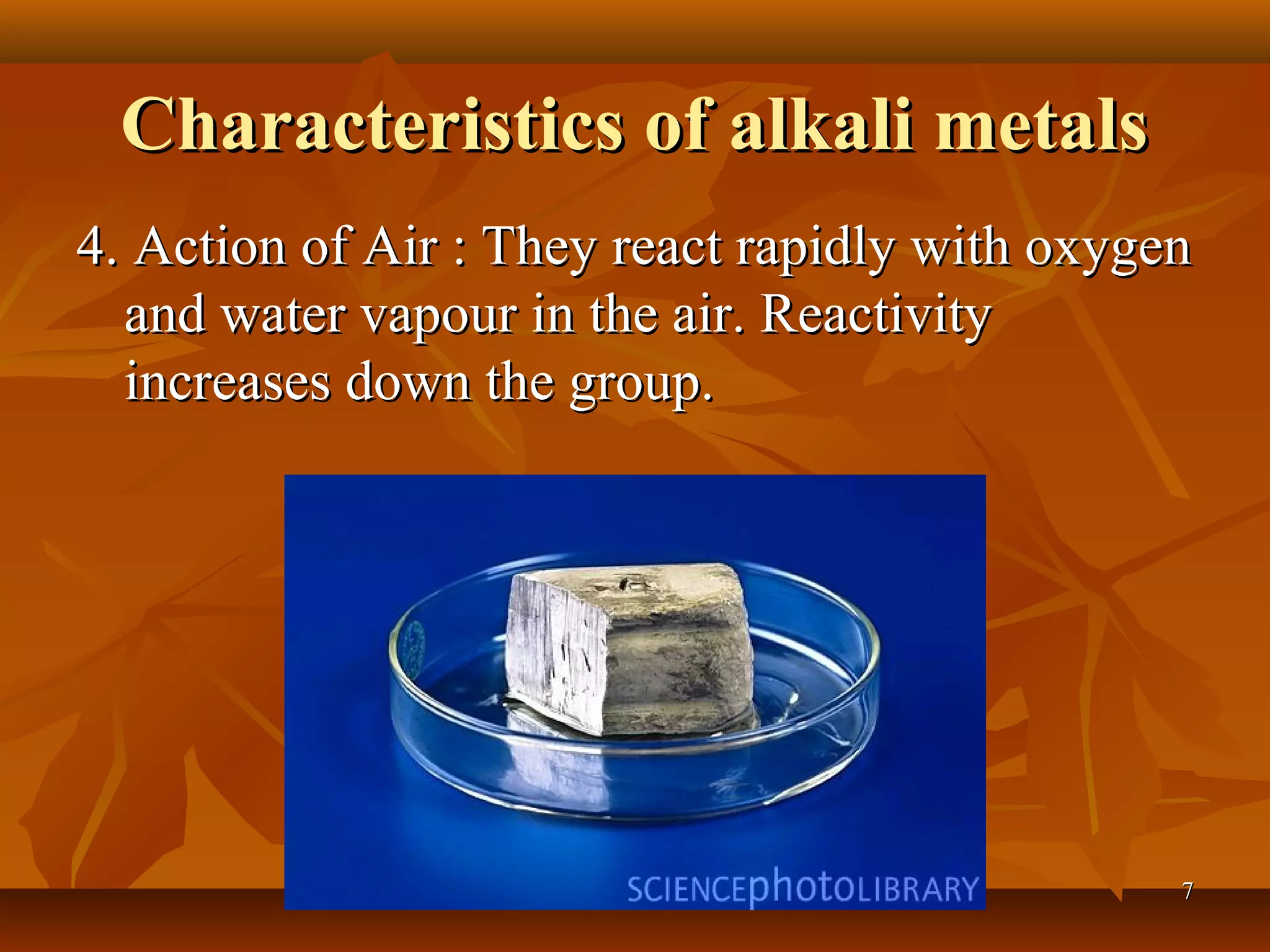
4. Action of Air : They react rapidly with oxygen4. Action of Air : They react rapidly with oxygen
and water vapour in the air. Reactivityand water vapour in the air. Reactivity
increases down the group.increases down the group.
77
Characteristics of alkali metalsCharacteristics of alkali metals
5.Action of water: They react violently with5.Action of water: They react violently with
water and produce hydrogen.water and produce hydrogen.
2M + H2M + H22OO  2MOH + H2MOH + H22
88
Characteristics of alkali metalsCharacteristics of alkali metals
6.Action of acids: They react violently with acids, dil6.Action of acids: They react violently with acids, dil
HCl and Dil HHCl and Dil H22SOSO44 to produce hydrogen gas.to produce hydrogen gas.
2M + 2HCl2M + 2HCl  2MCl +H2MCl +H22
C
L
I
C
K
99
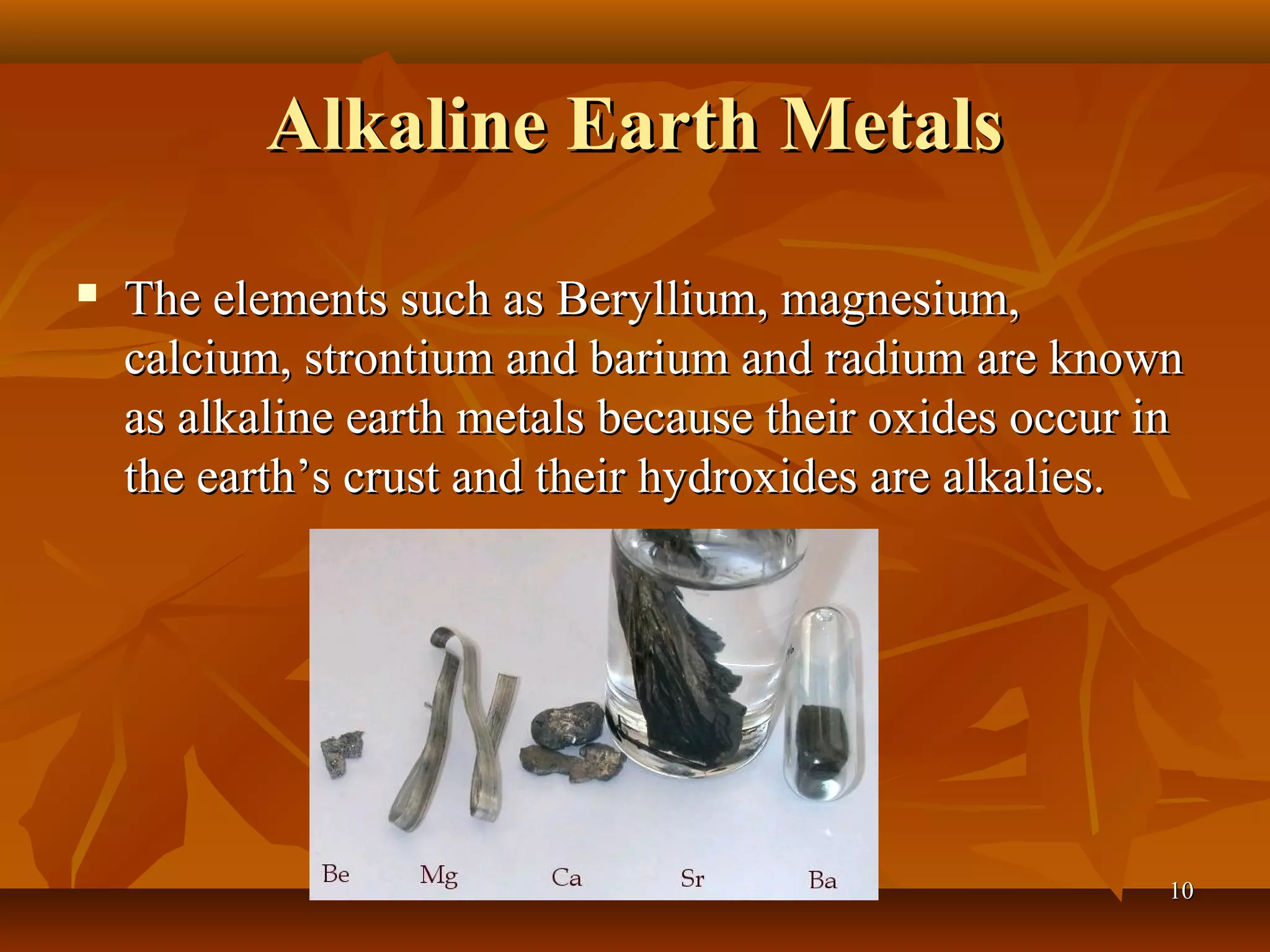
Alkaline Earth MetalsAlkaline Earth Metals
 The elements such as Beryllium, magnesium,The elements such as Beryllium, magnesium,
calcium, strontium and barium and radium are knowncalcium, strontium and barium and radium are known
as alkaline earth metals because their oxides occur inas alkaline earth metals because their oxides occur in
the earth’s crust and their hydroxides are alkalies.the earth’s crust and their hydroxides are alkalies.
1010
Characteristics of Alkaline earthCharacteristics of Alkaline earth
metalsmetals
1.Occurrence: They are reactive1.Occurrence: They are reactive
metals (less reactive than alkalimetals (less reactive than alkali
metals); hence they also do notmetals); hence they also do not
occur in free in nature.occur in free in nature.
They have two electrons in theirThey have two electrons in their
last shell so they are placed inlast shell so they are placed in
group IIA of the Periodic table.group IIA of the Periodic table.
1111
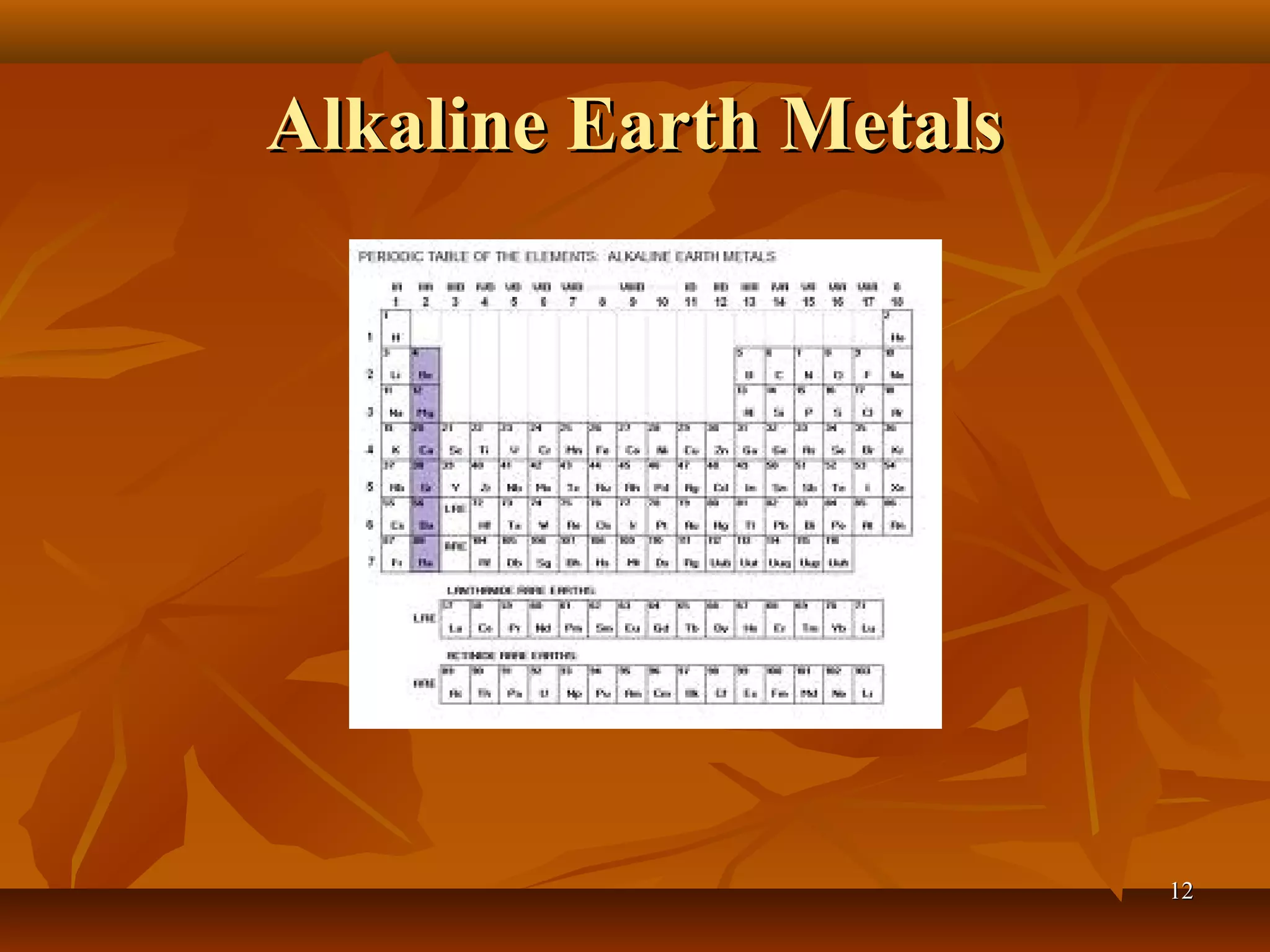
Alkaline Earth MetalsAlkaline Earth Metals
1212
Characteristics of Alkaline earthCharacteristics of Alkaline earth
metalsmetals
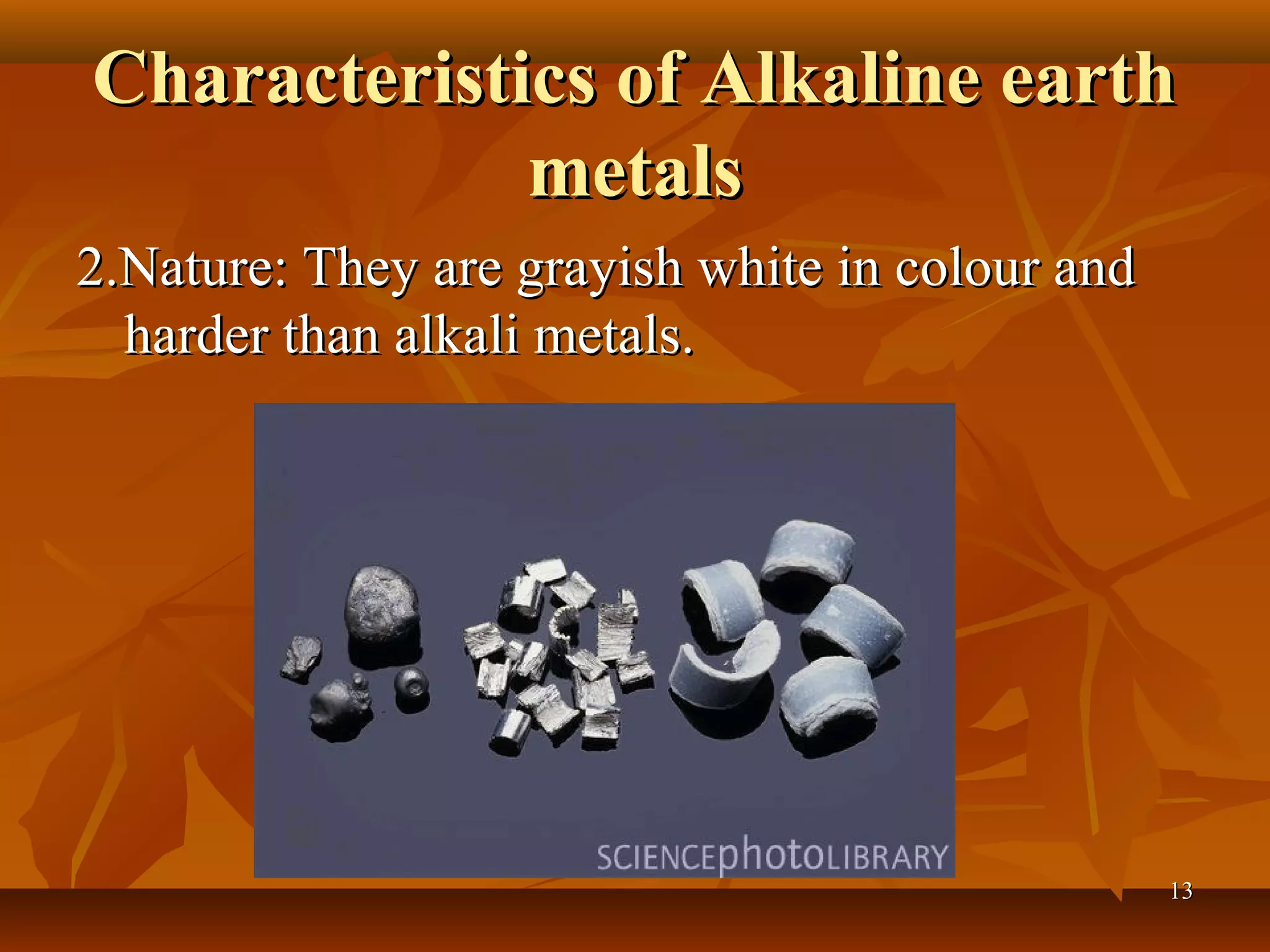
2.Nature: They are grayish white in colour and2.Nature: They are grayish white in colour and
harder than alkali metals.harder than alkali metals.
1313
Characteristics of Alkaline earthCharacteristics of Alkaline earth
metalsmetals
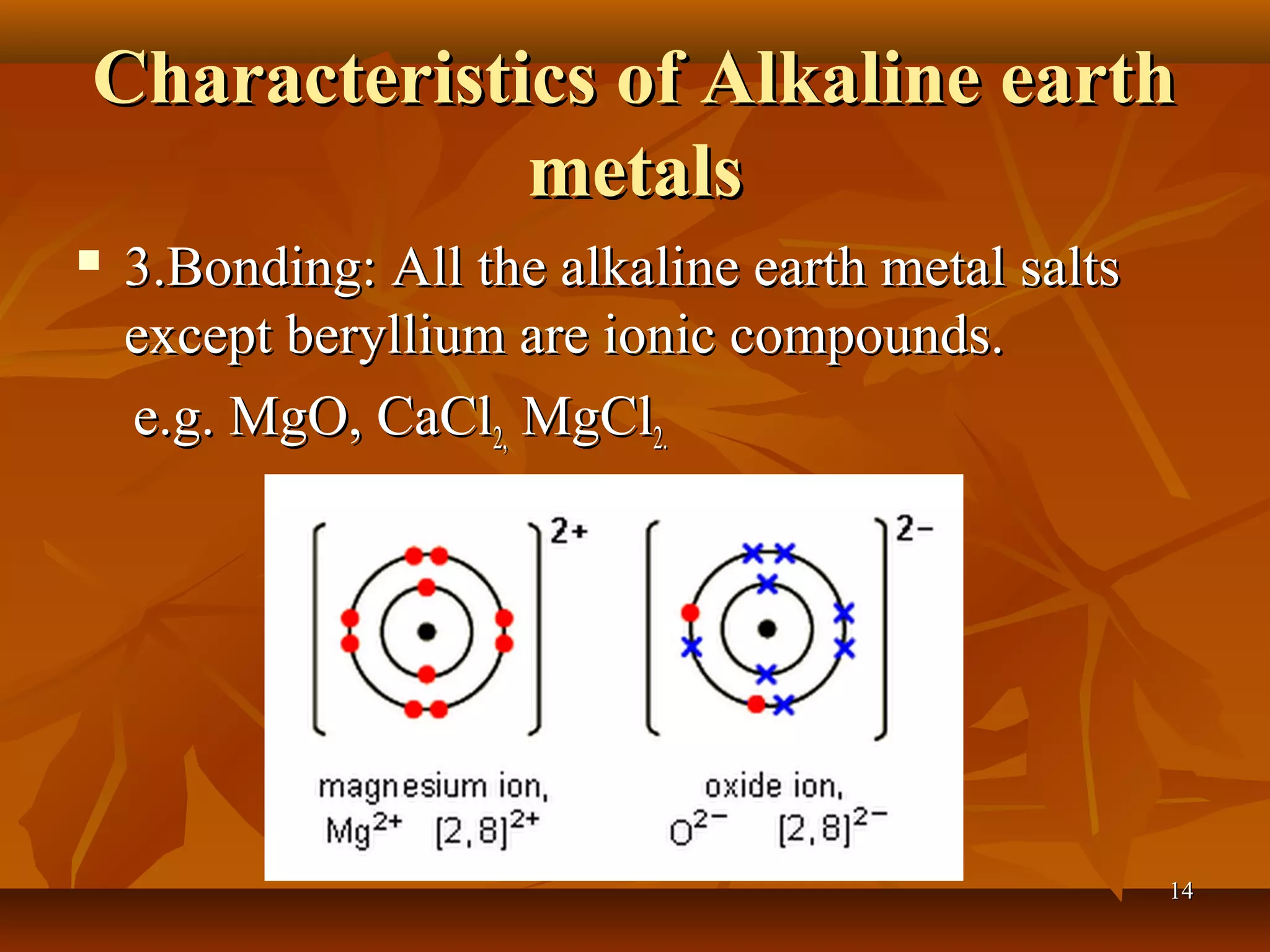
 3.Bonding: All the alkaline earth metal salts3.Bonding: All the alkaline earth metal salts
except beryllium are ionic compounds.except beryllium are ionic compounds.
e.g. MgO, CaCle.g. MgO, CaCl2,2, MgClMgCl2.2.
1414
Characteristics of Alkaline earthCharacteristics of Alkaline earth
metalsmetals
4.Action of air: They are less reactive than alkali4.Action of air: They are less reactive than alkali
metals.metals.
Their reactivity increases on moving down theTheir reactivity increases on moving down the
groupgroup
1515
Characteristics of Alkaline earthCharacteristics of Alkaline earth
metalsmetals
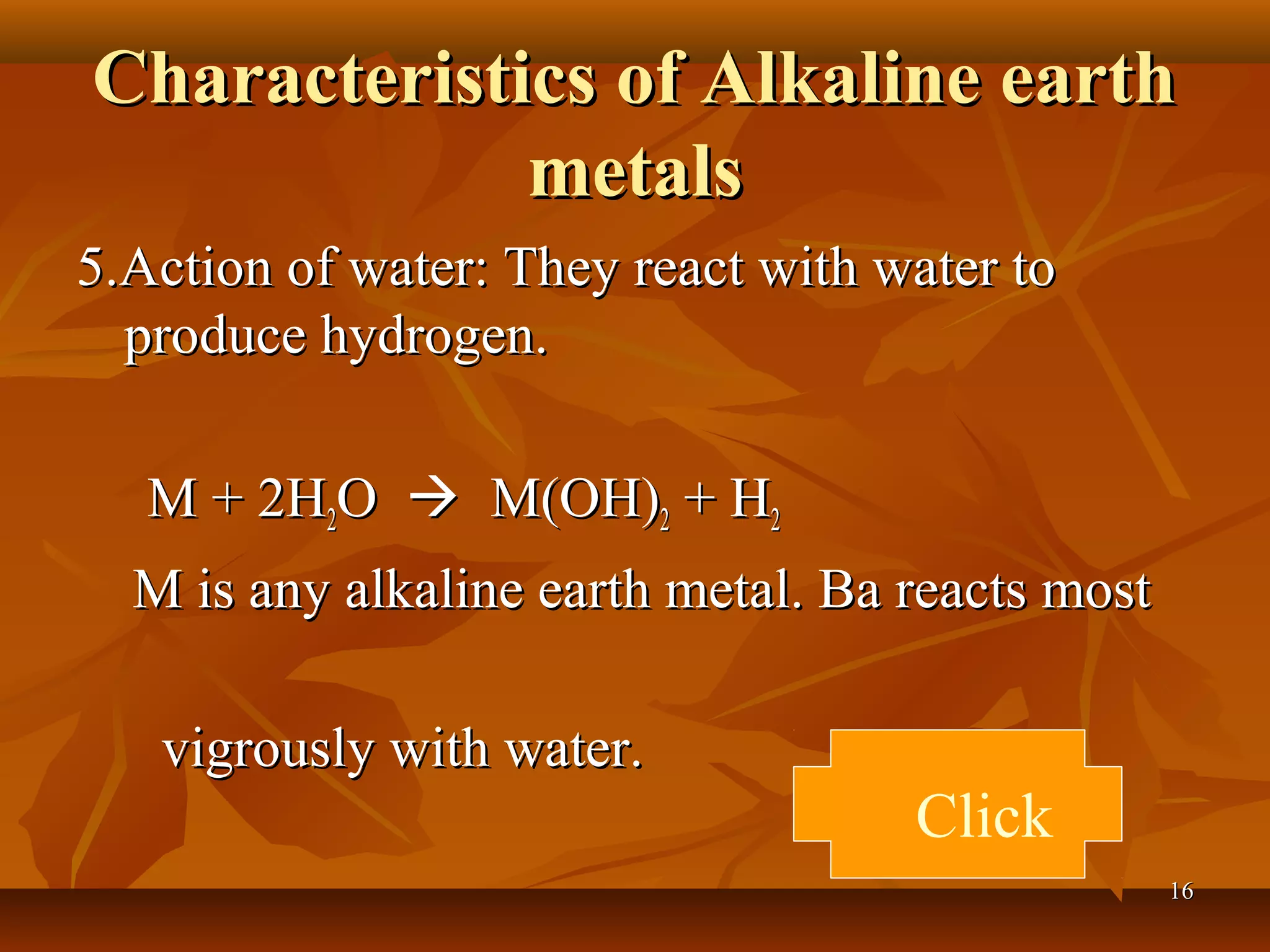
5.Action of water: They react with water to5.Action of water: They react with water to
produce hydrogen.produce hydrogen.
M + 2HM + 2H22OO  M(OH)M(OH)22 + H+ H22
M is any alkaline earth metal. Ba reacts mostM is any alkaline earth metal. Ba reacts most
vigrously with water.vigrously with water.
Click
1616
Characteristics of Alkaline earthCharacteristics of Alkaline earth
metalsmetals
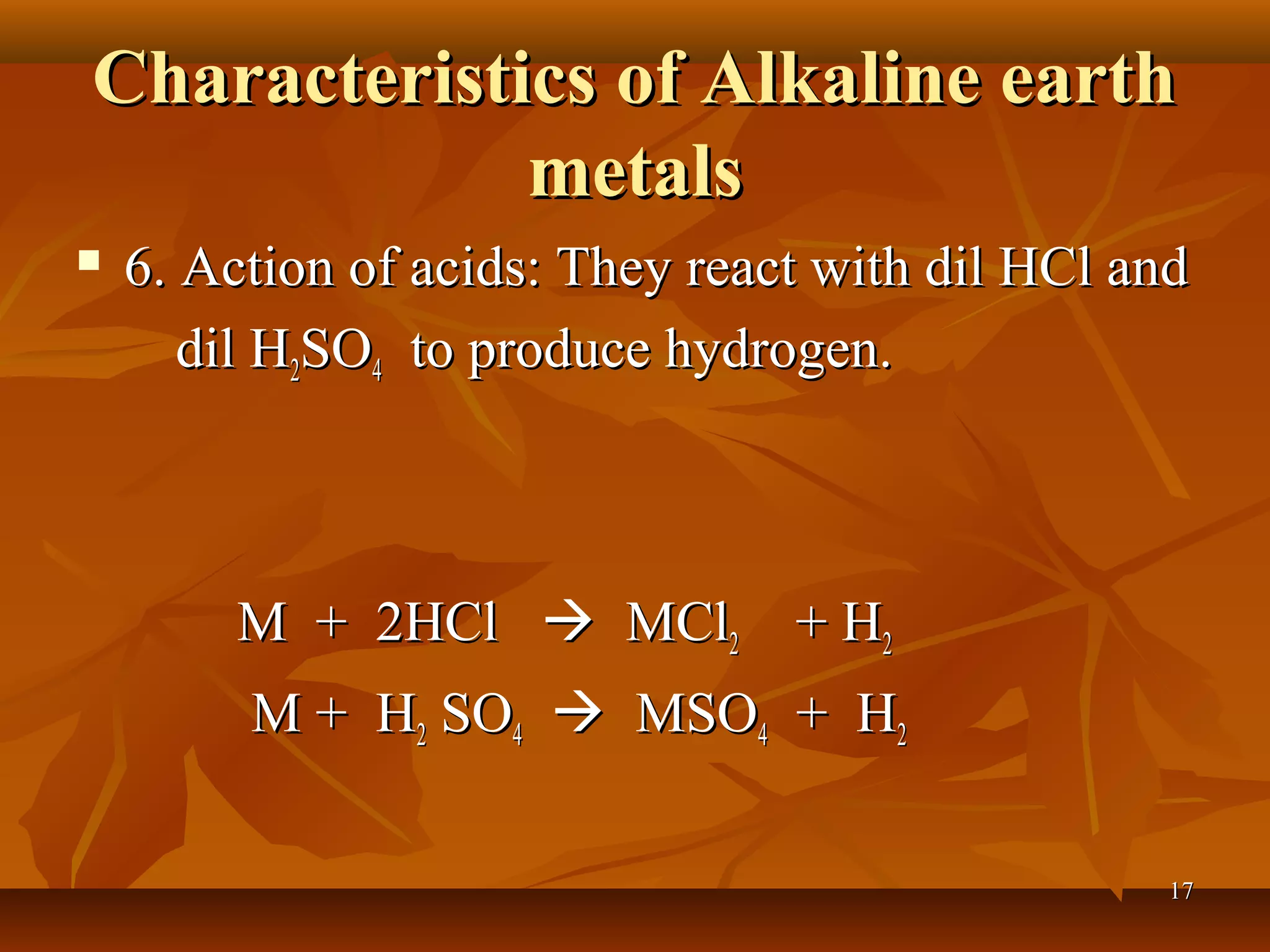
 6. Action of acids: They react with dil HCl and6. Action of acids: They react with dil HCl and
dil Hdil H22SOSO44 to produce hydrogen.to produce hydrogen.
M + 2HClM + 2HCl  MClMCl22 + H+ H22
M + HM + H22 SOSO44  MSOMSO44 + H+ H22
1717
AssessmentAssessment
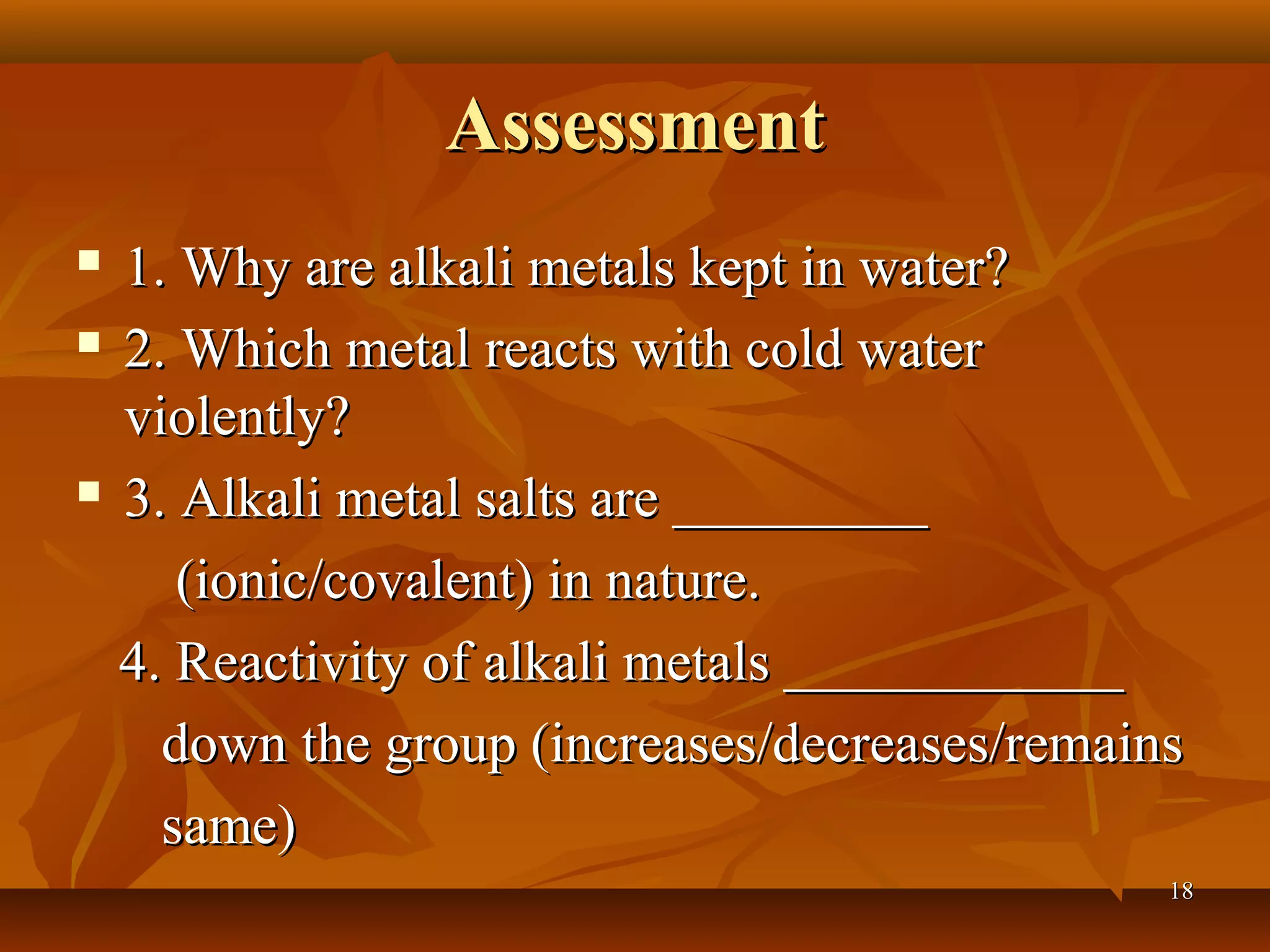
 1. Why are alkali metals kept in water?1. Why are alkali metals kept in water?
 2. Which metal reacts with cold water2. Which metal reacts with cold water
violently?violently?
 3. Alkali metal salts are _________3. Alkali metal salts are _________
(ionic/covalent) in nature.(ionic/covalent) in nature.
4. Reactivity of alkali metals ____________4. Reactivity of alkali metals ____________
down the group (increases/decreases/remainsdown the group (increases/decreases/remains
same)same)
1818
1919

Metallurgy part i (1)

  • 1.
    Topic: Alkali metalsand AlkalineTopic: Alkali metals and Alkaline metalsmetals AKM A- FormAKM A- Form Chapter - Metallurgy 11
  • 2.
    Alkali MetalsAlkali Metals Theelements such as Lithium (Li), sodiumThe elements such as Lithium (Li), sodium (Na), potassium(K), rubidium(Rb),Cesium(Na), potassium(K), rubidium(Rb),Cesium (Cs) and francium(Fr) have one electron in(Cs) and francium(Fr) have one electron in their outermost shelltheir outermost shell so they are placed in IAso they are placed in IA group of the periodic table.group of the periodic table. They react with water to form their hydroxidesThey react with water to form their hydroxides which are strong alkalis.which are strong alkalis. 22
  • 3.
    Position of Alkalimetals in groupPosition of Alkali metals in group IAIA 33
  • 4.
    Characteristics of alkalimetalsCharacteristics of alkali metals 1.Occurance : All of them are very reactive and do not occur in free state. 44
  • 5.
    Characteristics of alkalimetalsCharacteristics of alkali metals  2. Nature: They are soft and can be cut with a2. Nature: They are soft and can be cut with a knife and have low melting and boiling points.knife and have low melting and boiling points. 55
  • 6.
    Characteristics of alkalimetalsCharacteristics of alkali metals 3. Bonding: All alkali metal salts are ionic in3. Bonding: All alkali metal salts are ionic in nature.nature. e.g. NaCl, KBr, LiCl,e.g. NaCl, KBr, LiCl, 66
  • 7.
    Characteristics of alkalimetalsCharacteristics of alkali metals 4. Action of Air : They react rapidly with oxygen4. Action of Air : They react rapidly with oxygen and water vapour in the air. Reactivityand water vapour in the air. Reactivity increases down the group.increases down the group. 77
  • 8.
    Characteristics of alkalimetalsCharacteristics of alkali metals 5.Action of water: They react violently with5.Action of water: They react violently with water and produce hydrogen.water and produce hydrogen. 2M + H2M + H22OO  2MOH + H2MOH + H22 88
  • 9.
    Characteristics of alkalimetalsCharacteristics of alkali metals 6.Action of acids: They react violently with acids, dil6.Action of acids: They react violently with acids, dil HCl and Dil HHCl and Dil H22SOSO44 to produce hydrogen gas.to produce hydrogen gas. 2M + 2HCl2M + 2HCl  2MCl +H2MCl +H22 C L I C K 99
  • 10.
    Alkaline Earth MetalsAlkalineEarth Metals  The elements such as Beryllium, magnesium,The elements such as Beryllium, magnesium, calcium, strontium and barium and radium are knowncalcium, strontium and barium and radium are known as alkaline earth metals because their oxides occur inas alkaline earth metals because their oxides occur in the earth’s crust and their hydroxides are alkalies.the earth’s crust and their hydroxides are alkalies. 1010
  • 11.
    Characteristics of AlkalineearthCharacteristics of Alkaline earth metalsmetals 1.Occurrence: They are reactive1.Occurrence: They are reactive metals (less reactive than alkalimetals (less reactive than alkali metals); hence they also do notmetals); hence they also do not occur in free in nature.occur in free in nature. They have two electrons in theirThey have two electrons in their last shell so they are placed inlast shell so they are placed in group IIA of the Periodic table.group IIA of the Periodic table. 1111
  • 12.
  • 13.
    Characteristics of AlkalineearthCharacteristics of Alkaline earth metalsmetals 2.Nature: They are grayish white in colour and2.Nature: They are grayish white in colour and harder than alkali metals.harder than alkali metals. 1313
  • 14.
    Characteristics of AlkalineearthCharacteristics of Alkaline earth metalsmetals  3.Bonding: All the alkaline earth metal salts3.Bonding: All the alkaline earth metal salts except beryllium are ionic compounds.except beryllium are ionic compounds. e.g. MgO, CaCle.g. MgO, CaCl2,2, MgClMgCl2.2. 1414
  • 15.
    Characteristics of AlkalineearthCharacteristics of Alkaline earth metalsmetals 4.Action of air: They are less reactive than alkali4.Action of air: They are less reactive than alkali metals.metals. Their reactivity increases on moving down theTheir reactivity increases on moving down the groupgroup 1515
  • 16.
    Characteristics of AlkalineearthCharacteristics of Alkaline earth metalsmetals 5.Action of water: They react with water to5.Action of water: They react with water to produce hydrogen.produce hydrogen. M + 2HM + 2H22OO  M(OH)M(OH)22 + H+ H22 M is any alkaline earth metal. Ba reacts mostM is any alkaline earth metal. Ba reacts most vigrously with water.vigrously with water. Click 1616
  • 17.
    Characteristics of AlkalineearthCharacteristics of Alkaline earth metalsmetals  6. Action of acids: They react with dil HCl and6. Action of acids: They react with dil HCl and dil Hdil H22SOSO44 to produce hydrogen.to produce hydrogen. M + 2HClM + 2HCl  MClMCl22 + H+ H22 M + HM + H22 SOSO44  MSOMSO44 + H+ H22 1717
  • 18.
    AssessmentAssessment  1. Whyare alkali metals kept in water?1. Why are alkali metals kept in water?  2. Which metal reacts with cold water2. Which metal reacts with cold water violently?violently?  3. Alkali metal salts are _________3. Alkali metal salts are _________ (ionic/covalent) in nature.(ionic/covalent) in nature. 4. Reactivity of alkali metals ____________4. Reactivity of alkali metals ____________ down the group (increases/decreases/remainsdown the group (increases/decreases/remains same)same) 1818
  • 19.