
PhotosynthesisBy. DhitaAyu PS,S.Pd.
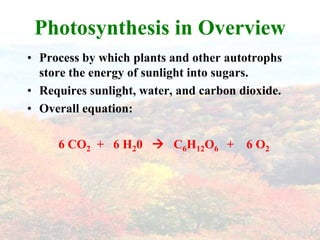
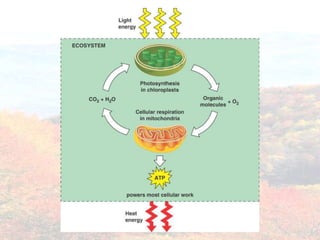
Photosynthesis in OverviewProcess by which plants and other autotrophs store the energy of sunlight into sugars.Requires sunlight, water, and carbon dioxide.Overall equation:6 CO2  +   6 H20      C6H12O6   +    6 O2
4Question:Where does photosynthesis take place?
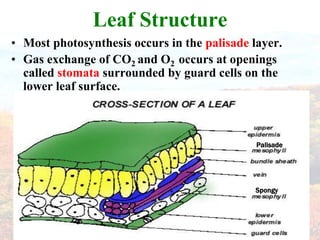
Leaf StructureMost photosynthesis occurs in the palisade layer.Gas exchange of CO2 and O2  occurs at openings called stomata surrounded by guard cells on the lower leaf surface.PalisadeSpongy
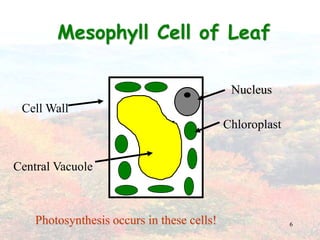
6NucleusCell WallChloroplastCentral VacuoleMesophyll Cell of LeafPhotosynthesis occurs in these cells!
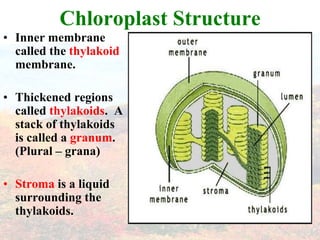
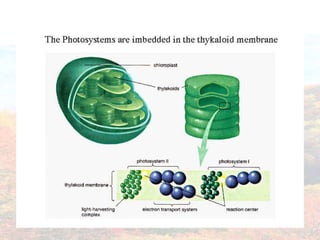
Chloroplast StructureInner membrane called the thylakoid membrane.Thickened regions called thylakoids.  A stack of thylakoids is called a granum. (Plural – grana)Stroma is a liquid surrounding the thylakoids.
8Question:Why are plants green?
9Chlorophyll MoleculesLocated in the thylakoid membranesChlorophyll have Mg+ in the centerChlorophyll pigments harvest energy (photons) by absorbing certain wavelengths (blue-420 nm and red-660 nm are most important)Plants are green because the green wavelength is reflected, not absorbed.
PigmentsChlorophyll A is the most important photosynthetic pigment. Other pigments called antenna or accessory pigments are also present in the leaf.Chlorophyll BCarotenoids (orange / red)Xanthophylls (yellow / brown)These pigments are embedded in the membranes of the chloroplast in groups called photosystems.
11Parts of Photosynthesis
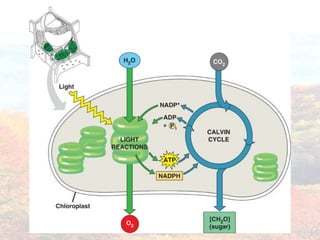
Photosynthesis: The Chemical ProcessOccurs in two main phases.Light reactionsDark reactions (The Calvin Cycle)Light reactions are the “photo” part of photosynthesis.  Light is absorbed by pigments.Dark reactions are the “synthesis” part of photosynthesis.  Trapped energy from the sun is converted to the chemical energy of sugars.
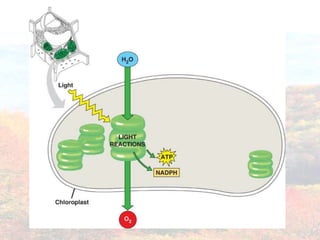
Light ReactionsLight-dependent reactions occur on the thylakoid membranes.Light and water are required for this process.Energy storage molecules are formed. (ATP and NADPH)Oxygen gas is made as a waste product.
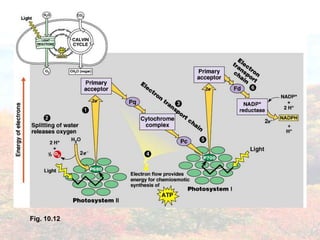
Fig. 10.12
During the light reactions, there are two possible routes for electron flow: cyclic and noncyclic.Noncyclic electron flow, the predominant route, produces both ATP and NADPH.When photosystem II absorbs light, an excited electron is captured by the primary electron acceptor, leaving the reaction center oxidized.An enzyme extracts electrons from water and supplies them to the oxidized reaction center.This reaction splits water into two hydrogen ions and an oxygen atom which combines with another to form O2.
Photoexcitedelectrons pass along an electron transport chain before ending up at an oxidized photosystem I reaction center.As these electrons pass along the transport chain, their energy is harnessed to produce ATP.The mechanism of noncyclicphotophosphorylation is similar to the process on oxidative phosphorylation.
5. At the bottom of this electron transport chain, the electrons fill an electron “hole” in an oxidized P700 center.6. This hole is created when photons excite electrons on the photosystem I complex.  The excited electrons are captured by a second primary electron acceptor which transmits them to a second electron transport chain.Ultimately, these electrons are passed from the transport chain to NADP+, creating NADPH.NADPH will carry the reducing power of these high-energy electrons to the Calvin cycle.
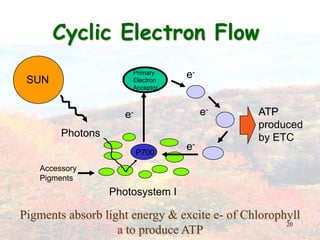
20e-PrimaryElectronAcceptorSUNe-ATPproducedby ETCe-Photonse-P700AccessoryPigmentsPhotosystem ICyclic Electron FlowPigments absorb light energy & excite e- of Chlorophyll a to produce ATP
Dark ReactionsDark reactions (light-independent) occur in the stroma.Carbon dioxide is “fixed” into the sugar glucose.The actual sugar product of the Calvin cycle is not glucose, but a three-carbon sugar, glyceraldehyde-3-phosphate (G3P).For the net synthesis of one G3P molecule, the cycle must take place three times, fixing three molecules of CO2.To make one glucose molecules would require six cycles and the fixation of six CO2 molecules.ATP and NADPH molecules created during the light reactions power the production of this glucose.
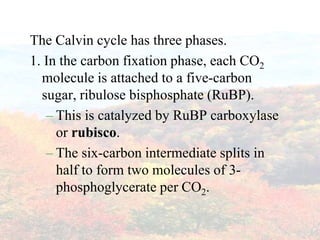
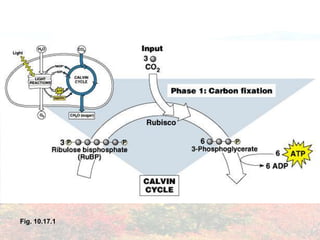
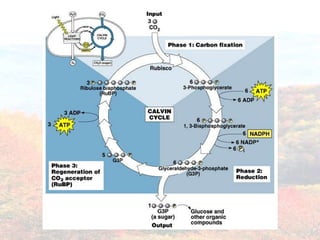
The Calvin cycle has three phases.1. In the carbon fixation phase, each CO2 molecule is attached to a five-carbon sugar, ribulosebisphosphate (RuBP).This is catalyzed by RuBPcarboxylase or rubisco.The six-carbon intermediate splits in half to form two molecules of 3-phosphoglycerate per CO2.
Fig. 10.17.1
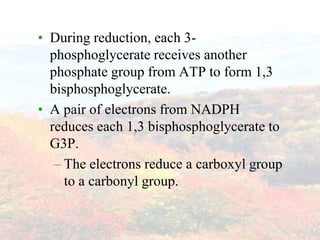
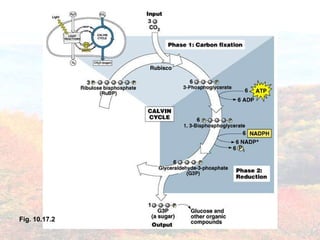
During reduction, each 3-phosphoglycerate receives another phosphate group from ATP to form 1,3 bisphosphoglycerate.A pair of electrons from NADPH reduces each 1,3 bisphosphoglycerate to G3P.The electrons reduce a carboxyl group to a carbonyl group.
Fig. 10.17.2
If our goal was to produce one G3P net, we would start with 3 CO2 (3C) and three RuBP (15C).After fixation and reduction we would have six molecules of G3P (18C).  One of these six G3P (3C) is a net gain of carbohydrate.This molecule can exit the cycle to be used by the plant cell.The other five (15C) must remain in the cycle to regenerate three RuBP.
In the last phase, regeneration of the CO2 acceptor (RuBP), these five G3P molecules are rearranged to form 3 RuBP molecules.To do this, the cycle must spend three more molecules of ATP (one per RuBP) to complete the cycle and prepare for the next.
For the net synthesis of one G3P molecule, the Calvin recycle consumes nine ATP and six NAPDH.It “costs” three ATP and two NADPH per CO2.The G3P from the Calvin cycle is the starting material for metabolic pathways that synthesize other organic compounds, including glucose and other carbohydrates.
Metabolisme 3
Metabolisme 3

Metabolisme 3

  • 2.
  • 3.
    Photosynthesis in OverviewProcessby which plants and other autotrophs store the energy of sunlight into sugars.Requires sunlight, water, and carbon dioxide.Overall equation:6 CO2 + 6 H20  C6H12O6 + 6 O2
  • 4.
  • 5.
    Leaf StructureMost photosynthesisoccurs in the palisade layer.Gas exchange of CO2 and O2 occurs at openings called stomata surrounded by guard cells on the lower leaf surface.PalisadeSpongy
  • 6.
    6NucleusCell WallChloroplastCentral VacuoleMesophyllCell of LeafPhotosynthesis occurs in these cells!
  • 7.
    Chloroplast StructureInner membranecalled the thylakoid membrane.Thickened regions called thylakoids. A stack of thylakoids is called a granum. (Plural – grana)Stroma is a liquid surrounding the thylakoids.
  • 8.
  • 9.
    9Chlorophyll MoleculesLocated inthe thylakoid membranesChlorophyll have Mg+ in the centerChlorophyll pigments harvest energy (photons) by absorbing certain wavelengths (blue-420 nm and red-660 nm are most important)Plants are green because the green wavelength is reflected, not absorbed.
  • 10.
    PigmentsChlorophyll A isthe most important photosynthetic pigment. Other pigments called antenna or accessory pigments are also present in the leaf.Chlorophyll BCarotenoids (orange / red)Xanthophylls (yellow / brown)These pigments are embedded in the membranes of the chloroplast in groups called photosystems.
  • 11.
  • 12.
    Photosynthesis: The ChemicalProcessOccurs in two main phases.Light reactionsDark reactions (The Calvin Cycle)Light reactions are the “photo” part of photosynthesis. Light is absorbed by pigments.Dark reactions are the “synthesis” part of photosynthesis. Trapped energy from the sun is converted to the chemical energy of sugars.
  • 13.
    Light ReactionsLight-dependent reactionsoccur on the thylakoid membranes.Light and water are required for this process.Energy storage molecules are formed. (ATP and NADPH)Oxygen gas is made as a waste product.
  • 16.
  • 17.
    During the lightreactions, there are two possible routes for electron flow: cyclic and noncyclic.Noncyclic electron flow, the predominant route, produces both ATP and NADPH.When photosystem II absorbs light, an excited electron is captured by the primary electron acceptor, leaving the reaction center oxidized.An enzyme extracts electrons from water and supplies them to the oxidized reaction center.This reaction splits water into two hydrogen ions and an oxygen atom which combines with another to form O2.
  • 18.
    Photoexcitedelectrons pass alongan electron transport chain before ending up at an oxidized photosystem I reaction center.As these electrons pass along the transport chain, their energy is harnessed to produce ATP.The mechanism of noncyclicphotophosphorylation is similar to the process on oxidative phosphorylation.
  • 19.
    5. At thebottom of this electron transport chain, the electrons fill an electron “hole” in an oxidized P700 center.6. This hole is created when photons excite electrons on the photosystem I complex. The excited electrons are captured by a second primary electron acceptor which transmits them to a second electron transport chain.Ultimately, these electrons are passed from the transport chain to NADP+, creating NADPH.NADPH will carry the reducing power of these high-energy electrons to the Calvin cycle.
  • 20.
    20e-PrimaryElectronAcceptorSUNe-ATPproducedby ETCe-Photonse-P700AccessoryPigmentsPhotosystem ICyclicElectron FlowPigments absorb light energy & excite e- of Chlorophyll a to produce ATP
  • 21.
    Dark ReactionsDark reactions(light-independent) occur in the stroma.Carbon dioxide is “fixed” into the sugar glucose.The actual sugar product of the Calvin cycle is not glucose, but a three-carbon sugar, glyceraldehyde-3-phosphate (G3P).For the net synthesis of one G3P molecule, the cycle must take place three times, fixing three molecules of CO2.To make one glucose molecules would require six cycles and the fixation of six CO2 molecules.ATP and NADPH molecules created during the light reactions power the production of this glucose.
  • 22.
    The Calvin cyclehas three phases.1. In the carbon fixation phase, each CO2 molecule is attached to a five-carbon sugar, ribulosebisphosphate (RuBP).This is catalyzed by RuBPcarboxylase or rubisco.The six-carbon intermediate splits in half to form two molecules of 3-phosphoglycerate per CO2.
  • 23.
  • 24.
    During reduction, each3-phosphoglycerate receives another phosphate group from ATP to form 1,3 bisphosphoglycerate.A pair of electrons from NADPH reduces each 1,3 bisphosphoglycerate to G3P.The electrons reduce a carboxyl group to a carbonyl group.
  • 25.
  • 26.
    If our goalwas to produce one G3P net, we would start with 3 CO2 (3C) and three RuBP (15C).After fixation and reduction we would have six molecules of G3P (18C). One of these six G3P (3C) is a net gain of carbohydrate.This molecule can exit the cycle to be used by the plant cell.The other five (15C) must remain in the cycle to regenerate three RuBP.
  • 27.
    In the lastphase, regeneration of the CO2 acceptor (RuBP), these five G3P molecules are rearranged to form 3 RuBP molecules.To do this, the cycle must spend three more molecules of ATP (one per RuBP) to complete the cycle and prepare for the next.
  • 29.
    For the netsynthesis of one G3P molecule, the Calvin recycle consumes nine ATP and six NAPDH.It “costs” three ATP and two NADPH per CO2.The G3P from the Calvin cycle is the starting material for metabolic pathways that synthesize other organic compounds, including glucose and other carbohydrates.