MAYAN CIVILIZATION
Introduction
The Mayan civilization was a complex and
sophisticated civilization in Central and North
America that existed from antiquity to the early
modern period. 250 CE.- 900 CE
Mayan
Geography
They are located to what
is now Mexico,
Guatemala, Belize,
western Honduras, and El
Salvador
Mayan
Culture
Mayans ties beads and
boards on their
children's forehead.
Mayan
Culture
They were an agriculture
based society. They grow
corn, beans, and squash,
and practice many of the
same crafts, such as
weaving and pottery
MAYAN
CONTRIBUTIONS
MAYAN CALENDAR
Mayan developed two
different calendars; the Haab
and the Tzolk'in.
The Haab have 365 days
divided into 18 months–20
days plus 5 days called
uayeb. Tzolk'in have 260 days
divided into 13 months–
20 days each.
NUMBER SYSTEM
The Mayan numeral
system was a base-20
system used by the
ancient Mayans to
represent numbers and
calendar dates, also
known as vigesimal
system.
MAYAN HIEROGLYPHS
Developed hieroglyphic-
style writing to record
astronomical
observations, calendar,
calculations, & historical
information
MAYAN BOOK
It is called "Codex"
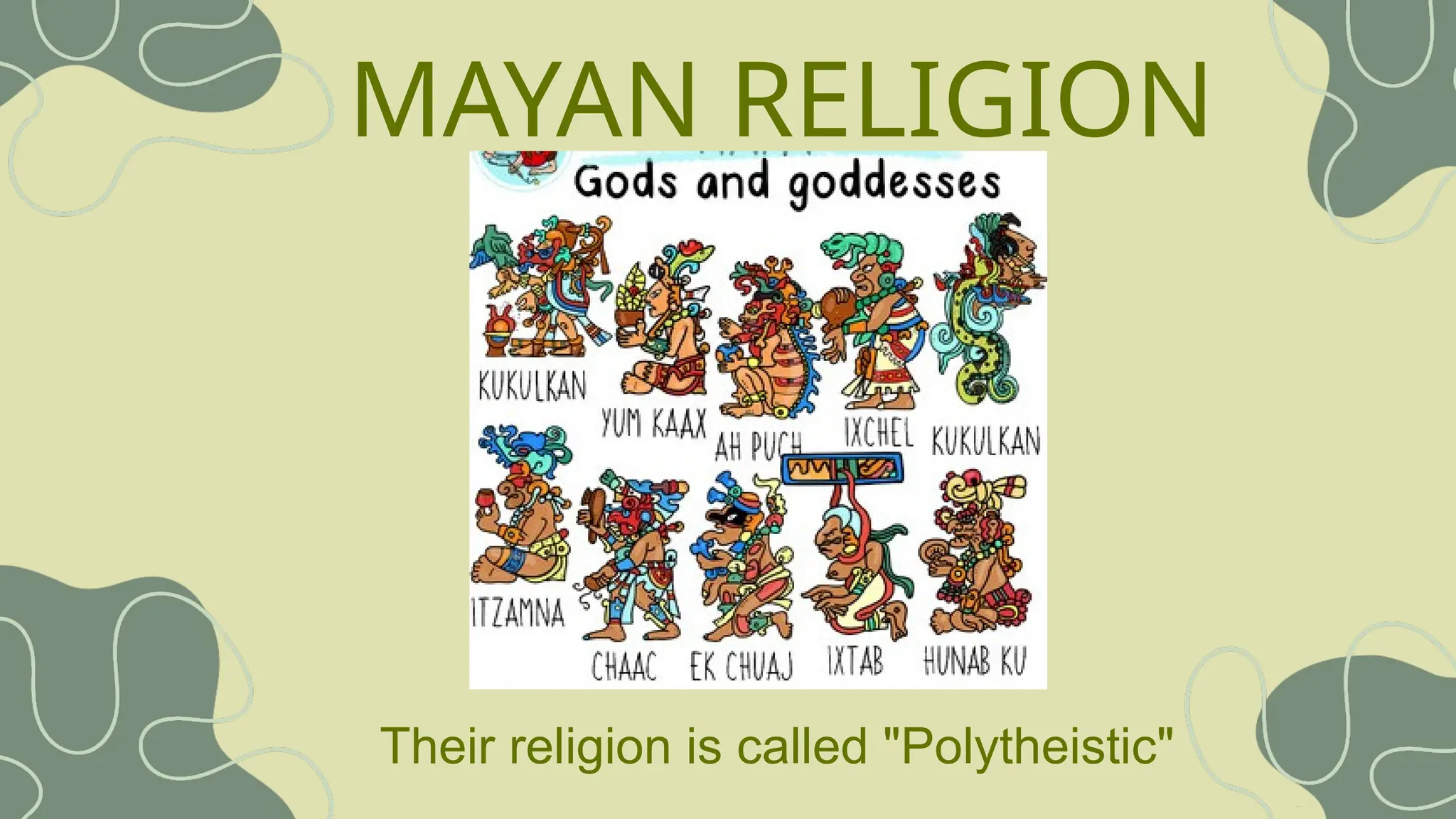
MAYAN RELIGION
Their religion is called "Polytheistic"
MAYAN BALL GAME
The ball was very hard to
get through the hoop.
Because of this, when u
player successfully got the
ball through hoop, the
spectators would have to
give inim their jewelry
MAYAN BALL COURT
The court was
shaped like an
upper case, many
believe it to be the
first team sport.
-INCA-
The Inca civilization was a pre-Columbian empire
that flourished in the Peruvian highlands.
Known as Tawantinsuyu and the capital is Cusco.
They are located to what is now Peru.
INCA
GEOGRAPHY
The Inca Empire, also known as
Tawantinsuyu. Tawa means 4, ntin
means group and suyu is region.
•Chinchaysuyu (north)
•Antisuyu (east)
•Cuntisuyu (west)
•Collasuyu (south)
INCA
GOVERNMENT The Sapa Inca was all-powerful.
Everything belonged to the
Sapa Inca. He ruled his people
by putting his relatives in
positions of power. Since
punishment was harsh and
swift, almost no one broke the
law
INCA
GOVERNMENT
Local officials had the power to
make all decisions about the
lives of the people they ruled.
Inspectors visited frequently to
check on things. Breaking the
law usually meant the death
penalty.
INCA
COMMONERS
The Incas were very class
conscious and were divided
into nobles and common
people. The nobles pretty
much did what they
wanted, while the common
people were tightly
controlled by the
government
INCA
TAX
Each common person was listed in
the consus. Each person listed had
to pay a tax. The Incas loved gold
and silver, but they had no use for
money. The people paid their tax
each year in physical labor-serving
in the army, working in the mines, or
building roads, temples, and
palaces.
Machu Picchu and
Inca Road
High in the Andes Mountains. the Incas connected their empire
with 14,000 miles of well-built roads. Some sections of road
were over 24 foot wide. Some were even paved. Some roads
were so steep that the Incas built stone walls along the edge to
prevent people from falling off the cliff.
QUI
PU
To keep records. The Inca
used quipus which are
knotted cords used as
counting tools and it is
their way communication.
-OLMEC-
The Olmecs were the first major
civilization in Mesoamerica, living in the
tropical lowlands of present-day Mexico.
1200 BCE-400 BCE
OLMEC
GEOGRAPHY
The Olmec civilization was
located in the hot, humid
lowlands of the Gulf of Mexico
coast in what is now southern
Mexico. The Olmecs lived in the
region that is now the states of
Tabasco and Veracruz
OLMEC
SCULPTURE HEADOlmecs is known
for their huge
sculpture of heads
OLMEC GREAT
PYRAMID
The first civilization to
create pyramids.
OLMEC
HIEROGLYPHS
•The Olmec used an
early form of glyph
writing to record events,
dates, and to tell stories.
OLMEC
CALENDAR
They developed a
calendar that was
amazingly accurate for
its time. Combination of
Haab and Tzolk'in.
OLMEC'S POT-
A-TOK
Shooting a rubber ball
through a stone ring
without using your hands
or feet.
OLMEC
JEWELRY
They mainly traded for luxury
items such as precious stones.
Were known for making wein
from these gems and stones
Knowledge and ideas were also
exchanged at these trade
centers.
HEAD SCULPTURE AS
KINGS
These realistic sculptures are
thought to be portraits of Olmec
kings who ruled from palaces in
San Lorenzo and La Venta. The
heads depict individual rulers with a
variety of facial expressions, and
were likely created from living or
recently deceased rulers.
-AZTEC-
The Aztecs, is originated as a nomadic tribe in northern
Mexico, arrived in Mesoamerica around the beginning
of the 13th century. From their magnificent capital city,
Tenochtitlan, the Aztecs emerged as the dominant force
in central Mexico, developing an intricate social,
political, religious and commercial organization that
brought many of the region’s city-states under their
control by the 15th century. Invaders led by the Spanish
conquistador Hernán Cortés overthrew the Aztec
Empire by force and captured Tenochtitlan in 1521,
bringing an end to Mesoamerica’s last great native
civilization.
Hernán Cortés is best known for conquering the Aztecs
and claiming Mexico on behalf of Spain. Cortés (Don
Hernán Cortés de Monroy y Pizarro Altamirano) first
served as a soldier in an expedition of Cuba led by Diego
Velázquez in 1511.
In 1519, Cortés was set to command his own expedition to
Mexico when Velázquez cancelled it. Cortés ignored the
order and traveled to Mexico, setting his sights on
overthrowing ruler Montezuma II in the Aztec capital of
Tenochtitlan. The Aztecs eventually drove the Spanish
from Tenochtitlan, but Cortés returned to defeat the
natives and take the city in 1521. He spent much of his
later years seeking recognition for his achievements and
support from the Spanish royal court.
WHO IS?
Early Aztec History
The exact origins of the Aztec people are
uncertain, but they are believed to have begun
as a northern tribe of hunter-gatherers whose
name came from their homeland Aztlan, or
“White Land” in the Aztec language of
Nahuatl.
The Aztec Empire, known for its
rich culture and significant
influence in Mesoamerica,
flourished from the 14th to the 16th
centuries. Centered in what is now
Mexico City, the empire was
characterized by its impressive
architecture, advanced agricultural
practices, and complex social
structure.
At the heart of the Aztec civilization was Tenochtitlan, an island city that showcased
stunning temples, palaces, and a sophisticated system of canals. The Aztecs were
known for their impressive engineering feats, including the construction of
chinampas, or floating gardens, which allowed them to maximize agricultural
production.
THE AZTEC
CALENDAR
Xiuhpohualli- has 365 days. It
describes the days and rituals related to
the seasons, and therefor might be called
the agricultural year or the solar year.
Tonalpohualli- or day-count has 260
days, it is called a sacred calendar. It
divides the days and rituals between the
gods.
THE AZTEC
RELIGION
The Aztecs had a noble priest class that played a
key role in their religious practices. Priests were
responsible for collecting tributes, ensuring there
were enough goods for sacrifices, and training
young men to impersonate deities.
THE AZTEC
LANGUAGE
The language of the Aztecs was Nahuatl, an
indigenous language spoken in Central Mexico. It
was the lingua franca of the Aztec Empire, which
ruled Mexico from the 14th to 16th centuries.
Did you know? The Aztec language, Nahuatl,
was the dominant language in central Mexico
by the mid-1350s. Numerous Nahuatl words
borrowed by the Spanish were later absorbed
into English as well, including chile or chili,
avocado, chocolate, coyote...
THE AZTEC
GOVERNMENT
The Aztec Empire was ruled by a
monarch called the Huey Tlatoani,
who had semi-divine status. The Huey
Tlatoani was the ruler of the capital
city, Tenochtitlan, and the entire
empire. Other major cities were ruled
by tlatoanis, who were like kings or
high lords.
-AFRICA-
INTRODUCTIO
N
Africa is home to some of the oldest and
strongest civilizations on Earth, and people
have lived there for over three million years.
Africa is also believed to be the birthplace
of modern humans.
AFRICA
GEOGRAPHY
Africa is the world's second-largest
continent, spanning almost 12
million square miles. It's located in
the south of Europe and west of
India, and is bordered by the
Mediterranean Sea, Indian Ocean,
and Atlantic Ocean.
AFRICA
CULTURE
Maasai culture is a semi-nomadic
lifestyle in East Africa that centers
around cattle herding. The Maasai
are a pastoral people who live in
Kenya and Tanzania.
The governments of ancient African civilizations
were usually led by kings or queens, with a
centralized administration. The kings had near
absolute power, and the government structure was
often maintained even when one empire replaced
another.
AFRICA
GOVERNMENT
AFRICA
CONTRIBUTIONS
African civilizations have contributed to the
world in many ways, including science,
technology, art, and more.
Bone tools are believed to have originated in
Africa. The earliest evidence of bone tools
comes from sites in South Africa and date back
to at least 70,000 years ago.
Copper and iron were used in
Africa to make tools, weapons,
and jewelry. Iron was also used to
make agricultural tools, which
helped to increase the amount of
food that could be produced.
Art and music
Blues, reggae, jazz, and
Afrobeat:
These genres of music originated
in Africa.
African head sculptures include the
Lydenburg Heads from South Africa
and the Nok heads from Nigeria. These
sculptures are examples of the early
African Iron Age and terracotta figure
production.
Thank You!

MAYAN CIVILIZATIONnnnnnnnnnnnnnnnnn.pptx

  • 1.
  • 2.
    Introduction The Mayan civilizationwas a complex and sophisticated civilization in Central and North America that existed from antiquity to the early modern period. 250 CE.- 900 CE
  • 3.
    Mayan Geography They are locatedto what is now Mexico, Guatemala, Belize, western Honduras, and El Salvador
  • 4.
    Mayan Culture Mayans ties beadsand boards on their children's forehead.
  • 5.
    Mayan Culture They were anagriculture based society. They grow corn, beans, and squash, and practice many of the same crafts, such as weaving and pottery
  • 6.
  • 7.
    MAYAN CALENDAR Mayan developedtwo different calendars; the Haab and the Tzolk'in. The Haab have 365 days divided into 18 months–20 days plus 5 days called uayeb. Tzolk'in have 260 days divided into 13 months– 20 days each.
  • 8.
    NUMBER SYSTEM The Mayannumeral system was a base-20 system used by the ancient Mayans to represent numbers and calendar dates, also known as vigesimal system.
  • 9.
    MAYAN HIEROGLYPHS Developed hieroglyphic- stylewriting to record astronomical observations, calendar, calculations, & historical information
  • 10.
    MAYAN BOOK It iscalled "Codex"
  • 11.
    MAYAN RELIGION Their religionis called "Polytheistic"
  • 12.
    MAYAN BALL GAME Theball was very hard to get through the hoop. Because of this, when u player successfully got the ball through hoop, the spectators would have to give inim their jewelry
  • 13.
    MAYAN BALL COURT Thecourt was shaped like an upper case, many believe it to be the first team sport.
  • 14.
    -INCA- The Inca civilizationwas a pre-Columbian empire that flourished in the Peruvian highlands. Known as Tawantinsuyu and the capital is Cusco. They are located to what is now Peru.
  • 15.
    INCA GEOGRAPHY The Inca Empire,also known as Tawantinsuyu. Tawa means 4, ntin means group and suyu is region. •Chinchaysuyu (north) •Antisuyu (east) •Cuntisuyu (west) •Collasuyu (south)
  • 16.
    INCA GOVERNMENT The SapaInca was all-powerful. Everything belonged to the Sapa Inca. He ruled his people by putting his relatives in positions of power. Since punishment was harsh and swift, almost no one broke the law
  • 17.
    INCA GOVERNMENT Local officials hadthe power to make all decisions about the lives of the people they ruled. Inspectors visited frequently to check on things. Breaking the law usually meant the death penalty.
  • 18.
    INCA COMMONERS The Incas werevery class conscious and were divided into nobles and common people. The nobles pretty much did what they wanted, while the common people were tightly controlled by the government
  • 19.
    INCA TAX Each common personwas listed in the consus. Each person listed had to pay a tax. The Incas loved gold and silver, but they had no use for money. The people paid their tax each year in physical labor-serving in the army, working in the mines, or building roads, temples, and palaces.
  • 20.
    Machu Picchu and IncaRoad High in the Andes Mountains. the Incas connected their empire with 14,000 miles of well-built roads. Some sections of road were over 24 foot wide. Some were even paved. Some roads were so steep that the Incas built stone walls along the edge to prevent people from falling off the cliff.
  • 21.
    QUI PU To keep records.The Inca used quipus which are knotted cords used as counting tools and it is their way communication.
  • 22.
    -OLMEC- The Olmecs werethe first major civilization in Mesoamerica, living in the tropical lowlands of present-day Mexico. 1200 BCE-400 BCE
  • 23.
    OLMEC GEOGRAPHY The Olmec civilizationwas located in the hot, humid lowlands of the Gulf of Mexico coast in what is now southern Mexico. The Olmecs lived in the region that is now the states of Tabasco and Veracruz
  • 24.
    OLMEC SCULPTURE HEADOlmecs isknown for their huge sculpture of heads
  • 25.
    OLMEC GREAT PYRAMID The firstcivilization to create pyramids.
  • 26.
    OLMEC HIEROGLYPHS •The Olmec usedan early form of glyph writing to record events, dates, and to tell stories.
  • 27.
    OLMEC CALENDAR They developed a calendarthat was amazingly accurate for its time. Combination of Haab and Tzolk'in.
  • 28.
    OLMEC'S POT- A-TOK Shooting arubber ball through a stone ring without using your hands or feet.
  • 29.
    OLMEC JEWELRY They mainly tradedfor luxury items such as precious stones. Were known for making wein from these gems and stones Knowledge and ideas were also exchanged at these trade centers.
  • 30.
    HEAD SCULPTURE AS KINGS Theserealistic sculptures are thought to be portraits of Olmec kings who ruled from palaces in San Lorenzo and La Venta. The heads depict individual rulers with a variety of facial expressions, and were likely created from living or recently deceased rulers.
  • 31.
  • 32.
    The Aztecs, isoriginated as a nomadic tribe in northern Mexico, arrived in Mesoamerica around the beginning of the 13th century. From their magnificent capital city, Tenochtitlan, the Aztecs emerged as the dominant force in central Mexico, developing an intricate social, political, religious and commercial organization that brought many of the region’s city-states under their control by the 15th century. Invaders led by the Spanish conquistador Hernán Cortés overthrew the Aztec Empire by force and captured Tenochtitlan in 1521, bringing an end to Mesoamerica’s last great native civilization.
  • 33.
    Hernán Cortés isbest known for conquering the Aztecs and claiming Mexico on behalf of Spain. Cortés (Don Hernán Cortés de Monroy y Pizarro Altamirano) first served as a soldier in an expedition of Cuba led by Diego Velázquez in 1511. In 1519, Cortés was set to command his own expedition to Mexico when Velázquez cancelled it. Cortés ignored the order and traveled to Mexico, setting his sights on overthrowing ruler Montezuma II in the Aztec capital of Tenochtitlan. The Aztecs eventually drove the Spanish from Tenochtitlan, but Cortés returned to defeat the natives and take the city in 1521. He spent much of his later years seeking recognition for his achievements and support from the Spanish royal court. WHO IS?
  • 34.
    Early Aztec History Theexact origins of the Aztec people are uncertain, but they are believed to have begun as a northern tribe of hunter-gatherers whose name came from their homeland Aztlan, or “White Land” in the Aztec language of Nahuatl.
  • 35.
    The Aztec Empire,known for its rich culture and significant influence in Mesoamerica, flourished from the 14th to the 16th centuries. Centered in what is now Mexico City, the empire was characterized by its impressive architecture, advanced agricultural practices, and complex social structure. At the heart of the Aztec civilization was Tenochtitlan, an island city that showcased stunning temples, palaces, and a sophisticated system of canals. The Aztecs were known for their impressive engineering feats, including the construction of chinampas, or floating gardens, which allowed them to maximize agricultural production.
  • 36.
    THE AZTEC CALENDAR Xiuhpohualli- has365 days. It describes the days and rituals related to the seasons, and therefor might be called the agricultural year or the solar year. Tonalpohualli- or day-count has 260 days, it is called a sacred calendar. It divides the days and rituals between the gods.
  • 37.
    THE AZTEC RELIGION The Aztecshad a noble priest class that played a key role in their religious practices. Priests were responsible for collecting tributes, ensuring there were enough goods for sacrifices, and training young men to impersonate deities.
  • 38.
    THE AZTEC LANGUAGE The languageof the Aztecs was Nahuatl, an indigenous language spoken in Central Mexico. It was the lingua franca of the Aztec Empire, which ruled Mexico from the 14th to 16th centuries.
  • 39.
    Did you know?The Aztec language, Nahuatl, was the dominant language in central Mexico by the mid-1350s. Numerous Nahuatl words borrowed by the Spanish were later absorbed into English as well, including chile or chili, avocado, chocolate, coyote...
  • 40.
    THE AZTEC GOVERNMENT The AztecEmpire was ruled by a monarch called the Huey Tlatoani, who had semi-divine status. The Huey Tlatoani was the ruler of the capital city, Tenochtitlan, and the entire empire. Other major cities were ruled by tlatoanis, who were like kings or high lords.
  • 41.
  • 42.
    INTRODUCTIO N Africa is hometo some of the oldest and strongest civilizations on Earth, and people have lived there for over three million years. Africa is also believed to be the birthplace of modern humans.
  • 43.
    AFRICA GEOGRAPHY Africa is theworld's second-largest continent, spanning almost 12 million square miles. It's located in the south of Europe and west of India, and is bordered by the Mediterranean Sea, Indian Ocean, and Atlantic Ocean.
  • 44.
    AFRICA CULTURE Maasai culture isa semi-nomadic lifestyle in East Africa that centers around cattle herding. The Maasai are a pastoral people who live in Kenya and Tanzania.
  • 45.
    The governments ofancient African civilizations were usually led by kings or queens, with a centralized administration. The kings had near absolute power, and the government structure was often maintained even when one empire replaced another. AFRICA GOVERNMENT
  • 46.
    AFRICA CONTRIBUTIONS African civilizations havecontributed to the world in many ways, including science, technology, art, and more.
  • 47.
    Bone tools arebelieved to have originated in Africa. The earliest evidence of bone tools comes from sites in South Africa and date back to at least 70,000 years ago.
  • 48.
    Copper and ironwere used in Africa to make tools, weapons, and jewelry. Iron was also used to make agricultural tools, which helped to increase the amount of food that could be produced.
  • 49.
    Art and music Blues,reggae, jazz, and Afrobeat: These genres of music originated in Africa.
  • 50.
    African head sculpturesinclude the Lydenburg Heads from South Africa and the Nok heads from Nigeria. These sculptures are examples of the early African Iron Age and terracotta figure production.
  • 51.