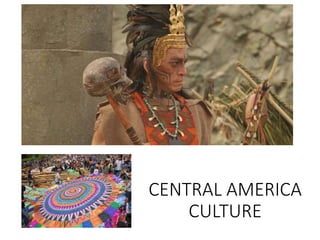
CENTRAL AMERICA
CULTURE
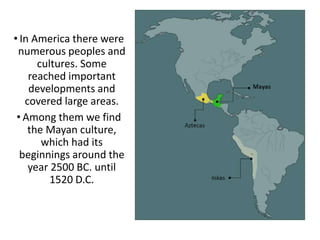
• In America there were
numerous peoples and
cultures. Some
reached important
developments and
covered large areas.
• Among them we find
the Mayan culture,
which had its
beginnings around the
year 2500 BC. until
1520 D.C.
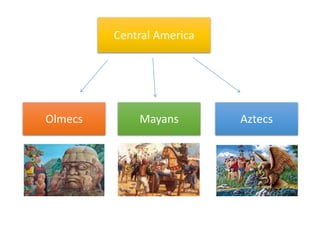
Central America
Olmecs Mayans Aztecs
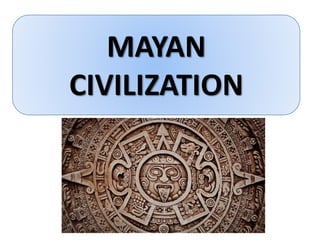
MAYAN
CIVILIZATION
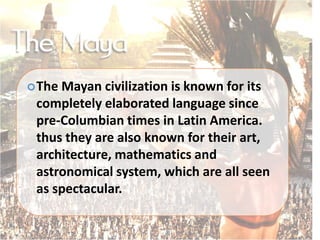
The Mayan civilization is known for its
completely elaborated language since
pre-Columbian times in Latin America.
thus they are also known for their art,
architecture, mathematics and
astronomical system, which are all seen
as spectacular.
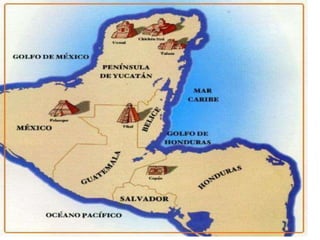
Geographic location:
•It was developed in the Yucatan Peninsula.
•The geographical spread of the Maya extends
throughout southern Mexico, including the states of
Chiapas, Tabasco and the Yucatan Peninsula, Quintana,
Roo and Campeche.
•We also find that the Maya spread through northern
Central America, including what is now the Republic of
Guatemala, Belize, El Salvador and the western part of
Honduras
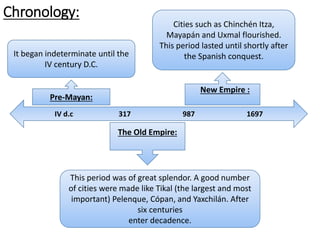
IV d.c 317 987 1697
Chronology:
Pre-Mayan:
The Old Empire:
New Empire :
It began indeterminate until the
IV century D.C.
Cities such as Chinchén Itza,
Mayapán and Uxmal flourished.
This period lasted until shortly after
the Spanish conquest.
This period was of great splendor. A good number
of cities were made like Tikal (the largest and most
important) Pelenque, Cópan, and Yaxchilán. After
six centuries
enter decadence.
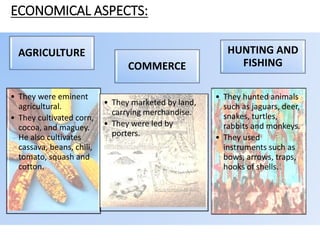
ECONOMICAL ASPECTS:
AGRICULTURE
• They were eminent
agricultural.
• They cultivated corn,
cocoa, and maguey.
He also cultivates
cassava, beans, chili,
tomato, squash and
cotton.
COMMERCE
• They marketed by land,
carrying merchandise.
• They were led by
porters.
HUNTING AND
FISHING
• They hunted animals
such as jaguars, deer,
snakes, turtles,
rabbits and monkeys.
• They used
instruments such as
bows, arrows, traps,
hooks of shells.
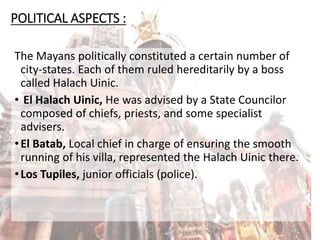
POLITICAL ASPECTS :
The Mayans politically constituted a certain number of
city-states. Each of them ruled hereditarily by a boss
called Halach Uinic.
• El Halach Uinic, He was advised by a State Councilor
composed of chiefs, priests, and some specialist
advisers.
•El Batab, Local chief in charge of ensuring the smooth
running of his villa, represented the Halach Uinic there.
•Los Tupiles, junior officials (police).
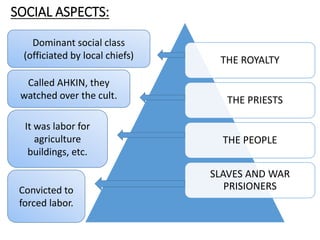
SOCIAL ASPECTS:
THE ROYALTY
THE PRIESTS
THE PEOPLE
SLAVES AND WAR
PRISIONERS
Dominant social class
(officiated by local chiefs)
Called AHKIN, they
watched over the cult.
It was labor for
agriculture
buildings, etc.
Convicted to
forced labor.
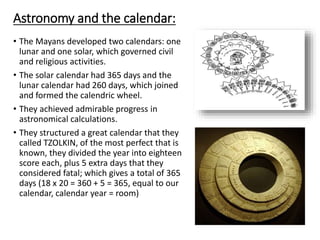
Astronomy and the calendar:
• The Mayans developed two calendars: one
lunar and one solar, which governed civil
and religious activities.
• The solar calendar had 365 days and the
lunar calendar had 260 days, which joined
and formed the calendric wheel.
• They achieved admirable progress in
astronomical calculations.
• They structured a great calendar that they
called TZOLKIN, of the most perfect that is
known, they divided the year into eighteen
score each, plus 5 extra days that they
considered fatal; which gives a total of 365
days (18 x 20 = 360 + 5 = 365, equal to our
calendar, calendar year = room)
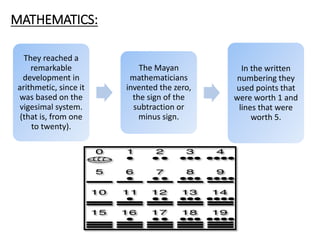
They reached a
remarkable
development in
arithmetic, since it
was based on the
vigesimal system.
(that is, from one
to twenty).
The Mayan
mathematicians
invented the zero,
the sign of the
subtraction or
minus sign.
In the written
numbering they
used points that
were worth 1 and
lines that were
worth 5.
MATHEMATICS:
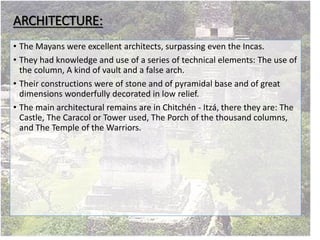
ARCHITECTURE:
• The Mayans were excellent architects, surpassing even the Incas.
• They had knowledge and use of a series of technical elements: The use of
the column, A kind of vault and a false arch.
• Their constructions were of stone and of pyramidal base and of great
dimensions wonderfully decorated in low relief.
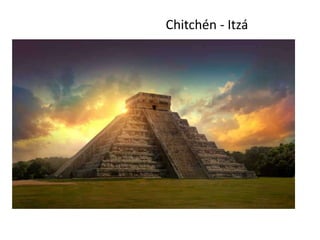
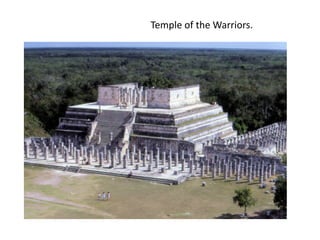
• The main architectural remains are in Chitchén - Itzá, there they are: The
Castle, The Caracol or Tower used, The Porch of the thousand columns,
and The Temple of the Warriors.
Chitchén - Itzá
Temple of the Warriors.
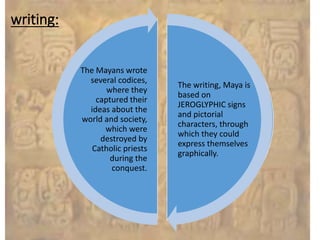
The writing, Maya is
based on
JEROGLYPHIC signs
and pictorial
characters, through
which they could
express themselves
graphically.
The Mayans wrote
several codices,
where they
captured their
ideas about the
world and society,
which were
destroyed by
Catholic priests
during the
conquest.
writing:
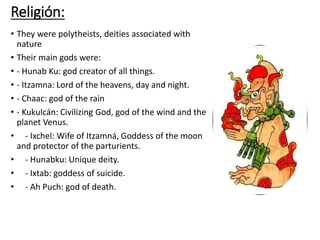
Religión:
• They were polytheists, deities associated with
nature
• Their main gods were:
• - Hunab Ku: god creator of all things.
• - Itzamna: Lord of the heavens, day and night.
• - Chaac: god of the rain
• - Kukulcán: Civilizing God, god of the wind and the
planet Venus.
• - Ixchel: Wife of Itzamná, Goddess of the moon
and protector of the parturients.
• - Hunabku: Unique deity.
• - Ixtab: goddess of suicide.
• - Ah Puch: god of death.
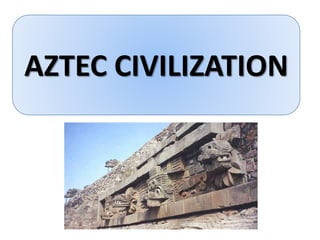
AZTEC CIVILIZATION
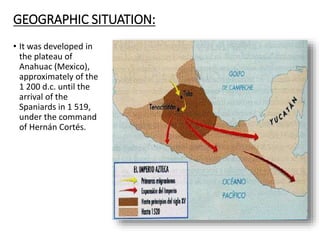
GEOGRAPHIC SITUATION:
• It was developed in
the plateau of
Anahuac (Mexico),
approximately of the
1 200 d.c. until the
arrival of the
Spaniards in 1 519,
under the command
of Hernán Cortés.
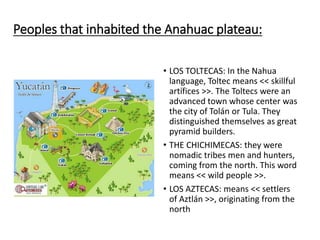
Peoples that inhabited the Anahuac plateau:
• LOS TOLTECAS: In the Nahua
language, Toltec means << skillful
artífices >>. The Toltecs were an
advanced town whose center was
the city of Tolán or Tula. They
distinguished themselves as great
pyramid builders.
• THE CHICHIMECAS: they were
nomadic tribes men and hunters,
coming from the north. This word
means << wild people >>.
• LOS AZTECAS: means << settlers
of Aztlán >>, originating from the
north
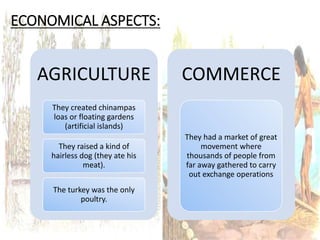
ECONOMICAL ASPECTS:
AGRICULTURE
They created chinampas
loas or floating gardens
(artificial islands)
They raised a kind of
hairless dog (they ate his
meat).
The turkey was the only
poultry.
COMMERCE
They had a market of great
movement where
thousands of people from
far away gathered to carry
out exchange operations
POLITICAL ASPECTS:
• It was a centralized military state that exercised a broad domain over the
adjacent towns. Its capital was: Tenochtitlán.
• The Aztecs constituted an elective monarchy, that is, the supreme
commander was elected. Its main political authorities were:
THE TLACATECULI: It was also called TLATOQUE. He was the Supreme
Head of Government, considered the son of the Gods. His decisions
were unappealable. << Head of Men >>
THE CÍHUACOATI: It means << Serpent Woman >> (although this
official was always male). It happened in the government to the
Tlacateculi in case of death.
THE SUPREME COUNCIL: Formed by the delegates of the clans or
calpullis. These members are called TLOTOANI; they fulfilled
administrative, political, and legal functions.
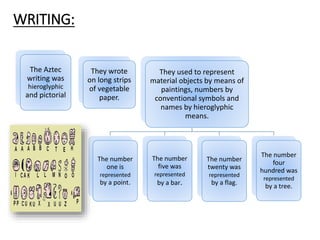
The Aztec
writing was
hieroglyphic
and pictorial
They wrote
on long strips
of vegetable
paper.
They used to represent
material objects by means of
paintings, numbers by
conventional symbols and
names by hieroglyphic
means.
The number
one is
represented
by a point.
The number
five was
represented
by a bar.
The number
twenty was
represented
by a flag.
The number
four
hundred was
represented
by a tree.
WRITING:
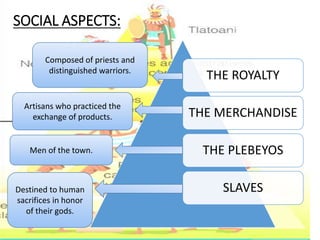
SOCIAL ASPECTS:
THE ROYALTY
THE MERCHANDISE
THE PLEBEYOS
SLAVES
Composed of priests and
distinguished warriors.
Men of the town.
Artisans who practiced the
exchange of products.
Destined to human
sacrifices in honor
of their gods.
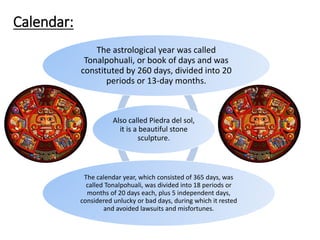
Also called Piedra del sol,
it is a beautiful stone
sculpture.
The astrological year was called
Tonalpohuali, or book of days and was
constituted by 260 days, divided into 20
periods or 13-day months.
The calendar year, which consisted of 365 days, was
called Tonalpohuali, was divided into 18 periods or
months of 20 days each, plus 5 independent days,
considered unlucky or bad days, during which it rested
and avoided lawsuits and misfortunes.
Calendar:
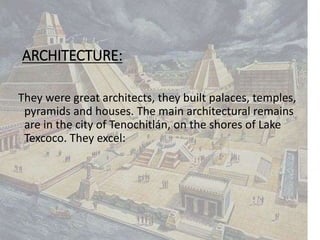
ARCHITECTURE:
They were great architects, they built palaces, temples,
pyramids and houses. The main architectural remains
are in the city of Tenochitlán, on the shores of Lake
Texcoco. They excel:
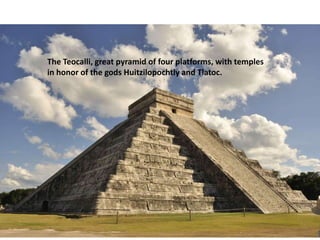
The Teocalli, great pyramid of four platforms, with temples
in honor of the gods Huitzilopochtly and Tlatoc.
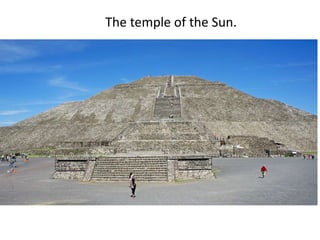
The temple of the Sun.
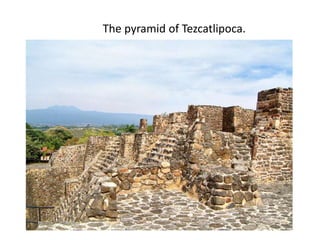
The pyramid of Tezcatlipoca.
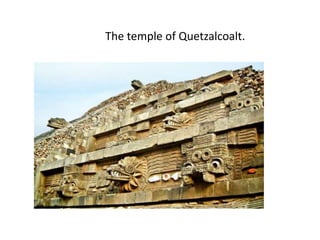
The temple of Quetzalcoalt.
RELIGION:
The Aztec religion was polytheistic, because they had them at the end of
their development were in trance to monotheism because the god
TEZCATLIPOCA had assumed a superior character to other gods. Their
main gods were:
QUETZALCOATL: The << feathered serpent >> was the god of good,
creator and civilizer, protector of artists and god supreme and
benefactor.
HUITZILOPOCHTLI: god of war, fierce and bloodthirsty, was their main
divinity, to whom they offered human sacrifices.
TEZCATLIPOCA: << The Summer sun >> of good harvests or terrible
harvests. Its name means << smoking mirror >>.
TLALOC: That was the god of water.
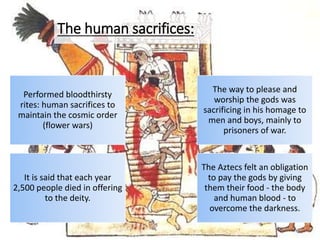
Performed bloodthirsty
rites: human sacrifices to
maintain the cosmic order
(flower wars)
The way to please and
worship the gods was
sacrificing in his homage to
men and boys, mainly to
prisoners of war.
It is said that each year
2,500 people died in offering
to the deity.
The Aztecs felt an obligation
to pay the gods by giving
them their food - the body
and human blood - to
overcome the darkness.
The human sacrifices:
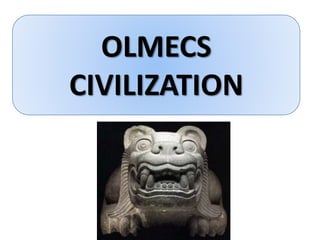
OLMECS
CIVILIZATION
Olmecs
Siguiente
The Olmecs (/ˈɒlmɛks, ˈoʊl-/) were the earliest
known major civilization in Mesoamerica following
a progressive development in Soconusco.
They lived in the tropical lowlands of south-central
Mexico, in the present-day states of Veracruz and Tabasco. It has been
speculated that the Olmecs derive in part from neighboring Mokaya or Mixe–
Zoque.
Etymology
The name 'Olmec' comes from the Nahuatl word for the Olmecs: Ōlmēcatl
[oːlˈmeːkat͡ɬ] (singular) or Ōlmēcah [oːlˈmeːkaʔ] (plural). This word is
composed of the two words ōlli [ˈoːlːi], meaning "rubber", and mēcatl
[ˈmeːkat͡ɬ], meaning "people", so the word means "rubber people"
Overview
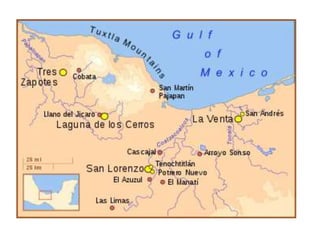
The Olmec heartland, where the Olmec reigned from 1400 to 400 BCE
The Olmec heartland is the area in the Gulf lowlands where it expanded
after early development in Soconusco, Veracruz.
This area is characterized by swampy lowlands punctuated by low hills,
ridges, and volcanoes. The Tuxtlas Mountains rise sharply in the north,
along the Gulf of Mexico's Bay of Campeche. Here, the Olmec constructed
permanent city-temple complexes at San Lorenzo Tenochtitlán, La Venta,
Tres Zapotes, and Laguna de los Cerros. In this region, the first
Mesoamerican civilization emerged and reigned from c. 1400–400 BCE.
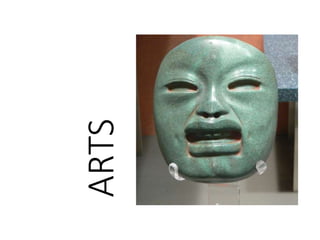
ARTS
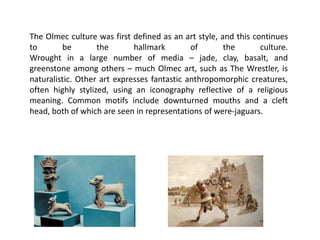
The Olmec culture was first defined as an art style, and this continues
to be the hallmark of the culture.
Wrought in a large number of media – jade, clay, basalt, and
greenstone among others – much Olmec art, such as The Wrestler, is
naturalistic. Other art expresses fantastic anthropomorphic creatures,
often highly stylized, using an iconography reflective of a religious
meaning. Common motifs include downturned mouths and a cleft
head, both of which are seen in representations of were-jaguars.
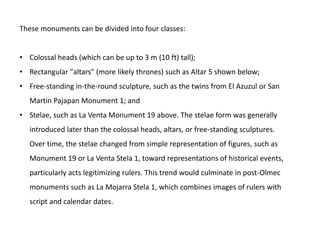
These monuments can be divided into four classes:
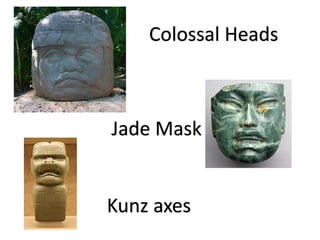
• Colossal heads (which can be up to 3 m (10 ft) tall);
• Rectangular "altars" (more likely thrones) such as Altar 5 shown below;
• Free-standing in-the-round sculpture, such as the twins from El Azuzul or San
Martin Pajapan Monument 1; and
• Stelae, such as La Venta Monument 19 above. The stelae form was generally
introduced later than the colossal heads, altars, or free-standing sculptures.
Over time, the stelae changed from simple representation of figures, such as
Monument 19 or La Venta Stela 1, toward representations of historical events,
particularly acts legitimizing rulers. This trend would culminate in post-Olmec
monuments such as La Mojarra Stela 1, which combines images of rulers with
script and calendar dates.
Colossal Heads
Jade Mask
Kunz axes
VOCABULARY
• Civilization
• Pre-Columbian
• Astronomical system
• Geographic situation
• Mayans
• Aztecs
• Olmecs
• Political aspects
• Social aspects

Unit 1 Central America

  • 1.
  • 2.
    • In Americathere were numerous peoples and cultures. Some reached important developments and covered large areas. • Among them we find the Mayan culture, which had its beginnings around the year 2500 BC. until 1520 D.C.
  • 3.
  • 4.
  • 5.
    The Mayan civilizationis known for its completely elaborated language since pre-Columbian times in Latin America. thus they are also known for their art, architecture, mathematics and astronomical system, which are all seen as spectacular.
  • 6.
    Geographic location: •It wasdeveloped in the Yucatan Peninsula. •The geographical spread of the Maya extends throughout southern Mexico, including the states of Chiapas, Tabasco and the Yucatan Peninsula, Quintana, Roo and Campeche. •We also find that the Maya spread through northern Central America, including what is now the Republic of Guatemala, Belize, El Salvador and the western part of Honduras
  • 8.
    IV d.c 317987 1697 Chronology: Pre-Mayan: The Old Empire: New Empire : It began indeterminate until the IV century D.C. Cities such as Chinchén Itza, Mayapán and Uxmal flourished. This period lasted until shortly after the Spanish conquest. This period was of great splendor. A good number of cities were made like Tikal (the largest and most important) Pelenque, Cópan, and Yaxchilán. After six centuries enter decadence.
  • 9.
    ECONOMICAL ASPECTS: AGRICULTURE • Theywere eminent agricultural. • They cultivated corn, cocoa, and maguey. He also cultivates cassava, beans, chili, tomato, squash and cotton. COMMERCE • They marketed by land, carrying merchandise. • They were led by porters. HUNTING AND FISHING • They hunted animals such as jaguars, deer, snakes, turtles, rabbits and monkeys. • They used instruments such as bows, arrows, traps, hooks of shells.
  • 10.
    POLITICAL ASPECTS : TheMayans politically constituted a certain number of city-states. Each of them ruled hereditarily by a boss called Halach Uinic. • El Halach Uinic, He was advised by a State Councilor composed of chiefs, priests, and some specialist advisers. •El Batab, Local chief in charge of ensuring the smooth running of his villa, represented the Halach Uinic there. •Los Tupiles, junior officials (police).
  • 11.
    SOCIAL ASPECTS: THE ROYALTY THEPRIESTS THE PEOPLE SLAVES AND WAR PRISIONERS Dominant social class (officiated by local chiefs) Called AHKIN, they watched over the cult. It was labor for agriculture buildings, etc. Convicted to forced labor.
  • 12.
    Astronomy and thecalendar: • The Mayans developed two calendars: one lunar and one solar, which governed civil and religious activities. • The solar calendar had 365 days and the lunar calendar had 260 days, which joined and formed the calendric wheel. • They achieved admirable progress in astronomical calculations. • They structured a great calendar that they called TZOLKIN, of the most perfect that is known, they divided the year into eighteen score each, plus 5 extra days that they considered fatal; which gives a total of 365 days (18 x 20 = 360 + 5 = 365, equal to our calendar, calendar year = room)
  • 13.
    They reached a remarkable developmentin arithmetic, since it was based on the vigesimal system. (that is, from one to twenty). The Mayan mathematicians invented the zero, the sign of the subtraction or minus sign. In the written numbering they used points that were worth 1 and lines that were worth 5. MATHEMATICS:
  • 14.
    ARCHITECTURE: • The Mayanswere excellent architects, surpassing even the Incas. • They had knowledge and use of a series of technical elements: The use of the column, A kind of vault and a false arch. • Their constructions were of stone and of pyramidal base and of great dimensions wonderfully decorated in low relief. • The main architectural remains are in Chitchén - Itzá, there they are: The Castle, The Caracol or Tower used, The Porch of the thousand columns, and The Temple of the Warriors.
  • 15.
  • 16.
    Temple of theWarriors.
  • 17.
    The writing, Mayais based on JEROGLYPHIC signs and pictorial characters, through which they could express themselves graphically. The Mayans wrote several codices, where they captured their ideas about the world and society, which were destroyed by Catholic priests during the conquest. writing:
  • 18.
    Religión: • They werepolytheists, deities associated with nature • Their main gods were: • - Hunab Ku: god creator of all things. • - Itzamna: Lord of the heavens, day and night. • - Chaac: god of the rain • - Kukulcán: Civilizing God, god of the wind and the planet Venus. • - Ixchel: Wife of Itzamná, Goddess of the moon and protector of the parturients. • - Hunabku: Unique deity. • - Ixtab: goddess of suicide. • - Ah Puch: god of death.
  • 19.
  • 20.
    GEOGRAPHIC SITUATION: • Itwas developed in the plateau of Anahuac (Mexico), approximately of the 1 200 d.c. until the arrival of the Spaniards in 1 519, under the command of Hernán Cortés.
  • 21.
    Peoples that inhabitedthe Anahuac plateau: • LOS TOLTECAS: In the Nahua language, Toltec means << skillful artífices >>. The Toltecs were an advanced town whose center was the city of Tolán or Tula. They distinguished themselves as great pyramid builders. • THE CHICHIMECAS: they were nomadic tribes men and hunters, coming from the north. This word means << wild people >>. • LOS AZTECAS: means << settlers of Aztlán >>, originating from the north
  • 22.
    ECONOMICAL ASPECTS: AGRICULTURE They createdchinampas loas or floating gardens (artificial islands) They raised a kind of hairless dog (they ate his meat). The turkey was the only poultry. COMMERCE They had a market of great movement where thousands of people from far away gathered to carry out exchange operations
  • 23.
    POLITICAL ASPECTS: • Itwas a centralized military state that exercised a broad domain over the adjacent towns. Its capital was: Tenochtitlán. • The Aztecs constituted an elective monarchy, that is, the supreme commander was elected. Its main political authorities were: THE TLACATECULI: It was also called TLATOQUE. He was the Supreme Head of Government, considered the son of the Gods. His decisions were unappealable. << Head of Men >> THE CÍHUACOATI: It means << Serpent Woman >> (although this official was always male). It happened in the government to the Tlacateculi in case of death. THE SUPREME COUNCIL: Formed by the delegates of the clans or calpullis. These members are called TLOTOANI; they fulfilled administrative, political, and legal functions.
  • 24.
    The Aztec writing was hieroglyphic andpictorial They wrote on long strips of vegetable paper. They used to represent material objects by means of paintings, numbers by conventional symbols and names by hieroglyphic means. The number one is represented by a point. The number five was represented by a bar. The number twenty was represented by a flag. The number four hundred was represented by a tree. WRITING:
  • 25.
    SOCIAL ASPECTS: THE ROYALTY THEMERCHANDISE THE PLEBEYOS SLAVES Composed of priests and distinguished warriors. Men of the town. Artisans who practiced the exchange of products. Destined to human sacrifices in honor of their gods.
  • 26.
    Also called Piedradel sol, it is a beautiful stone sculpture. The astrological year was called Tonalpohuali, or book of days and was constituted by 260 days, divided into 20 periods or 13-day months. The calendar year, which consisted of 365 days, was called Tonalpohuali, was divided into 18 periods or months of 20 days each, plus 5 independent days, considered unlucky or bad days, during which it rested and avoided lawsuits and misfortunes. Calendar:
  • 27.
    ARCHITECTURE: They were greatarchitects, they built palaces, temples, pyramids and houses. The main architectural remains are in the city of Tenochitlán, on the shores of Lake Texcoco. They excel:
  • 28.
    The Teocalli, greatpyramid of four platforms, with temples in honor of the gods Huitzilopochtly and Tlatoc.
  • 29.
    The temple ofthe Sun.
  • 30.
    The pyramid ofTezcatlipoca.
  • 31.
    The temple ofQuetzalcoalt.
  • 32.
    RELIGION: The Aztec religionwas polytheistic, because they had them at the end of their development were in trance to monotheism because the god TEZCATLIPOCA had assumed a superior character to other gods. Their main gods were: QUETZALCOATL: The << feathered serpent >> was the god of good, creator and civilizer, protector of artists and god supreme and benefactor. HUITZILOPOCHTLI: god of war, fierce and bloodthirsty, was their main divinity, to whom they offered human sacrifices. TEZCATLIPOCA: << The Summer sun >> of good harvests or terrible harvests. Its name means << smoking mirror >>. TLALOC: That was the god of water.
  • 33.
    Performed bloodthirsty rites: humansacrifices to maintain the cosmic order (flower wars) The way to please and worship the gods was sacrificing in his homage to men and boys, mainly to prisoners of war. It is said that each year 2,500 people died in offering to the deity. The Aztecs felt an obligation to pay the gods by giving them their food - the body and human blood - to overcome the darkness. The human sacrifices:
  • 34.
  • 35.
    Olmecs Siguiente The Olmecs (/ˈɒlmɛks,ˈoʊl-/) were the earliest known major civilization in Mesoamerica following a progressive development in Soconusco. They lived in the tropical lowlands of south-central Mexico, in the present-day states of Veracruz and Tabasco. It has been speculated that the Olmecs derive in part from neighboring Mokaya or Mixe– Zoque. Etymology The name 'Olmec' comes from the Nahuatl word for the Olmecs: Ōlmēcatl [oːlˈmeːkat͡ɬ] (singular) or Ōlmēcah [oːlˈmeːkaʔ] (plural). This word is composed of the two words ōlli [ˈoːlːi], meaning "rubber", and mēcatl [ˈmeːkat͡ɬ], meaning "people", so the word means "rubber people"
  • 37.
    Overview The Olmec heartland,where the Olmec reigned from 1400 to 400 BCE The Olmec heartland is the area in the Gulf lowlands where it expanded after early development in Soconusco, Veracruz. This area is characterized by swampy lowlands punctuated by low hills, ridges, and volcanoes. The Tuxtlas Mountains rise sharply in the north, along the Gulf of Mexico's Bay of Campeche. Here, the Olmec constructed permanent city-temple complexes at San Lorenzo Tenochtitlán, La Venta, Tres Zapotes, and Laguna de los Cerros. In this region, the first Mesoamerican civilization emerged and reigned from c. 1400–400 BCE.
  • 38.
  • 39.
    The Olmec culturewas first defined as an art style, and this continues to be the hallmark of the culture. Wrought in a large number of media – jade, clay, basalt, and greenstone among others – much Olmec art, such as The Wrestler, is naturalistic. Other art expresses fantastic anthropomorphic creatures, often highly stylized, using an iconography reflective of a religious meaning. Common motifs include downturned mouths and a cleft head, both of which are seen in representations of were-jaguars.
  • 40.
    These monuments canbe divided into four classes: • Colossal heads (which can be up to 3 m (10 ft) tall); • Rectangular "altars" (more likely thrones) such as Altar 5 shown below; • Free-standing in-the-round sculpture, such as the twins from El Azuzul or San Martin Pajapan Monument 1; and • Stelae, such as La Venta Monument 19 above. The stelae form was generally introduced later than the colossal heads, altars, or free-standing sculptures. Over time, the stelae changed from simple representation of figures, such as Monument 19 or La Venta Stela 1, toward representations of historical events, particularly acts legitimizing rulers. This trend would culminate in post-Olmec monuments such as La Mojarra Stela 1, which combines images of rulers with script and calendar dates.
  • 41.
  • 42.
    VOCABULARY • Civilization • Pre-Columbian •Astronomical system • Geographic situation • Mayans • Aztecs • Olmecs • Political aspects • Social aspects