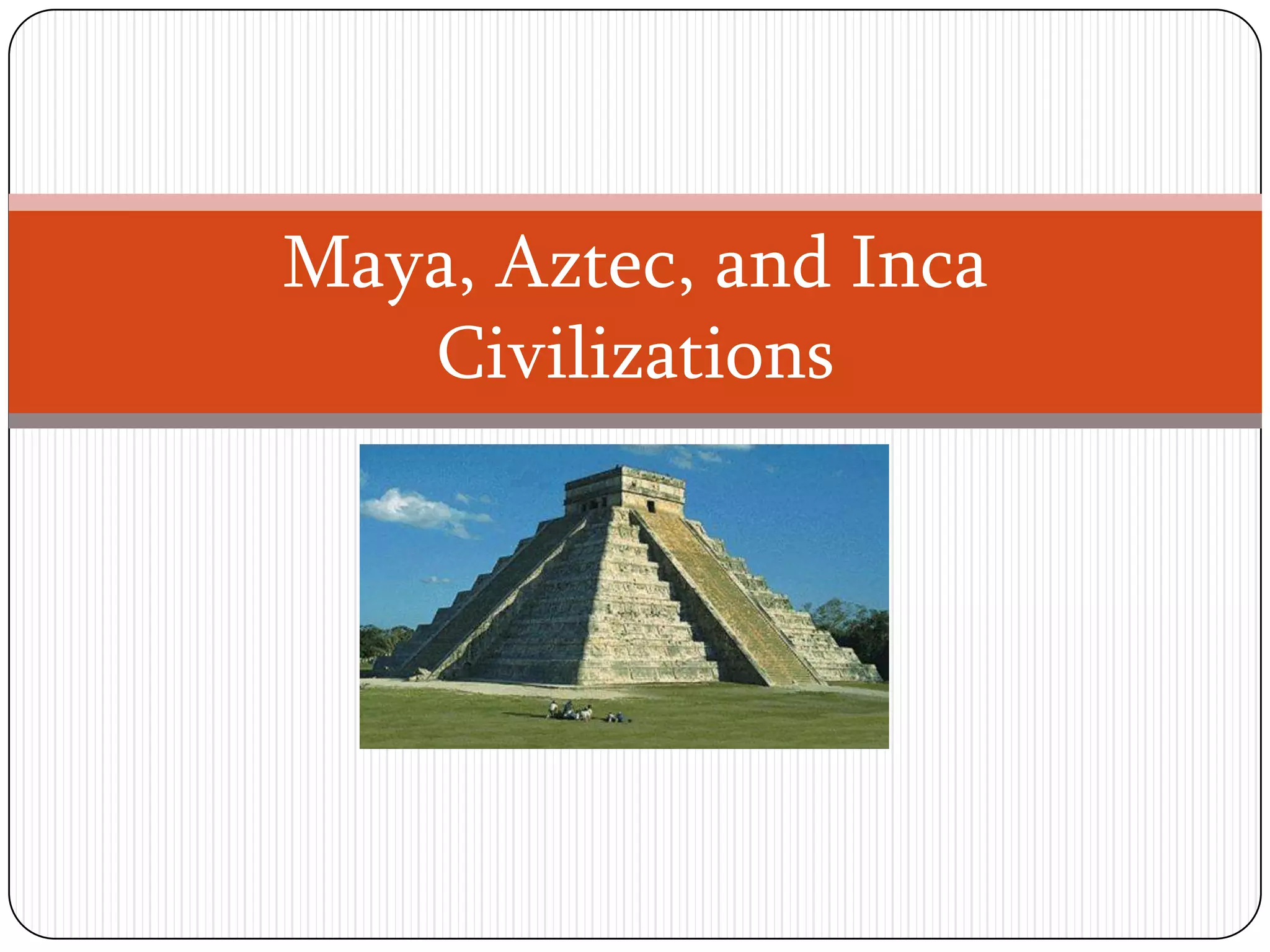
Maya, Aztec, and Inca
   Civilizations
How did people first get to the
Americas?
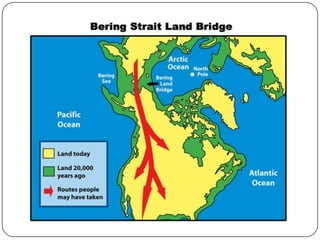
 Theory #1 = Bering land bridge


     Humans migrated into North America from
 Asia by crossing over a land bridge between
 Alaska and Siberia…
How did people first get to the
Americas?
 Theory #2 = Coastal migration

   Humans migrated to the Americas by crossing the
   seas, most likely the Pacific Ocean, and settling
   along the western coasts of the Americas…
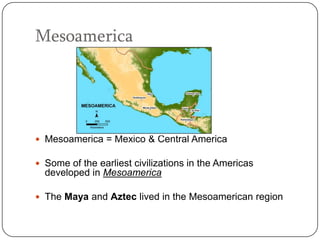
Mesoamerica


 Mesoamerica = Mexico & Central America

 Some of the earliest civilizations in the Americas
  developed in Mesoamerica

 The Maya and Aztec lived in the Mesoamerican region
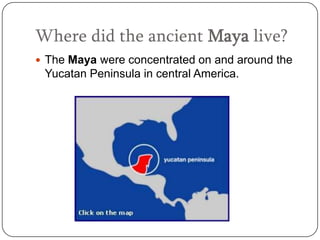
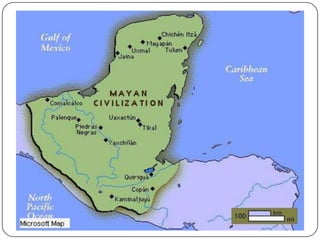
Where did the ancient Maya live?
 The Maya were concentrated on and around the
 Yucatan Peninsula in central America.
Maya Political Structure
 The Maya were NOT AN EMPIRE and NOT
 UNITED politically…

 Maya civilization was made up of city-states.
 City-states were controlled by their own ruler.

 In your opinion, do you think that the Mayan
 political structure helped or harmed the people?
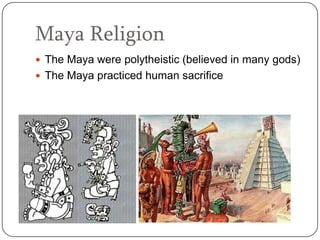
Maya Religion
 The Maya were polytheistic (believed in many gods)
 The Maya practiced human sacrifice
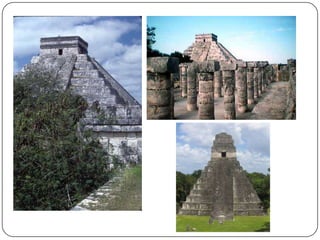
Maya Architecture
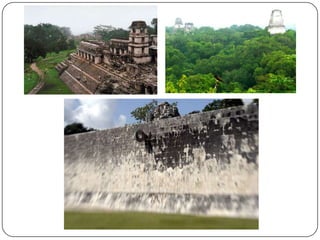
 The Maya built towering temples and
 elaborate palaces

 Atop the temples, priests performed religious
 ceremonies and sacrifices while people
 watched from the plazas below

 Ceremonial
 platforms, temples, pyramids, observatories
 and ball courts were all built by the Maya
Advances in learning
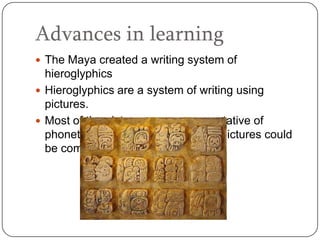
 The Maya created a writing system of
  hieroglyphics
 Hieroglyphics are a system of writing using
  pictures.
 Most of the pictures were representative of
  phonetic sounds. This means that pictures could
  be combined to form words.
Advances in learning
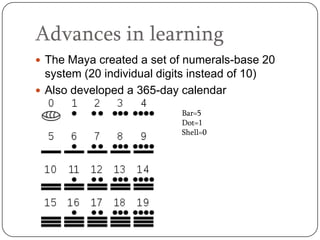
 The Maya created a set of numerals-base 20
  system (20 individual digits instead of 10)
 Also developed a 365-day calendar

                             Bar=5
                             Dot=1
                             Shell=0
What happened to the Maya?
 The Maya abandoned many of their cities around
 900 A.D.

 Archaeologists DO NOT KNOW WHY Maya
 civilization declined

 BUT…
Maya today
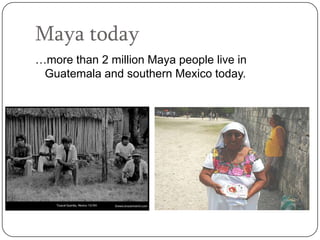
…more than 2 million Maya people live in
 Guatemala and southern Mexico today.
Maya Video Clip
http://www.watchknow.org/Video.aspx?VideoID=12
  203

 This National Geographic video shows the Mayan
 Pyramids. It is part of the series Lost Temples and it tries
 to give an answer to the question "Why did the Maya
 abandon their magnificent city of Chichen Itza?" There
 is reference to Maya culture.
Aztecs:
Where did the Aztecs live?
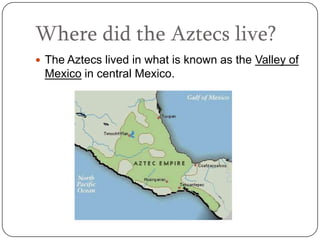
 The Aztecs lived in what is known as the Valley of
 Mexico in central Mexico.
Tenochtitlan
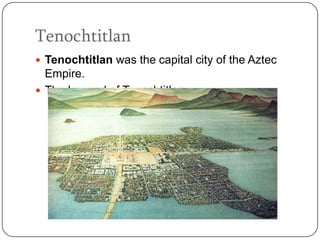
 Tenochtitlan was the capital city of the Aztec
  Empire.
 The Legend of Tenochtitlan
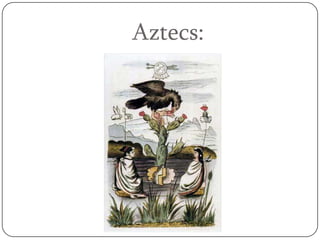
Legend of Tenochtitlan
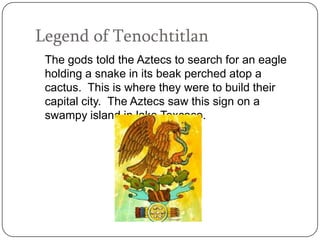
 The gods told the Aztecs to search for an eagle
 holding a snake in its beak perched atop a
 cactus. This is where they were to build their
 capital city. The Aztecs saw this sign on a
 swampy island in lake Texcoco.
Tenochtitlan
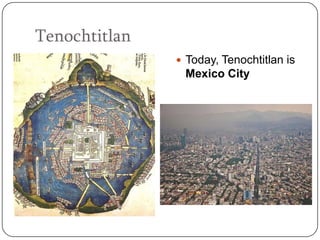
                Today, Tenochtitlan is
                Mexico City
How did the Aztecs build a city in the
center of a lake?
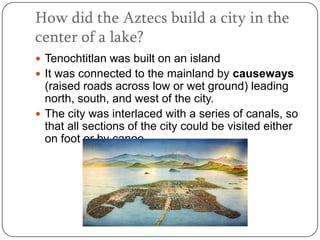
 Tenochtitlan was built on an island
 It was connected to the mainland by causeways
  (raised roads across low or wet ground) leading
  north, south, and west of the city.
 The city was interlaced with a series of canals, so
  that all sections of the city could be visited either
  on foot or by canoe.
Government
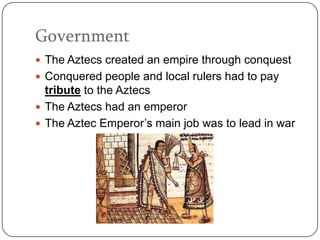
 The Aztecs created an empire through conquest
 Conquered people and local rulers had to pay
  tribute to the Aztecs
 The Aztecs had an emperor
 The Aztec Emperor’s main job was to lead in war
Who was Montezuma?
 Montezuma (Montezuma II) was the 9th
 emperor of the Aztecs. He was the most
 famous Aztec emperors.

 He was the Aztec emperor who met Hernan
 Cortes. Cortes was a Spanish Conquistador.
 (Conquistador= military leader in the Spanish
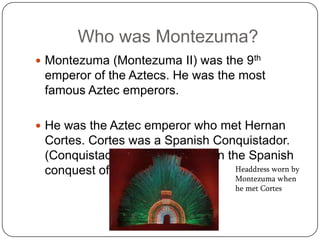
 conquest of the New World)          Headdress worn by
                                        Montezuma when
                                        he met Cortes
Montezuma
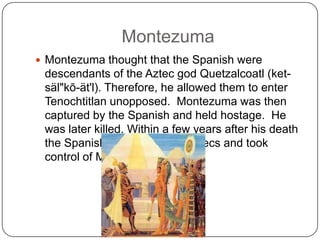
 Montezuma thought that the Spanish were
 descendants of the Aztec god Quetzalcoatl (ket-
 säl"kō-ät'l). Therefore, he allowed them to enter
 Tenochtitlan unopposed. Montezuma was then
 captured by the Spanish and held hostage. He
 was later killed. Within a few years after his death
 the Spanish conquered the Aztecs and took
 control of Mexico.
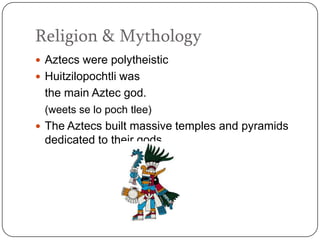
Religion & Mythology
 Aztecs were polytheistic
 Huitzilopochtli was
 the main Aztec god.
 (weets se lo poch tlee)
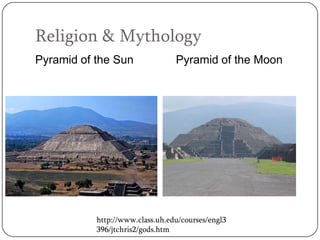
 The Aztecs built massive temples and pyramids
 dedicated to their gods
Religion & Mythology
Pyramid of the Sun               Pyramid of the Moon


           http://www.class.uh.edu/courses/engl3
           396/jtchris2/gods.htm
Human Sacrifice
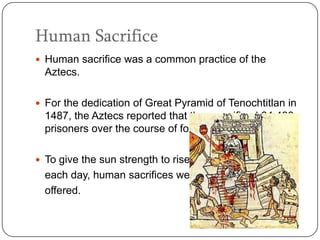
 Human sacrifice was a common practice of the
  Aztecs.

 For the dedication of Great Pyramid of Tenochtitlan in
  1487, the Aztecs reported that they sacrificed 84,400
  prisoners over the course of four days.

 To give the sun strength to rise
  each day, human sacrifices were
  offered.
What happened to the Aztecs?
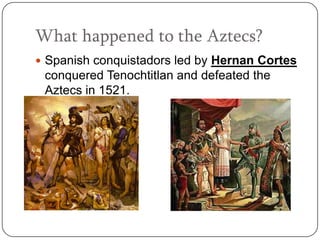
 Spanish conquistadors led by Hernan Cortes
 conquered Tenochtitlan and defeated the
 Aztecs in 1521.
Aztec Video Clips
“Engineering An Empire”
http://www.watchknow.org/Video.aspx?VideoID=62
  55

“What the Ancients Did For Us”
http://www.watchknow.org/Video.aspx?VideoID=10
  964
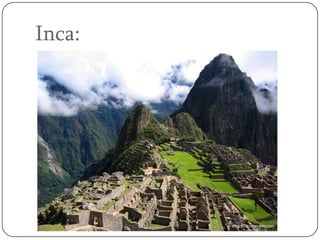
Inca:
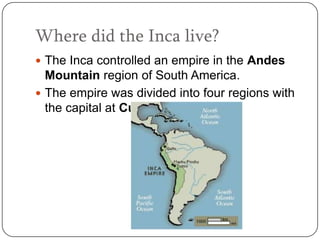
Where did the Inca live?
 The Inca controlled an empire in the Andes
  Mountain region of South America.
 The empire was divided into four regions with
  the capital at Cuzco.
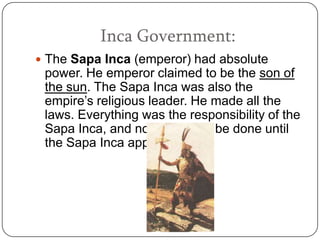
Inca Government:
 The Sapa Inca (emperor) had absolute
 power. He emperor claimed to be the son of
 the sun. The Sapa Inca was also the
 empire’s religious leader. He made all the
 laws. Everything was the responsibility of the
 Sapa Inca, and nothing could be done until
 the Sapa Inca approved it.
How the Government was
  Organized?
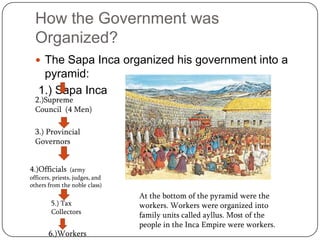
   The Sapa Inca organized his government into a
    pyramid:
   1.) Sapa Inca
  2.)Supreme
  Council (4 Men)

  3.) Provincial
  Governors


4.)Officials      (army
officers, priests, judges, and
others from the noble class)
                                 At the bottom of the pyramid were the
        5.) Tax                  workers. Workers were organized into
        Collectors               family units called ayllus. Most of the
                                 people in the Inca Empire were workers.
       6.)Workers
Inca Construction and Architecture:
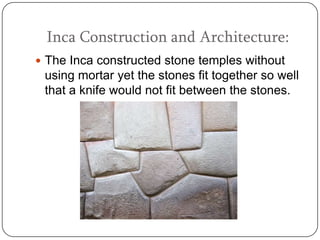
 The Inca constructed stone temples without
 using mortar yet the stones fit together so well
 that a knife would not fit between the stones.
Inca Construction and Architecture:
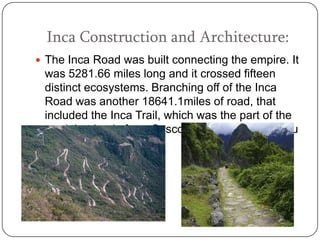
 The Inca Road was built connecting the empire. It
 was 5281.66 miles long and it crossed fifteen
 distinct ecosystems. Branching off of the Inca
 Road was another 18641.1miles of road, that
 included the Inca Trail, which was the part of the
 road that leads from Cusco (the capital) to Machu
 Picchu.
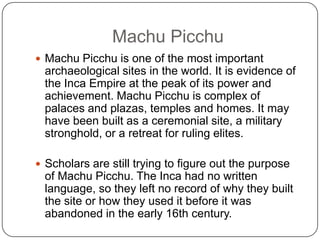
Machu Picchu
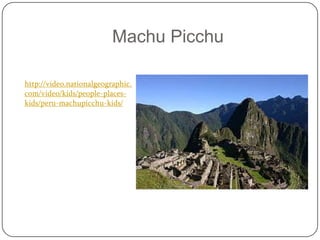
 Machu Picchu is one of the most important
 archaeological sites in the world. It is evidence of
 the Inca Empire at the peak of its power and
 achievement. Machu Picchu is complex of
 palaces and plazas, temples and homes. It may
 have been built as a ceremonial site, a military
 stronghold, or a retreat for ruling elites.

 Scholars are still trying to figure out the purpose
 of Machu Picchu. The Inca had no written
 language, so they left no record of why they built
 the site or how they used it before it was
 abandoned in the early 16th century.
Machu Picchu

http://video.nationalgeographic.
com/video/kids/people-places-
kids/peru-machupicchu-kids/
Inca Religion
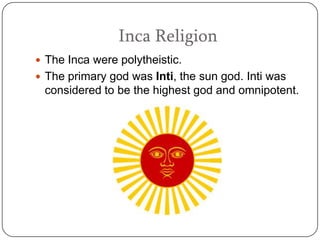
 The Inca were polytheistic.
 The primary god was Inti, the sun god. Inti was
 considered to be the highest god and omnipotent.
Inca Religion
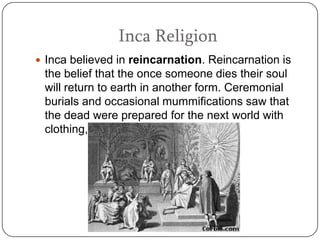
 Inca believed in reincarnation. Reincarnation is
 the belief that the once someone dies their soul
 will return to earth in another form. Ceremonial
 burials and occasional mummifications saw that
 the dead were prepared for the next world with
 clothing, food, and other items.
Inca Culture
 Each family in a community was assigned a specific job.
 Government officials arranged marriages.
 The government organized mandatory public service building
  projects.
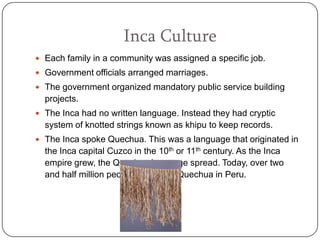
 The Inca had no written language. Instead they had cryptic
  system of knotted strings known as khipu to keep records.
 The Inca spoke Quechua. This was a language that originated in
  the Inca capital Cuzco in the 10th or 11th century. As the Inca
  empire grew, the Quechua language spread. Today, over two
  and half million people still speak Quechua in Peru.
What happened to the Inca?
 Civil war in the empire broke out and the Inca
 empire fell because of the following:
   Civil War
   Smallpox
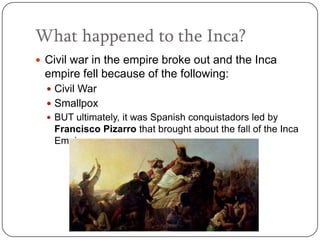
   BUT ultimately, it was Spanish conquistadors led by
   Francisco Pizarro that brought about the fall of the Inca
   Empire.
Inca Video Clip

http://www.watchknow.org/Video.aspx?VideoID=23
  01

Maya Aztec Inca

  • 1.
    Maya, Aztec, andInca Civilizations
  • 2.
    How did peoplefirst get to the Americas?  Theory #1 = Bering land bridge Humans migrated into North America from Asia by crossing over a land bridge between Alaska and Siberia…
  • 4.
    How did peoplefirst get to the Americas?  Theory #2 = Coastal migration Humans migrated to the Americas by crossing the seas, most likely the Pacific Ocean, and settling along the western coasts of the Americas…
  • 5.
    Mesoamerica  Mesoamerica =Mexico & Central America  Some of the earliest civilizations in the Americas developed in Mesoamerica  The Maya and Aztec lived in the Mesoamerican region
  • 6.
    Where did theancient Maya live?  The Maya were concentrated on and around the Yucatan Peninsula in central America.
  • 8.
    Maya Political Structure The Maya were NOT AN EMPIRE and NOT UNITED politically…  Maya civilization was made up of city-states. City-states were controlled by their own ruler.  In your opinion, do you think that the Mayan political structure helped or harmed the people?
  • 9.
    Maya Religion  TheMaya were polytheistic (believed in many gods)  The Maya practiced human sacrifice
  • 10.
    Maya Architecture  TheMaya built towering temples and elaborate palaces  Atop the temples, priests performed religious ceremonies and sacrifices while people watched from the plazas below  Ceremonial platforms, temples, pyramids, observatories and ball courts were all built by the Maya
  • 13.
    Advances in learning The Maya created a writing system of hieroglyphics  Hieroglyphics are a system of writing using pictures.  Most of the pictures were representative of phonetic sounds. This means that pictures could be combined to form words.
  • 14.
    Advances in learning The Maya created a set of numerals-base 20 system (20 individual digits instead of 10)  Also developed a 365-day calendar Bar=5 Dot=1 Shell=0
  • 15.
    What happened tothe Maya?  The Maya abandoned many of their cities around 900 A.D.  Archaeologists DO NOT KNOW WHY Maya civilization declined  BUT…
  • 16.
    Maya today …more than2 million Maya people live in Guatemala and southern Mexico today.
  • 17.
    Maya Video Clip http://www.watchknow.org/Video.aspx?VideoID=12 203 This National Geographic video shows the Mayan Pyramids. It is part of the series Lost Temples and it tries to give an answer to the question "Why did the Maya abandon their magnificent city of Chichen Itza?" There is reference to Maya culture.
  • 18.
  • 19.
    Where did theAztecs live?  The Aztecs lived in what is known as the Valley of Mexico in central Mexico.
  • 20.
    Tenochtitlan  Tenochtitlan wasthe capital city of the Aztec Empire.  The Legend of Tenochtitlan
  • 21.
    Legend of Tenochtitlan The gods told the Aztecs to search for an eagle holding a snake in its beak perched atop a cactus. This is where they were to build their capital city. The Aztecs saw this sign on a swampy island in lake Texcoco.
  • 22.
    Tenochtitlan  Today, Tenochtitlan is Mexico City
  • 23.
    How did theAztecs build a city in the center of a lake?  Tenochtitlan was built on an island  It was connected to the mainland by causeways (raised roads across low or wet ground) leading north, south, and west of the city.  The city was interlaced with a series of canals, so that all sections of the city could be visited either on foot or by canoe.
  • 24.
    Government  The Aztecscreated an empire through conquest  Conquered people and local rulers had to pay tribute to the Aztecs  The Aztecs had an emperor  The Aztec Emperor’s main job was to lead in war
  • 25.
    Who was Montezuma? Montezuma (Montezuma II) was the 9th emperor of the Aztecs. He was the most famous Aztec emperors.  He was the Aztec emperor who met Hernan Cortes. Cortes was a Spanish Conquistador. (Conquistador= military leader in the Spanish conquest of the New World) Headdress worn by Montezuma when he met Cortes
  • 26.
    Montezuma  Montezuma thoughtthat the Spanish were descendants of the Aztec god Quetzalcoatl (ket- säl"kō-ät'l). Therefore, he allowed them to enter Tenochtitlan unopposed. Montezuma was then captured by the Spanish and held hostage. He was later killed. Within a few years after his death the Spanish conquered the Aztecs and took control of Mexico.
  • 27.
    Religion & Mythology Aztecs were polytheistic  Huitzilopochtli was the main Aztec god. (weets se lo poch tlee)  The Aztecs built massive temples and pyramids dedicated to their gods
  • 28.
    Religion & Mythology Pyramidof the Sun Pyramid of the Moon http://www.class.uh.edu/courses/engl3 396/jtchris2/gods.htm
  • 29.
    Human Sacrifice  Humansacrifice was a common practice of the Aztecs.  For the dedication of Great Pyramid of Tenochtitlan in 1487, the Aztecs reported that they sacrificed 84,400 prisoners over the course of four days.  To give the sun strength to rise each day, human sacrifices were offered.
  • 30.
    What happened tothe Aztecs?  Spanish conquistadors led by Hernan Cortes conquered Tenochtitlan and defeated the Aztecs in 1521.
  • 31.
    Aztec Video Clips “EngineeringAn Empire” http://www.watchknow.org/Video.aspx?VideoID=62 55 “What the Ancients Did For Us” http://www.watchknow.org/Video.aspx?VideoID=10 964
  • 32.
  • 33.
    Where did theInca live?  The Inca controlled an empire in the Andes Mountain region of South America.  The empire was divided into four regions with the capital at Cuzco.
  • 34.
    Inca Government:  TheSapa Inca (emperor) had absolute power. He emperor claimed to be the son of the sun. The Sapa Inca was also the empire’s religious leader. He made all the laws. Everything was the responsibility of the Sapa Inca, and nothing could be done until the Sapa Inca approved it.
  • 35.
    How the Governmentwas Organized?  The Sapa Inca organized his government into a pyramid: 1.) Sapa Inca 2.)Supreme Council (4 Men) 3.) Provincial Governors 4.)Officials (army officers, priests, judges, and others from the noble class) At the bottom of the pyramid were the 5.) Tax workers. Workers were organized into Collectors family units called ayllus. Most of the people in the Inca Empire were workers. 6.)Workers
  • 36.
    Inca Construction andArchitecture:  The Inca constructed stone temples without using mortar yet the stones fit together so well that a knife would not fit between the stones.
  • 37.
    Inca Construction andArchitecture:  The Inca Road was built connecting the empire. It was 5281.66 miles long and it crossed fifteen distinct ecosystems. Branching off of the Inca Road was another 18641.1miles of road, that included the Inca Trail, which was the part of the road that leads from Cusco (the capital) to Machu Picchu.
  • 38.
    Machu Picchu  MachuPicchu is one of the most important archaeological sites in the world. It is evidence of the Inca Empire at the peak of its power and achievement. Machu Picchu is complex of palaces and plazas, temples and homes. It may have been built as a ceremonial site, a military stronghold, or a retreat for ruling elites.  Scholars are still trying to figure out the purpose of Machu Picchu. The Inca had no written language, so they left no record of why they built the site or how they used it before it was abandoned in the early 16th century.
  • 39.
  • 40.
    Inca Religion  TheInca were polytheistic.  The primary god was Inti, the sun god. Inti was considered to be the highest god and omnipotent.
  • 41.
    Inca Religion  Incabelieved in reincarnation. Reincarnation is the belief that the once someone dies their soul will return to earth in another form. Ceremonial burials and occasional mummifications saw that the dead were prepared for the next world with clothing, food, and other items.
  • 42.
    Inca Culture  Eachfamily in a community was assigned a specific job.  Government officials arranged marriages.  The government organized mandatory public service building projects.  The Inca had no written language. Instead they had cryptic system of knotted strings known as khipu to keep records.  The Inca spoke Quechua. This was a language that originated in the Inca capital Cuzco in the 10th or 11th century. As the Inca empire grew, the Quechua language spread. Today, over two and half million people still speak Quechua in Peru.
  • 43.
    What happened tothe Inca?  Civil war in the empire broke out and the Inca empire fell because of the following:  Civil War  Smallpox  BUT ultimately, it was Spanish conquistadors led by Francisco Pizarro that brought about the fall of the Inca Empire.
  • 44.