Merit ratting
Submitted by :- Apoorv dixit
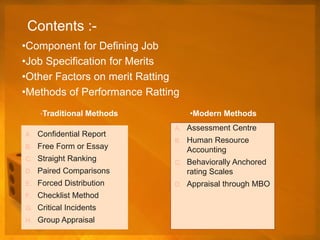
Contents :-
•Component for Defining Job
•Job Specification for Merits
•Other Factors on merit Ratting
•Methods of Performance Ratting
•Traditional Methods
•Modern Methods
A. Confidential Report
B. Free Form or Essay
C. Straight Ranking
D. Paired Comparisons
E. Forced Distribution
F. Checklist Method
G. Critical Incidents
H. Group Appraisal
A. Assessment Centre
B. Human Resource
Accounting
C. Behaviorally Anchored
rating Scales
D. Appraisal through MBO
•Modern Methods
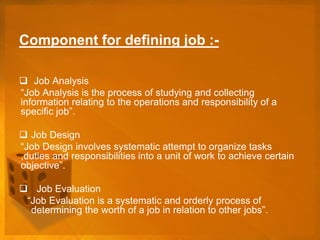
Component for defining job :-
 Job Analysis
“Job Analysis is the process of studying and collecting
information relating to the operations and responsibility of a
specific job”.
 Job Design
“Job Design involves systematic attempt to organize tasks
,duties and responsibilities into a unit of work to achieve certain
objective”.
 Job Evaluation
“Job Evaluation is a systematic and orderly process of
determining the worth of a job in relation to other jobs”.
JOB SPECIFICATION FOR MERITS :-
• Qualifications
• Experience
• Physical characteristics
• Psychological characteristics
• Social characteristics
Other Factors For Merit Rating :-
• Performance of a employee
• Understanding between his supervisor and him
• Knowledge of work .
• Punctuality for job.
• Behavior with his collogues & supervisor .
• Suggestion / Improvement
• Response time
•
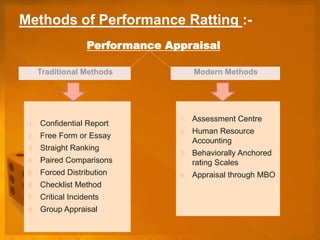
Methods of Performance Ratting :-
Performance Appraisal
Traditional Methods Modern Methods
1. Confidential Report
2. Free Form or Essay
3. Straight Ranking
4. Paired Comparisons
5. Forced Distribution
6. Checklist Method
7. Critical Incidents
8. Group Appraisal
1. Assessment Centre
2. Human Resource
Accounting
3. Behaviorally Anchored
rating Scales
4. Appraisal through MBO
1. Confidential Report :- Used in most government
organization. A confidential report is a report prepared
by the employee’s immediate superior. It cover the
strengths and weaknesses, main achievements and
failure, personality and behavior of the employee’. It is
descriptive appraisal used for promotion and transfers
of employees.
2. Free Form or essay Method :- The evaluator
writes a short essay on the employee’s performance on
the basis of overall impression.
TRADITIONAL METHOD
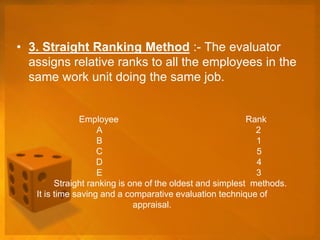
• 3. Straight Ranking Method :- The evaluator
assigns relative ranks to all the employees in the
same work unit doing the same job.
Employee Rank
A 2
B 1
C 5
D 4
E 3
Straight ranking is one of the oldest and simplest methods.
It is time saving and a comparative evaluation technique of
appraisal.
• Paired Comparisons Method :- This is a modified from
of man to man ranking. Herein, each employee is
compared will all the others in pairs one at a time. The
number of times an employee is judged better then the
others determines his rank. Comparison is made on the
basis of overall performance .
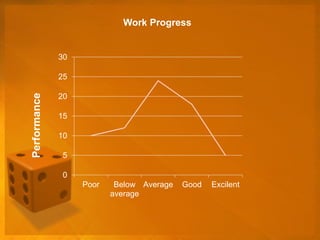
• Forced Distribution Method :- The rater is required to
distribute his rating in the form of a normal frequency
distribution. The purpose is to eliminate the rater’s basis
of central tendency. Here also ranking technique is used.
This method is highly simple to understand and easy to
apply .
Performance
0
5
10
15
20
25
30
Poor Below
average
Average Good Excilent
Work Progress
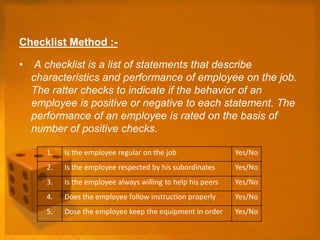
Checklist Method :-
• A checklist is a list of statements that describe
characteristics and performance of employee on the job.
The ratter checks to indicate if the behavior of an
employee is positive or negative to each statement. The
performance of an employee is rated on the basis of
number of positive checks.
1. Is the employee regular on the job Yes/No
2. Is the employee respected by his subordinates Yes/No
3. Is the employee always willing to help his peers Yes/No
4. Does the employee follow instruction properly Yes/No
5. Dose the employee keep the equipment in order Yes/No
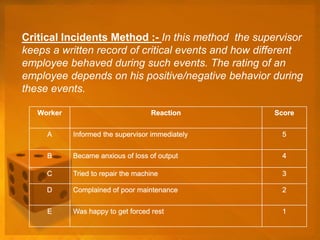
Critical Incidents Method :- In this method the supervisor
keeps a written record of critical events and how different
employee behaved during such events. The rating of an
employee depends on his positive/negative behavior during
these events.
Modern Methods
• 1. Assessment Centre Method :- An assessment
centre is a group of employees drawn from different work
units. These employees work together on an assignment
similar to the one they would be handling when
promoted. Evaluates observe and rank the performance
of all the participants. Experienced managers with
proven ability serve as evaluators.
• 2.Human Resource Accounting Method :- Under this
method performance is judged in terms of costs and
contribution of employees. Costs of human resources
consist of expenditure on human resource planning,
recruitment, selection, induction, training, compensation,
etc.
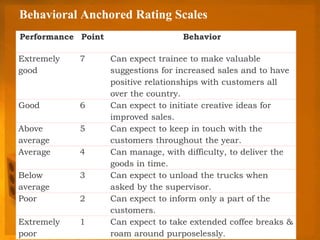
Behavioral Anchored Rating Scales
Performance Point Behavior
Extremely
good
7 Can expect trainee to make valuable
suggestions for increased sales and to have
positive relationships with customers all
over the country.
Good 6 Can expect to initiate creative ideas for
improved sales.
Above
average
5 Can expect to keep in touch with the
customers throughout the year.
Average 4 Can manage, with difficulty, to deliver the
goods in time.
Below
average
3 Can expect to unload the trucks when
asked by the supervisor.
Poor 2 Can expect to inform only a part of the
customers.
Extremely
poor
1 Can expect to take extended coffee breaks &
roam around purposelessly.
Merit by Results or MBO :-
• The concept of management by objectives(MBO) was
developed by Peter Drucker in 1954. He called it
management by objectives and self control’.
• Management by objectives has been defined as “a
process whereby the superior and subordinate
managers of an organisation jointly identify its common
goals, define each individual’s major areas of
responsibility in terms of results expected of him and use
these measures as guides for operating the unit and
assessing the contribution of each of its members” In
other words.MBO involves appraisal of performance
against clear, time bound and mutually agreed job goals.
Merit ratting apoorv dixit

Merit ratting apoorv dixit

  • 1.
  • 2.
    Contents :- •Component forDefining Job •Job Specification for Merits •Other Factors on merit Ratting •Methods of Performance Ratting •Traditional Methods •Modern Methods A. Confidential Report B. Free Form or Essay C. Straight Ranking D. Paired Comparisons E. Forced Distribution F. Checklist Method G. Critical Incidents H. Group Appraisal A. Assessment Centre B. Human Resource Accounting C. Behaviorally Anchored rating Scales D. Appraisal through MBO •Modern Methods
  • 3.
    Component for definingjob :-  Job Analysis “Job Analysis is the process of studying and collecting information relating to the operations and responsibility of a specific job”.  Job Design “Job Design involves systematic attempt to organize tasks ,duties and responsibilities into a unit of work to achieve certain objective”.  Job Evaluation “Job Evaluation is a systematic and orderly process of determining the worth of a job in relation to other jobs”.
  • 4.
    JOB SPECIFICATION FORMERITS :- • Qualifications • Experience • Physical characteristics • Psychological characteristics • Social characteristics
  • 5.
    Other Factors ForMerit Rating :- • Performance of a employee • Understanding between his supervisor and him • Knowledge of work . • Punctuality for job. • Behavior with his collogues & supervisor . • Suggestion / Improvement • Response time •
  • 6.
    Methods of PerformanceRatting :- Performance Appraisal Traditional Methods Modern Methods 1. Confidential Report 2. Free Form or Essay 3. Straight Ranking 4. Paired Comparisons 5. Forced Distribution 6. Checklist Method 7. Critical Incidents 8. Group Appraisal 1. Assessment Centre 2. Human Resource Accounting 3. Behaviorally Anchored rating Scales 4. Appraisal through MBO
  • 7.
    1. Confidential Report:- Used in most government organization. A confidential report is a report prepared by the employee’s immediate superior. It cover the strengths and weaknesses, main achievements and failure, personality and behavior of the employee’. It is descriptive appraisal used for promotion and transfers of employees. 2. Free Form or essay Method :- The evaluator writes a short essay on the employee’s performance on the basis of overall impression. TRADITIONAL METHOD
  • 8.
    • 3. StraightRanking Method :- The evaluator assigns relative ranks to all the employees in the same work unit doing the same job. Employee Rank A 2 B 1 C 5 D 4 E 3 Straight ranking is one of the oldest and simplest methods. It is time saving and a comparative evaluation technique of appraisal.
  • 9.
    • Paired ComparisonsMethod :- This is a modified from of man to man ranking. Herein, each employee is compared will all the others in pairs one at a time. The number of times an employee is judged better then the others determines his rank. Comparison is made on the basis of overall performance . • Forced Distribution Method :- The rater is required to distribute his rating in the form of a normal frequency distribution. The purpose is to eliminate the rater’s basis of central tendency. Here also ranking technique is used. This method is highly simple to understand and easy to apply .
  • 10.
  • 11.
    Checklist Method :- •A checklist is a list of statements that describe characteristics and performance of employee on the job. The ratter checks to indicate if the behavior of an employee is positive or negative to each statement. The performance of an employee is rated on the basis of number of positive checks. 1. Is the employee regular on the job Yes/No 2. Is the employee respected by his subordinates Yes/No 3. Is the employee always willing to help his peers Yes/No 4. Does the employee follow instruction properly Yes/No 5. Dose the employee keep the equipment in order Yes/No
  • 12.
    Critical Incidents Method:- In this method the supervisor keeps a written record of critical events and how different employee behaved during such events. The rating of an employee depends on his positive/negative behavior during these events.
  • 13.
    Modern Methods • 1.Assessment Centre Method :- An assessment centre is a group of employees drawn from different work units. These employees work together on an assignment similar to the one they would be handling when promoted. Evaluates observe and rank the performance of all the participants. Experienced managers with proven ability serve as evaluators. • 2.Human Resource Accounting Method :- Under this method performance is judged in terms of costs and contribution of employees. Costs of human resources consist of expenditure on human resource planning, recruitment, selection, induction, training, compensation, etc.
  • 14.
    Behavioral Anchored RatingScales Performance Point Behavior Extremely good 7 Can expect trainee to make valuable suggestions for increased sales and to have positive relationships with customers all over the country. Good 6 Can expect to initiate creative ideas for improved sales. Above average 5 Can expect to keep in touch with the customers throughout the year. Average 4 Can manage, with difficulty, to deliver the goods in time. Below average 3 Can expect to unload the trucks when asked by the supervisor. Poor 2 Can expect to inform only a part of the customers. Extremely poor 1 Can expect to take extended coffee breaks & roam around purposelessly.
  • 15.
    Merit by Resultsor MBO :- • The concept of management by objectives(MBO) was developed by Peter Drucker in 1954. He called it management by objectives and self control’. • Management by objectives has been defined as “a process whereby the superior and subordinate managers of an organisation jointly identify its common goals, define each individual’s major areas of responsibility in terms of results expected of him and use these measures as guides for operating the unit and assessing the contribution of each of its members” In other words.MBO involves appraisal of performance against clear, time bound and mutually agreed job goals.