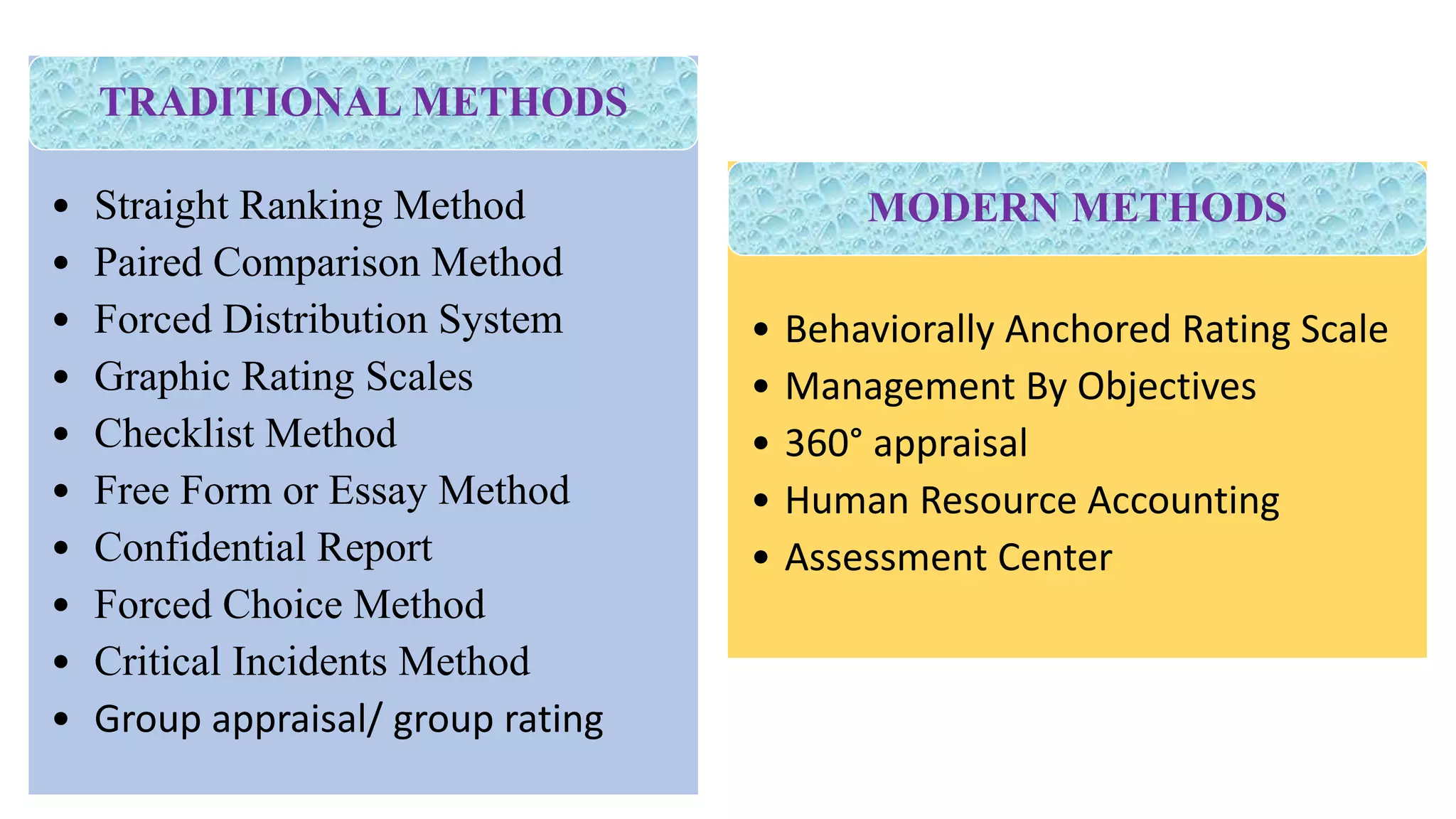
TRADITIONAL METHODS
• Straight Ranking Method
• Paired Comparison Method
• Forced Distribution System
• Graphic Rating Scales
• Checklist Method
• Free Form or Essay Method
• Confidential Report
• Forced Choice Method
• Critical Incidents Method
• Group appraisal/ group rating
MODERN METHODS
• Behaviorally Anchored Rating Scale
• Management By Objectives
• 360° appraisal
• Human Resource Accounting
• Assessment Center
Employee Rank
A 2
B 1
C 5
D 4
E 3
1. Straight Ranking Method
In this technique, the evaluator assigns relative ranks to all the employees in the same
work unit doing the same job. The evaluator provides a rank to the employees from
good to poor on the basis of their performance. For Example, if five persons A, B, C, D,
and E get a rank on the basis of their performance, it will be like:
[Here, 1 means good and 5 stand for poor.]
2. Paired Comparison Method
This traditional method of appraisal is a modification to the straight ranking method. Under
this method, unlike the straight ranking method, all the employees are put to relative
comparisons. After the comparison, the employee gets a rank on the basis of his status of being
better than other employees.
C
C
D
E
B
B
C
D
E
D
E
D E
A
A B C D E
A - A C A E
B - - C D E
C - - - C C
D - - - - E
E - - - - -
POSITIVE EVALUATION = POSITIVE COMPARISON ÷ TOTAL COMPARISON x 100
‘A’ = 2 ÷ 4 x 100 = 50% C = 4 ÷ 4 x 100 = 100%
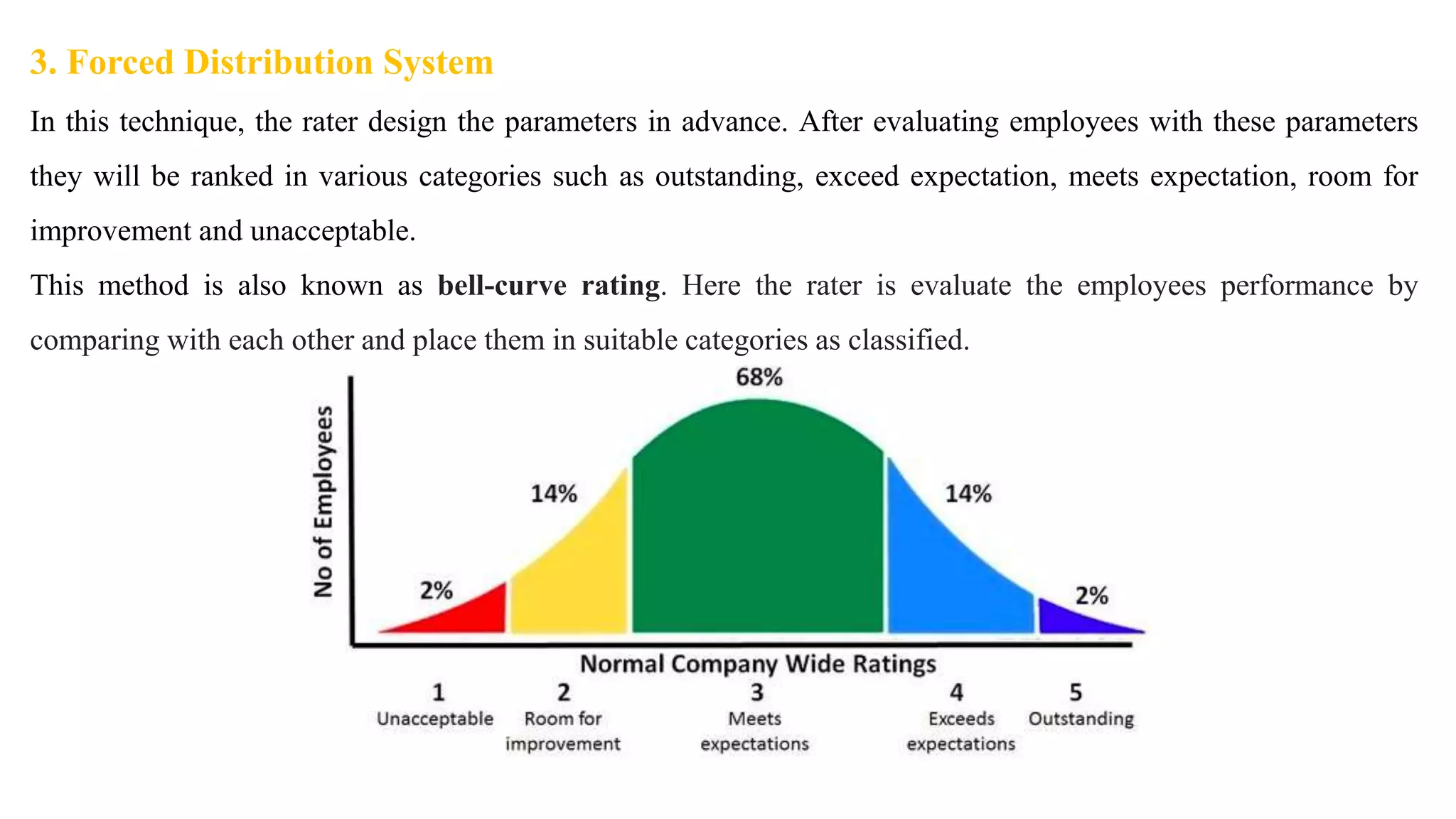
3. Forced Distribution System
In this technique, the rater design the parameters in advance. After evaluating employees with these parameters
they will be ranked in various categories such as outstanding, exceed expectation, meets expectation, room for
improvement and unacceptable.
This method is also known as bell-curve rating. Here the rater is evaluate the employees performance by
comparing with each other and place them in suitable categories as classified.
4. Graphic Rating Scales
It is a numerical scale which states different degrees of a particular trait. under this
method, the company or organization provides a form to each evaluator. Each form
contains many characteristics relating to the personality and performance of the employee.
Hence, the rater records his judgment on the employee’s trait on the scale and allot score.
5. Checklist Method
This is one of the traditional methods of appraisal. A checklist is nothing but a list of
statements that describe the characteristics and performance of employees on the job. the
rater ticks/checks to indicate if the employee possesses any specific trait/quality or
not. Hence, the number of ticks describe the rating or result of the employee.
There are three types of checklist methods. Those are
1. Simple checklist method
2. Weighted checklist method
3. Forced choice method
6. Free Form or Essay Method
Under this method, the evaluator writes a short essay on the employee’s performance on the
basis of overall impressions. It provides a good amount of information about the employee.
This method suffers some drawbacks like biases due to the high level of subjectivity, the
dependence of evaluation on the writing ability of the evaluator, etc.
7. Confidential Report
This is a traditional method of appraisal. Generally, government organizations use it for
appraisal. Employee’s immediate superior prepares this report. It covers the strengths and
weaknesses, main achievements and failure, etc. of the employee.
Hence, it becomes a descriptive report for the promotions and transfers of the employees.
One of the disadvantages of this method is its dependability on impressions rather than data.
This method focuses on evaluation rather than developing employees.
8. Forced Choice Method: The series of statements arranged in the blocks of two or more are
given and the rater indicates which statement is true or false. The rater is forced to make a
choice. HR department does actual assessment. Advantages – Absence of personal biases
because of forced choice. Disadvantages – Statements may be wrongly framed.
9. Critical Incidents Method: The approach is focused on certain critical behaviors of
employee that makes all the difference in the performance. Supervisors as and when they
occur record such incidents. Advantages – Evaluations are based on actual job behaviors,
ratings are supported by descriptions, feedback is easy, reduces recency biases, chances of
subordinate improvement are high. Disadvantages – Negative incidents can be prioritized,
forgetting incidents, overly close supervision; feedback may be too much and may appear to
be punishment.
10. Group appraisal/ group rating:
Under this method employee performance is appraised by a group of appraisers. This
group consists of experts, supervisors, manager and head of the department.
the supervisor of the employee explains about the nature of employees job to
group of appraiser on which they use techniques to appraise the employee.
MODERNTECHNIQUES: • Behaviorally Anchored Rating Scale
• Management By Objectives
• 360° appraisal
• Human Resource Accounting
• Assessment Center
Behaviorally Anchored Rating Scale (BARS):
Under this method job behaviors and critical areas of effective performance are considered
to appraise the employee. This is combination of rating scale and critical incidents methods.
BARS refers the set of expected effective and ineffective behavior related to job, classifying
incidents and rate them as it represent performance ( from 1 to 9 scale).
Behaviorally anchored rating scale is a measuring system which rates employees
according to their performance and specific behavioral patterns.
Rater observe the job performance behavior of an employee and compare them with set
behaviors previously ascertained.
Management By Objective (MBO):
It is an technique and philosophy where superior and subordinate managers together set
goals, major areas of responsibility and performance expected by subordinates. And use these
measures for operating and assessing the contribution of employee.
Here in this method both superior and subordinate jointly discuss whether the subordinate
achieved the goals or not. If not, they should identify the reasons for deviation.
New goals and performance objectives are determined by the superior and employee for the
next period based on performance levels.
Process of MBO:
1. Setting organizational goals : superior and subordinate managers jointly set
organizational goals.
2. Setting individual goals / common goals : On the basis of organizational goals
individual goals are set. These are the expectations of the company.
3. Review performance of employees
4. Controlling performance
5. Feedback :
360° appraisal /
multi rater assessment and feedback system (MAFS)
In this method information about performance will be collected from
all concerned sources and a comprehensive report is prepared to
assess the performance of employee.
An employee is evaluated by self, peer, subordinates, customers and
supervisor.
• Human Resource Accounting
It deals with cost of and contribution of human resources to the organization.
Cost of the employee includes cost of manpower planning, selection, training,
compensation, training and development etc.
Cost of human resources is considered as standard. employees performance
can be measured in terms of his contribution to the organization.
If employee performance is more than the standard Is treated at positive
performance.
Employee’s performance is evaluated by comparing his level of
performance with the money spent by the company on such
employee.
• Assessment Center
An assessment center is a central location where managers may come
together to have their participation in job related exercises evaluated by
trained observers.
This is used for evaluating executive or managers. This is not a technique. It
is a system where by using various methods of appraisal such as role play,
case study etc experts evaluate executives.

Methods of performance appraisal

  • 2.
    TRADITIONAL METHODS • StraightRanking Method • Paired Comparison Method • Forced Distribution System • Graphic Rating Scales • Checklist Method • Free Form or Essay Method • Confidential Report • Forced Choice Method • Critical Incidents Method • Group appraisal/ group rating MODERN METHODS • Behaviorally Anchored Rating Scale • Management By Objectives • 360° appraisal • Human Resource Accounting • Assessment Center
  • 3.
    Employee Rank A 2 B1 C 5 D 4 E 3 1. Straight Ranking Method In this technique, the evaluator assigns relative ranks to all the employees in the same work unit doing the same job. The evaluator provides a rank to the employees from good to poor on the basis of their performance. For Example, if five persons A, B, C, D, and E get a rank on the basis of their performance, it will be like: [Here, 1 means good and 5 stand for poor.]
  • 4.
    2. Paired ComparisonMethod This traditional method of appraisal is a modification to the straight ranking method. Under this method, unlike the straight ranking method, all the employees are put to relative comparisons. After the comparison, the employee gets a rank on the basis of his status of being better than other employees. C C D E B B C D E D E D E A A B C D E A - A C A E B - - C D E C - - - C C D - - - - E E - - - - - POSITIVE EVALUATION = POSITIVE COMPARISON ÷ TOTAL COMPARISON x 100 ‘A’ = 2 ÷ 4 x 100 = 50% C = 4 ÷ 4 x 100 = 100%
  • 5.
    3. Forced DistributionSystem In this technique, the rater design the parameters in advance. After evaluating employees with these parameters they will be ranked in various categories such as outstanding, exceed expectation, meets expectation, room for improvement and unacceptable. This method is also known as bell-curve rating. Here the rater is evaluate the employees performance by comparing with each other and place them in suitable categories as classified.
  • 6.
    4. Graphic RatingScales It is a numerical scale which states different degrees of a particular trait. under this method, the company or organization provides a form to each evaluator. Each form contains many characteristics relating to the personality and performance of the employee. Hence, the rater records his judgment on the employee’s trait on the scale and allot score.
  • 7.
    5. Checklist Method Thisis one of the traditional methods of appraisal. A checklist is nothing but a list of statements that describe the characteristics and performance of employees on the job. the rater ticks/checks to indicate if the employee possesses any specific trait/quality or not. Hence, the number of ticks describe the rating or result of the employee. There are three types of checklist methods. Those are 1. Simple checklist method 2. Weighted checklist method 3. Forced choice method
  • 8.
    6. Free Formor Essay Method Under this method, the evaluator writes a short essay on the employee’s performance on the basis of overall impressions. It provides a good amount of information about the employee. This method suffers some drawbacks like biases due to the high level of subjectivity, the dependence of evaluation on the writing ability of the evaluator, etc. 7. Confidential Report This is a traditional method of appraisal. Generally, government organizations use it for appraisal. Employee’s immediate superior prepares this report. It covers the strengths and weaknesses, main achievements and failure, etc. of the employee. Hence, it becomes a descriptive report for the promotions and transfers of the employees. One of the disadvantages of this method is its dependability on impressions rather than data. This method focuses on evaluation rather than developing employees.
  • 9.
    8. Forced ChoiceMethod: The series of statements arranged in the blocks of two or more are given and the rater indicates which statement is true or false. The rater is forced to make a choice. HR department does actual assessment. Advantages – Absence of personal biases because of forced choice. Disadvantages – Statements may be wrongly framed. 9. Critical Incidents Method: The approach is focused on certain critical behaviors of employee that makes all the difference in the performance. Supervisors as and when they occur record such incidents. Advantages – Evaluations are based on actual job behaviors, ratings are supported by descriptions, feedback is easy, reduces recency biases, chances of subordinate improvement are high. Disadvantages – Negative incidents can be prioritized, forgetting incidents, overly close supervision; feedback may be too much and may appear to be punishment.
  • 10.
    10. Group appraisal/group rating: Under this method employee performance is appraised by a group of appraisers. This group consists of experts, supervisors, manager and head of the department. the supervisor of the employee explains about the nature of employees job to group of appraiser on which they use techniques to appraise the employee.
  • 11.
    MODERNTECHNIQUES: • BehaviorallyAnchored Rating Scale • Management By Objectives • 360° appraisal • Human Resource Accounting • Assessment Center Behaviorally Anchored Rating Scale (BARS): Under this method job behaviors and critical areas of effective performance are considered to appraise the employee. This is combination of rating scale and critical incidents methods. BARS refers the set of expected effective and ineffective behavior related to job, classifying incidents and rate them as it represent performance ( from 1 to 9 scale). Behaviorally anchored rating scale is a measuring system which rates employees according to their performance and specific behavioral patterns. Rater observe the job performance behavior of an employee and compare them with set behaviors previously ascertained.
  • 12.
    Management By Objective(MBO): It is an technique and philosophy where superior and subordinate managers together set goals, major areas of responsibility and performance expected by subordinates. And use these measures for operating and assessing the contribution of employee. Here in this method both superior and subordinate jointly discuss whether the subordinate achieved the goals or not. If not, they should identify the reasons for deviation. New goals and performance objectives are determined by the superior and employee for the next period based on performance levels.
  • 13.
    Process of MBO: 1.Setting organizational goals : superior and subordinate managers jointly set organizational goals. 2. Setting individual goals / common goals : On the basis of organizational goals individual goals are set. These are the expectations of the company. 3. Review performance of employees 4. Controlling performance 5. Feedback :
  • 14.
    360° appraisal / multirater assessment and feedback system (MAFS) In this method information about performance will be collected from all concerned sources and a comprehensive report is prepared to assess the performance of employee. An employee is evaluated by self, peer, subordinates, customers and supervisor.
  • 15.
    • Human ResourceAccounting It deals with cost of and contribution of human resources to the organization. Cost of the employee includes cost of manpower planning, selection, training, compensation, training and development etc. Cost of human resources is considered as standard. employees performance can be measured in terms of his contribution to the organization. If employee performance is more than the standard Is treated at positive performance.
  • 16.
    Employee’s performance isevaluated by comparing his level of performance with the money spent by the company on such employee.
  • 17.
    • Assessment Center Anassessment center is a central location where managers may come together to have their participation in job related exercises evaluated by trained observers. This is used for evaluating executive or managers. This is not a technique. It is a system where by using various methods of appraisal such as role play, case study etc experts evaluate executives.